
June 3, 2023
by Carla Hay

Directed by David Redmon and Ashley Sabin
Some language in Italian with subtitles
Culture Representation: Taking place in the United States, Italy, and South Korea, the documentary “Kim’s Video” features a predominantly white group of people (with a few Asians and African Americans) discussing the legacy and noteworthy inventory of Kim’s Video & Music, a New York City-based retail company that operated from 1995 to 2014, and was known for having thousands of obscure and rare movies.
Culture Clash: “Kim’s Video” co-director Davd Redmon goes on investigative journey to find out what happened to the store’s approximately 55,000 videos that Kim’s Video founder Yongman Kim donated to the small Italian city of Salemi, Sicily, in 2009.
Culture Audience: “Kim’s Video” will appeal primarily to people who are interested in “treasure hunt” type of documentaries and documentaries about the history of video stores.
“Kim’s Video” is a love letter to not just one video store but also a bygone era when people gathered at actual video stores to rent and buy movies and TV shows. This documentary’s “gonzo” style sometimes looks staged, but the movie is mostly entertaining. “Kim’s Video” had its world premiere at the 2023 Sundance Film Festival and has since made the rounds at other film festivals in 2023, including the Beijing International Film Festival, the Copenhagen Documentary Film Festival and the Tribeca Festival.
Directed by David Redmon and Ashley Sabin, “Kim’s Video” features Redmon as one of the “stars” of the movie. He can be heard on camera as the narrator and interviewer, but he is almost never seen on camera. Most of “Kim’s Video” is about the hunt to find out what happened to the approximately 55,000 videos that used to be inventory for the New York City-based retail company Kim’s Video & Music (more commonly known as Kim’s Video), whose specialty was selling and renting obscure and rare movies.
“Kim’s Video” begins with Redmon giving a brief summary of his personal history. He says he became “obsessed” with movies from a very early age during his childhood in rural Texas. He explains that his parents were only 17 when he was born, and they sent him to live with his grandmother when he was 6 years old. His grandmother let him watch a lot of movies, which inspired his desire to become a filmmaker.
Redmon says he became so obsessed with movies and filmmaking, “Sometimes I found it difficult to distinguish between fiction and reality.” As an example, he mentions that after seeing director Richard Linklater’s 1990 mumblecore comedy/drama film “Slacker” (which was filmed in Austin, Texas), Redmon drove to Austin and tried to look for the characters in “Slacker,” because he thought they were real people.
He also says that where he lived in Texas (he does not name the city) did not have a video store and the closest that someone could go to be around movies was the local Wal-Mart. He got a job there but got fired after the manager accused him of stealing movies and putting them a dumpster. Redmon moved to New York City and discovered Kim’s Video. “I knew immediately that I found a new home,” Redmon says of this retail business.
Before the documentary gets to the “treasure hunt” part of the story, there’s a fairly long stretch of interviews with former Kim’s Video employees, most of whom were store clerks or store managers. Many of these ex-Kim’s Video employees went on to work in the movie industry in some capacity, including filmmaker Alex Ross Perry, comedian David Wain and journalists Dennis Dermody and Lorry Kitka. All of them have nothing but praise for Kim’s Video, which had a chain of about seven stores in New York City, until all but one named Mondo Kim’s remained open. The other store locations all had the word “Kim’s” in the title, such as Kim’s Underground, Kim’s Mediapolis and Kim’s West.
Dermody describes the selections of bootlegs and obscure releases at Kim’s Video: “It was a treasure trove.” Wain remembers what he felt like when he walked into the store: “I’m stepping into the gold mine of cool.” Anna Thorngate, a former Kim’s Video employee, comments on what made Kim’s Video so special: “It was just this weird little headquarters of watching and thinking about movies. It was the place to get weird movies.” Kitka says that Kim’s Video customers Joel Coen and Ethan Coen—two brothers who would go on to become Oscar-winning filmmakers—had $600 in late fees by the time the last Kim’s Video store shut down.
Although many of the employees paint a rosy picture of Kim’s Video, the company had a shady history of trafficking a lot of bootleg videos, and the company would regularly get fined and raided by the FBI. It’s mentioned in the documentary that Kim would get many of these bootlegs by requesting movies from the U.S. Embassy, making copies of the tapes, and selling those copies. Former Kim’s video employee Ryan Krivoshey says that every time a Kim’s Video store got busted for bootlegs, owner Kim would just replenish the bootleg supply even more.
However, all this bootlegging eventually caught up to Kim’s Video. It’s the main reason why the company shut down having multiple locations and was only left with one, until that final one closed too. Robert Greene, a former Kim’s Video employee, recalls fondly: “We were really proud of those tapes … We felt we were above the law. The law said, ‘Ownership matters.’ We said, ‘Film knowledge matters more.'” Other former Kim’s Video employees interviewed in the documentary include Isabell Gillies, Eric Hynes and Sean Price Williams.
There’s a significant part of the documentary that’s about trying to track down Yongman Kim, the mysterious South Korean entrepreneur who founded Kim’s Video. The company was fully operational from 1995 to 2009, and the very last Kim’s Video retail location officially closed in 2014. The documentary mentions that not much is known about Kim outside of his video business. He served in the Korean military; immigrated to the U.S. in 1979, when he was 21; and he started a laundry business before going into the video retail business. In his youth, Kim went to film school and later also dabbled in filmmaking.
In 2008, Kim did something very unexpected: He announced that the Kim’s Video flagship New York City store Mondo Kim’s would be closing the following year and that he was donating the company’s inventory of about 55,000 movies to the Italian city of Salemi, located in Sicily. Why was Salemi chosen? The city promised to take proper care of the videos, give free rentals to customers, and offer sleeping quarters to people who were in the Kim’s Video membership program.
Salemi hired Glen Hyman, a Kim’s Video customer, to write the proposal to Kim’s Video. In the documentary, Hyman admits he had no idea what he was doing at the time when he got involved in this business deal. Filmmaker/ex-Kim’s video employee Perry says he’s still amazed that this relatively obscure city was chosen instead of a more well-known place. “What on earth was anyone thinking that this [donating the inventory to Salemi] made more sense than NYU [New York University] saying, ‘We’ll take it’?”
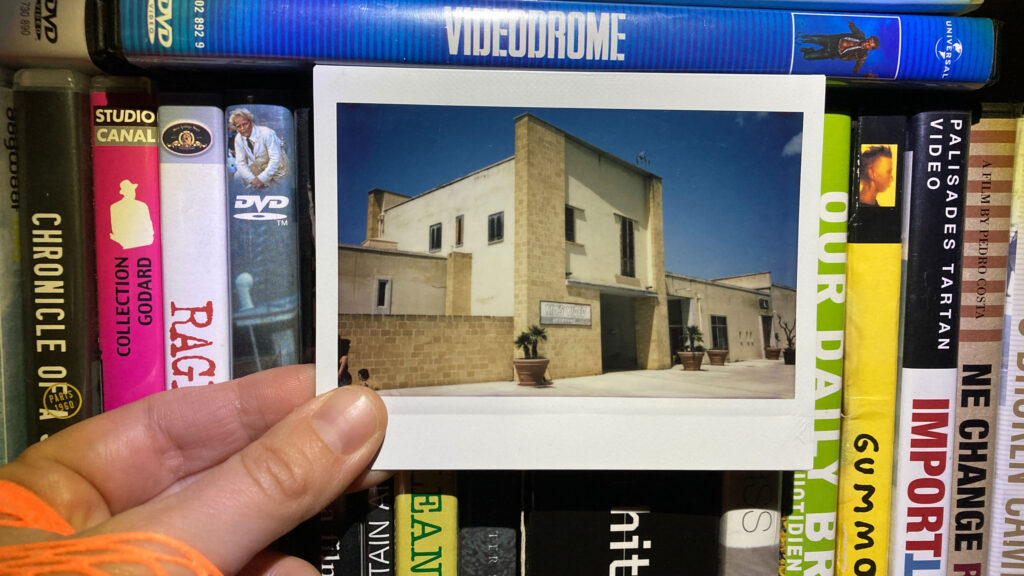
And so, off Redmon goes to Salemi (in 2017), in search of these lost movies, which are mostly in the formats of cassette tapes and DVDs. It turns out that finding the inventory in Salemi wasn’t as easy as some people thought it might be. Instead of the video store being a tourist attraction, as originally intended, Redmon shows in the documentary that, in 2017, the videos were stored in a place shrouded in mystery and kept off-limits to the public.
“Kim’s Video” takes a sometimes comical tone when Redmon confronts certain people and demands access to the videos, because he says he’s still a card-carrying member of Kim’s Video. And then, the movie takes a dark turn when it exposes the Mafia connection to this bizarre story. It’s a tale of greed and politics. Leopoldo Falco, who was president of Italy’s Anti-Mafia Investigative Commission, gives one of the most memorable interviews in the film. Redmon also gets help from an Italian journalist named Marco Bora.
During the course of the documentary, Redmon has various run-ins with Salemi police chief Diego Muraca, as well people whose job is to guard the place where the long-lost Kim’s Video movies were kept in Salemi. There’s also some amusing footage of Redmon trying to get an interview with then-Salemi mayor Domenico Venuti. It should come as no surprise that Redmon had to stalk Venuti in public places in attempts to get this interview. At one point, Redmon becomes well-known enough to Venuti’s entourage that Venuti is shown on camera actively avoiding Redmon whenever he sees Redmon.
The second half of the documentary is better than the first half, which wastes a little too much time with repetitive gushing about Kim’s Video from ex-employees. One of the other problems that some people might have with the “Kim’s Video” documentary is that it’s difficult to know how much of an act Redmon is putting on for the camera when he does this type of ambush documentary filmmaking. There’s a break-in scene that looks like it could have been staged and possibly scripted.
Is “Kim’s Video” co-director Redmon a dedicated Kim’s Video fan, or is he a fanatic who’s gone too far? “Kim’s Video” invites viewers to make up their own minds. At the very least, the movie gives answers that a lot of Kim’s Video enthusiasts might have about what really happened to Kim’s Video founder Kim and all the videos that he donated. People who follow the news about a certain Austin-based company with various locations might already know where those videos are now. But the “Kim’s Video” documentary is a mostly entertaining chronicle of the quest to find out answers to a lot of Kim’s Video questions, although cinephiles who are fans of obscure movies are most likely to appreciate this documentary.
UPDATE: Drafthouse Films will release “Kim’s Video” in select U.S. cinemas on April 5, 2024, with an expansion to more U.S. cinemas on April 12, 2024.