Review: ‘Barbara Walters Tell Me Everything,’ starring Barbara Walters, Oprah Winfrey, Cynthia McFadden, Connie Chung, Bette Midler, Peter Gethers and Victor Neufeld

June 28, 2025

by Carla Hay

Katharine Hepburn and Barbara Walters in a 1991 interview shown in “Barbara Walters Tell Me Everything” (Photo courtesy of American Broadcasting Companies, Inc./Hulu)

“Barbara Walters Tell Me Everything”

Directed by Jackie Jesko

Culture Representation: The documentary film “Barbara Walters Tell Me Everything” features a predominantly white group of people (with one African American and one Asian) in the media and entertainment industry discussing the life and career of pioneering TV new journalist Barbara Walters.

Culture Clash: Walters battled sexism in her career and a turbulent personal life (including a volatile childhood, failed marriages and long estrangements from her adopted daughter), all while breaking down barriers and creating controversies in TV news journalism.

Culture Audience: “Barbara Walters Tell Me Everything” will appeal primarily to people who are fans of Walters and documentaries about famous media people.

Barbara Walters and Muammar el- Quaddafi in a 1989 interview shown in “Barbara Walters Tell Me Everything” (Photo courtesy of American Broadcasting Companies, Inc./Hulu)

The documentary “Barbara Walters Tell Me Everything” is more about being carefully curated than being completely candid in telling the life story of trailblazing TV news journalist Barbara Walters. Some interviews and archival footage are revealing, but the documentary doesn’t mention her health decline and cause of death. Although the documentary has a treasure trove of highlights from her career, it misses an opportunity to tell her entire story and lessen the stigma of being an elderly person with health issues.

Walters died on December 30, 2022, at the age of 93. She reportedly was diagnosed with dementia in 2017. And although it can argued that the documentary left out this crucial information for privacy reasons, this type of cover-up defeats the purpose of Walters’ reputation and legacy of being a journalist who always strived for the whole truth to be revealed, no matter how embarrassing it would be for the people she exposed in her work. Even with these omission flaws, “Barbara Walters Tell Me Everything” is worth watching for a history lesson on how TV news evolved when Walters (who spent most of her career at ABC News) was alive and how she made her mark in TV news journalism.

Directed by Jackie Jesko, “Barbara Walters Tell Me Everything” had its world premiere at the 2025 Tribeca Festival. Emmy-winning news producer Jesko got her start in professional journalism as a producer at ABC News (she worked for ABC’s “Nightline” from 2014 to 2017), and ABC News Studios produces “Barbara Walters Tell Me Everything.” Therefore, the documentary has a tone that its was very sanctioned and filtered by whatever ABC News wanted the public to see about Walters in this documentary.

It’s a catch-22 for celebrity biography documentaries in these circumstances: Doing an authorized biographical documentary will usually give the documentarians better access to footage and interviews about the documentary subject. But the compromise is usually that the documentarians are explicitly or implicitly pressured to leave out the most unflattering information or the most uncomfortable topics.

Walters was born in Boston on September 25, 1929, but she spent most of her life and career being based in the New York City metropolitan area. Her father Lou Walters was a nightclub owner and live entertainment promoter, most notably owning the Latin Quarter nightclub in Boston. Growing up in a showbiz family meant that Barbara was accustomed to being around entertainers and celebrities from an early age. Not much is said about Barbara’s mother Dena, but it’s mentioned that Barbara’s parents had an unhappy marriage.

Barbara can be heard in voiceover narration in the documentary, which compiles this narration from various archival interviews that Walters did over the years, including some interviews that were previously unreleased. In one of the interviews, Barbara admits that she used to be ashamed of her mentally disabled older sister Jacqueline, who died of ovarian cancer in 1985. Barbara mentions having vivid childhood memories of Jacqueline being bullied by other kids in their community.

When Barbara was in her 20s, her father lost all of his businesses and nearly overdosed on pills. She took on the responsibility to be the family breadwinner. She began her TV career doing publicity/public relations for the NBC affiliate in New York City (WNBT-TV, now know as WNBC-TV) , before moving on to producing and writing in television at various other TV outlets.

Her on-camera breakthrough was on NBC’s “Today” (also known as “The Today Show”), where she did lifestyle segments aimed at appealing to women. Although she shared the “Today” anchor desk with male co-hosts Hugh Downs and later Frank McGee, McGee refused to conduct joint interviews with Walters until he could ask the first three questions in each interview. Barbara used this sexist treatment to her advantage by getting exclusive interviews that she could do herself outside of the TV studio.

She garnered a reputation for being persistent and tough in her interviews, where she often asked uncomfortable questions when the person she was interviewing was caught off guard. Barbara officially became a co-anchor of “Today” in 1974, after McGee died of cancer. This job promotion made her the first woman to co-anchor a nationally televised morning newscast in the United States. In 1975, she earned her first Daytime Emmy for co-hosting “Today.”

Barbara broke gender barriers again in 1976, when she was recruited to work for ABC News as co-anchor of “ABC Evening News,” with Harry Reasoner as her co-anchor. This position made her the first woman to co-anchor a nationally televised primetime newscast in the United States. She had a then-unprecedent salary for a female news journalist: A five-year contract that would pay her $1 million for each year of the contract.

By all accounts, Barbara’s time working with Reasoner (from 1976 to 1978) was miserable because he and most of the male staff members were either condescending to Barbara or refused to talk to her. Barbara was eventually moved to ABC News’ primetime newsmagazine “20/20” in 1979, first as a correspondent and then as a co-anchor. She made the most impact with her ABC News specials, where she interviewed almost every imaginable famous person, such as political leaders, entertainers, business moguls and notorious criminals. Her last televised interview was with Donald Trump in 2015.

Barbara is credited with being a pioneer of mixing “hard news” (politics and breaking news) with “soft news” (pop culture and lifestyle) in her TV reports and TV specials. At the time she started doing that in the 1970s, this blend was controversial, but it is now commonplace. At the peak of her popularity, Barbara’s TV specials were “event television” that people watched at the exact time that the specials aired on television. This type of “event television” has become increasingly rare for pre-recorded TV news programs, which release clips in advance online. TV host/executive producer Andy Cohen comments in the documentary: “Barbara Walters represented, for me, event television.”

In 1997, Barbara co-created (with Bill Geddie) the ABC News daytime talk show “The View,” where she was a co-host until 2014. She returned as an occasional guest co-host until 2016, and she retained her executive producer title for the show until her death 2022. The documentary ends her story with her 2014 retirement from co-hosting “The View,” a show where she encouraged the all-female co-hosts to express their political views. (The majority of “The View’s” co-hosts have been politically liberal.)

Included is a clip from Barbara’s memorable retirement/farewell episode of “The View,” when several notable female TV news journalists from various TV outlets showed up to pay tribute to her. Joy Behar, a longtime co-host of “The View,” is interviewed in the documentary but plays it safe by not saying much that’s substantial about Barbara. It’s a contrast to Behar’s persona of being one of the most outspoken and most controversial co-hosts of “The View.”

The documentary mentions that McGee, Reasoner and ABC News anchor Peter Jennings (who are now all deceased) were Barbara’s three biggest bullying co-workers. Although Barbara undoubtedly experienced sexism in her career, the mistreatment described in the documentary pales in comparison to the horrific work-related abuse stories that have been part of the #MeToo movement. According to this documentary, the worst things that Barbara experienced in the workplace were rude comments or deliberate isolation from some of her male co-workers. Considering that certain discrimination laws didn’t exist when she started her career, you get the feeling that she experienced a lot worse than what she was willing to publicly discuss.

The documentary doesn’t acknowledge that Barbara’s racial privilege was a factor in her rise to the top of the TV news business. The documentary also doesn’t seem completely forthright because it only mentions male enemies that Barbara had, when she surely had female enemies too. Barbara’s rivalry with ABC News anchor Diane Sawyer (who joined ABC News in 1989) was a source of tension that was fueled by their boss Roone Arledge (president of ABC News from 1977 to 1998), who pitted the two women against each other, according to people interviewed in the documentary.

Barbara was reportedly very insecure about Sawyer (whom she called a “blonde goddess”) being younger and more physically attractive than Barbara. Bob Iger, who was president of the entire ABC network from 1994 to 1995, says in the documentary: “It was the most painful period of my life,” when commenting on how this rivalry affected his job. Victor Neufeld, a former ABC News executive producer, says that Barbara’s insecurities were “nightmarish.”

According to ABC News correspondent Cynthia McFadden, who worked with both women: “I never had a conversation with Diane about her feelings about Barbara, but I had plenty with Barbara about her feelings about Diane, because she was certainly dogged by Diane’s very existence.” Sawyer reportedly declined to comment for this documentary. In archival interviews, Barbara and Sawyer both don’t deny the rivalry but deny reports that they hated each other.

Barbara’s failed marriages and her rocky relationship with her adopted daughter Jacqueline “Jackie” Guber (Barbara’s only child) are also given some screen time. All three of Barbara’s ex-husbands are deceased. Barbara’s first marriage (from 1955 to 1957) to businessman Robert Henry Katz was annulled. Barbara said in interviews that she was too young to be married when she was married to Katz.

Barbara’s second marriage (from 1963 to 1976) to theater owner/producer Lee Guber ended in divorce because Barbara said that she and Lee eventually grew apart. Barbara (who had some miscarriages during the marriage) and Lee adopted Jacqueline in 1968, when Jacqueline was a baby. In her teenage years, Jacqueline (who spent some time in a facility for troubled kids) had problems with drugs and juvenile delinquency. The up-and-down relationship between Jacqueline and Barbara was reportedly estranged in the last few years of Barbara’s life.

Barbara was married to television executive Merv Adelson twice—from 1981 to 1984 and from 1986 to 1992—with each marriage ending in divorce. Adelson (who co-founded the production company Lorimar Television) and Barbara lived and worked in separate cities—she was in New York, he was in Los Angeles—during much of their relationship. In a voiceover comment, Barbara can be heard in an interview saying: “I don’t think I was good at marriage.” Peter Gethers, who was the editor of Barbara’s 2008 memoir, “Audition,” says of Barbara’s marriages and many of her romantic relationships: “A lot of the relationships she developed were career moves.”

Jacqueline declined to be interviewed for the documentary, although a clip is included of a rare TV interview that Jacqueline did with McFadden in 2001 for the ABC News adoption special “Born in My Heart: A Love Story.” “Barbara Walters Tell Me Everything” has footage of Barbara watching the interview as it happened and making occasional comments under her breath. One of the best parts of “Barbara Walters Tell Me Everything” is how it includes previously unreleased outtakes and behind-the-scenes footage of Barbara. These are glimpses into what she was like at work when she knew whatever was being filmed was not going to be part of her packaged television report.

Although publicly, Barbara said that adopting Jacqueline was the best decision that Barbara ever made, other people in the documentary say they aren’t convinced that being a parent was truly a top priority for Barbara. Oprah Winfrey, who describes Barbara as Winfrey’s “role model,” says that Winfrey saw from how Barbara lived that if women wanted to be at the top of the TV news business, women couldn’t be completely devoted parents because the work demands are so high in TV news. Winfrey comments, “That’s why I did not have children. I knew I couldn’t do both well.” Gethers says that Barbara’s career was the greatest love of Barbara’s life.

Barbara was also contradictory about other things that she said in public and what she did in private, according to people interviewed in the documentary. Although she said in interviews that she wasn’t star-struck by celebrities, Gethers says that in reality, “She was obsessed with money, fame and power.” And although Walters presented herself as having high standards in journalism ethics, Gethers says: “She didn’t have the strongest moral compass.”

It’s mentioned that Barbara enjoyed sex and having flings with men. Lori Klein, a makeup artist who worked with Barbara for about 29 years, says in the documentary: “She definitely was a romantic kind of person, but romance never worked in her life for long.” She was certainly attracted to men with power: Among her former paramours were Alan Greenspan in the 1970s (Greenspan later became U.S. Federal Reserve chairman) and former U.S. Senator John Warner in the 1990s, after he was divorced from actress Elizabeth Taylor.

Even though it’s a breach of journalistic ethics for a journalist to have a sexual or romantic relationship with anyone the journalist is interviewing for a story, it’s hinted that Barbara crossed that line many times, although only one man is named in the documentary as someone with whom she had this type of forbidden affair: Republican politician Edward Brooke, who was a U.S. Senator representing Massachusetts from 1967 to 1979.

She had an affair with married man Brooke (who died in 2015), whom she interviewed in the midst of their once-secret affair. Gossip about the affair essentially ended his political career. In a documentary voiceover, Barbara can be heard saying that Brooke was in a “horrible marriage,” and her breakup with Brooke was mutual.

Barbara also admitted that the celebrity she was most attracted to was Clint Eastwood, whom she interviewed multiple times. The documentary has a clip from her 1982 interview with Eastwood, where he openly flirts with her and hints he’d be open to hooking up with her. Publicly, Barbara said she and Eastwood never got sexually involved with each other.

The documentary also mentions Barbara’s longtime close relationship with controversial (and eventually disbarred) attorney Roy Cohn, who was a mentor to Trump. Cohn, who died of AIDS-related complications in 1986, was a closeted gay man who publicly denied having AIDS. At times, Cohn presented Barbara as his “romantic girlfriend” when they went on dates together. Gethers says in the documentary that Walters was extremely loyal to Cohn because when Barbara’s father had serious tax and financial problems in the 1950s, Cohn made all of those problems disappear.

Cohn had a reputation for being very corrupt and for the cruel ways that he destroyed people’s lives, but Barbara stayed loyal to Cohn throughout all of his scandals. Gethers comments: “She could forgive anyone who was good to her, no matter what they did in other parts of their lives.” Gossip columnist Cindy Adams says of the relationship that Barbara had with Cohn: “They were two people who loved PR [public relations].”

“Barbara Walters Tell Me Everything” also has the expected clips of several of her most famous interviews, with not much additional insight. The documentary includes some behind-the-scene details about of the ultra-competitive ways that Barbara and her producer colleagues would cajole and entice people to do interviews. Neufeld, David Sloan (ABC News senior executive producer) and former ABC News producers Martin Clancy, Chris Vlasto and Katie Nelson Thomson all give anecdotal comments about what it was like to work with Barbara, by describing it as a work environment that was more cutthroat than conducive to camaraderie.

Long before this documentary was made, it was already well-known years ago that Barbara’s March 1999 interview with Monica Lewinsky (which remains the highest-rated TV news interview of all time, with 74 million U.S. viewers) was the result of Barbara and her team “poaching” Lewinsky for this exclusive interview from Winfrey, who had an informal agreement with Lewinsky to do the interview. Under the ABC News deal with former White House intern Lewinsky (the woman at the center of Bill Clinton’s biggest sex scandal), Lewinsky was not paid for the interview, but she was free to be paid by other news outlets for interviews after Lewinsky’s ABC interview aired. The interview was also televised in its edited entirety only once on ABC, as part of the deal.

In the documentary, Winfrey is diplomatic about losing out on this exclusive interview by saying that ABC could offer a bigger audience than Winfrey could at the time. It’s obvious that not getting this interview still has a certain sting for Winfrey. Lewinsky is also interviewed in the documentary and says she chose to give the exclusive interview to Barbara because she felt more comfortable telling her story to Barbara.

It’s a testament to how Barbara could make her interview subjects feel at ease while also knowing that she could ask unnerving questions. This interview style is commented on in a montage shown in the beginning of the documentary. Winfrey says: “She asked the questions that nobody else had asked—and asked it in a way that hit a nerve.” (Later in the documentary, Winfrey talks about when Barbara interviewed her for the first time, it was also the first time that Winfrey revealed in an interview that Winfrey had been sexually abused as a child.)

McFadden says of Barbara’s signature interviewing style: “Sitting down with Barbara Walters, no one ever really got out totally unscathed.” TV journalist Katie Couric comments, “She could talk to anyone about anything.” Actress/singer Bette Midler (the only entertainer interviewed for the documentary) says, “She was fearless, and sometimes she got under people’s skin.” Midler, who was interviewed by Barbara multiple times, adds that although she considered Barbara to be her friend, Midler never forgot that Barbara was also a journalist, so “I was very careful.”

Also interviewed in the documentary is TV news journalist Connie Chung. In 1993, when she was working for CBS News, Chung became the second woman to co-anchor a nationally televised primetime newscast in the United States. Just like what happened with former ABC News co-anchors Reasoner and Barbara Walters, Chung’s male co-anchor (Dan Rather) had uncomfortable friction with Chung, and she left the co-anchor job after two years.

In 1997, Chung joined ABC News, thinking that she would have more female solidarity at a network that employed her idol Barbara Walters and Sawyer. Chung says in hindsight, it was a “stupid” mistake to join ABC News at the time, because Chung got caught in the middle of the Walters/Sawyer rivalry and because Chung was perceived as more female competition for these more-established TV divas. Chung left ABC News in 2003.

“Barbara Walters Tell Me Everything” is a somewhat ironic title because it doesn’t tell everything about her as the subject of this documentary. It presents her as a flawed human being, but there are many aspects of her life, especially in her last years, that are completely ignored. However, the movie succeeds as a tribute to Barbara Walters and the untold numbers of ways that she influenced TV news and the people who present it.

Hulu premiered “Barbara Walters Tell Me Everything” on June 23, 2025.

https://www.youtube.com/watch?v=4u8UCNCDszM

Review: ‘The Story of Soaps,’ starring Susan Lucci, Bryan Cranston, Carol Burnett, Genie Francis, Maurice Benard and Diedre Hall

May 20, 2020

by Carla Hay
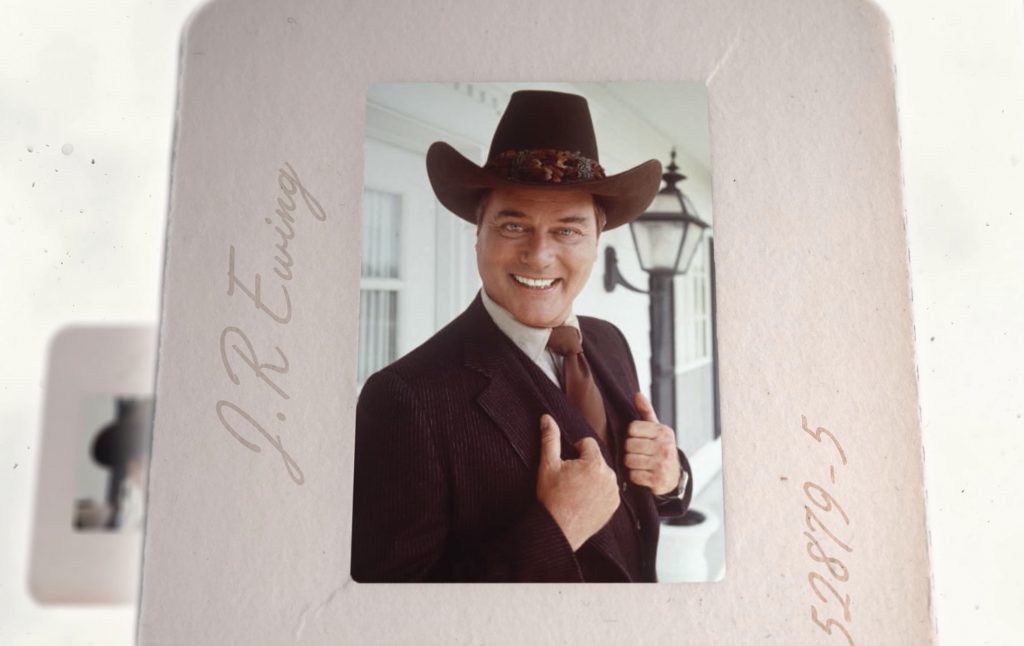
“Dallas” star Larry Hagman in “The Story of Soaps” (Photo courtesy of ABC)

“The Story of Soaps”

Directed by Robin Pelleck and Rebecca Gitlitz

Culture Representation: The documentary “The Story of Soaps” takes a historical look at American TV soap operas and their impact on pop culture, by interviewing a racially diverse (white, African American and Latino) group of actors, screenwriters, TV producers and other people connected to the business of soap operas.

Culture Clash: Many of the people say in the documentary that soap operas are often misunderstood or underrated and that reality TV shows have brought on the decline of soap operas with professional actors.

Culture Audience: “The Story of Soaps” will appeal primarily to people who want to learn more about this type of this “guilty pleasure” TV genre and also take a breezy nostalgia trip for American soap operas’ most notable moments.
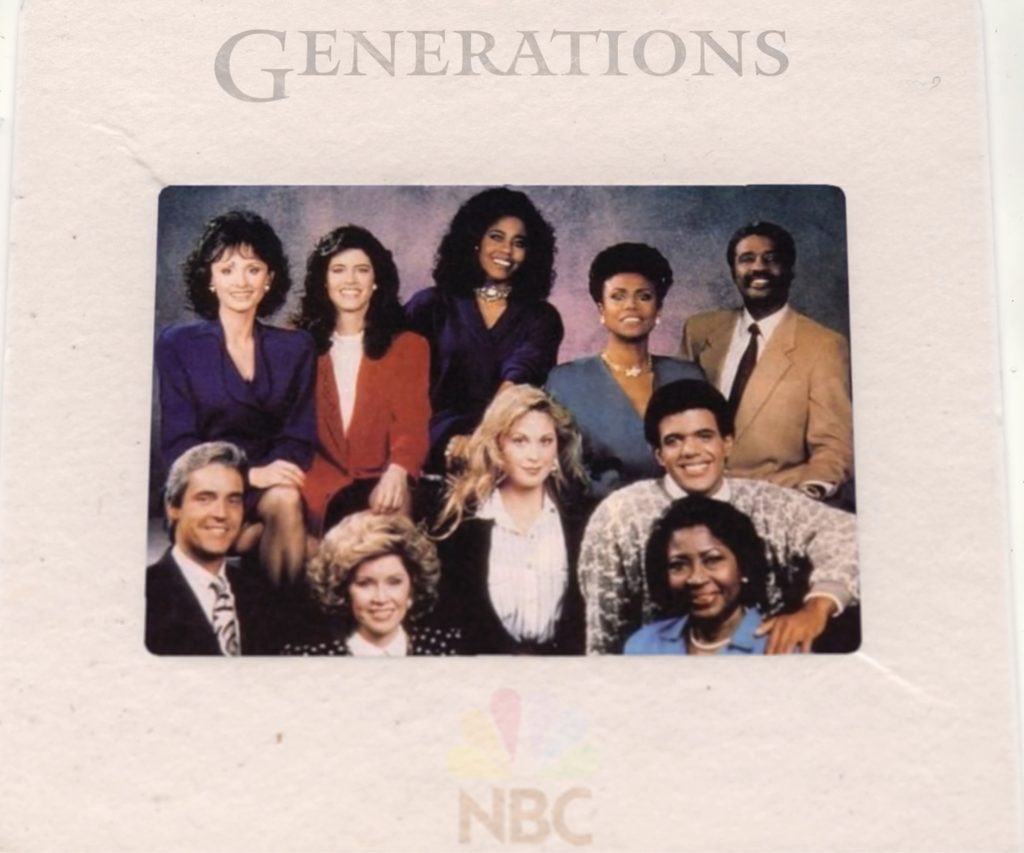
The stars of “Generations” in “The Story of Soaps” (Photo courtesy of ABC)

The comprehensive and thoroughly entertaining “The Story of Soaps” skillfully manages to make this documentary go beyond the expected compilation of TV clips and commentaries from talking heads about the history of American TV soap operas. The documentary also puts all of this sudsy entertainment into a cultural context that shows how soap operas have had much more influence than they’re typically given credit for when it comes to our entertainment choices and how we see the world.

Directed by Robin Pelleck and Rebecca Gitlitz (who are also executive producers of the documentary), “The Story of Soaps” packs in interviews with numerous people (mostly actors, screenwriters and producers) who are connected to the world of TV soap operas in some way. The long list of actors includes Kristian Alfonso, John Aniston, Alec Baldwin, Maurice Benard, Carol Burnett, Bryan Cranston, Mary Crosby, Eileen Davidson, Vivica A. Fox, Genie Francis, Diedre Hall, Jon Hamm, Drake Hogestyn, Finola Hughes, Susan Lucci, John McCook, Eddie Mills, Denise Richards, Marc Samuel, Melody Thomas Scott, Erika Slezak, John Stamos, Susan Sullivan, Greg Vaughan, Chandra Wilson and Laura Wright.

Screenwriters and producers interviewed in “The Story of Soaps” include Shelly Altman (“General Hospital,” “The Young and the Restless”); Brad Bell (“Husbands”); Lorraine Broderick (“All My Children,” “Days of Our Lives”); James H. Brown (“All My Children,” “The Young and the Restless”); Andy Cohen (“The Real Housewives” franchise); Marc Cherry (“Desperate Housewives”); David Jacobs (“Dallas,” “Knots Landing”); Agnes Nixon (the “All My Children” creator who passed away in 2016); Jonathan Murray (“The Real World”); Ken Olin (“This Is Us”); Jill Farren Phelps (“General Hospital”); Angela Shapiro-Mathes (“All My Children: Daytime’s Greatest Weddings”); Yhane Smith (“Harlem Queen”) and Chris Van Etten (“General Hospital”).

Other people interviewed are People magazine editorial director of entertainment Kate Coyne, “The Survival of Soap Opera” co-author Abigail De Kosnik, “The Real Housewives of Beverly Hills” co-star Erika Jayne, Netflix consultant Krista Smith, casting director Mark Teschner and Soap Opera Festivals Inc. co-founders Joyce Becker and Allan Sugarman.

Brad Pitt, Julianne Moore, Morgan Freeman and Tommy Lee Jones are named in the documentary as some of the Oscar-winning actors whose early careers on screen included roles in soap operas. Leonardo DiCaprio, Melissa Leo, Marisa Tomei and Kathy Bates are other Oscar-winning actors who were in soap operas before they became famous. Other alumni of daytime soap operas include William H. Macy, Demi Moore and Meg Ryan.

The documentary begins with testimonials from several actors who were in soap operas in the early years of careers, such as Cranston (“Loving”), Baldwin (“The Doctors,” “Knots Landing”), Stamos (“General Hospital”) and Fox (“Days of Our Lives”). Cranston’s first TV job was a guest role in “One Life to Live” in 1968. And when he was in his 20s, he landed a recurring role as Douglas Donavan in “Loving” in 1983.

Cranston says, “I think there are these derisive comments made about soap operas and it’s not fair and it’s not accurate. You’re there to learn. You’re there to bring as much honesty and reality as you can to the moment—and it’s difficult.”

“This genre [soap operas], this job invited me in and put me to work like nobody’s business,” Cranston continues. “It made me feel accomplished, like I broke through a barrier.” Cranston went on to become an Emmy-winning actor several years later, for his role as methamphetamine manufacturer/dealer Walter White in “Breaking Bad,” which he says was a show that was really a soap opera.

Baldwin also says that working in soap operas was extremely valuable to him. He describes “Knots Landing” (where he played the role of Joshua Rush from 1983 to 1985) this way: “It was probably one of the five most important times of my life. They had a very good cast. They had a very talented cast. And that changes everything when you go to work. You don’t care if it’s a soap if you’re working with somebody who’s great. I loved it.”

The grueling hours of working on a soap opera, especially a daytime soap opera that airs five times a week, results in a “sink or swim” atmosphere for a lot of actors who are new to the business. Stamos, who’s best known for starring in the long-running sitcom “Full House,” comments on his 1982-1984 stint as Blackie Parrish in “General Hospital,” which made him a star: “It was great training.”

Fox (who co-starred with Will Smith in the 1996 film “Independence Day”) says of her time on “The Young and the Restless,” where she played the character of Stephanie Simmons from 1994 to 1995: “I learned so much. I learned to hit my cue, how to memorize, how to cry, how to flip my hair.”

“General Hospital” casting director Teschner comments: “There was this stigma to daytime [soap operas] and people misperceiving the acting style as being over-the-top and ‘soapy.’ But I always say that if you can do daytime, you can do any time.” Teschner also mentions that it’s not unusual for a daytime soap opera to film up to 120 pages of dialogue a day, which is the amount of pages that’s typical for a feature-length movie.

“General Hospital” star Francis, who’s been playing Laura on the show since 1977, says in the documentary about her dedication to staying on a soap opera: “Why do I do it? Why do I put myself through this? Because I love to tell stories.”

“General Hospital” co-star Wright, who’s played the role of Carly on the show since 2005, offers a more business-minded perspective to what actors bring to the escapism appeal of soap operas: “It’s our job to sell it to you.” Many of the actors in “The Story of Soaps,” including Melody Thomas Scott (who’s played the character of Nikki on “The Young and the Restless” since 1979), say that because TV brings repeated familiarity in people’s homes, many soap opera fans confuse the actors with the characters that they play on TV.

“The Story of Soaps” has various themed segments which give excellent analysis and commentary on important aspects of soap-opera history. The segment titled “By Women, For Women” details how daytime soap operas have provided many of the best opportunities for women working in television behind the scenes. While male executives dominated prime-time programming, female executives were allowed to shine in daytime television, since the early years of television.

Irna Phillips, who’s often referred to as the “Queen of the Soaps,” could be considered the godmother of daytime TV soap operas, which took the concept of radio soap operas and transferred them to a visual medium. Phillips created the TV soaps “Guiding Light,” “As the World Turns” and “Another World.” She also mentored “All My Children” creator Nixon (who also created “One Life to Live” and “Loving”) and William J. Bell, who created “Another World” (with Phillips), “The Young and the Restless” and “The Bold and the Beautiful.”

In the 1950s, when it was more common for the majority of women to be homemakers, daytime soap operas provided an ideal captive audience for advertisers. The term “soap opera” comes from the fact that during the radio era (before television was invented), soap companies would be frequent advertisers on these drama series.

“The Survival of Soap Opera” co-author De Kosnik notes that when soap operas began on TV, they pioneered the lingering close-ups of actors’ faces to show their emotions, thus adding to the melodramatic appeal. She also mentions that loyalty to certain soap operas would be handed down from generation to generation of women, much like loyalty to certain sports teams would be a generational tradition for men. Although soap operas tend to have a female-majority audience, there’s been a steady increase of male fans of soap operas over the years, especially for primetime soaps.

The documentary’s “Fan-Addicts” segment examines the culture of soap opera fans. Benard (who’s played Sonny Corinthos on “General Hospital” since 1993) calls soap-opera enthusiasts: “The most loyal fans in the world.” The documentary includes a lot of archival footage of fans giving adulation to some of the most famous soap stars over the years, including Stamos and Lucci.

Lucci says of her iconic Erica Kane character, which she played during the entire run of “All My Children” from 1970 to 2011: “I loved playing her. There was such range with her. She was a capable of doing and saying just about anything. And the audience saw humanity in her stories.” And yes, the documentary includes footage of Lucci finally winning her first Daytime Emmy in 1999, after she had a long losing streak of being nominated 18 times and never winning before.

Soap Opera Festivals Inc. co-founder Becker reminisces about the company’s first fan event in 1977, which she says drew “hundreds of thousands of people”—a crowd turnout that probably wouldn’t be possible today, considering how much the popularity of daytime TV soap operas has declined. Becker also describes why soap opera fans are devoted to soap opera cast members: “It’s almost like your own family.”

Legendary comedian Burnett is famously an “All My Children” superfan—so much so that she had a guest-starring role on the show as Verla Grubbs in 1983, 1995, 2005 and 2011. In “The Story of Soaps,” she repeats a story she told in her memoir: When she and her husband spent a month-long vacation in Europe many years ago (before VCRs and the Internet), Burnett asked a friend of hers to send a telegram every Friday with a summary of everything that happened on “All My Children” that week.

One time in the early-morning hours, Burnett was awakened by a hotel employee who was trembling with the telegram, because the visibly shaken employee thought that all the tragic bad news in the telegram was real. Burnett said she started laughing so hard that she began to cry, and the hotel employee thought that she was crying hysterical tears of sorrow, until she explained that what was in the telegram was really an “All My Children” plot summary. Burnett says later in the documentary about “All My Children” being cancelled in 2011: “I’m still angry that they took it off the air.”

A documentary segment called “Love, Lust, Luke & Laura” explores how TV soaps often pushed the boundaries of raunchiness with sex scenes and outrageous love stories, beginning in the 1970s and ramping up even more in the 1980s. Stories about infidelities are very common in soap operas, but the sexual revolution also opened up wilder storylines on soap operas, such as falling in love with a space alien, taboo stepsibling romances and as much nudity as possible.

“General Hospital” characters Luke Spencer (played by Anthony Geary) and Laura were undoubtedly the most famous couple on daytime TV soap operas. Luke and Laura’s 1981 wedding on the show was a major media event, and it remains the highest-rated daytime TV soap opera event, with an estimated 30 million U.S. viewers. However, their relationship was controversial because Luke raped Laura when they first began dating.

De Kosnik says that the 1979 rape storyline was concocted by “General Hospital’s” then-executive producer Gloria Monty (who died in 2006), in a desperate ploy to boost the show’s ratings, because “General Hospital” was on the verge of being cancelled at the time. The show’s producers explained that the rape was “rape seduction” and justified it by saying that Luke really loved Laura. However, that kind of storyline would not have gotten such an easy pass if it had been suggested in later decades.

In “The Story of Soaps,” Francis says about that controversial rape storyline: “I had to justify it for so many years. And I have to say that it feels good to sit here and say it’s awful. They shouldn’t have done it.” In 1998, “General Hospital” made an attempt to remedy this wrong by having Laura angrily confront Luke (they were still married at this point) about the rape.

The documentary segment “It’s a Revolution” is one of the best that demonstrates how soap operas are both a reflection of and influence on culture. Just as soap operas were often the first TV series to have groundbreaking stories about sex, soaps were also among the first scripted TV drama series to address serious social issues. The Vietnam War controversy, abortion, interracial romances, gay teens, transgender relationships, AIDS, mental illness and eating disorders were among the many topics that were considered too taboo for scripted TV series until they were presented on TV soap operas.

“Days of Our Lives” star Diedre Hall, who has played Marlena Evans on the show since 1976, says: “The most compelling thing about daytime drama is that we follow the pulse of what’s goin on.” “General Hospital” writer Van Etten says that he used to be a “deeply closeted” gay man, but he was influenced to come to terms with his own sexuality after seeing Ryan Phillippe portray gay teen Billy Douglas in a 1992 “One Life to Live” storyline.

Emmy-winning “General Hospital” star Benard’s Sonny character is bipolar, and so is Benard in real life. Benard says of the “General Hospital” executives’ decision to make Sonny a biploar character: “I can’t thank them enough.” He says that authentic representation matters in destigmatizing mental illness.

The soap opera “Generations” also led the way in representation for African Americans, since it was one of the first scripted TV dramas to feature a white family and an African American family as equal stars of the show. Although the show didn’t last long (it was on the air from 1989 to 1991), “Generations” co-star Fox comments that the show “changed perceptions” of black people on soap operas, since the black characters on “Generations” weren’t just playing servants, sidekicks or other supporting characters.

But daytime soap operas began to have more competition in popularity with the resurgence of primetime soap operas. The documentary mentions two major social changes that began in the late 1970s and affected the rise of American primetime soaps, such as “Dallas,” “Dynasty,” “Knots Landing” and “Falcon Crest.” First, more women began working outside the home and didn’t have time to watch TV during the day, but they wanted to get their soap-opera fix at night. Second, the VCR became available as a home product, thereby revolutionizing the way people watched TV, by giving people the freedom to record and watch programs whenever they wanted.

“The Story of Soaps” also points out that the most popular primetime soaps in the 1980s were about rich families because it was a reflection of the decade’s fascination with excess and wealth. Former “Dallas” writer Jacob says it all came down to this concept: “People like to see people that rich [can be] that miserable.” And, of course, the documentary includes a look at the “Who Shot J.R.?” cliffhanger phenomenon of “Dallas” in 1980, when lead character/villain J.R. Ewing got shot in the show’s third-season finale in March of that year, leaving viewers to wonder (until it was revealed in November 1980) who shot him and whether or not he was going to live. An estimated 83 million U.S. viewers watched the fourth-season premiere “Dallas” episode that solved the mystery.

And each popular TV soap opera of a decade is a reflection of what was going on society at the time. “Beverly Hills 90210” and “Melrose Place” were about people from Generation X establishing their identities and careers in the beginning of the Internet age. “Desperate Housewives” was a commentary on middle-aged, middle-class women in the suburbs during the end of the George W. Bush era and the beginning of the Barack Obama era. And awareness in the mid-to-late 2010s of more inclusivity on TV has been reflected in primetime soaps such as “Empire” (a show about an African American family dynasty) and “This Is Us,” which centers on an interracial family with diversity in body sizes.

The documentary’s “Stranger Than Fiction” segment takes an unflinching look at how reality TV has eroded the popularity of traditional soap operas. Reality TV programs have proliferated and thrived because they’re almost always cheaper to produce than scripted shows with professional actors. Several people interviewed say that the O.J. Simpson trial of 1995 was a TV game changer, since live coverage of the trial pre-empted many daytime soap operas, and many TV networks saw that the trial coverage got higher ratings than the soaps. The trial is often called “a real-life soap opera.”

“The Real World” executive producer Murray (who credits the show’s late co-creator Mary-Ellis Bunim for being a TV pioneer for TV soaps) says that they pitched MTV on the concept of “The Real World” as being a “docu-soap.” The late Pedro Zamora, who was on “The Real World: San Francisco” in 1994, is credited with helping bring more awareness to TV viewers about AIDS, since he was the first openly HIV-positive person to be on a reality TV series.

And most reality shows about people’s lives are basically just soap operas with people who usually aren’t professional actors. “The Real Housewives” franchise (which was inspired by “Desperate Housewives”) and the Kardashian/Jenner family are predictably mentioned. Many former reality TV stars have admitted (but not in this documentary) that much of what’s on these reality TV shows is already pre-planned by the show’s producers. Curiously, this documentary didn’t include any footage from “The Bachelor” franchise, which has been described as being among the most “soap opera-ish” reality shows of all time.

The documentary’s “Death of Daytime” segment gives an overview of the cancellations of numerous daytime TV soap operas in the 2000s and 2010s. “Guiding Light,” “As the World Turns,” “Passions,” “All My Children,” “One Life to Live” and “Port Charles” were the long-running American soap operas that were cancelled in these decades. “All My Children” was the cancellation that caused the most viewer outrage, according the documentary. The rise of social media, streaming services, interactive websites, apps and podcasts have further fragmented audiences, who now have millions of more options than the days when there were only a handful of national TV networks in the United States.

Although soap operas seem to be a dying genre, several people interviewed in the documentary point out that many Emmy-winning prestigious shows of the 2000s and 2010s were really soap operas, including “Game of Thrones,” “Breaking Bad,” “The Sopranos” and “Orange Is the New Black.” On the other end of the spectrum, trashy talk shows hosted by the likes of Jerry Springer, Maury Povich, Morton Downey Jr., Sally Jessy Raphael and Jenny Jones also took their cues from soap operas, since these shows thrived on creating nasty fights with guests while the cameras were rolling.

TV news has also absorbed the influence soap operas, as many news programs (especially on cable TV) have taken big stories and presented them as soap operas, with TV hosts and commentators being sort of like a Greek chorus weighing in with their opinions. The overall message of “The Story of Soaps” seems to be that if people have a snobbish attitude toward soap operas, then they should take a look at their favorite entertainment and media and see how much soap operas have had an influence. They might be surprised to see how much soap operas have impacted our culture.

ABC premiered “The Story of Soaps” on May 19, 2020.

New Year’s Eve specials ringing in 2020 will feature Post Malone, Gwen Stefani, LL Cool J and more

December 27, 2019

by Carla Hay

Watching a New Year’s Eve special on TV is a tradition for millions of people around the world. Here’s what is planned for the four biggest New Year’s TV specials in the United States:

Dick Clark’s New Year’s Rockin’ Eve with Ryan Seacrest 2020 

Ryan Seacrest (Photo by Lorenzo Bevilaqua/ABC)

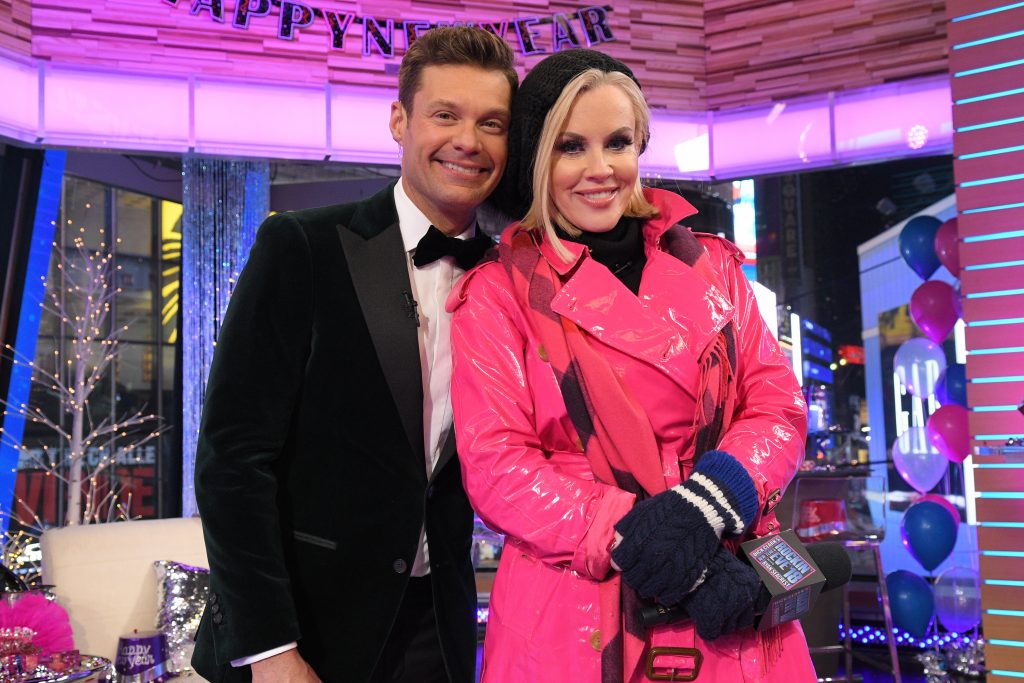
Celebrating its 48th year, “Dick Clark’s New Year’s Rockin’ Eve” (which is produced by Dick Clark Productions and airs in the U.S. on ABC) is still the most high-profile televised New Year’s Eve event. Post Malone, who performed on the show last year, is headlining the show this year from New York City’s Times Square. Ryan Seacrest will once again host the show, which begins airing from 8 p.m. to 11 p.m. ET, followed by 11:30 p.m. to 2:13 a.m. ET. Former “Pretty Little Liars” star Lucy Hale, who previously hosted the show’s Central Time Zone segments from New Orleans, replaces Jenny McCarthy to provide on-site reporting in Times Square. McCarthy quit the show because she said she wants to celebrate New Year’s Eve with her family. Other performers in Times Square this year include BTS, Sam Hunt and Alanis Morrissette.

Additionally, country artist Jessie James Decker will reveal the first Powerball millionaire of the year during this year’s live broadcast. She will provide live updates from the First Powerball Millionaire of the Year party throughout ABC’s live telecast and the big reveal announcing the winner will air just after midnight on January 1, 2020.

Ciara will once again host the Los Angeles segments of the show that will feature performances that were mostly previously recorded. Artists in the show’s Los Angeles segments will include Paula Abdul, Kelsea Ballerini, Blanco Brown, Dan + Shay, Green Day, Dua Lipa, Ava Max, Megan Thee Stallion, Anthony Ramos, Salt-N-Pepa and SHAED.

Meanwhile, Billy Porter will host the show’s third annual Central Time Zone celebration from New Orleans, where Sheryl Crow and Usher will perform. The show has added a segment from Miami, where Jonas Brothers will perform.

“Dick Clark’s New Year’s Rockin’ Eve with Ryan Seacrest 2020” is produced by Dick Clark Productions with Ryan Seacrest, Barry Adelman and Mark Bracco serving as executive producers. Larry Klein is producer.

Fox’s New Year’s Eve With Steve Harvey: Live From Times Square

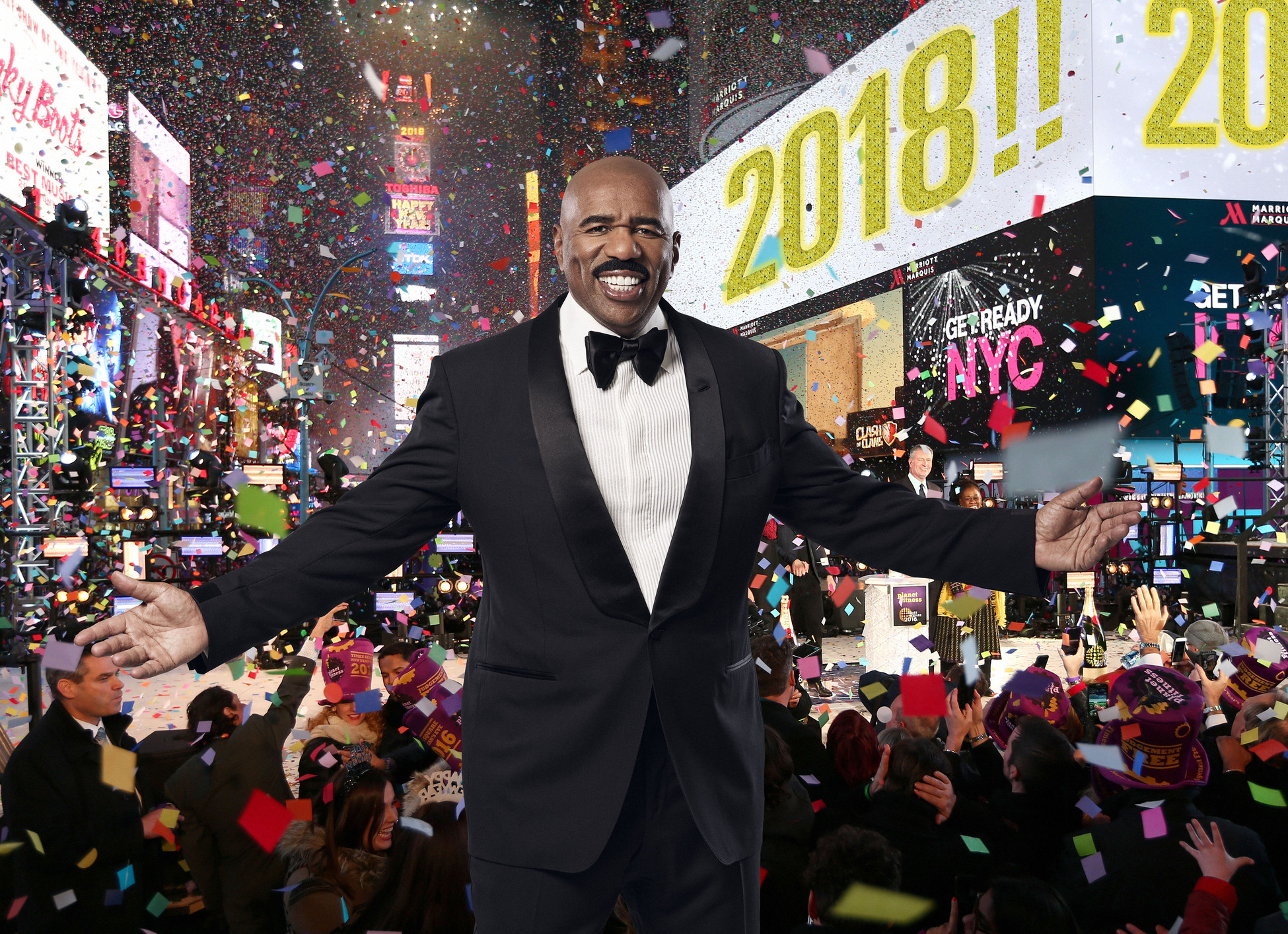
Steve Harvey (Photo courtesy of Fox)

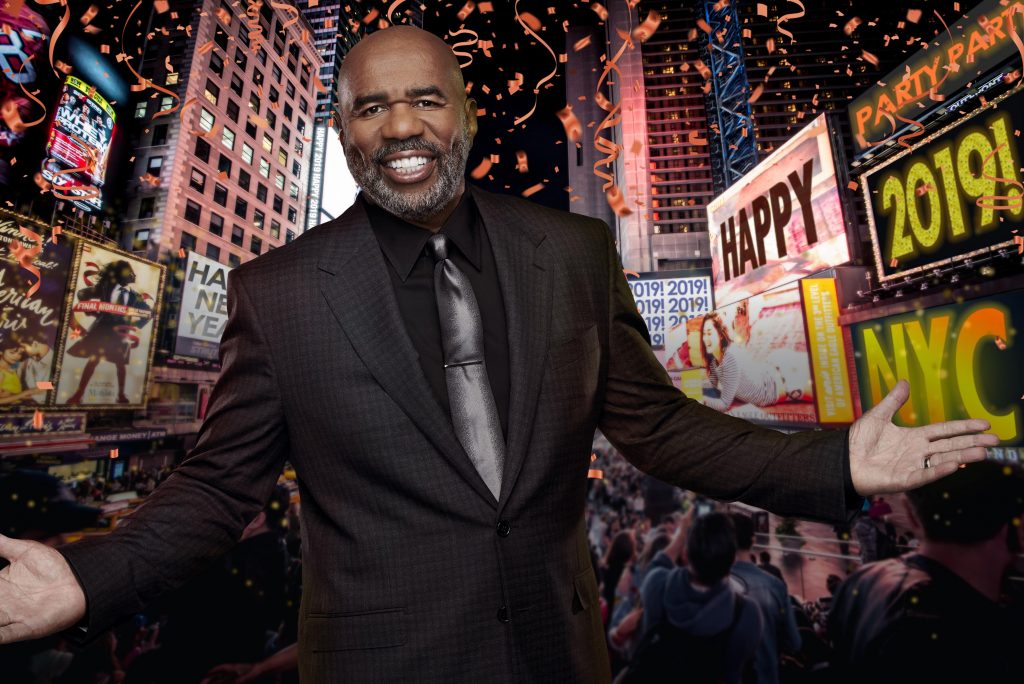
After televising its New Year’s Eve show (hosted by Pitbull) in Miami from 2014 to 2016, Fox changed locations and hosts in 2017, with the show now taking place at New York City’s Times Square with comedian/talk-show host Steve Harvey and former E! News personality Maria Menounous. This year, three-time Super Bowl Champion and Fox Sports NFL analyst Rob Gronkowski joins Harvey and Menounous to co-host the show, which airs on Fox from 8 p.m. to 10 p.m. ET and 11 p.m. to 12:30 a.m. ET live; CT/MT/PT tape-delayed. Performers will include headliner LL Cool J with DJ Z-Trip, The Chainsmokers, The Lumineers, Florida Georgia Line, the Backstreet Boys, Lauren Alaina, Tyga and The Killers. Select musical performances will be broadcast in collaboration with iHeartRadio. Additionally, the special will include celebrity cameo appearances by Gordon Ramsay, Will Arnett and Jenna Dewan, plus an exclusive WWE match featuring Roman Reigns. “Fox’s New Year’s Eve With Steve Harvey: Live From Times Square” is produced by Endeavor Content’s Film 45 and Done + Dusted. Guy Carrington, Katy Mullan, Michael Antinoro and David Chamberlin serve as executive producers.

NBC’s New Year’s Eve

(Photo courtesy of NBCUniversal)

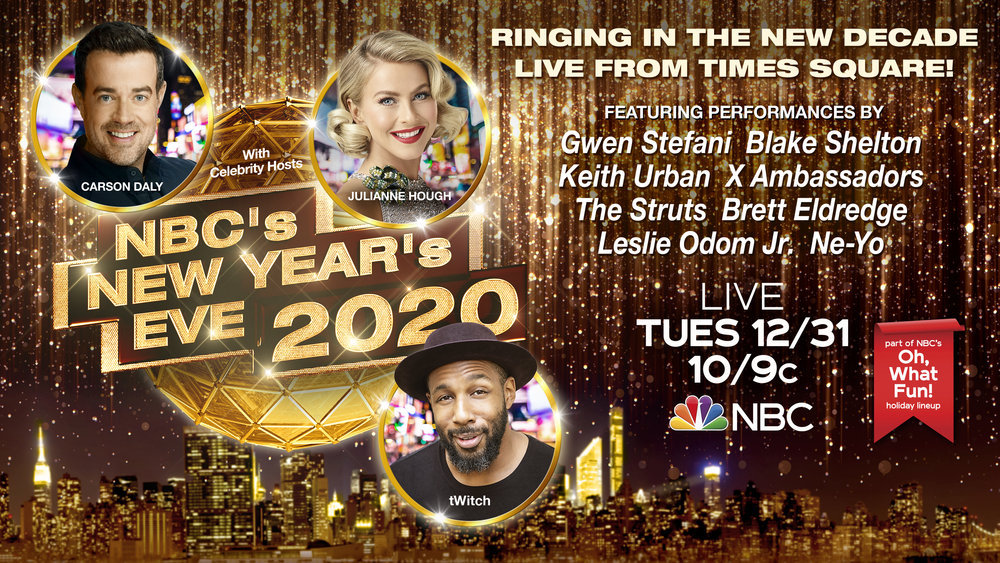
Stars from NBC’s “The Voice” are all over “NBC’s New Year’s Eve” special, which begins airing at 10 p.m. ET from New York City’s Times Square. Not only is “The Voice” host Carson Daly hosting the New Year’s Eve show (with Julianne Hough and correspondent Stephen “tWitch” Boss), but “The Voice” coaches Gwen Stefani and Blake Shelton are also performing on the special. Other performers include Hough, X Ambassadors, Brett Eldredge, Ne-Yo, Leslie Odom Jr. and The Struts.  Keith Urban will once again perform at Jack Daniel’s Music City Midnight: New Year’s Eve in Nashville, taking place near the Tennessee State Capitol at Bicentennial Capitol Mall State Park. “NBC Nightly News” and “Dateline NBC” anchor Lester Holt will also appear on stage before the iconic ball drop. “NBC’s New Year’s Eve” will be televised from 10 p.m. to 11 p.m. ET, followed by the New Year’s countdown segment 11:30 p.m. to 12:30 a.m. ET. “NBC’s New Year’s Eve” is executive produced by Daly and John Irwin through NBCUniversal Television Studio and Irwin Entertainment. It is co-executive produced by Casey Spira and directed by Alan Carter.

Before “NBC’s New Year’s Eve,” the network will air the special “A Toast to 2019!” from 8 p.m. to 10 p.m. ET. Hosted by Hoda Kotb and Jenna Bush Hager, the special will highlight the year’s biggest pop culture moments and trends. Celebrities interviewed for the show include Lauren Ash, Kristen Bell, Andrea Canning, Chris D’Elia, Dylan Dreyer, Ryan Eggold, Ben Feldman, Akbar Gbajabiamila, Willie Geist, Brad Goreski, Tony Hale, NBC’s Holt, Matt Iseman, Sheinelle Jones, Carson Kressley, Loni Love, Howie Mandel, Josh Mankiewicz, Craig Melvin, Natalie Morales, Brent Morin, Keith Morrison, Dennis Murphy, Patton Oswalt, Al Roker, Maya Rudolph, Martin Short, Ashley Tisdale, Johnny Weir and many more.

New Year’s Eve Live With Anderson Cooper and Andy Cohen

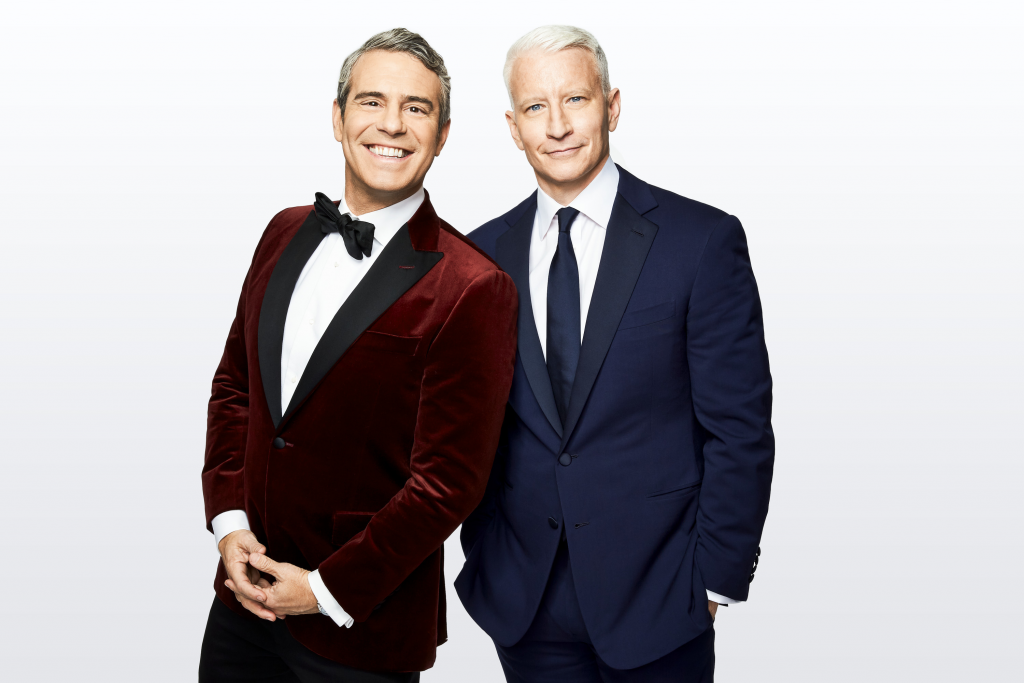
Anderson Cooper and Andy Cohen (Photo courtesy of CNN)

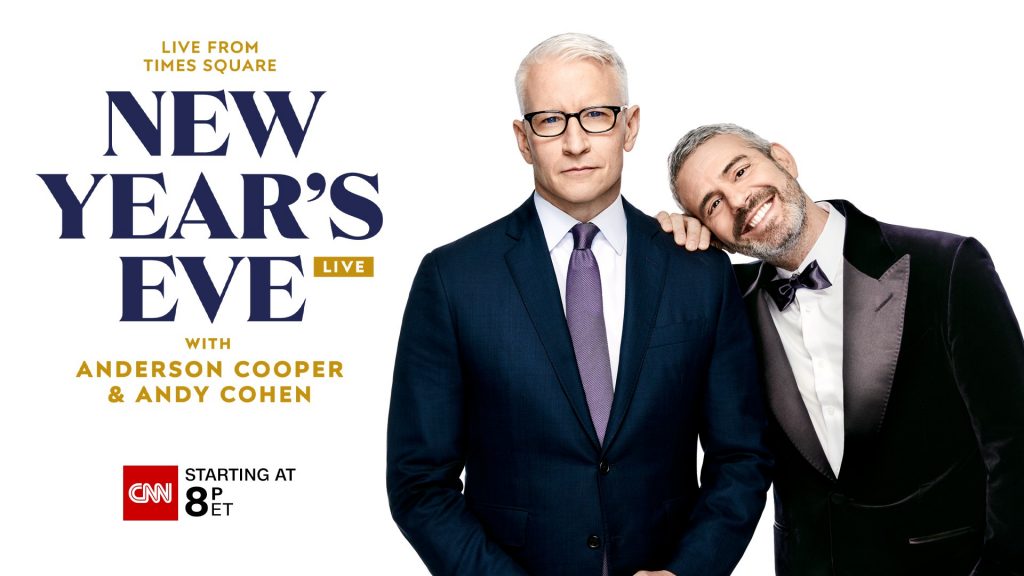
For the third year in a row, longtime friends Anderson Cooper and Andy Cohen will co-host CNN’s New Year’s Eve celebration, which begins at 8 p.m. ET. CNN’s 12th annual New Year’s Eve Show, which is telecast live from New York City’s Times Square. Performers on New Year’s Eve Live With Anderson Cooper and Andy Cohen will include Christina Aguilera, Lenny Kravitz, Shania Twain, Patti LaBelle, Keith Urban, 50 Cent, The Chainsmokers, and comedian/actress Dulcé Sloan. The show will also feature CNN’s Stephanie Elam, Randi Kaye, Richard Quest, Bill Weir and Gary Tuchman with daughter Lindsay at locations across America, including the Brady Bunch House and Key West. Then at 12:30am ET, CNN’s Brooke Baldwin and Don Lemon will do a New Year’s countdown from the Central Time Zone, live from Nashville for the Music City Midnight Celebration. In previous years, CNN’s Central Time Zone countdown took place in New Orleans.

In 2017, Cohen replaced Kathy Griffin, who was notoriously fired from the show in May of that year for publicly posting a photo of herself holding up a fake bloody head of President Donald Trump. Griffin and Cooper had co-hosted CNN’s New Year’s Eve Show since 2007, but the Cooper/Cohen duo brought in the show’s highest ratings so far. Cooper and Cohen have an established rapport, since they have done numerous speaking engagements together. The CNN live stream will be available on CNN.com and across mobile devices via CNN’s apps for iOS and Android. It can also be viewed on CNNgo. Leading up to “New Year’s Eve Live with Anderson Cooper and Andy Cohen” will be the CNN one-hour special “All the Best, All the Worst 2019,” beginning at 7 p.m. ET and hosted by Tom Foreman, covering the highlights and lowlights of the past year.

New Year’s Eve specials ringing in 2019 will feature Christina Aguilera, Jennifer Lopez, Sting and more

December 27, 2018

by Carla Hay

Watching a New Year’s Eve special on TV is a tradition for millions of people around the world. After taking a break from a New Year’s Eve Special in 2017, NBC is back with its star-studded party in New York City’s Times Square. Here’s what is planned for the four biggest New Year’s TV specials in the United States:

Dick Clark’s New Year’s Rockin’ Eve with Ryan Seacrest 2019 

Ryan Seacrest and Jenny McCarthy (Photo by Lorenzo Bevilaqua/ABC)

Celebrating its 47th year, “Dick Clark’s New Year’s Rockin’ Eve” (which is produced by Dick Clark Productions and airs in the U.S. on ABC) is still the most high-profile televised New Year’s Eve event. Mariah Carey headlined the show from New York City’s Times Square in 2018 and 2017. In 2018, another Grammy-winning diva—Christina Aguilera—is taking the headlining spot. Ryan Seacrest will once again host the show, which begins airing from 8 p.m. to 11 p.m. ET, followed by 11:30 p.m. to 2:13 a.m. ET. Jenny McCarthy will provide on-site reporting. Other performers in Times Square include Bastille, Dan + Shay and New Kids on the Block. Airing just after midnight Eastern Time, Post Malone will perform from a stop on his current tour in Brooklyn, New York, marking the first television performance of the new year. Meanwhile, the special has partnered with YouTube Music for the first time this year for cross-promotional programming.

Ciara will once again host the Los Angeles segments of the show that will feature performances that were mostly previously recorded. Artists in the show’s Los Angeles segments will include Lauren Alaina, Kelsea Ballerini, Bazzi, Kane Brown, Camila Cabello, The Chainsmokers, Ciara, Foster the People, Halsey, Dua Lipa, Ella Mai, Shawn Mendes, Charlie Puth and Weezer, as well as collaborations from Brown featuring Alaina; Macklemore with Skylar Grey; and The Chainsmokers featuring Ballerini.

Meanwhile, actress Lucy Hale (former star of “Pretty Little Liars”) will host the show’s second annual Central Time Zone celebration from New Orleans. Florida Georgia Line and Maren Morris will perform from the Allstate Fan Fest, leading up to the midnight countdown and fleur-de-lis drop near Jackson Square.  “Dick Clark’s New Year’s Rockin’ Eve with Ryan Seacrest 2019” is produced by Dick Clark Productions with Seacrest, Barry Adelman and Mark Bracco serving as executive producers. Larry Klein is producer.

Fox’s New Year’s Eve With Steve Harvey: Live From Times Square

Steve Harvey (Photo by Brian Bowen Smith/Fox)

After televising its New Year’s Eve show (hosted by Pitbull) in Miami from 2014 to 2016, Fox changed locations and hosts in 2017, with the show now taking place at New York City’s Times Square with comedian/talk-show host Steve Harvey and former E! News personality Maria Menounous. This year, Harvey and Menounous return to co-host the show, which airs on Fox from 8 p.m. to 10 p.m. ET and 11 p.m. to 12:30 a.m. ET live; CT/MT/PT tape-delayed. Performers will include Sting, Snoop Dogg, Robin Thicke, Florence + the Machine, Jason Aldean, Juanes and Why Don’t We. Additionally, the special will include celebrity cameo appearances by comedians Ken Jeong and Kenan Thompson, as well as “Fox NFL Sunday” commentators Curt Menefee, Terry Bradshaw, Howie Long, Michael Strahan and Jimmy Johnson. “Fox’s New Year’s Eve With Steve Harvey: Live From Times Square” is produced by IMG Original Content and Done + Dusted. Guy Carrington, Katy Mullan, Mike Antinoro, Dave Chamberlin and Orly Anderson serve as executive producers; and Eddie Delbridge serves as co-executive producer. IMG also produces Harvey’s self-titled talk show, as well as the Miss Universe Pageant and “It’s Showtime at the Apollo,” which have been hosted by Harvey over the past several years.

[December 30, 2018 UPDATE: Dierks Bentley has been added to the lineup performing in Times Square.]

NBC’s New Year’s Eve

Carson Daly, Chrissy Teigen, Leslie Jones, Keith Urban
(Photo courtesy of NBCUniversal)

Stars from NBC’s “The Voice” are all over “NBC’s New Year’s Eve” special, which begins airing at 10 p.m. ET from New York City’s Times Square. Not only is “The Voice” host Carson Daly hosting the New Year’s Eve show (with Chrissy Teigen and assistance from Leslie Jones), but “The Voice” coaches Kelly Clarkson, Blake Shelton and John Legend are also performing on the special. Other performers include Jennifer Lopez, Bebe Rexha, Diana Ross and Andy Grammer.  Keith Urban and  Brett Young will perform at Jack Daniel’s Music City Midnight: New Year’s Eve in Nashville. “NBC Nightly News” and “Dateline NBC” anchor Lester Holt will also appear on stage before the iconic ball drop. “NBC’s New Year’s Eve” will be televised from 10 p.m. to 11 p.m. ET, followed by the New Year’s countdown segment 11:30 p.m. to 12:30 a.m. ET. “NBC’s New Year’s Eve” is executive produced by Daly, Teigen and John Irwin through NBCUniversal Television Studio and Irwin Entertainment. It is co-executive produced by Casey Spira.

New Year’s Eve Live With Anderson Cooper and Andy Cohen

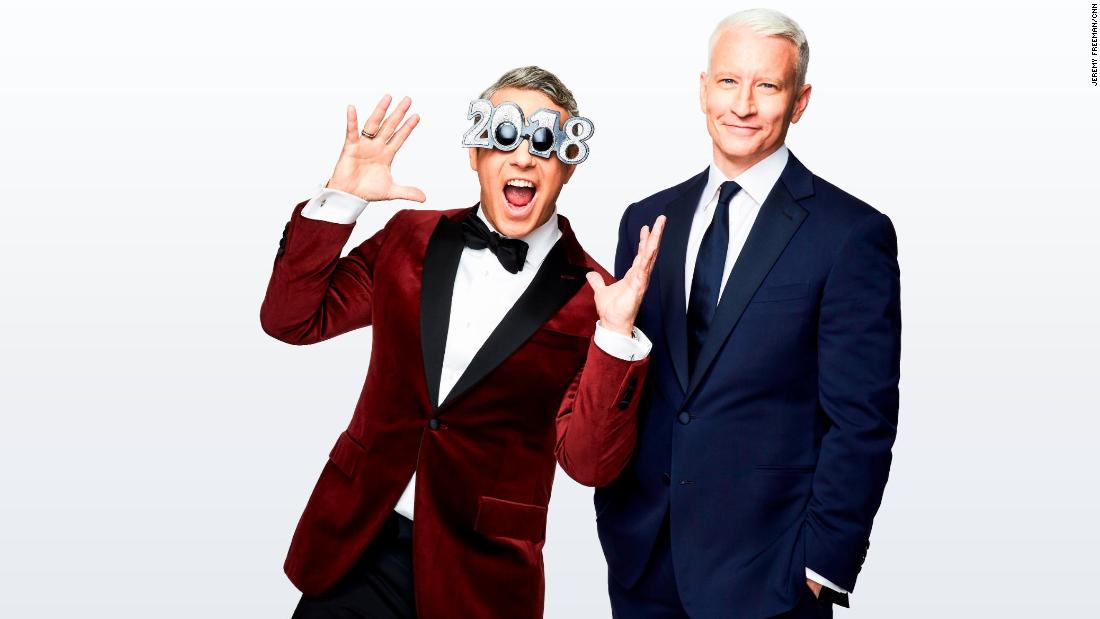
Andy Cohen and Anderson Cooper (Photo courtesy of CNN)

For the second year in a row, longtime friends Anderson Cooper and Andy Cohen will co-host CNN’s New Year’s Eve celebration, which begins at 8 p.m. ET. CNN’s 11th annual New Year’s Eve Show, which is telecast live from New York City’s Times Square has a more star-studded lineup this year than in previous years. Gwen Stefani is scheduled to perform from her Las Vegas residency, while Keith Urban (who also appears on NBC’s New Year’s Eve Special), Dave Chappelle, Patti LaBelle and Jack Black also round out the show’s celebrity lineup.  New Year’s Eve Live With Anderson Cooper and Andy Cohen will also spotlight Broadway musicals such as “The Band’s Visit,” “Wicked,” “Tootsie” and “Come From Away.” CNN’s New Year’s Eve Show begins at 8 p.m. ET, and will end at approximately 1:05 p.m. ET. CNN anchors Don Lemon and Brooke Baldwin will host a countdown from New Orleans at 12:30 a.m. ET. In 2017, Cohen replaced Kathy Griffin, who was notoriously fired from the show in May of that year for publicly posting a photo of herself holding up a fake bloody head of President Donald Trump. Griffin and Cooper had co-hosted CNN’s New Year’s Eve Show since 2007, but the Cooper/Cohen duo brought in the show’s highest ratings so far. Cooper and Cohen have an established rapport, since they have done numerous speaking engagements together.

New Year’s Eve specials ringing in 2018 will feature Mariah Carey, Celine Dion and more

December 26, 2017

by Carla Hay

Watching a New Year’s Eve special on TV is a tradition for millions of people around the world. For the first time in several years, NBC won’t be having a New Year’s Eve special this year. However, other networks are continuing the tradition. Here’s what is planned for the three biggest New Year’s TV specials in the United States:

Dick Clark’s New Year’s Rockin’ Eve with Ryan Seacrest 2018 

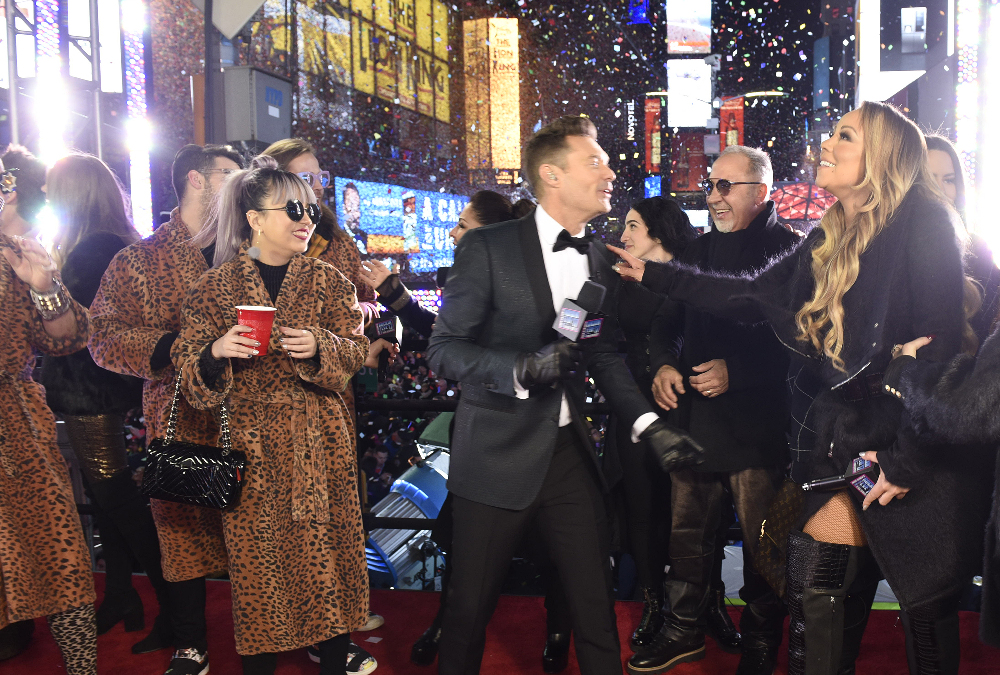
Ryan Seacrest (center) and Mariah Carey (far right) on "Dick Clark's New Year's Rockin' Eve with Ryan Seacrest 2017"
Ryan Seacrest (center) and Mariah Carey (far right) on “Dick Clark’s New Year’s Rockin’ Eve with Ryan Seacrest 2017” (Photo by Ida Mae Astute/ABC)

Celebrating its 46th year, “Dick Clark’s New Year’s Rockin’ Eve” (which is produced by Dick Clark Productions and airs in the U.S. on ABC) is still the most high-profile televised New Year’s Eve event. Mariah Carey wants a do-over of her embarrassing New Year’s Eve performance in the previous year, when she cut short her set after blaming technical difficulties on the show’s producers, who denied that they did anything wrong. Carey is back to try and redeem herself by headlining the show again this year in New York City’s Times Square. Ryan Seacrest will once again host the show, which begins airing at 8 p.m. ET. Jenny McCarthy will provide on-site reporting. Other performers in Times Square include Camila Cabello, Nick Jonas and Sugarland.

Ciara will host the Los Angeles segments of the show that will feature performances that were mostly previously recorded. Artists in the show’s Los Angeles segments will include Kane Brown, BTS, Kelly Clarkson, Fitz & The Tantrums, Florida Georgia Line, Halsey, Khalid, Shawn Mendes, Charlie Puth, Portugal. The Man and Hailee Steinfeld, and all-star collaborations from Alessia Cara and Zedd, G-Eazy and Halsey, Khalid with Marshmello, Bebe Rexha featuring Florida Georgia Line, and Hailee Steinfeld and Alesso featuring Florida Georgia Line and watt. Also in the Pacific Time Zone, Britney Spears will perform from The AXIS at Planet Hollywood Resort & Casino in Las Vegas. It will be her final show of her Planet Hollywood residency, which began in 2013.

Meanwhile, actress Lucy Hale (former star of “Pretty Little Liars”) will host the show’s second annual Central Time Zone celebration from New Orleans. Imagine Dragons will perform from the Allstate Fan Fest, while Walk the Moon will do a performance leading up to the midnight countdown and fleur-de-lis drop near Jackson Square.

Fox’s New Year’s Eve With Steve Harvey: Live From Times Square

Steve Harvey
Steve Harvey (Photo by Brian Bowen Smith/Fox)

After televising its New Year’s Eve show (hosted by Pitbull) from Miami for the previous three years, Fox is changing locations and hosts this year. On site at New York City’s Times Square, comedian/talk-show host Steve Harvey and former E! personality Maria Menounous will co-host the show, which airs on Fox from 8 p.m. to 10 p.m. and 11 p.m. to 12:30 a.m. ET live; CT/MT/PT tape-delayed. Performers will include Celine Dion, Backstreet Boys, Macklemore featuring Skylar Grey, Flo Rida, Neil Diamond, Andra Day, Maroon 5 and the Zac Brown Band. “Fox’s New Year’s Eve With Steve Harvey: Live From Times Square” is produced by IMG, which also produces Harvey’s self-titled talk show, as well as the Miss Universe Pageant and “It’s Showtime at the Apollo,” which have been hosted by Harvey over the past few years.

December 28, 2017 UPDATE: Actor/comedian Rob Riggle has joined the lineup of celebrities appearing on Fox’s New Year’s Eve show, while “Beat Shazam” host Jamie Foxx will be featured on the show to announce a special surprise.

New Year’s Eve Live With Anderson Cooper and Andy Cohen

Andy Cohen and Anderson Cooper (Photo courtesy of CNN)

Longtime friends Anderson Cooper and Andy Cohen will co-host CNN’s New Year’s Eve celebration, which begins at 8 p.m. ET. CNN’s New Year’s Eve show, which is telecast live from New York City’s Times Square, focuses more on news and comedic commentary instead of on-site, live musical performances that are found on America’s broadcast networks.  However, there will be performances of Keith Urban in Nashville and Celine Dion in Las Vegas. This year, Cohen replaces Kathy Griffin, who was notoriously fired from the show in May 2017, for publicly posting a photo of herself holding up a fake bloody head of President Donald Trump. Griffin and Cooper had co-hosted CNN’s New Year’s Eve Show since 2007. Cooper and Cohen have an established rapport, since they have done numerous speaking engagements together. New Year’s Eve Live With Anderson Cooper and Andy Cohen has not announced if any other celebrities will be guests on the show, so expect the possibility of surprise guests.

Purina ONE 28 Day Challenge launches for 2017 to help North Shore Animal League

April 20, 2017

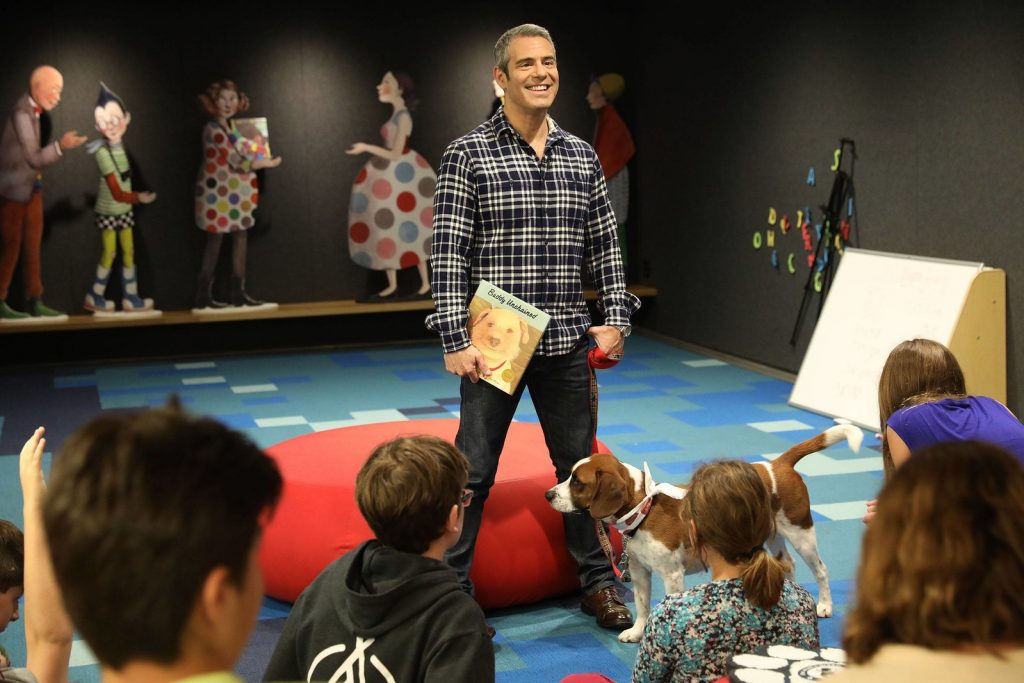
Andy Cohen Purina One Difference campaign
Andy Cohen engages with students while leading a lesson in New York on April 20, 2017. Along with a $20,000 donation to North Shore Animal League America’s Mutt-i-grees program, Purina ONE is partnering with Mutt-i-grees and Andy Cohen as part of its ONE Difference Campaign, which focuses on nourishing the lives of both students and shelter dogs across the country. (Photo by Amy Sussman/AP Images for Purina ONE)

From April 20 to May 31, 2017, Nestlé Purina PetCare Company will donate $10 (U.S. dollars) to the animal shelter/rescue organization North Shore Animal League America (NSALA) for each new consumer who registers for the Purina ONE 28 Day Challenge subject to a maximum donation of $20,000.  The Purina ONE 28 Day Challenge invites dog owners to their dog’s food to Purina ONE SMARTBLEND.

Andy Cohen’s rescue dog, Wacha, enjoys a Purina ONE lunch on in New York City on April 20, 2017. (Photo by Amy Sussman/AP Images for Purina ONE)

For the second consecutive year, the ONE Difference campaign will benefit NSALA’s Mutt-i-grees, a shelter-led academic curriculum that brings shelter dogs into classrooms and libraries, allowing students to engage with the pets while learning lessons in emotional competence, academic achievement and social awareness. According to a Purina press release, Mutt-i-grees was developed by The Pet Savers Foundation, an affiliate of NSALA and Yale University School of the 21st Century. More than 4,000 schools and libraries nationwide participate in the program.

On April 20, 2017, Purina elebrated its ONE Difference campaign today with the help of television personality Andy Cohen and his former shelter dog Wacha. The Bravo executive/talk show host joined the brand and North Shore Animal League America at a library in New York City to name Wacha an honorary “Mutt-i-gree” for the day and help lead a lesson with area elementary school students.

Copyright 2017-2025 Culture Mix
CULTURE MIX