
Review: ‘The Lychee Road,’ starring Da Peng, Bai Ke, Sabrina Zhuang and Terrance Lau

July 27, 2025

by Carla Hay

Da Peng in “The Lychee Road” (Photo courtesy of CMC Pictures)

“The Lychee Road”

Directed by Da Peng

Mandarin with subtitles

Culture Representation: Taking place during the Tang Dynasty (sometime during the 750s decade) in China, the dramatic film “The Lychee Road” (based on the 2022 novel Lychees of Chang’an) features an-all Asian cast of characters representing the working-class, middle-class and wealthy.

Culture Clash: A mid-level Bureau of Imperial Gardens inspector experiences various dangerous and frustrating obstacles after being tasked with delivering numerous fresh lychees from Lingnan to Chang’an (about 1,553 miles between the two cities) to the emperor for the emperor’s birthday, before the lychees become spoiled in about three days.

Culture Audience: “The Lychee Road” will appeal primarily to people who are interested in suspenseful dramas that are set in ancient times but have themes that are still relevant to today.

Sabrina Zhuang and Bai Ke in “The Lychee Road” (Photo courtesy of CMC Pictures)

“The Lychee Road” is a bittersweet drama that’s partly a race-against-time adventure and partly a piercing observation of corrupt bureaucracy. Da Peng gives a tour-de-force performance as a government inspector tasked with a difficult lychee delivery. Although some of the action scenes are far-fetched, “The Lychee Road” has many other scenarios that are entirely believable and well-acted. The movie also makes good use of comedic moments.

Written and directed by Da Peng, “The Lychee Road” is based on Ma Boyong’s 2022 novel “Lychees of Chang’an.” Shen Yuyue and Dai Siao are also credit as scriptwriters for “The Lychee Road.” (There’s also a 2025 Chinese limited drama TV series called “Litchi Road” that is based on the same book.) The movie takes place during the Tang Dynasty (sometime during the 750s decade) in China, with the story centered on travel to and from the capital city of Chang’an and the city of Lingnan, which are about 1,553 miles (or 2,500 kilometers) apart from each other.

“The Lychee Road” begins by showing a conspiracy plan being set in motion. A eunuch named Yu Chao’en (played by Chang Yuan), who is based on the real politician of the same name and is called Eunuch Yu in the movie, has been given orders to find a government employee who can be a scapegoat for an “impossible mission.” The employee has to deliver several fresh lychees (fruit that resembles red berries on the outside) to the emperor in time for the emperor’s birthday celebration on June 1. Failure to do so could be punishable by being exiled or worse.

The problem is that fresh lychees spoil after about three days, and the emperor specifically wants the lychees to come from Lingnan, which is 1,553 miles away from the emperor’s home base of Chang’an. Eunuch Yu knows that travel by horse and by ship would not be enough time to complete this mission, which is why he’s looking for a lower-level person who will get the blame when the mission is expected to fail. Eunuch Yu is seen meeting with a government director named Biao Biao (played by Yi Yunhe), who gleefully tells him that he knows the perfect person who can be set up for this doomed mission.

The targeted person is Li Shande (played by Da Peng), a middle-aged inspector who works in the Bureau of Imperial Gardens. In a voiceover narration, Shande is shown giving a brief summary of hs adult life: After graduating from college with a degree in mathematics, Shande joined the Bureau of Imperial Gardens at age 24.

Shande has been stuck in the ninth rank (the equivalent of middle management) for several years. He’s underpaid, overworked, and frequently bullied by his supervisors. Shande’s personal life is much happier: He has a very good marriage to his loyal wife Zheng Yuting (played by Yang Mi), and they are devoted parents to their adorable daughter Li Xiu’er, who is about 6 or 7 years old.

Shande is assigned the task and is told that he will get a job promotion to be the official lychee envoy if he completes this mission of delivering lychees to the emperor by June 1. (in real life, Emperor Xuanzong was the emperor of the Tang Dynasty during the period of time that this story takes place.) In addition to a higher salary, the job of lychee envoy would also give perks and prestige to Shande and his family. Shande signs a contract to make this delivery by the deadline.

However, Shande finds out later that he’s been conned: The contract that he signed said that the lychees would be preserved, not fresh. When he gets the contract after he’s signed it, he finds out that a tiny, hard-to-detect sticker with the word “fresh” was placed over the word “preserved” after he signed the contract. This altered contract makes it look Shande has agreed to deliver fresh lychees to the emperor by June 1.

Shande angrily confronts Biao Biao about this contract fraud. Biao Biao says that it’s too late for Shande to back out of the contract. Shande is despondent and in a panic because he knows this mission could ruin his life and the lives of his family members. On the day that Shande leaves for Lingnan, the June 1 deadline is 117 days away. He has this period of time to figure out how to deliver fresh lychees from Lingnan to Chang’an.

Before he leaves for the trip to Lingnan, Shande gets an unexpected visit from Du Shaoling (played by Zhang Ruoyun), the assistant military officer of the Right Guard Command. Shande confides in Shaoling about this big problem. Shaoling advises Shande to find a scapegoat if things go wrong. Shaoling also says that Shande could still possibly leverage the experience into being promoted to lychee envoy. Shande is given a Five Prefectures Pass to make his travels easier.

A skeptical and wary Shande travels by himself to Lingnan, in search of the perfect lychees. He encounters many challenges, including bad weather, wild animals, getting lost, and not knowing where to find lychees that would be suitable for the emperor. When he reaches Lingnan, he gets a hostile reaction from Lingnan’s governor He Qiguang (played by Lam Suet), who has some of his thugs rough up Shande because Qiguang doesn’t believe that Shande in on this mission for the emperor. However, Lingnan’s chief secretary Zhao Xinmin (played by Sunny Sun) intercedes and confirms that Shande’s mission is legitimate.

During Shande’s short visit with the governor, he sees an enslaved young man named Lin Yinu (played by Terrance Lau) being viciously whipped because Yinu has been accused of trying to make a partridge look like a peacock. After witnessing this cruelty, Shande has a private conversation with Yinu and tells Yinu that slavery is illegal in Chang’an. Shande promises that when Shande completes this mission, he will come back to get Yinu and take him to Chang’an, where Yinu can live as a free man.

Yinu, who has some speaking disabilities, ends up running away from his enslavers and following Shande around at an outdoor marketplace and other places where Shande goes. At first Shande is annoyed and thinks Yinu is being a pest. However, Yinu ends up becoming a very helpful assistant and later a trusted ally to Shande.

Just by chance, Shande meets a wealthy heir named Su Liang (played by Bai Ke, also known as White-K), who hears about this mission. Liang is up front in telling Shande that Liang’s father gives preference to Liang’s older brother Su Yan (played Wei Xiang) because their father doesn’t think Liang is a good-enough business. Liang wants to prove to their father that that he can do something successful in business. And so, Liang offers Shande the use of his merchant ship and crew to transport the lychees, with Liang covering all the expenses because Liang says he wants Shande to put in a good word for Liang with the emperor.

In exchange for this generous use of the ship and crew, Shande gives his Five Prefectures Pass to Liang, even though it’s illegal to give this pass to anyone else. Liang also tells Shande that the best lychees in Lingnan are at an orchard owned by a woman named Tong (played by Sabrina Zhuang), who inherited the property from her deceased parents. Tong is very outspoken and mistrustful of “city people.” However, Shande gains her trust, and she agrees to help him.

The rest of “The Lychee Road” shows how mathematician Shande uses some of his probability skills in testing various ways to get the lychees from Lingnan to Chang’an. Along the way, Shande encounters principal chancellor Yang Guozhong (played by Andy Lau), based on the real Yang Guozhong, who want Shande to fail in this mission. Shande also runs into a lot of bureaucractic complications when he has to get several approvals from various government ministry departments.

“The Lychee Road” has certain ideas for Shande’s problem that have more logic than other ideas. Several bureaucrats and other people in power don’t want Shande to succeed because they know that if he succeeds, he will look smarter than they are, and they will be exposed as mediocre or incompetent hacks. Shande’s physical abilities and psychological stamina are put to the ultimate tests.

Shaoling appears from time to time, mostly to give advice to Shande. He tells Shande that the three most important things that he learned as an official are (1) Going with the flow; (2) Sharing the benefits; and (3) Lifting each other up. However, Shande finds out that no amount of diplomacy or sycophancy can get a corrupt enemy to change if that enemy is rotten to the core.

With mostly solid direction and a well-paced screenplay, “The Lychee Road” has some memorable adrenaline-charged action sequences and moments of levity. Shande learns the value of teamwork with people of different backgrounds. The friendship that develops between Shande and Liang is thoroughly enjoyable to watch. Shande becomes like a father figure to Yinu. Shande also earns the respect of Tong.

Although all the cast members in “The Lychee Road” show talent in their roles, Da’s performance as Shande is the heart and soul of the movie. Shande goes through every possible emotion in “The Lychee Road,” which takes viewers on this wild and engrossing journey with Shande. The most underdeveloped character is Shande’s spouse Yuting, who is a stereotypical “worried wife of the hero” for most of her screen time.

The movie’s gorgeous cinematography is stunning, while the visual effects and production design are also above-average. And although there’s plenty of high-octane action and life-threatening things that happen in the story, “The Lychee Road” has some of its greatest impact in the quieter scenes, where guilt and emotional devastation are harder to recover from than physical wounds and injuries.

CMC Pictures released “The Lychee Road” in select U.S. cinemas on July 25, 2025. The movie was released in China on July 18, 2025.

Review: ‘High Forces,’ starring Andy Lau, Zhang Zifeng, Qu Chuxiao and Liu Tao

November 1, 2024

by Carla Hay

Andy Lau in “High Forces” (Photo courtesy of Universe Films Distribution)

“High Forces”

Directed by Oxide Pang

Mandarin with subtitles

Culture Representation: Taking place in an unnamed city in China and mostly on a Chinese airline jet, the action film “High Forces” features an all-Asian cast of characters representing the working-class, middle-class and wealthy.

Culture Clash: An international security expert ends up on the same plane as his ex-wife and their teenage daughter, and the plane is hijacked by criminals who want a $500 million ransom.

Culture Audience: “High Forces” will appeal mainly to people who don’t mind watching mindless movies about airplane hijackings.

Qu Chuxiao in “High Forces” (Photo courtesy of Universe Films Distribution)

“High Forces” is generic and utterly forgettable cinematic junk about a hijacked plane where the hero’s family is in danger and the action scenes are ridiculous. All of this unimaginative predictability adds up to a very mind-numbing film. It might be easier to take if “High Forces” had some self-aware comedy about how idiotic everything is in the movie, but “High Forces” takes itself way too seriously for a movie of this low quality.

Directed by Oxide Pang, “High Forces” (formerly titled “Crisis Route”) was written by Sun Chan and Bai Yu. The movie completed filming in 2021, but “High Forces” wasn’t released until 2024. It’s usually not a good sign when it takes this long for a completed movie to be released. No amount of post-production editing or reshoots would be able salvage this stinker movie because almost every scene that takes place during the hijacking is actively terrible.

“High Forces” (which takes place in unnamed areas of China) begins by introducing the movie’s protagonist: middle-aged Gao Haojun (played by Andy Lau), an international security expert. Haojun has bipolar disorder, which causes him to have manic episodes of uncontrollable rage. About 10 years ago, something happened during one of these manic episodes that permanently changed his life and the lives of his immediate family members.

The movie doesn’t reveal right away what happened during this life-changing incident. But eventually, a flashback scene shows what happened: About 10 years ago, Haojun was married to a woman named Fu Yuan (played by Liu Tao), and together they were raising their 8-year-old daughter Gao Xiaojun (played by Zhang Zifeng) during a time when Haojun was not getting treatment for his bipolar disorder.

One evening, Haojun was driving on a busy street, with Yuan and Xiaojun as the car’s passengers. Haojun had a manic episode where he experienced road rage. His road rage caused him to drive recklessly through a red light, which resulted in a car accident where another vehicle crashed into Haojun’s car. During this accident, Xiaojun was immediately blinded by shattered glass.

Now, 10 years after the accident, Haojun and Yuan have been divorced for several years. Xiaojun (who was raised by her mother after the divorce) is now 18 years old and has extra-sensitive hearing due in large part to her blindness. Haojun still has tremendous guilt for the accident that caused Xiaojun’s blindness. He is also taking prescribed doses of lithium carbonate, a drug that is often prescribed to treat bipolar disorder.

Meanwhile, the fictional HanYu Airlines is gearing up for the launch of a new luxury Airbus A380. Xiaojun and Yuan are on HanYu Airline’s maiden flight of this aircraft. And what a coincidence: Haojun had a last-minute cancellation of an assignment, so he’s on this flight too, but he’s seated in a different part of the plane,

Because most viewers of “High Forces” already know that this plane will be hijacked (this hijacking is shown in the movie’s trailer and is the majority of the film’s plot), there is very little surprise when it happens. The hijacking leader is named Mike (played by Qu Chuxiao), who poses as a polite and mild-mannered customer on the plane. In reality, Mike is the most ruthless and heartless of the hijackers.

The hijacking is weirdly staged. Before the hijacking happens, Mike is sitting next to a drunk and aggressive man (played by Wang Longzheng), who rudely demands that a flight attendant named Fiona (played by Jiang Mengjie) keep refilling his wine glass. Mike tells the man to stop harassing the flight attendant. In response, the man smashes a wine bottle on Mike’s head, leaving a bloody gash on Mike’s forehead.

Fiona informs the cockpit that there’s a disruptive customer on the plane. It turns out that the drunk guy is really one of the hijackers, and this fight was staged to be a distraction. The armed hijackers soon make their presence known and take over the plane. Mike really did get a bloody injury in staged fight, but it seems like a stupid plan to deliberately injure the leader of this operation. In total, there are 12 hijackers, some who are disguised as crew members.

Because there’s no WiFi on the plane (the movie never explains why), Haojun somehow communicates with Xiaojun through a hidden two-way device. Yuan has to be Xiaojun’s eyes and act as a sight translator when they talk to Haojun. And they have to do all of this without being noticed by the hijackers, who are watching all the captive people on the plane—except for Haojun, who is able to sneak around in the tightly enclosed plane without being seen by the hijackers. It’s as ludicrous as it sounds.

The worst parts of the movie are when a plane door opens during a fight scene and certain people are hanging out of the plane (holding on to a parachute rope) while the plane is in motion, thousands of feet in the air. In real life, people hanging out of a flying jet would be instantly killed by the sheer velocity from the jet that would fling people out of the plane and plunge them to their death. “High Forces” is not supposed to be a science-fiction film where people have superhuman strength. However, too many moronic scenes have people surviving things that would kill people in real life.

Meanwhile, on the ground, there are not-believable-at-all negotiations for the hijackers to get the ransom money. At no time is there any sign of any military or law enforcement coming to the rescue. There’s someone who’s the head of the emergency operating center (played by David Wang), who is ineffectual because the movie wants Haojun to be the chief hero. Let’s not forget that Haojun is a hothead whose bad temper might come in handy when he’s fighting the hijackers, who outnumber him but somehow he takes them on by himself.

The CEO of HangYu Airlines is Li Hang Yu (played by Guo Xiaodong), who tells the hijackers that he can’t get access to the $500 million immediately because HangYu Airlines is a public company. But then, Mike reminds Hang Yu that Hang Yu is married to the heir of Lius Air, the original secret name of Hangyu Airlines, so this wife has a private fortune. She’s the one who bears the burden of getting the ransom money transferred to a secret account. A HangYu Airlines official named Chen Jie (played by Jiang Chao) is an adviser to the couple.

Lau, who is one of the producers of “High Forces,” does an adequate job with his acting performance. The other cast members give serviceable performances too, but the personalities of these characters are very shallow and uninteresting. The Mike character is a two-dimensional villain with no backstory. The biggest problems with “High Forces” are the movie’s screenplay and fight scenes, which are so relentlessly mindless, no amount of good acting could save “High Forces,” which is a disaster movie because of how bad it is.

Universe Films Distribution released “High Forces” in select U.S. cinemas on October 25, 2024. The movie was released in China on October 10, 2024.

Review: ‘The Wandering Earth II,’ starring Andy Lau, Wu Jing, Li Xuejian, Sha Yi, Ning Li, Wang Zhi and Zhu Yanmanzi

March 3, 2023

by Carla Hay
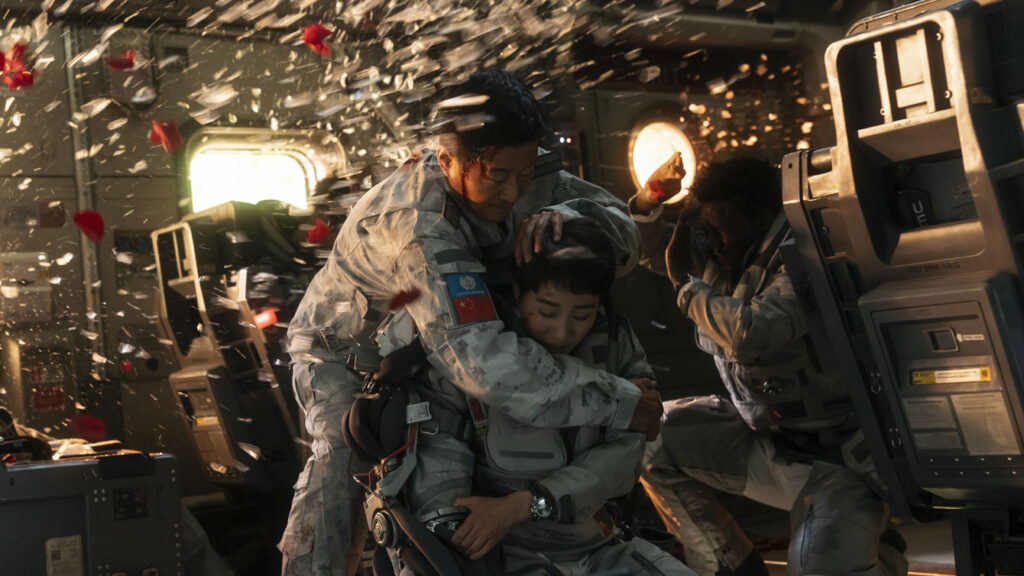
Wu Jing and Wang Zhi in “The Wandering Earth II” (Photo courtesy of China Film Group Corporation and Well Go USA)

“The Wandering Earth II”

Directed by Frant Gwo

Mandarin with subtitles

Culture Representation: Taking place on Earth and in outer space, from 2044 to 2058, the sci-fi action film “The Wandering Earth II” (a prequel to 2019’s “The Wandering Earth,” features a cast of predominantly Asian characters (with some white people) representing the working-class and middle-class.

Culture Clash: Scientists, engineers and other people frantically try to prevent the moon from crashing into Earth, and there are disagreements on the best way to do it. 

Culture Audience: “The Wandering Earth II” will appeal primarily to people who are fans of the movie’s headliners, “The Wandering Earth,” and epic sci-fi disaster movies.
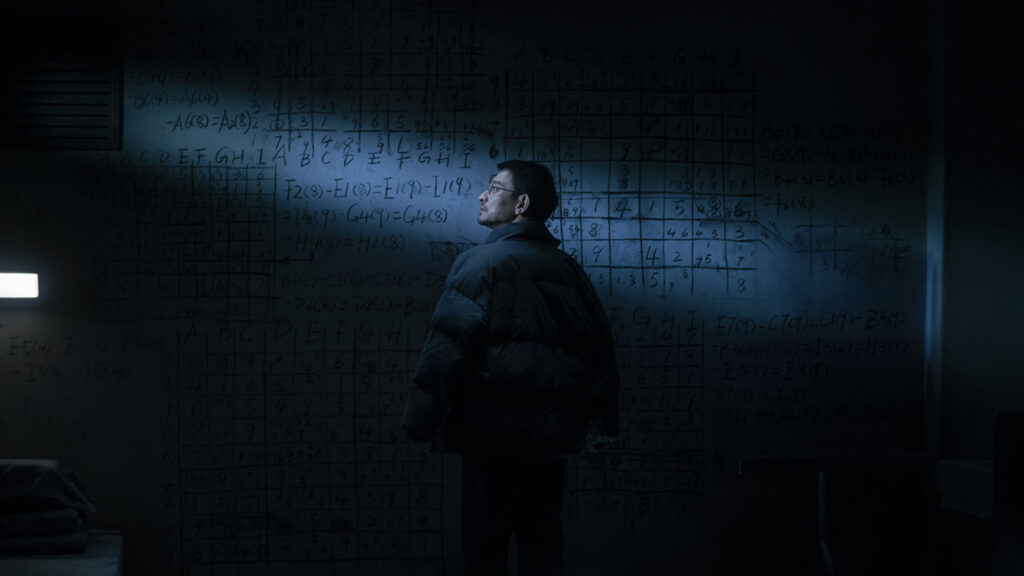
Andy Lau in “The Wandering Earth II” (Photo courtesy of China Film Group Corporation and Well Go USA)

In the sci-fi action movie “The Wandering Earth II,” the novelty has worn off a little bit from the movie’s predecessor, 2019’s “The Wandering Earth.” After all, how many times can there be a “Wandering Earth” movie about another planet being on a collision course toward Earth? “The Wandering Earth II,” which is a prequel to “The Wandering Earth,” repeats this concept with generally entertaining but long-winded results: “The Wandering Earth II” is nearly three hours long.

Frant Gwo, who directed “The Wandering Earth,” returns to helm “The Wandering Earth II,” which he co-wrote with Gong Ge’er. “The Wandering Earth II” is an over-the-top sci-fi spectacle that doesn’t lose sight of the human stories in this saga about trying to avert an outer-space disaster. In other words, the movie delivers exactly what viewers can expect from “The Wandering Earth” franchise.

“The Wandering Earth II,” which takes place from 2044 to 2058, is about scientists, engineers and other people trying to prevent the moon from crashing into Earth. In “The Wandering Earth,” which takes place from 2058 to 2078, is about scientists, engineers and other people trying to prevent Jupiter from crashing into Earth.

All of this is happening because the sun is expanding and could destroy Earth in the 22nd century if Earth doesn’t get out of the way and move to a safer part of the universe. However, changing Earth’s location can cause problems if could cause other planets to crash into Earth. These problems are at the crux of “The Wandering Earth” movies, which are based on Liu Cixin’s 2000 short story of the same name.

It’s not necessary to see “The Wandering Earth” before seeing “The Wandering Earth II,” since “The Wandering Earth II” is a prequel. However, since “The Wandering Earth” before seeing “The Wandering Earth II” gives better context to some of the motivations of the characters.

In “The Wandering Earth II,” the United Nations has been renamed the United Earth Government (UEG) and is backing the Moving Mountain Project, which will use gigantic ion engines to move Earth out of the current solar system into a safer part of the universe. UEG has shut down a radical opposition group called Digital Life Project (DLP), which believes that the future of human survival is by making humans into digital form and uploading everything using the advance mind technology.

In China, a former DLP computer scientist named Tu Hengyu (played by Andy Lau) agrees to work on the Moving Mountain Project, but he secretly continues his research into the digital mind upload technology that he thinks is still the better way for humans to survive any interplanetary disaster. Hengyu has a personal reason for wanting to make humans immortal in digital form: His wife and daughter died in a car crash, when his daughter Yaya was about 4 or 5 years old. Hengyu keeps looking at a digital simulation of Yaya that can only lasts two minutes at a time. Hengyu wants the technology to be developed so that people can bring back and preserved their deceased loved ones in digital form.

Meanwhile, from 2044 to 2058, UEG has developed enough ion engines to stop Earth’s rotation, a necessary first step in getting it out of the current solar system. The Moving Mountain Project has now been renamed the Wandering Earth Project. But something goes terribly wrong when Hengyu uploads the digital memories of Yaya into the 550W supercomputer that Hengyu helped invent. It leads to the moon going on a collision course toward Earth.

Several people who work for UEG are involved in this disaster prevention mission. Liu Peiqiang (played by Wu Jing) is a UEG astronaut who represents the “everyday” man in the story who finds his inner hero when he is called on to save lives. Someone who was a trainee in the astronaut program is Han Duoduo (played by Wang Zhi), who has confidence and intelligence that Peiqiang immediately finds attractive.

Much of the earlier part of “The Wandering Earth II” chronicles a shy and awkward Peiqiang trying to court Duoduo, who rebuffs his advances but the warms up to him. It’s not spoiler information (since it’s already in “The Wandering Earth”) that Peiqiang and Duoduo eventually fall in love with each other, get married, and start a family together.

Another important person in Peiqiang’s life is Zhang Peng (played by Sha Yi), a senior-level UEG fighter pilot who becomes Peiqiang’s mentor. Other supporting characters in the story are Zhou Zhezhi (played by Li Xuejian), who is China’s ambassador to UEG; Hao Xiaoxi (played by Zhu Yanmanzi), who is Zhezhi’s personal assistant; Ma Zhao (played by Ning Li), who works with Hengyu as a quantum computing researcher; and Mike (played by Andy Friend), the U.S. ambassdor to UEG; and Andre Graschnov (played by Vitalli Makarychev), a Russian senior-level UEG fighter pilot. There’s also a cute computer robot named Benben.

“The Wandering Earth” packs in a lot of action and suspense, which are expected. However, the movie also skillfully weaves together the parallel stories of Hengyu and Peiqiang. Hengyu is working outside the UEG system with his secretive, behind-the-scenes computer research. Peiqiang is working inside the UEG system and is on the front lines of the battles to save lives. Peiqiang has a mentor. Hengyu does not. Both men experience grief related to a death in the family.

Beyond the explosions and races against time, “The Wandering Earth” explores issues related to hope and faith in humanity. It’s also an emotionally moving story about what personal sacrifices can mean if they are for a cause that’s bigger than one person’s needs. No one is going to win any major acting awards for “The Wandering Earth II,” but the cast members are believable in their roles. It doesn’t matter if viewers understand all the sci-fi jargon in the movie, because the greater message of “The Wandering Earth” is about the lengths that people will go to for their survival and the survival of future generations.

China Film Group Corporation and Well Go USA released “The Wandering Earth II” in U.S. cinemas on January 22, 2023, the same date the the movie was released in China and several other countries. The movie will be released on digital and VOD on May 9, 2023.

Copyright 2017-2026 Culture Mix
CULTURE MIX