
March 4, 2021
by Carla Hay

Directed by Craig Brewer
Culture Representation: Taking place in the fictional African country of Zamunda and briefly in the New York City borough of Queens, the comedy sequel “Coming 2 America” features a predominantly black cast of characters (with a few white people) representing African royalty, working-class Africans and Americans of various classes.
Culture Clash: An African royal, who is shamed for not having a male heir, finds out that he has an illegitimate American son, who is brought to Africa to be groomed as an heir to the throne.
Culture Audience: “Coming 2 America” will appeal primarily to fans of 1988’s “Coming to America,” but this sequel lacks the charm of the original movie.
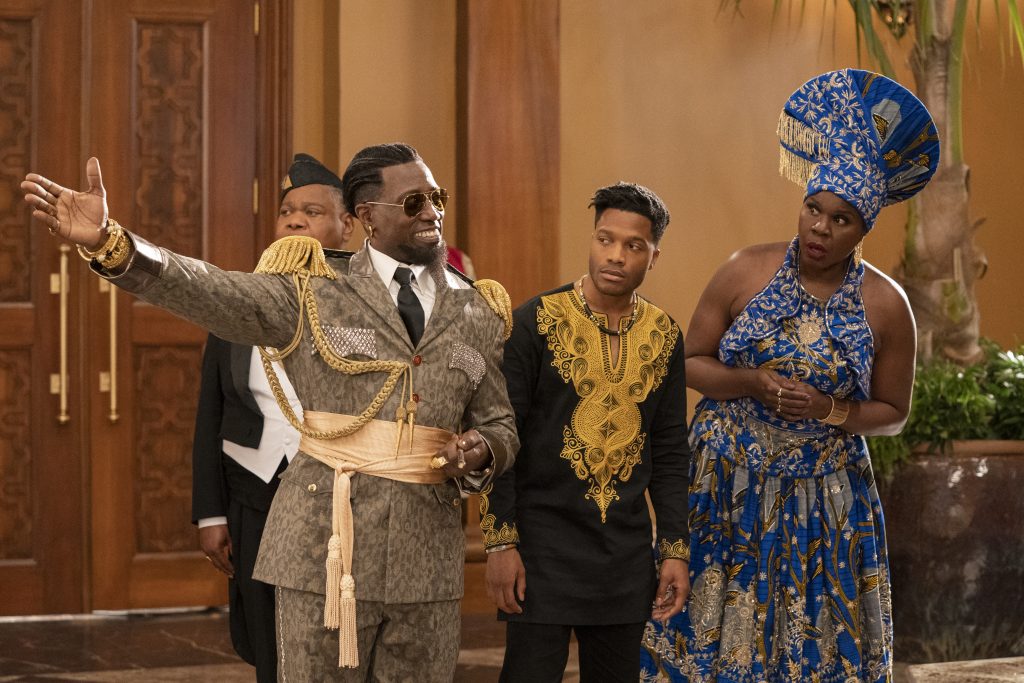
The comedy film “Coming 2 America,” which is the sequel to 1988’s “Coming to America,” is a perfect example of a movie that was not worth the wait. It’s a dull and disappointing mess that trashes or wastes the character relationships that made the “Coming to America” a crowd-pleasing hit. Co-stars Eddie Murphy and Arsenio Hall, who were a dynamic duo in “Coming to America,” don’t have very many scenes together in “Coming 2 America.”
The new characters that are introduced in “Coming 2 America” are bland or obnoxious. An endearing romance/courtship that was at the heart of “Coming to America” is largely absent from “Coming 2 America,” which rushes a predictable relationship between a young couple who have almost no believable chemistry with each other. And “Coming 2 America” is filled with misogyny and racist stereotypes about black people, from a mostly white team of filmmakers.
The title of this dreadful and boring sequel shouldn’t have been “Coming 2 America.” It should have been titled “Shucking and Jiving in Zamunda.” That’s essentially what all the main characters do throughout this idiotic movie that takes place mostly in the fictional African country of Zamunda, not in America.
The “fish out of water” premise of culture shock that worked so well in “Coming to America” is muddled and mishandled in “Coming 2 America,” which was directed by Craig Brewer. This entire film looks like a tacky TV-movie instead of what it should have been: a cinematic triumph in comedy. (It’s easy to see why Paramount Pictures chose not to release “Coming 2 America” in theaters and sold it to Prime Video instead.) It doesn’t help that the movie’s musical score is schlocky sitcom music by Jermaine Stegall. Kenya Barris, Barry W. Blaustein and David Sheffield wrote the awful and lazy screenplay for “Coming 2 America.”
Murphy and Hall do their expected schticks of portraying various characters (some in prosthetic makeup), just like they did in “Coming to America.” It brings some mildly amusing moments that are fleeting and recycled. (The barbershop scene is back, and it’s not as funny as it was in the first “Coming to America” movie.) But these moments are not enough to save “Coming 2 America,” which is ruined by too many stale jokes that would’ve been outdated in 1988.
In fact, there’s almost nothing modern about “Coming 2 America,” except for some of the contemporary costumes. The song selections and musical numbers that are used as filler in this movie are straight out of the early 1990s, as if the filmmakers are trying to relive the music of their youthful days. And there are several celebrity cameos from African American entertainers, to distract from the movie’s silly plot. However, sticking a bunch of talented black people in front of the camera doesn’t make the writing and directing of “Coming 2 America” any less moronic and cliché.
In the beginning of “Coming 2 America,” Prince Akeem (played by Murphy) and his loyal sidekick/best friend Semmi (played by Hall) are living an uneventful life in Zamunda. Akeem and his American wife Lisa (played by Shari Headley)—who met, fell in love, and got married in “Coming to America”—are now celebrating their 30th wedding anniversary, as well as peace and prosperity in Zamunda. Semmi is still portrayed as a bachelor who has nothing better to do with his life but to be Akeem’s glorified lackey.
Akeem and Lisa have three children, all daughters: eldest Meeka (played by KiKi Layne), who’s in her mid-to-late 20s, is the only daughter with a distinct personality, since she’s the most assertive and outspoken of the three. Middle teenage daughter Omma (played by Bella Murphy, one of Eddie Murphy’s real-life daughters) and youngest pre-teen daughter Tinashe (played by Akiley Love) don’t have much dialogue in the movie. Their only moments where they get to shine are in some choreographed fight scenes.
Lisa’s father Cleo McDowell (played by John Amos) has expanded his fast-food McDowell’s restaurant business to Zamunda. McDowell’s blatantly copies McDonald’s, even down to having a “golden arches” sign in the shape of the letter “M.” This copycat gag leads to a not-very-funny segment in the beginning of the movie about how much McDowell’s imitates McDonald’s. Cleo quips, “They’ve got Egg McMuffins. We’ve got Egg McStuffins.” That’s what’s supposed to pass as comedy in this horribly written film.
Oscar-winning “Black Panther” costume designer Ruth E. Carter did the costumes for “Coming 2 America.” The costumes in “Coming 2 America” are among the few high points of the movie. Unlike “Black Panther,” which treated its female and male characters as equals, “Coming 2 America” is a parade of misogyny that makes the female characters look inferior to the male characters in subtle and not-so-subtle ways.
The running “joke” in the film is that Zamunda is a socially “backwards” country with laws where women can’t be the chief ruler of the nation, and women can’t own their own businesses. The Zamundan culture is that women exist only to cater to men. Females can’t make any big decisions without the approval of the closest patriarch in her family. It’s sexism that could be ripe for parody, if done in a funny and clever way. But “Coming 2 America” bungles it throughout the entire movie, except for the end when a predictable decision is made to resolve a certain problem related to Zamunda’s sexist laws.
That decision is rushed in toward the very last few minutes of the movie. And it looks like what it is: the filmmakers’ way of pandering to feminism. However, this fake feminist plot development doesn’t erase all the ways that “Coming 2 America” marginalizes and “dumbs down” the women in the movie in a way that’s so foul and unnecessary.
“Black Panther” proved you don’t have to make black women in an African country look like they’re incapable of being smart and strong leaders. The “Coming 2 America” filmmakers try to rip off a lot of “Black Panther’s” visual style, but it’s all a smokescreen for the way “Coming 2 America” makes the African country of Zamunda (and therefore the people who live there) look like a very ignorant culture that’s behind the times.
In “Coming 2 America,” the “rank and file” black female citizens in Zamunda are just there to literally shake their butts in the dance routines; act as servants who are required to bathe or groom the royal men; or be preoccupied with marriage and/or motherhood. Akeem is shamed and ridiculed by a rival named General Izzi (played by Wesley Snipes) because Akeem has no male heirs. Izzi is portrayed as a cartoonishly buffoon villain who’s power-hungry and jealous of Akeem’s status as a royal heir.
In order to gain power in Zamunda, Izzi would rather form some kind of alliance with Akeem, instead of fighting Akeem. When Izzi storms the royal palace with an army of men, Izzi tells Akeem: “I came here for blood, but not the murder kind. Family blood, marriage blood.” Izzi suggests that Izzi’s son Idi (played by Rotimi Akinosho) marry Meeka, but Akeem rejects the offer.
Akeem’s widower father King Jaffe Joffer (played by James Earl Jones) thinks he’s going to die soon. And the king isn’t happy that Akeem doesn’t have a son. “The throne must pass to a male heir,” King Jaffe declares. Jones, who is a majestic presence in many other movies, has his talent squandered in “Coming 2 America,” which makes him look like a sexist old fool who doesn’t think any of his granddaughters could be worthwhile leaders.
Izzi tells Akeem that it’s too bad that Akeem doesn’t have a male heir, because Izzi think his daughter Bopoto (played by Teyana Taylor) would be a perfect match for any son of Akeem’s. And just like that, Semmi and a crotchety elderly man named Baba (played by Hall, who’s made to look like a tall, African version of Gollum) tell Akeem that he actually does have a son that Akeem didn’t know about for all of these years. Akeem doesn’t really believe it, until he’s reminded of something that happened when he and Semmi were in the New York City borough of Queens, during the time that the “Coming to America” story took place.
Meanwhile, King Jaffe announces, “My funeral should be spectacular. Let’s have it now, while I’m alive.” This was apparently an excuse for the “Coming 2 America” filmmakers to have one of several dance numbers in the movie as a gimmick to fill up time.
King Jaffe’s “funeral party” features Morgan Freeman introducing performances by En Vogue and Salt-N-Pepa, who perform the 1993 hit “Whatta Man.” Also performing at the party is Gladys Knight, who is forced to embarrass herself in butchering her 1973 classic “Midnight Train to Georgia” because the filmmakers made her change the song to “Midnight Train to Zamunda.” At any rate, King Jaffe dies at the party (he falls asleep and doesn’t wake up), which is a good thing for Jones, because the less screen time he has in this garbage movie, the better.
After his father’s death, Akeem becomes king, but Akeem is now desperate to find a male heir. Akeem’s son (who is constantly called a “bastard” in this movie) was the result of a one-night stand that Akeem had in Queens. “Coming 2 America” then shows how this son was conceived. Akeem and Semmi, who were in Queens to look for a woman to marry Akeem, were at a nightclub, when Semmi spotted an American woman named Mary Junson (played by Leslie Jones) at the bar. (“Coming 2 America” uses flashbacks from “Coming to America” and some visual effects to recreate this moment.)
Semmi struck up a conversation with Mary and told her that he was working for an African prince who was looking for a bride. Mary takes one look at Akeem and doesn’t need any encouragement to hook up with Akeem. She invites Akeem back to her place. And as Akeem remembers it in the present day, Mary blew smoke from marijuana (which he calls “wild herbs”) in his face, thereby impairing his judgment.
Akeem describes Mary and his sexual encounter with her in this way: “A wild boar [Mary] burst into the room and rammed me and rammed me.” The sex is shown in a flashback in a very problematic scene, because it portrays Mary as someone who sexually assaulted Akeem. He definitely wasn’t a willing partner, by the way it’s portrayed in the movie, but it’s played off as something to laugh at in the movie. It makes Mary look like she’s so desperate for sex that she will incapacitate and rape a man.
And the dialogue in this sexual assault scene is just so cringeworthy. Before Mary attacks Akeem, she says to him, “I hope you like pumpkin pie, ’cause you goin’ to get a whole slice.” Mary can’t speak proper English in the movie because the filmmakers want to make her look as dumb and uneducated as possible.
It’s also downright sexist and racist to call a black woman a “boar,” which is an animal that is an uncastrated male swine. It doesn’t make it okay if another black person says this insult, just because he was paid to say it as an actor. It should be mentioned that two out of the three screenwriters of this crappy “Coming 2 America” screenplay are white. Had there been more black people on the filmmaking team, it’s doubtful that there would have been so many insulting and offensive portrayals of black people (especially black women) in this trash dump of a movie.
Portraying Mary as a desperate sexual assaulter isn’t the only problematic thing about this character. The entire character of Mary is problematic, because it’s all about reinforcing the worst negative stereotypes that movies and TV have about black women who are single mothers: loud, crude, stupid, broke/money-hungry and promiscuous. Mary (who doesn’t seem to have a job) calls herself a “ho” multiple times in the movie.
Akeem also calls Mary a “morally bereft” woman when he describes his memory of her. And when Akeem and Semmi inevitably go back to Queens to find Mary and the mystery son, Mary isn’t sure if Akeem is the father of her child. That is, until she finds out how rich Akeem is (Semmi accidentally drops open a suitcase full of cash in front of her), and suddenly Mary can’t wait to move to Zamunda and live in the royal palace.
The filmmakers go out of their way to make Mary as mindless and vulgar as possible. When Mary goes to Zamunda and she’s served caviar, she doesn’t know what this delicacy is and calls it “black mashed potatoes.” And in another scene in the movie, Mary shouts, “I am so hungry, I could eat the ass out of a zipper!”
Mary and Akeem’s son Lavelle Junson (played by Jermaine Fowler) is a good guy overall. But the filmmakers force a negative stereotype on him, by making him yet another black male who breaks the law. Lavelle and his Uncle Reem (played by Tracy Morgan, using the same shady clown persona that he usually has in his movies and TV shows) are ticket scalpers. Clearly, the “Coming 2 America” filmmakers wanted yet another ghetto stereotype of black people who commit illegal acts to make money.
“Coming 2 America” has a very racially condescending scene of Lavelle and Reem (who is Mary’s brother) at a corporate office on Lavelle’s 30th birthday. Lavelle is at this company (a firm called Duke & Duke) to apply for some kind of computer job. Lavelle tells Reem that he’s tired of having an unstable income from ticket scalping, and he wants to earn an honest living in a steady job. Reem thinks Lavelle is a dolt for wanting to get a legitimate job, and he asks Lavelle if he’s going to use his “white voice” in the interview.
In the interview with the firm’s racist scion named Calvin Duke (played by Colin Jost), Lavelle is subjected to a barrage of bigoted assumptions that are meant to make Lavelle feel inferior. When Calvin finds out that Lavelle was raised by a single mother who’s unemployed (she got laid off from her job), Calvin makes a snide remark: “They say that not having a dominant male figure at home is detrimental to a child.” There are some more racist insults (Calvin asks Lavelle if his mother is addicted to drugs or gambling), before the interview ends predictably, with Lavelle angrily telling Calvin he doesn’t want the job.
The thing is that even though the character of Calvin is supposed to represent white elitists who are racists, the “Coming 2 America” filmmakers do everything to make a lot of the movie’s black characters (especially Mary) the very degrading stereotype that racists like Calvin have of black people. And that’s why the movie’s job interview scene is very phony in its intentions to make it look like racists are most likely to be spoiled white rich kids. The reality is that people from all walks of life can be racists.
It turns out that Lavelle isn’t going to need a job because Akeem soon finds Lavelle (who’s scalping tickets outside of Madison Square Garden), introduces himself as Lavelle’s long-lost father, and tells Lavelle that his new identity is as a wealthy royal heir in Zamunda. Lavelle says he won’t move out of New York without his mother. And quicker than you can say “stupid comedy sequel,” Lavelle and Mary are in Zamunda. And this time, the Americans are the ones who are the “fish out of water.”
Lisa isn’t too happy that Akeem has a son that they didn’t know about until recently. However, she’s willing to forgive Akeem because Lavelle was conceived before Akeem met Lisa. Someone who is even less thrilled about Lavelle is Meeka, who sees Lavelle as a threat to any leadership power she hoped to inherit as a legitimate member of this royal family. The sibling rivalry scenes predictably ensue.
Meanwhile, Lavelle meets a hair stylist named Mirembe (played by Nomzamo Mbatha), who works for the royal family. She’s single and available, so you know where this is going. Mirembe changes Lavelle’s hairstyle from the Kid ‘n Play-inspired fade that he had in Queens to a short-cropped locks hairstyle that Erik Killmonger from “Black Panther” would wear, but with a rat tail braid in the back.
Mirembe says that she would love to open her own hair salon one day (her biggest inspiration is the 2005 movie “Beauty Shop”), but she’s sad and discouraged because the law in Zamunda doesn’t allow women to own their own businesses. Lavelle thinks this law is wrong and he promises her that when he has the power, he’s going to change the law. Lavelle and Mirembe are good-looking, but there’s no believable romantic spark between them, so their inevitable courtship is very boring.
The only thing that looks authentic between them is a meta moment when Mirembe and Lavelle have a conversation about which of the “Barbershop” movies is the best of the series, and how sequels usually aren’t as good as the original. Mirembe says, “This is true about sequels. Why ruin it?” If only the “Coming 2 America” filmmakers took that advice for this movie.
It should come as no surprise that the movie relies on the cliché of a love triangle. Now that Akeem has a male heir, Izzi ramps up the pressure for Bopoto to become Lavelle’s wife. Akeem is open to the idea after Bopoto does a sexy dance for the royal family while showing her ample cleavage. However, Bopoto is deliberately written as a submissive airhead. More than once in the story, Lavelle says he wants to be with an intelligent and independent-minded woman, so it’s obvious which woman he’ll choose in the love triangle.
Fowler has an appealing screen presence as Lavelle, but he’s hemmed in by a character that’s written as average and unremarkable. “Coming 2 America” is also very unfocused, since it can’t decide if the story should be more about the Lavelle/Mirembe romance or the Lavelle/Meeka rivalry. Truth be told, even though Layne plays Lavelle’s half-sister, her scenes with Fowler are more dynamic and have more energy than the scenes with Fowler and Mbatha. Layne’s considerable talents are underappreciated in “Coming 2 America,” because her Meeka character isn’t in the movie as much as people might think she should be.
Continuing with the fixation on early 1990s music, there’s another out-of-place musical number where people do a big sing-along to Prince’s “Gett Off,” led by Akeem’s servant Oha (played by Paul Bates). And there’s an atrociously written scene where Queen Lisa gets drunk with Mary at a party, and they start dancing to Digital Underground’s “The Humpty Dance.” This scene is supposed to make it look like Lisa is getting back in touch with her New York hip-hop roots.
But when they have Lisa and Mary repeat the lines, “Uppity bitch what?,” it just goes back to making the black women in this movie look like they have a ghetto mentality. It says a lot that the “Coming 2 America” filmmakers make the woman who is literally the movie’s black queen incapable of being completely dignified. They try to make it look like Lisa has been suppressing her “true” self as a trashy party girl, when Lisa was never that way in the first “Coming to America” movie. Almost all the black women in this movie are marginalized as either existing only in the story because they’re appendages to the men, as wives/love interests/sex partners, servants or daughters.
One of the signs of a creatively bankrupt movie is when it relies too much on celebrity cameos without bringing any genuine laughs. (John Legend sings during a mid-credits scene, and it’s a useless appearance that has no bearing on the movie’s story.) Trevor Noah makes a quick and inconsequential cameo as a TV newscaster named Totatsi Bibinyana of the Zamunda News Network.
Eddie Murphy, who is the main attraction for the “Coming to America” franchise, should have been a producer and/or writer of “Coming 2 America.” His company Eddie Murphy Productions helped finance the movie, but Murphy himself was not a credited producer responsible for the movie’s content and day-to-day operations. If he had been a producer or writer, Eddie Murphy could have brought better creative clout to this movie, which makes him do silly sketches that are way beneath his talent. The comedy and tone, including the slapstick scenes, are monotonous and unimaginative.
Lavelle goes through an initiation process that includes taming a tiger and a “circumcision” ritual that are ineptly written and filmed. As part of his “royal training,” Lavelle gets criticism from Semmi, who yells at him: “You walk like an American pimp!” Lavelle shouts back, “You dress like a slave from the future!”
Doing a high-profile, highly anticipated sequel such as “Coming 2 America” isn’t just about the paychecks. It’s about making good entertainment and a fairly accurate representation of cultures to make the story look relatable. And it should be about celebrating people, instead of making them demeaning caricatures that embody what racist and sexist bigots believe.
Prime Video will premiere “Coming 2 America” on March 5, 2021.