
Review: ‘Predator: Badlands,’ starring Elle Fanning and Dimitrius Schuster-Koloamatangi

November 4, 2025

by Carla Hay

Elle Fanning and Dimitrius Schuster-Koloamatangi in “Predator: Badlands” (Photo courtesy of 20th Century Studios)

“Predator: Badlands”

Directed by Dan Trachtenberg

Culture Representation: Taking place in outer space, the sci-fi action film “Predator: Badlands” features a group of outer-space alien creatures and robots.

Culture Clash: After his family is destroyed by betrayal, a Yautja creature named Dek, who comes from a long line of predators, is determined to prove himself as a worthy warrior by killing a giant apex predator called the Kalisk, with help from a talkative android.  

Culture Audience: “Predator: Badlands” will appeal primarily to people who are fans of the movie’s headliners, the “Predator” franchise and sci-fi sequels that dare to do some things differently from their predecessors.

A scene from “Predator: Badlands” (Photo courtesy of 20th Century Studios)

Up until “Predator: Badlands,” the “Predator” franchise (which began with 1987’s “Predator”) has been synonymous with sci-fi action stories that have touches of horror and have the Predator as a vicious killer from outer space who targets the heroes in the stories. With themes of found family and anti-hero empathy, “”Predator: Badlands is a departure from the usual formula of making the Predator the chief villain. This less-violent and more-comedic “Predator” movie is original in some areas and cliché in other areas.

Directed by Dan Trachtenberg and written by Patrick Aison, “Predator Badlands” has a simple concept that works well because the movie doesn’t get cluttered and bogged down by trying to cram too much into the plot. The Predator in each “Predator” movie comes from a mysterious species of creatures called the Yautja. “Predator: Badlands” is the first movie in the franchise to show the Yautja as beings with family bonds that are similar to what humans would have, for better or for worse.

This de-mystification of the Yautja in “Predator: Badlands” might get mixed reactions from fans. However, it’s a unique premise that should be commended for not lazily recycling the same type of story that has been other “Predator” movies. “Predator: Badlands” is also the first “Predator” movie where humans are not main characters in the story.

The fictional Yautja language is shown in subtitles in the movie. “Predator: Badlands” was filmed in Australia. Trachtenberg also directed two previous movies in the “Predator” franchise: 2022’s “Prey” and 2025’s animated “Predator: Killer of Killers.” Viewers don’t need to see any previous “Predator” movie to understand what happens in “Predator: Badlands,” which can be considered a stand-alone sequel.

In the beginning of “Predators: Badlands,” on the planet of Yautja Prime, a male Yautja creature named Dek (played by Dimitrius Schuster-Koloamatangi) is shown fighting for respect from his older brother Kwei (played by Michael Homick, voiced by Stefan Grube), who is much taller and stronger that Dek. Kwei and Dek face off in a mock battle, where Dek is easily defeated by Kwei. They also argue over whether not either of them can fight like someone who is considered a superior warrior to both of them: their father Njohrr (played by Reuben De Jong, voiced by Schuster-Koloamatangi), the leader of the clan.

Njohrr has disdain for Dek, who is smaller than the average male Yautja and was born with an eye disability. The mark of a great warrior in the Yautja culture would be anyone who can kill a giant apex predator called the Kalisk, which resides on a “death planet” called Genna. A Yautja who can bring back the corpse of the Kalisk as a hunting trophy would make that Yautja creature the unidsputed, legendary leader of the clan.

The Kalisk is considered almost impossible to find and kill. Many hunters and warriors have tried and lost their lives in the process, which is one of the reasons why Genna (which has a lot of dense jungles) is called a “death planet.” Dek believes he can kill the Kalisk, but his brother and father are very skeptical.

Njohrr is very cruel to Dek and doesn’t think he’s worthy of being part of the clan. In the first 15 minutes of the movie, Njohrr tries to murder Dek, but Kwei sacrifices himself by pushing Dek into a locked spaceship while Njohrr attacks Kwei. Njohrr is bigger and stronger than Kwei and murders Kwei as Dek watches helplessly from the spaceship.

A devastated Dek escapes in the spaceship, which goes to Genna. Even though his father committed a heinous act of betrayal, Dek is determined to prove is is a worthy of the clan by going ahead with his goal to kill the Kalisk. Dek also wants to replace his evil father as the clan leader.

Dek is ejected in a pod in a jungle area of Genna. After some solo hiking, he encounters a human-looking robot named Thia (played by Elle Fanning), who is stuck in a vulture’s nest. Thia, who is friendly and talkative, is missing tthe lower half of her body, from the waist down. Thia explains to Dek that she was built and deployed by the Weyland-Yutani Corporation (in the “Alien” franchise) for research. Her spaceship crashed, and she says she was attacked by the Kalisk, which caused her dismemberment and why she is stuck in the vulture’s nest.

Dek helps Thia out of the net and immediately can sense that Dek is hunting for the Kalisk. Thia wants to be Dek’s travel companion. Dek is gruff and abrupt with Thia and says that he hunts alone. However, after Dek gets attacked by a poisonous flying creature that resembles Pterodactylus, Thia is able to convince Dek to take her with him because she says she knows where to get an antidote to the poison.

When Thia first meets Dek, she mentions having an identical twin android named Tessa (also played by Fanning), who was with Thia during the Kalisk attack, but the Thia and Tessa got separated during this attack. Thia says she’s looking for Tessa and “I refuse to believe she’s dead.” Thia’s sibling relationship with Tessa is supposed to be a poignant juxtaposition to Dek’s grief over losing his brother.

“Predator: Badlands” is mainly about how Thia and Dek go from being unlikely travel companions to each other’s protectors during this dangerous journey. They get another companion in a female creature that Thia names Bud (played by Rohinal Nayaran), a non-talking animal who resembles a mutant monkey with webbed feet. It’s a predictable way for “Predator: Badlands” to have a “cute” creature that doesn’t frighten impressionable young children and for the creature to be designed as the movie’s popular merchandising toy.

The visual effects for “Predator: Badlands” are stunning and believable for much of the terrain and the creatures. The movie’s fight scenes have some suspense, but they get to be repetitive and monotonous in some parts of the movie. A showdown near the end of the film is resolved in a very stereotypical way.

Thia’s bubbly personality goes against type and is the opposite of the usual emotionless robots that are in most sci-fi movies. Her non-stop yapping might be irritating to some viewers, but Fanning’s performance gives Thia enough charm that goes a long way in the story. By contrast, Tessa has an aloof personality. Schuster-Koloamatang’s performance as Dek is serviceable and gets the job done in showing the vulnerable side of this Predator.

By having Thia and Tess as creations of the Weyland-Yutani Corporation, “Predator: Badlands” hints that there could be a more extensive crossover of the “Alien” and “Predator” universes. Let’s hope it’s better than the “Alien vs. Predator” movies. “Predator: Badlands” is a step in the right direction in rejuvenating the “Predator” franchise with better stories that still deliver the type of thrilling action that fans want.

20th Century Studios will release “Predator: Badlands” in U.S. cinemas on November 7, 2025. A sneak preview of the movie will be shown in U.S. cinemas on November 5, 2025. “Predator: Badlands” will be released on digital and VOD on January 6, 2026. The movie will be released on DVD and 4K Blu-ray and February 17, 2026.

Review: ‘Prey’ (2022), starring Amber Midthunder, Dakota Beavers, Stormee Kipp, Michelle Thrush, Julian Black Antelope and Dane DiLiegro

August 3, 2022

by Carla Hay

Amber Midthunder and Dane DeLiegro in “Prey” (Photo courtesy of 20th Century Studios/Hulu)

“Prey” (2022)

Directed by Dan Trachtenberg

Some language in Comanche and French with no subtitles

Culture Representation: Taking place in North America’s Nothern Great Plains in 1719 (in the area now known as Canada), the sci-fi horror film “Prey” features a cast of predominantly Native American characters (with some white people) portraying people from the Comanche Indian tribe and white French trappers.

Culture Clash: A teenage girl from the Comanche tribe must prove her worth as a hunter when people doubt she can do it because she’s a female, and she encounters the deadly Predator from outer space. 

Culture Audience: “Prey” will appeal primarily to people who are fans of the “Predator” franchise and anyone who doesn’t mind watching predictable, boring and idiotic horror movies.
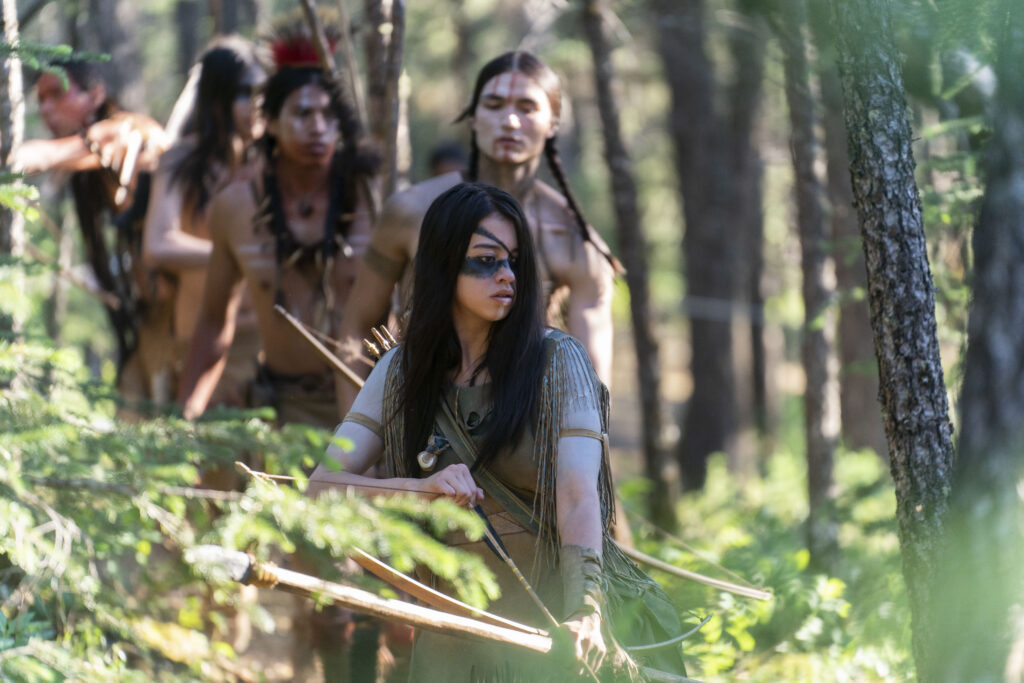
Cody Big Tobacco, Harlan Kywayhat, Stormee Kipp, Dakota Beavers and Amber Midthunder in “Prey” (Photo courtesy of 20th Century Studios/Hulu)

“Prey” is a dull and lousy rehash and not a real origin story for “The Predator” franchise. Expect to see more of the same types of killings that are in other “Predator” movies, except that “Prey” takes place in 1719. This mindless horror flick clumsily panders to gender politics by having the theme that women are underestimated as hunters. The movie’s female protagonist literally says so in the movie, in order to explain why the Predator beast hasn’t attacked her yet.

Directed by Dan Trachtenberg and written by Patrick Aison, “Prey” is shamefully a wasted opportunity to explore and educate viewers on the Comanche Nation tribe of Native Americans, who are the primary characters in this movie’s story. Instead, the movie uses the same old tired and generic stereotypes of Native Americans in frontiers of North America (before the United States and Canada existed as nations), with “Prey” providing little to no insight on what makes the Comanche tribe special from other Native American cultures. Yes, some of the movie’s language is spoken in Comanche, but that’s about it.

Instead, “Prey” pounds viewers over the head with the concept that only one female in this tribe is brave enough to want to be a hunter alongside the men. Her name is Naru (played by Amber Midthunder), who gets constant reminders from the male members of her tribe that she’s not “good enough” to be their equal. Naru (who looks to be about 16 or 17 years old) and her tribe live in the Northern Great Plains of an area that is now part of Canada. (“Prey” was filmed on location in Alberta, Canada.)

Even though she is the focus of the movie, Naru doesn’t have anything that resembles a true personality. She’s just a combination of predictable and over-used clichés about teenage heroines who do action scenes. And that’s not a good sign when this character is supposed to be the central character in what should have been a compelling horror movie but instead is just a lackluster imitation of the worst “Predator” movies.

The first third of the movie consists of Naru trying to tell skeptical members of her tribe that there’s a predatory and deadly creature that’s not a bear or a lion. She doesn’t know what this creature is, but she’s not believed by the members of her tribe. Naru’s older brother Taabe (played by Dakota Beavers), who’s in his 20s, is one of the people who doubts Naru’s hunting abilities and what she is saying.

One of the more insulting depictions about Native American culture that “Prey” perpetuates is that it depicts Native Americans of this era as not being capable of having anything but simplistic conversations. Therefore, viewers will get mind-numbing dialogue in “Prey” such as a conversation between Naru and her disapproving mother Sumu (played by Stefany Mathias), who is barely in the movie. (Sumu’s screen time is less than 10 minutes.)

In this conversation, Sumu says to Naru: “My girl, you are so good at so many other things. Why do you want to hunt?” Naru replies, “Because you all think that I can’t.” All of the cast members are serviceable in their roles (which are hindered by the terrible screenwriting), but no one in the “Prey” cast does a great performance either.

People familiar with the “Predator” franchise already know that the Predator is a deadly mutant creature from outer space. The Predator’s standing height is about 7 to 8 feet tall, and its muscular body has human-like arms and legs. Instead of fingernails, the Predator has elongated talons. This creature has the ability to be invisible. The Predator also has vision similar to an X-ray. And the Predator doesn’t speak or give any indication for why it kills.

The way that the Predator (played by Dane DiLiegro) suddenly appears in “Prey” is an example of the movie’s tacky and cheap-looking visual effects. An origin story is supposed to explain why and how a saga started. It’s not supposed to rehash storylines that were already seen in other stories in the franchise. And that’s why, as an origin story, “Prey” is an utter and pathetic failure.

The middle and last third of “Prey” are just a series of soulless killings that have been seen in other “Predator” movies, with the only difference being that the people in the Comanche tribe and some scruffy-looking Frenchmen trappers are now the targets. The supporting characters in “Prey”—including a sexist Comanche warrior named Wasape (played by Stormee Kipp), a tribe woman named Aruka (played by Michelle Thrush) and the tribe’s Chief Kehetu (played by Julian Black Antelope)—are written as utterly forgettable or bland characters.

“Prey” is so lazy when it comes not bothering to come up with enough original ideas, it recycles the famous line uttered by Arnold Schwarzenegger’s character named Dutch in 1987’s “Predator” movie: “If it bleeds, we can kill it.” In “Prey,” Taabe says these same words to Naru. It might be the “Prey” filmmakers’ way of paying tribute to this very first “Predator” movie, but it comes across as a corny throwaway line of dialogue because no one on the “Prey” filmmaking team could think of anything better. And for people who are fans of 1987’s “Predator,” re-using this line of dialogue is just a reminder of how much of a better movie “Predator” is to “Prey.”

Naru encounters the Predator several times but manages to escape in several badly edited scenes. As Naru tells her brother Taabe, the Predator isn’t attacking her because the Predator doesn’t see her as a threat. Since when does the Predator care about the gender of its victims? Apparently, in “Prey,” the Predator somehow thinks that any female human is somehow “not a threat” and therefore less likely to be a target of the Predator. It reeks of sexism and going overboard to pander to some idea of feminism when a female comes along to challenge the Predator.

This ludicrous storyline in “Prey” is in fact the opposite of female empowerment, because the “Prey” filmmakers have now made it look like this notorious horror villain from outer space thinks female humans aren’t smart enough or strong enough to kill it. And only one female from the tribe has the courage to possibly do so. It’s the worst type of female tokenism that “Prey” takes to idiotic levels.

It should come as no surprise that Naru and the Predator do indeed have a showdown, but that doesn’t really happen until the last 15 minutes and only after Naru feels justified to do something out of “revenge.” Don’t expect anything resembling a coherent plot in this terrible movie. It’s easy to see why the movie studio decided to release “Prey” directly to streaming services instead of in theaters first, because a lot of people who would see this ripoff horror flick in cinemas would probably want a refund.

Hulu will premiere “Prey” on August 5, 2022. Outside the U.S., “Prey” will premiere on Star+ in Latin America, and Disney+ under the Star banner in other territories on August 5, 2022.

Copyright 2017-2026 Culture Mix
CULTURE MIX