
Review: ‘Lilo & Stitch’ (2025), starring Maia Kealoha, Sydney Elizebeth Agudong, Billy Magnussen, Tia Carrere, the voice of Chris Sanders, Courtney B. Vance and Zach Galifianakis

May 20, 2025

by Carla Hay

Stitch (voiced by Chris Sanders) and Maia Kealoha in “Lilo & Stitch” (Photo courtesy of Disney Enterprises Inc.)

“Lilo & Stitch” (2025)

Directed by Dean Fleischer Camp

Culture Representation: Taking place in Hawai’i and in outer space, the live-action/animated film “Lilo & Stitch” (a remake of the 2002 animated film) features a predominantly Pacific Islander cast of characters (with some white people and African Americans) representing the working-class, middle-class and wealthy.

Culture Clash: A mischievious outer-space alien crash lands on Earth, where he is adopted by a 6-year-old girl and her guardian 18-year-old sister, while outer-space officials hunt for the alien to bring it back to captivity.

Culture Audience: “Lilo & Stitch” will appeal primarily to people who are fans of the 2002 “Lilo & Stitch” movie, the movie’s headliners, and family-friendly entertainment that delivers a good mix of comedy and drama.

Billy Magnussen and Zach Galifianakis in “Lilo & Stitch” (Photo Zach Dougan/Disney Enterprises)

The good news is that “Lilo & Stitch” is a worthy remake of the 2002 animated film, with an ending that’s arguably better. The bad news is that the hunt for fugitive alien Stitch is worse than the original movie. That’s because the 2025 version of “Lilo & Stitch” clumsily adds a body-transformation aspect to the story’s two space-alien hunters that makes them impersonate buffoonish humans who just aren’t very funny. Fortunately, these two bozos are not the movie’s main characters. The main characters in 2025’s “Lilo & Stitch” are endearing, doing justice their counterparts in 2002’s “Lilo & Stitch,” while bringing their own admirable qualities to these characters.

Directed by Dean Fleischer Camp, the 2025 version of “Lilo & Stitch” was written by Chris Kekaniokalani Bright and Mike Van Waes. Camp received an Oscar nomination (Best Animated Feature Film) for directing and producing 2021’s “Marcel the Shell With Shoes On,” a quirky live-action/animation hybrid that he also co-wrote. Because the 2025 version of “Lilo & Stitch” is a remake of a Disney classic, there isn’t much room to be offbeat, but 2025’s “Lilo & Stitch” mostly strikes the right balance of energetic comedy and heartfelt drama. The movie also has perfect casting of the two sisters who are the main human characters of the story.

The 2025 version of “Lilo & Stitch” begins in the same way as the 2002 “Lilo & Stitch” movie: In outer space, on the fictional Planet Turo, a rogue scientist named Jumba (voiced by Zach Galifianakis) has gotten into trouble for inventing a creature through illegal experimentation. The male creature, which looks like a blue koala with antennae, is called Experiment 626, and will later be named Stitch when the creature lands on Earth and impersonates a dog. Chris Sanders, who co-directed and co-wrote 2002’s “Lilo & Stitch,” returns as the voice of Stitch/Experiment 626, a character that Sanders is credited with creating.

Jumba is facing punishment before a committee led by the Grand Councilwoman (voiced by Hannah Waddingham), the leader of the Galactic Federation. The Grand Councilwoman decides that Experiment 626 (who is hyper, mischievous and very intelligent) must be exiled on a desert asteroid. However, Experiment 626 causes havoc on the spaceship carrying him. The ship crashes instead on Earth, on the Hawaiian island of Kaua’i. (The 2025 version of “Lilo & Stitch” was actually film on the Hawaiian island of O’ahu.)

A horrified Grand Councilwoman orders Jumba to retrieve Experiment 626 from Earth and send him to the original asteroid destination. Jumba admittedly doesn’t know much about Earth. But an eager law enforcement official named Agent Pleakley (voiced by Billy Magnussen), a self-proclaimed Earth expert, offers to accompany Jumba on this mission. Pleakley (who has a cheerful and goofy personality) explains that he’s been doing extensive research of Earth, which he and his colleagues have been using as a planet to repopulate mosquitos.

Grand Councilwoman allows Pleakley to go on this mission. Jumba, who is gruff and impatient, isn’t pleased about this situation because he’s somewhat of a loner who likes to be the “alpha male” of everything. Predictably, Jumba thinks Pleakely is annoying, and thier conflicts sometimes hinder their mission. It’s a familiar story formula of two beings with opposite personalities who are forced to work together for a common goal.

In the original “Lilo & Stitch,” Jumba and Pleakley kept their original alien bodies but were under strict orders not to reveal themselves to humans. Jumba and Pleakley had the ability to make themselves invisible. In the 2025 version of “Lilo & Stitch,” Jumba and Pleakley can still make themselves invisible, but this time, they decided to disguise themselves as humans, to make it easier to interact with people.

How do Jumba and Pleakley disguise themselves as humans? Jumba and Pleakley are at a Hawaiian airport and take photos of two male companion travelers (played by Galifianakis and Magnussen), who are outside of a terminal on their way to getting checked in for their flight. Jumba and Pleakley then use those photos to transform themselves into looking like these two human travelers. There’s some not-that-funny sitcom-ish slapstick where Jumba and Pleakley both have problems adjusting to walking and dressing like humans.

Meanwhile, the two main human characters of the story are introduced: Lilo (played by Maia Kealoha) is an energetic and curious 6-year-old girl, who lives with her bright but overwhelmed 18-year-old sister Nani (played by Sydney Elizebeth Agudong) in a modest Kaua’i house. Nani is Lilo’s guardian because their parents died in a car accident a few months ago. Nani has been juggling child-raising responsibilities with her job as a server at a resort restaurant called Jimmy’s Luau, which has live entertainment.

A new aspect to the story is Nani had plans to study marine biology at her first-choice college: the University of California at San Diego, where she had a full academic scholarship. But because Nani has to take care of Lilo, Nani has put her college plans on indefinite hold. Nani has to deal with a lot because Lilo has a tendency to get into trouble. Viewers have to assume that this story takes place during the summer because Lilo is never seen in school.

In both “Lilo & Stitch” movies, Lilo is treated like a weird outcast by her peers. Just like in both movies, an early scene shows Lilo is late for a hula dancing performance at the resort because she was busy feeding a sandwich to some fish in the sea. Lilo also says she can communicate with the fish. She gets teased about it by some “mean girls” in the group.

In both “Lilo & Stitch” movies, Lilo gets kicked out of the dance group because of a conflict with a “mean girl” in the group who insulted Lilo. In the 2002 “Lilo & Stitch.” Lilo punches the girl and gets in a brawl with her. The 2025 “Lilo & Stitch” tones down Lilo’s violence and just has Lilo pushing the mean girl off of the dance stage.

Nani is understanding but exasperated by Lilo’s rebellious antics. Lilo asks Nani, “Am I a bad person?” Nani replies, “No, but sometimes you do bad things.” Just like in both movies, the concept of ‘ohana (family) is repeated as “no one gets left behind.”

And just like in both movies, Lilo is lonely and wants a best friend. She loves animals and is a big fan of Elvis Presley’s music, which is played throughout the movie. The Presley songs include “Heartbreak Hotel,” “Hound Dog,” Suspicious Minds,” “Stuck on You,” “(You’re the) Devil in Disguise” and a Bruno Mars cover version of “Burning Love.” Hawaiian music is also part of the movie’s soundtrack, including songs written for the movie (such as “He Lei Pāpahi No Lilo a me Stitch” and “Hawaiian Roller Coaster Ride”) and Hawaiian music classics, such as “Aloha ‘Oe” and “Henehene Kou ‘Aka.”

In both “Lilo & Stitch” movies, Nani’s guardianship of Lilo is under scrutiny by a social worker, who does home visits and is concerned about the sisters’ living situation and Nani’s ability to properly take care of Lilo. In the 2002 “Lilo & Stitch” movie, Tia Carrere was the voice of Nani. In the 2025 “Lilo & Stitch” movie, Carrere has the role of social worker Mrs. Kekoa, who is assigned to monitor Nani’s guardianship of Lilo.

Mrs. Kekoa’s first visit to the home is a disaster. The place is a mess. There’s not enough food in the refrigerator. And she finds out that Nani sometime leaves Lilo by herself, which is something that Nani lies about by denying it. Mrs. Kekoa tries to give Nani some leeway by telling Nani that Nani has three tasks to complete before Mrs. Kekoa’s next visit: (1) stock the fridge; (2) clean up the house; (3) and get health insurance for Nani and Lilo.

Later, Mrs. Kekoa is aided by a CIA operative named Cobra Bubbles (played by Courtney V. Vance), who is also looking for Experiment 626, but Cobra fools Mrs. Kekoa by going posing as the director of the social services agency. In the 2002 “Lilo & Stitch” movie, the Cobra Bubbles character (voiced by Ving Rhames) was much more menacing and imposing than the Cobra Bubbles in 2025’s “Lilo & Stitch.” Cobra was the only social services worker in 2002’s “Lilo & Stitch,” and his CIA identity was revealed much later in the movie.

It just so happens that on the night that Experiment 626 crash-landed on Earth, it looked like a falling star that Lilo and Nani could see from Lilo’s bedroom window. Just like in both movies, Lilo pushes Nani out of the room so that Lilo can be alone to wish on the falling star. Nani eavesdrops and sees that Lilo’s wish is to find a best friend who loves her unconditionally and will never abandon her.

It doesn’t take long for Experiment 626 to cause chaos on Earth. He crashes and runs all over a wedding reception, where people scream, fall down and hurt themselves when they see this creature. Experiment 626 is then taken by animal care control workers to a local animal rescue shelter called Na Me Ola, where he is put in the section for dogs.

Lilo’s introduction to Experiment 626 is slightly different in both movies, but the end results are the same. In 2002’s “Lilo & Stitch,” it’s Nani’s idea to bring Lilo to the shelter so that Lilo can find an animal friend. In 2025’s “Lilo & Stitch,” an elderly neighbor friend named Tūtū (played by Amy Hill) suggests that Lilo go to the animal shelter and accompanies Lilo to this visit. In 2002’s “Lilo & Stitch,” Hill had a different elderly woman role: Mrs. Hasagawa, the owner of a fruit stand.

Tūtū lives with her grandson David (played by Kaipo Dudoit), a surfer who has a crush on Nani, who is also an avid surfer. David asks Nani to go on surfing dates, but she politely turns down his invitations. It’s in contrast to 2002’s “Lilo & Stitch,” where Nani’s romance with David was already established. Jason Scott Lee was the voice of David in 2002’s “Lilo & Stitch.” In 2025s “Lilo & Stitch,” Lee portrays the manager of Jimmy’s Luau.

The workers at the animal shelter don’t know what type of animal Experiment 626 is, so they plan to have the creature stay at the shelter until some local scientists can take this creature for evaluation. Experiment 626 sees dogs and photos of dogs at the shelter, and he is intelligent enough to transform himself to look as much like and act as much like a dog as possible. That includes make his antennae and extra feet hide inside his body. In 2002’s “Lilo & Stitch” the other dogs are so frightened of Experiment 626, they hide on top of their cages. But in 2025’s “Lilo & Stitch,” the dogs in the shelter aren’t bothered by Experiment 626.

When Lilo meets Experiment 626, she’s immediately interested in him because he looks so different from other animals in the shelter. Even when she’s told that this animal is not up for adoption, Lilo insists that this is the pet that she wants. Just like in both movies, Experiment 626 sees a poster of a girl hugging a dog, so he hugs Lilo to ensure that she will want to adopt him. The tactic works.

Of course, once Experiment 626 is in Lilo’s home, it acts like an unruly dog. One day, while he’s in Nani’s truck with Nani and Lilo, Experiment 626 rips the upholstery on a car seat. Nani is annoyed and says that she’ll now have to get the seat stitched up. And that’s how Lilo gets the idea to name this pet Stitch.

The rest of “Lilo & Stitch” is delightful to watch when Lilo, Nani and Stitch are in the scenes. Kealoha and Agudong (who are both native Hawaiians) are completely believable as sisters. Agudong gives a likable and relatable performance, even though she looks like she’s in her mid-20s instead of the 18-year-old character she’s supposed to be.

And although Stitch is the cute creature of the movie, precocious Kealoha as Lilo is an equal star of the show. Kealoha has great comedic timing and performs convincingly in the dramatic scenes. “Lilo & Stitch” is Kealoha’s first movie. And it’s a very impressive debut for her. The rest of the human characters in the movie are serviceable or fairly bland.

Where 2025’s “Lilo & Stitch” falters is in showing Jumba and Pleakley’s pursuit of Stitch/Experiment 626. In the 2002 “Lilo & Stitch” movie, there was more suspense for this hunt because Jumba and Pleakley actually seemed to be dangerous. In the 2025 “Lilo & Stitch” movie, Jumba and Pleakley are just bickering clowns in cartoonish human form, wearing garish tourist clothing. Pleakley’s wardrobe choices are especially cringeworthy because he dresses like a 5-year-old boy and often acts like one.

The 2025 “Lilo & Stitch” movie also doesn’t seem to know how to deal with Jumba and Pleakley, whose hunt is so inept, it feels like the stakes are diminished because of how Jumba and Pleakley are presented as screw-ups in this version of “Lilo & Stitch.” The Cobra character is brought in the middle of the film and is more fatherly than scary. In other words, the villains in this movie needed act more like villains.

Despite these flaws, 2025’s “Lilo & Stitch” retains the warmth and playfulness of the 2002 movie. The live-action visuals are an obvious improvement from the 2-D animation of the 2002 version of “Lilo & Stitch.” Best of all, 2025’s “Lilo & Stitch” gives a more realistic view of the world from the perspectives of Lilo and Nani, particularly in how Nani’s guardianship of Lilo is handled. The movie gives an important lesson that life doesn’t always work out as originally planned but it can work out for what’s best at that particular time.

Walt Disney Pictures will release “Lilo & Stitch” in U.S. cinemas on May 23, 2025.

Review: ‘Marcel the Shell With Shoes On,’ starring the voice of Jenny Slate

June 21, 2022

by Carla Hay

Connie (voiced by Isabella Rossellini) and Marcel (voiced by Jenny Slate) in “Marcel the Shell With Shoes On” (Image courtesy of A24)

“Marcel the Shell With Shoes On”

Directed by Dean Fleischer Camp

Culture Representation: Taking place in Los Angeles, the animated/live-action film “Marcel the Shell With Shoes On” has a nearly all-white cast of characters (with one Latina) representing the working-class and middle-class.

Culture Clash: A young male seashell and his grandmother, who are living by themselves in an Airbnb rental house after their other family members have gone missing, have to adjust to a new life when a documentary filmmaker moves into the house.

Culture Audience: “Marcel the Shell With Shoes On” will appeal primarily to people who like quirky films that blend animation with live action.
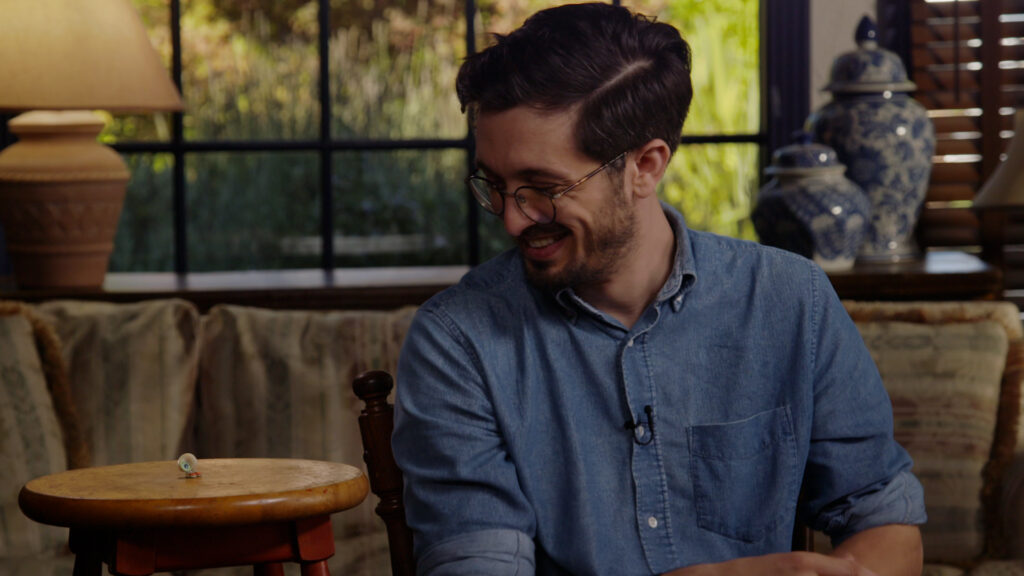
Marcel (voiced by Jenny Slate) and Dean Fleischer Camp in “Marcel the Shell With Shoes On” (Image courtesy of A24)

“Marcel the Shell With Shoes On” could have been an excessively cute film about tiny sea shells with human-like characteristics, but this unique movie is an offbeat charmer with an appealing mix of comedy and sentimentality about life and love. The movie has an artistic blend of live action and stop-motion animation that looks organic, not forced. And although there are some parts of the film that get repetitive and not all of the jokes land well, the positive aspects of “Marcel the Shell With Shoes On” far outnumber any of the movie’s small flaws. “Marcel the Shell With Shoes On” had its world premiere at the 2021 Telluride Film Festival and made the rounds at other film festivals, including South by Southwest (SXSW), the Seattle International Film Festival and the San Francisco International Film Festival.

The origin story of “Marcel the Shell With Shoes On” is self-referenced throughout the movie, which has a plot that’s similar to how the movie’s title character first became an international sensation. In real life, filmmaker Dean Fleischer Camp and actress Jenny Slate did a series of short comedy videos called “Marcel the Shell With Shoes On,” beginning in 2010. In these videos, Slate voiced the character of Marcel, a talkative one-inch sea shell with one eye, human feet and a wryly observant and inquisitive view of life. Based on the way that Marcel talks, he has the intelligence and emotional maturity of a human boy who’s about 9 or 10 years old.

These videos about Marcel became a worldwide hit on the Internet and inspired children’s books written by Slate and Flesicher Camp. And now, there’s an entire movie about Marcel. The feature film “Marcel the Shell With Shoes On,” directed by Fleischer Camp (who co-wrote the movie’s screenplay with Slate and Nick Paley) takes viewers on Marcel’s often-emotional journey to find his missing family members. Marcel lives in a middle-class house somewhere in Los Angeles, where the unmarried human couple named Larissa (played by Rosa Salazar) and Mark (played by Thomas Mann), who previously occupied the house, had a bitter breakup. The house is now being used as an Airbnb rental.

Marcel’s wise and practical grandmother Connie (voiced by Isabella Rossellini) is Marcel’s only family member who hasn’t gone missing. Among the those who have gone missing in Marcel’s family (they are all one-eyed small shells with feet) are Marcel’s parents Mario and Connie and Marcel’s brother Justin. What bothers Marcel and Connie the most is that they didn’t have a chance to say goodbye, and they have no idea where the other family members went. Marcel and Connie have photos and illustrations of their family members as visual mementos.

Marcel and Connie have a very close relationship. She often teaches Marcel things about life, often in answer to Marcel’s seemingly endless stream of questions. Connie and Marcel also love to watch “60 Minutes” together and are big fans of “60 Minutes” correspondent Lesley Stahl. Marcel describes Connie as very independent and resourceful. For example, Marcel says that Connie taught herself how to farm. Connie also loves to garden and spends a lot of her time in the home’s garden.

At times, Marcel has a childlike wonder and curiosity about the modern world. Other times, he has a simple clarity about how to react to difficulties or problems because he doesn’t have as much emotional baggage or insecurity as someone who is an adult. Throughout the movie, there are whimsical moments and more serious moments where Marcel’s personality and quirks get various reactions to those around him.

In the beginning of the movie, Marcel says that he and Connie are living by themselves in the house, along with their pet lint named Alan. Their solitude ends when an Airbnb renter moves into the house with his white terrier mix dog named Arthur. He’s a mild-mannered filmmaker named Dean Fleischer-Camp (playing a version of himself), who needs a new place to stay because he has recently separated from his wife. In a case of art imitating life, Slate and Fleischer Camp (who used to spell his surname as Fleischer-Camp) got married in 2012 and then got divorced in 2016.

As expected, Marcel is curious about the house’s new human resident, and the feeling is mutual. It takes Marcel much longer to get used to Arthur, Dean’s dog, since Marcel is sometimes annoyed by how the dog smells and keeps interrupting Marcel like a curious and playful dog would do. Marcel shows Dean around the house, including the potted plant where Marcel sleeps on a slice of bread. Marcel describes where he sleeps as his “breadroom.”

Marcel might seem like a precocious child, but he doesn’t know a lot about modern technology. Dean tells Marcel that he’s making an online documentary. Marcel’s response is “Online? You lost me.” Eventually, Dean shows Marcel how the Internet works when Dean begins posting videos of Marcel online. The videos become an international sensation, with Marcel developing a huge fan base. (Sound familiar?)

Marcel is overwhelmed and often flabbergasted by all this newfound attention. However, he thinks it can be put to good use when he asks Dean to help get the word out about Marcel’s missing family members. You can easily predict which TV news show might get involved. Someone who doesn’t really want to get too caught up in the fanfare is Connie, who is very skeptical of the Internet and all modern technology.

The first third of “Marcel the Shell With the Shoes On” seems like a series of skits weaved together, with a lot of wisecracking remarks from Marcel, as he and Dean start to get to know each other and eventually become friends. The other two-thirds of the movie begin to have more substance when the story focuses more on the search for Marcel’s family members. The movie has themes of love, heartbreak and grief that are handled with sensitivity without being mawkish.

For example, Marcel begins to notice after a while that Dean is very curious about Marcel, but Dean is very reluctant to talk about himself. And it’s not just because Dean wants to be an journalistic documentarian. Dean is having difficulty processing the breakup of his marriage. Dean’s preoccupation with Marcel’s problems are a way for him to cope with or avoid his own personal problems.

The movie doesn’t fully show Dean on camera until a pivotal part of the story when he’s essentially forced to talk about himself. It’s a clever way that the movie has Dean “coming out of the shadows” that reflect his own willingness to be open up more about himself and show more vulnerability. Fleischer Camp gives a solid performance, but the character of Dean seems to know that Marcel is the real star of the show.

“Marcel the Shell With Shoes On” has terrific voice work from Slate and Rossellini, who make an endearing and believable duo as a grandparent and grandchild. Connie isn’t a new character, but this movie is the first time that Connie gets her own backstory and story arc. Not everything in “Marcel the Shell With Shoes On” is comedic, since the movie has some tearjerking moments that might catch some viewers by surprise. In a cinematic era when animated/live-action hybrid films are so focused on dazzling viewers with big adventures that are visual spectacles, it’s nice to have a movie like “Marcel the Shell With Shoes On” that focuses more on everyday emotional connections and appreciating loved ones during life’s ups and downs.

A24 will release “Marcel the Shell With Shoes On” in select U.S. cinemas on June 24, 2022, with an expansion to more U.S. cinemas on July 15, 2022.

Copyright 2017-2026 Culture Mix
CULTURE MIX