
Review: ‘Juliet & Romeo,’ starring Clara Rugaard, Jamie Ward, Jason Isaacs, Dan Fogler, Rebel Wilson, Rupert Everett and Derek Jacobi

May 9, 2025

by Carla Hay

Clara Rugaard and Jamie Ward in “Juliet & Romeo” (Photo courtesy of Briarcliff Entertainment)

“Juliet & Romeo”

Directed by Timothy Scott Bogart

Culture Representation: Taking place in the 1301, in Verona, Italy, the musical film “Juliet & Romeo” (based on the play “Romeo & Juliet”) features a predominantly white cast of characters (with some black people and Latin people) representing the working-class, middle-class and wealthy.

Culture Clash: A teenage boy and a teenage girl fall in love with each other, even though their families are feuding with each other. 

Culture Audience: “Juliet & Romeo” will appeal primarily to people who are fans of William Shakespeare’s “Romeo and Juliet” and the movie’s headliners, but this bland and muddled musical’s drastic change to the original story’s ending might be too much of a turnoff to many viewers.

A scene from “Juliet & Romeo.” Pictured from left to right: Sarah Lazzaro, Tayla Parx, Rupert Everett, Rebel Wilson, Clara Rugaard, Lidia Vitale, Jason Isaacs, Nicholas Podany, Max Parker and Zac Bellward. (Photo courtesy of Briarcliff Entertainment)

“Juliet & Romeo” is a musical with forgettable songs, a romance with no sizzle, and an ending with a terrible revision and tone-deaf announcement about an unwanted sequel. Everyone in this misguided flop looks like they’re doing Renaissance Faire cosplay. Without question, “Juliet & Romeo” will be ranked as one of the worst “Romeo and Juliet” movie adaptations of all time. The movie is supposed to take place in Verona, Italy, in 1301, but it looks and sounds like a Hollywood throwaway musical from 2001.

Written and directed by Timothy Scott Bogart, “Juliet & Romeo” (which takes place over the course of four days) is such a mind-numbing misfire, Juliet (played by Clara Rugaard) and Romeo (played by Jamie Ward) are only in a handful of scenes together. And when Romeo and Juliet are together, they spend most of their time being coy and talking about superfical nonsense. Not once do you believe that these two characters have such a deep connection and a burning passion for each other that they would literally die for each other, which is the famous ending of the “Romeo and Juliet” play that William Shakespeare wrote in the 1590s. And brace yourselves: Bogart has said in interviews that he conceived his “Juliet & Romeo” movies to be a trilogy.

The pop/rock songs in “Juliet & Romeo” aren’t completely terrible, mainly because talented people are singing the songs. Evan Kidd Bogart (Timothy Scott Bogart’s younger brother) and Justin Gray wrote the original songs for “Juliet & Romeo.” The problem with the songs is that they don’t have any catchy and memorable hooks. The lyrics are very bland and don’t add much to the story of Romeo and Juliet. These songs could be on any D-list pop album and you wouldn’t be able to tell that these songs were written for a movie about Romeo and Juliet.

The first scene of “Juliet & Romeo” is actually the funeral of Romeo and Juliet, who are shown embracing each other in a coffin. The funeral service is conducted by Friar Lawrence (played by Derek Jacobi), a clergyman who flip-flops during the story when it comes to his approval of Romeo and Juliet’s romance. The movie then flashes back to three days earlier and shows what happens during those three days and then shows the funeral that took place on the fourth day and what happened after the funeral.

While it’s possible that some people seeing this movie have never heard of the famous ending of “Romeo and Juliet,” by putting Romeo and Juliet’s funeral in the movie’s first scene, it ensures that this spoiler information is revealed from the start. It also shows that the filmmakers don’t have enough respect for the intended impact of the original ending of “Romeo and Juliet” because not only did they reveal this information too early in the movie, but they also used it as a cheap gimmick to fabricate a very different ending. This altered ending is as cringeworthy and superficial as the rest of the movie.

A great deal of the tragedy of “Romeo and Juliet” is because these two doomed lovers died mainly because their prominent Verona families are locked in a bitter feud and would not accept the couple’s relationship. Romeo comes from the Montague family, led by his parents Lord Montague (played by Jason Isaacs) and Lady Montague (played by Lidia Vitale), who are cold and domineering. Juliet comes from the Capulet family, led by her parents Lord Capulet (played by Rupert Everett) and Lady Capulet (played by Rebel Wilson), who are gregarious and manipulative.

Romeo also has a loyal adopted brother named Mercutio (played by Nicholas Podany), who was adopted as an orphan. Also in Romeo’s family is his cousin Benvolio (played by Max Parker), who doesn’t have a personality that stands out. Juliet has a hothead cousin named Tybalt (played by Ferdia Walsh-Peelo), who is constantly picking fights with Romeo. Expect to see many brawls and chase scenes on streets and in alleyways, as if this movie is confused and thinks it’s “West Side Story.”

Why are the Montagues and the Capulets feuding? Don’t expect this movie to give clear answers. There’s a lot of shouting and scheming about who’s going to be loyal to the government and who’s going to be loyal to the Pope. At one point, Lord Montague slaps Romeo hard in the face and snarls, “You stand with this family, or you stand alone, son.” Meanwhile, Juliet’s parents give her distress by arranging for her to be engaged to a count named Paris (played by Dennis Andres), whom she doesn’t know. Juliet finds out about this engagement before she’s even met Paris.

“Juliet & Romeo” spends way too much time on side characters. Juliet has a clique of female friends named Rosaline (played by Tayla Parx), Veronica (played by Martina Ortiz Luis) and Lilly (played by Quinn Scott Bogart) who are like a tame 1301 Verona version of the “Sex and the City” women. There’s even a “female empowerment” sextet song titled “The Mask I Wear,” where each of them gets a solo with Lady Capulet and a newly created character named Vesante (played by Ledisi), whose purpose just seems to be so Grammy-winning singer Ledisi could have a role in this movie. Too bad the song packs a punch like a limp wrist.

Mercutio is having a romance with Veronica, so the movie shows them on dates and the first time that they spend the night together. Rosaline had a thing going with Tybalt, but she loses interest in him because he’s too much of a jerk. Is this the Romeo and Juliet story, or is it a teen soap opera? And by the way: Romeo, Juliet and most of their friends in this movie look much older than the teenagers they are supposed to be.

Surprisingly, Walsh-Peelo (who’s arguably the most talented male singer in the “Juliet & Romeo” cast; see the 2016 movie “Sing Street” for proof) does not get any solo songs as Tybalt, the story’s chief villain. He’s only heard in the group song “Streets on Fire,” which also features Rugaard, Ward, Parx, Ledisi, Podany and Parker. It seems like such a waste of Walsh-Peelo’s musical talent.

Other characters in the movie include Juliet’s nurse from childhood (played by Sarah Lazzaro), who would be called a nanny in modern times, but her character is sidelined for the teen romances. There’s also an unnamed apothecary (played by Dan Fogler), who invents the fateful potion that is consumed by Romeo and Juliet. He is depicted in this movie as a “mad scientist” type who does experiments on rats. And if you waited your whole life to see this story’s friar and apothecary do a duet called “I Should Write This Down” in a musical, then “Juliet & Romeo” is the movie for you.

Juliet and Romeo meet when she is visiting Verona from France, where she has been living as a student. They flirt with each other, but she won’t tell him her name the first time that they meet. Later, when Romeo is getting chased in an alley fight by Tybalt and some of his cronies, Juliet grabs Romeo and kisses him so that his face can be obscured. We’re supposed to believe that the guys chasing Romeo suddenly forget what he’s wearing because they don’t notice Romeo kissing Juliet as Tybalt and his fighting pals run right past Romeo and Juliet.

When Juliet and Romeo kiss again in another scene, she says to him: “I can’t tell if your poetry is prose.” She pauses and says, “Poetry it is then,” as she leans into him to give him another kiss. Rugaard is a little more convincing than Ward at showing emotions, but Ward and Rugaard lack the necessary chemistry together to be believable as a legendary couple. Ward shows more passion in the fight scenes than the love scenes, which is not the way to do things in one of the most famous love stories of all time.

Some of the cast members in “Juliet & Romeo” were in Timothy Scott Bogart’s 2023 feature-film directorial debut “Spinning Gold,” a very flawed biopic of his father Neil Bogart, a record company executive who helped artists such as Kiss, Donna Summer and Parliament-Funkadelic become major stars. Parx, Fogler and Ledisi were in “Spinning Gold,” which had the cast members do their own singing when performing songs from famous artists. “Spinning Gold” and “Juliet & Romeo” have the same problems: good singing trapped in a movie with a bad screenplay and mishandled direction. And when a movie about Romeo and Juliet doesn’t have an authentic-looking romance, it’s doomed to fail.

Briarcliff Entertainment released “Juliet & Romeo” in U.S. cinemas on May 9, 2025.

Review: ‘Fitting In’ (2024), starring Maddie Ziegler, Emily Hampshire, Djouliet Amara and D’Pharaoh Woon-A-Tai

February 24, 2024

by Carla Hay

D’Pharaoh Woon-A-Tai and Maddie Ziegler in “Fitting In” (Photo courtesy of Blue Fox Entertainment)

“Fitting In” (2024)

Directed by Molly McGlynn

Culture Representation: Taking place in an unnamed city in Canada, the comedy/drama film “Fitting In” (which is semi-autobiographical story from writer/director Molly McGlynn) features a predominantly white cast of characters (with some African Americans and Latinos) representing the working-class and middle-class.

Culture Clash: A 16-year-old girl finds out that she has a rare gynecological condition called MRKH syndrome, where she can’t menstruate or conceive children, and she struggles with how to tell people who might be friends or intimate partners. 

Culture Audience: “Fitting In” will appeal primarily to people who are fans of star Maddie Ziegler and movies that take an empathetic look at reproductive issues that are rarely depicted in movies.
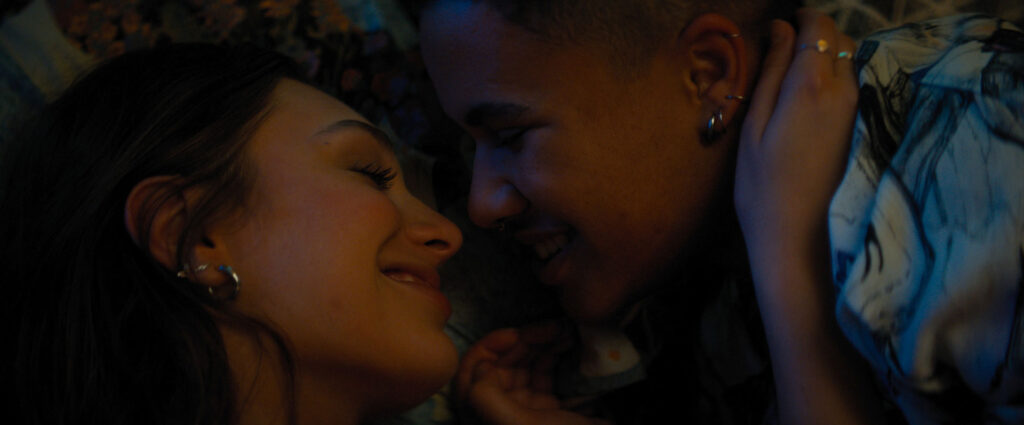
Maddie Ziegler and Ki Griffin in “Fitting In” (Photo courtesy of Blue Fox Entertainment)

The narrative of “Fitting In” occasionally wanders, but this comedy/drama has convincing performances in this coming-of-age story of a 16-year-old girl with a rare gynecological condition. It’s a unique movie with familiar views of teenage life. Because the movie’s story is based partially on the real-life experiences of “Fitting In” writer/director Molly McGlynn, “Fitting In” has a tone of authenticity that is complemented by the movie’s talented cast members.

“Fitting In” had its world premiere at the 2023 Toronto International Film Festival. McGlynn is a Canadian filmmaker. “Fitting In” takes place in an unnamed Canadian city and was actually filmed in Sudbury, Ontario. Although the movie takes place in Canada, it has situations and themes that are relatable to many cultures and the growing pains that teenagers experience.

“Fitting In” begins and ends with a scene of 16-year-old girl named Lindy (played by Maddie Ziegler) masturbating on her bed in her bedroom. By the end of the movie, she’s not quite the same person that she was in the beginning of the movie. That’s because by the end of the movie, she has already gotten the life-changing news that she has MRKH syndrome, a rare gynecological condition. Lindy has ovaries but no uterus, no cervix, and her vaginal canal is very stunted. She was born this way.

In the beginning of the movie, Lindy (who is an only child living with he divorced mother) thinks that she’s a typical teenager with typical teenage issues. She has a crush on a charismatic classmate named Adam (played by D’Pharaoh Woon-A-Tai), who is a popular athlete at their high school. Lindy, who is a virgin when the story begins, isn’t quite sure how much Adam likes her or is attracted to her, but he has definitely noticed her. In fact, when Lindy is first seen masturbating in the movie, she’s having a fantasy that she and Adam are having sex.

Lindy has a talkative best friend named Vivian (played by Djouliet Amara), who is gossipy about what other students are doing in their love lives. One day, Lindy and Vivian are talking about Adam and his most recent ex-girlfriend, who is another student named Karina. Lindy wonders out loud if Adam and Karina had sex when they were a couple. Vivian days that Adam and Karnina most likely had sex and Karina “does anal.”

Vivian and Lindy are both rising-star athletes on their school’s track team. Lindy has a harmless crush on their track coach, whose name is Coach Mike (played by Dennis Andres), a tattooed guy in his 30s. Lindy’s identity at school is wrapped up in being on the track team, but her outlook on life and who she is will change after she finds out that she has MRKH syndrome

Lindy hasn’t begun menstruating yet, but she thinks it’s because she’s late bloomer. She’s still embarrassed about not getting her menstrual period when it seems like all of her teenage girl peers have already developed in this way. Lindy pretends to Vivian and anyone else who might notice that Lindy has a menstrual cycle.

Lindy and Vivian happen to be in a drugstore together when they meet a classmate named Jax (played by Ki Griffin), who identifies as non-binary and uses the pronouns “they” and “them.” Jax is androgynous-looking and happens to be intersex, which means that Jax was born with male and female genital characteristics. Over time, Lindy and Jax get to know each other better. The movies shows whether or not Lindy and Jax confide in each other about their unusual biological conditions.

Meanwhile, a large part of “Fitting In” is about the sometimes-tense relationship between Lindy and her mother Rita (played by Emily Hampshire), a therapist who works from home and often does sessions with her clients through online videoconferencing. When Lindy and Rita argue, it’s usually because Lindy thinks Rita is being too meddling, while Rita thinks Lindy is being too standoffish with Rita. Lindy’s father abandoned Rita and Lindy when Lindy was very young, and he is no longer in their lives. Rita is neurotic and insecure about a lot of things: dating as a single mother, being rejected, and dealing with past trauma from her childhood.

Rita mentions that her own mother was difficult and “crazy,” which is why Rita tries so hard to have a good relationship with Lindy. Rita is in a situation that many mothers of teenage girls experience: As the teenage daughter approaches adulthood, the mother wants to have a balance of being an authoritative parent and being an understanding friend. It’s a balance that is often uneasy and often comes with misunderstandings and conflicts, as the teenage daughter wants more independence from a parent.

When Lindy tells Rita that Lindy still hasn’t developed a menstrual cycle, Rita immediately arranges for Lindy to go to a gynecologist named Dr. Aranda (played by Rhoslynne Bugay), who is professional and informative. Lindy and Rita find out at the same time in the doctor’s office that Lindy has MRKH syndrome. Rita bursts into tears. Lindy is in shock and is initially confused, until the knowledge starts to sink in that Lindy can never get pregnant or give birth.

“Fitting In” shows the fluidity of Lindy’s dating experiences, as three people end up getting sexually close to Lindy in various ways: Adam; a mild-mannered, fast-food worker named Chad (played by Dale Whibley); and Jax. “Fitting In” is mostly about Lindy’s journey in the weeks after she finds out about having MRKH syndrome. She goes through a myriad of emotions that Ziegler expresses realisitically. The supporting cast members, especially Hampshire, Woon-A-Tai and Griffin also handle their roles with aplomb.

Aside from issues about her reproductive health, Lindy’s diagnosis MRKH syndrome also affects her sexual health. She is given medical dildos by a nurse named Lisa (played by Emma Hunter), who tells Lindy that it will take about three to 18 months of using these dildos to create a vaginal opening that looks “normal.” Lisa tactlessly tells Lindy about using these dildos to make Lindy’s vagina bigger: “You’re an athlete, right? Think of it like training or vagina boot camp.” Lindy also has visits with another gynecologist named Dr. Doheny (played by Michael Therriault), who is less compassionate than Lisa.

“Fitting In” has typical scenes of teenage parties, where some of the drama happens in Lindy’s love life. She also has an awkward experience when her gynecologist recommends that she go to a support-group meeting for people who identify as LGBTQIA2S+ (lesbian, gay, bisexual, transgender, queer/questioning, intersex, asexual, or two-spirit), where Jax is a regular attendee. Lindy grapples with shame, defiance, anger and acceptance about her condition. Ultimately, “Fitting In” tells a sometimes-serious, sometimes-amusing story that allows viewers to think about how much or if reproductive organs should define the essence of who people are.

Blue Fox Entertainment released “Fitting In” in select U.S. cinemas on February 2, 2024.

Copyright 2017-2025 Culture Mix
CULTURE MIX