
Review: ‘Tere Ishk Mein,’ starring Dhanush and Kriti Sanon

November 28, 2025

by Carla Hay

Kriti Sanon and Dhanush in “Tere Ishk Mein” (Photo courtesy of AA Films)

“Tere Ishk Mein”

Directed by Aanand L. Rai

Telugu with subtitles

Culture Representation: Taking place in India, primarily in Delhi, the dramatic film film “Tere Ishk Mein” (a “spiritual sequel” to 2013 movie “Raanjhanaa”) features an all-Asian cast of characters representing the working-class, middle-class and wealthy.

Culture Clash: A lieutenant pilot in the Indian Air Force has a turbulent and disturbing past romance with the psychotherapist who has been assigned to counsel him, and their shared history has disastrous consequences in both of their current lives.

Culture Audience: “Tere Ishk Mein” will appeal primarily to people who are fans of the movie’s headliners, “Raanjhanaa,” and trashy movies where abuse is made to look romantic.

Dhanush and Kriti Sanon in “Tere Ishk Mein” (Photo courtesy of AA Films)

“Tere Ishk Mein” has a very off-putting way of glorifying a toxic relationship between two obsessive lovers. This nasty drama tries to make a violent man into a romantic hero when he causes destruction and makes suicide threats. That’s abuse, not true love. The woman in the relationship can’t be completely absolved either, because she’s the very definition of a co-dependent enabler who mistakes unhealthy dysfunction for passion.

Directed by Aanand L. Rai, “Tere Ishk Mein” (which means “In Your Love” in Hindi) was written by Himanshu Sharma and Neeraj Yadav. “Tere Isk Mein” has been described as a “spiritual sequel” to the 2013 dramatic movie “Raanjhanaa,” which was directed by Rai and written by Sharma. The things that these two movies have in common are they are Indian movies with a love triangle that ends badly; the two rival men in the love triangle have the names Shankar and Jasjeet (although they are completely different characters in each movie); and Dhanush stars as the Shankar character. Shankar is the last name of the main character in “Raanjhanaa,” while Shankar is the first name of the main character in “Tere Ishk Mein.”

“Tere Ishk Mein” begins by showing Indian Air Force lieutenant pilot Shankar Gurukkal (played by Dhanush) participating in a combat defense against Chinese military fighters who have attacked about 25 Indian military bases. Shankar is a very skilled pilot (he’s technically considered to be the best on his team), but he’s an impulsive hothead who has difficulty obeying authority figures. Not surprisingly, Shankar doesn’t follow orders during this combat mission.

Shankar is punished for this insubordination by Captain V. Shekhawat (played by Vineet Kumar, also known as Vineet Kumar Singh), who is the group’s commanding officer. Shankar gets a suspension, which includes being “grounded” from flying until further notice. A few of Shankar’s colleagues object to this punishment by telling Captain Shekhawat that Shankar is the most important and most talented pilot on their team. Captain Shekhawat is unmoved and orders Shankar to appear before a disciplinary committee and undergo a psychiatric evaluation during this suspension.

A psychiatric evaluation seems like an extreme way of dealing with this problem. But as time goes on, it’s obvious that something is seriously wrong with Shankar, who at the very least has an anger management problem and probably has an undiagnosed mental illness. But sometimes, mental illness can’t be used as excuse. Some people are just self-hating, troublemaking bullies who take their rage out on other people. By all indications, Shankar is this type of bully.

Shankar is upset over being suspended. But he gets even more upset when he sees who will be the psychotherapist doing his evaluation. Her name is Mukti Beniwal (played by Kriti Sanon), and she’s his ex-girlfriend. Seven years ago, Mukti and Shankar had a very bitter breakup. She is now married to someone else and is about eight or nine months pregnant.

When Shankar and Mukti see each other in an office meeting, and she’s introduced to him as his evaluating psychotherapist, it’s the first time that these two ex-lovers have seen each other in quite some time. Before this meeting, Mukti knew in advance that Shankar would be the person she had to evaluate. In fact, she insisted that she would be the one to do the evaluation. However, Shankar is blindsided and didn’t expect his psychotherapist would be Mukti.

Shankar and Mukti get teary-eyed with they see each other. Shankar is so troubled by seeing her again, he says out loud that he feels like vomiting, and he quickly excuses himself from the office. As he runs outside, he starts having memories of his life and how it was affected by knowing Mukti.

“Tere Ishk Mein” (which jumps back and forth in time) then goes into flashback mode to seven years earlier, when Shankar and Mukti had their whirlwind romance in Delhi. At the time, Shankar was a student at the University of Delhi, where he was president of the Delhi University Students Union. Mukti was a Ph.D. candidate at the University of Delhi.

The first time that Shankar and Mukti meet, she is giving a presentation about violence and anger management in a lecture hall attended by students and faculty members. In her presentation, Mukti says that people with violent anger issues can be treated by getting compassionate evaluations done and by teaching them behavior modification. Ironically, Mukti will see how bad Shankar’s rage issues are when they meet for the first time.

At the same time that Mukti has been giving her presentation, Shankar has been furiously chasing another male student around campus and whipping him hard with a belt. It doesn’t matter what this student did to get Shankar angry. The student who is being attacked is defenseless, and this type of physical assault is heinous and illegal.

The student is bloody from his injuries and frantically runs into the lecture hall and sits down, to try and hide from Shankar. Unfortunately, Shankar finds him in the lecture hall and continues to beat the student with a belt. Mukti is horrified and yells at Shankar to stop.

Mukti goes up to Shankar to hit him, as a way to stop the attack. Shankar grabs Mukti’s upraised hand. For a few seconds, their eyes meet. And the movie makes it obvious that Shanka and Mukti are instantly attracted to each other. Shankar then takes Mukti’s hand so that she can lightly slap him on the face. He smirks, and then he walks away. He is soon apprehended by the campus police.

Most people with any ounce of self-respect and decency would be turned off and offended by this disgusting brute. But not Mukti. She is intrigued. She wants to get to know Shankar better. The next few times that Mukti and Shankar see each other, they play flirtatious mind games with each other. Shankar is actually very rude to her.

However, Mukti wants to “study” Shankar for her anger management thesis. She asks him out on a date, which she insists will be strictly platonic and for “research purposes.” Well, you know that’s a lie because she’s been attracted to him from the moment she first saw him, even though she knows he’s a violent abuser. Shankar and Mukti “fall in love.”

But in a trashy melodrama like “Tere Ishk Mein,” this young couple has a stereotypical obstacle: a disapproving parent. In this case, it’s Mukti’s father Yashwant Beniwal (played by Tota Roy Chowdhury), who thinks Shankar is bad for Mukti and unsuitable for anyone who wants a stable and loving partner. (Yashwant is absolutely correct.) Yashwant also disapproves of Shankar because Shankar is in a lower caste.

Even though Shankar is an awful person, he has some loyal supporters. His biggest supporter is his widowed father Raghav Gurukkal (who Prakash Raj), who overlooks and is in denial about Shankar’s serious rage that has caused Shankar to commit violent crimes. In other words, Raghav is an enabler who’s part of the problem.

Shankar also has a best friend named Ved (played by Priyanshu Painyuli), whose only purpose in the movie is to be an unquestioning sidekick to Shankar. Ved is such a sycophant imitator, he does the same activities that Shankar does, including joining the Indian Air Force at the same time as Shankar. Ved needs to get a life, a backbone, and his own identity that’s separate from a loser like Shankar.

The only reason why Shankar joins the Indian Air Force is because of an argument that he had with Yashwant, who refused to give his blessing for Shankar and Mukti to get married. In the argument, Shankar told Yashwant that he would prove to Yashwant that Shankar is worthy of being Mukti’s husband by passing the Union Public Service Commission (UPSC) test, a national-level exam in India that qualifies people to work in various civil service jobs.

Shankar works hard to pass the exam. He joins the Indian Air Force. And for the first three years in the Indian Air Force, Shankar thinks Mukti will wait for him until he gets enough Air Force respectability for her father to give his blessing for Shankar and Muti to get married. But there would be no “Tere Ishk Mein” movie if things were going to be that easy.

Mukti doesn’t wait for Shankar. She moves on to having a relationship with a man named Jasjeet (played by Paramvir Singh Cheema), whom she first met when they were grad students at the University of Delhi. Jasjeet was a biochemistry student, but he eventually becomes a pilot in the Indian Navy. Jasjeet is a typical “nice guy” who was Mukti’s longtime platonic friend who had a crush on her. She finally decided to let their relationship become romantic, and they get engaged. Mukti’s father approves of Jasjeet.

However, Mukti is not “in love” with Jasjeet in the way that she’s “in love” with Shankar. At the engagement party for Mukti and Jasjeet (which is held outdoors at Jasjeet’s home), Mukti gives forced smiles and a half-hearted speech where she says that sometimes the person you’re meant to marry has been there all along as a friend. In other words: “I’m settling for someone who is safe but boring because I can’t be with the unstable person I think is more exciting.”

Here’s the part of “Tere Ishk Mein” where Shankar’s unhinged abusiveness becomes irredeemable, although the movie tries very hard to make it look excusable: When Shankar finds out that Mukti is engaged to another man, Shankar not only crashes the engagement party, but he also throws Molotov cocktails to literally burn the party to the ground. Mukti’s house is one of the things that gets destroyed by the fire. During this rampage, Shankar also abusively yells at Mukti for “betraying” him.

Luckily, no one was killed or injured during this vile arson. But who in their right mind thinks this violence is attractive, romantic and sexy? Only people who have no idea what healthy love is. If you hear anyone describe this garbage movie as showing a “great romance,” tell them to go get counseling, because chances are, they have a messed-up perspective of what true love is.

Shankar is arrested for the arson. But that’s not the end of his stalking. As already shown in the movie’s trailer, Shankar also shows up uninvited to Mukti’s wedding to Jasjeet, who marries Mukti, even though she confesses to him during their engagement that she’s still obsessed with Shankar. At the wedding reception, Shankar angrily pours so-called holy water on Mukti’s head, so that she can be “cleansed” for being so “sinful.” It’s a degrading act that is completely excused in this horrible movie.

In addition to being a violent monster, Shankar often threatens to commit suicide, in order to manipulate people to do what he wants. It’s one of the most common tactics used by the worst and most manipulative abusers. Shankar experiences a tragedy soon after his arsonist meltdown at Mukti’s engagement party. It’s just the movie’s pathetic way of trying to make viewers feel sorry for Shankar. And if you look at the circumstances of the tragedy, this tragedy wouldn’t have happened if it weren’t for Shankar’s drunken selfishness.

Shankar shouldn’t get all the blame for this disastrous relationship from hell. Mukti is also responsible for her own misery by fixating on this tormentor, who is so obviously damaging to himself and others and is unwilling to change, he is no way suitable to be anyone’s love partner. Mukti also has no credibility as a psychotherapist, based on the bad judgment she has about Shankar, whom she pines over like a lovesick puppy. Mukti has her own moments of wallowing in alcohol and self-pity.

Far from being an uplifting film, “Tere Ishk Mein” is grim, depressing, and has a deeply warped view of romantic love. This long-winded 169-minute movie is also boring and repetitive drudgery to sit through, with too many extensive scenes of hostile Shankar and co-dependent Mukti moping around because they’re not together. The acting in this movie ranges from average to unwatchably terrible.

Perhaps the only good thing about “Tere Ishk Mein” is the musical score by Oscar-winning composer A. R. Rahman, but the music is wasted on this heinous movie. Since winning two Oscars (Best Original Score and Best Original Song) for 2008’s “Slumdog Millionaire,” Rahman has done music scores for many bad movies, so his name alone does not guarantee that a movie will be high-quality. Anyone who denies that “Tere Ishk Mein” is a poorly veiled attempt to make abuse look romantic should be ashamed of themselves.

If you think Mukti and Shankar have a wonderful love story, and if you think “Tere Ishk Mein” is an admirable movie, then please rethink your values and how you might condone abuse when it shouldn’t be condoned. And if you care about the types of movies you want to support, then don’t waste any time or money supporting this junkpile repulsive movie that wants to make this horrendous abuse look acceptable and tries to make an abuser look like a martyr.

AA Films released “Tere Ishk Mein” in select U.S. cinemas and in India on November 28, 2025.

Review: ‘Kuberaa,’ starring Dhanush, Nagarjuna, Rashmika Mandanna, Jim Sarbh and Dalip Tahil

June 20, 2025

by Carla Hay

Dhanush and Rashmika Mandanna in “Kuberaa” (Photo courtesy of Pratyangira Cinemas)

“Kuberaa”

Directed by Abishan Jeevinth

Telugu or Tamil and some Hindi with subtitles

Culture Representation: Taking place in the Indian cities of Mumbai, Delhi, and Tirupati, the action film “Kuberaa” features an all-Asian cast of characters representing the working-class, middle-class and wealthy.

Culture Clash: A ruthless business mogul and a corrupt former Central Bureau of Investigation agent to recruit unsuspecting beggars to commit financial fraud, but one of the beggars escapes and has to run for his life before it’s too late. 

Culture Audience: “Kuberaa” will appeal primarily to people who are fans of the movie’s headliners and tension-filled thrillers about the intersections of wealth, greed and poverty.

Nagarjuna and Saurav Khurana in “Kuberaa” (Photo courtesy of Pratyangira Cinemas)

“Kuberaa” is a wild and suspenseful crime thriller about corrupt officials using homeless beggars to do dirty deeds in a massive fraud scheme. Some of the action scenes are far-fetched, but the movie has some satire and sharp commentary about classism. Even though there’s some deadly violence in the movie, “Kuberaa” still has moments of comedy relief without bungling these tonal shifts.

Directed by Sekhar Kammula, “Kuberaa” was co-written by Chaithanya Pingali and Kammula. The movie takes place primarily in Mumbai, India, where “Kuberaa” was filmed on location. “Kuberaa” is a non-stop ride that keeps viewers on edge about what will happen next. The movie is also a study in contrasts between the extremely wealthy and the desperately poor.

“Kuberaa” begins by showing an oil rigger discovering 14 trillion cubic tons of oil reserve in the Indian Ocean. Neeraj Mithra (played by Jim Sarbh)—the extremely wealthy, greedy and ruthless CEO of Global Enterprise—hatches a plan to blow up the oil rigger and seize control of this extremely valuable oil reserve. The explosion of the oil rigger is a distraction to make the area look unsafe so that Global Enterprise can swoop in and mine the oil reserve area. Neeraj’s unnamed father (played by Dalip Tahil) reluctantly approves of this plan but warns Neeraj that it’s a risky plan and he has to be careful about not getting caught.

Neeraj uses the fortune from this newfound oil reserve to bribe certain lawmakers and politicians. Neeraj also decides to launder the money fortune that he’s gotten and find a way to do wire transfers without the transactions being traced back to him. One day, Neeraj sees homeless beggars on the street and comes up with the idea of recruiting beggars, giving them makeovers, and having them pretend to be business people to do the wire transfers.

Neeraj doesn’t want to do the dirty work himself. Instead, he decides to enlist the help of Deepak Tej (played by Nagarjuna), a former Central Bureau of Investigation (CBI) officer, who is in prison on corruption charges. Deepak has maintained that he is not guilty of the charges and is in the process of appealing his case. Neeraj tells Deepak that he can get Deepak out of prison if Deepak works with Neeraj, who expects unwavering loyalty in return.

Deepak’s wife Shilpa (played by Sunaina) believes in and supports Deepak’s fight to prove Deepak’s did not commit the crimes he’s been accused of committing. Deepak is anxious to get out of prison so he can be reunited with Shilpa and their underage daughter, which is why he agrees to work with Neeraj. Neeraj tells Deepak about the plan to use homeless people to commit financial fraud. Deepak reluctantly goes along with the plan and only agrees to it because he thinks that violence won’t be involved. Deepak is very wrong about that assumption.

Neeraj has a group of thugs working for him. The most vicious of these thugs is Robo (played by Saurav Khurana), who is later shown to be a sadist and a misogynist who sexually abuses women. Neeraj puts Deepak in charge of Robo and the thugs to do what is necessary if things get rough. Deepak often has to scold Robo for going too far in being violent when Robo inevitably roughs up people during Robo’s cruel bullying.

Four homeless beggars are chosen as unwitting perpetrators of this fraud. All of the, are in their late 20s or 30s. The one who is a main character in the story is naïve, kind and uneducated Deva (played Dhanush), who spent most of his childhood as an orphan. As an adolescent, Deva ran away from the foster care system after he was the victim of human trafficking. He has been living on the streets ever since.

The three other homeless people who’ve been recruited are Kehlu, a duplicitous thief; Debya, an immigrant from Nepal; and Khushboo, an unmarried pregnant woman. Under the direction of Deepak, all four vagrants undergo makeovers and learn how to act like business people so that they can convincingly do wire transfers of large funds without arousing suspicions.

Deepak treats these recruits with kindness and respect. The same can’t be said for Robo, who doesn’t hesitate to bully the recruits any chance that he gets, Robo has an extreme hated of homeless people who beg on the streets. He openly calls them scum and the lowest forms of human beings.

Neeraj has no intention of letting these recruits live after they fulfill his purpose to complete the transaction. Robo has been selected as the one who will murder the recruits. Deepak and Deva eventually find out about these deadly plans. Deepak objects to the recruits being murdered, but Neeraj orders Deepak to stay loyal to Neeraj by threatening Deepak with sending Deepak back to prison and making Deepak’s family destitute.

As already revealed in the “Kuberaa” trailer, Deva escapes from the compound. An enraged Neeraj orders Deepak to find Deva. Much of the movie is about Deva’s desperate attempts to hide and stay alive. Along the way, he meets a helpful young woman named Sameera (played by Rashmika Mandanna), who has her own personal issues.

Deva first encounters Sameera at a train station platform at night. She is heartbroken because a man she had hoped to elope with hasn’t show up at the train station, which is his way of breaking up with her. Deva is so exhausted and hungry, he faints on the platform. Sameera helps him regain consciousness and lets Deva borrow her phone.

The movie’s comedic moments happen because just when Sameera thinks she’s seen the last of Deva, he comes back into her life asking for more help. “Kuberaa” eventually shows if Sameera finds about how much danger Deva is in and who is looking for him. Sameera often gets impatient with Deva because he is very ignorant about many things, and she feels obligated to teach him.

“Kuberaa” would have enough story if it only focused on Sameera and Deva. However, the movie also takes a compelling look at the inner conflicts of Deepak, who is torn between his humane instincts to have mercy on Deva and between Deepak’s fear of what will happen if Deepak disobeys Neeraj. There are several times when Deepak is faced with a moral dillemma and he has to live with the consequences and guilt if he decides to do something that erodes his soul and humanity.

Neeraj is the mastermind of these horrific crimes and is the person giving the orders. And for that reason, Neeraj is the story’s chief villain. However, “Kuberaa” is really a tug of war between Deepak and Deva. Dhanush and Nagarjuna each give impressive performances as Deva and Deepak change during the course of the story. Credit should also be given to the screenplay for making Deva and Deepak fully formed people instead of two-dimensional characters.

Sarbh (as Neeraj) and Khurana (as Robo) give capable performances, as far as depicting two characters who are pure evil. Neeraj is the more dangerous villain because he has unchecked power and he’s fooled many people in the general public by presenting himself as a loving family man. Mandanna does an adequate job in her role as Sameera; her mannerisms are at times too exaggerated in attempts to be comedic. Beyond the action-packed scenes of chases and fights, “Kuberaa” has something meaningful to say about human beings’ real value that has nothing to do with money.

Prathyangira Cinemas released “Kuberaa” in select U.S. cinemas and in India on June 20, 2025.

Review: ‘Vaathi,’ starring Dhanush, Samuthirakani and Samyuktha

February 25, 2023

by Carla Hay
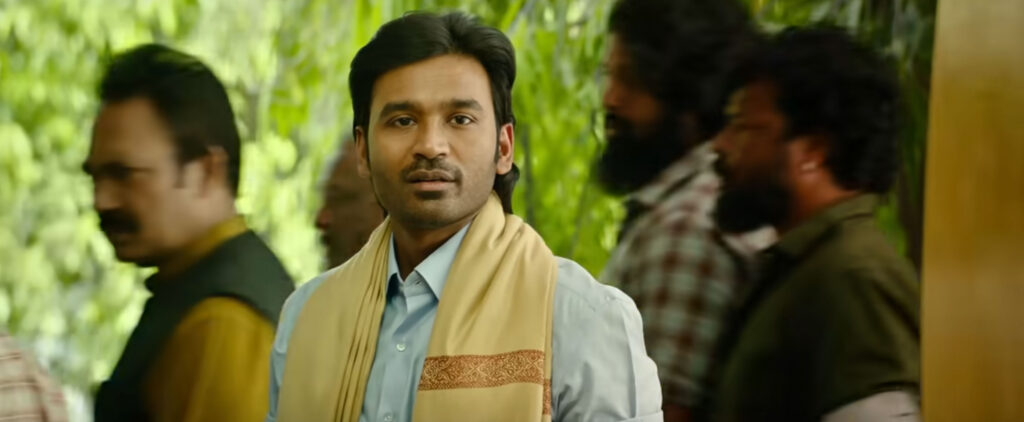
Dhanush in “Vaathi” (Photo courtesy of Sithara Entertainments)

“Vaathi”

Directed by Venky Atluri

Tamil and Telugu with subtitles

Culture Representation: Taking place in India, mostly in the 1990s, the dramatic film “Vaathi” features an all-Indian cast of characters representing the working-class and middle-class.

Culture Clash: After a greedy businessman manipulates the educational system so that schoolteachers from government-run schools are sent to his private school system, a dedicated teacher goes against the rules to teach students who can’t afford a private education. 

Culture Audience: “Vaathi” will appeal primarily to people who are interested in watching movies about inspirational schoolteachers, even if some of the scenarios are very exaggerated for dramatic purposes.

Samuthirakani and Dhanush in “Vaathi” (Photo courtesy of Sithara Entertainments)


[Editor’s note: “Vaathi” was filmed in the languages of Tamil and Telugu. The Tamil title of the movie is “Vaathi,” while the Telugu title of the movie is “Sir.” A few of the movie’s characters have different names, depending on the language. This reviewer saw the movie in the Tamil language, so the review will have the characters names that were in the Tamil version of the movie.]

“Vaathi” tells a sentimental story that takes a searing look at how the debate over government-funded education versus private education in India affects those who are financially disadvantaged. The movie shows how one person can make a positive difference. With a total running time of 148 minutes, the movie is a little too long, and there are some unnecessary and unrealistic action fight scenes, but the movie’s overall message and how the story is told is mostly watchable and entertaining.

Written and directed by Venky Atluri, “Vaathi” takes place mostly in the 1990s, but the movie begins in the early 2020s. Three guys in their late teens have traveled from Vellore to visit a district collector. They find out that his name is A. M. Kumar (played by Sumanth), who has a story to tell these teenagers. (In the Telugu version of the movie, this character’s name is A. S. Murthy.) A.M. Kumar has a photo hanging up on the wall of an influential schoolteacher, who has become somewhat of legend in A.M.’s small hometown village of Sozhavaram. (In the Telugu version of the movie, A.S. Murthy’s hometown is Siripuram.)

The movie then flashes back to the 1990s, to show the story from the perspective of this schoolteacher. In the Tamil version of the movie, his name is Bala Balamurugan. In the Telugu version of the movie, his name is Bala Gangadhar Thilak. (Dhanush has the role of Bala.) Bala is passionate about teaching and has a strong belief that education should be a right, not a privilege reserved only for those who can afford it.

A brief introduction in “Vaathi” explains that in 1990, the privatization of much of India’s economy led to many government-run schools being shut down and more schools becoming privately owned businesses. Teachers at these shuttered government schools were often transferred to the private schools, with the transferred teachers often making less money than what they were paid working for government-run schools. Meanwhile, depending on the area, private schools raise their tuitions, making education available only to those who can afford it.

The poorest of the poor can’t afford to pay any tuition for education. It’s an inequality that Bala finds very hard to accept. He becomes a teacher who is transferred from a government-run school to a private high school that is part of the Thirupathi Teaching Center, which is owned by a ruthless and greedy businessman named Thirupathi (played by Samuthirakani), who has an elitist and disrespectful attitude toward people who are working-class and poor. (In the Telugu version of the movie, the corrupt businessman’s name is Tripathi.)

Bala (who teaches mathematics) arrives at the school with two male co-workers who are also his friends: Prakash Reddy (played by Sha Ra), who is a physics teacher, has a friendly and easygoing personality. Karthik (played Hyper Aadi), who is a chemistry teacher, has a socially awkward and goofy personality. One of the first people they meet at this school is a pretty woman named Meenakshi (played by Samyuktha), who is a biology teacher.

All three men are immediately attracted to Meenakshi. The movie wastes some time with the three pals arguing about who will get to date her, even though it’s obvious to viewers which one of the friends will end up with Meenakshi. Karthik bungles his attempts to court her when he makes a pass at her that Meenakshi thinks is offensive. Karthik makes a sheepish apology and says this pass was just a “romantic gesture.”

One of the students at the school is named Muthu (played by Ken Karunas), whose parents tragically committed suicide. Muthu wears a leg brace and is often teased or bullied by other students about it. As a result, Muthu often has low self-esteem. Bala takes an interest in helping Muthu in many ways, including boosting Muthu’s confidence.

Bala spends a lot of time trying to convince the low-income villagers to send their underage children to this school. He gets a lot of resistance from the villagers who need their children to work for money instead of getting a school education. The children of low-income villagers who go to the school get treated as inferior by the students from families with higher incomes. Bala notices this discrimination and he figures out a way to stop it in his classroom.

But there’s a big problem looming: Thirupathi wants to raise the school’s tuition. And he doesn’t care if many people in the village won’t be able to afford this higher tuition. Bala gets in many conflicts with Thirupathi over this tuition increase, because Bala knows that many of the school’s students will have to drop out.

The school’s headmaster Thanigachalam (played by Tanikella Bharani) is at the mercy of Thirupathi. The village president (played P. Sai Kumar) also can’t do much to about Thirupathi and seems to be intimidated by this money-hungry businessman. Bala is the only one who seems to be standing up to Thirupathi the most and advocating for the children to get an affordable education.

Thirupathi won’t back down from the tuition increase. Bala knows that he is about to be fired, so he takes matters into his own hands and quits to start his own free “school” for the students who can’t afford Thirupathi’s tuition. Bala’s “school” is really just an outdoor gathering of students underneath a makeshift shelter outside of the village’s border.

Of course, Thirupathi doesn’t like Bala’s act of resistance one bit. He sends several thugs to cause some damage to the makeshift school and physically assault Bala. (None of this is spoiler information, since it’s shown in the movie’s trailer.) It starts a “war” between Bala and Thirupathi, with the students siding with Bala.

Most of “Vaathi” is about the conflicts between Bala and Thirupathi, but there’s also some romance, as Bala and Meenakshi become closer. She starts to fall in love with him after she sees how he treats all of his students with compassion and fairness. Bala is the type of teacher who leads by example.

“Vaathi” is filled to the brim with positive messages about how important education and good teachers are, but the movie sometimes goes overboard in making Bala look too good to be true. In his over-the-top fight scenes, he turns into a skilled action here who can take on and often defeat several men at once. He is almost saint-like as a teacher. Even when he is captured and tortured (already revealed in the movie’s trailer), he looks like a martyr.

However, the movie makes Bala more human when he has some moments of doubt and insecurity. He often gets advice from his supportive father (played by Aadukalam Naren), who’s a taxi driver. When Thirupathi goes on a derogatory rant to Bala about people who are poor or lower-middle-class, Bala says he comes from a lower-middle-class family and is proud of it. Thirupathi stammers a little and tries to backtrack from his insulting comments, but it’s obvious that he’s embarrassed that Bala has called him out for being a bigot.

Overall, “Vaathi” has acting that ranges from mediocre to above-average. The movie sometimes gets repetitious and a little dull. But aside from the phony-looking action scenes, there’s much about “Bala” that rings true when it comes to the battles that teachers have to experience when they want to educate underprivileged students who are being prevented from having the same access and resources as more privileged students. “Vaathi” is ultimately a love letter to underpaid and dedicated teachers who persist and make a positive impact on their students’ lives, despite the challenges and odds stacked against these teachers.

Sithara Entertainments released “Vaathi” (also titled “Sir”) in select U.S. cinemas and in India on February 17, 2023.

Copyright 2017-2026 Culture Mix
CULTURE MIX