
Review: ‘There’s Still Tomorrow,’ starring Paola Cortellesi, Valerio Mastandrea, Emanuela Fanelli, Giorgio Colangeli and Vinicio Marchioni

March 12, 2025

Carla Hay

Paola Cortellesi in “There’s Still Tomorrow” (Photo courtesy of Greenwich Entertainment)

“There’s Still Tomorrow”

Directed by Paola Cortellesi

Italian with subtitles

Culture Representation: Taking place in Rome, from May to June 1946, the dramatic film “There’s Still Tomorrow” features a predominantly white cast of characters (with a few African Americans) representing the working-class, middle-class and wealthy.

Culture Clash: An abused housewife tries to get independence wherever she can around the same time that she gets a chance to exercise her right to vote.

Culture Audience: “There’s Still Tomorrow” will appeal mainly to people who are interested movies about feminism and civil rights during a time in a nation’s history when women gained the right to vote.

Pictured clockwise, from upper left: Paola Cortellesi, Romana Maggiora Vergano, Valerio Mastandrea, Mattia Baldo, Gianmarco Filippini and Giorgio Colangeli in “There’s Still Tomorrow” (Photo courtesy of Greenwich Entertainment)

“There’s Still Tomorrow” is an absorbing drama that draws parallels between personal freedoms and voting rights, as told from an oppressed woman’s perspective in 1946. The movie’s touches of comedy work well in what is otherwise serious subject matter. The cast members give very good performances that make their characters believable, although some of the droll comedy might not be to some viewers’ liking.

Paola Cortellesi, who stars in the movie, makes her feature-film directorial debut with “There’s Still Tomorrow,” which Cortellesi co-wrote with Furio Andreotti and Giulia Calenda. “There’s Still Tomorrow” (which is entirely in black and white) had its world premiere at the 2023 Rome Film Festival. “There’s Still Tomorrow” takes place in Rome, from May to June 1946, and is told in mostly chronological order, with a few flashbacks.

The protagonist of “There’s Still Tomorrow” is a homemaker named Delia (played by Cortellesi), who makes some money by doing limited part-time work in the neighborhood, such as being a seamstress and doing home care assistance. The home care assistance includes doing laundry and injecting patients with medicine in places on their bodies where they can’t reach.

Delia is trapped in a terrible marriage where her husband Ivano (played by Valerio Mastandrea) physically, verbally and emotionally abuses Delia. Divorce isn’t really an option for someone like Delia in 1946. Divorce is taboo and too expensive for this working-class Roman Catholic family.

Delia and Ivano live with four other family members: Ivano’s disabled father Ottorino (played by Giorgio Colangeli) and the couple’s three children: outspoken Marcella (played by Romana Maggiora Vergano) is about 18 or 19; mischievous Sergius (played by Mattia Baldo) is about 11 or 12; and playful Franchino (played by Gianmarco Filippini) is about 7 or 8. Delia is the caretaker for Ottorino, who is frequently bedridden.

Ottorino not only approves of Ivano’s abuse of Delia, but Ottorino also encourages it. In the minds of these misgyonistic men, wives are supposed to be entirely submissive and accepting of whatever treatment they get from their husbands. Ivano acts like he has to constantly prove to his father that Ivano is a “real man,” based on how Ivano mistreats Delia.

The movie’s first scene gives an indication of the marriage that Delia and Ivano have. Ivano and Delia wake up one morning in bed. Delia cheerfully says, “Good morning.” Ivano’s response is to slap her hard across her face. Delia says nothing and goes about her day.

The domestic violence is not graphic in “There’s Still Tomorrow.” In other words, there are no scenes of Delia getting beaten up by Ivano. What’s mostly shown are the injuries that Delia gets after she gets beatings from Ivano. Her face sometimes has cuts, and there are bruises on parts of her body.

And what does Ivano do to contribute to the household income? Not much. He takes the money that Delia earns and decides what to do with it. At this point in time, finances are a big concern for this couple because Marcella (who also does some part-time work) is expected to get married and live with her future husband. And that means one less person in Ivano and Delia’s household who could earn money for the household.

Ivano has upwardly mobile plans for Marcella and will only approve of her marrying into a family that has more money than Ivano’s family. Marcella has been dating Giulio (played by Francesco Centorame), the son of an affluent family that owns a local ice cream parlor. Marcella is madly in love with Guilio and is getting anxious about when Giulio might propose to her. Ivano is anxious about it too because he wants to financially benefit from Marcella marrying into a well-to-do-family.

Delia is well-liked and respected in the community. Almost everyone who knows her is aware that she’s an abused wife, but they do nothing about it. This widespread complacency isn’t because the story takes place in 1946. It’s because domestic violence is more likely to be acceptable in cultures that teach men are superior to women, who are punished if they expect to be treated as equals to men.

To be clear: “There’s Still Tomorrow” is not a man-hating film that portrays all men as evil oppressors. There are several men in the film who treat Delia with kindness and respect. One example is Alvaro (played by Raffaele Vannoli), an amiable neighbor and a family friend. Delia does nice things for him, such as make sandwiches for Alvaro.

Nino (played by Vinicio Marchioni) is a car mechanic who dated Delia before she marred Ivano. Nino and Delia still have a strong attraction to each other. Their relationship ended because Nino went away and when he returned, Ivano had begun dating Delia and ended up marrying her. Delia often visits Nino at work, where they make lovey-dovey eyes at each other but don’t act on their attraction because Delia know she would become a social outcast if she committed adultery.

Delia makes an unexpected friend: an American soldier named William (played by Yonv Joseph), one of several Americans who have been assigned as military police patrolling the streets of Italy after World War II. Delia meets William on one of these streets when she finds a family photo that he accidentally dropped and notices that he’s looking for it. When she gives him the photo, William gives Delia a big hug and thanks her profusely. William explains that he hasn’t seen his family for quite some time, and this is the only photo he has of his family.

Later, on another, William notices a huge bruise on Delia’s shoulder. When he asks her about this injury, Delia doesn’t want to talk about it. Sensing that Delia is too afraid to name her abuser, William tells Delia that she can count on him if she ever needs any help. Delia takes William up on his offer, and he helps her with something unexpected. It’s a scene in which Delia makes a bold decision, in order to try and stop the cycle of abuse in her famliy.

Delia’s closest friend is Marisa (played by Emanuela Fanelli), who works as a grocer. Marisa know that Ivan abuses Delia, so Marisa encourages Delia to be more independent. Not surprisingly, Ivano doesn’t really lke Marisa, because he thinks Marisa is a “bad influence” on Delia.

Delia wants a close relationship with her daughter Marcella, but Marcella has grown somewhat distant from Delia because Marcella doesn’t respect Delia for putting up with Ivano’s abuse. Marcella is certain that she’s not as “weak” as Delia. Marcella tells Delia that Marcella would make a smart choice when it comes to choosing a husband.

“There’s Still Tomorrow” shows how Delia still mantains her dignity, even when she experiences indignities. At one of her jobs where she makes umbrellas, Delia finds out that a new male employee (played by Davide Di Vetta), who has less experience than Delia, is getting paid much more than Delia is for doing the same job. When Delia asks her male boss why this less-experienced employee is getting paid more than she is, the boss answers as if it’s the most acceptable answer in the world: “He’s a man.”

In 1945, Italy passed a law that gave women the right to vote. In 1946, women in Italy got to excercise this right vote in elections for the first time. Delia gets her voter registration documents in the mail. Ivano strictly forbids Delia to vote and threatens her with violence. Will she follow his orders or will she risk her safety by voting?

Cortellesi gives a terrific performance as Delia, who goes through a wide range of emotions during the course of the story. Even during Delia’s toughest times, she still manages to make room for some levity. Viewers will notice that Delia likes to make people laugh, even when she herself is suffering. Maggiora Vergano also does an admirable job as Marcella, whom Delia sees as reflection of Delia’s hope for the future.

In subtle and not-so-subtle ways, “There’s Still Tomorrow” shows the gender double standards that exist in society. Men are more likely to be excused for personality flaws, compared to women who might have the same flaws. Women who are mothers are especially expected to be “saintly,” patient and children-oriented at all times. These are impossible standards where men who are fathers usually don’t get judged as harshly if they don’t live up to these parental standards.

Beyond the acting performances, “There’s Still Tomorrow” is an overall well-made film in all technical aspects, especially the cinematography. It’s easy to see why “There’s Still Tomorrow” was a massive hit in Italy. “There’s Still Tomorrow” won six prizes at the 2024 David di Donatello awards ceremony (the Italian version of the Oscars): Best New Director; Best Actress (for Cortellesi); Best Supporting Actress (for Fanelli), Best Original Screenplay, the David Youth Award and the David Audience Award. Even though “There’s Still Tomorrow” takes place in 1946, the themes in the movie are relevant in a world where women are still fighting for equal rights.

Greenwich Entertainment released “There’s Still Tomorrow” in select U.S. cinemas on March 7, 2025. The movie will be released on digital and VOD on April 8, 2025. “There’s Still Tomorrow” was released in Italy on October 26, 2023.

Review: ‘Immaculate’ (2024), starring Sydney Sweeney

March 19, 2024

by Carla Hay

Sydney Sweeney in “Immaculate” (Photo courtesy of Neon)

“Immaculate” (2024)

Directed by Michael Mohan

Some language in Italian with subtitles

Culture Representation: Taking place in Italy, the horror film “Immaculate” features an all-white cast of characters representing the middle-class and working-class, with most of the characters as clergy from the Catholic Church.

Culture Clash: A young nun joins a convent, where she has nightmarish visions and finds out that she has mysteriously become pregnant.

Culture Audience: “Immaculate” will appeal primarily to people who are fans of star Sydney Sweeney and horror movies about nuns.
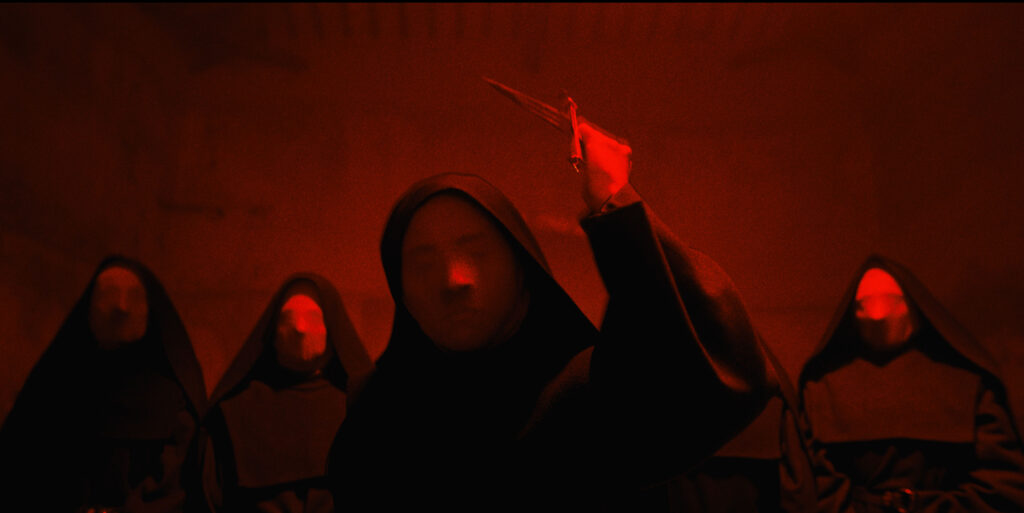
A scene from “Immaculate” (Photo courtesy of Neon)

“Immaculate” has no real surprises, but this horror movie about a pregnant nun delivers plenty of creepy suspense with some campiness. Sydney Sweeney’s committed performance and an intense ending are worth watching. The movie’s bloody gore goes where the lackluster “The Nun” movies are too tame to go. Sweeney is one of the producers of “Immaculate.”

Directed by Michael Mohan and written by Andrew Lobel, “Immaculate” had its world premiere at the 2024 SXSW Film and TV Festival. It’s an uncomplicated story about a young American nun named Sister Cecilia (played by Sweeney), who experiences horror at a Catholic convent called Our Lady of Sorrows in an unnamed rural area in Italy. The beginning of the movie shows Sister Cecilia arriving to take her final nun vows and live permanently at the convent. Viewers know that there’s something very wrong with this convent, because the opening scene shows a young nun trying to escape from the convent, but she is murdered by other nuns, who are wearing sinister veils over their faces.

The convent has a stereotypical stern Mother Superior (played by Dora Romano) and a patriarchal leader of the adjoining church: Cardinal Franco Merola (played by Giorgio Colangeli), who officiates the ceremony where Sister Cecilia takes her vows. He is also the clergyman who listens to the nuns’ confessions. Another associate of Our Lady of Sorrows is Father Sal Tedeschi (played by Álvaro Morte), who recruited Cecilia to the convent after her previous convent in the United States shut down due to low attendance for the church affiliated with the convent.

As soon as Father Sal tells Sister Cecilia that he had a scientific background in biology before he became priest, you can easily predict what the convent’s big secret is when virgin Sister Cecilia finds out she’s pregnant after undergoing an admittance medical exam at the convent. This admittance exam is not shown in the movie, but the movie shows the follow-up exam where Sister Cecilia is told that she is pregnant. Our Lady of Sorrows has an in-house medical professional named Doctor Gallo (played by Giampiero Judica), who works in a secretive room that looks more like a science lab than a regular doctor’s office.

Sister Cecilia, who is originally from the Detroit area, has a troubled past that is vaguely hinted at in the movie. She is plagued by nightmares and hellish visions as soon as she stays at the convent. One of her nightmares is a memory of when she was a child and had a near-death experience when she accidentally fell through an icy body of water and nearly drowned.

Sister Cecilia befriends another nun named Sister Guendalina, also known as Sister Gwen (played by Benedetta Porcaroli), who is the convent’s resident rebel. Sister Gwen tells Sister Cecilia that the several young nuns who are at the convent were recruited because they are “head cases or runaways.” Sister Cecilia asks Sister Gwen which category describes Sister Gwen. “Both,” Sister Gwen replies with a slight smirk. Another young nun at the convent is Sister Isabelle (played by Giulia Heathfield Di Renzi), who is standoffish and rude to Sister Cecilia.

“Immaculate” goes through some predictable motions of Sister Cecilia experiencing abuse and more terror at the convent. The movie has above-average cinematography and production design, which greatly enhance the sinister atmosphere. Of course, the main reason people will keep watching “Immaculate” is to find out what will happen if or when Sister Cecilia gives birth. It all leads to a memorable and terrifying series of events that make up for some of the occasional tediousness in the rest of the film.

Neon will release “Immaculate” in U.S. cinemas on March 22, 2024. The movie will be released on digital and VOD on April 16, 2024. “Immaculate” will be released on Blu-ray and DVD on June 11, 2024.

Copyright 2017-2025 Culture Mix
CULTURE MIX