
March 6, 2023
by Carla Hay
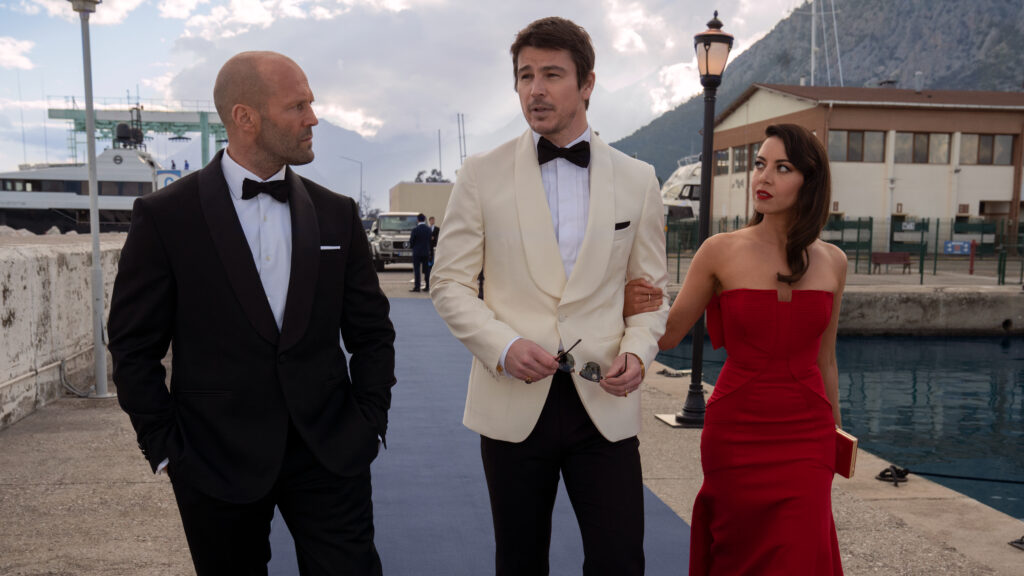
“Operation Fortune: Ruse de Guerre”
Directed by Guy Ritchie
Culture Representation: Taking place in various countries in Europe and Asia, the action film “Operation Fortune: Ruse de Guerre” features a predominantly white cast of characters (with a few black people and Asians) representing the working-class, middle-class and wealthy.
Culture Clash: A group of undercover operatives, who work for the British government, recruit a movie star to work with them on a mission, as they try to stop an illegal deal involving weapons of mass destruction, in order to save the world.
Culture Audience: “Operation Fortune: Ruse de Guerre” will appeal primarily to people who are fans of filmmaker Guy Ritchie, star Jason Statham, and formulaic and soulless spy movies.

When does a movie about undercover operatives become boring and useless? When you can predict everything that will happen within the first 10 minutes of watching the film. “Operation Fortune: Ruse de Guerre” is so formulaic and lacking in creativity, you could literally fall asleep in the middle of the film and not miss much, because there isn’t much of a plot. This smug and cliché-plagued action flick is proof that Guy Ritchie and Jason Statham have gotten lazy in their movie collaborations. The fights look too fake. The whole film is a failure of imagination, motivated by greed and paid trips to exotic places.
Ritchie directed “Operation Fortune: Ruse de Guerre” from a screenplay that he co-wrote with Ivan Atkinson and Marn Davies. Ritchie, Atkinson and Davies previously collaborated on the screenplays for 2020’s “The Gentlemen” and 2021’s “Wrath of Man,” which were both also directed by Ritchie. The quality of each of these collaborations has rapidly decreased with each subsequent film.
Stop if you’ve heard this plot before: A ragtag group of undercover operatives jet back and forth to various countries to try to stop a “fill in the blank” from happening, in order to save the world. In the case of “Operation Fortune: Ruse de Guerre,” the mission is to stop a billionaire arms dealer from selling a stolen cargo of weapons of mass destruction, and to prevent these weapons from being available on the open market. This over-used concept describes every other big-budget spy film with an ensemble cast of stars, whose characters fight, get involved in car chases, dodge explosions, and maybe have a little romance along the way.
“Operation Fortune: Ruse de Guerre” (“ruse de guerre” means “ruse of war” in French) is a checklist of these stereotypes, without coming close to being as charming and funny as the movies thinks it is. Half of the principal cast members look like they’ve checked out emotionally and act no better than robots, while the other half of the principal cast members try to salvage the weak and derivative screenplay by playing their roles with a “tongue in cheek” tone that just looks awkward when they’re in the same scenes as their lackluster co-stars. It’s not the worst spy movie ever, but it shouldn’t be this bad, since the filmmakers and stars of this movie are capable of doing much better.
“Operation Fortune: Ruse de Guerre” (which was filmed in Turkey and Qatar but takes place in several countries in Europe and Asia) opens with a scene of a world-weary British government operative named Nathan (played by Cary Elwes) being somewhat annoyed, as he walks through a government building to have an office meeting with his supervisor: a no-nonsense and bland bureaucrat named Knighton (played by Eddie Marsan), who has summoned Nathan to this meeting on a Sunday morning.
Nathan is irritated because of the time and day of this meeting. Nathan apparently still doesn’t understand that he doesn’t have the type of job where the only work hours are 9 a.m. to 5 p.m., from Monday to Friday. Nathan acting like he should have regular office hours is one of many ways that “Operation Fortune” makes these spy characters look like idiots. Knighton tells Nathan that 20 armed guards were killed two nights earlier, during an armed robbery that happened near Johannesburg, South Africa.
Knighton gives Nathan this order about the stolen cargo: “I want you to retrieve what went missing, and to find out who the seller is, who the buyer is, and what it is. It’s worth about $10 billion. it’s been given the name The Handle.” Translation: The screenplay is so sloppy and underdeveloped, the screenwriters didn’t bother to come up with any interesting details before this mission began. And if Knighton doesn’t know what the missing cargo is, how does he really know it’s worth $10 billion? It’s all just so illogical and stupid.
Knighton says to Nathan: “I need a creative, cunning and unconventional vision to retrieve this kind of mercurial threat. A courier on a bicycle in congested traffic. Not the official team. They’d take forever to wade through traffic, and the clock doth ticketh.”
First of all, “creative, cunning and unconventional” is not how to describe this movie. Second, who says nonsense like “The clock doth ticketh?” Third, the answer to that question: Only people in a badly written movie.
Nathan then begrudgingly assembles a team that includes these three core members for this mission:
- Orson Fortune (played by Statham), a stern Brit, is described as having claustrophobia, agoraphobia and a penchant for having the British government pay for his lavish expenses, which he calls “rehab,” whether it’s for legitimate rehab or not.
- Sarah Fidel (played by Aubrey Plaza), a wisecracking American, is a quick thinker and a computer technology expert.
- JJ Davies (played by Bugzy Malone), a quiet and loyal Brit, has keen shooter skills and can handle himself well in a fist fight.
This is the type of idiotic dialogue in the movie. In the meeting between Nathan and Orson to get Orson to join the team, Nathan says, “[A] threat is imminent.” Orson asks, “How imminent?” Nathan replies, “Imminently imminent.”
Nathan is not looking forward to working with Orson, because Nathan thinks that Orson is too high-maintenance and problematic, but Knighton has ordered that Orson be on Nathan’s team. Meanwhile, Orson and Sarah have some friction with each other because they each think they are smarter than the other one. JJ is truly a token character who doesn’t say or do much except show up at the right times to help out in a fight. Nathan does some traveling with his crew, but for most of the movie, he’s giving orders while he’s in an office or away at a luxury resort.
Sarah used to work for Nathan’s fiercest operative rival Mike Hook (played by Peter Ferdinando), who also works for the British government, but Mike has a habit of poaching Nathan’s best employees. John Welch (played by Nicholas Facey) is a recently poached employee who currently works for Mike. Nathan thinks hiring Sarah for Nathan’s team is some sort of revenge that he can get on Mike.
“Operation Fortune” has several repetitive scenes showing Nathan and/or members of his team having snarling, sneering and sniping encounters with Mike and his team. After the third time this happens, you’ll feel like yelling at the screen: “We get it: Nathan’s people and Mike’s people don’t like each other!” Here are some choice words that Nathan has to say about Mike when Nathan is having a phone conversation with Knighton: “Mike only has two talents: blowing his cover and blowing himself.”
After Nathan and Orson go to Madrid to bring Sarah and JJ into their team, there’s a silly caper sequence that’s supposed to take place at Merchant Logo Adolfo Suárez Madrid–Barajas Airport, where a retired professor named Donald Bakker (played by Ian Bartholomew) with a brown crocodile briefcase has been identified as the “bag man” with an important computer data drive. Nathan’s team and Mike’s team are all spying on Donald at the airport at the same time.
Somehow, throughout the entire movie, Sarah seems to have video surveillance and wireless microphones everywhere. She works like a one-person, far-reaching command center to tell people, who are long distances away, everything she’s seeing while they all wear hidden ear pieces. Sarah also spends a lot of time directing people on where to go, as if they’re characters in a voice-activated video game.
Nathan’s team finds out that a billionaire arms dealer named Greg Simmonds (played by Hugh Grant) is involved in the deal to sell the stolen cargo. Greg (who is jaded and arrogant) and a dimwitted action movie star named Danny Francesco (played by Josh Hartnett) have a platonic bromance that heats up during the course of the movie. It’s a one-note joke that quickly gets old. Orson and Sarah come up with a plan to enlist Danny’s help to spy on Greg, by having Sarah pose as Danny’s girlfriend when Greg invites Danny to stay at Greg’s luxurious estate in Cannes, France.
Greg has several generically shallow people in his entourage, including a scowling assistant named Emilia (played by Lourdes Faberes); other employees named Trent (played by Tom Rosenthal) and Arnold (played by Oliver Maltman); and hangers-on/friends named Alexander (played by Tim Seyfi), Dmitry (played by Ayhan Eroğlu), Yiv (played by Savaş Ak), Natalya (played by Oleksandra Zharikova) and Katya (played by Mishel Lazarenko). These characters have no real purpose in the movie except to possibly add to the inevitable body count of murdered people.
“Operation Fortune: Ruse de Guerre” has no shortage of glamorous-looking locations, as these characters zip around to places such as Morocco, Quatar and Turkey. But having pretty-looking scenery just looks like an ineffective distraction to a flimsy plot. The movie’s fight scenes are underwhelming, while the jokes mostly fall flat, despite Plaza and Grant making an effort to bring some personality to this hack job pretending to be a thrilling spy caper.
“Operation Fortune: Ruse de Guerre” rehashes the same outdated spy-movie ensemble stereotypes of having a group of protagonists consisting of several macho men and one token woman. And (sexist cliché alert) she has to use her sexuality to accomplish her work goals, while the men never have to use their sexuality to accomplish their work goals. Filmmakers who resort to these tired clichés, when there are so many other options that are fresh and innovative, just expose how backwards their mindsets are when it comes to how women are presented in their movies. “Operation Fortune: Ruse de Guerre” has several scenes that show off how much money was probably spent to film the movie in exotic or pricey locations. But make no mistake: “Operation Fortune: Ruse de Guerre” is creatively bankrupt.
Lionsgate released “Operation Fortune: Ruse de Guerre” in U.S. cinemas on March 3, 2023. The movie was released in several other countries, beginning in January 2023.