
November 28, 2021
by Carla Hay
“Who We Are: A Chronicle of Racism in America”
Directed by Emily Kunstler and Sarah Kunstler
Culture Representation: The documentary “Who We Are: A Chronicle of Racism in America” features a predominantly African American group (with a few white people) of civil rights activists, entrepreneurs, historians and authors discussing the racial prejudices and challenges experienced by people of color, particularly African American men, in the United States.
Culture Clash: The documentary, led by civil rights activist/attorney Jeffrey Robinson, has the premise that people cannot truly be honest about racism in America without acknowledging that America was built on white supremacy that oppresses non-white people in entrenched systems that still exist today.
Culture Audience: “Who We Are: A Chronicle of Racism in America” will appeal primarily to people interested in historical accounts of racial bigotry in America that have a personal touch (due to Robinson’s on-camera narration and interviewing), but don’t expect there to be much discussion about racism against people who aren’t African American men.
“Who We Are: A Chronicle of Racism in America” is partly a filmed lecture by scholar Jeffrey Robinson, partly a historical account and partly a personal journey taken by Robinson to retrace past experiences with racism and race relations. The movie features compelling interviews and information but puts an overwhelming emphasis on bigotry inflicted on black men. The documentary should have been more inclusive of other people of color who experience racism too.
For example, the documentary has almost no acknowledgement of the genocide of Native Americans that allowed white Europeans to take over the land that is now known as the United States of America. You can’t have a truly comprehensive discussion about racism in America without including the brutally honest but necessary history explaining how white people became the dominant race in a part of North America where Native Americans were the dominant race for centuries. The documentary also does not cover the well-documented and shameful examples of U.S. government-sanctioned racism and other forms of bigotry experienced by Latinos and Asians in America.
“Who We Are: A Chronicle of Racism in America” (directed by sisters Emily Kunstler and Sarah Kunstler) is nevertheless a well-intentioned film and addresses many important topics about racial discrimination. The title is just a little misleading though. A more accurate title would be “Who We Are: A Chronicle of Racism Against Black Men in America.” That’s because almost all of the examples of racist hate crimes that are examined in this documentary are crimes in America against black men. This documentary packs in a considerable amount of information in its 118-minute running time, but the vast scope of what this documentary intended would have been better-suited as a docuseries instead of a feature-length film.
“Who Are Are: A Chronicle of Racism in America” made the rounds at several film festivals, including the SXSW Film Festival, Hot Docs, AFI Fest and DOC NYC. It’s the type of movie that is supposed to make people uncomfortable because it covers uncomfortable truths that many people want to deny or forget. The documentary sounds an alarm that there’s still a lot of work to be done in healing from and preventing the damage of racism that is still pervasive today.
If it seems like “Who We Are: A Chronicle of Racism in America” has a well-articulated and methodical tone of attorneys presenting a case, that’s because several attorneys or people with legal backgrounds were involved in the making of this film. Jeffrey Robinson, the movie’s on-screen narrator and interviewer, is an attorney who founded the Who We Are Project non-profit group to combat racism. Proceeds from this documentary will go to Who We Are Project. He has a background working as a deputy legal director and the director of the American Civil Liberties Union (ACLU) Trone Center for Justice and Equality, as well as a public defender and an attorney in private practice.
Robinson, Emily Kunstler and Sarah Kunstler are among the producers of “Who We Are: A Chronicle of Racism in America.” Emily Kunstler and Sarah Kunstler (who co-founded the social-justice film production company Off Center Media) are two of the daughters famed civil rights attorney William Kunstler. Sarah is a practicing attorney. Emily’s mother is attorney Margaret Ratner Kunstler.
When white directors make a documentary or any project about white supremacist racism, some people will automatically question the validity or authenticity of the project. Emily Kunstler responded to this skepticism by making this statement in the “Who We Are” documentary’s production notes: “Throughout the making of this film, one of the questions we often get is why are two white women making this film? Our answer is that the history of slavery in the United States is not Black history, it is American history; a history of white supremacy and white complicity as well as a history of Black oppression and resistance. Growing up, Sarah and I were taught that it was our moral responsibility to stand up against racism and fight for justice. This responsibility includes learning and sharing our country’s painful history.”
“Who We Are: A Chronicle of Racism in America” has three distinctive types of footage that are all interwoven seamlessly throughout the film:
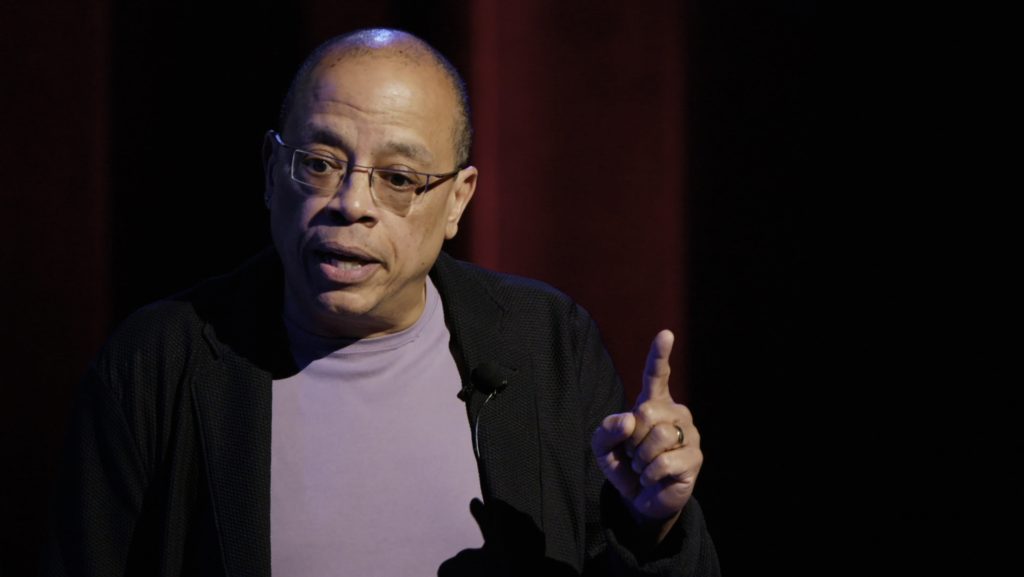
- (1) A filmed speaking appearance about American racism that Robinson did in June 2018 at New York City’s Town Hall. This footage was directed by Gbenga Akinnagbe, who is one of the producers of this documentary.
- (2) Archival footage of many of the people, places and events discussed in the documentary.
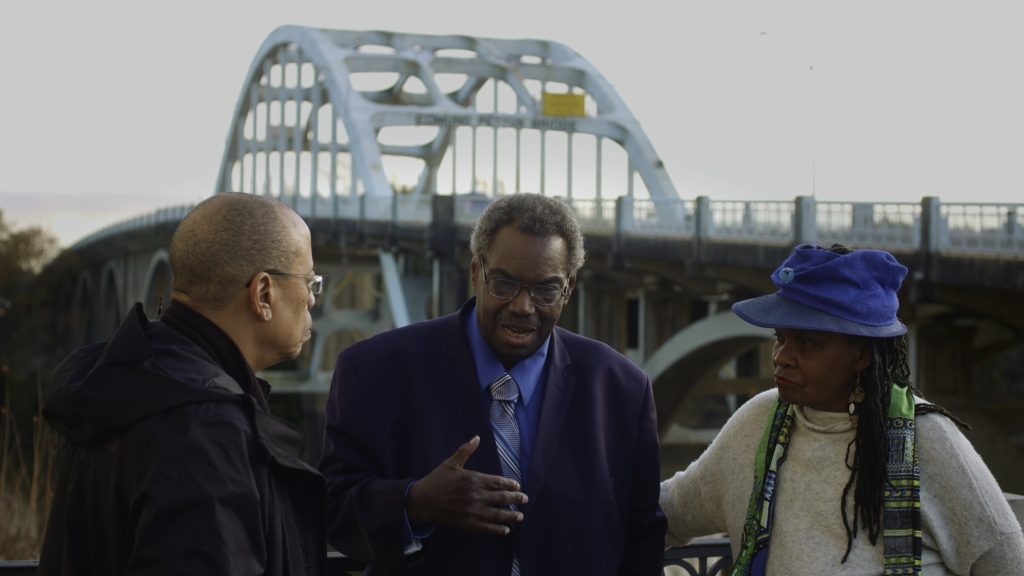
- (3) Interviews about racism in America that Robinson conducted in various U.S. cities.
Robinson has an engaging style of public speaking that is partly like a scholarly history teacher, partly like an intellectual sociologist and partly like an impassioned civil rights activist. He infuses his recitation of alarming statistics and data about racism with his own personal anecdotes, in order to make the information more relatable. He sometimes cracks sarcastic jokes to lighten the mood. Other times, his facial expressions show the emotional pain of remembering being the target of racism and feeling empathy to others who’ve also experienced this type of hatred and discrimination.
In the documentary’s opening scene, Robinson is seen on stage at the Town Hall appearance addressing a common argument that some people have when trying to minimize the damage caused by slavery in America. Robinson says that these deniers often say, “‘Slavery is not our responsibility.’ But it’s our shared history. And when we try to turn it into something that it’s not, when we try to make more light of what it was, then we are denying who we really are and are impeding our ability to move forward as a community and as a nation.”
As an example of how divisive people’s opinions are about how slavery in America should be remembered, the documentary mentions the ongoing debates of whether or not certain slave owners in American history should be celebrated. Controversies over which public statues should be removed or which architectural structures should be renamed indicate that this is a hot-button topic that won’t be going away anytime soon. Oftentimes, when people talk about not removing these statues or other tributes, they say it’s about “being patriotic.” But does “being patriotic” mean embracing historical racists as heroes?
In the documentary, Robinson shares his opinion on where people should draw the line: If a historical figure (especially a slave owner) is best known for doing things that advocated for keeping slavery and/or racial segregation legal, then those historical figures should not be celebrated with public statues, structures or any government-funded institutions named after them. If a historical figure’s accomplishments consist mainly of progress for the United States that’s greater than the fact that the historical figure participated in enslaving people when it was legal in the United States, then it’s best to not remove the statue or tribute. Robinson cites former U.S. presidents who were slave owners (George Washington and Thomas Jefferson, to name a few) as examples of historical figures who shouldn’t be “erased” or “cancelled,” because their legacies for what they did in U.S. history far outweigh the fact that they owned slaves.
Several of the flashpoint events in civil rights history are mentioned during Robinson’s Town Hall speaking appearance, which includes a Power Point-type visual presentation on stage. These tragedies include the 1921 massacre and burning of Black Wall Street in Tulsa, Oklahoma; the 1955 murder of 14-year-old Emmitt Till, who was brutally slaughtered by two white men in Money, Mississippi, after Till was wrongfully accused of whistling at a white woman; and the 1968 assassination of civil rights leader Martin Luther King Jr. in Memphis. For many of these tragic events, Robinson goes to the scene and/or interviews people who were associated in some way to the victims of these hate crimes.
In Tulsa, Robinson interviews Lessie Benningfield Randle, one of the last known survivors of the Tulsa massacre. Even though she was a little girl when the massacre happened, she still has horrific memories of this tragedy. She witnessed people being shot and bodies piled up on the street. “I never want to see anything like that again,” she says with a haunted look in her eyes.
Also in Tulsa, Robinson visits Dr. Tiffany Crutcher, the twin sister of Terence Crutcher, an unarmed college student who was killed in 2016 by a white police officer named Betty Jo Shelpy, who claimed self-defense. Dr. Cruther says that her brother was not identified as a suspect when Shelpy arrived on the scene and that the media “dehumanized” him as a criminal when in fact he was not a criminal. “He laid on the street like an animal,” she says bitterly about how her brother’s dead body was unattended to for hours.
While in Memphis (Robinson’s childhood hometown), Robinson visits the Lorraine Motel, the site of King’s assassination. Robinson describes his own father as someone who was involved in the civil rights movement, and he has vivid memories of being taken to protest marches as a child. Also in Memphis, Robinson has an emotional reunion with Robert “Opie” Orians, a former classmate and friend of Robinson’s when they both attended St. Louis Catholic School and were on the school’s basketball team. Jeffrey Robinson and his older brother Herbert Robinson (who appears briefly in another part of the documentary) were the first black students at the school.
Opie’s father Richard Orians is also part of the reunion with Opie and Jeffrey. Richard, who used to coach the school’s basketball team, talks about an incident when the St. Louis team was barred from entry for a game at a rival school because a black student (Jeffrey) was on the St. Louis team. All three men get emotional, with eyes tearing up and voices cracking, when Richard says that, out of principle, he removed the team from the premises because he didn’t want to the team to be associated with a school that would make this racist decision. At the time, Richard says that he protected the team by not telling them the real reason why they were withdrawing from the game.
Jeffrey also remembers another racist incident he experienced as a child during a basketball game, when someone on the other team called him the “n” word. Jeffrey’s father was watching the game nearby, so Jeffrey went to his father to complain about the racist insult. Jeffrey remembers his father’s empathetic but stern response: “What do you want to do about it?”
His father asked Jeffrey if he would rather quit the game and let the racist feel superior, or stay in the game to prove to the racist that a racist slur wasn’t going to stop Jeffrey from playing the game. Jeffrey decided to stay in the game. He said it was an early lesson in not letting racists get what they want when they using racist insults and other forms of racism to make the targets of their hate feel inferior or defeated.
Jeffrey shares another personal story when he meets up with Kathie Fox, whose mother-in-law Mildred was the realtor of the Robinson family. The family—Jeffrey’s parents Herbert Sr. and Lameris; older brother Herbert Jr.; and younger brother Larry (who appears briefly in this documentary); and Jeffrey—couldn’t move into a mostly white neighborhood until Mildred enlisted her married white friends Lib and Pat Smith to buy a house in the neighborhood and then transfer the deed to Herbert Sr. and Lameris. Jeffrey remembers the look of shock on some neighbors’ faces when his family moved into the neighborhood. It was not uncommon for African American families to have to ask white allies to be their proxies to buy a house in a white neighborhood, because racist realtors would not sell houses to black people.
Also in Memphis, Jeffrey meets up with Tami Sawyer, a Shelby County commissioner of District 7, who led the charge to take down a statue in Memphis of Nathan Bedford, a Confederate Army general and the first Grand Wizard of the Ku Klux Klan. Sawyer says there’s no legitimate excuse for any past or present member of the KKK to be honored with a publicly funded statue that makes that person look like a hero. Still, the people who successfully lobbied to have the statue removed got a lot of resistance from those who say statues like that represent “Southern pride.” To other people, these types of statues are symbols of racist white supremacy.
While visiting Clayborn Temple in Memphis, Jeffrey interviews Carolyn Payne, whose unarmed brother Larry Payne was shot to death by a cop when Larry was 18 years old. Larry was unfortunately in the wrong place at the wrong time, since there was no evidence that he did anything wrong. Nothing ever happened to the cop who killed Larry. Carolyn says that she and her family will probably never know what really happened because she thinks there was a racist cover-up by the police who were involved. Sadly, there are too many other incidents like this to put into just one documentary.
In Alabama, Jeffrey visits author Josephine Bolling McCall, whose father Elmore Bolling was murdered in 1967, for being “too successful to be a Negro,” according to a newspaper report that she reads out loud and which is shown in the documentary. She describes how her family found her father shot to death in a ditch. “It’s ingrained in my memory,” she says with heartbreak. No one was indicted for this crime.
While in Selma, Alabama, Jeffrey speaks with retired Alabama senator Hank Sanders and activist Faya Ora Rose Touré, who are part of a group of citizens who want the Edmund Pettus Bridge in Selma to be renamed the Freedom Bridge. Edmund Pettus was a Grand Dragon in the KKK. Considering the historical significance of Selma in the civil rights movement, many people think it’s an insult that there’s a bridge in Selma (or anywhere, for that matter) named after someone who was proud to be a racist.
While in Charleston, South Carolina, Jeffrey visits the Old Slave Mart Museum, where operations manager Ista Clarke gives a harrowing, detailed description of what it was like for slaves to be bought and sold there. Also in Charleston, Jeffrey accompanies Sights and Insights Tours owner Al Miller on a trip to the Ashley Avenue Oak Tree, which was the site of numerous lynchings, mainly of African American men. It’s mentioned that in almost all of these lynching cases, the victims were lynched not for doing anything wrong but for not being white.
African Americans are the vast majority of people who are interviewed in this documentary, but one white person is interviewed who represents people who think that the Confederate flag is not a symbol of racist hate. In Charleston, Jeffrey talks to one of three white men standing outside on the street while holding the Confederate flag. The three men are from a pro-Confederate flag group called Flags Across the South. It should be noted that although these men claim to be proud to stand up for their cause, they’re all wearing hats and sunglasses, as if they don’t want their faces to be fully exposed.
Jeffrey talks to Flags Across the South chairman Braxton Spivey on the street. And what Spivey has to say can only be described as being making excuses for slavery. Spivey comments, “Slavery had nothing to do with the [Civil] War. It was about money.” Spivey adds, “Slaves were treated like family,” and he believes that enslaved people “chose to stay” in captivity.
Jeffrey looks visibly disgusted at Spivey’s historically inaccurate rhetoric and blatant racism. When Spivey is asked if he would ever want to be owned as a slave, he admits he would not. But the subtext of what Spivey believes is that he thinks that white people shouldn’t be the slaves in society. Jeffrey shakes his head as he walks away and comments on Spivey: “Facts are not important to that gentleman.”
While in New York City, Jeffrey talks to law student Darren Martin, who had the cops called on him when he was moving into his apartment. Apparently, an unidentified neighbor assumed that because Martin is African American, his moving activities were thieving activities. Martin says that six police officers responded to the complaint as if he were a criminal, even though he showed proof that he was a new resident of the building and he was moving in. Like many people who experience this type of racism, Martin took out his phone and video recorded the incident. His video went viral and made the news.
Also in New York City, Jeffrey interviews Gwen Carr, the mother of Eric Garner, an unarmed African American man who died in 2013 after a police officer put Garner in a chokehold and Garner repeatedly yelled, “I can’t breathe!” The cop acted with this type of force in response to seeing Garner illegally selling loose cigarettes. That incident was captured on video, made international news, and became a touchstone tragedy that fueled the Black Lives Matter movement.
Carr describes her slain son: “He was a gentle giant.” She also says that she went into a deep depression after his death but then had a spiritual awakening: “The Holy Spirit spoke to me one evening” and asked if she was going be dead like her son, or if she was “going to get up, lift up his name, and let people know exactly who he was, and not let the media demonize him. Even though it’s too late for my son, we have to save other lives.”
While in New York City, Jeffrey interviews Inside Out Tours managing director Stacey Toussaint, who talks about how slave labor was the backbone of New York City, which was a financial hub for insurance and financing of the slave trade. Toussaint says that she wants more people to understand that even though Southern states are often singled out as the worst states in America for racism, the reality is that racism can be anywhere.
Other people interviewed in the documentary are Chief Egunwale F. Amusan, president of the African Ancestral Society in Tulsa; Reverend Dr. Robert Turner, pastor of Historic Vernon Chapel A.M.E. Church in Tulsa; Kristi Williams, a Historic Greenwood/Black Wall Street historian; and Jeffrey’s nephew Matthew Liam Brooks, whom Jeffrey raised as a son after Brooks’ mother died.
During his Town Hall speaking appearance, Jeffrey says that dealing with racism means dealing with the ugly fact that many people are too heavily invested in keeping white supremacist racism in the economy and other systems that affect people lives. And when it comes to stopping racism, he makes this pointed observation: “A lot of people say they want change. They just don’t want the change to cost them anything or require them to change anything about the way they are living.”
One of the best ways to sum up the point of this documentary is from something that Jeffrey says in his Town Hall speaking engagement: “America has demonstrated its greatness time and time and time again, and America is one of the most racist countries on the face of the earth. Those two things are not mutually exclusive. It is not an either/or. And the reason I’m asking us to think about this is that literally, the future is at stake.”
Sony Pictures Classics will release “Who We Are: A Chronicle of Racism in America” in select U.S. cinemas on January 14, 2022.