
Review: ‘The Unbreakable Boy,’ starring Zachary Levi, Meghann Fahy, Jacob Laval, Drew Powell and Patricia Heaton

February 21, 2025

by Carla Hay

Pictured from left to right: Meghann Fahy, Gavin Warren, Patricia Heaton, Jacob Laval, Zachary Levi and Todd Terry in “The Unbreakable Boy” (Photo by Daniel McFadden/Lionsgate)

“The Unbreakable Boy”

Directed by Jon Gunn

Culture Representation: Taking place in Oklahoma, the dramatic film “The Unbreakable Boy” (based on the non-fiction book of the same name) features a predominantly white cast of characters (with a few African Americans and Asians) representing the working-class and middle-class.

Culture Clash: A married couple with two sons have ups and downs in their family life because of their older son’s autism and rare bone condition; the couple’s financial problems; and the father’s alcoholism.

Culture Audience: “The Unbreakable Boy” will appeal mainly to people who are fans of the movie’s headliners and faith-based movies that put schmaltz over realism.

Peter Facinelli, Zachary Levi and Drew Powell in “The Unbreakable Boy” (Photo by Daniel McFadden/Lionsgate)

“The Unbreakable Boy” puts a fairytale spin on a real-life family’s unsettling problems. There’s plenty of melodrama about medical conditions and financial struggles, but there’s an over-use of movie clichés that sugarcoat the truth. The truth is that the family’s problems that are depicted in this sappy movie don’t get resolved as easily in real life as the filmmakers want people to think they can be resolved, by presenting a perky boy with autism as if he’s some kind of good luck charm used for the family’s benefit.

Written and directed by Jon Gunn, “The Unbreakable Boy” is based on the 2014 non-fiction book “The Unbreakable Boy: A Father’s Fear, a Son’s Courage, and a Story of Unconditional Love,” written by Scott LeRette and Susy Flory. “The Unbreakable Boy” isn’t a typical faith-based movie that gets preachy about religion, although there are certainly some religious elements to the film. Instead, it’s a somewhat misleading movie that makes people think that it will be about mostly about the “unbreakable boy.” The movie actually takes a detour and becomes about how the boy’s self-admitted disappointing father goes on a downward spiral and has to find a way to prove that he’s a responsible parent and husband.

It’s a shame that the movie’s title is not reflective of the movie’s agenda and focus. “The Unbreakable Boy” movie also changes the age of the title character, just to make the most of having a cute underage kid to make the movie more appealing to families. In the book, the “unbreakable boy” is actually 18 years old. In the movie, he’s 13. It’s easy to see why the filmmakers wanted to reduce the age of “the unbreakable boy”: It’s more dramatic to have an underage kid be emotionally wiser and more honest than his screwed-up father. Making the kid a legal adult is much less compelling.

“The Unbreakable Boy” takes place in Oklahoma, where the movie was filmed on location. The movie’s title character is talkative 13-year-old Austin LeRette (played by Jacob Laval), who has autism and who was born with osteogenesis imperfecta, a rare condition that causes bones to break easily. Austin inherited osteogenesis imperfecta from his mother Teresa (played by Meghann Fahy), who has the same condition. Austin, whose nickname is Auz-Man (his imaginary superhero alter ego), is the chirpy narrator of the movie’s story. Austin likes to wear a jester hat, which becomes a symbol of his cheerful optimism.

Austin says in the narration that sometimes things get broken in life. He ominously says, “This is the night when everything broke.” “The Unbreakable Boy” begins with a scene where Austin’s father Scott LeRette (played by Zachary Levi) is drunk at a New Year’s Eve party at a country club. Scott has Austin and Austin’s 11-year-old brother Logan (played by Gavin Warren) at the party with him when he drives away from the party with the boys as passengers.

The car swerves and narrowly misses hitting another car. Scott is obviously too drunk to drive, but the movie never really shows anyone actually confront him about this reckless and irresponsible driving, nor is it shown if he got arrested for driving under the influence. This drunk-driving incident is never mentioned again and the only clue that it happened is when Scott is later shown in an Alcoholics Anonymous meeting.

“The Unbreakable Boy” movie does that a lot in the movie: It has a dramatic, tension-filled buildup to a problem. But then, it abruptly segues to another part of the family’s life and leaves many questions unanswered, or it presents a trite, not-very-believable solution to the problem. You get the feeling that this family has a lot more dirty laundry that they just didn’t want to put in this movie. (Scott and Teresa LeRette are two of the executive producers of the movie.)

After this drunk-driving scene, the movie quickly goes into flashback mode, as Austin describes how his parents met and how the couple’s relationship progressed to becoming married parents. Thirteen years earlier, Scott was working as a medical supply salesperson when he went into a clothing store to buy a pair of trousers. Some green khaki trousers caught his eye but what really captured his interest was Teresa, a sales clerk at the store.

It’s mutual attraction at first sight. During this “meet cute” moment, Scott says he’ll buy up to eight pairs of the trousers if she’ll go out on a date with him. He also compliments Teresa on her bright blue eyes, which she says are bright because of a birth defect. Teresa gives him her phone number and says he doesn’t have to buy anything in the store but he can take her out for coffee. On their first date, a casually dressed Teresa is surprised that instead of going to a coffee shop, Scott has arranged for them to go to an upscale restaurant.

It’s the beginning of some communication problems that start early in the couple’s relatonship. Teresa has secrets that eventually get exposed. Scott and Teresa are casually dating for a few months when Teresa gets pregnant. Scott comes from a religious Christian family, so when he finds out that Teresa is pregnant, he proposes marriage. Teresa and Scott aren’t “in love” yet, but they’re getting there.

Teresa says no to the marriage proposal because she doesn’t think that she and Scott need to get married. She’s still emotionally scarred by her parents’ toxic marriage. Teresa says her father was an abusive alcoholic. Teresa also tells Scott that she has osteogenesis imperfecta, which is genetic, and she’s afraid this unborn child will have osteogenesis imperfecta too. Scott is more optimistic than Teresa is that their unborn child won’t have osteogenesis imperfecta.

Teresa’s main support in her family is her sister Lori (played by Amy Acker), a character who’s just in this movie as a sounding board to Teresa’s rants. Teresa’s parents are never shown in the movie, but Scott’s parents are. Scott’s father Dick LeVette (played by Todd Terry) takes the news in stride about the unplanned pregnancy. By contrast, Scott’s mother Marcia LeVette (played by Patricia Heaton) is furious because she knows that Scott now has to delay his plans to quit his job to go to grad school.

Marcia throws and breaks objects as she angrily shouts at Scott that he’s throwing his life away. That kind of violence isn’t very Christian, but the movie glosses over Marcia’s nasty temper as acceptable because she’s the type of “righteous” mother that these faith-based movies frequently excuse when these mothers are overly judgmental or hypocritical. Scott even jokes to his father that Marcia’s temper tantrum isn’t as bad as Scott thought it would be.

Scott and a pregnant Teresa move in together. And that’s when he finds out Teresa’s biggest secret when he discovers some of her legal papers: She’s been married and divorced twice before. Both marriages were short-lived, and her ex-husbands are no longer in her life. Scott gets upset but eventually forgives Teresa, who tells him that she’s sorry for not disclosing this information before their relationship got serious.

Scott proposes marriage again, and she says yes. Teresa wants to get married in a church. Scott wants to get married at a courthouse. Austin says in a voiceover that his parents reached a compromise. The next scene shows Scott and Teresa getting married in a church. It’s the movie’s way of saying that Teresa usually gets her way in the relationship. Teresa is never seen working outside the home again, so the movie implies that she became a homemaker after the birth of her children.

Austin is born, and the movie spends a great deal of time showing him as an infant, as a toddler (played by Roy Jackson Miller) and as a 5-to-6-year-old (played by Kellen Martelli), which is the period of time that Scott and Teresa find out that Austin has osteogenesis imperfecta and autism. There are several montages of Austin breaking his bones in various ways, usually from running around or jumping while he’s playing. Scott is shown as the only parent who’s with Austin when Austin gets his most serious injuries, which is another way of the movie putting an emphasis on Scott being the more “irresponsible” parent.

Logan is born two years after Austin. Logan, who does not have any health issues, is a compassionate and protective brother who gets sidelined a lot in this story because so much of the kid focus is on Austin, who does a few horrendous and abusive things while in a manic state of mind. Logan does not get enough credit for being such a wonderful child when Logan has so many reasons to be bitter and resentful about his parents having to pay so much attention to Austin.

Austin has the type of autism where he doesn’t know how to pick up on social cues, he will talk incessantly, and he will often take things literally. He will repeat doing things in almost an obsessive-compulsive way. He’s highly intelligent but socially awkward. And you know what that means: He gets bullied at school, but the bullying is psychological and emotional, not physical. The main bully to Austin is Tyler (played by Pilot Bunch), who actually gets physically aggressive with Logan, not Austin.

“The Unbreakable Boy” shows the ups and downs of the family and how Austin remains mostly positive through it all. Scott’s alcoholism gets worse after he loses his job. But he’s not the only irresponsible parent in the household. Teresa becomes unemployed too and appears to have become addicted to playing video games and shopping for things that the family didn’t need, thereby driving the family into debt. Teresa’s culpability is glossed over a lot in this movie, while Scott gets blamed the most as being the “terrible parent.”

But those are not all the questionable things about this schmaltzy film. Throughout the movie, Scott has an imaginary adult friend named Joe (played by Drew Powell), who’s supposed to be Scott’s conscience and “voice of reason.” Scott talks out loud to Joe, who sometimes dresses in identical clothing as Scott, and sometimes in different clothing. Joe mostly looks like a lumberjack who has nothing better to do than to hang out with Scott, who becomes a “sad sack” as his problems get worse.

The problem with “The Unbreakable Boy” is that it plays fast and loose with the truth and avoids answering some crucial questions. For starters, the movie unrealistically makes it look like Scott and Teresa had to take care of their two kids all by themself, even though there are indications that plenty of people could’ve helped. This potential support includes Lori, Scott’s parents and people at the church where Scott and Teresa attend. (Peter Facinelli has a supporting role as Preacher Rick, the church’s amiable leader.) The movie never shows if Scott and Teresa asked for any help in taking care of their kids. You don’t even see a babysitter in the movie.

Second, the couple’s debt is a big issue in the story, but the movie never explains if Teresa was willing to get a job to help pay off the debt, or if she and Scott agreed that she would be a homemaker, no matter what their financial situation. Sure, Teresa could’ve hidden all the debt she racked up, and Scott eventually found out. But the movie takes a very patriarchal view that it was Scott’s responsibility to fix this problem, even though Teresa was the one who caused the overspending problem. There’s also a scene where Teresa looks worried when she sees Austin’s medical bills that are a five-figure total, but then that medical debt is never mentioned again.

Third, that drunk driving scene is dropped into the beginning of the movie and then never properly addressed again. Instead, “The Unbreakable Boy” is more concerned about underage Austin preaching at the audience when he rambles on about his philosophies and observations about life. It all becomes a bit too phony, just like the movie’s force-fed concept that all anyone has to do is be in Austin’s presence, and life will turn out just fine.

Despite the movie’s obvious flaws, Laval gives a mostly delightful performance, although people with autism are probably the best judges of how autism is portrayed in the movie. (“The Unbreakable Boy” was originally scheduled to be released in 2022, but it was released in 2025, when Laval looks a lot different than he did when he filmed the movie.) Levi seems to enjoy portraying adults with emotional maturity issues, so this role as a flaky father is just more of the same for him. The rest of the cast members are serviceable, not outstanding, in their roles.

To its credit, “The Unbreakable Boy” has a positive message about how kindness can go a long way in changing someone’s life for the better. The movie also brings more awareness about osteogenesis imperfecta and autism, although families should teach any underage and impressionable children that this type of movie is not quite as realistic as it should be in portraying how public schools for children are legally allowed to resolve certain issues that are depicted in the movie. What’s really “breakable” in “The Unbreakable Boy” is how it reaches a breaking point of credibility in how these issues and more are mishandled in the movie.

Lionsgate released “The Unbreakable Boy” in U.S. cinemas on February 21, 2025.

Review: ‘8-Bit Christmas,’ starring Winslow Fegley, Neil Patrick Harris, Steve Zahn, June Diane Raphael, Bellaluna Resnick and Sophia Reid-Gantzert

December 26, 2021

by Carla Hay

Winslow Fegley in “8-Bit Christmas” (Photo by Sabrina Lantos/New Line Cinema/HBO Max)

“8-Bit Christmas”

Directed by Michael Dowse

Culture Representation: Taking place in the Chicago area in the present day and in 1988, the comedy film “8-Bit Christmas” features a predominantly white cast of characters (with some African Americans) representing the working-class, middle-class and wealthy.

Culture Clash: A man in his mid-40s tells his 11-year-old daughter the story of his misadventures in 1988, when he was an 11-year-old boy who desperately wanted a Nintendo Entertainment System for Christmas, even though his parents forbade him from playing video games at the time.

Culture Audience: “8-Bit Christmas” will appeal primarily to people who are interested in watching lightweight Christmas holiday comedies that are steeped heavily in 1980s nostalgia.
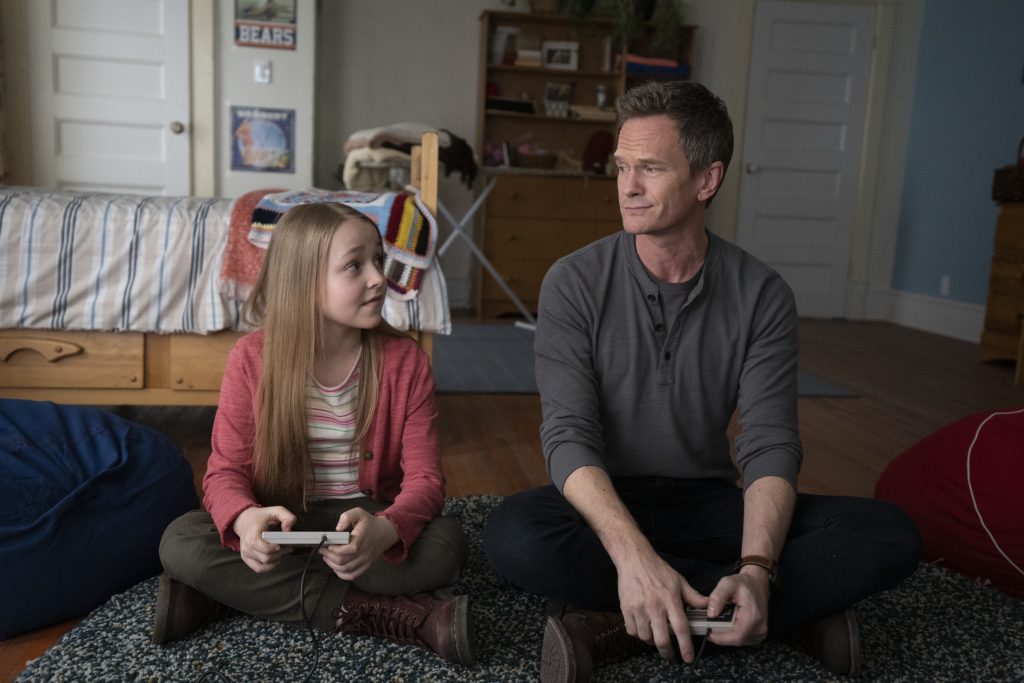
Sophia Reid-Gantzert and Neil Patrick Harris in “8-Bit Christmas” (Photo by Sabrina Lantos/New Line Cinema/HBO Max)

The formulaic family comedy “8-Bit Christmas” is elevated by a watchable and occasionally amusing performance by Winslow Fegley as an 11-year-old boy in 1988 who goes to great lengths to get a Nintendo Entertainment System for Christmas. Directed by Michael Dowse, “8 Bit Christmas” is really just a series of slapstick scenarios that culminate in a sentimental “life lesson” that’s expected in a movie with a Christmas theme. Kevin Jakubowski adapted the “8-Bit Christmas” screenplay from his 2013 novel of the same name. The movie is best appreciated by viewers who have some fondness for 1980s nostalgia or who know how big of a deal a Nintendo Entertainment System was to many kids during this decade. (The movie’s title refers to the primitive 8-bit data resolution of 1980s video games.)

“8-Bit Christmas” begins with a man in his mid-40s named Jake Doyle (played by Neil Patrick Harris), who is traveling with his 11-year-old daughter Annie Doyle (played by Sophia Reid-Gantzert) to the home of Jake’s widowed mother for a Christmas holiday visit. Jake grew up in Batavia, Illinois (a suburb of Chicago), where his mother still lives. Annie has been pestering Jake to get her a smartphone for Christmas.

Jake adamantly refuses because he thinks Annie is too young to have this type of phone. Annie has to use Jake’s phone, only when he’s with her. It’s embarrassing to Annie that she doesn’t have her own phone, but Jake won’t change his mind.

Instead, Jake tells Annie about the time in 1988, when he was Annie’s age and was obsessed with getting a Nintendo Entertainment System for Christmas. Jake says to Annie, “When I was a kid, I wanted a Nintendo worse than you wanted a phone.” Annie replies, “That’s not possible.”

Jake is prompted into telling this story when he and Annie arrive at his mother’s house and they find his old Nintendo Entertainment System in the room that Jake had as a child. Annie knows that there was a time when Jake’s parents didn’t allow him to play video games, so she wants to know how he ended up with a Nintendo Entertainment Sysem . Most of the movie then switches to flashback mode when Jake tells his story in voiceover narration, with occasional scenes that go back to the present-day Jake and Annie.

In 1988, 11-year-old Jake (played by Winslow Fegley) considered himself to be an average boy in an average middle-class American family. His parents John Doyle (played by Steve Zahn) and Kathy Doyle (played by June Diane Raphael) are happily married. Jake has a precocious younger sister named Lizzy (played by Bellaluna Resnick), who is about 6 or 7 years old in 1988. Lizzy is a “goody-two-shoes” child who likes to snitch on Jake to their parents whenever Jake does something wrong.

The kids at Jake’s school are envious of a spoiled rich boy named Timmy Keane (played by Chandler Dean), who’s apparently the only kid for miles who has his own Nintendo Entertainment System. Therefore, small crowds of children gather in front of Timmy’s house on a regular basis because they want to get invited inside Timmy’s home to play Nintendo games with him. However, Timmy will only allow certain kids inside, based on whatever gifts or favors they can offer to him.

Needless to say, Timmy is an obnoxious brat who takes advantage of his social status to make some kids feel bad about themselves if they don’t get invited into his house. Timmy has an elaborate play area in his home that would rival any recreational arcade for children. The first time that Jake plays Nintendo, it’s at Timmy’s house. Jake instantly gets hooked and wants his own Nintendo Entertainment System.

It’s the same wish for many of Jake’s friends too. Jake hangs out with a small group of kids, who eventually make it their mission to get their own Nintendo system. The close-knit pals in Jake’s clique are:

  • Mikey Trotter (played by Che Tafari), whom Jake describes as being allowed to watch R-rated movies, and Mikey has an adult cursing vocabulary and mischievous nature to prove it.
  • Evan Olsen (played by Santino Barnard), who is nervous and neurotic.
  • Tammy Hodges (played by Brielle Rankins), who is smart and confident.
  • Teddy Hodges (played by Braelyn Rankins), who is Tammy’s fun-loving twin brother.

Other kids who are not part of this clique but who factor into the story are:

  • Josh Jagorski (played by Clay Arnold), the school’s large and violent bully, who looks like he’s a teenager, not a pre-teen like all the other students.
  • Jeff Farmer (played by Max Malas), whom Jake describes as a “pathological liar.”
  • Conor Stump (played by Jacob Laval), who is the school’s nerdy social outcast.
  • Katie Sorrentino (played by Sofie Michal Maiuri), a classmate who casually observes some of the shenanigans of Jake and his friends.

Jake knows that his parents are not inclined to want to give him a Nintendo Entertainment System for Christmas. Therefore, he comes up with a scheme to trick them into saying yes to his request. With his mother, Jake waits until she’s distracted and asks her for this gift when she’s not really listening to him. She says yes.

With his father, whom an adult Jake describes in a voiceover as a “dyslexic Bob Vila” when it comes to carpentry hobbies, Jake waits until they have some father/son time doing some woodshopping in the garage. Jake compliments his father John on John’s hand strength. Jake says he would like a gift for Christmas that would let him build up his hand strength, so Jake suggests a Nintendo Entertainment System. John says yes to this request too.

But there would be no “8-Bit Christmas” movie if Jake got his wish so easily. Eventually, Jake’s parents (and some of his friends’ parents) become paranoid that video games are bad for children, so the parents are determined to not have anything related to video games in their homes. Undeterred, Jake and his male friends, who are members of the Ranger Scouts, find out about a Ranger Scouts contest where the person who sells the most Christmas wreaths will win the grand prize of a brand-new Nintendo Entertainment System.

A large part of “8-Bit Christmas” is about this race against time to sell the most Christmas wreaths, as friends turn into rivals to win this contest. There’s also some gross-out comedy, such as a scene of a child vomiting profusely and repeatedly, and a joke that goes on for too long about Jake having to clean up defecation from the family dog Ellwood. Not surprisingly, Jake wants avoid cleaning up after the dog as much as possible, so it leads to some minor conflicts with between Jake and his father John.

David Cross has a small role in “8-Bit Christmas” as an unnamed opportunist, who sells toys (probably stolen) out of the trunk of his car. His stash includes a Nintendo Entertainment System and Cabbage Patch dolls. Jake’s sister Lizzy wants a Cabbage Patch doll for Christmas, so Jake feels some sibling jealousy when John is more eager to get Lizzy’s most-wanted Christmas gift but is unwilling to get Jake’s most-wanted Christmas gift.

There’s a lot of mediocre slapstick scenarios in “8-Bit Christmas” that clog up the story. For example, a recurring “joke” in the movies is that Jake’s mother Kathy accidentally bought a pair of girls’ Esprit snow boots (purple with flower-print trimming) during a frenzied shopping sale. Kathy never bothered to get Jake any other boots, because apparently she didn’t want to go back to the store to exchange the Esprit boots for boots that Jake actually wants to wear.

Jake is embarrassed because his mother makes him wear these boots to school and other places when there’s snow outside. (Animotion’s 1984 hit “Obsession” plays on the movie’s soundtrack every time Jake puts on these boots.) And predictably, Jake gets harassed by bully Josh when Josh sees Jake wearing these feminine-looking shoes. It’s a not-very-well-written part of the story because this problem would’ve easily been solved by a merchandise exchange at the store.

Jake’s humiliation for wearing these boots (which is an over-used gag in “8-Bit Christmas”) plays into tired movie/TV stereotypes that anything “feminine” associated with a boy is supposed to automatically be a reason for the boy to be ridiculed and bullied. The movie makes a half-hearted attempt at explaining this sexist trope, by having the adult Jake explain to his daughter Annie that in the 1980s, people were less open-minded about gender equality and many other things. But if the filmmakers wanted a recurring joke about Jake being embarrassed about something that his mother makes him do, they could’ve picked a funnier scenario than Jake having to wear feminine-looking boots.

The good news is that “8-Bit Christmas” at least presents the girls in the movie as just as intelligent if not smarter than the boys. It certainly makes up for how this movie gives most of the screen time and the most adventurous parts of the story to the male characters. It’s pretty obvious that the movie’s main target audience is supposed to be anyone who has nostalgic memories of 1980s Nintendo video games, even though there isn’t one particular Nintendo game that gets spotlighted in the movie.

In terms of the “8-Bit Christmas” cast members, Fegley as the young Jake absolutely carries this movie to any level of charm that it might have to audiences. And that helps a lot, because the young Jake gets the vast majority of the screen time in this movie. Fegley has good comedic timing, and his character is relatable to most people who’ve been an 11-year-old child, regardless of gender. The rest of the cast members are serviceable in their roles, with some of the actors continuing to be typecast as characters they’ve played in many other movies. (Zahn as a goofball; Cross as a sarcastic wiseass.)

“8-Bit Christmas,” which clocks in at a breezy 97 minutes, isn’t the type of movie that’s going to be considered a Christmas holiday classic, but it’s an agreeable way for viewers to pass some time if they want to see an entertaining Christmas holiday film for people in various age groups. The last 20 minutes of “8-Bit Christmas,” which are the best parts of the film, make up for much of the silliness that lowers the quality of the rest of the movie. “8-Bit Christmas” is ultimately a film that’s enjoyable without demanding too much intelligence or emotional investment from viewers.

HBO Max premiered “8-Bit Christmas” on November 24, 2021.

Copyright 2017-2026 Culture Mix
CULTURE MIX