Review: ‘Ella McKay,’ starring Emma Mackey, Jamie Lee Curtis, Kumail Nanjiani, Ayo Edebiri, Spike Fearn, Rebecca Hall, Albert Brooks and Woody Harrelson

December 10, 2025

by Carla Hay

Emma Mackey, Jamie Lee Curtis and Albert Brooks in “Ella McKay” (Photo courtesy of 20th Century Studios)

“Ella McKay”

Directed by James L. Brooks

Culture Representation: Taking place in 2008 (with flashbacks to the 1990s) in an unnamed state on the East Coast of the United States, the comedy/drama film “Ella McKay” features a predominantly white cast of characters (with a few black people, Latin people and Asians) representing the working-class, middle-class and wealthy.

Culture Clash: A politician must navigate major changes in her personal life and in her career after she suddenly becomes governor of her state, which leads to her husband becoming jealous and her estranged father coming back into her life.

Culture Audience: “Ella McKay” will appeal primarily to people who are fans of the movie’s headliners, filmmaker James L. Brooks, and comedy/drama movies where almost everything comes across as phony.

Jack Lowden and Emma Mackey in “Ella McKay” (Photo courtesy of 20th Century Studios)

Tonally off-balance and annoying, “Ella McKay” is a comedy/drama polluted with unrealistic dialogue. A talented cast can’t save this dull and witless movie about a politician whose life is negatively affected by her boorish father and selfish husband. This is the type of movie that tries too hard to be a “screwball comedy” but ends up falling flat in almost every way.

Written and directed by James L. Brooks, “Ella McKay” has a jumbled way of telling the story, and there’s a subplot in the movie that is completely unnecessary and very irritating to watch. The movie takes place in an unnamed state on the East Coast of the United States. “Ella McKay” was actually filmed in Rhode Island, and there are several Rhode Island landmarks in the movie. The story in “Ella McKay” takes place mostly in 2008, but there are a few flashbacks taking place in the 1990s.

The irksome levels of “Ella McKay” start right from the beginning of the film, which is narrated by a character named Estelle Roth (played by Julie Kavner), who has a gravelly voice that is memorable but very unpleasant to hear as narration. There might be a minority of people who love Kavner’s voice in this movie, but most people will feel like they’re hearing fingernails on a chalkboard every time Estelle pipes in with her uninteresting and distracting commentary.

Estelle is the loyal administrative assistant of 34-year-old politician Ella McKay (played by Emma Mackey), who is ambitious and intelligent but not very well-liked among her peers because they think she is somewhat standoffish and condescending to them. In the beginning of the movie, Ella is lieutenant governor of her state. She has risen to this level of power mainly because she’s been mentored by Bill Moura (played by Albert Brooks), the state’s governor. Ella has worked with Bill for almost her entire career, including when she was Bill’s chief of staff when he was mayor of an unnamed city.

Ella is also dealing with some emotional baggage stemming from her unhappy childhood, which is shown in flashback scenes that are also narrated by Estelle. These flashback scenes, which take place in the 1990s, show that when Ella was a senior in high school in 1990, her life changed because of a scandal caused by her philandering father Eddie McKay (played by Woody Harrelson), a high-ranking executive at an unnamed company. Eddie had to resign from his job because of sexual misconduct allegations against him.

Eddie leaving the company was labeled a “retirement” for public-relations reasons, but too many people know the real reason for Eddie’s abrupt exit from his job. Eddie’s wife Claire McCay (played by Rebecca Hall) is humiliated but decides to stay in the marriage. When Ella asks her why, Claire says sadly, “Because I love him.” During this turbulent time in the McKay family, Ella’s younger brother Casey McKay (played by Lincoln Whitty) is 4 years old and too young to understand what is going on.

Eddie and Claire decide to move to California to start a new life. Ella is close to finishing high school, and her parents don’t want to interrupt her education by having her start over in a new school in California. Ella is very close to Casey, and their parents don’t want the kids to be separated. And so, the decision is made to have Ella and Casey stay behind, with Eddie’s no-nonsense sister Helen McKay (played by Jamie Lee Curtis) becoming the guardian of the kids. Helen (a bachelorette who owns a restaurant/bar) is furious with Eddie over how his misdeeds have ripped apart the family. Helen says she’ll never forgive Eddie.

It should be noted that although co-star Hall shares top top billing for this movie, her screen time in “Ella McKay” is less than 10 minutes. Another flashback shows that six years after Eddie and Claire moved to California, Claire died of a terminal illness. Casey (played by Kellen Raffaelo) was 10 years old, and Ella was a college student. At the funeral wake, Ella is disgusted to see one of Eddie’s obvious mistresses playfully groping Eddie on his rear end, as Eddie seems to enjoy this groping. None of this is spoiler information because the trailer for “Ella McKay” reveals about 70% of the movie’s plot.

In 2008, Ella is married to restaurateur Ryan Newell (played by Jack Lowden), who was her high-school sweetheart. Ryan’s family owns a chain of restaurants. His unnamed parents are still married, but they don’t have an equal partnership. Ryan’s mother (played by Becky Ann Baker) is domineering and materialistic, while his father (played by John Neisler) is very passive and sweet-natured. It’s hinted that Ryan’s father might have dementia.

Ella and Ryan are a case of “opposites attract.” Ella tends to be an uptight planner and has a “hero” complex, where she wants to be the hero in everything that she does. Ryan tends to be adventurous, spontaneous and not as concerned with wanting to “save the world.” The cause that Ella is most passionate about is pre-natal health care. She’s been trying for years to get a controversial bill passed into law that will give better access to pre-natal health care. The bill is controversial because it will be costly to taxpayers if passed into law.

Ella and Ryan, who do not have children together, seem to have a good marriage in the beginning of the movie. One of the things that they’ve been doing to keep their sexual intimacy alive is having secret dates where they have sex at an uninhabited apartment that’s government property. It’s technically illegal for Ella (an elected official) to do this because it’s “wrongful use” of government property.

Somehow, a journalist for an unnamed well-known media outlet has found out about these trysts and is threatening to report this story, which could be a big scandal for Ella. This journalist is never seen in the movie. However, Ryan tells Ella that he and the journalist have been in contact with each other. This contact will have repercussions throughout this jumbled story.

Ella is still very close to Helen, the only family member who has consistently been in Ella’s adult life. Ella has not seen or spoken to her father Eddie for 13 years. Ella is also estranged from Casey (played by Spike Fearn), who is now a socially awkward young adult who works from home as a technology analyst. Casey cut off contact with Ella sometime after he began living on his own. The details are murky, but it’s later revealed that Casey has agoraphobia and is embarrassed about it.

Helen doesn’t really approve of Ryan and has never really liked him, ever since Helen caught teenage Ella sneaking out of the house to spend the night with Ryan. Helen also doesn’t think Ryan has integrity because she remembers an instance when adult Ryan bragged about how he was able to make an extra $300,000 in one year because he watered down the tomato sauce in his family’s restaurants.

Ella’s life goes through a big change when Bill is appointed secretary of the interior in the administration for Barack Obama who, at the time this story takes place in 2008, is the president-elect of the United States. (Bill’s new job in the Obama administration is the only indication in the movie that Ella and Bill are Democrats.) Bill resigns from his position as governor, so Ella automatically becomes governor and is expected to serve out the 14-month remainder of the governor’s term that Bill had. The scene of Ella’s inauguration as governor is one of the most cringeworthy in the movie because Bill keeps passing notes to Ella to remind her to mention him in her speech.

Ella has a friendly rapport with her driver, a state trooper named Nash (played by Kumail Nanjiani), who genuinely likes Ella. However, their conversations are stilted and sound very fake, much like a lot of other conversations in this mishandled movie. Nash’s only purpose in the movie is to show that someone other than Bill and Estelle likes spending time with Ella on the job. Ella is supposedly so unlikable, Bill tells her that their colleagues want to run the other way when she enters the room.

Around the same time that Ella becomes governor, her father Eddie comes back into her life because his current girlfriend Olympia (voiced by Tracey Ullman) insists that she will break up with Eddie unless he mends his relationship with Ella. Olympia is never seen in the movie and is only heard as a voice on the phone. Eddie asks Ella for forgiveness, but his contrition is exactly what it appears to be: forced and not his idea.

There’s a completely useless subplot about Casey pining over a woman named Susan (played by Ayo Edebiri), who was a close platonic friend until Casey deliberately cut off contact with her by changing his phone number a few years ago. Casey wanted their relationship to become romantic, but he fumbled his attempt to tell her, so he decided it would be better not to communicate with Susan again after she began dating someone else. After Ella reaches out to Casey and reconnects with him, she encourages Casey to reconnect with Susan and confess his true feelings to Susan. Just like “Ella McKay” cast member Hall, Edebiri has a role in the movie that’s really just a glorified cameo with less than 10 minutes of screen time.

After Ella becomes governor, she experiences problems in her marriage. Ryan’s manipulative mother convinces him that he’s being emasculated unless Ella gives him a cushy government job. Ryan, who is spineless and shallow, agrees because he thinks that he should have a title other than “governor’s husband” for the parking space that he has when he visits the governor’s office. None of this makes any sense because Ryan must have known at some point that ambitious Ella would eventually want to become governor. It’s not as if she suddenly switched careers to becoming a politician.

In addition, Ryan has his own busy and successful career in the restaurant industry. It’s mentioned several times in the movie that Ryan is essentially the leader of his family’s business. But somehow, he thinks Ella owes him a prestigious government position while he also wants to keep his demanding restaurateur job. Ryan’s jealousy about Ella’s career looks like a contrivance just so certain things can happen in the movie.

One of the worst things about “Ella McKay” is how it introduces supporting characters and doesn’t do much with giving viewers enough reasons to care about these characters. And there are pieces of information that are dumped in the movie with no meaningful context. For example, at one point in the movie, Casey mentions that he makes $2 million a year from his job, but it’s never explained why he lives in a small apartment that looks like it’s occupied by someone who is most definitely not a millionaire. Is this supposed to make Casey look modest and quirky?

Far from being a movie about female empowerment, “Ella McKay” repeatedly shows how the movie’s female protagonist has her entire life controlled and affected by men with a toxic patriarchal attitude. She becomes governor not by being elected on her own merits but because her egotistical governor boss resigned, and she was given the job by default. Ella’s personal misery comes mostly from her father and her husband, whose horrible actions have long-lasting consequences. Helen has a much stronger personality than Ella, but Helen is made to look like a squawking meddler. The cast members do the best that they can with the subpar material that they are given, but they are stuck in a boring and tone-deaf movie that stumbles along until its very corny end.

20th Century Pictures will release “Ella McKay” in U.S. cinemas on December 12, 2025.

Review: ‘Freakier Friday’ starring Jamie Lee Curtis, Lindsay Lohan, Julia Butters, Sophia Hammons, Manny Jacinto and Mark Harmon

August 5, 2025

by Carla Hay

Julia Butters, Lindsay Lohan, Jamie Lee Curtis and Sophia Hammons in “Freakier Friday” (Photo by Glen Wilson/Disney Enterprises, Inc.)

“Freakier Friday”

Directed by Nisha Ganatra

Culture Representation: Taking place in the Los Angeles area, the comedy film “Freakier Friday” (a sequel to the 2003 film “Freaky Friday,” which was based on the 1972 young adult novel of the same name) features a predominantly white cast of characters (with some Asians and African Americans) representing the working-class, middle-class and wealthy.

Culture Clash: Music manager Anna Coleman and her psychotherapist mother Tess Coleman find themselves in another body swap situation— this time, with two teenage girls: Anna’s daughter Harper and Harper’s snobbish school enemy Lily Reyes, who despise each other but are about to become stepsisters because Anna is marrying Lily’s widower father Eric.  

Culture Audience: “Freakier Friday” will appeal primarily to people who are fans of the movie’s headliners, the 2003 “Freaky Friday” movie, and “body swap” comedies that are about the ups and downs of families and friendships.

Manny Jacinto and Lindsay Lohan in “Freakier Friday” (Photo by Glen Wilson/Disney Enterprises, Inc.)

When a movie sequel arrives more than 20 years after its predecessor, it can either imitate the predecessor or forge ahead with an entirely new story. “Freakier Friday” does both. Some of this comedy sequel trips over its own awkward tangled web, but “Freakier Friday” finds its stride in the movie’s second half. “Freakier Friday” is best appreciated by people who’ve seen 2003’s “Freaky Friday.”

Directed by Nisha Ganatra and written by Jordan Weiss, “Freakier Friday” has many of the same characters who were in 2003’s “Freaky Friday.” The original “Freaky Friday” story (about a mother and her teenage daughter whose bodies are switched on a freaky Friday) was a young adult novel written by Mary Rodgers and published in 1972. The book’s first movie adaptation was 1976’s “Freaky Friday,” starring Barbara Harris and Jodie Foster as the mother and daughter.

Since then, there have been different versions of the “Freaky Friday” story with the same title: a 1995 ABC TV-movie, starring Shelley Long and Gaby Hoffmann; a 2016 to 2017 regional stage musical, starring Emma Hunton and Heidi Blickenstaff; and a 2018 Disney Channel TV-movie, starring Cozi Zuehlsdorff and Blickenstaff, which was a filmed version of the stage musical. Other movies have used the “Freaky Friday” concept, but with different titles and main characters who were not a mother and a daughter.

In 2003’s “Freaky Friday” (which takes place in the Los Angeles area), psychotherapist Tess Coleman (played by Jamie Lee Curtis) and her 15-year-old daughter Anna Coleman (played by Lindsay Lohan) do not get along with each other. Anna is a slightly rebellious, wannabe rock star who plays lead guitar in a teenage band called Pink Slip. Tess is an intellectual who likes her life to be orderly and well-planned.

Most of the friction in “Freaky Friday” comes from Anna and Tess expecting each other to live their lives in a certain way. Anna doesn’t want her widowed mother Tess to marry Tess’ fiancé Ryan (played by Mark Harmon), a good man who has no children. Meanwhile, Tess disapproves of Anna’s romantic interest in motorcycle-riding schoolmate Jake (played by Chad Michael Murray), who’s slightly older than Anna.

Tess is afraid that Jake will break Anna’s heart. Anna is afraid that Tess will love Ryan more than Anna’s deceased father. Tess and Anna each think that each other’s lives are easier than their own lives. Anna also has less-serious conflicts with her younger brother Harry Coleman (played by Ryan Malgarini), an adolescent brat who irritates Anna, but he secretly admires her and does things to get attention from her.

A visit to Pei Pei’s Chinese restaurant changes the lives of Tess and Anna when the restaurant manager Pei-Pei (played by Rosalind Chao) and Pei-Pei’s unnamed mother (played by Lucille Soong) overhear Tess and Anna arguing. Tess and Anna open a fortune cookie given to to them by Pei-Pei’s mother, and an earthquake happens that only Tess and Anna can feel.

The next morning, Tess and Anna wake up and find out that their bodies have been switched, just a few days before Tess’ wedding to Ryan and about two days before Anna has an important audition with Pink Slip. Tess and Anna are told by Pei-Pei’s mother that the only way their bodies can be switched back is if Tess and Anna do something out of selfless love.

All of this information is important to know before seeing “Freakier Friday” because the body swap comedy is even more complicated in “Freakier Friday” than in “Freaky Friday.” It’s explained in the beginning of “Freakier Friday” that Tess and Anna (who live near each other in Los Angeles) now have a better relationship than they did when Anna was a teenager. They still argue with each other, but their conflicts aren’t serious enough to cause an estrangement.

Anna is now a single mother to a 14-year-old daughter named Harper (played by Julia Butters), who is going through the same rebellious and teenage argumentative stage of life that Anna went through with Tess. Harper’s biological father is not seen or mentioned in “Freakier Friday,” but Tess says in a voiceover that Anna chose to be a single parent. Anna now uses a lot of her mother’s “Zen” techniques to calm down during conflicts. The worst things that Anna and Tess argue about (as shown in the beginning of “Freakier Friday”) are who is going to drive Harper to school.

Tess is still married to Ryan, who appears to be retired. Tess hosts a podcast called Rebelling With Respect. Anna quit Pink Slip years ago when she became a single parent, but she secretly still writes and records songs. Anna is now the manager of a pop star named Ella (played by Maitreyi Ramakrishnan), who is signed to Capitol Records.

In the first third of the movie, there’s a clumsy and uninteresting subplot about Anna having to prevent Ella fromhaving a debilitating meltdown because Ella’s music star ex-boyfriend Trevor (who is never seen or heard in the movie) released a song about their breakup called “Better Than the Last One.” This subplot is ultimately a waste of time. Almost every scene with Ella didn’t need to be in the movie.

Harper is a lot like Anna was in high school: a somewhat disheveled teen who loves music but who doesn’t really fit in with any of the cliques in the school. Harper is having a miserable time in school because she’s stuck being the lab partner of a British snob named Lily Reyes (played by Sophia Hammons), a trendy social media influencer who does things such as brag about going to fashion shows and interacting with Anna Wintour.

Lily’s widowed father Eric Reyes (played by Manny Jacinto) is a successful restaurateur who owns an upscale eatery named Lily’s. Eric and Lily relocated from London to Los Angeles after the death of his wife/Lily’s mother. Lily makes it known to anyone she meets that she prefers living in London, which she thinks is a more “cultured” city than Los Angeles.

During the school’s annual bake sale, Lily and Harper get into an argument and instigate a massive food fight that involves several students. They both get detention as punishment. And when Anna and Eric both show up at the school to meet with Principal Waldman (played by X Mayo), there’s an instant attraction between Anna and Eric. The inevitable happens: Anna and Eric begin dating each other.

The movie shows a montage of the courtship of Anna and Eric. And six months later, Anna and Eric are engaged to be married and plan to move to London with their daughters. This engagement obviously horrifies Harper and Lily, who agree on one thing: They both want to stop this marriage from happening. Meanwhile, Tess approves of Eric but she doesn’t want Anna and Harper to move far away from her.

The “body swap” begins after something that happens at Anna’s bachelorette party at a nightclub. This review won’t go into all the details, but it involves a psychic named Madame Jen (played by Vanessa Bayer), who was hired to be entertainment for the party in a side room. The movie pokes fun at gig economy workers by making Madame Jen someone who has several different jobs that she tries to promote at the same time.

Tess and Anna see Madame Jen for fun but quickly leave when they sense another body switch could happen to them again. And then, Harper and Lily go to Madame Jen to get a psychic reading on how to end Anna and Eric’s relationship. A familiar earthquake happens.

The next morning, there’s a quadruple body switch: Tess and Lily now have each other’s bodies, while Anna and Harper now have each other’s bodies. Although “Freaky Friday” was originally about the comedy of a mother and a daughter switching bodies, the best and funniest aspects of “Freakier Friday” have to do with the body swap between Tess and Lily, who aren’t related to each other. Some viewers won’t like this unique aspect of “Freakier Friday” but others will embrace it because it’s such a unique departure from the original story.

Even for people who saw 2003’s “Freaky Friday,” “Freakier Friday” is a lot to asborb, because of how much “Freakier Friday” wants to cram in the body swap story of four people (who all have very opinionated personalities), in addition to catering to nostalgia while also trying to be relevant to the 2020s time period in which this movie was released. It’s a juggling act that doesn’t always work well, particularly in some slapstick comedy scenes. The movie’s best comedy is in verbal joking, not the physical stunts.

“Freakier Friday” makes a lot of cutting commentary about generation gaps and aging. In one scene, Facebook is called a “database for old people,” and Coldplay is described as a band for old people. Tess, who believes in aging naturally, is mortified when she finds out what Lily (in Tess’ body) does to make Tess’ lips look younger. Not as funny is an unnecessary scene where Tess (inhabited by Lily) and Ryan are in a pickleball tournament against a very competitive opponent named Veronica (played by June Diane Raphael), with comedians George Wallace and Sherry Cola inexplicably portraying themselves as announcers at the tournament. The outcome of this scene is inconsistent with the movie’s joke that Lily can’t handle being in Tess’ older body.

There’s also plenty of fan service for those who like 2003’s “Freaky Friday.” Murray reprises his role as Jake, a bachelor who’s still a heartthrob. Jake is now the owner/manager of a record store called the Record Parlour. Jake gets unwittingly pulled into a scheme to break up Anna and Eric. And toward the end of the movie, “Freakier Friday” shows an amusing reference to a “Freaky Friday” subplot when Jake briefly had a crush on Tess when Anna was in Tess’ body.

“Freakier Friday” also has cameos from other alumni of 2003’s “Freaky Friday”: Stephen Tobolowsky reprises his role as Elton Bates, the high school’s mean-spirited teacher who has a grudge against Tess and her family because decades ago, Tess rejected his invitation to take Tess to their school prom. When Harper asks Mr. Bates why he hasn’t retired yet, there’s a hilarious answer.

Chao and Soong return as Pei-Pei (who is called Mama P in “Freakier Friday”) and Pei-Pei’s mother (whose name is listed in the end credits as Grandma Chiang), who do the catering for Anna’s bachelorette party. Malgarini makes a quick appearance as Anna’s younger brother Harry. And don’t be surprised if certain Pink Slip members show up in “Freakier Friday.” Some of these cameos are predictable, but they’re handled very well.

Curtis, who was the MVP of 2003’s “Freaky Friday,” continues to be the standout cast member who is the most convincing and the funniest in the body swap scenes. She also handles the emotionally dramatic scenes with great aplomb. Butters shows a lot of talent and admirable comedic timing, even though “Freakier Friday” has an understandably more mature and calmer version of Anna. Lohan and Hammons do well in their roles, although they’re not consistently great in their body swap scenes.

Of the supporting cast members, Bayer is a scene stealer who makes everything she does very funny. Jacinto does the best that he can with a generic character. Murray gamely pokes fun at his sex-symbol image, especially since “Freakier Friday” makes Jake more confused than ever by the antics of Anna and Tess.

“Freakier Friday” is an ambitious film whose flaws have to do with trying to be many things at the same time: a screwball “body swap” comedy, a romantic saga, an emotional family film, and a nostalgia-filled sequel. Much of the cluttered tone of the movie has to do with the introduction of several new characters. Credit should be given to director Ganatra for reigning in most of the mess that could have been made. Anyone who sees “Freakier Friday” is better off seeing 2003’s “Freaky Friday” first, or else risk getting drowned in some confusion.

Walt Disney Pictures will release “Freakier Friday” in U.S. cinemas on August 8, 2025.

Review: ‘The Last Showgirl,’ starring Pamela Anderson, Kiernan Shipka, Brenda Song, Billie Lourd, Dave Bautista and Jamie Lee Curtis

December 14, 2024

by Carla Hay

Pamela Anderson in “The Last Showgirl” (Photo courtesy of Roadside Attractions)

“The Last Showgirl”

Directed by Gia Coppola

Culture Representation: Taking place in Las Vegas, the dramatic film “The Last Showgirl” features a predominantly white cast of characters (with a few Asians) representing the working-class and middle-class.

Culture Clash: A 57-year-old showgirl dancer has to come to terms with losing her longtime job in a profession that values youth, as she tries to repair her relationship with her estranged adult daughter.

Culture Audience: “The Last Showgirl” will appeal primarily to people who are fans f the movie’s headliners and dramas about people going through a mid-life crisis.

Billie Lourd in “The Last Showgirl” (Photo courtesy of Roadside Attractions)

“The Last Showgirl” is a nearly perfect showcase for Pamela Anderson as a showgirl dancer grappling with ageism, sexism and parenting regrets, as her long-running job is about to end. This drama realistically depicts an entertainer’s mid-life crisis. “The Last Showgirl” is not without flaws, but Anderson proves to be ideal for the starring role. The movie is also a harsh reality check of how the definition of “sexy” is more likely to have an expiration date for women than for men.

Directed by Gia Coppola and written by Kate Gersten, “The Last Showgirl” had its world premiere at the 2024 Toronto International Film Festival. The movie takes place and was filmed on location in Las Vegas. “The Last Showgirl” would make a great double feature with the 1995 camp classic “Showgirls” because “The Last Showgirl” portrays what happens to a showgirl who got her start in the 1990s, and has defied the odds by staying in the same production for almost 30 years.

In the “The Last Showgirl,” Anderson portrays Shelly, a 57-year-old showgirl who used to be the star attraction at Le Razzle Dazzle, a long-running Las Vegas production that features topless female dancers. Shelly, who is friendly but somewhat flaky, loves her showgirl job more than anything else in her life. Le Razzle Dazzle likes to think it’s inspired by French cabaret shows at Moulin Rouge, but it’s really a gawdy and glitzy Las Vegas show. As Shelly got older, her place on stage in Le Razzle Dazzle went from performing in the center to being in the background.

Shelly’s life has revolved around Le Razzle Dazzle, ever since she joined the show in the 1990s. More recently, the number of the show’s performances during the week have been reduced to make way for a tiger act. Le Razzle Dazzle stage manager Eddie (played by Dave Bautista), who has a gruff but caring personality, announces early in the story that Le Razzle Dazzle will soon permanently close because the venue owner wants the tiger act to take over for the entire week. Shelly is naturally devastated because she knows the chances are almost next to nothing that she can get a similar job somewhere else.

“The Last Showgirl” depicts the final days before Le Razzle Dazzle closes. Shelly has become close to two of the dancers who are young enough to be her daughter: Mary-Anne (played by Brenda Song) is outspoken and independent. Jodie (played by Kiernan Shipka) is ambitious but emotionally vulnerable. Mary-Anne and especially Jodie see Shelly and Eddie as surrogate parents.

In a conversation with Jodie, Shelly mentions that she was married for about two years to a man who didn’t like living in Las Vegas. He moved to New York and met someone else, so that was the end of the marriage. Shelly has never remarried, and the movie implies that Shelly hasn’t been unlucky in love for a very long time, probably because she hasn’t found someone who can handle her passion for her job.

The man whom Shelly is closest to at this time in her life is Eddie, who is also a workaholic. Unlike Shelly, Eddie isn’t panicking about Le Razzle Dazzle ending because he’s been asked by the venue owner to stay on as the stage manager for the tiger show. There are hints that Shelly is attracted to Eddie. When she asks him to dinner, she shows up in a sexy beige sequined dress. Eddie’s response: “You look really beautiful—even covered up.”

Shelly has a young adult daughter named Hannah (played by Billie Lourd), who often felt neglected by Shelly when Hannah was a child. Shelly eventually let underage Hannah live with one of Shelly’s married friends, who raised Hannah for the rest of Hannah’s childhood. And where is Hannah’s biological father? That question is answered in the movie.

“The Last Showgirl” has scenes of Shelly, Jodie and Mary-Anne getting ready for performances. But some of the most impactful scenes are between Shelly and Hannah, who arrives for a visit from Tucson, Arizona, where she will soon graduate from college with a major in photography. Shelly and Hannah haven’t seen each other in a year.

The raw feelings and tension between this mother and daughter are examples of the collateral damage that has accumulated because of Shelly’s past choices as a parent. But there are also tender scenes between Shelly and Hannah, such as when Shelly encourages Hannah to pursue a career doing something that Hannah loves, not what other people expect Hannah to do. Hannah admits to Shelly that she’s not a fan of Le Razzle Dazzle.

Jamie Lee Curtis has a small supporting role as Annie, a tough-talking cocktail waitress at the venue. Annie used to be a showgirl for Le Razzle Dazzle from 1987 to 1999. Although Annie doesn’t like to admit it, she misses being on stage. A memorable scene in the movie is when Annie spontaneously gets on stage while in her cocktail waitress uniform and dances to Bonnie Tyler’s 1983 hit “Total Eclipse of the Heart.”

Curtis stands out in the movie because she somewhat over-acts and looks like she wants to steal all the scenes where she appears. Lourd also stands out for different reasons, because her effective performance as Hannah (who has mixed feelings about Shelly) is more about being a scene partner rather than a scene stealer. Bautista, Song and Shipka also capably handle their roles, but their characters in the movie don’t have enough development or insight into who Eddie, Mary-Anne and Jodie are outside of their jobs.

“The Last Showgirl” begins with a scene of Shelly auditioning to be a dancer somewhere, and this scene is revisited with more information later in the movie. It’s revealed that this audition took place after Shelly found out that Le Razzle Dazzle was closing. Shelly auditions to the 1982 Pat Benatar song “Shadows of the Night.” And the feedback she gets from the rude director (played by Jason Schwartzman) becomes a turning point for Shelly.

Anderson brings a lot of emotional authenticity to this role of Shelly, perhaps because she’s lived the experience of becoming famous as a sex symbol dealing with skepticism about her talents as an entertainer. (For “The Last Showgirl,” Anderson received a 2025 Golden Globe Award nomination for Best Performance by an Actress in a Motion Picture – Drama.) Shelly doesn’t think Le Razzle Dazzle is a tacky nudie show. “This is breasts and rhinestones and joy!” Shelly says backstage in exasperation after experiencing a small and disinterested audience.

But a more telling moment in the movie is when Shelly describes not how she wants audiences to feel when watching Le Razzle Dazzle but how she feels when she’s performing in the show: “I love the show. I feel so good about myself in the show … The costumes, the set, being bathed in that light, night after night. Feeling seen, feeling, beautiful. And I can’t imagine my life without it.”

“The Last Showgirl” has some pacing issues. And some of the film tends to be a bit rambling. But the strength of the movie is rooted in Anderson’s compelling portrayal of someone who centered her life around a job that requires sex appeal. And now that her job is ending, and she’s at an age when women are considered “not as sexy” as younger women, she wonders what kind of life she will have. The movie doesn’t pretend to have the answers about what Shelly should or should not do next. However, “The Last Showgirl” can be both a cautionary tale and an inspiration for how to be a showbiz survivor.

Roadside Attractions released “The Last Showgirl” in Los Angeles on December 13, 2024, with an expansion to more U.S. cities on January 10, 2025.

Review: ‘Borderlands’ (2024), starring Cate Blanchett, Kevin Hart, the voice of Jack Black, Edgar Ramírez, Ariana Greenblatt, Florian Munteanu, Gina Gershon and Jamie Lee Curtis

August 8, 2024

by Carla Hay

Cate Blanchett, Claptrap (voiced by Jack Black), Kevin Hart, Ariana Greenblatt, Florian Munteanu and Jamie Lee Curtis in “Borderlands” (Photo by Katalin Vermes/Lionsgate)

“Borderlands” (2024)

Directed by Eli Roth

Culture Representation: Taking place mostly on a planet called Pandora, the sci-fi/action film “Borderlands” (based on the video game of the same name) features a predominantly white cast of characters (with some black people and Latin people) portraying the various characters that are human or not human.

Culture Clash: A bounty hunter is tasked with finding the daughter of a ruthless business tycoon/weapons manufacturer because the daughter is believed to be the key to opening a vault that holds all-powerful secrets.  

Culture Audience: “Borderlands” will appeal primarily to people are fans of the movie’s headliners and the video game on which the movie is based, but even the most die-hard fans will find it difficult to like this messy misfire.

Pictured clockwise, from upper left: Ariana Greenblatt, Florian Munteanu, Jamie Lee Curtis, Claptrap (voiced by Jack Black), Kevin Hart and Cate Blanchett in “Borderlands” (Photo courtesy of Lionsgate)

“Borderlands” should be called “Bored and Bland” to describe this slipshod movie adaptation of the video game. It’s just a mishmash of mindless action scenes, annoying characters and shameless ripoffs of “Star Wars” and “Mad Max” movies. Cate Blanchett puts in some effort to be entertaining in leading a nearly all-star cast as the bounty hunter character Lilith. However, celebrity name recognition alone can’t save this lackluster flop.

Directed by Eli Roth (who co-wrote the abysmal “Borderlands” screenplay with Joe Crombie), “Borderlands” had a troubled production that required reshoots and multiple delays for the movie’s release. Those are never good signs for a movie. The end results prove that “Borderlands” was not worth the wait.

“Borderlands,” which has some voiceover narration from the Lilith character, begins with a rushed explanation that an alien race called Eridians ruled the universe but disappeared. The Eridians left behind their technology and a special Vault that holds Eridian secrets to control the universe. This unique Vault is on the planet of Pandora and can only be opened by the daughter of Erdia, a female leader of the Eridians.

Meanwhile, a bratty tween named Tiny Tina (played by Ariana Greenblatt) gets abducted by a fast-talking outlaw named Roland Greaves (played by Kevin Hart) and his gas-mask-wearing sidekick named Krieg (played by Florian Munteanu), who are both Vault Hunters. Krieg doesn’t really talk. He mostly grunts.

Lilith, who has a tough and jaded personality, is hanging out at her favorite bar on the planet Promethea when she is contacted by a ruthless business tycoon called Atlas (played by Edgar Ramírez), who hires her to find Tiny Tina on Pandora. Atlas is the leader of Atlas Corporation, which makes war weapons. Tiny Tina is believed to be the daughter of Eridia.

Lilith hates the idea of going to Pandora, which is the planet were she grew up. Multiple times throughout the movie, Lilith calls Pandora a “shithole”—and it’s not just because Pandora is a wasteland filled with garbage and sewage. Pandora also brings back bad memories for Lilith.

Flashbacks in the movie show that Pandora was invaded when Lilith (played by Riana Emma Balla) was a girl. Lilith’s single mother (played by Haley Bennett) did not escape the carnage and died. During the invasion massacre, Lilith’s mother frantically asked a neurotic scientist friend named Tannis (played by Jamie Leigh Curtis) to take care of Lilith, who was about 9 or 10 years old at the time. Tannis currently lives in Sanctuary City.

It doesn’t take long for Lilith to find Tiny Tina, who doesn’t want to go back home to Atlas. Tiny Tina’s family origins are purposely muddled to give her an air of mystery. It’s really just sloppy screenwriting. One minute, Tina says that she doesn’t have a father. Another minute, she’s describing Atlas as “my daddy.”

Lilith isn’t the only one looking for Tiny Tina. There’s an utterly generic character named Commander Knoxx (played by Janina Gavankar) of the Crimson Lance, a group of beings that are enemies of humans and have more powerful weapons than humans. (In the “Borderlands” video game, Commander Knoxx is male.) Instead of taking Tiny Tina back to Atlas, Lilith ends up trying to dodge being captured by Commander Knox and her army, who work for Atlas.

Roland and Krieg are determined to find the Vault, but there are three keys needed to open the Vault. Much of “Borderlands” is a race against time to find all three keys before Atlas and his allies can. Lilith gets caught up in this hunt because she doesn’t want the secrets of the Vault to end up in Atlas’ possession. Gina Gershon has a small role as Moxxi, the owner of a bar in Sanctuary City, who is a friendly acquaintance of Lilith.

Somewhere along the way, Lilith brings along Tannis (played by Jamie Leigh Curtis), who has a tense relationship with Lilith because Tannis didn’t follow through on the request of Lilith’s mother to take care of orphaned Lilith. Instead, Tannis left Lilith to be raised by other people. Even though Tannis expresses remorse, Lilith is still very bitter about this abandonment.

Also in this ragtag group is a talking robot named Claptrap (voiced by Jack Black), who is an inferior “Borderlands” combo version of the “Star Wars” robots C-3PO and R2-D2. Just like C-3PO in the “Star Wars” movies, Claptrap is a helpful talking android that seems constantly surprised by all the mayhem. And just like R2-D2 in the “Star Wars” movies, Claptrap rolls instead of walks and can transmit hologram images and messages. Claptrap has little of the charm of C-3PO and R2-D2 and mostly tells stale jokes.

The wasteland landscape of Pandora in “Borderlands” borrows heavily from the “Mad Max” movies. (“Borderlands” was filmed partially in Hungary.) And just like in the “Mad Max” movies, there’s a roving group of anarchic hoodlums that wear gas masks. The visual effects in “Borderlands” often look appallingly incomplete. There’s an action sequence toward the end of the movie where Lilith doesn’t look like a real person and looks like computer animation from a video game. It’s as if the “Borderlands” filmmakers didn’t bother to put the finishing touches on a template scene.

Blanchett tries to brings some charisma to Lilith, but she’s hampered by flat dialogue that ultimately makes Lilith a two-dimensional character. Roland is just another in a long list of Kevin Hart characters who are irritating chatterboxes. Tannis doesn’t do much except look confused or frightened and occasionally comes out of her out-of-place daze to think of a useful idea. Tiny Tina is just a tiresome and rude complainer who thinks she’s smarter than she really is. As for chief villain Atlas, he’s just shallow and boring.

Mostly, “Borderlands” just slogs along by going from one unimaginative scene to the next. The action scenes are extremely derivative. Even the supposedly “surprise” ending can easily be predicted because the movie drops some not-so-subtle clues. “Borderlands” is the type of disappointing dreck that tries to look very busy and bold when in it’s actually filmmaking that is very lazy and cowardly in how there wasn’t enough effort to make a creative and appealing movie.

Lionsgate will release “Borderlands” in U.S. cinemas on August 9, 2024. The movie will be released on digital and VOD on August 30, 2024.

Review: ‘Haunted Mansion’ (2023), starring LaKeith Stanfield, Tiffany Haddish, Owen Wilson, Danny DeVito, Rosario Dawson, Jamie Lee Curtis and Jared Leto

July 25, 2023

by Carla Hay
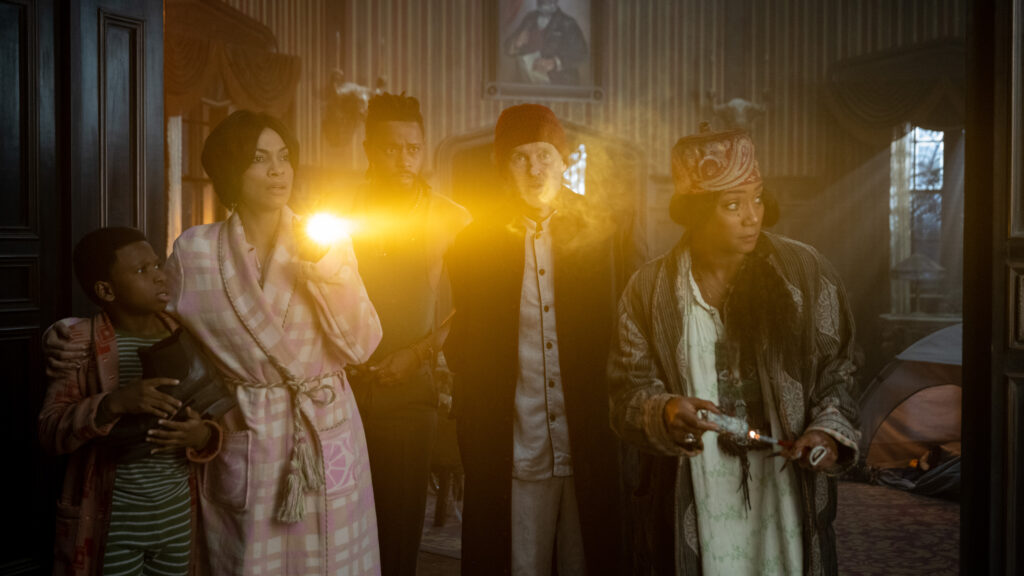
Chase W. Dillon, Rosario Dawson, LaKeith Stanfield, Owen Wilson and Tiffany Haddish in “Haunted Mansion” (Photo by Jalen Marlowe/Disney Enterprises, Inc.)

“Haunted Mansion”

Directed by Justin Simien

Culture Representation: Taking place in New Orleans, the comedy horror film “Haunted Mansion” (based on the Disney amusement park ride) features an African American and white cast of characters representing the working-class, middle-class and wealthy.

Culture Clash: A single mother and her son move into a haunted mansion and enlist several people (including a ghost tour guide, a history professor, a priest and a medium) to help get rid of the evil spirit haunting the house.

Culture Audience: “Haunted Mansion” will appeal primarily to people who are fans of the movie’s headliners, the Disney amusement park ride on which the movie is based, and mildly interesting but underwhelming horror comedies.
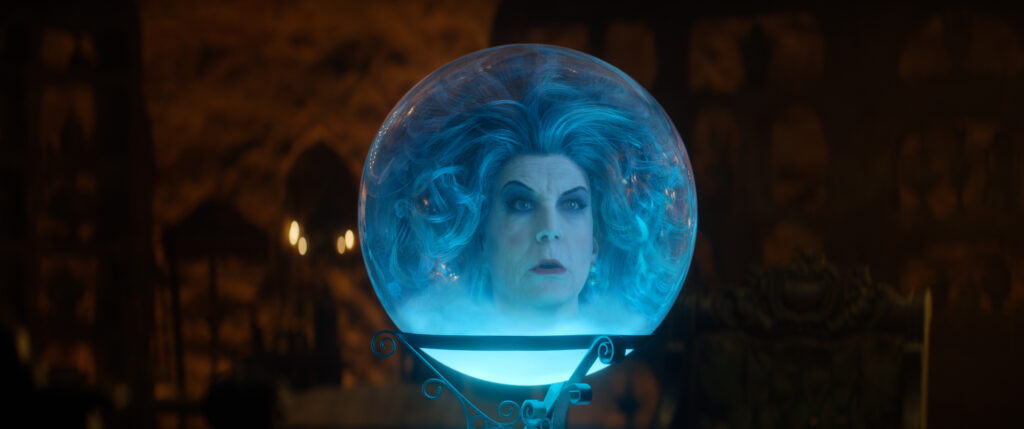
Jamie Lee Curtis in “Haunted Mansion” (Photo by Jalen Marlowe/Disney Enterprises, Inc.)

As a horror comedy, “Haunted Mansion” is built on a sinkhole of mishandled opportunities. The jokes are weak. The action is underwhelming. This stale reboot isn’t a complete waste of time, but it’s disappointing, considering the talented people involved. But it’s not too surprising, considering there’s nothing much that’s truly innovative in this lazy “Haunted Mansion” retread that has a lot of annoying product placement mentions incorporated into the mediocre dialogue.

Directed by Justin Simien and written by Katie Dippold, “Haunted Mansion” is a reboot of the 2003 comedy film “The Haunted Mansion” (starring Eddie Murphy), which was also a not-very-funny movie version of Disney’s iconic Haunted Mansion amusement park ride. The 2023 “Haunted Mansion” movie could have done so many unique and fantastic things for the story, but instead took the most obvious and boring route possible: A family moves into a haunted mansion, experiences terror from an evil spirit, and then must find an artifact previously owned by the ghost, in order to cast the spell that will permanently send the evil spirit away.

It takes an awfully long time for “Haunted Mansion” (which clocks in at a little more than two hours) for the characters to get to the revelation of how to get rid of the ghost. The “adventure” part of the story doesn’t really start until the movie is more than halfway over. Until then, “Haunted Mansion” is just a series of scenes where characters are introduced, and then they babble and argue about different ways to find out the secret of this haunted mansion. Just because certain characters get a lot of screen time, doesn’t mean that viewers will really learn a lot about these characters during the course of the movie.

“Haunted Mansion” was filmed on location in New Orleans, where the story takes place. Although the 2023 “Haunted Mansion” movie has an ensemble cast, the story’s chief protagonist is a former astrophysicist named Ben Matthias (played by LaKeith Stanfield), who now works as a “ghost tour” guide in New Orleans. Ben’s wife Alyssa (played by Charity Jordan), who died in a car accident, used to have this job. Near the beginning of the movie, a flashback shows that Alyssa and Ben met at a New Year’s Eve party. During their flirtatious conversation, Alyssa told him that she was a ghost tour guide, and she invited him on a tour, even though Ben says he doesn’t believe in ghosts.

Ben and Alyssa’s marriage is never shown in the movie, except for a few fleeting and superficial scenes of them cuddling as spouses. The problem with this void in the story is that a huge part of the plot hinges on Ben’s grief over Alyssa’s death. Viewers only get a quick “drive-by” version of the marriage. And therefore, there’s not much context given for Ben’s grief, since he barely talks about the marriage in the movie. Stanfield’s performance as Ben is perfectly adequate (Ben has a big emotional scene toward the end of the movie), but Stanfield also looks bored for a great deal of the movie.

Ben gets mixed up in the haunted house hijinks when he gets a visit from a wisecracking priest named Father Kent (played by Owen Wilson), who tells Ben that someone wants to hire Ben for a paranormal investigation of a mansion that is believed to be haunted. Ben immediately says no, but Ben changes his mind when he finds out that he’ll be paid $1,000. Ben takes the job because he desperately needs the money. Ben also has a “paranormal” camera that he invented because he thinks this camera can take photos of ghosts.

The person whose mansion needs to be investigated for paranormal activity is a doctor named Gabbie (played by Rosario Dawson, in a capable but bland performance), who has moved from New York to New Orleans with her 9-year-old son Travis (played by Chase W. Dillon), who is intelligent, sensitive and a bit nerdy. Gabbie’s deceased mother used to own this mansion, which Gabbie and Travis found out was haunted on the first night that they both stayed there as residents. And where is Travis’ father? That information is revealed later in the story.

To Ben’s surprise, his paranormal camera works and takes a photo of the ghost at the mansion. An investigation reveals that the mansion, which was built in 1888, used to be owned by a wealthy man named William Gracey (played by J.R. Adduci), who bought the house for his ailing wife Eleanor Gracey (played by Erika Coleman). A psychic medium named Madame Leota (played by Jamie Lee Curtis) and an affluent real-estate heir named Alistair Crump (played by Jared Leto), who both lived in New Orleans during that era, also factor into the story.

Alistair’s story is an obvious spoof commentary of Donald Trump’s story. It should come as no surprise to many viewers which character is the story’s villain. Leto appears in “Haunted Mansion” as a CGI ghost that looks like a tuxedo-wearing version of the Cryptkeeper from “Tales from the Crypt.” The Madame Leota character is trapped in a crystal ball, so only Madame Leota’s talking head is shown for most of Madame Leota’s screen time. It’s all very ho-hum horror.

Joining the investigation are a loudmouthed psychic/medium named Harriet (played by Tiffany Haddish) and a cranky professor of history named Bruce Davis (played by Danny DeVito), who is the most oddly placed character in the movie. Due to sloppy film editing and a jumbled screenplay, Bruce randomly shows up here and there and doesn’t do much but say things that often offend the other characters. There’s a scene where Bruce spends the night at the haunted mansion, with no good explanation for why he’s sleeping there.

“Haunted Mansion” is very deficient in character development. Almost all of the characters don’t have fully formed personalities, but are only playing “types.” Harriet sure likes to talk a lot (she’s the character with the most “product placement” lines), but by the end of the movie, there’s nothing interesting that has been revealed about Harriet. Travis is supposedly treated like an outcast by his student peers at school, based on what he tells people, but the movie never shows Travis in school. Father Kent has a secret that is so obvious and not surprising at all when it’s revealed. Ben is the only “Haunted Mansion” character who has something resembling a backstory, but it’s shown in fleeting clips.

As an example of how much the 2023 “Haunted Mansion” movie squanders the chance to bring some memorable flair to the story, the movie severely under-uses a sassy character named Vic (played by Dan Levy), who is a tour guide for the Crump mansion, which has been declared a historic landmark. Vic is in the movie for less than 10 minutes. There’s a scene where Vic is entertaining guests at the Crump mansion with a sing-along, but everything is only heard (not seen) in another room, for a brief moment that last less than 30 seconds.

It’s incredibly mind-boggling and foolish to waste the talents of Emmy-winning “Schitt’s Creek” star Levy by barely featuring him in the movie. The “Haunted Mansion” audience is teased with the fact that Levy’s Vic character is a music performer, but the movie never shows Vic actually being a music performer. Also very under-used is Winona Ryder, who has a quick cameo as another Crump mansion tour guide named Pat. Ryder’s screen time in “Haunted Mansion” is less than three minutes of uttering forgettable dialogue.

The blame for these bad decisions lies mostly with director Simien, whose previous films “Dear White People” and “Bad Hair” (he wrote and directed both movies) had elements of sharp satire that are absent from “Haunted Mansion,” which is admittedly a family-oriented movie. But even if “Haunted Mansion” is supposed to be a tame horror comedy that shouldn’t be too scary or too edgy for underage kids, Simien seems to have been worn down by the Disney corporate machine, to the point where “Haunted Mansion” has no spark or creative vision. Simien’s real-life amusing personality does not shine through in this generically directed movie. And that’s a shame, because the 2023 “Haunted Mansion” movie had the opportunity to be an instant classic.

Compared to the 2003 “Haunted Mansion” movie, the 2023 “Haunted Mansion” mansion movie benefits from better technology for more advanced visual effects. However, in the 20 years between the releases of the two “Haunted Mansion” movies, Disney has not offered a reboot with a better story than its predecessor. The 2023 “Haunted Mansion” film exists as a hollow promotional tool for the Disney amusement park ride and the companies that paid for the movie’s awkward and shameless product placements.

Walt Disney Pictures will released “Haunted Mansion” in U.S. cinemas on July 28, 2023.

Review: ‘Halloween Ends,’ starring Jamie Lee Curtis, Andi Matichak, James Jude Courtney, Will Patton, Rohan Campbell and Kyle Richards

October 15, 2022

by Carla Hay

Jamie Lee Curtis and Michael Myers, also known as The Shape (played by James Jude Courtney), in “Halloween Ends” (Photo by Ryan Green/Universal Pictures)

“Halloween Ends”

Directed by David Gordon Green

Culture Representation: Taking place in 2019 and 2022, in the fictional Haddonfield, Illinois, the horror flick “Halloween Ends” has a predominantly white cast of characters (with a few African Americans) representing the working-class and middle-class.

Culture Clash: Serial killer Michael Myers is on the loose again and will murder anyone who gets in his way.

Culture Audience: “Halloween Ends” will appeal primarily to people who are fans of the “Halloween” movie franchise and star Jamie Lee Curtis, but anyone who sees this movie should brace themselves for a disappointing bore that fails in suspense and storytelling.

Andi Matichak and Rohan Campbell in “Halloween Ends” (Photo by Ryan Green/Universal Pictures)

There’s no other way to put it: “Halloween Ends” is a cesspool of bad filmmaking decisions. By now, most horror fans know that the “Halloween” move franchise (which began with 1978’s “Halloween,” directed by John Carpenter) follows the seemingly endless saga of masked serial killer Michael Myers (also known as The Shape), who somehow manages to survive after being shot, stabbed, beaten, and set on fire. Because indestructible Michael Myers has unrealistically escaped death so many times, the “Halloween” franchise now implies that he’s not completely human and there’s something supernatural about him.

In the first “Halloween” movie, Laurie Strode (played by Jamie Lee Curtis), who was a high school student at the time, was a survivor of his Halloween night massacre in the fictional Haddonfield, Illinois. Laurie and some of her teenage peers were babysitting on that deadly night. The Laurie Strode character has appeared off and on in “Halloween” movies ever since, with all reboots and sequels failing to live up to the groundbreaking and terrifying original “Halloween” movie.

“Halloween Ends” has been described as the third movie in a “Halloween” trilogy directed by David Gordon Green, beginning with the 2018 “Halloween” reboot and continuing wth 2021’s “Halloween Kills.” The 2018 reboot of “Halloween” was good enough to show there was potential to restore the “Halloween” franchise back to being critically acclaimed horror instead of the mindless schlockfest that the franchise turned out to be. “Halloween Kills” foreshadowed that the quality of the franchise was sliding back into idiotic territory. “Halloween Ends” is the proverbial nail in the coffin that solidifies the unfortunate pattern of filmmakers ruining the “Halloween” franchise with mind-numbing and silly stories.

“Halloween Ends” was written by Green, Paul Brad Logan, Chris Bernier and Danny McBride. (It’s usually not a good sign when a movie has at least four credited screenwriters, because the screenplay usually ends up having “too many cooks in the kitchen” syndrome.) How bad is “Halloween Ends”? Michael Myers’ killing spree doesn’t begin until nearly one hour into this horrific misfire. There’s not enough Laurie Strode and too much of a dull romance between Laurie’s granddaughter and an accused killer.

The movie begins on Halloween night in Haddonfield in 2019. A 21-year-old college student named Corey Cunningham (played by Rohan Campbell) has been hired to babysit a boy named Jeremy Allen (played by Jaxon Goldenberg), who’s about 9 or 10 years old. Jeremy’s parents (played by Candice Rose and Jack William Marshall), who don’t have first names in the movie, are going out for the night to a Halloween costume party. Corey is nerdy and socially awkward, but he’s also very responsible and has plans to go to graduate school.

Before the parents leave for the party, Mrs. Allen tells Corey that ever since the Michael Myers massacre that took place during Halloween the previous year (as shown in “Halloween Kills”), Jeremy has been very fearful, he’s been wetting his bed, and he’s been hearing voices. Corey tells her that’s a normal reaction that a lot of kids would have. What Corey also finds out is that Jeremy is a little bit of a spoiled brat who likes to get his own way.

Jeremy insists on watching a horror movie on TV with Corey. When the violence in the horror movie gets too intense, Corey decides that they should stop watching the horror movie, which he thinks isn’t appropriate viewing for a child of Jeremy’s age. Jeremy wants to keep watching the horror movie though and says he’s not afraid of the horror movie or Michael Myers.

Jeremy smirks to Corey: “Michael Myers kills babysitters, not kids.” (Apparently, Jeremy never heard what Michael Myers did in 2018’s “Halloween,” where a pre-teen child became a Michael Myers murder victim.) Jeremy puts up a little bit of fuss for Corey telling Jeremy what they can and can’t watch on TV.

The next thing Corey knows, Jeremy goes missing in the house, but Corey can hear Jeremy’s voice taunting him and laughing at him in the distance. Some sloppy film editing then shows Corey locked in an upstairs closet by Jeremy, who is standing nearby in the hallway but who refuses Corey’s demands to unlock the closet door. Corey kicks his way out of the closet with such force, it knocks Jeremy over the stairwell, with Jeremy falling to an instant death on the floor of the house’s foyer.

And what a coincidence: Jeremy’s parents come home just seconds after Jeremy’s fatal fall. When they open the front door, Jeremy’s bloodied and broken body is right in front of them. Jeremy’s mother wails and screams at this gruesome sight. Jeremy’s parents immediately think that Corey killed Jeremy on purpose. A panicked and remorseful Corey is arrested and proclaims that Jeremy’s death was an accident.

“Halloween Ends” then flashes forward to 2022. Laurie now owns a house in Haddonfield, where she lives with her granddaughter Allyson (played by Andi Matichak), who is Laurie’s only grandchild. “Halloween Kills” showed what happened to Allyson’s divorced mother Karen (played by Judy Greer), who was Laurie’s only child. What happened to Karen is also mentioned at the beginning of “Halloween Ends.” Laurie, who is now apparently working on a memoir, is shown in various “Halloween Ends” scenes typing on her laptop computer and reading parts of her memoir in ominous voiceovers.

Laurie says that that she bought the house as “a place to live with love and trust—not a trap, not a place to hide.” Allyson, who is in her mid-20s, works as a nurse at a local hospital. Laurie seems to be at peace with her past and is no longer hiding from Michael Myers. But there would be no “Halloween Ends” movie if Michael Myers (played by James Jude Courtney) were completely out of of Laurie’s life. It’s later revealed in “Halloween Ends” where Michael has been hiding in Haddonfield.

Meanwhile, Corey has had a rough time in Haddonfield because he’s a social outcast who is still thought of as a child killer by many members of the community. Although it’s not shown in the movie, it’s mentioned that Corey went on trial for Jeremy’s death and was found not guilty. Corey’s reputation was ruined anyway.

Corey currently lives with his parents and works as a mechanic in his father’s mechanic shop. Corey’s father Ronald (played by Rick Moose) is easygoing and compassionate, while Corey’s mother Joan (played by Joanne Baron) is domineering and impatient. Both parents firmly believe in Corey’s innocence.

One day, Corey is standing outside a local convenience store, when four teenagers approach him to ask him to buy them some beer. The names of the teenagers are Terry (played by Michael Barbieri), Stacy (played by Destiny Mone), Billy (played by Marteen) and Margo (played by Joey Harris). Terry is the leader of these teenage troublemakers.

When Corey declines the teens’ request to buy alcohol for them, they begin to insult Corey by calling him names such as “psycho babysitter.” Laurie happens to arrive outside and sees this bullying. The teens then begin to taunt Corey and Laurie, by calling them “the psycho and the freak show.”

Corey is holding a glass bottle of chocolate milk, and he gets so angry that he squeezes the glass bottle until it breaks, thereby injuring his hand. The teens just laugh and go into the grocery store. Laurie then takes out a knife and asks Corey if he or she should use the knife to slash a tire of the car that the teens used to get there. Corey then takes the knife and does the tire slashing.

Laurie insists that Corey go to the local hospital, where Corey happens to get medical treatment from Allyson. There’s an immediate attraction between Corey and Allyson, but Corey is too shy to act on it. Corey mentions that he’s a mechanic at the local mechanic shop, and he recently got a used motorcylce, given to him by his father. Allyson uses this information as an excuse to visit Corey at his job so that he can give her lessons on how to ride a motorcycle.

And so begins the most tedious part of “Halloween Ends”: the courtship of Corey and Allyson. This limp romance drags down the movie to the point where viewers will be wondering where Michael Myers and Laurie are. The misleading marketing for “Halloween Ends” makes it look like Laurie and Michael Myers are in most of the movie, but “Halloween Ends” actually takes a long and unwelcome detour into Corey’s world.

Allyson’s estranged father happens to be a Haddonfield cop named Officer Mulaney (played by Jesse C. Boyd), who acts like a stalker by showing up in the same places where Allyson is, and complaining that she never contacts him or returns his messages. Allyson is never happy to see him. Needless to say, Officer Mulaney (who has no first name in the movie) disapproves of Allyson dating Corey.

Laurie keeps an open mind about Corey, because she knows what it’s like to be misjudged. Some people in Haddonfield blame Laurie for causing Michael Myers to come back. There’s a scene where a wheelchair-using, mute, middle-aged woman named Sondra (played by Diva Tyler) and Sondra’s sister (played by Leila Wilson) happen to be in the same store parking lot as Laurie. Sondra’s sister angrily confronts Laurie and says that Sondra is “damaged” because of Michael Myers, and the sister berates Laurie for tempting Michael Myers back to Haddonfield.

As the romance between Corey and Allyson begins to blossom, there are hints that Laurie’s love life could also be heating up. In “Halloween Kills,” it was revealed that a Haddonfield cop named Frank Hawkins (played by Will Patton) was a young rookie on duty during the 1978 Halloween night when Michael Myers went on his massacre. Frank, who’s supposed to be about four or five years older than Laurie, has had a crush on Laurie ever since. In “Halloween Kills,” Frank and Laurie ended up in the same hospital room together, where they discovered their mutual attraction to each other.

Frank is still interested in dating Laurie, but she’s been more hesitant about getting into a romantic relationship with anyone. And so, for much of Laurie’s screen time, Frank is sometimes hanging around like a lovesick puppy who wants some sign of affection from Laurie. Is this a romantic drama or a horror movie?

Because “Halloween Ends” veers so far into being a romantic drama for much of the movie’s scenes, the tone of the movie is very disjointed and awkward. “Halloween Kills” character Lindsey Wallace (played by Kyle Richards), a survivor of Michael Myers’ 1978 massacre, returns in “Halloween Ends” as a good friend of Laurie’s. In “Halloween Ends,” Lindsey is a totally useless character who just stands around and looks sympathetic to Laurie. “Halloween Ends” gives Lindsey no character development or further insight into Lindsey’s life. Sheriff Barker (played by Omar J. Dorsey) from “Halloween Kills” also returns for a smaller role in “Halloween Ends.”

“Halloween Ends” has a yammering radio DJ character named Willy the Kid (played by Keraun Harris), from a local radio station called WURG “The Urge,” and his annoying voiceovers pepper some of the scenes with commentary about the legend of Michael Myers. As soon as this radio DJ character’s voice keeps showing up in the movie, you just know that sooner or later, Willy the Kid will be seen in person, and his fate is easily predicted. There’s also an unnamed, elderly homeless man (played by Blaque Fowler) who lives near some abandoned tunnels in Haddonfield. His purpose in the movie is also very obvious.

Because “Halloween Ends” takes so long for Michael Myers to actually appear, some viewers might be wondering during the first half of the movie if this is a “Halloween” movie spinoff, not a “Halloween” movie sequel. Curtis makes an effort to bring some gravitas and emotional resonance to her role. However, the rest of the cast members’ performances in the movie are mediocre and unremarkable. The scenes of Michael Myers on a killing spree have a “been there, done that” formulaic quality that look like tired retreads of previous “Halloween” movies.

Note to filmmakers of future “Halloween” movies: People want to see a “Halloween” movie to have mostly Michael Myers horror scenes, not lukewarm romance scenes that take up too much of the story and look like something from a bland soap opera. That’s why “Halloween Ends” not only fails to live up to the hype but it’s also a horror movie that lacks edge, originality and truly terror-inducing scenes. In other words, “Halloween Ends” is a ripoff and a complete waste of time.

Universal Pictures released “Halloween Ends” in U.S. cinemas and on Peacock on October 14, 2022.

Review: ‘Everything Everywhere All at Once,’ starring Michelle Yeoh, Ke Huy Quan, Stephanie Hsu, James Hong, Jamie Lee Curtis, Tallie Medel and Jenny Slate

March 23, 2022

by Carla Hay

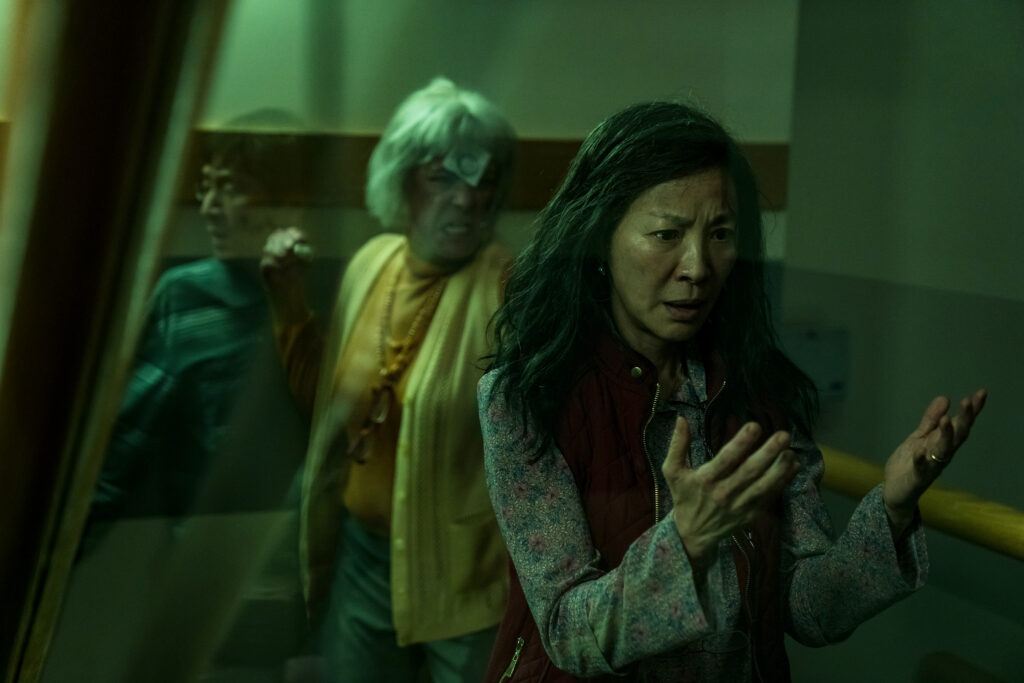
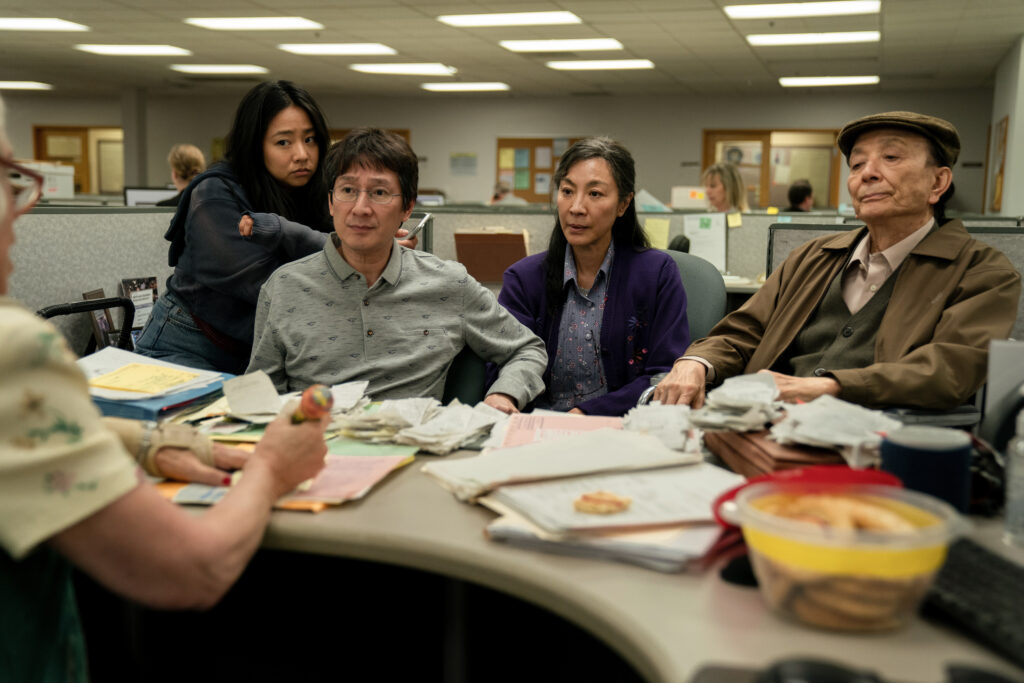
Ke Huy Quan, Jamie Lee Curtis and Michelle Yeoh in “Everything Everywhere All at Once” (Photo by Allyson Riggs/A24)

“Everything Everywhere All at Once”

Directed by Daniel Kwan and Daniel Scheinert

Some language in Mandarin and Cantonese with subtitles

Culture Representation: Taking place in unnamed cities and various dimensions, the sci-fi action film “Everything Everywhere All at Once” features a cast of Asian and white characters (with a few Latinos) representing the working-class and middle-class.

Culture Clash: A laundromat owner, who has troubled relationships with her husband and young adult daughter, finds out that she and other people she knows have different lives in other dimensions. 

Culture Audience: “Everything Everywhere All at Once” will appeal primarily to people who don’t mind watching very unique and sometimes deliberately confusing movies with a time-travel component.

Stephanie Hsu, Ke Huy Quan, Michelle Yeoh and James Hong in “Everything Everywhere All at Once” (Photo by Allyson Riggs/A24)

The frenetic, genre-blurring “Everything Everywhere All at Once” sometimes tries too hard to be eccentric, but this highly innovative film stands out for refusing to play it safe. Get ready for a bumpy and bizarre ride. There’s so much hyperactive editing in the movie that speeds though different times and spaces, viewers might feel like they just went through the cinematic version of a psychedelic experiment after the movie is over.

Daniel “Dan” Kwan and Daniel Scheinert (also known as filmmaking duo Daniels) wrote and directed “Everything Everywhere All at Once,” which takes leaps and bounds across different genres, from sci-fi to action, in a mash-up of a comedic tone and a dramatic tone. At the core is the story of a family that is falling apart in the beginning of the film, and the family members find themselves gaining new perspectives when they discover what their lives would be like as other beings in different times and places. It’s not a film for people who want conventional structures in the movie. Underneath all the craziness in the movie is a story with a heartfelt message of love and acceptance.

“Everything Everywhere All at Once” starts off looking like it’s going to be a typical family drama. Evelyn Wang (played by Michelle Yeoh) is a domineering and stern matriarch who is trying to keep her family’s laundromat business afloat in the midst of some personal turmoil: Evelyn and her mild-mannered husband Waymond Wang (played by Ke Huy Quon) are at a breaking point in their marriage. Divorce papers have been drawn up, and the movie eventually reveals who was the one who filed for divorce.

Evelyn and Waymond live above the laundromat together. Evelyn’s father Gong Gong (played by James Hong), who has traditional Chinese views on life, has been staying with them for a visit. Evelyn and Waymond have a daughter in her early 20s named Diedre “Joy” Wang, who is an out-of-the-closet lesbian or queer woman. Joy (who tends to get easily irritated by her mother) has been happily dating laid-back Becky Sregor (played by Tallie Medel), who is accepted by Joy’s parents, even though Evelyn is afraid to tell Gong Gong that Becky is Joy’s girlfriend.

When Evelyn introduces Becky to Gong Gong, she describes Becky as Joy’s “good friend,” which upsets Joy. However, Joy doesn’t correct her mother about misleading Gong Gong about the true nature of Joy and Becky’s relationship. Evelyn and Joy have been having tensions over Joy thinking that Evelyn doesn’t completely accept who Joy is. And who can blame Joy for feeling this way? Evelyn is the type of mother who tells Joy: “You have to eat healthier. You’re getting fat.”

One day, the four members of the Wang family visit an IRS agent named Deirdre Beaubeirdra (played by Jamie Lee Curtis) in an audit meeting about their tax returns. Deirdre is a frumpy and grumpy accountant who becomes a little impatient at how the family doesn’t have some of the documents that she needs to complete her work. Evelyn is preoccupied with an upcoming party that she wants to have for the laundromat’s customers. One of the invited customers is someone whom Evelyn only calls Big Nose (played by Jenny Slate), who has a Pomeranian dog as her constant companion.

It’s at this IRS office that things start to get weird. Waymond takes Evelyn aside and tells her that he’s not really her husband but he’s really a being from another dimension who needs her help to save his world. Things happen with an umbrella; ear buds where people pick up various audio frequencies; giant black circles; and a slew of flat, plastic eyes (similar to rag doll eyes) that all take the story through various twists and turns. The being who says he’s not Waymond calls himself Alpha Waymond, and he comes from the Alphaverse.

Without giving away too much information, it’s enough to say that some of the various incarnations of the characters in the movie include two people who are live-in lovers and have hot dogs for fingers, so they have to do a lot of things with their feet; two people who become rocks and have silent conversations with each other; and a chef named Chad (played by Harry Shum Jr.), who has a raccoon living under his chef’s hat. There are fights involving martial arts, gun shootouts and some very strange rituals that might make some people squirm and/or laugh.

All of the cast members fully commit to the full range of wildly different characters that they have to portray in the film. Yeoh is the obvious standout because of Evelyn’s central story arc in the movie. Even for people with short attention spans, “Everything Everywhere All at Once” might be too much of a spectacle overload. But if you’re prepared for a unique cinematic experience and have the curiosity to absorb it all, “Everything Everywhere All at Once” might make you further appreciate filmmaking that takes bold risks.

A24 will release “Everything Everywhere All at Once” in select U.S. cinemas on March 25, 2022. A special one-night-only fan event will take place at select IMAX theaters in the U.S. (with cast members appearing in person at select locations) on March 30, 2022. The movie’s release expands to more U.S. cinemas on April 8. 2022.

Review: ‘Halloween Kills,’ starring Jamie Lee Curtis, Judy Greer, Andi Matichak, Will Patton, Thomas Mann and Anthony Michael Hall

October 16, 2021

by Carla Hay

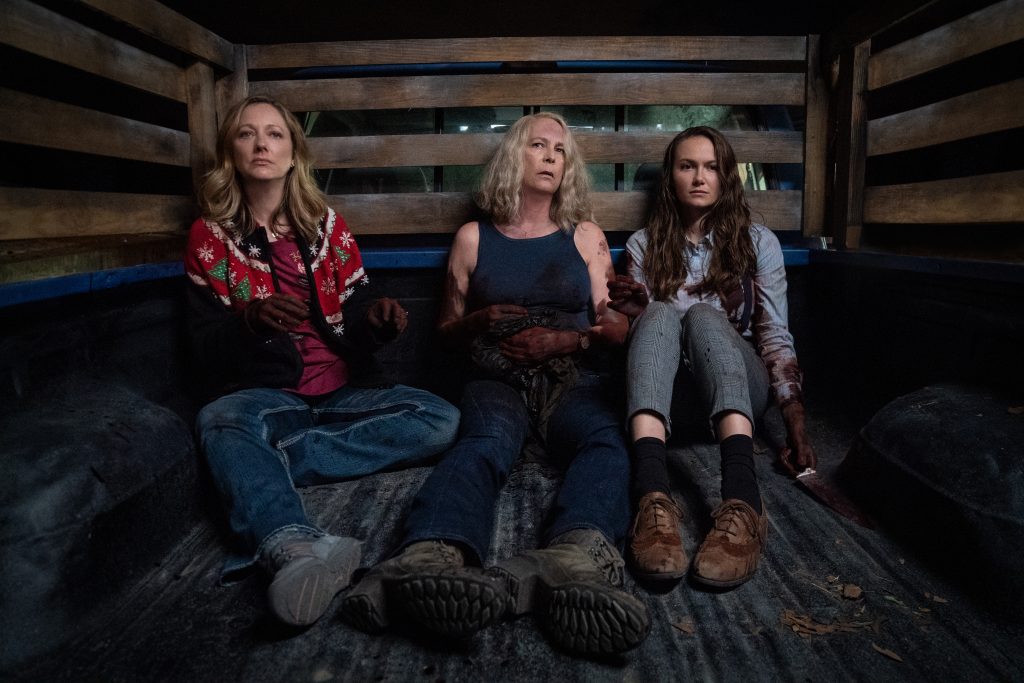
Judy Greer, Jamie Lee Curtis and Andi Matichak in in “Halloween Kills” (Photo courtesy of Universal Pictures)

“Halloween Kills”

Directed by David Gordon Green

Culture Representation: Taking place in 2018, in the fictional Haddonfield, Illinois, the horror flick “Halloween Kills” has a predominantly white cast of characters (with a few African Americans) representing the working-class and middle-class.

Culture Clash: Serial killer Michael Myers is on the loose again and will murder anyone who gets in his way.

Culture Audience: “Halloween Kills” will appeal primarily to people who are interested in watching horror movies that care more about creating bloody murder scenes than creating any suspense or an interesting story.

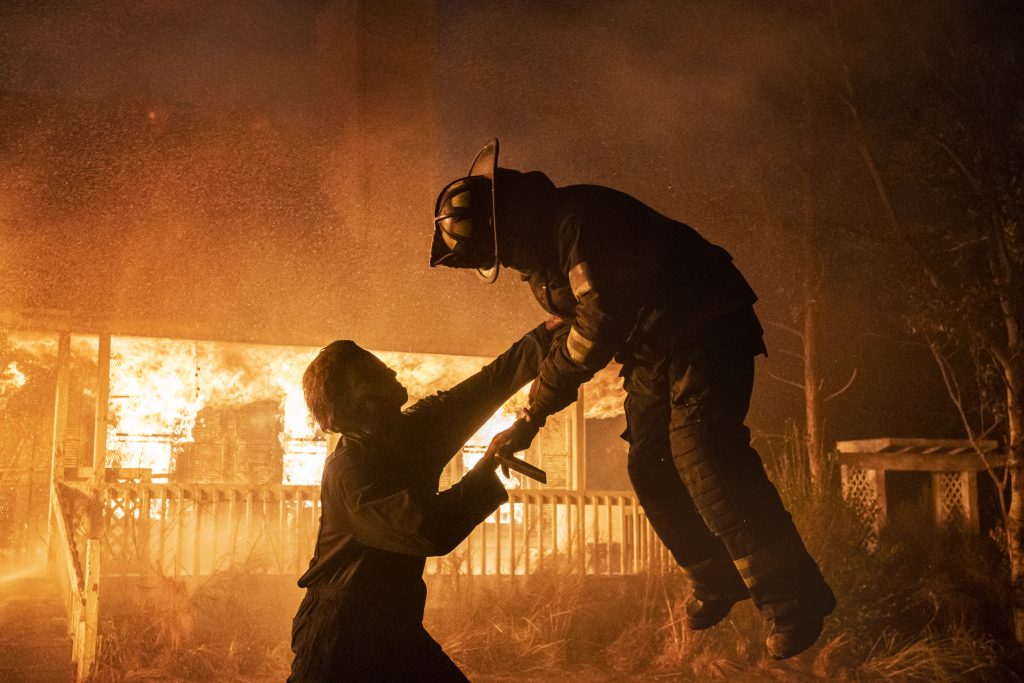
Michael Myers (also known as The Shape, pictured at left) in “Halloween Kills” (Photo courtesy of Universal Pictures)

“Halloween Kills” is an apt description for what this boring slog of a horror movie does to further destroy the already damaged “Halloween” franchise. It also commits the unforgivable sin of confining “Halloween” icon Laurie Strode to a hospital for most of the movie. Horror movie aficionados will find nothing scary about this cynical cesspool of lazy filmmaking, because “Halloween Kills” is just a series of gory murders thrown into an incoherent and flimsy plot.

The 2018 “Halloween” movie indicated that Jamie Lee Curtis’ Laurie Strode character (the most famous survivor of mask-wearing serial killer Michael Myers) would return to the franchise as an active hero doing battle against Michael Myers, who is also known as The Shape. The movie also introduced Laurie’s estranged daughter Karen (played by Judy Greer) and Karen’s daughter Allyson (played by Andi Matichak) into the mix, to make this hunt for Michael Myers a multi-generational family mission. At the end of the movie, Laurie and Karen had begun to mend their relationship, with Allyson being somewhat of a bridge between the two.

In “Halloween Kills,” which picks up right after the 2018 “Halloween” movie ended, any expectation that Laurie, Karen and Allyson would join forces is shattered. The three women spend most of the movie apart from each other. And when they are together, they often bicker with each other about who should or shouldn’t go after Michael Myers, who has returned to his hometown of Haddonfield, Illinois, to wreak more havoc on Halloween night. (“Halloween Kills” was actually filmed in North Carolina.) Meanwhile, men dominate in the planning of vigilante mob actions that play out in “Halloween Kills” in the most ludicrous ways.

David Gordon Green directed 2018’s “Halloween” and “Halloween Kills,” and he co-wrote both movies with Danny McBride. Jeff Fradley was the third co-writer of 2018’s “Halloween,” while Scott Teems was the third co-writer of “Halloween Kills.” It’s difficult to know if replacing Fradley with Teems is the reason why the quality of the “Halloween Kills” screenplay took a noticeable descent into moronic hell. The 2018 “Halloween” movie is by no means a classic horror flick, but it’s an exceedingly better film than the dreck of “Halloween Kills.” The director is chiefly responsible for how a movie turns out, so it’s disappointing that Green chose to coast off of the success of his “Halloween” movie and churn out such a formulaic and unimaginative dud with “Halloween Kills.”

Simply put: “Halloween Kills” wallows in the worst stereotypes of awful horror flicks. Characters go into a house alone to try and confront the extremely dangerous killer on the loose. When opportunities come to capture or kill the murderer once and for all, characters stand around talking to (or screaming at) the mute psycho killer Michael Myers, as if they think striking up a one-way conversation with him will suddenly turn him to a reasonable, law-abiding citizen. (In “Halloween Kills,” Michael Myers is portrayed by three actors: James Jude Courtney and Nick Castle in the 2018 scenes and Airon Armstrong in the 1978 scenes.)

And even though this serial killer is murdering people all over town, police officers and ambulances are mysteriously absent for most of the mayhem because almost all the imbecile characters in this movie usually don’t call 911. The nonsensical explanation in the movie is that the vigilante citizens think they can take Michael Myers on their own. Many of them think the Haddonfield police are incompetent. But that still doesn’t explain why the police aren’t showing up in force anyway.

And worst of all for a horror movie: There’s almost no suspense and nothing is truly terrifying. Gruesome? Yes. Scary? No. It’s very easy to predict who will die and who will survive in this movie. There’s also the predictable ending scene of someone who might or might not be dead. (It’s the most obvious way for a horror movie to set up a sequel.) The murders are done in such a monotonously routine way, it would be understandable for viewers to think that Michael Myers is sleepwalking. There is absolutely nothing creatively done in this movie when it comes to the plot, dialogue or action sequences.

“Halloween Kills” also squanders a compelling idea of reuniting many of the characters who survived the Michael Myers massacre that took place in the original 1978 “Halloween” movie. Several characters are introduced as having a meaningful connection to “Halloween” lore, but “Halloween Kills” won’t let viewers get to know these characters in a meaningful way. There are flashbacks in “Halloween Kills” that are ultimately a waste of time.

In one such flashback, which takes place in 1978 during Michael Myers’ first massacre in Haddonfield, viewers see a rookie cop in his 20s named Hawkins (played by Thomas Mann) and his older, more experienced partner Pete McCabe (played by Jim Cummings) on the scene. They are among the first cops to respond to this emergency. It’s enough to say that McCabe doesn’t make it out alive, but Hawkins does. In 2018, Hawkins (played by Will Patton) is still a Haddonfield cop, and he’s been wounded in this latest Michael Myers massacre.

Laurie is also wounded, because Michael stabbed her in the abdomen, as shown in 2018’s “Halloween.” She’s first seen in “Halloween Kills” bleeding profusely and in agony in the back of a truck with Karen and Allyson, as the truck speeds to the nearest hospital. It’s at this hospital that Laurie will stay for most of her screen time in “Halloween Kills.” She’s sidelined into being either being unconscious or, when she wakes up, being a cranky grandmother who thinks she knows best when it comes to who should go after Michael Myers.

And what a coincidence: A wounded Hawkins ends up being in the same hospital room as Laurie. There’s an almost laughable backstory put in “Halloween Kills” that Laurie and Hawkins had a flirtation with each other back in 1978. And so, in the midst of all the madness and mayhem with this latest Michael Myers killing spree, Laurie and Hawkins make goo-goo eyes at each other in their hospital beds, as they reminisce about their “could’ve been” near-miss romance. It’s an example of how off-the-rails this movie is in keeping Laurie mostly out of the action.

Besides Laurie and Hawkins, these are the other Haddonfield survivors from the original 1978 massacre who become targets of Michael Myers in the 2018 massacre:

  • Tommy Doyle (played by Anthony Michael Hall): In 1978, Laurie was babysitting Tommy and his sister on the Halloween night when Michael Myers went on his deadly rampage. Tommy’s sister became one of Michael Myers’ murder victims.
  • Lindsey Wallace (played by Kyle Richards): She was also a kid in 1978, and her babysitter was murdered by Michael Myers that night.
  • Marion Chambers (played by Nancy Stephens): She was the nurse of the late Dr. Loomis (played by Donald Pleasance), the psychiatrist who was treating Michael Myers when Michael escaped from the psychiatric institution on that fateful Halloween in 1978. (Stephens reprises her role that she had in 1978’s “Halloween” movie.)
  • Lonnie Elam (played by Robert Longstreet): When he was 9 or 10 years old, he had a near-miss encounter with Michael Myers on a sidewalk on Halloween night 1978. (Tristian Eggerling portrays Lonnie as a child in a flashback scene.)

“Halloween Kills” also has some other characters who encounter Michael Myers on Halloween night in 2018. Lonnie’s son Cameron Elam (played by Dylan Arnold) happens to be Allyson’s boyfriend. Cameron is also the person who finds a wounded Hawkins on the street. It’s one of the few times that someone in this movie has the common sense to call 911 for help. But that’s not what happens later in the movie when Lonnie, Cameron and Allyson foolishly decide to hunt down Michael Myers on their own.

Married couple Marcus (played by Michael Smallwood) and Vanessa (played by Carmela McNeal), who are dressed in Halloween costumes as a doctor and a nurse, meet Tommy at a local bar and quickly befriend him after he gets up on stage and talks about being a Michael Myers survivor. And there’s a gay couple named Big John (played by Scott MacArthur) and Little John (played by Michael McDonald), who work together in real estate. Big John and Little John happen to live in the house that Michael Myers used to live in before Michael was sent to a psychiatric institution in 1963 for killing his 17-year-old sister Judith when he was 6 years old. What are the odds that Michael will go back to his childhood home when Big John and Little John are there?

Michael Myers was supposed to be in his 20s in 1978, which means that he’s getting too old to have the type of superhuman strength that he has in these “Halloween” movies. He’s also been “killed” in several ways in various “Halloween” movies, but he still keeps coming back. All of that is explained in “Halloween Kills” when Laurie gives an absurdly bad monologue about how she’s come to the conclusion that Michael Myers is not human and he feeds off of people’s fear of him.

The “mob justice” aspect of “Halloween Kills” is idiotic and badly mishandled. Expect to see Tommy shout, “Evil dies tonight!” multiple times, as it becomes a rallying cry for the vigilante crowd. Just by coincidence, two psychiatric patients have escaped that night from a psychiatric institution that held Michael Myers. It’s a plot contrivance that’s set up for a silly “mistaken identity” subplot.

Even though the people of Haddonfield should know by now what Michael Myers’ height and general physical build should be (his body type hasn’t changed since 1978), the crazed vigilantes go after one of these escapees who’s considerably shorter and stockier than Michael Myers. Apparently, for this mob, any old psychiatric hospital escapee will do.

Karen is the only one with an iota of common sense to notice that this escapee doesn’t have Michael Myers’ physical characteristics. As the practical-minded Karen, Greer gives the best performance of this movie’s cast members. However, that’s not saying much because everyone’s acting in “Halloween Kills” is mediocre overall.

Oddly, there’s a lone elderly cop in uniform who gets swept up in the vigilante mob. His allegiances are never really clear. One minute, he seems to want to try to stop the mob madness. The next minute, he seems to be going along with the crowd. He doesn’t ask for backup from his fellow police officers. The only thing that’s clear is that he’s a terrible cop who should be fired and can kiss that pension goodbye.

There are many plot holes in “Halloween” that the filmmakers want to cover up with some cringeworthy dialogue and bloody action sequences. “Halloween Kills” has so much arguing and melodrama in a hospital, viewers will be wondering: “Is this a horror movie or a soap opera?” At one point, Laurie rips out her medical tubes and injects herself in the rear end with a painkiller. If you waited your whole life to see Laurie Strode give herself a butt injection, then “Halloween Kills” is the movie for you.

During one of her hospital rants, Laurie says to Karen about why Michael Myers is still on the loose and what Laurie wants to do about it: “The system failed … Let him come for me! Let him take my head as I take his! … You and Allyson shouldn’t have to keep running because of the darkness I created.”

But wait a minute, Laurie. “Halloween Kills” doesn’t want you to take all the credit for Michael Myers going on a rampage. Hawkins thinks Michael Myers is on this killing spree because of Hawkins. He makes a guilt-ridden confession that doesn’t make any sense at all for why Hawkins would be the reason for Michael Myers’ serial killings. There’s a badly written flashback scene involving a cover-up that wouldn’t be plausible in the real world because of autopsy reports and how bullet trajectories would be investigated.

It’s not as if viewers should expect a terrible horror movie like “Halloween Kills” to be realistic. But the movie just doesn’t offer a horrifying mystery, engaging new characters, or even twist-filled “hunt for the killer” chase scenes. It’s all so predictable, hollow and generic. “Halloween Kills” puts too much emphasis on a mindless and forgettable mob of people while sidelining Laurie Strode, the most memorable and iconic hero of the “Halloween” franchise. That’s the real injustice in “Halloween Kills.”

Universal Pictures released “Halloween Kills” in U.S. cinemas and on Peacock on October 15, 2021.

2019 CinemaCon: What to expect at this year’s event

April 1, 2019

by Carla Hay

CinemaCon

CinemaCon, the annual convention for the National Association of Theatre Owners (NATO), will be held April 1 to April 4, 2019, at Caesars Palace in Las Vegas. About 5,000 people attend the event, which gives movie studios the chance to showcase what they expect to be their biggest hits of the year.

A major change to this year’s event is that Sony Pictures Entertainment and 20th Century Fox will not be giving presentations. Movie studios scheduled to give their presentations at the event are STX Films and Warner Bros. Pictures on April 2; Universal Pictures and Walt Disney Pictures on April 3; and Paramount Pictures and Lionsgate on April 4.

Independent film studio Neon will promote its music-based drama “Wild Rose” with a screening of the movie on April 1 and a “Wild Rose” party on April 2. Other movies that will be screened in their entirety at CinemaCon 2019 will be Warner Bros. Pictures’ “Blinded by the Light” on April 2, Amazon’s “Late Night” on April 3 and Lionsgate’s “Long Shot” on April 4.

CinemaCon culminates with the CinemaCon Big Screen Achievement Awards ceremony, which will take place April 4.

Here are the announced winners of the awards:

CinemaCon Icon Award
Steve Buscemi

Steve Buscemi (Photo by Kristina Bumphrey/Starpix)

One of the most respected actors in the entertainment industry, Emmy-winning “Boardwalk Empire” star Steve Buscemi has played a wide range of characters in movies and television. His most memorable films include 1992’s “Reservoir Dogs,” 1996’s “Fargo” and 2001’s “Ghost World.” He has also voiced several roles in hit animated movies such as 2017’s “The Boss Baby,” and the “Hotel Transylvania” films. Buscemi’s 2019 film is the horror comedy, co-starring Adam Driver, Chloë Sevigny, Bill Murray and Tilda Swinton.

CinemaCon Vanguard Award
Jamie Lee Curtis

Jamie Lee Curtis (Photo by Andrew Eccles/Universal Pictures)

In a career spanning more than 40 years, Jamie Lee Curtis has made her mark in the film industry, beginning with her starring role in her movie debut: the 1978 horror classic “Halloween.” She has starred in multiple “Halloween” sequels, most notably 2018’s “Halloween,” which made her the first woman over the age of 60 to star in a movie that debuted at No. 1 in the United States. Curtis’ other well-known movies include the 1980 horror flick “Prom Night,” the 1988 comedy “A Fish Called Wanda,” the 1994 action film “True Lies” and the 2003 remake of the comedy “Freaky Friday.” Curtis has two films due out in 2019: the crime drama “Knives Out” and the comedy “Senior Entourage.”

CinemaCon International Star of the Year
Kevin Hart

Kevin Hart (Photo by David Lee)

Kevin Hart is one of the busiest people in showbiz, with starring roles in movies, TV and Web series, in addition to headlining successful arena tours. The year 2019 started out with the dramedy “The Upside” (starring Hart and Bryan Cranston) debuting at No. 1 in the United States. His 2018 comedy film “Night School” was also a hit.

CinemaCon Ensemble Award: The Cast of “Terminator: Dark Fate” – Linda Hamilton, Natalia Reyes, Mackenzie Davis and Gabriel Luna

Natalie Reyes, Mackenzie Davis and Linda Hamilton of “Terminator: Dark Fate” (Photo by Kerry Brown)

“Terminator: Dark Fate” is the 2019 entry in the longtime “Terminator” film series. “Terminator: Dark Fate” stands out from the rest of the films in the series because the cast is led by women: Linda Hamilton (who starred in the first two “Terminator” movies), Natalie Reyes and Mackenzie Davis. The movie’s cast also includes Gabriel Luna. Original “Terminator” star Arnold Schwarzenegger is reportedly making a cameo appearance.

CinemaCon Directors of the Year
Anthony Russo and Joe Russo

Joe Russo and Anthony Russo (Photo by Gareth Cattermole/Getty Images)

Director brothers Joe Russo and Anthony Russo helmed the superhero movie “Avengers: Endgame,” which is expected to be the biggest box-office blockbuster of 2019. The Russo brothers also directed several other Marvel movie blockbusters, including 2018’s “Avengers: Infinity War,” 2016’s “Captain America: Civil War” and 2014’s “Captain America: The Winter Soldier.”

CinemaCon Action Star of the Year
David Harbour

David Harbour (Photo by Marion Curtis/ StarPix for Summit Entertainment)

David Harbour might be best-known as a co-star of Netflix’s horror series “Stranger Things,” but he’s aiming to make a big splash in movies by starring as the title character in the 2019 superhero flick “Hellboy.” Harbour takes over the role that was originated by Ron Perlman.

Cinema Spotlight Award
Octavia Spencer

Octavia Spencer  (Photo by Todd Williamson/Getty Images for Fox Searchlight Pictures)

Octavia Spencer won an Oscar for Best Supporting Actress for her breakthrough role in 2011’s “The Help.” She has also has Oscar nominations for her supporting roles in 2016’s “Hidden Figures” and 2017’s “The Shape of Water.” Spencer has branched out into producing films, including the 2019 horror flick “Ma,” where she has a starring role.

CinemaCon Male Star of Tomorrow
Henry Golding

Henry Golding (Photo by Kelsey McNeal/ABC)

Henry Golding made his feature-film debut with a starring role in the 2018 blockbuster romantic comedy “Crazy Rich Asians.” He was also in the 2018 crime thriller “A Simple Favor,” co-starring Anna Kendrick and Blake Lively. Golding has re-teamed with “A Simple Favor” director Paul Feig for the 2019 romantic comedy “Last Christmas,” co-starring Emilia Clarke, Emma Thompson (who wrote the movie’s screenplay) and “Crazy Rich Asians” co-star Michelle Yeoh.

CinemaCon Female Stars of Tomorrow
Beanie Feldstein and Kaitlyn Dever

Beanie Feldstein and Kaitlyn Dever (Photo by Francois Duhamel)

Beanie Feldstein and Kaitlyn Dever co-star in the 2019 comedy “Booksmart,” about two straight-laced best friends who decide to go wild on the day before their high-school graduation. Feldstein is also known for her supporting roles in the 2018 Oscar-nominated comedy film “Lady Bird” and the 2016 comedy film “Neighbors 2: Sorority Rising,” while Dever is a co-star of the comedy series “Last Man Standing.” Dever’s other recent film roles include the 2018 dramas “Beautiful Boy” and “The Front Runner.”

CinemaCon Breakthrough Director of the Year
Olivia Wilde

Olivia Wilde (Photo by Vivien Killilea/Getty Images)

Olivia Wilde made her directorial feature-film debut with the 2019 comedy film “Booksmart,” which got rave reviews when it had its world premiere at the SXSW Film Festival. Wilde is an accomplished actress who has starred in such films as 2018’s “Life Itself” and 2010’s “Tron: Legacy.” She is also known for her past TV roles in the medical drama “House” and the nighttime soap opera “The O.C.”

CinemaCon Comedy Stars of the Year
Seth Rogen and Charlize Theron

Seth Rogen and Charlize Theron (Photo by Philippe Bossé)

Seth Rogen and Charlize Theron play unlikely love interests in the 2019 political comedy film “Long Shot.” Rogen is best known for his comedic roles in movies (such as 2007’s “Knocked Up,” 2008’s “Pineapple Express” and the “Neighbors” films), while Theron does mostly dramatic and action movies, including 2005’s “Monster” (for which she won an Oscar for Best Actress), 2015’s “Mad Max: Fury Road” and 2017’s “Atomic Blonde.”

Other awards that will be given at the ceremony:

  • CinemaCon International Filmmaker of the Year Award: Graham King, producer of 2018’s “Bohemian Rhapsody”
  • CinemaCon Passpartout Award: Helen Moss, Paramount Pictures senior vice president of international distribution
  • NATO Marquee Award: John D. Loeks, Studio C chairman
  • Career Achievement in Exhibition Award: Jérôme Seydoux, Pathé co-chairman/CEO and Les Cinémas Gaumont Pathé chairman/CEO
  • Lifetime Achievement Award: Anthony Bloom, Cineworld Group chairman
Copyright 2017-2026 Culture Mix
CULTURE MIX