
Review: ‘Neighborhood Watch’ (2025), starring Jeffrey Dean Morgan, Jack Quaid, Cecile Cubiló, Jack Klock and Malin Akerman

April 25, 2025

by Carla Hay

Jeffrey Dean Morgan and Jack Quaid in “Neighborhood Watch” (Photo courtesy of RLJE Films)

“Neighborhood Watch” (2025)

Directed by Duncan Skiles

Culture Representation: Taking place in Alabama, the dramatic film “Neighborhood Watch” features a predominantly white cast of characters (with a few African Americans) representing the working-class and middle-class.

Culture Clash: A mentally ill man witnesses a young woman being kidnapped and teams up with a grouchy neighbor to solve the mystery of the kidnapping.

Culture Audience: “Neighborhood Watch” will appeal primarily to people who are fans of stars Jeffrey Dean Morgan and Jack Quaid, but this limp and unrealistic movie will disappoint fans of crime-solving stories.

Jeffrey Dean Morgan and Jack Quaid in “Neighborhood Watch” (Photo courtesy of RLJE Films)

The slow-moving drama “Neighborhood Watch” is tainted with unfunny jokes and a tacky portrayal of mental illness. It’s a wretched and uninspired story of two mismatched neighbors who team up to solve a kidnapping mystery. None of it looks believable.

Directed by Duncan Skiles and written by Sean Farley, “Neighborhood Watch” (formerly titled “Nowhere Men”) takes place in various cities in and near Birmingham, Alabama. And even though “Neighborhood Watch” was filmed on location in Alabama, almost no one in the movie sounds like they’re from Alabama. That’s not the only phony-looking thing about “Neighborhood Watch,” which is filled with too many nonsense scenes that insult viewers’ intelligence. It’s really a shame because the movie has some well-known cast members who are capable of doing much better work.

“Neighborhood Watch” begins by showing a man in his early 30s named Simon McNally (played by Jack Quaid) going to interview for a server job at Flapjack’s Diner of Birmingham. Simon (who lives in the suburban city of Homewood) has a mental illness that is not named in the movie. However, he seems to have schizophrenia because he hears voices in his head that insult and berate him. He also hallucinates seeing a disheveled and shirtless elderly man (played by Jonathan Fuller and voiced by William Reyes), who appears when Simon gets nervous or afraid.

The interview is a disaster. The manager (played by Melanie Jeffcoat) who is interviewing Simon looks at his job application and asks Simon why he hasn’t been employed for the past 10 years. Simon is honest and tells her that he has medical problems and was in a hospital. He then nervously hides one of his wrists, which has cutting scars. The manager notices the scars anyway.

Simon can sense that he’s not making a good impression. But things get worse. During the interview, the voices in his head begin again, and he hallucinates seeing the old man. Simon then shouts, “The color of this lady is do not sleep tonight!” The manager asks if Simon is okay, even though he’s clearly not okay.

Simon denies that anything is wrong, but it’s too late. Based on the manager’s reaction, Simon knows he’s not getting the job. It’s later revealed that when Simon gets very anxious, he blurts out “word salad” sentences that make no sense. He later says his brain feels scrambled when these “word salad” episodes happen. Simon is usually passive but he has a nasty, violent and unpredictable temper that comes out in random moments.

Simon lives in a house with his older sister DeeDee McNally (played by Malin Akerman), a third-year nursing student who works part-time at a beauty salon. DeeDee is having financial problems (she’s avoiding phone calls that she gets from a mortgage company), but she hides details of these problems from Simon. DeeDee will only tell Simon that he needs to get a job because they need the money. Much later in the movie, DeeDee mentions that she gets only $200 a month in state disability payments for being Simon’s guardian.

Meanwhile, Ed Deerman (played by Jeffrey Dean Morgan) is an unemployed grouch who lives next door to Simon and DeeDee. Ed, who lives alone, has an addiction to online gambling that has left him almost financially broke. He also has health issues: He has a prescription for Rampiril that he refuses to take, and he has an enlarged prostate, but he ignores advice to get medical help.

One day, Ed shows up unannounced at his former job at Kenzer Community College, where Ed worked as senior director of security and surveillance operations. Ed has been replaced by a pompous egomaniac named Jeremy (played by Jack Klock), who is as problematic as Ed, but for different reasons that are revealed later in the movie. It’s soon shown why aggressive and stubborn Ed has the type of personality that got him fired.

Ed is at a school cafeteria when he sees a male student (played by Will Deusner) stealing some muffins and bagels in a salad-bar serving area. Ed maces the student, hauls him into the security office, tells Jeremy that he caught the student stealing food from the school cafeteria, and demands that Jeremy call the police to have the student arrested. Jeremy refuses because Ed overreacted by illegally macing the student, who is let go with a warning.

Ed then berates Jeremy for not doing a good job and complains about the low quality of locks on campus. Jeremy responds by giving Ed this blistering comment: “There are two types of failures in this world: has-beens and never-wases. And you are a never-was. I think it would be best for everyone if you don’t come around here for a while.”

“Neighborhood Watch” juxtaposes these two introductory scenes of Simon and Ed to make it obvious that even though meek Simon and domineering Ed seem to be complete opposites, they are both sad sacks who are “misunderstood” and rejected by people around them. It’s all so formulaic because you know “Neighborhood Watch” is going to be the type of movie that has stereotypes of two clashing personalities who end up spending time with each other and have to find a way to work together for a common goal. And in movies about two people trying to solve a crime together, it’s become quite the cliché to have one of the people as an older cynic, while the other person is naïve and less-experienced.

One day, while a dejected Simon is walking down a street near his house, he sees a young prostitute (played by Chatham Kennedy), whose name is later revealed to Anya, getting pushed around in an alley by her pimp (played by Billy Culbertson), whose name is later revealed to be Walsh. Simon then sees Anya getting shoved into the back of the van against her will. Simon hears voices in his head taunting him about being too wimpy to do anything about this crime. He decides to prove the voices in his head wrong by running after the van. The van drives away, but Simon memorizes the license plate number.

Simon doesn’t have a car and apparently doesn’t have a cell phone because he’s never seen using a cell phone in the movie. Instead of going to the police right away, Simon goes to Ed’s house to ask for a car ride to try to find the kidnapped woman. It’s in this scene that it’s revealed why Simon is a pariah in the neighborhood.

Ed rudely refuses to help Simon because Ed says he still remembers when Simon punched two police officers in the middle of the road, and there were reporters in the neighborhood for two days straight after that incident. Ed angrily asks Simon, “Do you have any idea what that kind of publicity does to neighborhood property values?”

Simon then goes to the Homewood Police Department to report the crime. The official who takes the report is Detective Glover (played by Cecile Cubiló), who looks very uninterested. Simon gives vague descriptions of the kidnapper and the kidnapping victim and admits he didn’t get a good look at the kidnapper’s face. However, Simon remembers the license plate number of the van. Detective Glover takes all the information and asks Simon for his date of birth.

After he leaves, Detective Glover does a background check on Simon and finds out that he has an arrest record for disorderly conduct and he was sentenced to a psychiatric facility. Detective Glover assumes that Simon’s mental illness lowers his credibility and thinks he could be lying about witnessing a kidnapping. Later, when Simon calls Detective Glover to ask if there’s an update on the case, she tells him that the license plate number that he gave to her was registered to a vehicle that was pulled over that morning in a place that was 300 miles away. She makes it clear that she doesn’t believe Simon.

Simon then goes back to Ed and begs for help again because Simon remembers that Ed worked in security or law enforcement. Simon tells Ed that the police won’t help because the police don’t believe Simon. Ed is a wannabe police detective, so he agrees to help Simon only find out who owns the kidnapper van, based on the license plate information that Simon has.

Vehicle ownership based on a license plate number is restricted information that is protected by certain privacy laws and can only be accessed by certain agencies and not by the general public. Ed warns Simon that the license plate information that Simon remembers could be faulty, such as the number five could be the letter “s,” or the number one could be the letter “i,” or any other variables, such as the license plate could have been stolen.

And this is when “Neighborhood Watch” really starts to get idiotic. A mild spoiler alert for anyone who wants to waste time watching this mind-numbing film: It takes literally half of this 92-minute movie for Simon and Ed to investigate the license plate number. They do many stupid things to drag out this bungled search, including going to the local Department of Motor Vehicles, where Ed thinks he can get this information from a DMV clerk, just by pretending to still be a security officer from Kenzer Community College.

Ed constantly acts like he’s extremely knowledgeable about detective work. And yet, Ed constantly leads Simon to commit crimes as part of their “sleuthing,” where they make all types of moronic mistakes, such as break into places where they leave their fingerprints and DNA everywhere. There’s a running “joke” in the movie that Ed thinks he can identify when someone is lying if they blink too much or don’t blink at all when they’re talking.

As for the characters of Simon and Ed: Quaid and Morgan have done these types of characters many times before—Quaid tends to play insecure and neurotic characters, Morgan tends to play gruff and bossy characters—so “Neighborhood Watch” is just more typecasting for Quaid and Morgan. By sheer coincidence, Quaid is in another 2025 movie where he also depicts a man with medical issues who’s turns into a vigilante while looking for a kidnapped woman: “Novocaine,” which is a far superior film to the sluggish “Neighborhood Watch.”

Almost nothing is revealed about Ed’s personal life. There’s a “blink and you’ll miss it” moment that is a very tiny clue. Shortly after Ed agrees to help Simon, there’s a scene in Ed’s home where Ed shows Simon that he uses a clock as a hiding place. One of the things hidden in the clock is a Kenzer Community College photo ID for a middle-aged woman named Kathy Deerman, whose job title is listed as director of dining services. It might explain why Ed was hanging out at a Kenzer cafeteria, but whoever Kathy is remains an unanswered question. It would be easy to assume that Kathy is Ed’s former wife.

Akerman’s DeeDee character is treated like a bookend: She’s only in the first part and last part of “Neighborhood Watch,” a cinematic dud that gets increasingly ridiculous—and not in an enjoyable way. There’s nothing special about the acting performances, while the movie’s screenplay and direction wallow in ineptitude. Simon’s mental illness is used as a story gimmick. Ultimately, this dreadful and boring movie is just a tired parade of predictability and nonsense.

RLJE Films released “Neighborhood Watch” in select U.S. cinemas, on digital and VOD on April 25, 2025.

Review: ‘Fall’ (2022), starring Grace Caroline Currey, Virginia Gardner and Jeffrey Dean Morgan

September 20, 2022

by Carla Hay
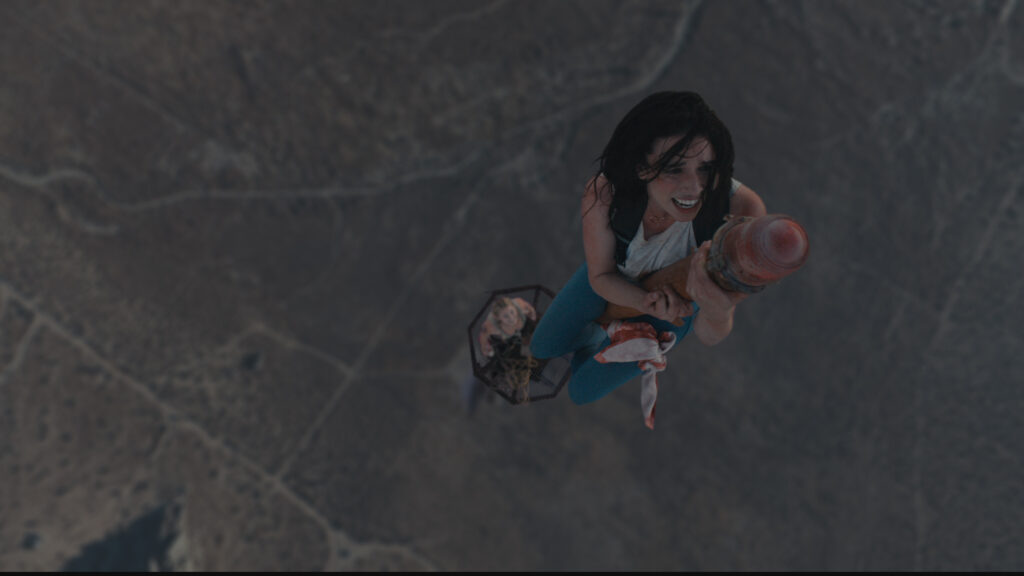
Grace Caroline Currey in “Fall” (Photo courtesy of Lionsgate)

“Fall” (2022)

Directed by Scott Mann

Culture Representation: Taking place in California, the dramatic film “Fall” features a predominantly white cast of characters (with a few African Americans) representing the working-class and middle-class.

Culture Clash: Two young women set an adventure challenge for themselves by climbing a 2,000-foot TV tower in a remote desert area in California, but then they get stranded on the tower without being able to get signals on their phones to call for help.

Culture Audience: “Fall” will appeal mainly to people who are interested in watching survival thriller movies that aren’t award-worthy but offer plenty of suspense and satisfactory entertainment.
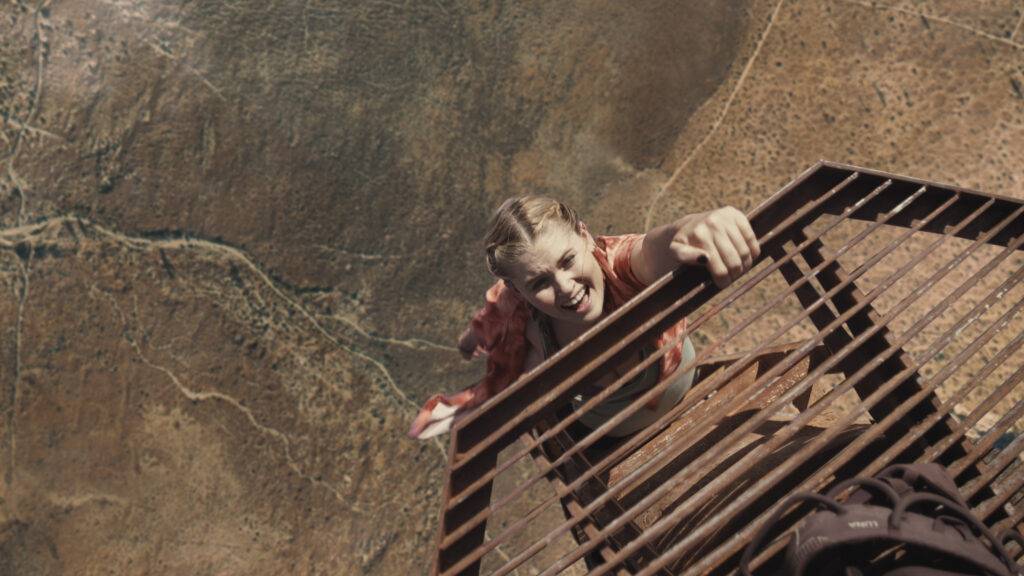
Virginia Gardner in “Fall” (Photo courtesy of Lionsgate)

“Fall” is a suspenseful “lives in peril” thriller with a key part of the story that requires some suspension of disbelief. The movie also runs longer than necessary. However, there’s enough realism and competent acting to overcome any of the movie’s flaws.

Directed by Scott Mann (who co-wrote the “Fall” screenplay with Jonathan Frank), “Fall” starts off as a fairly straightforward survival story, but it has two major plot twists that should surprise most viewers. One of the plot twists has a soap opera element to it, and it’s not as surprising as the other plot twist. “Fall” could have used better film editing, which drags out the movie’s middle section and then rushes the movie’s ending.

“Fall,” which takes place in California, opens with a scene of three adventurous people in their late 20s on a mountain climbing trip where they are using ropes for safety but are climbing the rocks with bare hands. The three people on this trip are Becky Connor (played by Grace Caroline Currey); Becky’s husband, Dan Connor (played by Mason Gooding); and Becky’s best friend Shiloh Hunter (played by Virginia Gardner), who wants to be called Hunter. Suddenly, a bird flies out of a crevice and startles Dan, who slips and falls to his death.

The movie’s timeline then fast-forwards nearly one year later (51 weeks, to be exact) and shows a grieving and depressed Becky, who has become a recluse on her way to becoming an alcoholic, if she’s not an alcoholic already. Her father, James (played by Jeffrey Dean Morgan), has become very worried about Becky’s physical and mental health, but she brushes off his concerns. She’s been ignoring his phone calls and avoiding him in other ways.

In one of his voice mail messages, James tells Becky: “A horrible thing happened to you, but you have to start living your life again. There’s a whole big, wide world that needs you. And believe it or not, I need you.” It’s mentioned early on in the movie that James did not approve of Dan, and it’s one of the reasons why Becky has been estranged from James.

One night, James sees a drunk Becky coming out of a bar. He offers to give her a ride home, but she refuses. James then tells Becky something that makes an emotional impact on her: James says that if Becky had died on that fateful trip, and Dan had lived, Dan would not be “drowning in his sorrows.” Later, when Becky is at home, she finds out that Dan’s cell phone number, which she had been calling just to hear his outgoing voice mail message, has now been disconnected.

Becky sees this phone disconnection as a sign that she should start trying to move on with her life. Around the same time, Becky hears from someone she hasn’t really been in touch with since Dan’s death: Hunter, the best friend who also witnessed everything in Dan’s fatal accident.

Becky and Hunter have had opposite reactions to Dan’s death. Becky has become emotionally withdrawn and is now terrified of heights. Hunter has become more of a daredevil and has created a social media persona for herself called Danger D, so that she can become famous for doing risky stunts.

Hunter has reached out to Becky to pitch an adventure challenge that Hunter wants to put on Hunter’s social media channels: Hunter and Becky will climb to the top of the B67 TV Tower, which is 2,000 feet high and in a remote desert area. The B67 TV Tower is a fictional name for the movie, but it’s based on the real-life 2,000-foot KXTV/KOVR radio tower, also known as the Sacramento Joint Venture Tower, in Walnut Grove, California. A much-smaller replica (about 60 feet high) of the Sacramento Joint Venture Tower was used for “Fall,” and the 2,000-feet-high appearance was created through visual effects.

Becky’s first reaction to Hunter’s invitation is to immediately say no. Hunter pleads with Becky: “It would be an adventure, like old times. And you can scatter Dan’s ashes on top [of the tower] … If you don’t confront your fears, you are always going to be afraid.”

After thinking about it for a short time, Becky agrees. She says to Hunter, “If you’re scared of dying, don’t be afraid to live. That’s what Dan used to say. Let’s do it. Let’s climb your stupid tower.”

The two pals go on the trip, which includes walking about one mile to get to the tower. The movie never really explains why Becky and Hunter couldn’t drive closer to the tower except to say that they just couldn’t. Another unexplained aspect of the story is why Becky and Hunter didn’t carry enough food and water with them for their tower climb. Hunter and Becky only brought a few granola bars and two bottles of water. It’s a foolish decision they will soon regret.

Becky and Hunter have their cell phones with them though. Hunter uses her phone to take photos and videos to post on social media. Hunter also announces to her several thousand followers on social media that she and Becky will be climbing the B67 TV Tower. When Becky and Hunter get to the tower, Becky hesitates and says she can’t go through with climbing it. But once again, Hunter convinces Becky to change her mind.

On the climb up, the movie foreshadows the danger to come by showing how, unbeknownst to Becky and Hunter, a few screws have come loose from the tower during the climb. Becky and Hunter are too far away to see these screws fall out of their sockets. However, what Hunter and Becky see is that this creaky tower is rusty and rickety, but that doesn’t stop them from continuing to climb up this shaky-looking structure.

Most people who see “Fall” will probably know before watching the movie that the story is about two women who get trapped on a very high tower in the desert. (It’s also shown in the movie’s trailer.) Hunter and Becky get trapped when the tower’s ladder falls down, due to the missing screws, and both women find out that they can’t get signals on their phones from where they are trapped on the tower.

The rest of “Fall” is about Hunter and Becky’s desperate efforts to get help, since the now-useless ladder was their only means of getting down from the tower. Becky and Hunter have ropes, but the ropes aren’t long enough to slide back down to the ground. Perhaps the movie’s biggest plot hole is that it tries to make it look like no one will come looking for Becky and Hunter. But this wasn’t a secret trip: Hunter already announced in real time on social media that she and Becky were going to climb this tower.

In the meantime, the movie depicts the dangers of being stranded in a remote area without enough food and water. And, as expected in a movie titled “Fall,” there are plenty of scenes that are meant to give the feeling of vertigo to anyone watching. Hunter and Becky come up with some ideas to try to get help, but there are some setbacks when they try these ideas.

When “Fall” tends to get repetitive and the pacing gets a little sluggish, what makes the movie worth watching are the believable performances by Currey and Gardner as estranged friends who share a tragedy and whose attempt to reconnect goes terribly wrong in many ways. No one is going to get nominated for any major awards for “Fall,” but the cast members are convincing in the roles that they perform for this movie. “Fall” also shows in effective ways that the movie isn’t only about conquering a fear of heights but also about conquering a fear of heartbreak.

Lionsgate released “Fall” in U.S. cinemas on August 12, 2022.

Review: ‘The Unholy’ (2021), starring Jeffrey Dean Morgan, Katie Aselton, William Sadler, Cricket Brown, Diogo Morgado and Cary Elwes

June 6, 2021

by Carla Hay

Cricket Brown in “The Unholy” (Photo courtesy of Screen Gems)

“The Unholy” (2021) 

Directed by Evan Spiliotopoulos

Culture Representation: Taking place primarily in the fictional town of Banfield, Massachusetts, the horror film “The Unholy” features a predominantly white cast of characters (with a few black people and Hispanic people) representing the working-class, middle-class and wealthy.

Culture Clash: A disgraced journalist discovers what appears to be a “miracle” teenager, who became cured of blindness and muteness, and seems to have the ability to heal others through the power of the Virgin Mary, but things take a sinister turn when people in the town start dying.

Culture Audience: “The Unholy” will appeal primarily to people who don’t mind watching predictable horror movies that have plot holes and aren’t very scary.

Jeffrey Dean Morgan and Katie Aselton in “The Unholy” (Photo courtesy of Screen Gems)

“The Unholy” is yet another drab and forgettable horror flick that uses Christianity as a plot device for the movie’s supernatural occurrences. It plods along at a dull pace with an easy-to-solve mystery and a storyline that gets more idiotic until the very hokey ending. “The Unholy” is based on James Herbert’s 1983 horror novel name, but you don’t have to read the book to know exactly how this movie is going to end because it’s so derivative of better-made horror movies that have similar themes.

Written and directed by Evan Spiliotopoulos, “The Unholy” has a group of cast members who show satisfactory talent in their roles. It’s too bad that their characters are written as shallow and mostly uninteresting. The protagonist is supposed to be a cynical and emotionally wounded individual, but not much is revealed about disgraced journalist Gerald “Gerry” Fenn (played by Jeffrey Dean Morgan), except for the damage he inflicted on his own career and that he likes to feed his ego by putting himself at the center of a news story.

And because much of the movie’s focus is on Roman Catholic religious beliefs, it’s utterly predictable that Gerry is a lapsed Catholic who seems to now identify as agnostic. What he might or might not believe when it comes to religion and spirituality can therefore fluctuate as he witnesses so-called “miracles” that seem to have a basis in Christianity. Gerry is supposed to be an investigative journalist, but his subpar investigative skills are almost laughable in this story because he misses very big clues.

“The Unholy” begins with a grisly scene of an execution-by-fire death in Boston in 1845. The person being torched by a small, angry mob of religious fanatics is an unnamed woman who’s accused of being a witch. She is bound, gagged, hanged by a tree, and then set on fire. The execution is shown from her perspective, as she sees the mob from the viewpoint of someone wearing a hood or a mask with holes for the eyes.

Now that the movie has given away the very obvious plot point that the mob and their descendants will be cursed, “The Unholy” then moves to the present day, where Gerry is driving to the small Massachusetts town of Banfield. There are empty bottles of liquor in his SUV, just so Gerry can be the cliché of the hard-drinking, grizzled journalist.

Gerry is a freelancer who’s been trying to claw his way back to respectability by chasing down whatever newsworthy stories that he can find. It’s revealed at one point in the movie that he used to be a staff reporter at a newspaper called The Examiner, where he made a name for himself as someone who got exclusives on sensationalistic and shocking news. However, Gerry was fired 10 years ago when he was caught fabricating a news story. Gerry is his own photographer/video camera operator, so there are several scenes of him using a professional camera when he stumbles onto a big story in Banfield.

“The Unholy” is so poorly written that it doesn’t adequately explain why Gerry went to Banfield in the first place. When Gerry arrives, all he sees is the town’s chief Catholic priest named Father William Hagan (played by William Sadler) telling a farmer to get the man’s cow off of the church property. The farmer lives next door to the church and the cow is in a field that’s on church property because the famer has a broken fence that hasn’t been fixed yet.

It’s not the type of news that a hard-nosed journalist like Gerry would realistically bother going to Banfield for, but it’s just a movie contrivance to put Gerry in the same outdoor field where he’ll see the mysterious tree that plays a big role in the story. Of course, viewers who’ve seen enough horror movies can automatically figure out that it’s the same tree where the “witch” was burned in 1845. The tree is later revealed to have a magical aura. But is it good or evil?

Gerry goes over to the tree and notices that there’s a doll inside a hollow part of the tree trunk. He takes out the doll, which is wrapped in deteriorated fabric, and sees that the doll has a label with the date February 31, 1845. February 31 doesn’t exist as a calendar date, but it’s later revealed why that incorrect date was placed on the doll’s label. Gerry just assumes that it was just a label error.

When the farmer sees the doll, he mentions to Gerry that it’s part of local legend that if someone breaks a talisman, it will unleash evil, and mutilations will begin. A skeptical Gerry is amused by this story and doesn’t believe a word of it. So what does he do? He smashes the doll. Of course he does, because how else would that explain what comes later in the movie?

Gerry doesn’t think there’s anything newsworthy to report in Banfield. And so, he starts to drive out of town through the deserted woods at night, as you do in a horror movie where something bad is supposed to happen when you’re alone in a dark, wooded area. As he’s driving, he sees a ghostly figure of a young woman, who’s barefoot and wearing a white flowing nightgown.

You know what happens next: He crashes his car when he swerves to avoid hitting this mysterious person. But when he gets out of the car, Gerry sees she isn’t in the street, so he starts looking for her in the woods. It turns out that she’s not a ghost, but a teenage girl who hasn’t been hit by the car but seems to be unconscious or in a trance. At this point, viewers know that Gerry is going to be in Banfield for a while.

Gerry carries the girl back to the church, which is the closest shelter he knows of in Banfield. The movie doesn’t show Gerry using his phone to call for help so she could go to a hospital first. No, that would be too logical for a silly movie like “The Unholy.” Conveniently, his car accident isn’t serious enough to cause significant damage to his car.

At the church, the girl regains consciousness. Gerry finds out that her name is Alice Padgett (played by Crickett Brown) and she’s the orphaned 15-year-old niece of Father Hagan. Alice lives with Father Hagan. And she’s also deaf and mute.

Shortly after she was found wandering in the woods, Alice begins to speak and hear. One of the first things that she says is: “The lady has an amazing message for all of us. She wants all of us to come tomorrow. She says her name is Mary.”

Gerry is excited about seeming to witness a “miracle,” so he takes photos and makes videos of Alice speaking and hearing, with the amazed reactions of Father Hagan and other people in the community. Whether or not Gerry thinks the miracle is real isn’t as important to him as the idea that this story could be his big comeback. He calls Monica Slade (played by Christine Adams), his former editor at The Examiner, to pitch her on this story about a deaf and mute girl who can now hear and speak.

Monica turns down the pitch because Gerry has damaged his reputation for fabricating stories and she’s skeptical that he’s telling her the truth. She also mentions that she still thinks that Gerry is as fame-hungry as he was when they worked together. Gerry is undeterred and decides to pursue the story on his own.

The next day, several people in the town, including Gerry and Father Hagan, have gathered to where Alice has led them: that big tree in the field owned by the church. Two parents named Dan Walsh (played by Dustin Tucker) and Sophia Walsh (played by Gisela Chipe) have brought their wheelchair-using son Toby Walsh (played by twins Danny Corbo and Sonny Corbo) to this gathering.

Alice immediately zeroes in on Toby and says to him, “Mary commands you to walk.” Toby replies, “I can’t.” Alice says, “Believe.” And sure enough, Toby gets up (hesitantly at first) and starts to walk. The crowd reacts exactly like how a crowd would react to witnessing a miracle. Meanwhile, Gerry is video recording and taking photos of what happened to Toby for Gerry’s news story, which has just now gotten much bigger.

The word quickly spreads about Toby gaining his ability to walk. And soon, it makes international news, and numerous people flock to Banfield to see Alice and maybe get some of the miracles that she now seems capable of making happen. The tree becomes a popular gathering place, as does the local Catholic church where Alice also makes appearances. Alice tells anyone who asks that she is only a vessel for Mary, which people assume is the Virgin Mary.

It’s mentioned in “The Unholy” that in order for something to be considered a true miracle, it must meet three criteria: (1) It has to cure what was medically diagnosed as incurable; (2) The cure must be instantaneous; and (3) The cure must be complete and permanent. It’s too bad that the elements of a good horror movie weren’t applied to “The Unholy,” such as (1) an interesting screenplay; (2) belivable scares/visual effects; and (3) actors who look fully enagaged, not like they’re just going through the motions.

It doesn’t help that the dialogue in the movie is so simplistic and boring. In one scene, a supporting character named Dr. Natalie Gates (played by Katie Aselton), who is Alice’s medical doctor, asks Alice what Mary really wants. Alice replies, “She wants faith.” This is basically the movie’s way of saying that Mary wants her own cult of believers, starting with anyone she can get in Banfield. Anyone who expresses doubt in Mary is punished.

The character of Dr. Natalie Gates is a stereotype of a potential love interest for the main protagonist in a formulaic movie like this one: At first, she acts like she’s not impressed by Gerry and she’s somewhat antagonistic toward him. But then, as they start to get closer, she warms up to him. It’s just all so predictable.

Gerry gets a lot of attention for being the first journalist to get this “miracle” story, which is compared in the news media to other famous Virgin Mary miracle stories, such as those in Fátima, Portugal or Lourdes, France. Gerry’s former boss Monica changes her mind about hiring him to do a news story for The Examiner. She calls Gerry to give the assignment, but she calls at the worst possible time, in an awkwardly written scene that happens later in the movie.

With all the media attention come moneygrubbers looking to cash in on the story. And soon, Banfield has all the characteristics of a tourist attraction, with people selling Virgin Mary merchandise and other memorabilia. Gerry is soaking up all the notoriety that he’s getting, but he notices that Alice has become increasingly obsessed with having a big ceremony where everyone will proclaim their allegiance to Mary.

Here’s where the movie falters when it comes to how it tries to incorporate the Catholic religion into the story. Although there are plenty of real-life examples of movements aimed at getting people to believe in or convert to Christianity, the Catholic religion would not have an entire ceremony dedicated to worshipping the Virgin Mary, because Jesus Christ or God is considered the supreme being.

Even if Gerry knew nothing about the Catholic religion (and he does because he’s supposed to be a lapsed Catholic), as a journalist covering this story, he’s supposed to do his research. And if he did, he would’ve found out that what Alice is doing looks suspiciously like what cult leaders do. It would be enough to set off warning signs to a good investigative journalist, but Gerry is too caught up in the praise and glory for getting exclusive news scoops for this story.

“The Unholy” also unrealistically ignores the vast number of people from a massive institution like the Catholic Church who would be involved in this story. Instead, the Vatican sends only two Catholic clergymen who come to Banfield to investigate. Each man has his own agenda on how they can be part of the growing spectacle.

Bishop Gyles (played by Cary Elwes) is a smirking clergy leader who dismisses and thwarts anyone who expresses doubts that what Alice is doing isn’t a true Christian miracle. Father Delgarde (played by Diogo Morgado) is a devout priest who’s more open-minded to hearing various opinions because he has debunked false miracle claims before. But because Father Deglarde is an underling of Bishop Gyles, Father Delgarde has to go along with whatever the bishop orders.

It’s easy to see that Bishop Gyles is invested in keeping the miracle stories going because he wants to use these stories as a way to boost his own career in the Catholic Church. Father Delgarde is mainly concerned with doing God’s work and is more diplomatic and open-minded than Bishop Gyles is, in looking at various possibilities. Gerry and Bishop Gyles both have big egos about this “miracle” story, so the two men have inevitable clashes, especially when things happen and Gerry starts to have doubts that Alice is acting on behalf of the Virgin Mary.

Because “The Unholy” is a horror movie, there are gruesome deaths that happen. And what is causing these miracles is eventually revealed. The answers won’t surprise anyone who’s seen enough of these type of religion-based supernatural horror movies. It all leads up to a very fire-and-brimstone climax that isn’t scary as much as it’s ridiculous, tacky and filled with bad dialogue.

As the characters of Gerry and Alice, “The Unholy” co-stars Morgan and Brown have the most screen time in the movie. Morgan is doing yet another version of the roguish characters that he tends to play. Brown fulfills her role of Alice morphing from a shy, innocent teenager into someone who is very aware of the power of persuasion. There isn’t much depth to any of the personalities in this movie. Bishop Gyles is nothing but a caricature.

“The Unholy” isn’t even a “guilty pleasure” bad movie that’s enjoyable. Very little effort was made in creating a good mystery that’s a challenge to figure out, and there are no mind-blowing plot twists. The visual effects look very cheap (especially the scenes involving fire) and none of the movie’s significant characters is particularly likable, except for Father Delgarde. If horror movies are considered the junk food of cinema, then “The Unholy” is the equivalent of something that’s more like the disposable wrapping rather than the food itself.

Screen Gems released “The Unholy” in U.S. cinemas on April 2, 2021, and on digital and VOD on May 25, 2021. The movie’s release date on Blu-ray and DVD is June 22, 2021.

Copyright 2017-2026 Culture Mix
CULTURE MIX