
Review: ‘I Know What You Did Last Summer’ (2025), starring Madelyn Cline, Chase Sui Wonders, Jonah Hauer-King, Tyriq Withers, Sarah Pidgeon, Freddie Prinze Jr. and Jennifer Love Hewitt

July 16, 2025

by Carla Hay

Chase Sui Wonders, Jonah Hauer-King, Sarah Pidgeon, Tyriq Withers and Madelyn Cline in “I Know What You Did Last Summer” (Photo by Matt Kennedy/Columbia Pictures)

“I Know What You Did Last Summer” (2025)

Directed by Jennifer Kaytin Robinson

Culture Representation: Taking place in 2024 and 2025, in the fictional Southport, North Carolina, the horror film “I Know What You Did Last Summer” (based on the novel of the same name) features a predominantly white cast of characters (with a few African Americans and multi-racial people) representing the working-class, middle-class and wealthy.

Culture Clash: A group of former high school friends are targeted by a serial killer who’s dressed as a hat-wearing, masked fisherman and who knows about the friends’ secret manslaughter involvement in the accidental car death of a young man. 

Culture Audience: “I Know What You Did Last Summer” will appeal primarily to people who are fans of the movie’s headliners, the “I Know What You Did Last Summer” franchise, and horror sequels that rely too heavily on nostalgia for earlier movies in the series.

Jennifer Love Hewitt and Freddie Prinze Jr. in “I Know What You Did Last Summer” (Photo by Matt Kennedy/Columbia Pictures)

The 2025 version of “I Know What You Did Last Summer” is one of several horror movie franchises (such as “Scream,” “Saw,” “The Exorcist” and “The Strangers”) that have been revived in the 2020s, in order to attract new generations of fans. The 2025 version of “I Know What You Did Last Summer” is an example of a franchise movie that goes overboard in fan-service nostalgia instead of building a creative new path. There are some plot holes, and the murder mystery is easy to solve when the body count increases. Most horror fans will find something to like about this reboot/sequel, but it’s not enough to save a movie that’s full of recycled ideas and unanswered questions.

Directed by Jennifer Kaytin Robinson, “I Know What You Did Last Summer” was co-written by Sam Lansky and Robinson. The movie is based on Lois Duncan’s classic 1973 young-adult novel of the same name. The book was adapted into the 1997 horror film “I Know What You Did Last Summer,” which spawned the dreadful 1998 sequel “I Still Know What You Did Last Summer.” The 2006 film “I’ll Always Know What You Did Last Summer” was released direct-to-video and had none of the characters (except for the Fisherman serial killer) that were in the first two “Last Summer” movies. There was also the 2021 short-lived Prime Video series “I Know What You Did Last Summer,” which flopped with critics and audiences.

The 2025 movie version of “I Know What You Did Last Summer” brings back at least two of the characters from the 1990s movies. In 2025’s “I Know What You Did Last Summer,” the ages have increased for the group of friends who made a pact to secretly cover up being involved in a man’s accidental death. In the 1990s movies (and in the original novel), the friends are teenagers in high school and then in college. In the 2025 version of “I Know What You Did Last Summer,” the friends are in their mid-20s, although some of them still act like teenagers in high school.

The movie begins on July 4, 2024, when Ava Brucks (played by Chase Sui Wonders) has arrived back in her hometown of Southport, North Carolina. Southport was the location of 1997’s “I Know What You Did Last Summer,” but this beach city has been transformed since the 1990s, due to gentrification. The formerly middle-class Southport is now an enclave to many affluent residents. In the movie, one of the characters describes Southport as “the Hamptons of the South.” (The 2025 movie version of “I Know What You Did Last Summer” was actually filmed in New South Wales, Australia.)

Ava (who graduated from high school in 2017) is among the people who grew up in a life of privilege in Southport. She’s also from a generation who wasn’t even born when the first wave of serial killings happened in Southport. Ava has come back to visit Southport to attend the Fourth of July engagement party of Danica Richards (played by Madelyn Cline), who was Ava’s best friend in high school.

Ava and Danica grew apart after they graduated from high school. They haven’t seen or spoken to each other in a few years because Ava stopped returning Danica’s calls and messages. Danica is engaged to marry Teddy Spencer (played by Tyriq Withers), who is the spoiled son of wealthy and powerful real-estate developer Grant Spencer (played by Billy Campbell) and his socialite wife Jill Spencer (played by Simone Annan), who is seen very briefly in the beginning of the film. Grant has a reputation for being the main reason why Southport has gentrified.

Also invited to this engagement party is someone whom Ava is somewhat nervous to see: Teddy’s best friend Milo Griffin (played by Jonah Hauer-King), who has a generic personality and who works in Washington, D.C., in some type of political job. Ava and Milo had a vague romantic attraction in high school. It seems like if Ava and Milo were ever a “couple,” it wasn’t a serious relationship, and it didn’t last. The point is that Ava and Milo are supposed to have sexual tension when they see each other again all these years later.

One of the biggest flaws in this version of “I Know You Did Last Summer” is that Ava unrealistically never mentions any of her family members when going back to her hometown. She’s seen getting dressed for the engagement party in a bedroom that is decorated the same way that she had it decorated in high school, which suggests that she’s in her former childhood bedroom. Her parents or other relatives (if she has any) are nowhere to be seen in the movie.

Ava is obviously supposed to be the movie’s main protagonist, but hardly anything is revealed about her life before and after she moved away from Southport. She never talks what she does for a living. She has limited and very superficial conversations with Danica about their friendship in high school. Ava tells Danica that she’s sorry about cutting off contact, but that’s about as revealing as their conversations go in the movie.

Danica’s family members are also invisible/non-existent in the movie. It’s a bizarre and unexplainable omission for someone who’s planning to have a lavish “high society” wedding. Danica talks a lot about shallow things, but not once does she mention who her family is. Danica might as well have been plopped into the movie like she got lost on the way to a “Real Housewives” reality show audition.

As the enagement party ends that night, the four reunited pals (Ava, Danica, Teddy and Milo) decide to continue their tradition of watching Fourth of July fireworks from a cliffside view. Teddy is ready to get very drunk and stoned. He’s already tipsy on alcohol, and he’s got some marijuana that he smokes on the way there. Ava also indulges in some of the marijuana smoking.

Before they drive off, the four friends notice two workers from the restaurant/bar that catered the party: Stevie Ward (played by Sarah Pidgeon) and Hannah Decker (played by Georgia Flood) are busy packing up some supplies. Hannah is a member of Southport Trinity Church, which has a creepy and overly zealous leader named Pastor Judah (played by Austin Nichols), who is introduced fairly late in the movie. Stevie is invited to join the four pals to watch the fireworks.

Why are Ava, Danica, Teddy and Milo interested in hanging out with Stevie? In dialogue that’s basically an exposition dump, it’s quickly explained that Stevie used to be a close friend of Ava, Danica, Teddy and Milo when they were in high school. However, Stevie’s life went downhill after her father was sent to prison for some type of fraud that caused her family’s finances to be ruined. Stevie developed an addiction that landed her in rehab while her former friends went away to college and seemed to forget all about Stevie.

Ava, Danica, Teddy and Milo feel some guilt about abandoning their friendship with Stevie at a low point in her life, which is why they invite her to watch fireworks with them. Stevie declines the offer at first because she says she has to finish working that night. But she is persuaded to join the group.

On a winding cliffside road, Teddy is drunk and stoned when he gets out of the car and starts acting like an idiot in the middle of the road. He narrowly avoids being hit by one car. A pickup truck drives up less than minute later and swerves to avoid hitting him. The truck crashes through a guardrail and is hanging over a steep cliff. The only person in the truck is the driver: a young man who’s barely conscious.

Ava, Danica, Teddy, Milo and Stevie panic about what to do as the car tilts precariously off the cliff. Anyone who goes inside the truck to try to pull out the driver could cause the truck to fall over the cliff. And then, the worst-case scenario happens: The truck falls over the cliff with the driver trapped inside. It’s a different scenario than the original “I Know What You Did Last Summer,” which had a hit-and-run accident.

Teddy calls 911 to report seeing the truck go over the cliff, but he tells the others that he won’t tell authorities what caused the accident, and he insists that they all leave the scene of this manslaughter crime before police and anyone else sees them. Ava and Stevie are the only ones in the group who think they should wait for the police to arrive and tell the truth about everything that happened. Danica and Teddy (who don’t want their wedding to be ruined by this scandal) are the ones who feel strongest about keeping what happened a secret.

Eventually, all five of them make a pact to keep it a secret. However, Teddy later reveals that he told his father Grant, in case he needs Grant to help him get out of trouble. Grant has obvious motives to keep it a secret too. It’s revealed early on in the movie that the person in the car really did die because his body was found, and his death was in the local news. His name was Sam Cooper.

By changing the car accident from a hit-and-run to a victim’s car swerve gone wrong, 2025’s “I Know what You Did Last Summer” makes it more believable that this accident could be kept a secret because there was no damage done to the car that Teddy was driving. However, there are too many implausible things that happen in 2025’s “I Know What You Did Last Summer” that become even harder to accept once it’s revealed who’s behind the murders that happen in the movie. After this information is revealed, it makes law enforcement and some other people look incredibly stupid for not knowing about certain information that would be easily known and investigated in real life.

One year after the car accident, Danica is having another Fourth of July engagement party. This time, she’s engaged to marry another handsome and wealthy guy. His name is Wyatt (played by Joshua Orpin), and he’s addicted to alcohol, but Danica says that she’s willing to overlook Wyatt’s drinking problem because Wyatt treats her well. It’s mentioned that Danica broke up with Teddy because Teddy went on a downward spiral of abusing alcohol after the car accident. (Danica seems to have a thing for alcohol-abusing, rich pretty boys.)

And once again, Ava and Milo are at this engagement party. This time, Danica gets an anonymous greeting card that says, “I know what you did last summer.” At first, Danica accuses Teddy of sending the card because she thinks he’s jealous that she’s moved on to a new fiancé. Teddy (who is still a heavy drinker) vehemently denies it because he wants to keep their big secret too.

Someone who’s in town to do a story on the serial killings that have plagued Southport is a true crime podcaster named Tyler (played by Gabbriette Bechtel), who hosts a podcast called Live, Love, Slaughter. Tyler (who has a brash and crude personality) thinks she can uncover information that no one else has reported. Ava and Tyler met because they were on the same airplane flight. Tyler is first seen in the movie having a sexual hookup with Ava in an airport bathroom.

It’s another example of how disjointed the movie is, because even though it shows that Ava is queer or bisexual, the movie doesn’t reveal hardly anything else about her personal life. In another scene, Ava drops a major hint to Milo that she’s into BDSM sex, which makes straght-laced Milo very uncomfortable. All of this might be the movie’s way of being provocative, but it looks so phony, contrived and irrelevant to the main story.

After Danica gets the mystery greeting card, the killings begin. Just like in the other “Last Summer” movies, the masked killer is dressed in a fisherman’s hat and jacket and uses a fisherman’s hook to murder the victims. This killer is called the Fisherman.

One of the movie’s biggest failings is how easy it is to narrow down who the killer could be. The movie has very few characters who are tall enough and strong enough to do all the strenuous fighting and murders that take place between the Fisherman and the murder victims. And then, when you look at possible motives and who’s still alive in the last 20 minutes of the film, it becomes even easier to figure out who committed the murders.

Two of the characters from 1997’s “I Know What You Did Last Summer” make their return in the 2025 version of the movie: Julie James (played by Jennifer Love Hewitt) and Ray Bronson (played by Freddie Prinze Jr.), who were a dating couple in high school. Julie and Ray are now a divorced couple who can’t stand each other. Julie works as a criminology professor at a local university. Ray owns Ray’s Bar, where Stevie and Hannah work.

Aside from not having enough possible suspects, “I Know What You Did Last Summer” has a big problem with how the screenplay overlooks or omits many things that should be in a believable slasher movie. The movie has no significant law enforcement presence that’s investigating these murders. That doesn’t mean police detectives had to be the main characters, but the movie needed to show at least one law enforcement official consistently interacting with any witnesses and anyone who was close to the murder victims.

Police officers are briefly seen but are mostly background characters. Danica has a scene where she’s alone in a police interview room, but that scene is mostly a setup for a nostalgia-oriented “surprise.” The “surprise” doesn’t last long and only serves as a reminder that 2025’s “I Know What You Did Last Summer” has a shortage of fresh new ideas for its characters.

When you factor in that the people being murdered in this movie mostly come from affluent and influential families, that’s when “I Know What You Did Last Summer” loses all credibility that law enforcement is almost non-existent in this film. Instead, the movie shows Ava unrealistically trying to solve the crimes on her own. A few of the murders happen and then are never mentioned again. The screenplay is just so sloppy and distracting with these plot holes.

The acting performances are serviceable, with Hewitt making the most out of her screen time. Prinze is a little stiff in his role, but his acting doesn’t ruin the movie. However, all the new characters are as hollow as hollow can be. The movie’s fan-service pandering reaches its peak at the end of the film (including a mid-credits scene), which makes it obvious that the filmmakers opened the door for a sequel.

“I Know What You Did Last Summer” has satirical comedy and some homages to the franchise’s first two films. And the movie has some effective amusing moments when it pokes fun at how a privileged character like Danica can live in a bubble of materialistic vanity. But when you consider at how much information is on the Internet and on social media, it’s hard not to overlook how ridiculous it is that the motive for these murders wasn’t discovered very early on in whatever investigation took place.

“I Know What You Did Last Summer” movies have never been about supernatural or paranormal killers. The killers in these movies are very much human. And that’s why 2025’s “I Know What You Did Last Summer” makes the egregious mistake of making it only about the grisly ways that people get killed and ignoring all of the things that make the victims seem like real people whose murders would be investigated.

Columbia Pictures and Screen Gems will release “I Know What You Did Last Summer” in U.S. cinemas on July 18, 2025.

2020 Athena Film Festival: movie reviews and recaps

March 5, 2020

by Carla Hay

Athena Film Festival

Pictured  from left to right at the 2020 Athena Film Festival Awards, held February 26 at Barnard College in New York City: filmmaker Effie T. Brown, Athena Film Festival co-founder/artistic director Melissa Silverstein, filmmaker Unjoo Moon, actress Beanie Feldstein, Athena Film Festival co-founder Kathryn Kolbert and Barnard College president Sian Beilock. (Photo by Lars Niki/Getty Images for the Athena Film Awards)

The 10th annual Athena Film Festival—which took place at New York City’s Barnard College from February 27 to March 1, 2020—once again had an impressive presentation of female-oriented movies, panels and networking events.

The festival was preceded on February 26 by the annual Athena Film Festival Awards, which honored actress Beanie Feldstein, filmmaker Jennifer Kaytin Robinson and producer Effie T. Brown with Athena Awards, while filmmaker Unjoo Moon received the event’s first Breakthrough Award. Moon’s Helen Reddy biopic “I Am Woman” was the opening-night film at the festival, where the movie had its New York premiere. Gloria Steinem, filmmaker Greta Gerwig (a 2006 Barnard graduate), director Paul Feig (“Bridesmaids”), actress Lorraine Toussaint and Oscar-winning filmmaker Dan Cogan (“Icarus”) were among the presenters at the award show, while singer Arianna Afsar performed at the event. Also in attendance were actress Andrea Riseborough, filmmaker Liz Garbus (“What Happened, Miss Simone?”) and author/public speaker Verna Myers.

One of the changes to Athena Film Festival this year was that it became more environmentally conscious by not having pamphlets, which were provided at previous Athena Film Festivals. (People who still needed to see a schedule on paper could go to the information area, which had a paper schedule on display.) Saving paper by not having pamphlets and encouraging people to go online for information are steps in the right direction for helping the environment. Kudos to the Athena Film Festival producers for being forward-thinking about this important issue.

Almost all of the movies had their world premieres at other festivals, but there were several that had their New York premieres at the Athena Film Festival. (Full reviews will be posted later and can be found at Culture Mix’s Movie & TV Reviews section.)

The New York premieres at the Athena Film Festival included these movies:

The narrative centerpiece film was “Lost Girls,” a mystery thriller directed by Liz Garbus and starring Amy Ryan as a mother searching for her missing 24-year-old daughter. The movie is based on the true story of Mari Gilbert’s quest to find justice for her daughter Shannan Gilbert, who was among the victims of the Gilbo Beach Murders on New York’s Long Island. The story includes how Mari and other family members of the murder victims joined forces to try find out who murdered their loved ones. Netflix will begin streaming “Lost Girls” on March 13, 2020.

If you liked Netflix’s 2019 “Unbelievable” limited series (which was based on a true crime story about the hunt for a serial rapist), you’ll also like “Lost Girls.” The movie’s screenplay, written by Michael Werwie, is based on Robert Kolker’s book “Lost Girls: An Unsolved American Mystery.”
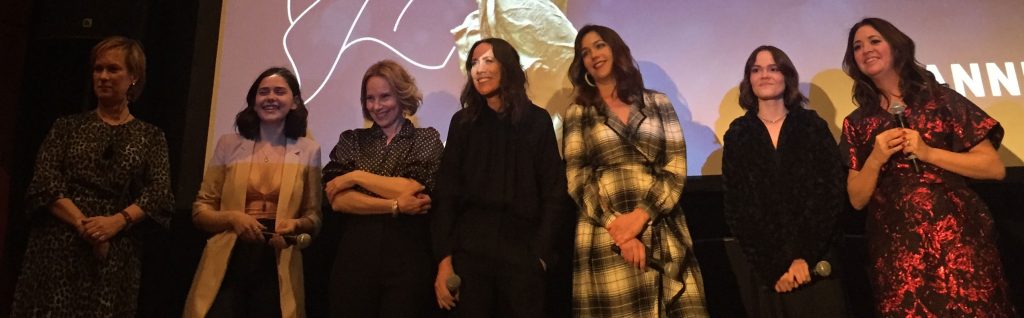
“Lost Girls” team members at the Athena Film Festival premiere of the movie at Barnard College in New York City on February 29, 2020. Pictured from left to right: producer Anne Carey, actress Molly Brown, actress Amy Ryan, actress Miriam Shor, actress Lola Kirke, actress Oona Laurence and director Liz Garbus. (Photo by Carla Hay)

At the Q&A after the “Lost Girls” screening, which was attended by many of the real-life people who are portrayed in the film, Garbus said that she wanted to direct this movie: “I fell in love with the story. I felt if I could be part of telling and elevate the story again and appreciating the incredible work by these women in keeping their loved ones’ stories alive, then it would be a great honor.”

Ryan, who plays Mari Gilbert in “Lost Girls,” was visibly moved when she spoke to Mari’s daughter Sherre Gilbert, who was in the front row of the audience.  “I am so grateful to use my voice to help to keep this story going …This story matters. it was really an honor to play your mom.” Ryan added that the actresses who portrayed the grieving allies shared a real-life friendship on the movie set. “Our connection to each other was an amazing reflection of that … I just think when you get a group of women together in a room, it can be very powerful.”

“Never Rarely Sometimes Always” was another standout film at the Athena Film Festival. This drama, written and directed by Eliza Hittman, follows the emotionally harrowing journey of a 17-year-old named Autumn Gallagher (played by Sidney Flanigan), who has to travel from her hometown in rural Pennsylvania to New York City to get an abortion for an unplanned and unwanted pregnancy. The movie realistically shows the obstacles she faces, as well as the toll that her abortion decision takes on her physically and psychologically. Hittman had been scheduled to do a post-premiere Q&A at the Athena Film Festival, but she had to bow out to attend the Berlin International Film Festival, where “Never Rarely Sometimes Always” won the Silver Bear Award (second-place prize). Focus Features will release “Never Rarely Sometimes Always” in select U.S. cinemas on March 13, 2020.

The dramatic film “The Perfect Candidate,” directed and co-written by Haifaa al-Mansour, is about a woman named Maryam (played by Mila Al Zahrani), who’s facing a different type of obstacle. She’s a Saudi Arabian female doctor who running for her local city council, in a culture where women rarely try to be political leaders because it’s considered unladylike and almost taboo. Not surprisingly, she faces a lot of sexism and degrading reactions to her campaign. It’s a well-acted film that provides further insight into how far some countries need to go before they won’t place a stigma on gender-equality opportunities that women in other countries take for granted. Music Box Films will release “The Perfect Candidate” in U.S. cinemas, on a date to be announced. The movie was already released in Saudi Arabia, which selected “The Perfect Candidate” as the country’s official 2019 Academy Awards submission for Best International Feature Film.

Perhaps the best underrated gem of the festival was the Canadian drama “Kuessipan,” directed and co-written by Myriam Verreault and Naomi Fontaine, based on Fontaine’s novel of the same time. The mostly French-language movie tells the story of two teenage girls in Québec who’ve been best friends since childhood, but their lives are going in different directions. Mikuan (played by Sharon Ishpatao Fontaine) comes from a stable family and is headed to college, while Shaniss (played by Yamie Grégoire) comes from a troubled broken home and is an unwed teenage mother who’s dropped out of school. What makes this story different from others with a similar concept is that the girls happen to be from the Innu tribe. Their racial identity and issues related to their culture are rarely seen in movies, so it’s refreshing that this film does it in a very authentic way. The movie is engaging and very well-made, from beginning to end. “Kuessipan” is highly recommended for anyone who likes coming-of-age stories that ring true.

The only feature film to have its world premiere at the festival was the documentary “Dying Doesn’t Feel Like What I’m Doing,” directed by Paula Weiman-Kelman, about female rabbi/activist Rachel Cowan and how she lived with terminal brain cancer before her death in 2018. The movie played to a sold-out audience. It’s an intimate and starkly made film that treats Cowan with dignity and respect. At the Q&A that was held after the screening, Weiman-Kelman said that she started filming the documentary before Cowan was diagnosed with brain cancer, but Cowan graciously wanted her to keep filming after the diagnosis.

The inspiring documentary “Woman in Motion” (directed by Todd Thompson) tells the story of “Star Trek” actress Nichelle Nicholas’ 1970s campaign to recruit more women and people of color to join NASA and become astronauts. This movie would make a great companion piece to the 2016 Oscar-nominated hit drama “Hidden Figures,” which told the story of three African American women who were underappreciated pioneers at NASA in the 1960s. “Woman in Motion” also takes a look at how “Star Trek” also played a role in opening up people’s minds to the idea that a diverse group of people could be in outer space.

The Irish horror flick “Sea Fever” (written and directed by Neasa Hardiman) is definitely influenced by the 1979 classic film “Alien,” since it’s about a group of people trapped on board with a parasitic creature that can multiply easily, infect humans, and then kill them. And the smartest one in the group is a scientific-minded woman, who’s the best chance that they have of survival. But instead of being a gun-toting warrior like Sigourney Weaver’s “Alien” character Ripley, the heroine of “Sea Fever” is a marine-biology student Siobhán (played by Hermione Corfield), who’s the youngest person on an isolated ship that’s under attack by a mysterious sea creature. Even though the movie has some predictable tropes, what makes “Sea Fever” different from other horror films of this type is that Siobhán has to deal with ageism, as well as the expected sexism. For most of the story, the other people on board don’t take her seriously. And there are dire consequences when her warnings go unheeded. Gunpowder & Sky will release “Sea Fever” in U.S. cinemas on a date to be announced.

“Rocks,” a drama directed by Sarah Gavron, was the festival’s closing-night film. “The movie (written by Theresa Ikoko and Claire Wilson) is about a London teenager nicknamed Rocks (played by Bukky Bakray), who comes home to find her single mother missing, and she has to take care of her younger brother Emmanuel (played by D’angelou Osei Kissiedu) by herself. With the help of her female friends, Rocks tries to hide her situation from child protective services, which would separate the siblings in foster care. Overall, the movie is good, although some people might have an issue with one aspect of the movie’s conclusion that ends up being vague and open to interpretation. (It has to do with a decision that Rocks makes about Emmanuel.) However, the movie’s greatest strength is that it doesn’t sugarcoat the problems that Rocks encounters as an unexpected underage guardian of her brother.  Film4 will release “Rocks” in the U.K. and Ireland on April 24 , 2020. The movie’s U.S. release date is undetermined, as of this writing.

Other movies that had their New York City premieres at the festival included the Marie Curie biopic “Radioactive”; the lesbian cop drama “The Long Shadow”; the Papua New Guinea women’s rugby documentary “Power Meri”; the British drama “Military Wives”; the Israeli political documentary “Objector”; the French coming-of-age drama “Stars by the Pound”; the Spanish lesbian drama “Carmen & Lola”; and the Italian female boxing documentary “Butterfly.”

The festival had some movies that were originally released in 2019 and have won prizes and Oscar nominations. They included the Syrian war documentary “For Sama” (co-directed by and starring Waad al-Kateab); Greta Gerwig’s Oscar-nominated version of “Little Women,” based on the classic Louisa May Alcott novel; the Disney animated sequel “Frozen 2” (co-directed by Jennifer Lee); and the Harriet Tubman biopic “Harriet,” directed by Kasi Lemmons.

There were also networking events (most were invitation-only), discussion panels and creative workshops.

The Athena Film Festival’s “The Silence Breakers” panel at Barnard College in New York City on February 29, 2020. Pictured from left to right: Sarah Anne Masse, Jasmine Lobe, Drew Dixon and Sheri Sher. (Photo Carla Hay)

The most-talked about panel, which also packed the room with about 250 people, was “The Silence Breakers,” featuring #MeToo accusers of disgraced entertainment moguls Harvey Weinstein and Russell Simmons. The panel, which took place on February 29, was moderated by The Hollywood Reporter executive film editor Tatiana Siegel, who has covered several #MeToo stories in the entertainment industry. The panelists shared their thoughts on the February 24 verdict that convicted Weinstein of a first-degree criminal sexual act and a third-degree count of rape. A New York City jury of seven men and five women delivered the verdict, which acquitted Weinstein of the most serious charges: two counts of predatory sexual assault and one count of first-degree rape.

The panelists shared their thoughts on the verdict. “I was really relieved. It felt like a weight I’d been carrying on my shoulders for 12 years had been lifted,” commented actress Sarah Ann Masse, who claims that Weinstein sexually harassed her during a job interview in 2008. “I was expecting him to get away with it, like he had for decades.”

Jasmine Lobe, an writer/actress who says that Weinstein sexually assaulted her in 2006, had this to say about Weinstein being convicted of sex crimes: “There was a tremendous sense of victory. We were all preparing for the worst.” Weinstein continues to deny all sexual-misconduct allegations against him. He will receive his prison sentence on March 11, 2020.

Drew Dixon (a former A&R executive at Def Jam Records and Arista Records) and Sheri Sher (a founding member of the all-female hip-hop group Mercedes Ladies) each claim that they were raped by Simmons, who founded the companies Def Jam and Rush Communications. He stepped down from his businesses in 2017, after several women went public with similar allegations. Dixon says her assault happened in 1995, while Sher claims that Simmons sexually violated her in 1983. Simmons has denied all the accusations against him. As of this writing, he has not been arrested for any alleged sex crimes that still fall under the statute of limitations, but he’s being sued in California by an unnamed woman who claims he raped her in 1988.

“It is a game-changer, a watershed moment,” Dixon said of the Weinstein rape conviction. “Also, the fact that a majority-male jury understood the nuance of remaining in touch with your perpetrator.” Simmons accuser Sher added that since the resurgence of the #Me Too movement and now that Weinstein has been convicted of rape, there’s a “sense that it’s a new era. It’s time to change. It’s real.”

Dixon and Sher are among the Simmons accusers featured in the documentary “On the Record,” directed by Amy Ziering and Kirby Dick. The movie was publicly protested by Simmons and some of his supporters. Executive producer Oprah Winfrey and Apple TV+ then dropped out of the project. HBO Max then picked up the documentary, which will begin streaming on a date to be announced. Dixon mentioned that when black women accuse black men of abuse, the situation is more complicated because of the racial injustices that black men face in the legal system.

Meanwhile, the panelists said that although organizations such as Time’s Up have been helpful for many #MeToo survivors, a lot more progress needs to be made in order to change the culture where sexual harassers and predators can still thrive. The panelists advocate for laws that extend or suspend statutes of limitations for sex crimes. They also think there should be more policies that won’t allow non-disclosure agreements for settlements involving sexual misconduct.

Masse and Dixon also noted that more industry people in power who say they care about this issue need to practice what they preach and hire #MeToo silence breakers who’ve been victims of career retaliation. Because the #MeToo issue is not limited to the entertainment industry, Dixon commented that it’s everyone’s responsibility to do their part to stop the cycle of abuse: “If you see something, say something. You call it out. You don’t laugh it off.”

Copyright 2017-2026 Culture Mix
CULTURE MIX