
Review: ‘Stiller & Meara: Nothing Is Lost,’ starring Ben Stiller, Amy Stiller, Christine Taylor, Ella Stiller and Quinlin Stiller

October 5, 2025

by Carla Hay

A late 1960s archival photo of (pictured clockwise, from left) Anne Meara, Jerry Stiller, Amy Stiller and Ben Stiller in “Stiller & Meara: Nothing Is Lost” (Photo courtesy of Apple TV+)

“Stiller and Meara: Nothing Is Lost”

Directed by Ben Stiller

Culture Representation: The documentary film “Stiller & Meara: Nothing Is Lost” features an all-white group of people who are connected in some way to American entertainer spouses Jerry Stiller and Anne Meara.

Culture Clash: Stiller and Meara, who came from different backgrounds (his family was Polish Jewish, her family was Irish Catholic), overcame obstacles in their careers and personal lives to become successful entertainers during their 61-year marriage.

Culture Audience: “Stiller and Meara: Nothing Is Lost” will appeal primarily to people who are fans of the Stiller family of entertainers and celebrity documentaries that are told from the perspectives of family members.

Ben Stiller and Amy Stiller in “Stiller & Meara: Nothing Is Lost” (Photo courtesy of Apple TV+)

“Stiller and Meara: Nothing Is Lost” is the cinematic equivalent of looking at someone’s family photo albums, watching family home videos, and hearing family stories. This documentary is exactly what it appears to be: a loving tribute to Jerry Stiller and Anne Meara, directed by their son, Ben Stiller. It’s a not groundbreaking film, but it nicely demonstrates themes of love, loyalty and legacy. At times, the movie almost detours into a Ben Stiller biography, but it generally stays on track and achieves its purpose of giving an up-close-and-personal look at the matriarch and patriarch in this longtime successful showbiz family.

“Stiller & Meara: Nothing Is Lost”(which had its world premiere at the 2025 New York Film Festival) follows a conventional format of mixing archive footage with footage filmed exclusively for the documentary. Ben Stiller (who is a famous entertainer in his own right) gives insightful narration, as he puts the documentary in a setting of himself and his older sister Amy Stiller sifting through their parents’ belongings in a New York City apartment. Meara died in 2015, at age 85. Jerry Stiller died in 2020, at age 92.

The movie has an intimate tone because most of the people interviewed for the documentary are family members. In addition to featuring conversations with Ben and Amy, the documentary shows separate conversations that Ben with his actress wife, Christine Taylor, and their two children: Ella (born in 2002) and Quinlin (born in 2005). Also interviewed are Jerry’s sister Doreen Stiller; Dawn Eaton, a longtime associate of the Stiller family; and playwright John Guare, whose original 1971 off-Broadway production of “House of Blue Leaves” starred Meara.

The documentary chronicles what is already publicly known, such as how Meara and Jerry met in 1953, and fell in love in their hometown of New York City; how they got married in 1954, and became a famous comedic duo; and the end of their comedy duo act and what projects the spouses did separately. They were truly a case of opposites attract: He was from a Polish Jewish family and was neurotically insecure about his talent. She was from an Irish Catholic family and was the “life of the party.” He started his entertainment career doing mostly comedy. She came from a serious drama background in theater.

According to Ben, Jerry would be the type of entertainer who would diligently over-rehearse, while Meara was comfortable with improvisation. Jerry thought that Meara was more talented than he was, so he felt like he had to work harder. It’s mentioned several times in the documentary that the couple’s on-stage interactions were reflections of their off-stage relationship. Meara was the more outspoken partner who would often take the lead in conversations, while Jerry tended to be more deferential.

The documentary also includes discussion of the childhoods of Jerry and Meara. Jerry’s father Willie (who was a driver of taxis and buses) was a wannabe actor who attempted to make a career out of it but never made it. In an audio archival interview, Willie said he gave up acting because he had to have a job “to make ends meet.” Willie passed on his love of entertainment to Jerry, who graduated from Syracuse University in 1950 with a bachelor’s degree in speech and drama.

By all accounts, Meara (who had no siblings) had a family who did not expect her to work in showbiz. Meara’s path to becoming an entertainer started in 1947, when she took acting classes at the New School in New York City. Meara’s father Edward was an attorney, and she was deeply affected by her mother Mary’s suicide, which happened when Anne was 11 years old.

It’s hinted that this childhood trauma, which Anne did not like to discuss, could have led to her adult problem of alcohol abuse, which she was able to overcome with Jerry’s help. The movie gives some insight into how this drinking problem negatively affected her marriage and other relationships, However, you get the feeling that there was a lot more that happened concerning the alcohol abuse that was deliberately kept out of the documentary.

The documentary also shows that Jerry was the “pack rat”/family archivist. While sifting through boxes of his parents’ possessions, Ben marvels, “It’s insane what he kept.” (Some of the memorabilia includes admission tickets to places where the family went to in the 1960s and 1970s.) Jerry also kept articles about the family. One of the best parts of the documentary is when Ben reads excepts from a few of his parents’ love letters to each other.

“Stiller & Meara: Nothing Is Lost” would be remiss if it didn’t talk about the influence that this famous couple had on their children. Ben and Amy both share fond childhood memories of being encouraged to create characters and do skits. Ben says he became influenced to become a filmmaker when his father got him a Super 8 camera when Ben was a child.

In the documentary, Ben and Amy both say that their parents like to work on their comedy material behind closed doors and didn’t like to be disturbed when working. However, what made it into the comedy act was often dialogue that Ben and Amy say came from real-life conversations that their parents had. There are several clips in the documentary showing Amy and Ben being interviewed on TV with their parents, who clearly did not discourage their children from being in the spotlight.

Although Ben and Amy tell similar stories of their own childhoods, the documentary admirably shows how two siblings who grew up in the same family can also tell a story in two different ways. Ben says that when he decided to become a professional entertainer, he felt that his parents’ fame cast a long shadow, and he was determined to prove he could make it on his own. But then, Amy chimes in and reminds Ben that Ben always put either or both of their parents in almost every film or sketch he did early in his career.

The movie includes archival footage of Jerry and Anne in Ben’s audition video for “Saturday Night Live.” Ben had a short-lived stint on “Saturday Night Live” as a featured player during show’s 14th season in 1989. Ben’s big comedy series breakthrough was on “The Ben Stiller Show,” which was on the air from 1990 to 1995. The documentary also includes archival clips of Anne and Jerry on “The Ben Stiller Show.”

Ben describes his parents as loving, but his mother was harder to please. Even though Jerry and Anne were most famous for comedy, Ben says his mother still had a drama snob mentality for most of her life. She maintained an opinion that if entertainment has a hierarchy, then comedy is on the lower level. Viewers might be surprised to learn that although Ben might have benefited from being a “nepo baby,” Ben says his mother didn’t really encourage or fully approve of the comedy films that he became famous for, such as 1998’s “There’s Something About Mary” or 2000’s “Meet the Parents.” Anne liked it when Ben did a more “serious” movie like 1998’s “Permanent Midnight” or 2010’s “Greenberg.”

At times, “Stiller & Meara: Nothing Is Lost” gets a little too wrapped up in Ben’s perspective. For example, there’s a sequence that shows Jerry and Anne doing their comedy act on a breakthrough 1963 appearance on “The Ed Sullivan Show,” intercut with footage of Ben appearing at the Ed Sullivan Theatre in New York City for an appearance on “The Late Show With Stephen Colbert.” It’s meant to show how aspects of Ben’s life are continuations or parallels of his parents’ lives. However, it comes across as a bit self-indulgent because viewers are smart enough to already know that Ben has made public appearances at many of the same places that his parents did.

Despite a few missteps where the documentary’s tone veers into “enough about Jerry and Anne, here’s more about Ben,” the documentary benefits from Ben’s candor when he talks about his motivation for doing the documentary. Ben says that after his father died in 2020, Ben confesses that he felt “unhappy,” “out of balance” and “a little lost.” Having experienced a separation and reconciliation in his own marriage, Ben set out to make a documentary about his parents and their long-term marriage. “I wanted to understand how they did it.”

“Stiller & Meara: Nothing Is Lost” is about more than a marriage that survived the perils of showbiz. It’s a crowd-pleasing story about a family that is undoubtedly influenced by two people who paved the family’s way in the entertainment industry but also held the family together when so many others fall apart in similar circumstances. The message of the documentary is having an emotionally healthy and supportive family is an accomplishment and a privilege that matters so much more than fame and fortune.

Apple Studios will release “Stiller & Meara: Nothing Is Lost” in select U.S. cinemas on October 17, 2025. The movie will premiere on Apple TV+ on October 24, 2025.

Review: ‘Kaye Ballard: The Show Goes On!,’ starring Kaye Ballard

July 18, 2020

by Carla Hay

Kaye Ballard in “Kaye Ballard: The Show Goes On!” (Photo courtesy of Abramorama)

“Kaye Ballard: The Show Goes On!”

Directed by Dan Wingate

Culture Representation: Taking place in the United States, the documentary “Kaye Ballard: The Show Goes On!” features an all-white group of senior citizens in the entertainment industry discussing the career of entertainer Kaye Ballard, including Ballard herself.

Culture Clash: Ballard experienced sexual harassment, hostile work environments and career slumps during her more than 75 years in showbiz.

Culture Audience: Besides the obvious target audience of Kaye Ballard fans fans, “Kaye Ballard: The Show Goes On!” will appeal primarily to people who are interested in stories about the Golden Age of Hollywood and mid-20th century Broadway.
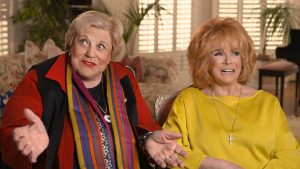
Kaye Ballard and Ann-Margret in “Kaye Ballard: The Show Goes On!” (Photo courtesy of Abramorama)

The documentary film “Kaye Ballard: The Show Goes On!” (directed by Dan Wingate) is a pleasant and often-humorous ride down Kaye Ballard’s memory lane of her seven decades in the entertainment business. It’s not going to reveal anything particularly new, and it’s the type of documentary that’s really just a compilation of interviews and archival footage. But it’s the closest thing to a filmed memoir for Ballard, who died in 2019 at the age of 93.

Born in Cleveland in 1925, Ballard’s birth name was Catherine Gloria Balotta. She was one of four children of Italian immigrants Lena and Vincenzo (later called Vincent James) Balotta. Long before she changed her stage name to Kaye Ballard, she knew from an early age (5 years old) that she wanted to become an entertainer. By the age of 16, Ballard was touring with comedian Spike Jones. And she went on to become a prolific actress and singer on stage, in movies and on television—even back in the days when entertainers were pressured to stick to one category of where to perform.

Ballard was a headliner on Broadway and for her nightclub shows, but in movies and television, she almost always had supporting roles, and they were usually comedies. Therefore, although she was famous, she wasn’t a superstar who was a household name worldwide. She mentions in the documentary that a highlight of her career was being on the cover of Life magazine in 1954 (for her starring role in the Broadway musical “The Golden Apple”), in one of famed photographer Richard Avedon’s rare photo shoots for Life magazine.

Because she’s a known comedian, Ballard mugs for the camera and jokes around a lot during her interviews. For almost the entire documentary, Ballard just talks about her career. The documentary’s big gaping void is the lack of information about her love life. Although she never married and did not have children, she doesn’t even discuss things such as if she ever fell in love, who she dated, or even if she had crushes on anyone.

The only time in the documentary that Ballard opens up about her personal life in this film is toward the end when she says, “I had the most wonderful family in the world.” She then talks about how close she was to her beloved grandmother, but her relationship with her parents wasn’t always as close.

Ballard describes her mother Lena as emotionally distant, although they did reconcile their differences toward the end of Lena’s life. As for Ballard’s dad, she says: “My father could never say ‘I love you.’ He’d say, ‘Well, I wish you good luck, always.’ He was the most noble man I knew.”

Ballard had a 2004 autobiography called “How I Lost 10 Pounds in 53 Years: A Memoir,” so this documentary is just a more updated version of that book, with the added context of archival clips. It’s clear from watching this film that Ballard is one of those entertainers who didn’t seem to have any close friends outside of showbiz. Everyone who’s interviewed in this documentary is someone from the entertainment business—usually people who’ve worked with Ballard at one time or another.

And they have nothing but good things to say about Ballard. (Some of the people interviewed in for this documentary have since passed away, including Jerry Stiller, Liz Smith, Carol Channing and Harold Prince.) Other people interviewed in the documentary are Ann-Margret, Carol Burnett, Michael Feinstein, Elaine Paige, Sandy Stewart, attorney/producer Mark Sendroff, Peter Marshall, Rex Reed, Mimi Hines, Joy Behar, Donna McKechnie, Woody Allen, Sandy Stewart and “Perry Como Show” producer Gary Smith.

The movie has a mostly chronological look at Ballard’s career. And, for the most part, Ballard has the expected fond memories, while the talking heads in the documentary give Ballard effusive praise. Commenting on Ballard’s 1959 album “The Fanny Brice Story in song,” Reed gushes, “She was more Fanny Brice than Barbra Streisand.” Stiller says about Ballard, “She made more people famous than you can imagine.”

Ballard also mentions that Mama Rose in the musical “Gypsy” was the “the best role ever written” that she got to perform. She also says some of her best working experiences were on “The Perry Como Show.” And she also retells the well-known story of how she rejected the “My Coloring Book” song (written by famed Broadway songwriting duo John Kander and Fred Ebb) because she didn’t think she would be believable singing it, so she suggested that Stewart sing it instead.

In one way or another, all of the people interviewed say that Ballard was a consummate professional who enjoyed helping other entertainers be their best. Behar shares a story about how, early in her career, she had a guest cameo on “The Steve Allen Comedy Hour” in 1967. Behar says she was so nervous that she flubbed the first take of the scene.

But after getting a pep talk from Ballard, who was on the set and standing near the camera, Behar sailed through the second take. Behar says in the documentary, “And so, I’m forever indebted to Kaye Ballard for helping me in my first humble day of showbiz where I was really scared.”

Ballard is certainly ebullient and upbeat in the documentary, but she does talk about some of the down sides of her showbiz career, such as being targeted for sexual harassment by comedian Phil Silvers and being blackballed by Johnny Carson. She also went through periods of time, especially when she got older, when she couldn’t get as much work. And because she wasn’t conventionally beautiful, she wasn’t considered a “leading lady” type for film and TV.

According to Ballard, Silvers wanted Rose Marie to be his leading lady in the 1951-1952 Broadway musical “Top Banana,” but Ballard was cast instead. Ballard says that Silvers sexually harassed her, and when she rejected his advances, she claims that he tried to get her fired and “he made my life miserable for 10 months.” When “Top Banana” was made into a 1954 feature film, Ballard says, “He didn’t let me do the movie, and I’m glad, because it was a bomb.”

As for getting on Carson’s bad side, she says it was because she was misquoted in a magazine article about her experience being a guest on his talk show. Carson never asked her back on his show and he didn’t seem to care about getting her side of the story. However, since showbiz is full of egos that are huge and fragile, even the nicest person can end up making enemies.

Ballard shares her philosophy on dealing with haters: “When somebody tries to get me down, it makes me stronger. I stick with it.” She says it’s one of the reasons why she refused to quit “Top Banana,” because she didn’t want to give Silvers the satisfaction that his bullying was going to run her out of the show before her contract ended.

In the documentary, Ballard’s tales of positive experiences far outnumber any negative experiences. Even when her contract was not renewed for the game show “Hollywood Squares,” it gets a positive spin in the documentary. Former “Hollywood Squares” host Marshall and Ballard both say in the documentary that she ended up not being a good fit for “Hollywood Squares” because she wasn’t good at deceiving the contestants, which is part of the game.

And she has some surprisingly nice things to say about a few showbiz people who had reputations for being difficult off-stage. Ballard comments on Lenny Bruce: “Many people get the wrong impression of Lenny Bruce. They think he was a dirty old man, but he was anything but—he was a sexy young man.” And on Jerry Lewis, Ballard says: “I’m one of the few people in the world who loves Jerry Lewis.”

If there’s one tiny criticism of Ballard’s commentary it’s that she tends to name-drop a little too much when she talks about celebrities who came to see her perform on stage. However, it can be excused as someone who was awed and humbled that people she respected took the time to watch her live performances.

And she certainly was surrounded by plenty of talented people. Ballard says that when she moved to New York City and lived in Greenwich Village, she says her best friends were Maureen Stapleton, Eli Wallach, Ann Jackson and Marlon Brando. By the way, she describes Brando as “just brilliant, lovely to know.”

One of the best production aspects of this documentary is that it has a lot of great archival footage that’s very well-edited with the interviews. Clips from Ballard’s TV appearances over the years are especially wonderful, because most of the clips won’t be seen on TV again anytime soon. And as the subject of the documentary, Ballard is the movie’s best asset, since she has a very engaging way to her storytelling.

Because “Kaye Ballard: The Show Goes On!” isn’t the type of documentary that shows Ballard’s life off-stage, the film looks a lot like a feature-length “sizzle reel,” with commentary from Ballard and her colleagues about her career. Ballard seemed to be fiercely protective about her private life, so it’s no surprise that this documentary doesn’t offer any new insight about how she shared her life with anyone outside of her work.

Abramorama released “Kaye Ballard: The Show Goes On!” in select U.S. virtual cinemas on July 17, 2020.

Copyright 2017-2026 Culture Mix
CULTURE MIX