
Review: ‘Christy’ (2025), starring Sydney Sweeney, Ben Foster, Merritt Wever and Katy O’Brian

November 5, 2025

by Carla Hay

Ben Foster (pictured at left) and Sydney Sweeney in “Christy” (Photo courtesy of Black Bear Pictures)

“Christy” (2025)

Directed by David Michôd

Culture Representation: Taking place in various parts of the United States, from 1989 to 2010, the dramatic film “Christy” (a biopic of American former boxing champ Christy Martin) features a predominantly white cast of characters (with some African American and Latin people) representing the working-class, middle-class and wealthy.

Culture Clash: While Martin was at the top of her career, she was also trapped in an abusive marriage to her coach/manager, and she became addicted to cocaine.

Culture Audience: “Christy” will appeal primarily to people who are fans of Martin, the movie’s headliners and formulaic but well-acted celebrity biopics.

Ben Foster and Sydney Sweeney in “Christy” (Photo courtesy of Black Bear Pictures)

The choppy drama Christy is partly a boxing biopic and partly a true crime story about Christy Martin. It’s a showcase for the versatile acting talents of the cast members, but the narrative has some hokey stereotypes usually found in made-for-TV movies. The uneven pacing for the story (including a fairly abrupt ending) doesn’t ruin the movie, but it lowers the quality of the movie, which is a mixed bag of impactful moments and maudlin predictability.

Directed by David Michôd (who co-wrote the “Christy” screenplay with Mirrah Foulkes), “Christy” had its world premiere at the 2025 Toronto International Film Festival. The movie is a fairly ambitious project where Sydney Sweeney plays the role of Martin from when Martin was in her early 20s to when Martin was in her early 40s. Martin was born on June 12, 1968, in Mullens, West Virginia. Unfortunately, the mediocre hairstyling and makeup for “Christy” don’t make the aging process look believable for the Christy Martin character in the movie.

“Christy” viewers have to watch Sweeney wear several obvious wigs (many of them ill-fitting), while the movie’s makeup department didn’t do a very good job to realistically age the character. As Martin, Sweeney looks like she’s in her mid-to-late 20s for most of the movie. It’s a bit distracting for people who know that the story’s timeline is supposed to take place over a period of about 21 years.

“Christy” is told in chronological order, from 1989 to 2010. The movie has a captioned epilogue that mentions what happened in Martin’s life between 2010 and 2025, when the movie was released. For the purposes of this review, the real Christy Martin will be referred to by her last name, while the Christy Martin in the movie will be referred to by her first name.

“Christy” begins by showing with a voiceover of Christy saying, “Someone told me once that I fight like I was trying to destroy everyone who did me wrong … Maybe it’s true.” Christy, whose birth name was Christy Salters, is then shown at about age 21, when she was living in Itmann, West Virginia. At the time, Christy had a basketball scholarship at Concord College in West Virginia.

Christy proudly shows her brother Randy Salters (played by Coleman Pedigo) the $300 she recently won in a Tough Man boxing competition. “Easiest 300 bucks I ever made,” Christy brags. Randy is happy for Christy and proud of her athletic accomplishments. Their mother Joyce Salters (played by Merritt Wever) has the opposite reaction: She’s horrified that Christy has taken an interest in boxing.

Joyce is a religious conservative who’s also displeased about Christy being romantically involved with Christy’s basketball teammate Rosie (played by Jess Gabor) because Joyce firmly believes that homosexuality or queerness is a sin that can send people to hell. Christy and Rosie are mostly closeted in a relationship that no one fully acknowledges but it’s an open secret. (In real life, the Rosie character was Sherry Lusk, a basketball teammate whom Martin began dating when they were in high school.)

Joyce speaks softly, but she’s the domineering and controlling parent in the Salters household. Her husband Johnny Salters (played by Ethan Embry) is also a religious conservative, but he’s not as harsh, judgmental and image-conscious as Joyce is. However, Johnny almost always goes along with whatever Joyce wants.

During a family dinner, Joyce gives this order to Christy about Christy’s relationship with Rosie: “We don’t want you to see her anymore. What you’re doing is not normal. We want you to have a normal and happy life.” Joyce also suggests that Christy and Rosie see a priest as a way to convince Christy and Rosie to break up.

A conflicted and troubled Christy pours her energy into boxing and getting into physical fights. At school, Christy gets into trouble for punching a basketball teammate who calls Christy a “fucking lesbian” while the team is having a practice session. Joyce discourages Christy from boxing because she thinks it isn’t ladylike and because women’s boxing was not considered a professional sport in the late 1980s.

However, Joyce starts to change her mind when a Bristol, Tennessee-based boxing promoter named Larry Carrier (played by Bill Kelly) takes an interest in paying Christy to box. Larry offers Christy an all-expenses-paid trip to Bristol to fight in a boxing match where the prize is $5,000. Christy easily wins the boxing match.

After this boxing match, Larry tells Christy that a boxing coach/manager named James “Jim” Martin (played by Ben Foster) wants to meet Christy at a later date. Rosie has accompanied Christy to Bristol. Larry notices how Christy and Rosie are together and quickly figures out that Christy and Rosie are both queer. Jim tells Christy that Christy’s mother needs to accompany Christy on the trip to meet Jim because Jim is a “family-oriented person.” Larry says it in a way so Christy knows that Jim is homophobic, and Jim won’t accept Christy being openly queer.

The first time that Christy meets Jim in a boxing gym, he’s standoffish and rude to her. He doesn’t take her seriously because Christy is a lot shorter than he thought she would be. And he hasn’t seen her fight yet. As a test, Jim has a male boxer do a mock boxing match with Christy. Jim quietly tells the male boxer to “hurt her” because Jim doesn’t want anything to do with Christy.

You can easily predict what happens next: Christy ends up knocking out her male opponent. The more Jim sees Christy box, the more he takes an interest in her and the type of money he can make from her boxing talent. Jim, who is 25 years older than Christy, charms Joyce by giving the impression that he will be a protective and conservative father figure to Christy. Jim convinces Christy to live with him in Bristol while he becomes her coach and her manager. Around the same time, Rosie and Christy drift apart because Rosie stays in West Virginia and begins dating a man.

Jim orders Christy to grow her hair and wear pink boxing outfits, so she looks more “feminine.” It isn’t long before Jim abuses his authority and power over Christy and gets sexually involved with her. By 1991, Jim and Christy are married because he convinces her that he’s the only one who can make her a rich and famous boxing champion. Jim tells Christy that it would be easier to achieve that goal if they were married.

“Christy” then goes through the usual motions showing the “rise, fall, and rise again” story arc that is typical in most celebrity biopics. Christy wins most of her boxing matches and becomes America’s first famous female professional boxer. Jim and Christy eventually move to Florida and settle in the city of Apopka.

The movie is more about how Christy became a boxing champion in spite of Jim, not because of him. Jim is hateful, abusive and controlling in all the worst ways. It also comes as no surprise when the movie shows he was also stealing money from Christy.

There are some lurid aspects to this story, such as when Jim forces Christy to do homemade porn videos, which he uses to blackmail her. The movie also hints that Jim became Christy’s pimp who would sell her to male fans who wanted to do erotic boxing and other sexual activities with her. There’s nothing too explicit in the movie, but there’s enough in the movie for viewers to figure out that it happened.

Christy and Jim’s toxic marriage is also plagued by their cocaine addiction. The movie depicts her account that Jim was the one who introduced her to cocaine and encouraged her to heavily use the drug. And as this dysfunctional marriage continues, the abuse gets worse, until it spirals out of control on the night of November 23, 2010. Even though what happened that night made big news that led to an arrest and trial, this review won’t say what happened, in case “Christy” viewers who don’t know the details might want to see the movie to find out.

Once the “Christy” biopic takes a turn into the true crime aspect of her life, it becomes somewhat like a Lifetime movie, with a very rushed ending where the victim’s recovery is presented as too quick to be an entirely accurate depiction of what happened in real life. However, Foster’s portrayal of the evil and creepy Jim is very unsettling and apparently so realistic, the real Christy Martin said she couldn’t be on the “Christy” film set when Foster was there because his depiction was so similar to the real person. (The real Christy Martin has a cameo in the film, as a hallway bystander who wishes Christy good luck on the way to a boxing match.)

Sweeney’s portrayal of Christy has a lot of grit and effective emotional moments. The boxing matches and the training are shown as “checklist” events in her life, rather than immersive cinematic experiences. Because Christy wins so many of her matches (often by knockouts), the movie’s only real suspense in her fights is for a 2003 boxing match when Christy fights Laila Ali (played by Naomi Graham), who is younger, taller and physically stronger than Christy. It’s the only boxing match in the movie where Christy genuinely is afraid and reluctant, but Jim pushes her into it because they need the money.

The boxing matches in the movie are adequately filmed. However, “Christy” is not convincing that Christy has changed much physically during the more than 20 years that this story takes place. And that’s a problem for a movie about a boxer who’s supposed to go from her early 20s to her early 40s in the story.

Sweeney’s performance is skilled at showing emotions but not very skilled in showing the natural maturity that takes place when most people evolve from their 20s to 40s. Even if Christy has some arrested development in her maturity, she was undoubtedly changed physically and emotionally because of her drug addiction, the abuse she got from her husband, and the effects of her long boxing career. However, the movie makes Christy look like she’s physically and emotionally stuck in her mid-to-late 20s. The movie could have also taken a more realistic approach in how Christy’s boxing injuries affected her.

An early scene in “Christy” is an example of the movie’s uneven filmmaking. Christy and Jim meet with notoriously flamboyant boxing promoter Don King (played by a scene-stealing Chad L. Coleman) when Christy is still an unknown boxer. Jim brings a VHS cassette tape to show some highlights of Christy’s boxing matches, but the tape doesn’t work on the VCR in Don’s office. It’s a very sitcom-type moment because the scene—especially Coleman’s performance—is played for laughs. The scene, although well-acted, sticks out like a sore thumb in this very serious movie.

Christy is able to convince Don to sign her, just by doing a few mock boxing jabs in his office. And he comes up with the idea to give her the nickname the Coal Miner’s Daughter (inspired by Loretta Lynn’s 1971 “Coal Miner’s Daughter” hit song) when Don finds out that Christy’s father really was a coal miner. It’s understandable why a movie would condense all of this in one meeting, but it all looks so fake in the way that this scene is written.

However, “Christy” does a good job of showing how someone can feel trapped in an abusive relationship, especially if the abuser has a lot of power over the abused person and isolates the abused person from loved ones. Years into the marriage, Christy asks her mother for help to get away from Jim, but her mother “gaslights” Christy by saying Christy is the problem in the marriage. Jim manipulates Joyce by convincing Joyce that Christy has become a flaky and pathological liar because Christy has a drug addiction.

Christy’s only true confidantes in the movie are Rosie (who is in and out of Christy’s life) and a boxer named Lisa Holewyne (played by Katy O’Brian), who lost to Christy in one of their high-profile matches. Lisa, who is openly a lesbian, is there for Christy during the lowest point in Christy’s life. O’Brian gives a good performance, but there’s not enough shown or told about Lisa for her to be a well-rounded character in the movie.

“Christy” gives a general overview of her career and personal life in the way that a biopic tends to do when it’s limited to telling the story in a time frame that’s less than three hours. (“Christy” clocks in at 135 minutes.) The movie doesn’t give enough information about who else knew about Jim’s abuse at the time that it was happening.

Very little is depicted about how the business of women’s professional boxing evolved from the 1990s to the 2010s. There’s a scene where Christy fakes being a heavier weight by putting a lot of coins in her pockets, in her shoes, and in her underwear before she gets weighed, so that she can qualify for a boxing match for a heavier weight class. It’s hard to imagine any professional boxer being able to get away with that trick nowadays.

Because the real Christy Martin has a memoir (2022’s “Fighting for Survival: My Journey Through Boxing Fame, Abuse, Murder, and Resurrection”) and a 2021 documentary (Netflix’s “Untold: Deal With the Devil”), people who are familiar with both of these non-fiction projects will know that “Christy” leaves out a lot of information that could’ve been in the movie. (For example, the “Christy” movie doesn’t mention that Christy has gone public about being sexually abused as a child, and Jim’s longtime abuses were much worse than what’s shown in the movie.) “Christy” is worthwhile as a story of inspirational empowerment. But as a biopic, it falls a little bit on the shallow side that’s held afloat by good performances.

Black Bear Pictures will release “Christy” in U.S. cinemas on November 7, 2025. A sneak preview of the movie was shown in U.S. cinemas on October 27, 2025.

Review: ‘The Machine’ (2023), starring Bert Kreischer, Mark Hamill, Jimmy Tatro, Iva Babić, Stephanie Kurtzuba and Jess Gabor

May 26, 2023

by Carla Hay
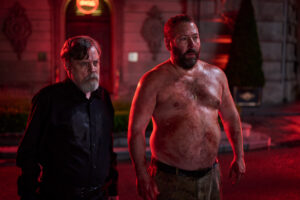
Mark Hamill and Bert Kreischer in “The Machine” (Photo by Aleksandar Letic/Screen Gems)

“The Machine” (2023)

Directed by Peter Atencio

Some language in Russian with subtitles

Culture Representation: Taking place in Russia and in the United States, the action comedy film “The Machine” features a nearly all-white cast of characters (with a few African Americans) representing the working-class, middle-class and wealthy.

Culture Clash: Rude and crude American comedian Bert “The Machine” Kreischer and his father are kidnapped and brought to Russia by Russian criminals, who want Bert to find a valuable watch that they claim he stole 23 years earlier, when Bert was a partying college student visiting Russia. 

Culture Audience: “The Machine” will appeal primarily to people who are fans of Kreischer, but even they might find this relentlessly idiotic and dull movie very hard to take.

Iva Babić and Bert Kreischer in “The Machine” (Photo by Aleksandar Letic/Screen Gems)

Crude, boring and obnoxiously stupid, “The Machine” repeatedly misfires and malfunctions as a showcase for stand-up comedian Bert “The Machine” Kreischer, who portrays a version of himself in his first starring movie role. Kreischer is also a producer of this grossly incompetent action comedy, released by Sony Pictures Entertainment’s Screen Gems. “The Machine” might have this corporate-owned movie studio as a distributor, but this junkpile film is worse than the most amateur, low-budget independent films that you could ever see.

Directed by Peter Atencio, “The Machine” has no creativity, no style and no charm. It stumbles around in repetitive scenarios and spews out deeply unfunny “jokes” that sound like ideas that would be rejected at low-rent comedy clubs. Kevin Biegel and Scotty Landes wrote the putrid screenplay for “The Machine,” which is proof that if you throw enough money around, untalented garbage can be made into a terrible movie. “The Machine” also has very unimaginative stereotypes of Russian mobsters. These lazy clichés quickly become tiresome.

“The Machine” doesn’t have much of a plot. The movie’s opening scene shows a Russian mobster boss named Igor (played by Nikola Djuricko) watching controversial stand-up comedian Bert Kreischer (whose persona is being a politically incorrect, drinking-and-drugging blowhard) doing a stand-up routine on TV. Igor becomes incensed and yells at the screen: “I want what you stole, Machine!” The enraged gangster than destroys the TV by shooting a gun at it.

A sloppily filmed montage near the beginning of the movie shows that Bert is having a meltdown in his career and in his personal life. Bert almost got his teenage daughter Sasha (played by Jess Gabor) arrested for something that was actually his fault. He’s such a terrible father, he livestreamed Sasha getting detained by police. As a result of the backlash, Bert took a hiatus from social media and cancelled his comedy tour.

Bert is smug and defiant during a family therapy session in the office of their therapist (played by Brian Caspe), who looks like he would rather be anywhere else but forced to be in a room with this lunkhead. Also in the therapy session are Bert’s long-suffering wife LeeAnn (played by Stephanie Kurtzuba), their obedient tween daughter Tatiana (played by Amelie Child Villiers) and a sulking Sasha. Bert congratulates himself for not calling anyone in the room the “c” word (as in “cunt”), even if he thinks they deserve to be called that word.

Back at home, Bert continues to heap praise on himself, by bragging to his family that he hasn’t done anything publicly embarrassing in three months. What does he want? A medal? Kreischer is married with two daughters in real life. This stinker of a movie is surely going to be an embarrassment for the entire family. Kreischer’s real-life wife (who really does have the name LeeAnn Kreischer) is also one of the producers of “The Machine,” which means she got suckered into sinking some of her own money into this irredeemable flop.

Bert wants to look like he’s sorry for what he’s done to Sasha, so he throws a big 16th birthday party for her at the family home. The problem is that party isn’t really about Sasha. It’s about Bert showing off. Sasha doesn’t even know most of the people whom Bert invited to the party. It just leads to Sasha having more resentment for her selfish father. To put on a façade that he’s “cleaned up his act,” Bert decided not have any alcohol served at the party, which is attended mostly by adults.

Here’s an example of the rotten “comedy” in “The Machine”: One of the party guests is a family friend named Madison (played by Tea Wagner), who is in the process of getting a divorce. Madison asks Bert in an annoyed voice about the lack of alcohol at the party: “No booze?” Bert replies, “Hey, Madison: No husband?” And then, he mutters underneath his breath: “Fucking bitch.”

Soon, it will be Bert’s turn to get annoyed, when his estranged father Albert Kreischer (played by Mark Hamill) shows up unannounced at the party. Bert is bitter because he thinks Albert has been an inattentive father for most of Bert’s life. Albert, who lives in Florida, owns a carpet company called Kreischer Karpets. Albert thinks that Bert’s career as a comedian is probably over, so he offers Bert a job at the carpet company. It’s an offer that Bert abruptly refuses.

There’s another uninvited guest who shows up at the party. She’s a Russian mob enforcer named Irina (played by Iva Babić, in a very campy performance), who works for Igor. Irina tells Bert that she’s there to get a pocket watch that Bert stole on a train 23 years ago, when he was a 25-year-old college student visiting Russia on a school trip. Bert denies knowing anything about this pocket watch.

However, Bert and Albert get kidnapped by Irina and her goons anyway and are taken by private plane to Russia. (“The Machine” was actually filmed in Serbia.) Irina says that while Bert is in Russia, his daughters will be under surveillance by some of her cronies. Irina warns Bert that if he doesn’t do what he’s told, then his daughters will be harmed. Irina’s cronies are mostly forgettable and generic, except for Irina’s bodyguard: a hulking dolt named Sponge (played by Martyn Ford), who immediately clashes with Bert.

The rest of “The Machine” is nothing but a slog of dimwitted dialogue and fake-looking fight scenes. There are some tedious flashbacks showing college-age Bert (played by Jimmy Tatro) and his shenanigans in Russia. In the flashbacks, there’s a useless subplot involving Bert treating his classmate Ashley (played by Rita Bernard-Shaw), who’s a potential love interest for Bert, like a subservient maid. It’s not a good look, considering Ashley is the only non-white character who has a speaking role in the movie. (Rachel Momcilov portrays the present-day Ashley.)

Kreischer is utterly cringeworthy as an actor and has no charisma on screen. All of the movie’s other performances range from mediocre to unwatchable. Hamill often looks like he regrets signing up for this cesspool of a movie, and he puts no credible effort in his performance. How did he end up in this tacky mess? Did the “Star Wars” franchise not pay Hamill enough money?

There’s no other way to put it: “The Machine” is a complete failure in every single way. It’s yet another example of how being a famous stand-up comedian doesn’t automatically mean that the comedian has what it takes to be a movie star. “The Machine” should have been put out of commission before it was even made.

Screen Gems released “The Machine” in U.S. cinemas on May 26, 2023.

Copyright 2017-2025 Culture Mix
CULTURE MIX