
Review: ‘She Rides Shotgun,’ starring Taron Egerton

August 17, 2025

by Carla Hay

Ana Sophia Heger and Taron Egerton in “She Rides Shotgun” (Photo courtesy of Lionsgate)

“She Rides Shotgun”

Directed by Nick Rowland

Culture Representation: Taking place in New Mexico, the dramatic film “She Rides Shotgun” (based on the novel of the same name) features a predominantly white cast of characters (with some Latin people) representing the working-class, middle-class and criminal underground.

Culture Clash: A divorced father abducts his 11-year-old daughter and goes on the run with her after he finds out that they are the targets of a homicidal gang that he has recently quit.

Culture Audience: “She Rides Shotgun” will appeal primarily to people who are fans of the movie’s headliners and crime thrillers where the main characters are family members.

Ana Sophia Heger and Taron Egerton in “She Rides Shotgun” (Photo courtesy of Lionsgate)

The compelling drama “She Rides Shotgun” overcomes some predictability because of strong performances from Taron Egerton and Ana Sophia Heger, who portray an ex-gang member and his 11-year-old daughter who become fugitives. There are a few questionable action sequences, but the emotional moments between the two main characters are consistently believable. This is the type of “road trip” movie that will keep viewers on edge, even if viewers might not agree with all of the filmmakers’ choices for the story.

Directed by Nick Rowland, “She Rides Shotgun” was written by Ben Collins and Luke Piotrowski, who adapted the screenplay from Jordan Harper’s 2017 novel of the same name. The movie has a different and more realistic ending than the book. In fact, the movie’s final scene is perhaps the most poignant and will pack the most tearjerking punch for some viewers.

The movie “She Rides Shotgun” (which weas filmed on location in New Mexico, where the movie takes place) doesn’t waste time in getting to the action in the story. The movie’s opening scene shows 11-year-old Polly Huff (played by Heger) waiting for her mother Ava Huff to pick her up from Polly’s school in the city of Albuquerque. (Polly’s age in the movie is also mentioned as 9 and 10, but for the purposes of this review, Polly’s age is listed as 11, as it is in the movie’s synopsis and in the novel.

Polly is the last student waiting outside the school for someone to give her a car ride home. Instead of Ava arriving at the school, Polly’s estranged father Nathan “Nate” McClusky (played by Egerton) shows up in a beat-up-looking car (with a broken front-passenger window) and tells her to get in the car. Polly has not seen or spoken to Nate in years, but she immediately knows who he is.

Through conversations in the movie, it’s eventually revealed that Nate has been mostly absentee father since he and Ava got divorced. Polly is wary about getting into the car with Nate. “I’m out. Let’s go.” She asks him: “Are you allowed to be here?” Polly also asks if Nate has hurt her mother. Nate says no, he didn’t hurt Ava. Nate assures Polly, “You’re safe. I’m not going to hurt you.”

Nate is acting suspiciously nervous. He and Polly check into a motel room, where he cuts and dyes Polly’s brown hair and changes it to strawberry blonde. Nate teaches Polly on how to swing a baseball bat as a weapon and instructs her to use the bat to attack anyone who will want to hurt them, especially anyone she sees with a tattoo of blue lightning. Polly is confused but obedient.

But then, Polly learns the truth about why Nate has shown up in her life again and what happened to her mother. While Nate is asleep, Polly is horrified when she sees on the local TV news that her mother and stepfather—Ava Huff and Tom Huff—were found murdered in their home. (Based on Polly’s surname Huff, it’s implied that her stepfather adopted her, which is a slight change from the book, which had Polly’s last name as McClusky.)

Nate is the prime suspect in the murders, and he’s wanted by law enforcement for abducting Polly. The news report also mentions that Nate is a known member of a white supremacist gang called Blue Lightning, which has been involved in various criminal activities, including murder, assault and methamphetamine trafficking. (In the “She Rides Shotgun” book, the gang is called Aryan Steel.)

Polly goes into a panic and calls the phone number for law enforcement that she saw on the news. And it just so happens that the person who answers her phone is the lead detective on the case: John Park (played by Rob Yang) of the Albuquerque Police Department. Polly identifies herself and tells Detective Park where she and Nate are.

Polly has mixed emotions: She’s angry and her father for not telling her the truth, but she also feels loyalty to protect him from getting arrested because he’s now her only living parent. When Polly tells Nate that she reported their location to police, Nate also goes into a panic and tells her that Ava and Tom were actually murdered by members of Blue Lightning because Nate recently quit the gang, which threatened to murder Nate and all of Nate’s family members.

Now that Polly knows that she and Nate are targets to be murdered, they become a team in trying to survive and not get taken into police custody. The rest of “She Rides Shotgun” shows the often-harrowing experiences that Polly and Nate go through when they become fugitives. Along the way, they encounter several people who might help or harm them, including Nate’s ex-girlfriend Charlotte (played by Odessa A’zion), Detective Park, police officer named Mitchell King (played by Edgar Damatian), a domineering sheriff named Samuel House (played by John Carroll Lynch), and various Blue Lightning members.

Beyond the expected chase scenes and gun shootouts, “She Rides Shotgun” capably depicts the gradual trust that Polly and Nate develop for each other. Their relationship doesn’t evolve smoothly. Polly has years of resentment for Nate being a willfully absentee dad. Nate feels guilt and remorse but also defiance because he says Ava kept him from seeing Polly because of Nate’s gang’s lfestyle.

Is Nate trying to make up for lost tme with Polly? Or is he using Polly to get more sympathy from people who might help them? He’s doing both. Nate also sometimes continues to make bad choices. But the truth is that having Polly with him makes it easier for people to find them, compared to a situation where Nate would be alone. Nate’s motive to protect Polly at all costs becomes abundantly clear, which make him more likable than if he had been a fugitive for purely selfish reasons.

“She Rides Shotgun” is a well-paced movie, withplenty of action and gritty drama. Some of the movie’s flaws have to do with the villains, who are a little too cartoonish. Not enough information is given about why Nate joined ths gang, but that’s because this is a story about a man in his daughter who are caught up in the present and don’t want to be stuck in the past. Egerton and Heger are fantastic together in their “She Rides Shotgun” performances, which are the main reason to watch this imperfect but thought-provoking film.

Lionsgate released “She Rides Shotgun” in select U.S. cinemas on August 1, 2025.

Review: ‘Sorry, Baby’ (2025), starring Eva Victor, Naomi Ackie, Lucas Hedges, John Carroll Lynch, Louis Cancelmi and Kelly McCormack

June 27, 2025

by Carla Hay

Eva Victor in “Sorry, Baby” (Photo courtesy of A24)

“Sorry, Baby” (2025)

Directed by Eva Victor

Culture Representation: Taking place in an unnamed Massachusetts city, the comedy/drama film “Sorry, Baby” features a predominantly white cast of characters (with a few black people) who representing the working-class and middle-class.

Culture Clash: Over a five-year period, a young woman copes with the aftermath of being sexually assaulted by someone she used to trust.

Culture Audience: “Sorry, Baby” will appeal primarily to people who are fans of the movie’s headliners and comedy/dramas with quirky protagonists.

Naomi Ackie and Eva Victor in “Sorry, Baby” (Photo courtesy of A24)

“Sorry, Baby” is a unique comedy/drama about coping with sexual trauma, from the perspective of an intelligent and quirky woman. Some viewers might be bored by the slow pacing, but this movie has enough wit and authenticity to keep most viewers interested. “Sorry, Baby” is the type of movie where you know within the first 15 minutes whether or not you will care to know more about the protagonist.

Written and directed by Eva Victor, “Sorry, Baby” is Victor’s feature-film directorial debut. The movie had its world premiere at the 2025 Sundance Film Festival, where “Sorry, Baby” won the Waldo Salt Screenwriting Award. “Sorry, Baby” takes place in an unnamed city in Massachusetts, where the movie was filmed on location in various Massachusetts cities. The story is told non-chronologically in five chapters, with each chapter reflecting the life of the protagonist, from the ages of 27 to 32.

“Sorry, Baby” begins with a chapter titled “The Year With the Baby,” which is also the title of the last chapter in the movie. The opening scene is a joyous reunion of two best friends: introverted Agnes (played by Victor) and extroverted Lydie (played by Naomi Ackie), who were roommates and attended the same grad school, where they studied English literature. Agnes and Lydie now live in different states.

Agnes, who is 31 years old in this chapter, lives in a house by herself in a rural part of Massachusetts. Lydie, who has come to visit Agnes, lives with Lydie’s spouse in New York. Agnes has an isolated existence where her closest neighbor is several yards away, and she doesn’t have any close friends except for Lydie. Nothing is told about Agnes’ biological family.

As the two friends reconnect, they start off with small talk. They both say that they miss the ability to see each other in person on a regular basis. They both say that they wished that they lived closer together. And then, Lydie breaks some joyous news to Agnes: Lydie is about 10 weeks pregnant.

Agnes is very happy for Lydie, who seems a little worried about Agnes. Agnes says that everything is fine. She also shares some good news of her own: She’s been promoted from being a part-time professor to a full-time professor at the same college where she and Lydie went to grad school.

During Lydie’s visit, Agnes nearest neighbor randomly shows up unannounced. His name is Gavin (played by Lucas Hedges), who’s about the same age as Agnes. Gavin is socially awkward and has an obvious crush on Agnes. The movie implies that Gavin might have some learning disabilities because Agnes reminds Gavin where he lives and politely tells him to go back home.

Later, Lydie and Agnes both have a reunion dinner with three people who were in their same study group in grad school: Devin (played by Cody Reiss), Logan (played by Jordan Mendoza) and Natasha (played by Kelly McCormack), who has an obsessive jealousy of Agnes. Natasha works at the same college and has always considered Agnes to be her biggest rival.

Natasha is hosting this dinner party, which quickly becomes tense when Natasha is rude to Agnes. When Agnes excuses herself to use the restroom, Lydie verbally cuts into image-conscious Natasha in a passive-aggressive way: Lydie complains to Natasha that there’s a bone in the fish that Lydie was served. Lydie admonishes Natasha for not being careful enough in checking for bones in the fish served to Natasha’s dinner guests.

The chapter titled “The Year With the Bad Thing” is the most pivotal chapter in the story. It’s a flashback to when Agnes was 27 years old and living with Lydie while they were both in grad school. Agnes, Lydie, Natasha, Devin and Logan were in a small study group that had a professor named Preston Decker (played by Louis Cancelmi) as their advisor.

Preston, who is a divorced father in his mid-to-late 40s, treats Agnes as if he thinks she’s his best student. Natasha, who wants to be “teacher’s pet,” believes that Preston gives special treatment to Agnes. Natasha pathetically tries to get praise from Preston, who is casually dismissive of Natasha.

In a private conversation at home, Lydie mentions to Agnes that Preston seems attracted to Agnes. Lydie asks Agnes if Agnes is interested in hooking up with Preston. A slightly mortified Agnes says no because she’s not interested in Preston and because Agnes knows it would be ethically wrong on many levels to have a sexual relationship with a faculty member who will influence her academic grades. Meanwhile, Lydie openly talks about her sex life to Agnes and drops a hint about Lydie’s true sexuality that is confirmed later in the story.

During a crucial period of time in the students’ academic careers, Preston wants to give in-depth feedback to Agnes about her dissertation and invites her over to his house for this discussion, to make up for cutting short their previous meeting in his office. The movie shows Agnes leaving Preston’s house several hours after she arrived. What happened during this house meeting is not shown but is described in detail by Agnes to Lydie after Agnes goes back to their home.

The trailer for “Sorry, Baby” already hints that the “something bad” that happens to Agnes is a sexual assault that prompted her to get a medical check-up, with Lydie accompanying her as comfort. In one of the movie’s most uncomfortable scenes, the unnamed doctor (played by Marc Carver) who examines Agnes is uncaring and glib when he finds out why Agnes wants this medical exam. Later, Agnes comes across a disheartening roadblock when she reports what happened to her and she attempts to get justice.

The chapter titled “The Year With the Questions” (the movie’s shortest chapter) shows Agnes in a jury duty situation. “The Year With the Good Sandwich” chapter has its best scene when Agnes has a panic attack while driving in her car, and she is helped by a kind stranger named Pete (played by John Carroll Lynch), who sees Agnes when she drives into a convenience store parking lot during this panic attack. “Sorry, Baby” is at its best when Agnes copes with indignities and reminders that she can’t escape her trauma by trying to forget that it happened.

“Sorry, Baby” also has a subplot about Agnes finding some comfort with Gavin, but it’s not the type of comfort that’s about people falling in love. It’s the type of comfort where she knows she will never fall in love with Gavin (even though he wants it to happen), but she wants to have a “friends with benefits” situation. Is she using Gavin for her own selfish needs? Yes, but Gavin is a consenting partner, even if his feelings for Agnes aren’t mutual.

Ackie gives a vibrant performance as outspoken Lydie, but Lydie is not in most of the movie. Agnes is front and center in this story. Where “Sorry, Baby” falls short is in telling more about who Agnes is outside of her career, her limited social interactions, and how she deals with her trauma. Shortly after her sexual assault, Agnes adopts a stray kitten (whom she names Olga), who becomes Agnes’ constant companion after Lydie moves away.

There is nothing revealed about Agnes’ family and nothing revealed about what she likes to do in her spare time besides reading. There’s a brief scene of Agnes in her classroom and another brief scene of Agnes getting positive feedback in the evaluation that leads to her job promotion. Agnes’ choice to have her students read Vladimir Nabokov’s 1955 novel “Lolita” (about a literature professor who sexually abuses his 12-year-old stepdaughter) is shown in “Sorry, Baby” as an example of how people can react differently to sexual controversy. But there are many unanswered questions about Agnes that make her depiction in the movie somewhat shallow at different times.

Still, Victor’s portrayal of Agnes has many meaningful insights into Agnes’ personality in other ways. Agnes is the type of person who doesn’t use her physical attractiveness to “get ahead” in her career. She’s eccentric but not mentally unstable. She’s an unapologetic literature nerd who’s not standoffish, but she has a hard time meeting anyone (other than Lydie) who’s on the same wavelength as she is.

These insights into Agnes’ life bring vitality to the story and will make interested viewers curious to see what will happen to Agnes. Because of Victor’s capable writing, directing and acting, “Sorry, Baby” brings some dark comedy to the disrespectful ways that people can degrade each other and emotional resonance to the compassionate ways that people can uplift each other. Most of all, “Sorry, Baby” isn’t about finding out if Agnes gets “closure” for her trauma, because it’s a story that takes a worthwhile glimpse at part of her bumpy journey along the way.

A24 released “Sorry, Baby” in select U.S. cinemas on June 27, 2025, with an expansion to more U.S. cinemas on July 25, 2025. The movie will be released on digital and VOD on August 5, 2025.

Review: ‘Babes” (2024), starring Ilana Glazer and Michelle Buteau

May 16, 2024

by Carla Hay

Ilana Glazer and Michelle Buteau in “Babes” (Photo by Gwen Capistran/Neon)

“Babes” (2024)

Directed by Pamela Adlon

Culture Representation: Taking place in New York City, from 2019 to 2020, the comedy film “Babes” features a racially diverse cast of characters (white, African American and Asian) representing the working-class and middle-class.

Culture Clash: Two longtime best friends go through very different experiences when they get pregnant and give birth within a year-and-a-half of each other. 

Culture Audience: “Babes” will appeal primarily to people who are fans of the movie’s headliners, director Pamela Adlon and female-focused movies that have adult-oriented comedy.

Michelle Buteau and Ilana Glazer in “Babes” (Photo courtesy of Neon)

“Babes” won’t be considered a major classic for films about childbirth and motherhood, but it’s entertaining enough for viewers who can tolerate crude jokes. The movie tries too hard to be raunchy, but the jokes are more hit than miss. Some of the situations in the movie are unrealistically absurd (and not in a good way), but the realistic female friendship depicted in “Babes” is the heart and soul of the movie.

Directed by Pamela Adlon, “Babes” was written by llana Glazer and Josh Rabinowitz. “Babes” takes place in New York City (where the movie was filmed on location), from 2019 to 2020. The movie had its world premiere at the 2024 SXSW Film and TV Festival. It’s a movie that has frank and frequently vulgar talk about pregnancy, sex, childbirth, body parts and bodily functions. It also shows the nuances of female friendships when two friends are at different stages of emotional maturity and personal responsibilities

“Babes” (which is told in chronological order) begins with a scene taking place at a movie theater sometime around Thanksgiving in 2019. Two longtime best friends—neurotic Eden (played by Glazer) and sassy Dawn (played by Michelle Buteau)—have had a tradition for the past 27 years to see the same unnamed movie around Thanksgiving time. This particular movie happens to be playing in a theater, although in real life, there is no movie theater in New York City that has played the same movie during Thanksgiving from 1992 to 2019.

Eden (a self-employed yoga teacher who works from home) arrives at the theater feeling a little flustered because she had to travel 115 minutes and take four subway trains to meet Dawn (who is a dentist) at this theater in New York City’s Manhattan borough. That’s because Eden lives in Astoria (in New York City’s Queens borough), and Dawn lives on Manhattan’s Upper West Side. Eden and Dawn used to live near each other in Astoria. Eden (who is a never-married bachelorette) is a little bitter that Dawn and her emotionally supportive husband Marty (played by Hasan Minhaj) have moved several miles away from Eden. Marty works for an unnamed business.

Dawn is pregnant with her second child and is due to give birth in two weeks. When Dawn and Eden go inside the screening room, Dawn notices that every seat she sits in is wet. And then, Dawn realizes that water is leaking from her vagina—or, as Dawn put it, she has “pussy drizzle.” Dawn begins to wonder if she’s in labor, so she asks Eden to see what her vagina looks like, right there in the nearly empty screening room. Eden confirms that Dawn’s vagina looks like it’s dilated, so Dawn calls her OB/GYN doctor, who says she’s probably in labor.

Instead of going to a hospital right away, Dawn and Eden decide to go to a restaurant and have an eating binge, since Dawn thinks she shouldn’t be eating this much after Dawn gives birth. At the restaurant, Eden looks at Dawn’s vagina again in public to check on the dilation size. When their waiter finds out that Dawn is in labor and starts to give unsolicited advice, Dawn snaps at him: “What are you? The Gordon Ramsay of my pussy?”

The trip to the hospital is chaotic. Dawn is in too much pain to walk, and she won’t sit down in a wheelchair, so she crawls to the delivery room. (It’s a very unrealistic scenario.) Eden and Marty are there in the delivery room, where Eden is nauseated by what she sees and is shocked to find out that someone can defecate while giving birth. You can easily predict how Eden will react to seeing an umbilical cord and placenta up close for the first time. If these types of scenes don’t sound like something you want to see in a comedy, then “Babes” is not the movie for you.

Dawn gives birth to a baby girl named Melanie and is on maternity leave. Dawn and Marty’s first child is 4-year-old Thomas, nicknamed Tommy (played by Caleb Mermelstein-Knox), who has some arrested development because he still wears diapers and still drinks from a baby bottle. During the course of the movie, Dawn stars to feel the pressure and stress of taking care of two children under the age of 5.

At the hospital where Dawn gave birth, Eden is shocked and annoyed that the hospital charged her nearly $500 for sushi that she ordered from hospital room service. Eden takes the sushi with her on the subway and starts to eat it inside the subway car. Sitting across from her is an actor named Claude (played by Stephan James), who is in a waiter uniform. She strikes up a conversation with Claude by offering to share some of her sushi with him. Claude tells her that he’s in costume because he’s an extra in a Martin Scorsese movie.

Eden and Claude have an immediate attraction to each other. They talk some more and find out that they share the same enthusiasm for the video game “Street Fighter,” so they go to her place to play “Street Fighter” together. Eden and Claude also reveal that they’ve never had unprotected sex with other partners. One thing leads to another, and Eden and Claude agree to have unprotected sex with each other. Eden tells Claude that she’s currently menstruating, but he doesn’t mind.

There are indications throughout the movie that although Eden is in her late 30s, she often still has the mindset of a child. For example, she thinks she can’t get pregnant while she’s menstruating. As already revealed in the “Babes” trailer, Eden does get pregnant. She decides to keep the child.

For reasons that are explained in the movie (but won’t be revealed in this review), Claude is unable to be in the child’s life. Dawn’s OB/GYN (obstetrics/gynecology) doctor Dr. Morris (played by John Carroll Lynch) becomes Eden’s OB/GYN doctor too. A running joke in the movie is how Dr. Morris handles his receding hairline and bald spots.

Eden is very emotionally co-dependent on Dawn and expects her friendship with Dawn to be the same as it was before they both became parents. It leads to the expected conflicts and arguments. There’s also a subplot about Dawn and Marty trying to rekindle their sex life, which has gone stagnant because they’re so exhausted from their jobs and taking care of their kids.

Glazer and Buteau are believable as best friends, but some of the jokes they’re given in “Babes” fall very flat. Some viewers might be offended by a scene where Dawn is worried that her breasts are not producing milk to breastfeed her newborn child, and Dawn takes illegal drugs anyway. In this scene, Eden (who doesn’t know yet that she’s pregnant) and Dawn decide to take psychedelic mushrooms together.

During this psychedelic experience, Dawn finds out that she is, in fact, lactating. The expected “breast squirting” scene ensues. During the hallucinations, Dawn’s breasts also talk to her. Whoopi Goldberg is the voice of Dawn’s breasts.

Nothing is shown or told about Dawn’s parents, but Eden’s widower father Bernie (played by Oliver Platt) is in a few scenes in the movie. (Eden’s mother died when Eden was 3 years old.) Bernie is described by Eden as someone who is a “hoarder” with mental health issues. Eden and Bernie are not close, but they don’t hate each other. Their best scene in the movie happens when Eden tells Bernie that she’s pregnant.

“Babes” has some rough spots where the movie drags, the dialogue is kind of stupid, and the comedic timing isn’t very good. However, the bright spots outshine the movie’s flaws. Viewers who don’t mind watching movies with a lot of explicit adult language might be charmed by how the friendship of Dawn and Eden authentically evolves. The ending of “Babes” is undeniably sappy, but it puts a sweet finishing touch on a comedy that is often very salty and deliberately distasteful.

Neon will release “Babes” in select U.S. cinemas on May 17, 2024, with an expansion to more U.S. cinemas on May 24, 2024. A sneak preview of the movie was held in U.S. cinemas on May 13, 2024.

Review: ‘The Trial of the Chicago 7,’ starring Eddie Redmayne, Sacha Baron Cohen, Jeremy Strong, Mark Rylance, Yahya Abdul-Mateen II, Joseph Gordon-Levitt, Frank Langella and Michael Keaton

December 29, 2020

by Carla Hay
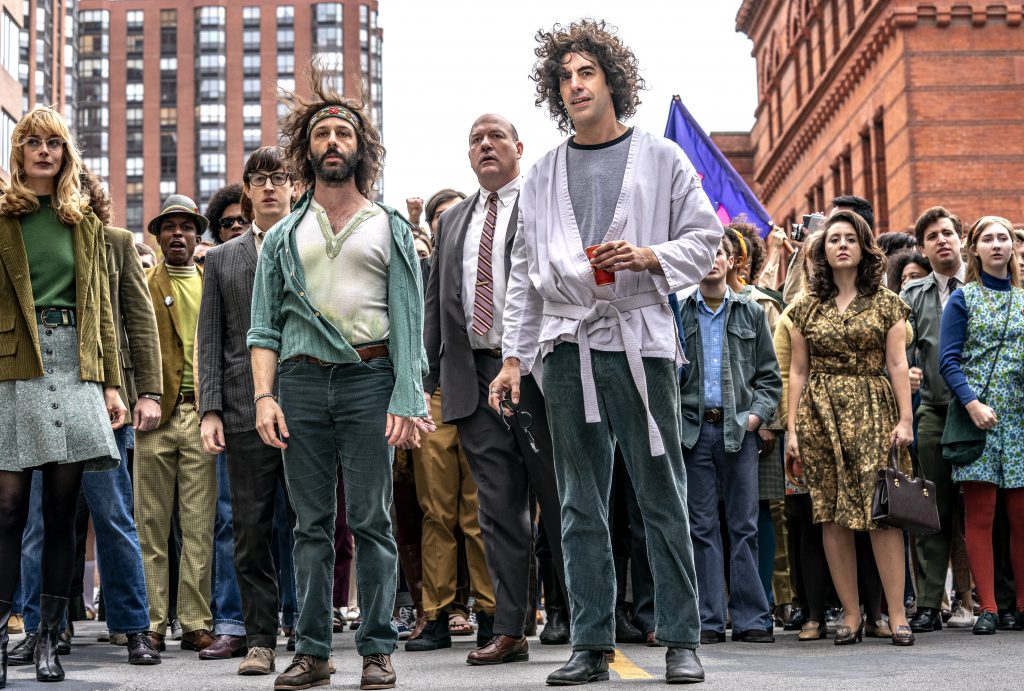
Pictured in front row: Caitlin FitzGerald, Alex Sharp, Jeremy Strong, John Carroll Lynch and Sacha Baron Cohen in “The Trial of the Chicago 7” (Photo by Nico Tavernise/Netflix) 

“The Trial of the Chicago 7”

Directed by Aaron Sorkin

Culture Representation: Taking place from 1968 to 1970, primarily in Chicago and briefly in Washington, D.C., the dramatic film “The Trial of the Chicago 7” features a predominantly white cast of characters (with some African Americans) representing the middle-class and upper-class.

Culture Clash: Eight men accused of inciting riots during the 1968 Democratic National Convention in Chicago go on trial in a case that exemplified the conflicts between the “establishment government” and “radical activists.”

Culture Audience: “The Trial of the Chicago 7″ will appeal primarily to people interested in dramatic interpretations of real political and legal events in American history during the Vietnam War, with the stories being unapologetically sympathetic to progressive liberal politics.
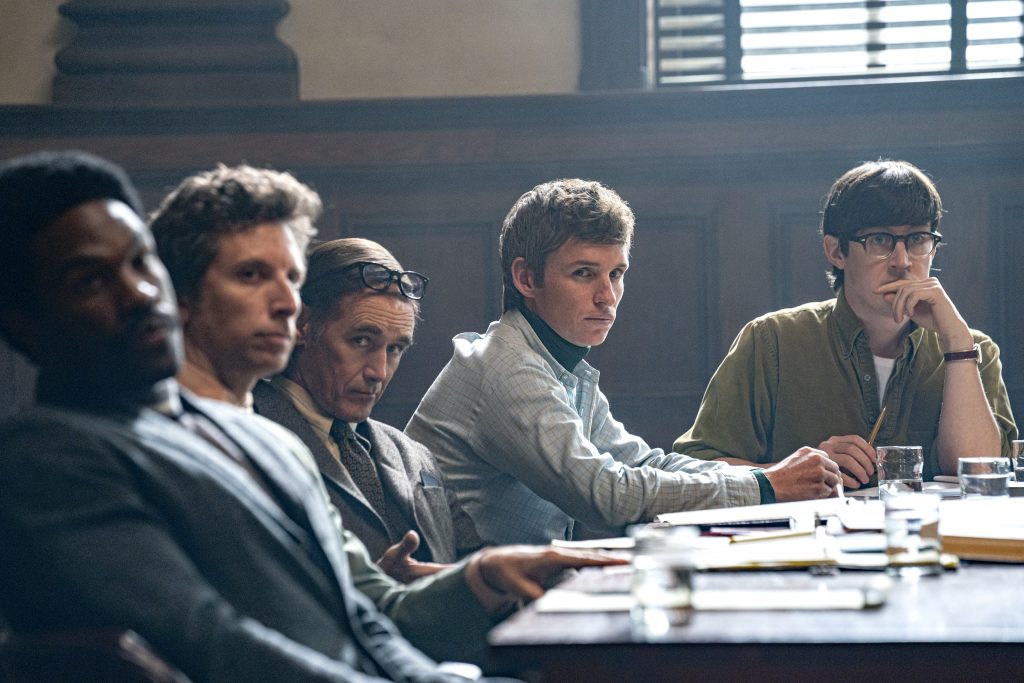
Yahya Abdul-Mateen II, Ben Shenkman, Mark Rylance, Eddie Redmayne and Alex Sharp in “The Trial of the Chicago 7” (Photo by Nico Tavernise/Netflix)

“The Trial of the Chicago 7” might as well have been called “The Showcase of Sacha Baron Cohen.” Although the movie has a big ensemble cast, he ends up stealing the show in his portrayal of left-wing activist Abbie Hoffman. This elevation of Hoffman as the “star” of the story is entirely by design, since “The Trial of Chicago 7” writer/director Aaron Sorkin has a reputation for not allowing actors to improvise in the movies that he writes and directs.

Taking place mostly in Chicago from 1968 to 1970, amid protests against the controversial Vietnam War, “The Trial of the Chicago 7” seems entirely calculated to win as many prestigious awards as possible. “The Trial of Chicago 7” exposes those ambitions too blatantly for it to feel like a truly immersive cinematic experience. The results are that viewers will feel constantly reminded that they’re watching showboat performances and re-enactments rather than being transported to experiencing the genuine emotions of the real-life people involved in this story.

Sorkin (who won an Oscar for writing the 2010 movie “The Social Network”) delivers the type of articulate and verbose screenplay that people would expect from the Emmy-winning former showrunner of “The West Wing.” “The Trial of Chicago 7” has got plenty of sociopolitical commentary that makes conservatives look like villains, and liberals look like heroes. (Sorkin is an outspoken liberal in real life.) There’s also a lot of snappy dialogue with witty one-liners and feisty arguments. And the film editing, which jumps back and forth in time, keeps the tone and pace of the movie very lively.

The trial is obviously the center of the story, but the movie’s non-chronological scenes alternate between showing the trial, showing events leading up to the trial, and showing what happened outside of the courtroom during the six months that the trial took place. It’s a lot to cram into a feature-length movie—”The Trial of the Chicago 7″ clocks in at 129 minutes—so some defendants get a lot more screen time and backstories than others. For the most part, the dramatic retelling of this true story works. However, there are a few scenes that were obviously fabricated for the movie, while the movie also leaves out a lot of uncomfortable truths.

“The Trial of the Chicago 7” begins with a brief overview of how the U.S. was affected by the Vietnam War, which was declared by President Lyndon Johnson (a moderate Democrat) in 1965 to save Vietnam from Communism. The Vietnam War escalated into a conflict that American protesters believed was a pointless and expensive war. As thousands of people died in the war, young men in America tried to avoid being drafted into the military. And millions of Americans, especially many of college age, became conscientious war protestors. Vietnam War advocates labeled anti-war protesters as “radicals” and “unpatriotic.”

In 1968, Johnson did not seek re-election. Hubert Humphrey, a former U.S. Senator from Minnesota, became the U.S. presidential nominee for the Democratic Party that year. Humphrey’s conservative Republican opponent was Richard Nixon, a former U.S. vice president under Dwight D. Eisenhower. Nixon would go on to win the presidential election in 1968 and was inaugurated in January 1969.

But before that happened, the Democratic National Convention (DNC) in Chicago in August 1968 became a flashpoint for increasing civil unrest over the Vietnam War and the civil rights movement. Thousands of protestors gathered in Chicago, resulting in violent clashes between law enforcement (Chicago police and the National Guard) and protestors. The riots lasted for two days and ended with 11 people dead, an untold number of people wounded, and thousands of people arrested.

In April 1968, U.S. Congress passed the Rap Brown Law, to make it illegal for people who live outside a community to incite confrontations in a community where they don’t live. It was intended as an anti-riot law, but critics of the law believed its was just the government’s response to people who wanted to organize widespread protests against the Vietnam War and racial injustice. People who advocated for the law believed that it was necessary to help prevent violence during protests.

Johnson and his administration’s U.S. Attorney General Ramsey Clark decided that there wasn’t enough evidence to federally prosecute anyone for the violence that happened at the 1968 DNC, which ended up being used as an example of how divided America was over the Vietnam War. However, Johnson’s presidential successor Nixon, who ran for U.S. president on a platform to restore “law and order,” had other ideas on how to deal with the chief protestors who were at the 1968 DNC. The Rap Brown Law was about to be enforced, and certain protestors were going to be prosecuted for it.

One of the early scenes in the movie takes place in 1969, in Washington, D.C., by depicting a meeting called by John Mitchell (played by John Doman), the U.S. attorney general appointed by Nixon. In the meeting with Mitchell are attorneys Richard Schultz (played by Joseph Gordon-Levitt), Thomas Foran (played by J.C. MacKenzie) and Howard Ackerman (played by Damien Young), who is a special adviser to Mitchell. Mitchell tells Schultz and Moran that he intends to use the Rap Brown Law to prosecute the leaders of some of the anti-Vietnam War groups who were at the 1968 DNC.

Schultz, who is a very by-the-book young attorney, can’t understand why this prosecution should take place, because Johnson declined to federally prosecute anyone for the 1969 DNC riots because of a lack of evidence. Mitchell essentially says that he doesn’t care, and he agrees with Nixon in wanting to make an example out of these “radical” left-wing leaders. Mitchell also strongly hints that he has a grudge against Clark (played by Michael Keaton), because Mitchell believes that Clark disrespected him in the transition process when the Nixon administration took over from the Johnson administration.

Mitchell decides that Schultz will be the lead prosecutor in the case, with Foran also on the prosecution team. Schultz is very reluctant to take the job because he feels that he doesn’t have enough experience in handling such a big, high-profile case. However, Mitchell insists that Schultz is the best person for the job and convinces Schultz to be the lead prosecutor in the case. It’s not said outright, but viewers can infer that Mitchell chose Schultz because Mitchell probably felt that Schultz’s youth and inexperience would make it easier for the U.S. government to manipulate Schultz.

On March 20, 1969, eight left-wing group leaders were indicted for conspiracy to cross state lines to incite the 1968 DNC riots, among other charges. Their joint trial began in Chicago on September 24, 1969. Presiding over the trial was Judge Julius Hoffman (played by Frank Langella) of the U.S. District Court for the Northern District of Illinois.

The eight men on trial were:

  • Tom Hayden (played by Eddie Redmayne), a former president and prominent leader of the activist group Students for a Democratic Society (SDS).
  • Rennie Davis (played by Alex Sharp), another prominent SDS leader, who is depicted in the movie as Hayden’s best friend.
  • Abbie Hoffman (played by Baron Cohen), co-founder of the Youth International Party, also known as the Yippies, a group advocating for counterculture politics and lifestyles.
  • Jerry Rubin (played by Jeremy Strong), co-founder the Youth International Party.
  • David Dellinger (played by John Carroll Lynch), a prominent member of the National Mobilization Committee to End the War in Vietnam (The MOBE), a conference of anti-Vietnam War groups.
  • John Froines (played by Danny Flaherty), a MOBE member who was eventually acquitted of all charges in the trial.
  • Lee Weiner (played by Noah Robbins), a MOBE member who was eventually acquitted of all charges in the trial.
  • Bobby Seale (played by Yayha Abdul-Mateen II), co-founder of the Black Panther Party, an activist group against racial discrimination of black people.

The attorneys for the defendants who are portrayed in the movie are William Kunstler (played by Mark Rylance) and his colleague Leonard Weinglass (played by Ben Shenkman). Kunstler is portrayed as passionate supporter of civil liberties who is fairly even-tempered except when his patience is pushed to the limits. On the prosecution side, Schultz’s courtroom style is more conventional than Kunstler’s style. The supporting lawyers on each side (Foran for the prosecution, Weinglass for the defense) don’t have as much screen time or personality in the movie as the lead attorneys.

And from the beginning, there were problems with Seale being on trial in the first place. He’s depicted as very outspoken in trying to distance himself from the other defendants, by saying that he didn’t even know most of them and certainly didn’t conspire with them. Seale was only in Chicago for four hours to give a speech on one of the days of the 1968 DNC. And in the portions of the trial that are depicted in the movie, Seale vehemently objected on his own behalf because his attorney Charles Garry wasn’t in the courtroom because Garry was in Oakland, California, having surgery.

“The Trial of the Chicago 7” portrays the biggest villain in the courtroom as Judge Hoffman, who doesn’t try to hide his bias against the defendants. The movie also shows that the judge had a racist side in how he treated Seale differently from the other defendants. Judge Hoffman didn’t seem to care that Seale’s attorney wasn’t present during the trial. In a harrowing scene, after Seale was jailed for contempt of court, for angrily talking back to the judge, the Black Panthers leader experienced police brutality from cops who were basically given permission by the judge to do whatever they wanted to Seale to teach him a lesson.

After being physically assaulted by these cops, Seale was paraded back in the courtroom in handcuffs and chains, with a gag on his mouth. Although the white defendants also received several contempt of court citations, they were not physically assaulted and humiliated in the way that Seale was during the trial. The movie depicts several people, including lead attorneys Kunstler and Schultz, being shocked and outraged at how Seale was mistreated, but not doing much about it.

In real life, several of the white defendants were heavily involved in the civil rights movement and fighting against racial discrimination. However, the movie focuses more on the white defendants’ anti-Vietnam War protests as their main activism. Racism is mostly used in the movie as a plot device for Seale’s storyline.

Early on in the trial, Kunstler advises Fred Hampton (played by Kelvin Harrison Jr.), the leader of the Chicago chapter of the Black Panthers, to tell the Black Panthers who are gathered in the courtroom to not sit together. The implication is clear: A bunch of black people sitting together is considered a “threat,” while it’s perfectly okay for white people to sit together. Hampton understands why this request was made, and he tells the Black Panthers in the courtroom to spread out and to take off their hats—not because he wants to be subservient to white racism but because he knows that Seale has a better chance of being acquitted if the Black Panthers in the courtroom aren’t perceived as a “threat.”

And once Seale is out of the picture (a mistrial was declared for Seale on November 6, 1969), the issue of racism also disappears from the movie. Seale’s departure leaves seven remaining defendants, and then the movie really becomes the Abbie Hoffman Show. “The Trial of Chicago 7” makes wisecracking Hoffman out to be the “class clown” who’s also the “hero” of the movie. Hoffman clashes with Hayden outside of the courtroom, so that the movie can show that these seven defendants didn’t have the united front that the public thought they had at the time.

Hoffman’s sarcastic persona is often expressed in how he talks back to the judge. In an early part of the trial, Judge Hoffman announces in court that the record should reflect that he’s not related to Abbie Hoffman. In response, defendant Hoffman shouts out in mock indignation, “Father!”

It’s one of many outbursts that Hoffman makes in the courtroom during the trial. Hoffman also makes fun of the judge when the judge repeatedly and mistakenly uses the name Derringer when referring to defendant Dellinger. Hoffman suggests that the judge remember that Derringer is the brand name of a gun.

While out on bail, the movie shows several scenes of Hoffman on stage in darkly lit places filled with audiences eager to hear what he has to say. The movie frames these scenes as if Hoffman is a stand-up comedian in a nightclub, as he delivers jokes and one-liners about what it’s like to be on trial and what a farce he thinks the trial is. Judge Hoffman is often mentioned in Abbie Hoffman’s rants against the system.

Rubin is portrayed as Hoffman’s loyal sidekick who is effective in a way that calls less attention to himself than Hoffman’s more loudmouthed techniques. However, Hoffman and Rubin’s fiery brand of activism and shenanigans outside the courtroom garner enough media attention that Judge Hoffman wants to sequester the jury. It’s also implied that Hayden resented all the media attention that Hoffman was getting, and that was part of the reason why Hoffman and Hayden clashed so much behind the scenes during the trial.

Although “The Trial of Chicago 7” makes Hoffman the comic relief in the film, the movie also portrays him not as a buffoon but as the savviest one of the defendants. He’s the first one to declare in a meeting with the other defendants, “This is a political trial. It [the outcome] was already decided for us,” while Hayden still wants to believe that the defendants will get a fair trial.

Hayden is less inclined to believe that there are larger political motives behind the trial. “I would love it if the trial wasn’t about us, but I assure you that it is,” he tells a disbelieving Hoffman. Hayden also disagrees with Hoffman’s view that society needs a radical overhaul. During one of their arguments, Hayden yells at Hoffman: “I don’t have time for cultural revolution! I have time for actual revolution!”

Overall, Hayden’s character is portrayed in a less sympathetic light than Hoffman’s character. Hayden is depicted as uptight, somewhat pretentious and someone who isn’t as revolutionary as he claims to be. There are many hints that show that Hayden was using SDS because he had future ambitions to become a mainstream politician. (And if you don’t know what Hayden did with his life after the trial, the movie has an epilogue summary of what happened to all the trial’s main players.)

The most problematic and unrealistic scene in the film is when Hoffman and Rubin, out on bail during the trial, see lead prosecutor Schultz with one of his kids in a park. Hoffman and Rubin call Schultz over for a conversation, which is basically yet another scene to showcase Hoffman being a wiseass. Anyone who knows anything about trials would immediately see that it’s highly unethical and a cause for a mistrial for a prosecutor, while a trial is ongoing, to talk to the trial’s defendants outside of the courtroom without the defendants’ attorneys present.

It’s a scene that’s also out-of-character for Schultz, who made an impression as someone with high standards of playing by the rules, up until this scene. It just doesn’t make sense for prosecutor Schultz to risk having an unethical conversation before the trial is over with two defendants in a public park, of all places, where there would be witnesses who could report seeing this conversation. Not only could this unethical conversation cause a mistrial, but it could also taint Schultz’s career.

And therefore, the only conclusion that viewers can come to when noticing this big legal blunder in the movie is that this scene was concocted as a way to make Hoffman and Rubin have a face-to-face confrontation with one of their trial adversaries outside of the courtroom. It cheapens the movie’s screenplay and it actually insults the intelligence of anyone who knows what the law is when it comes to what U.S. trial participants can and cannot do before the trial is over.

There are also many disruptions during the trial that look exaggerated for the sake of making the movie more dramatic, comedic and tension-filled. There’s a point in the movie where Judge Hoffman loses control of the courtroom in such a way that it looks very fake. Don’t take a drink of alcohol every time Judge Hoffman is seen banging his gavel in frustration because people won’t listen to him, because you might end up with alcohol poisoning.

The costume design and production design for “The Trial of the Chicago 7” are very accurate, but the way the movie is filmed, everything looks like a movie set and everyone looks like an actor playing a role. The riot scenes are filmed in a perfunctory manner, in the way that many other similar Vietnam War-era riot scenes have been filmed in other movies. There’s some real-life news footage spliced in some of the scenes, which will just remind viewers even more how staged the re-enactments are.

And this is very much a “boys club” movie, since the few women with significant speaking roles in the film are either playing the role of an office worker, a romantic partner or a “temptress.” Caitlin FitzGerald is the only woman who’s listed as a co-star in the cast ensemble. She plays Agent Daphne O’Connor, an undercover officer who poses as a radical counterculture activist named Debbie, who pretends to show a romantic interest in Rubin so she can get information out of him. Agent O’Connor later testifies for the prosecution in the trial, and the movie makes a big deal out of Rubin being emotionally hurt over being “tricked” by this temptress.

What’s deliberately omitted from “The Trial of the Chicago 7” is any acknowledgment that these so-called “liberal” and “free-thinking” men who were on trial were leaders of organizations that perpetuated a culture of sexism against women. While this movie is busy making Hoffman look like a progressive left-wing hero, it doesn’t show or question why Hoffman couldn’t be bothered to treat women as equals in the activist group that he founded.

Women are certainly seen in the movie’s protest scenes, but they’re only as background extras, along with male protesters. In real life, there were some women who were able to break through sexist barriers and have prominent roles in America’s anti-Vietnam War activism, such as Sandra “Casey” Cason, Judy Gumbo and Robin Morgan, just to name a few of the female contemporaries who at one time or another worked with Hoffman and/or Hayden. But these women, or women who are like them, are completely shut out of the movie.

If you were to believe everything in “The Trial of Chicago 7,” women didn’t come up with any clever ideas or take any leadership roles in organizing these protests or activism in general. It’s a huge blind spot in the movie that erases women’s important contributions to this part of American history and therefore paints a very inaccurate picture. The movie makes it look like men did all the real work behind the scenes, and women just basically answered the phones.

Despite these flaws, “The Trial of the Chicago 7” can be considered entertaining enough because of the performances from the cast members. Baron Cohen is the obvious standout, but Redmayne, Abdul-Mateen and Rylance also turn in memorable and noteworthy performances. But just like the TV series “Law & Order” shouldn’t be considered a completely accurate portrayal of the U.S. criminal justice system, “The Trial of the Chicago 7” shouldn’t be considered a completely accurate depiction of this notorious case.

Netflix released “The Trial of the Chicago 7” in select U.S. cinemas on September 25, 2020. The movie premiered on Netflix on October 16, 2020.

Copyright 2017-2025 Culture Mix
CULTURE MIX