
October 2, 2022
by Carla Hay
Directed by Chinonye Chukwu
Culture Representation: Taking place in 1955 in Illinois and Mississippi, the dramatic film “Till” features a predominantly African American cast of characters (with some white people) representing the working-class and middle-class.
Culture Clash: After her 14-year-old son (and only child) Emmett Till is murdered in a racist hate crime, Mamie Till-Mobley fights for justice in a system where white supremacy is enabled and enforced.
Culture Audience: “Till” will appeal primarily to people who are fans of stars Danielle Deadwyler and Whoopi Goldberg, as well as to people who are interested in well-acted biographical stories about the civil rights movement in the United States.
The heartbreaking and inspiring drama “Till” admirably tells the true story of Mamie Till-Mobley and how she not only fought for justice for her murdered son, Emmett Till, but also how she became an often-overlooked pioneer in the U.S. civil rights movement. Even though the events in “Till” take place in the 1955, everything about the movie remains relevant, as long as people are getting murdered, abused or harassed simply because of race or other parts of their identities. Danielle Deadwyler gives a stunning and emotionally stirring performance as a humble woman who channeled her grief over her murdered son (who was beaten, shot and lynched) into positive activism that has far-reaching effects that can be felt for years to come.
Directed by Chinonye Chukwu, “Till” could have easily been yet another civil rights movie about a crusading lawyer, a law-making politician, a famous activist with a large following, or a hate-crime victim. And although these characters are definitely in “Till,” all of these characters in this history-based movie are male. It’s rare that a movie about the U.S. civil rights movement focuses on an African American woman, even though African American women have been the backbone of many important social movements in the United States.
“Till” had its world premiere at the 2022 New York Film Festival in New York City. At the New York Film Festival’s “Till” press conference, which took place on the morning of the gala premiere, filmmaker Chukwu said that she didn’t want to direct the movie unless it centered on Till-Mobley. The movie’s producers agreed, and Chukwu presented her vision of the story, which included a rewrite of the screenplay to focus on Till-Mobley’s perspective. (Chukwu co-wrote the “Till” screenplay with Keith Beauchamp and Michael Reilly, two of the movie’s producers.)
It turned out to be the correct decision. One of Chukwu’s strengths as a director is in making great casting choices. Deadwyler, in the role of Till-Mobley, anchors the movie in a way that is the epitome of portraying inner strength and an ordinary person who becomes an extraordinary catalyst for social change. The movie also shows in subtle and not-so-subtle ways how grief and pain can be turned into something positive that becomes much bigger than being about just one person.
Many people watching “Till” might already be familiar with the name Emmett “Bo” Till and might already be aware of how the racist torture and murder of this innocent 14-year-old boy in 1955 was a turning point in the U.S. civil rights movement. The movie “Till” brings him to life in the performance of Jalyn Hall, who depicts Emmett as an outgoing and fun-loving teenager who liked to hang out with his friends and occasionally flirted with girls who caught his attention. People who know Emmett very well usually call him by his nickname Bo.
Born in 1941 in Chicago, Emmett was raised in Chicago, where his mother Mamie worked as an educator. Emmett was Mamie’s only child. In 1945, Emmett’s military father, Louis Till, died at the age of 23 in combat during World War II. Mamie then had a short-lived marriage (lasting from 1951 to 1952) to Pink Bradley, with the marriage ending in divorce. Mamie grew up in her home state of Mississippi but had relocated to Chicago in search of better work opportunities and a less oppressive racial environment.
That doesn’t mean racially integrated Chicago or anywhere is immune to racism. An early scene in “Till” shows Mamie shopping in a Chicago department store and asking a white store clerk about an item. The store clerk suggests to her that she shop in the basement, which was his way of saying that he didn’t want black customers to be shopping in the store’s main area.
With her head held high, Mamie looks him in the eye and calmly asks him, “Do the other customers know that too?” In other words, “Are you telling the white customers the same thing? Probably not.” It’s the first sign in the movie that Mamie is not going to play the role of a head-bowing, foot-shuffling servant, and that she can stand up for herself with intelligence and class.
In 1955, Mamie was in a happy and supportive relationship with Gene Mobley (played by Sean Patrick Thomas), who would eventually become her husband. Gene would become one of strongest sources of support during the family’s ordeal. Mamie and Gene didn’t legally marry until 1957 (two years after Emmett’s death), but they referred to each other as spouses, in a common-law way.
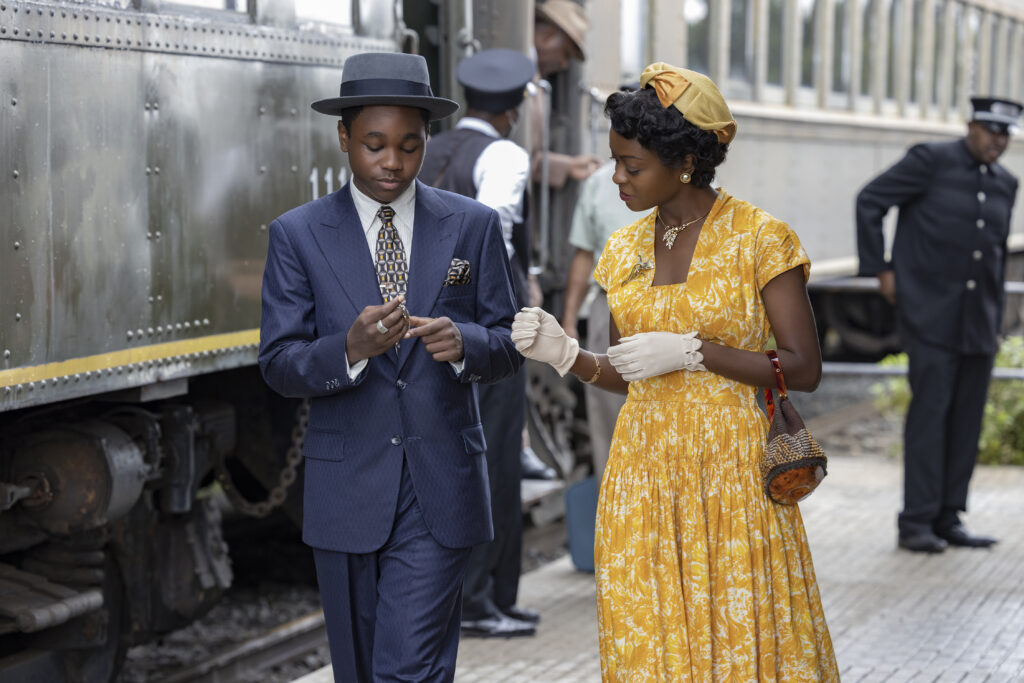
In August 1955, Mamie allowed Emmett to visit some of her relatives near Money, Mississippi, as part of his summer vacation. In the movie, perhaps out of a maternal instinct and concern, Mamie is apprehensive about sending Emmett to Mississippi by train on his own. At a time when racial segregation was legal and enforced in the South, she warns him that that “there are a different set of rules” for people who aren’t white in the South.
Emmett thinks that Mamie is being overprotective and maybe paranoid. Mamie’s mother Alma Carthan (played by Whoopi Goldberg) thinks so too. Alma tells Mamie that it’s time that Emmett be more independent since he’s close to being an adult and has to learn how to do things on his own. While Mamie says goodbye to Emmett the train station and he boards the train, she has a sudden look of fear on her face, which could be interpreted as a premonition that something terrible might happen to Emmett.
In Mississippi, Emmett stays with the Wright family, who are relatives on his mother’s side of the family. They include Emmett’s great-uncle Moses Wright (played by John Douglas Thompson); Moses’ wife Elizabeth (played by Keisha Tillis); and their son Maurice (played by Diallo Thompson). Moses makes money as a seller of cotton, and he oversees other African American men who pick cotton in the fields.
Emmett is expected to help out with this field work while he’s in Mississippi, but a city boy like Emmett immediately dislikes this type of physical labor. In the cotton fields, Emmett complains that picking cotton is a “square thing to do” (in other words, it’s too “country” for him), and he doesn’t take the work seriously. Instead, he sometimes goofs off on the job, such as pretending to pass out and getting a laugh when he reveals that nothing is wrong with him. It’s an example of Emmett’s impish sense of humor but also his naïveté at how different the lifestyle is for his working-class relatives in rural Mississippi, compared to the middle-class lifestyle he has in a big city like Chicago.
Maurice, who is in his late teens or early 20s, is a stern taskmaster who constantly warns Emmett not to be so cavalier about work and being an African American in an area where African Americans are targeted for lynchings and other hate crimes by white racists. During his stay in Mississippi, Emmett hangs out with Maurice and two of Maurice’s teenage pals who also work in the cotton fields: Wheeler Parker (played by Gem Marc Collins, also known as Marc Collins) and Simmy (played by Tyrik Johnson). Maurice is the unofficial leader of this group of friends.
When Emmett playfully flirts with some white teenage girls nearby, Maurice tells Emmett that he better not act that way with any white people, or else he could be killed. Emmett doesn’t take this warning seriously, because in his young life, he has personally never known anyone who was killed because of racist hate. And in Chicago, it’s not taboo for black people and white people to interact with each other.
One day, when Emmett, Maurice, Wheeler and Simmy have some time off from work, they hang out in front of a small grocery store. Emmett goes inside to buy a bottle of soda. The cashier behind the counter is Mrs. Carolyn Bryant (played by Haley Bennett), a white woman in her late 20s or early 30s. Emmett is friendly and open with everyone he meets, so he greets Carolyn with a smile and looks directly in her eyes.
In this racist area, where a black person is expected to act fearful and deferential toward white people, Emmett’s friendly confidence immediately makes Carolyn fill uneasy. She glares at him suspiciously has he pays for his soda. Emmett then tells her as a compliment, “You look like a movie star.”
Carolyn stares at him as if she can’t believe a black person is talking to her in this way. Emmett is oblivious to her silent hostility and takes his wallet and shows her a photo of actress Hedy Lamarr that he keeps in his wallet. “See?” Emmett says to Carolyn, as a way to point her physical resemblance. Carolyn looks even angrier, but Emmett doesn’t seem to notice.
Instead, Emmett cheerfully waves goodbye. And as if to make it clear that he thinks that Carolyn is pretty, she looks back at her and gives a flirtatious whistle. Carolyn is so incensed at this point, she leaves the counter to get a shotgun, which she plans to aim at Emmett. When Emmett sees that he could get shot but this angry racist, he suddenly understands the enormity of the situation.
Emmett runs outside while Carolyn follows him with the shotgun in aimed at him. Emmett and his pals quickly get in their truck and drive away before the situation escalates. Maurice is furious when he finds out what Emmett said and did. Maurice immediately wants to tell his father what happened, but Wheeler and Simmy convince Maurice to keep it a secret between the four of them.
However, this incident isn’t kept a secret by Carolyn. A few days later, her husband Roy Bryant (played by Sean Michael Weber) and his half-brother JW Milam (played by Eric Whitten) force their way with guns into the Wright family home, kidnap Emmett, and take him in their truck, where Carolyn and a few other men have come along for the ride. After Carolyn identifies Emmett as the teenager who flirted with her, Emmett is taken to an isolated farm area.
“Till” does not show on screen what happened to Emmett after he was kidnapped, but the movie does have some disturbing sound effects that don’t leave any doubt that he was tortured and beaten. At the New York Film Festival press conference for “Till,” Chukwu said she made a conscious decision for the movie not to show any physical violence against “black bodies.” It was the correct choice, because showing this type of violence could be thought of as exploitation and gives too much agency to the murderers.
Mamie finds out that Emmett has been kidnapped. Friends, family—including Mamie’s father, John Carthan (played by Frankie Faison), who is divorced from Alma and has remarried—as well as other people in the African American community join Mamie in their frantic search for Emmet. And then, they get the devastating news three days after his abduction that Emmett was found murdered (he was beaten and shot to death) in the Tallahatchie River. These scenes are heart-wrenching to watch.
Overwhelmed by grief, Mamie’s first priority was to get Emmett’s body returned to her so that he could be buried in Chicago. She wasn’t thinking about becoming an activist. But after seeing his disfigured and bloated body (which is replicated on screen), Mamie makes a crucial decision to let Emmett’s body be photographed and published by the media.
Mamie also decides that his funeral would be an open-casket funeral, where the thousands of attendees could see for themselves what the horrors and evils of racism look like up close. As Mamie says later in the movie when she tells reporters how she felt when she saw Emmett’s dead body: “My son came home to me reeking of racial hatred.”
The rest of “Till” takes viewers on an emotional journey as Mamie uses her inner strength to get justice for Emmett, which was also really a battle for anyone else wronged by a racist American society. Along the way, she meets some influential people who help her and teach her how to navigate being a civil rights activist with the agendas of politicians, lawyers and the media. Mamie also became more involved with the National Association for the Advancement of Colored People (NAACP) as a result of her political awakening.
Rayfield Mooty (played by Kevin Carroll), a Chicago labor who also happened to be Mamie’s second cousin, was instrumental in putting Mamie in with the NAACP. In the movie, Rayfield is the first person to bluntly tell Mamie that she has to think strategically. “It would be a good opportunity for a politician to take on Emmett’s cause in an election year,” he advises her.
Her other allies include NAACP attorney William Huff (played by Keith Arthur Bolden), who was recommended to Mamie by Rayfield; civil rights activists William Medger Evers (played by Tosin Cole) and Myrlie Evers (played by Jayme Lawson), Medger’s wife. “Till” shows how the murder of Emmett was just the beginning of the trauma, since murder trial was a continual barrage of racial inequalities that gave preference to the white defendants. Although it is widely believed that several people were involved in Emmett’s murder, only Bryant and Milam went on trial for the murder.
The murder trial in September 1955 (a quick turnaround, considering the murder happened just a month before) is an example of how there are often two types of justice, based on the races of the people involved. Although many “Till” viewers will already know the outcome of the trial before seeing the movie, it doesn’t make the outcome any less impactful. “Till” has a lot of riveting scenes that are meant to upset and enlighten people.
“Till” also shows that sexism against women also played a role in how Mamie was mistreated and misjudged by bigoted members of society during the media coverage of the trial. (Her morality was attacked because she had been divorced, which is criticism that would have been less likely to be inflicted on a divorced man.) She was also advised to not look angry in public, even though she had every right to be angry about what happened to her only child.
And that’s why it’s important for this movie to be shown from a female perspective. In 1955 American society, Mamie didn’t have the privilege of being a church leader or a chapter president of the NAACP, since those leadership positions were almost always were held by men. Even in the early civil rights movement, women were rarely allowed to give long and passionate speeches in public. It’s why what Mamie accomplishes goes beyond racism but also speaks to how she dealt with gender inequalities within the civil rights movement.
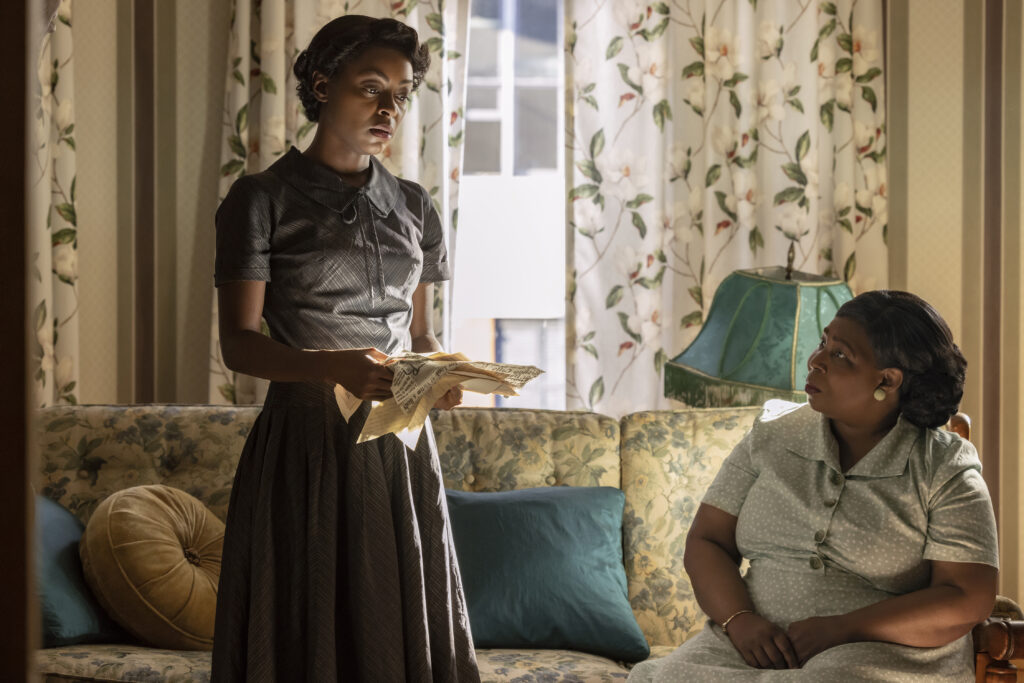
“Till” also shows in effective ways the burden of guilt that the women in Emmett’s family feel because they made the decision to let him take that fateful trip to Mississippi. One of Goldberg’s best scenes in the movie is showing through her body language the heavy heart that Alma must have felt in knowing that she was the one to convince Mamie that Emmett needed to go to Mississippi on his own. When Alma breaks down in tears and expresses an outpouring of guilt to Mamie, it’s an example of how trauma often makes loved ones feel responsible for what happened, or feel like they didn’t do enough to protect their loved one, even though it wasn’t their fault.
The movie also accurately depicts that Mamie did not become an activist overnight. It was a gradual process as she began to understand that no one else could be a better advocate for Emmett than she was. Mamie did not ask to become a public figure who was thrust into the spotlight. It was a calling that she answered, out of love and necessity.
Chukwu brings solid direction to “Till,” with many artistic choices in sound, production design, film editing, music, costume design and cinematography. It would be tempting for any filmmaker to make “Till” look like a sweeping epic melodrama. But thankfully, Chukwu and the other “Till” filmmakers refrained from making “Till” look like a social justice soap opera. An over-the-top tone would ruin the whole point of the movie, which is to make the story relatable.
“Till” shows in many ways that the horrific crime that happened to Emmett and his family can, has and does happen to ordinary, law-abiding people through no fault of their own. And, just as importantly, the movie helps people understand that you don’t have to come from a rich or privileged background to make a difference in society. “Till” arrives in theaters in the same year that the Emmett Till Antilynching Act was signed into law by U.S. President Joe Biden on March 29, 2022. The law now makes lynching a federal hate crime in the United States.
The technical aspects of “Till” work very well for the movie, but the story unquestionably has a particular resonance because of how Deadwyler and the rest of the cast members fully embody their characters with authenticity. Even when experiencing so many indignities, Deadwyler shows through her nuanced and outstanding performance how Mamie remained dignified and steadfast in her search for justice. “Till” is a necessary reminder that the work of Till-Mobley and other civil rights advocates is far from over, because racism is everyone’s problem, not just the problem of the people who are targets of this hate.
Orion Pictures will release “Till” in select U.S. cinemas on October 14, 2022, with an expansion to more U.S. cinemas on October 28, 2022.