
February 20, 2022
by Carla Hay

“Worst to First: The True Story of Z100 New York”
Directed by Mitchell Stuart
Culture Representation: Taking place in New York City and Secaucus, New Jersey, the documentary film “Worst to First: The True Story of Z100 New York” features a nearly all-white group of people (with a few African Americans and Latinos) representing the middle-class and wealthy and discussing the first decade of pop radio station Z100 New York, which launched in 1983.
Culture Clash: Z100 started off in last place in New York City’s radio ratings, but in just two-and-a-half months, it became the top-rated station in the area, largely due to radio personality Scott Shannon and his then-unorthodox methods of increasing an audience.
Culture Audience: “Worst to First: The True Story of Z100 New York” will appeal mainly to people who are interested in radio success stories, but the documentary leaves out a lot of truths about the radio business and the music industry.
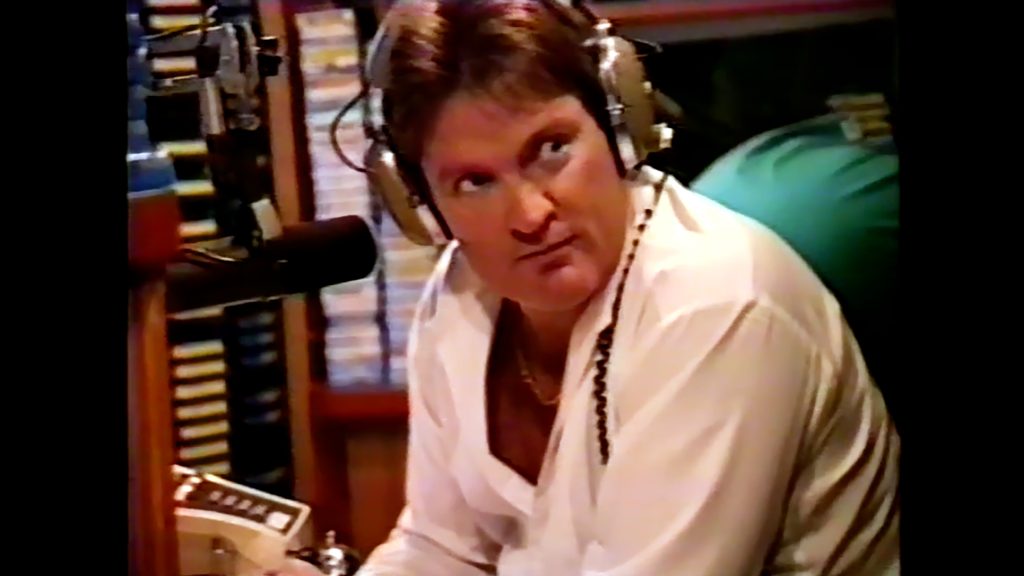
WHTZ, the New York City pop music radio station better known as Z100, is arguably the most influential pop-music radio station in the United States. (It can be heard on the FM frequency at 100.3 in the New York City metro era.) “Worst to First: The True Story of Z100 New York” is a documentary that takes a look at back at the origins of Z100 and how it went from “worst to first” in the radio ratings for the New York City metro area. “Worst to First” is really a tribute to Scott Shannon and his Z100 reign in the 1980s, rather than a comprehensive look at all of Z100’s history. The movie has flawed editing and diversity problems, but ultimately it’s lightweight nostalgia with entertaining stories.
“Worst to First” director Mitchell Stuart has a history with Z100, since he has directed footage for some of the radio station’s star-studded Z100 Jingle Ball concert events. (Stuart occasionally appears on camera in this documentary when he’s talking to Shannon.) Elvis Duran, who is currently the most famous on-air personality at Z100, is a producer of this documentary. Duran is also interviewed in “Worst to First.” If you know that information when watching this Z100 lovefest, you’ll have a better understanding of why this movie looks very biased in talking about things that only make Z100 look good, and not anything dirty or sordid that went on behind the scenes.
Still, “Worst to First” (which has a brisk total running time of 64 minutes) capably achieves its intent to show fondness for Z100 and how the radio station started off as an underdog that many people thought would never reach the heights that Z100 reached. One of the main reasons why the documentary is watchable is because of Shannon, who is a very engaging raconteur with a sense of comedic wit that can be a little cocky and rebellious. Shannon is clearly intended to be the star of the movie, because he gets the most credit for bringing Z100 to the top of the ratings in 1983, the year that the station launched. He left Z100 in 1989, and he has continued to work as a radio DJ.
Shannon, who was one of Z100’s original staffers, was the leader of the radio station’s morning-show team. Born in St. Louis in 1947, and raised near Indianapolis, Shannon came from a military family (his father was in the U.S. Army), so all the moving around that a military family has to do helped prepare him for his career in radio. Almost all radio DJs who are serious about making radio a long-term career have to frequently move from job to job and city to city to pay their dues and try to advance to larger radio markets.
Shannon was no different, and he eventually landed at WRBQ (Q105) in Tampa, Florida, where he and co-host Cleveland Wheeler led “The Q Morning Zoo” show. This “morning zoo” concept (one to three hosts who lead a team of sidekicks for a morning show) has been copied by hundreds of radio stations, but WRBQ is credited with being the first to have this concept. In “Worst to First,” Shannon says that he quit WRBQ around the same time that Milton Maltz, CEO of Malrite Communications, recruited Shannon to be part of the start-up team at a new radio station called WHTZ, nicknamed Z100.
At the time, Z100 was headquartered in Secaucus, New Jersey, which was considered a suburban void (compared to New York City) for the media and music industries. However, Z100’s radio signal (just like other radio stations in the New York City area) came from New York City’s Empire State Building, for a reach that extended from New York City to Long Island to parts of New Jersey and Connecticut. Not only was Secaucus considered out of the way for people in the entertainment industry, but Z100’s first office space was also drab and less-than-impressive, according the former Z100 staffers in the documentary.
Shannon says that he almost didn’t take the job because the unnamed executive who interviewed him was very condescending when asking Shannon during the interview: “What makes you think that you’re ready for the biggest [radio] market in the country?” Shannon’s response? “I got up, I threw my little booklet at him, and I walked out.”
According to Shannon, just as he was about to leave in the elevator, Malrite Communications CEO Maltz saw Shannon, who told him why he was leaving. However, Maltz persuaded Shannon to take the job. Shannon quips in the documentary: “Then, I realized I didn’t know anything about New York.” (Maltz is not interviewed in “Worst to First,” but the documentary has an interview with Malrite Communications vice president of programming Jim Wood, who essentially confirms this story.)
Duran comments on Shannon’s arrival as a DJ in the New York City metro area: “Scott came in not knowing anything about New York City, and I think that gave him the edge. He wasn’t scared by the city. You could tell he wasn’t from around these parts. I think that’s what made him stand out. He surrounded himself with a lot of caring, trusting people who not only communicated well with the audience, but they elevated him.”
Among the former Z100 staffers interviewed in the film are original “Z Morning Zoo” cast members Prof. Jonathan B. Bell, Ross Brittan, Claire Stevens, Anita Bonita and Cathy Donovan. Bell comments on the first time he heard about Shannon: “He had been described to me as a nutcase from Tampa, Florida, who walked around wearing shorts all the time. And somehow, he was going to revolutionize New York radio.”
Also interviewed are former Z100 DJs/hosts/personalities Sean “Hollywood” Hamilton, Patty Steele and “Magic” Matt Alan. And these former Z100 DJ/hosts/personalities are mentioned, although they are not interviewed in the documentary: Mr. Leonard (the alias of John Rio), J.R. Nelson, Jack the Wack, Janet From Another Planet and Dr. Christopher Reed. Mr. Leonard and his high-pitched voice persona had the reputation of being an eccentric who rarely went to the studio and called into the station instead when he was on the air.
Former Z100 employees who are interviewed in the documentary include Gary Fisher (Z100 director of sales from 1983 to 1987 and Z100 vice president/general manager from 1987 to 1992); Fank Foti (Z100 head engineer from 1983 to 1987); Michael Ellis (Z100 music director from 1983 to 1984); Ken Lane (Z100 promotion director from 1983 to 1989); Steve Kingston (Z100 program director from 1989 to 1996); and Tom Poleman (Z100 program director from 1997 to 2005 and currently iHeartMedia president of national programming).
Nile Rodgers (Chic co-founder, Grammy-winning producer and New York City native) says that radio in the early 1980s underwent this transition in a post-punk and post-disco world: “Basically, what was happening at radio, the way I saw it, was they could extract one lane that they thought was really working, and they would just format a whole show or station like that.” In other words, radio formats were becoming increasingly fragmented.
John Sykes, iHeart Media president of entertainment enterprises and a co-founder of MTV, comments on the state of New York City radio at the time that Shannon arrived on the scene: “There was a segment of New York radio that had gotten lazy.” Some of the heavy-hitters in the New York City market at the time include WPLJ (which changed from rock to pop/Top 40 in 1983); news/talk station WOR; WNBC, which had star hosts Don Imus and Howard Stern; WBLS, a longtime R&B/urban music powerhouse; and WKTU, whose specialty was dance music.
Z100’s biggest competitor at the time was obviously WPLJ. Shannon came out swinging in this fight. One of the first things he did to shake things up was announce to the audience that Z100 was in last place and that they needed help in getting to the top of the ratings. It was unheard of at the time for any radio station to publicly admit how bad its ratings were. Shannon encouraged listeners to make Z100 posters and other merchandise and to tell their friends about Z100.
Audience members were given incentives and rewards if they gave Z100 the names and contact information of people whom they told about Z100 and who pledged to listen to the station. It’s exactly the type of viral marketing that’s commonplace today on the Internet and social media. But, of course, the Internet and social media didn’t exist in 1983. Z100 also used some tried-and-true promotional gimmicks, such as giving away cash to listeners in sweepstakes and contests.
Shannon also did what was considered taboo in radio back then: He began personally insulting Z100’s radio rivals on the air. Perhaps the biggest target was WPLJ program director Larry Berger, whom Shannon began to call Larry Booger. Ironically, Shannon later worked at WPLJ, from 1991 to 2014. Berger, who left WPLJ in 1988, died in 2018.
Former Z100 VP/GM Fisher comments on Shannon’s tactics to get to the top of the ratings: “Scott is the best radio attack dog. He does his best work when he had a target.” The Z100 irreverence didn’t just come from Shannon. Kingston says that as, a prank, he went to the WPLJ studios with boxes of bumper stickers that said, “I Brake for Larry Berger.” He put several of these bumper stickers all over WPLJ vehicles and inside the WPLJ offices.
Even though people might think Shannon had a somewhat rude approach to surpassing his rivals, some of his past and present colleagues say that this brashness was all part of his radio persona and that his real personality was much more laid-back. Donnie Ienner, former CEO of Sony Music, remembers that he first met Shannon in 1972, when Shannon was DJ at WMAK in Nashville. At the time, Shannon was going by the DJ name Supershan and had his hair styled to look like early 1970s Elvis Presley. Ienner adds, “Privately, Scott is very demure and very quiet. And as soon as that microphone goes on, he’s on.”
Shannon is also praised in the documentary for his genuine passion for music. (What the documentary doesn’t mention is Shannon’s short-lived stint in a pop/rock duo called Wildfire, which had a minor hit song called “Here Comes the Summer” on Casablanca Records in 1977.) Shannon says he got into rock music when he was in his mid-teens, and he was hooked ever since. He also mentions in the documentary that he also grew to appreciate pop, R&B and other music genres.
Sony Music Entertainment chief creative officer Clive Davis says that Shannon’s genuine love of music set him apart from many other DJs who seemed to care more about crafting comedy personas: “Love of music allows you to be different, to not be totally predictable, and for that contagious spirit to come through.” In the documentary, Jon Bon Jovi also says that he appreciated the Z100 team for being true music fans, and for not making him feel like “a cog in the wheel” when it came to promoting his music at radio.
Shannon and other people talk about how Madonna (before she was famous) kept pestering Z100 to play her 1983 single “Holiday.” She would frequently call the station and would sometimes show up unannounced, in an effort to get Z100 to play her music. One day, she demanded to speak to Shannon on the phone. Shannon remembers that Madonna told him in that conversation that if Z100 played “Holiday,” she promised to do something special for Z100 when she became famous.
Z100 then played “Holiday,” and the rest is history. Madonna kept her promise, by giving Z100 exclusive radio access to the Times Square premiere of her 1987 movie “Who’s That Girl,” where Z100 did a live show. Shannon calls it one of the “greatest days” in his time at Z100. No one in the documentary mentions that “Who’s That Girl” was a huge flop at the box office, although Madonna did have some hit songs from the soundtrack.
Because of Z100’s headquarters location in Secaucus (which Z100 hosts cheekily tried to underplay, by saying they were broadcasting from the top of New York City’s Empire State Building), Z100 initially had a hard time convincing celebrities to go to the station for in-person interviews. Tony Orlando, who’s interviewed in the documentary, was Z100’s first celebrity guest, who was booked almost by a fluke, because a junior Z100 employee just happened to be a volunteer at a charity event hosted by Orlando. In the documentary, Geraldo Rivera and Joe Piscopo also weigh in with their thoughts on Z100.
The antics of the Z100 team and the free promotion and publicity that Z100 was getting from its rapidly growing fan base led to Z100 going from “worst to first” in the ratings in just 74 days. It was an unprecedented feat in New York City radio. Jim Kerr, who was a WPLJ morning DJ from 1974 to 1989, remembers after WPLJ switched to a pop/Top 40 format in 1983: “We were ready for our climb right to the top. And then, out of nowhere, came Scott Shannon.”
Shannon soon became a national celebrity. In 1984, he began hosting the nationally syndicated weekly series “Scott Shannon’s Rockin’ America: The Top 30 Countdown” on Westwood One. (This series was on the air until 1992.) National TV shows such as “Good Morning America” and “Entertainment Tonight” began featuring the “Z Morning Zoo” team in stories about why Z100 had such a meteoric rise to the top.
It’s undoubtedly an inspirational story, but it’s told from a very calculatedly safe bubble designed to shut out some harsh realities about problems in the radio industry and the music industry. There’s no mention of radio payola scandals in the 1980s. There’s no mention of racism and sexism. There’s no mention of rampant abuse of drugs and alcohol. In addition, “Worst to First” has some editing and sound mixing that are rough around the edges and a little bit amateurish.
An example of an edit that does this documentary a disservice is a disjointed interview segment with manager/producer/Blackheart Records co-founder Kenny Laguna, who’s best known for his association with rocker Joan Jett. (Jett is interviewed in the documentary too, but she doesn’t say much except generic comments about how happy she was to hear her music on the radio.) Laguna tells a story about a botched promotion for one of Jett’s 1980s singles, which he does not name. Laguna says that he hired a plane to fly outside the Z100 studios with banner that read: “Dear Scott, Please play Joan Jett. Love, Ken.”
The problem was that the pilot “flew the plane over the wrong part of Secaucus. And Scott didn’t see the plane,” says Laguna. And then that’s the end of the story. Why put that story in the documentary if there’s no follow-up answers to these questions: “Did Laguna do another plane stunt to correct the mistake? And if so, did Shannon see the message, and what did he think?” The story is just left to dangle with no follow-through or conclusion.
Another out-of-place edit is having Gavin DeGraw as one of the artists interviewed in the documentary. DeGraw was a child in the 1980s, he didn’t grow up in the New York City metro area, and he didn’t become a famous artist until his 2003 debut album “Chariot.” What is he doing commenting about Z100 in a documentary about Z100’s 1980s history? It makes no sense. The documentary even shows DeGraw expressing surprise when he says says that he didn’t know that Shannon was one of the original members of the Z100 team. It’s an irrelevant interview that should have been left out of the documentary.
In addition to some questionable editing decisions for content, some of the technical editing decisions don’t flow smoothly at all, with a few cringeworthy jump cuts. And considering that “Worst to First” director Stuart has experience in directing music shows, it’s disappointing that the sound mixing is uneven, with the volume on some interviews jarringly louder than others. It’s not too much of a distraction, but it’s noticeable.
However, one of the best things about “Worst to First” is the archival footage, much of which hasn’t been seen in years. In addition, the filmmakers interviewed people from various aspects of the media and the music industry outside of Z100. Other people interviewed include author/former New York Daily columnist David Hinckley; journalist/historian Jimi LaLumia, Columbia Records senior vice president of adult radio promotion Pete Cosenza; and Scott Shannon’s wife, Trish Shannon.
A significant flaw in the documentary is how it completely erases women of color. No women of color are interviewed in the documentary. That’s partially because no women of color were on the Z100 decision-making team. But former Z100 staffers aren’t the only ones interviewed in the documentary. Artists and music executives were interviewed for this documentary too, but the filmmakers chose not to include any women of color from these parts of the industry either.
In an era when Grammy-winning music superstars Tina Turner, Whitney Houston, Janet Jackson and Gloria Estefan were riding high on the pop charts and on Z100’s playlists, these women of color are not even mentioned in the documentary. The filmmakers probably wouldn’t be able to get Turner, Jackson or Estefan for interviews, just like Madonna (who’s mentioned quite a bit in the documentary) wouldn’t be available. But if the filmmakers bothered to include faded pop stars such as Debbie Gibson and Taylor Dayne for the documentary interviews, then they could’ve interviewed some women of color who were pop stars in the 1980s too. The filmmakers probably didn’t even make the attempt.
Surely, the filmmakers could’ve gotten at least one of these women of color artists for interviews: Salt-N-Pepa, Jody Watley, Jeanette Jurado from Exposé, Ruth Pointer from the Pointer Sisters, Lisa Lisa, or sisters Kathi Wolfgramm, Elizabeth Wolfgramm and Moana Wolfgramm from The Jets. Surely, the filmmakers could’ve interviewed women of color who’ve been influential music executives in the 1980s and beyond, such as Suzanne de Passe (formerly of Motown) or Sylvia Rhone, who’s been the president or chair/CEO of several record companies in her illustrious career, including Epic, Motown/Universal Motown, Elektra Entertainment Group and EastWest Records. The bottom line is that women of color were excluded from this documentary. When people talk about women of color being overlooked or sidelined, this documentary is an example of how it happens.
The documentary also completely ignores the obvious prejudices that women overall have to deal with in radio. Male radio hosts are allowed to be overweight, have gray and white hair and/or a lot of face wrinkles and jowls, but female radio hosts usually are not given this leeway in their physical appearance. Just look at the lineups of commercial radio station talent if you don’t believe this sexist double standard exists. (Non-commercial radio, which isn’t a slave to advertisers, tends to be more inclusive regarding what female radio hosts look like, but non-commercial radio has bigotry issues too.) Some people might say that when it comes to hiring people as radio hosts, audiences aren’t supposed to care what radio hosts look like. In reality, this belief only applies to male radio hosts, who benefit the most from this double standard.
The one token African American on the original “Z Morning Zoo” team was Bell, a light-skinned man, who had a “sidekick” job and was never put in charge of making the programming and hiring decisions. Because no one wants to admit on camera that they’ve been racist and sexist in employee decisions, these uncomfortable and truthful topics are kept out of a documentary designed to be a tribute. People who benefit the most from these prejudices are also the ones who tend to ignore this bigotry, condone this bigotry, and/or practice this bigotry the most. It’s not the 1980s anymore, when these issues were more likely to be swept under the rug.
It’s why “Worst to First,” for all of its jovial stories, looks like a whitewashed film made from a fan-worship perspective, instead of a documentary made by people with journalistic or truth-seeking standards. “Worst to First” is entertaining enough if people want a relatively short and fluffy breeze-through of 1980s nostalgia. However, there’s a lot more to the story that braver and more honest documentaries would have mentioned or included.
Gunpowder & Sky released “Worst to First: The True of Z100 New York” on digital and VOD on February 11, 2022.