
October 18, 2020
by Carla Hay
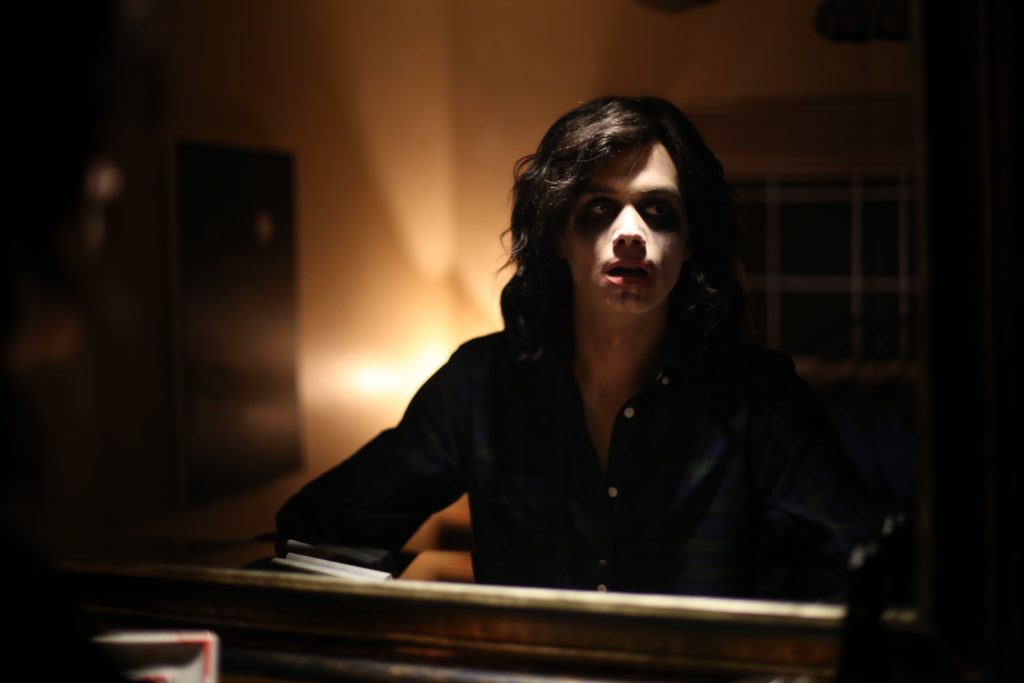
Directed by Barry Jay
Culture Representation: Taking place in an unnamed U.S. city, the horror flick “Killer Therapy” features a predominantly white cast (with a few African Americans) representing the middle-class.
Culture Clash: A troubled boy becomes a serial killer who targets people he thinks have done him wrong.
Culture Audience: “Killer Therapy” will appeal primarily to people who have a high tolerance for cheesy, low-budget horror films.

Taking a very well-worn horror concept (a “bad seed” child becomes a serial killer), “Killer Therapy” is a sometimes entertaining but mostly cringeworthy horror movie that is so tacky and badly filmed that it verges on being campy. It doesn’t help that the cast members’ experience levels of acting are reflected in their performances (the ones who are least experienced tend to be the worst actors in this movie), which gives “Killer Therapy” an uneven tone in this already off-kilter movie.
Directed by Barry Jay (who co-wrote the “Killer Therapy” screenplay with Andrew Krop), “Killer Therapy” shows three phases in the life of the movie’s serial killer: as a child, as a teenager and as an adult in his mid-20s. And he murders people in all three phases. His name is Brian Langston (played by Jonathan Tysor as a child and Michael Qeliqi as a teenager and adult), who is shown from the beginning to be a sociopath who doesn’t hesitate to murder or injure someone who angers him.
When Brian is 12 years old, his parents John Langston (played by Thom Mathews) and Debbie Langston (played by Elizabeth Keener) adopt a sweet-natured daughter named Aubrey, who’s about four years younger than Brian. Ivy George plays Aubrey as a child, while Emma Mumford plays Aubrey as a teenager and an adult.
The first third of the movie is slow-paced and repetitive, as it establishes that Brian hates Aubrey even before she comes to live in the family home. Brian is also worried that his parents will love Aubrey more than they love him. Brian’s mother Debbie reassures Brian that she won’t love Aubrey more than she loves Brian, but Debbie has to repeatedly implore Brian to accept Aubrey as part of the family.
Debbie is a lot more patient with Brian than John is, probably because Debbie is a child therapist. However, Debbie is also the parent who is the worse enabler when Brian’s lashing out in anger becomes too vicious to ignore. Debbie is in constant denial over how bad Brian is.
Brian spends a lot of time giving Aubrey evil-eyed stares and saying mean-spirited comments to her like, “Get your own mommy.” He also upsets Aubrey by doing things such as tearing off a leg of a stuffed pig that’s one of her toys. When Aubrey tries to take back the stuffed animal from Brian, he bites Aubrey on the wrist so hard that she bleeds.
Brian’s parents take him to a therapist named Dr. Keller (played by Michael Dempsey), who insists that Brian be alone with him in their first session together. A child therapist like Debbie should know better than to allow that, because the parents need that first session to explain to the therapist what’s going on with Brian before Brian’s treatment can start. But Brian’s parents foolishly leave him alone with Dr. Keller. And (most viewers can see this coming a mile away), Dr. Keller sexually abuses Brian and orders him not to tell anyone.
During Brian’s sparsely attended 13th birthday party that’s held outside in a park area, Brian throws a drink at Debbie’s friend Gloria (played by Lola Davidson) when she takes a picture of him. Debbie makes excuses for Brian’s horrible behavior by telling Gloria that Brian doesn’t like to have his picture taken. The only people at this party are Brian, Aubrey, Gloria, Gloria’s son Nathan (played by Aidan Lewis) and Debbie. John isn’t at the party because he’s working, but Brian will hold a grudge for years against John because John wasn’t at the party.
Nathan, who’s sitting in a tree during the party, bullies Aubrey by using a slingshot on her. Brian than goes after Nathan, not because of what Nathan did to Aubrey but because Nathan starts taunting Brian by calling him a “weirdo vampire freak.” Brian angrily climbs up the tree, and the next thing you know, Nathan is dead on the ground. It’s obvious to viewers that it wasn’t an accident.
Gloria immediately thinks that Brian pushed Nathan out of the tree because the two boys’ argument was seen by people at the party. However, conveniently for Brian, he is the only living witness to this murder, and he insists that Nathan fell by accident on his own. Brian is given the benefit of the doubt by his parents and authorities. However, because of his violent tendencies, Brian is still placed in a court-ordered psychiatric institution, where he stays for six years until he’s let out and allowed to go back home.
During his stay in the institution, Brian is treated by a psychiatrist named Dr. Emily Lewis (played by P.J. Soles), who tells Brian’s parents that he’s been diagnosed with bipolar disorder with sociopathic tendencies: “In Brian’s mind, there is no alternative to violence. He lacks basic human empathy to differentiate from right and wrong.”
Aubrey is now a teenager too, and she hates that Brian is coming back home to possibly disrupt their family life again. Even though he’s supposed to be 19 years old, Brian enrolls in the same high school as Aubrey, because he wasn’t in the type of institution that gives out high school diplomas. As part of Brian’s therapy when he enrolls in high school, a teacher named Mrs. Perkins (played by Adrienne King), who knows about Brian’s psychiatric problems, encourages Brian to write down his thoughts in a journal.
Aubrey keeps her distance as much as possible from Brian, but the tables have turned in their relationship. Aubrey is now the one who’s openly hostile to Brian, while he tries not to do anything that would trigger her to get angry at him. Aubrey makes it clear that she despises Brian, whom she thinks is a murderer.
But Brian’s mental problems and inclination to murder haven’t gone away. After getting out of the institution, he commits another murder, which is sloppily handled in the movie. Brian strangles this person and tries to make it look like the cause of death was by a car crash. But any medical examiner would be able determine the real cause of death.
Something such as a medical examiner investigation is conveniently overlooked in this badly written screenplay. Brian commits murders and leaves plenty of evidence behind (such as his fingerprints and DNA), but he isn’t caught. Police investigations into these murders are never shown, even though it’s obvious that Brian would be a person of interest because he was either the last person seen alive with the murder victim and/or he had a well-known grudge against the victim. The closest thing to an interrogation that Brian faces is when he’s called into the principal’s office after a fellow student is found dead.
Brian becomes infatuated with one of Aubrey’s friends named Liz (played by Angelique Maurnae), who has a very protective boyfriend named Blake Corbin (played by Daeg Faerch), who are all students at the same school. One day, while Liz, Blake and Aubrey are eating together in the school cafeteria, Blake immediately picks a fight with Brian when he sees Brian staring at Liz.
Brian’s obsession with Liz takes a creepy turn when he hides behind a tree and starts filming her with his phone. Blake catches him in the act and takes Brian’s journal as revenge. This theft of his journal sets Brian off in ways that are very predictable.
Meanwhile, Brian hasn’t forgotten about the bad therapists he encounters during his eventual descent into total madness. There’s Dr. Keller, who sexually abused Brian. There’s another therapist named Dr. Hyland (played by Javon Johnson), who sadistically administers electroshock therapy to Brian. And Brian eventually begins to hate Dr. Lewis and Mrs. Perkins for giving him therapy advice that obviously didn’t work.
One of the biggest problems with “Killer Therapy” is the inconsistent tone in the actors’ performances. Keener (as Brian’s deluded mother Debbie) and Maurnae (as Brian’s crush Liz) are actually among the better actors in this movie, but they perform like they’re in a serious drama. Faerch, as Brian’s enemy Blake, hams it up way too much and gives this movie a campy feel to it.
As the teenage and adult Brian, Qeliqi alternates between playing someone who seems to have a dead, emotionless soul; someone who acts like a wounded puppy; and someone who’s exploding with rage. And the movie’s direction is fairly sloppy, with a lot of quick-cut editing that doesn’t work that well, especially toward the end of the movie when Brian goes on a rampage. He has a beard in parts of the montage edits and doesn’t have a beard in other parts that are supposed to take place on the same night. He also puts on some makeup that makes him look like a demented descendant of Dr. Frank N. Furter from “The Rocky Horror Picture Show.”
“Killer Therapy” should be given credit for not being a completely boring film, and there are moments that are unintentionally funny. But there are so many things that are just poorly done in this movie that “Killer Therapy” can’t be recommended for anyone who wants to watch a quality horror film. There are already too many substandard horror movies like “Killer Therapy” that are amateurish and forgettable. Even die-hard horror fans who will watch any horror movie will find “Killer Therapy” hard to take.
4Digital Media released “Killer Therapy” on digital, VOD and DVD on September 15, 2020.