
March 25, 2023
by Carla Hay

Directed by Julian Higgins
Culture Representation: Taking place during one week in an unnamed rural area in the United States, the dramatic film “God’s Country” features a predominantly white cast of characters (with one black person and one Native American) representing the working-class and middle-class.
Culture Clash: A college professor, who lives alone, gets into a feud with two hunters, who get angry when she refuses to give them access to the woods behind her property.
Culture Audience: “God’s Country” will appeal mainly to people who are fans of star Thandiwe Newton and well-acted dramas about personal conflicts that have underlying roots in racism and sexism.
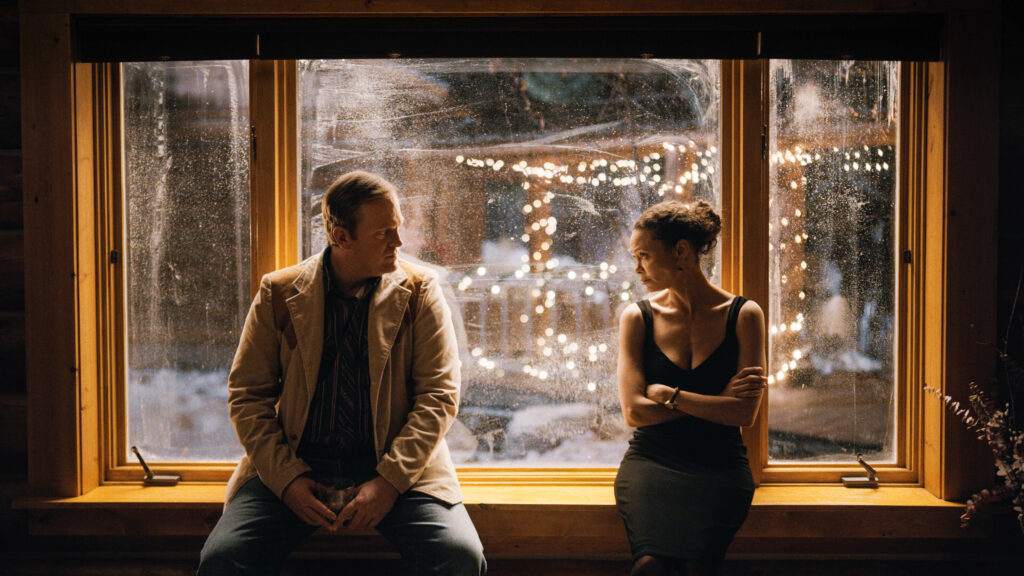
The slow-moving “God’s Country” has a very predictable ending. However, this drama about an escalating feud gets a tremendous boost from Thandiwe Newton’s riveting performance, as well as how director Julian Higgins builds tension in the movie. It’s not a movie that does anything spectacularly groundbreaking, but it has enough authentic-looking scenarios to keep viewers interested, if they are looking for a realistic drama. “God’s Country” had its world premiere at the 2022 Sundance Film Festival.
Higgins makes his feature-film directorial debut with “God’s Country,” a movie based on James Lee Burke’s short story “Winter Light,” which was published in Burke’s 2007 short-story collection “Jesus Out to Sea.” Higgins directed the 2015 short film “Winter Light” as a faithful adaptation of the story. For “God’s Country,” Higgins co-wrote the screenplay with Shaye Ogbonna, and they made a major change from the original story. In “Winter’s Light,” the college-professor protagonist is a white man in his 60s or 70s. In “God’s Country,” the college-professor protagonist is an African American woman in her 40s. (Newton is British in real life.)
In the production notes for “God’s Country,” Higgins says that changing the protagonist’s race and gender was his and Ogbonna’s direct response to Donald Trump winning the 2016 U.S. president election. “Shaye and I wanted to respond to the deep-rooted racism, sexism and misogyny reflected by the election results,” Higgins comments. “We wanted to explore the interaction between a person’s psychology and the social structures around them, especially when norms, institutions, and belief systems fail—as we felt they were. Shaye and I felt the very simple story framework presented by ‘Winter Light’ would be a perfect conduit to explore these ideas.”
“God’s Country” takes place during one week in a rural area in an unnamed U.S. state that gets snowy weather. (“God’s Country” was actually filmed in Montana.) A college professor named Cassandra “Sandra” Guidry (played by Newton), who lives alone in a remote and wooded area, is grieving over the recent death of her mother, who passed away from a unnamed illness. Sandra’s only companion at home is her dog.
Sandra teaches at a local university, where her closet colleague Arthur (played by Kai Lennox), who is another professor. It’s later shown during faculty meetings that all of the university’s professors are white, except for Sandra. Most of the other professors are men. Sandra also appears to be the only African American person living in this small town. At one point in the movie, Sandra mentions that she’s originally from New Orleans, so living in this small town is almost the complete opposite of living in New Orleans.
One day, Sandra notices that a red pickup truck is parked in the driveway, with the owner or driver nowhere in sight. She mentions to Arthur and wonders if she should call the police. Instead, she leaves a note on the truck asking the driver not to park there, because it’s private property.
The next day, the driver/owner of the truck comes back to retrieve it. His name is Nathan (played by Joris Jarsky), who explains that he’s a hunter who needs to go through her property to get to the woods where he hunts. Sandra later finds out that Nathan’s younger brother Samuel (played by Jefferson White) is Nathan’s frequent hunting companion.
Sandra calmly and firmly tells Nathan that she left a note on the truck, asking him not to park there because her land is private property. She adds, “All I’m saying, before you park on someone’s property, you have to ask.” Nathan seems casually dismissive of this request. Later, Sandra finds that her note has been torn and crumpled up in the snow.
The next day, Sandra sees the red truck parked in her driveaway again. And this time, she isn’t going to play nice. She takes a chain and tows the truck away herself to an area nearby that’s not on her property. It’s close enough so that the truck owner can find the truck without thinking that it’s stolen.
The day after that, she tells a local cop named Gus Wolf (played by Jeremy Bobb), who is the town’s acting sheriff, about this parking problem. Gus seems sympathetic to Nathan and Samuel, whom he calls “gentlemen.” And when Sandra gives Gus the truck’s license plate number so that the truck’s owner can be contacted, Gus asks Sandra in a condescending manner why she had to do that.
It’s a small town, so Gus already knows who the owner is. Gus thinks the matter can be resolved without any arrests or citations. Gus reluctantly goes with Sandra to where Nathan works and tells Nathan to stop bothering Sandra and to stop trespassing on her property, Getting this reprimand in a public place seems to set off Nate, because Sandra then becomes the target of harassment, including finding an arrow stuck in her front door.
The feud between Sandra and the two brothers gets much worse. Although it’s not said out loud, it’s implied at there’s an extra level of hostility directed at Sandra because she’s an African American woman. She lives in area where people who aren’t white are considered “outsiders,” no matter how much politeness they get from people who don’t want to look like racists or sexists. Sandra still gets a lot of people in the community who stare at her with an attitude that she doesn’t belong there, just because she’s an African American woman
The tensions over race also spill over into Sandra’s job. Sandra and Arthur have an argument in the hallway because he didn’t keep his promise to recommend at least one qualified person of color for a job vacated by a retired professor named George (played by George De Vries). The top three job candidates whom Arthur voted for are all white.
Sandra considers having a diverse group of qualified applicants to be the right thing to do, in order to have a more even playing field. However, Arthur keeps calling this diversity a “quota,” and he accuses Sandra of playing “identity politics.” The problem is that Arthur assumes that there won’t be enough qualified people of color to find. This heated conversation is very realistic to how many people view diversity issues very differently.
Observant viewers will notice that Arthur refuses to be held accountable for breaking his promise, and he made no effort to find or recommend any qualified candidates who weren’t white. Arthur tries to turn the argument back on Sandra by saying that the fact that she works there is proof that the university isn’t racist. Sandra should have told Arthur to look up the definition of “tokenism,” since she is the only non-white person in the university’s faculty.
Another issue related to racial and gender identities comes up when a Native American teaching assistant named Gretchen (played by Tanaya Beattya) confides in Sandra about a harassment incident that occurred between her Arthur, her supervising professor. Gretchen says that Arthur asked Gretchen to rub lotion on him. Up until that point, Gretchen and Arthur had a strictly professional relationship.
It’s a “he said/she said” situation where Arthur and Gretchen were the only witnesses. Gretchen is adamant that she won’t report the incident because she’s afraid that Arthur will retaliate against her, and she wants to keep her job. Gretchen also thinks that people will be less likely to believe her because she isn’t white. This #MeToo subplot isn’t handled very well in the movie’s narrative. It just seems like it was put in the screenplay as a way to stretch out the movie’s run time.
The movie’s main conflict, of course, is between Sandra and the obnoxious brothers Samuel and Nathan, who enlist some of their buddies to join in on the harassment of Sandra. These local men, who act very entitled to do what they want, also don’t seem afraid of getting arrested, since law enforcement is almost non-existent in this small town. Gus is the main cop, and he doesn’t have much backup or much of a backbone to stand up to these thugs.
And you know what that means: The people involved in this feud start to act like they can take the law into their own hands and twist it to fit whatever agenda they have. “God’s Country” invites viewers to think about the choices they would make if they were in the same situation. The main takeaway from this stark and bleak film is that when hate becomes the driving force behind how to handle conflicts, there are no real winners.
IFC Films released “God’s Country” in select U.S. cinemas on September 16, 2022. The movie was released on digital and VOD on October 4, 2022.