
November 11, 2022
by Carla Hay
Directed by Steven Spielberg
Culture Representation: Taking place from 1952 to 1965, in New Jersey, Arizona, and California, the dramatic film “The Fabelmans” (inspired by director Steven Spielberg’s own youth) features a predominantly white cast of characters (with a few Latinos) representing the working-class, middle-class and wealthy.
Culture Clash: Sammy Fabelman’s parents have contrasting opinions about his childhood dream to become a movie director, and his home life becomes turbulent when he finds out an emotionally painful secret.
Culture Audience: “The Fabelmans” will appeal primarily to people who are fans of Spielberg and anyone interested in coming-of-age stories about famous filmmakers.
Steven Spielberg tells a very personal story of his youth in “The Fabelmans,” a drama that’s a partial biopic and a therapeutic life analysis. The movie’s overly long run time drags it down, but Michelle Williams gives a transcendent performance as the mother of the fictional version of Spielberg. “The Fabelmans” (which clocks in at 151 minutes) is yet another story about a young person who ends up going to Hollywood to pursue a dream. But in this case, the young person turned out to be the Oscar-winning Spielberg, who is frequently lauded as one of the greatest filmmakers of all time.
Spielberg directed “The Fabelmans” and co-wrote the movie’s screenplay with Tony Kushner. Spielberg and Kushner previously collaborated on the 2021 remake of “West Side Story,” 2012’s “Lincoln” and 2005’s “Munich.” Spielberg has made a wide variety of films, but many of his movies—especially the ones having to do with outer-space creatures, such as 1977’s “Close Encounters of the Third Kind,” 1982’s “E.T. the Extra-Terrestrial” and 2005’s “War of the Worlds” remake—have a few themes in common, such as people dealing with fractured families and/or families in conflict because one person in the family is determined to pursue a particular goal against tremendous odds. In “The Fabelmans,” there are no outer-space creatures, but protagonist Sammy Fabelman (a fictional character based on the real-life Spielberg) often feels like he’s a proverbial alien in his own family.
“The Fabelmans” begins in New Jersey, on January 10, 1952. Sammy is 5 years old (played by Mateo Zoryon Francis-DeFord), and his parents have taken him to the movies to see director Cecil B. DeMille’s circus drama “The Greatest Show on Earth,” starring Betty Hutton, Cornel Wilde, Charlton Heston, Dorothy Lamour, Gloria Grahame and James Stewart. Before they go into the move theater, Sammy’s mother Mitzi Fabelman (played by Williams) and Sammy’s father Burt Fabelman (played by Paul Dano) assure a fearful Sammy that the people who will look like giants on the big screen are just images from the movie. Sammy doesn’t know it yet, but seeing this movie will change his life.
This moviegoing scene in “The Fabelmans” also establishes from the beginning how Mitzi and Burt have two different parenting styles and contrasting outlooks on life. Burt, who is a computer engineer, tries to explain to Sammy the technical aspects of how a movie projector beams images on the screen and how a human brain processes those images. Mitzi, who is an on-again/off-again professional pianist for radio, explains movies to Sammy this way: “They’re like dreams.” In other words, Burt views life like a scientist, while Mitzi views life like an artist.
It’s later mentioned in the movie that young Sammy has anxiety and is prone to panic attacks. But since he’s a child in the 1950s, when people usually didn’t seek psychiatric care for this medical condition, Sammy doesn’t get therapy in his childhood for his anxiety. The person in his family who is most likely to calm him down is his mother Mitzi, who has mental health struggles of her own. She is the person in the family who is most likely to understand Sammy.
Sitting between his parents while watching “The Greatest Show on Earth,” Sammy is in awe and slightly afraid of what he’s seeing on the big screen. He is particularly impacted by the movie’s train-wreck scene. In this scene, a criminal who has just robbed a circus train, which is stopped on the tracks, drives his car onto the tracks to frantically stop another circus train traveling right behind the first train. His plan doesn’t work, and the second train plows into his car and the first train, causing death and some of the wild circus animals to escape.
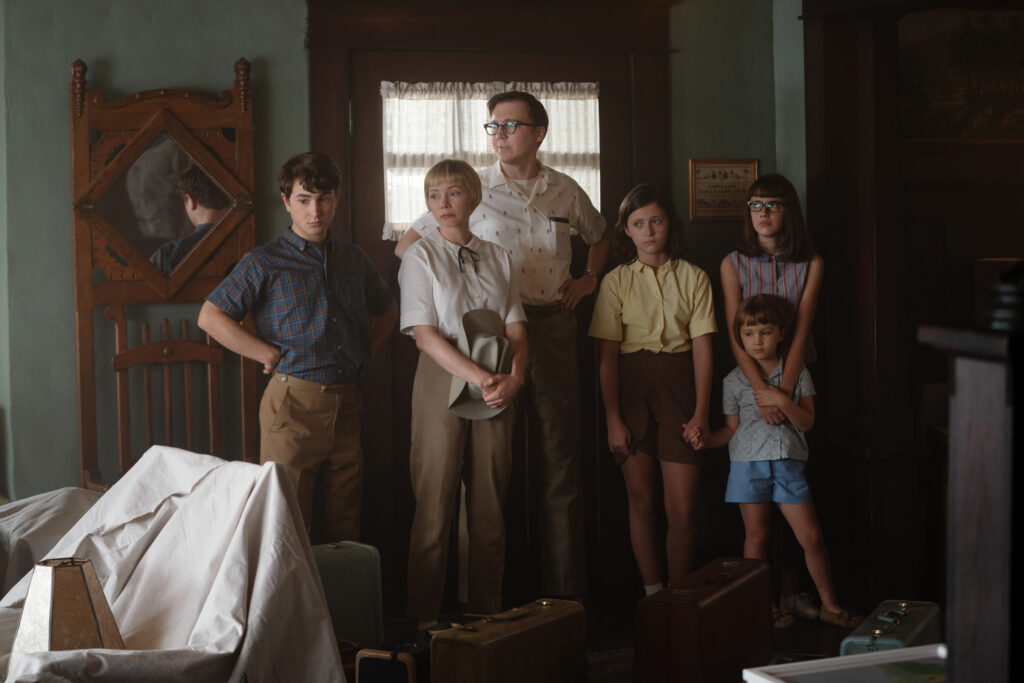
After Sammy gets home, his parents notice that he’s become obsessed with trains. As a Hanukkah gift, Sammy’s father gives him a train set. The other members of the Fabelman household are Sammy’s younger sisters Reggie Fabelman (played by Birdie Borria) and Natalie Fabelman (played by Alina Brace).
It isn’t long before Sammy is recreating the train wreck that he saw in “The Greatest Show on Earth.” Burt gets angry because he thinks Sammy isn’t respecting the toy train and is trying to ruin it, so he temporarily takes the train set away from Sammy as punishment. He orders Sammy not to simulate a train wreck when he plays with the toy train.
“I need to see them crash,” Sammy tells his parents to explain why he likes making the train crash into a toy car. Mitzi understands why Sammy has a fascination with creating a train wreck and explains it to Burt that it’s because Sammy wants control over the train. Burt doesn’t care to understand and just thinks Sammy is being a spoiled brat.
One night, after Sammy has gotten his toy train back, Mitzi takes him into the room where the train set is. She tells Sammy that he can crash the train one more time, but they will secretly use Burt’s film camera to film everything, so Sammy can watch the train wreck over and over without actually crashing the train. Mitzi tells Sammy that this film will be their little secret.
Of course, this film is the start of Sammy’s lifelong passion to become a filmmaker. By the following year, in 1953, the Fabelmans have a new addition to the family: a baby named Lisa. Burt gets a job working as a manager at General Electric (GE) in Phoenix, Arizona. Mitzi is supportive of the move, as long as Burt can get his best friend/co-worker Bennie Loewy (played by Seth Rogen) a job at GE too. It’s mentioned several times in the movie that Burt is an exceptional engineer and a computer visionary, while Bennie is an average employee who owes much of his career to getting help from Burt.
The Fabelman kids often call Burt’s best friend Uncle Bennie, even though Bennie isn’t biologically related to them. During a Fabelman family dinner, observant viewers will notice other dynamics in Bennie’s relationship to the Fabelmans. Bennie is a friendly jokester who likes to play harmless pranks and make people laugh, especially Mitzi.
Burt’s outspoken, widowed mother Hadassah Fabelman (played by Jeannie Berlin), who is a frequent visitor in the household, isn’t too fond of Bennie. Hadassah notices how Bennie and Mitzi have a playful banter with each other. Mitzi’s widowed mother Tina Schildkraut (played by Robin Bartlett), who is much more laid-back than Hadassah, doesn’t talk much and only has a few scenes in the movie.
Burt is mild-mannered, nerdy and slow to pick up on body language and social cues to figure out how people are really feeling. He’s a classic introvert who is more likely to consider facts when making a decision. Mitzi is impulsive, moody and very attuned to people’s unsaid thoughts. Mitzi is a classic extrovert, who is more likely to consider feelings when making a decision. Burt prefers to avoid confrontations. Mitzi isn’t afraid of confrontations and will often cause them.
It’s also implied that Mitzi has an undiagnosed mental illness, which is presented in “The Fabelmans” as looking a lot like bipolar disorder. In a scene that takes place in 1953, before the family moves from New Jersey to Arizona, a tornado strikes the area where the Fabelmans live. Instead of wanting to stay safe in their house or a secure shelter, like most people would, Mitzi spontaneously decides to take Sammy, Natalie and Reggie with her in the family car to drive toward the tornado so that they can get a closer look at it. (Mitzi at least has the sense to leave baby Lisa behind with Burt.)
Mitzi makes this decision so quickly, Burt doesn’t have time to stop her, and his protests are ignored. The kids are too young to understand that Mitzi could be putting them in danger, because she acts like this is a fun joy ride. As they get closer to the tornado and the rain storm gets worse, Mitzi stops the car, and the reality sinks in that this isn’t an adventure trip after all. She begins to cry but still pretends to the children that everything is just fine as she dejectedly drives home. You don’t have to be a psychiatrist to see that this incident looks like a manic episode from a person with bipolar disorder.
It’s no secret that in real life, Spielberg’s parents got divorced when he was a teenager. Spielberg has also been open about the reason why they got divorced. He talked about it in director Susan Lacy’s 2017 documentary “Spielberg,” as well as in some interviews that he’s given over the years. But the reason why is parents got divorced will be a surprise to many people who watch “The Fabelmans” for the first time, so those details won’t be revealed in this review.
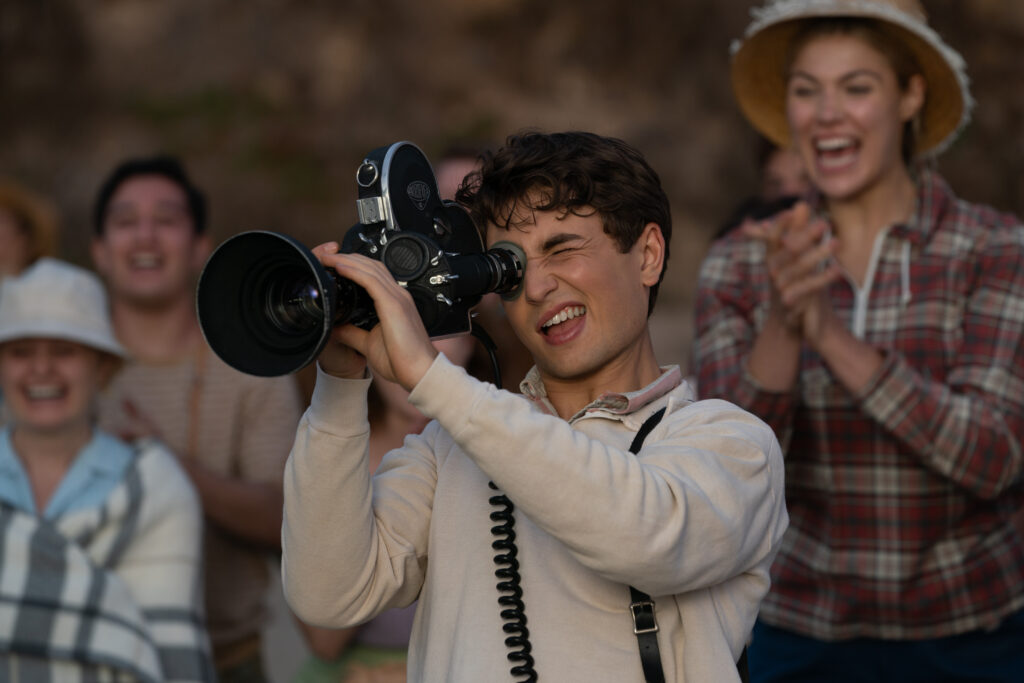
However, it’s enough to say that by the time the family moves to Phoenix, the cracks in the marriage are already starting to show. “The Fabelmans” then fast-forwards to the family’s life in Arizona during the early-to-mid-1960s. Sammy is now a blossoming teenage filmmaker (played by Gabriel LaBelle), who makes short films (mostly Westerns) with his schoolmates and members of his Boy Scout troop. Sammy gets a lot of praise and admiration from most people around him for his filmmaking. Bennie is in Arizona too, working at GE with Burt and often accompanying the Fabelmans on family gatherings.
After some initial skepticism, Sammy’s father Burt eventually becomes impressed with Sammy’s talent for filmmaking, but Burt is not entirely convinced that filmmaking is a good career choice for Sammy. He often tells Sammy to pursue a more “practical” profession. Burt also keeps calling Sammy’s filmmaking a “hobby,” and Sammy is offended by Burt not taking Sammy’s filmmaking seriously as a future career. By contrast, Mitzi is Sammy’s first and biggest filmmaking fan, and she never wavers or has doubts in encouraging Sammy to become a filmmaker.
Reggie (played by Julia Butters), who’s about two or three years younger than Sammy, is intelligent, assertive and opinionated. She’s also the sister who has the closest emotional bond to Sammy, and he values her opinion. (Reggie is based on Spielberg’s real-sister Anne, who became a screenwriter.) For example, while Steven is editing his short films, he sometimes shows Nancy early cuts of the films and asks her what she thinks.
Natalie (played by Keeley Karsten), who’s about four years younger than Sammy, is a polite and obedient kid. She’s based on Steven Spielberg’s middle sister Sue, who’s actually seven years younger than he is. Sammy’s youngest sister Lisa (played by Sophia Kopera), who’s six years younger than Sammy, doesn’t have much of a personality in the movie at all. (Lisa is based on Steven Spielberg’s youngest sister Nancy, who’s actually 10 years younger than he is.)
With the Fabelman kids at an age where they are all now in school, Mitzi begins to take up professional piano playing for radio again. The family members (with Bennie) often gather in their living room to watch Mitzi practice. Burt is reluctant to give any criticism to Mitzi, while Bennie is more forthright and isn’t afraid to tell Mitzi what he thinks.
There’s a telling scene where Mitzi’s long fingernails cause a clacking noise when she plays the piano. Burt denies there’s anything wrong with that, but Bennie says it’s going to be a problem for radio listeners to hear this clacking noise during Mitzi’s piano playing. Mitzi takes pride in her long, well-manicured fingernails and doesn’t want to cut them. She eventually relents when Bennie and some of the kids playfully tackle her, and Bennie cuts her nails.
One of the most memorable sequences in “The Fabelmans” is a fateful camping trip that the family takes while living in Arizona. Everything is going well. Everyone seems to be happy. Sammy is filming everything that he can during this trip.
One night during a campfire, Mitzi spontaneously decides to do a ballet dance in front of Burt, Bennie, Sammy and Reggie while she’s wearing a thin-fabric nightgown. Sammy is filming it, of course. In order to get better lighting, Bennie turns on the headlights of a car parked nearby. The bright lights essentially cause Mitzi’s nightgown to become see-through, and it’s obviously she’s completely naked underneath the gown.
Reggie is mortified, and she runs up to her mother to tell her discreetly that everyone can see through Mitzi’s nightgown. Mitzi ignores her and keeps dancing, while Reggie pleads for her mother to stop. Mitzi keeps dancing, while an annoyed Reggie runs away and says that everyone there is crazy.
Mitzi’s only audience is now Bennie, Burt and Sammy, who keeps the camera focused on Mitzi. All of them are looking at Mitzi, almost as if they’re in a trance. Their fascination with her is for different reasons, which can all be seen on the expressions on their faces. Sammy being in awe isn’t incestuous, although it does come across as a little creepy that he’s staring at his mother’s nearly naked body.
This scene shows that Sammy is so enthralled with his filmmaking and what he’s getting on camera, it’s almost as if he forgot that the woman in the see-through gown in front of him is his own mother. When Mitzi ends the dance, she looks at everyone staring at her with a expression of satisfaction but also a tinge of sadness. Later, when the family looks at the footage, Mitzi praises Sammy by telling him, “You really see me.”
Another pivotal sequence in “The Fabelmans” happens when Mitzi’s uncle Boris (played by Judd Hirsch) shows up at the Fabelmans’ home in Phoenix for a surprise visit. This visit happens after Mitzi had a nightmarish dream that her mother Tina (Boris’ sister) called Mitzi to warn her that something was coming. According to Mitzi, Boris used to bully Tina when Tina was a child, and Mitzi grew up in fear of him too. And so, when Boris arrives at the home, Mitzi greets him with a lot of apprehension, but she eventually relaxes when she sees that Boris is nice to her and her family.
Boris, who is now an elderly man, spent much of his life as a lion trainer in the circus. He has a personality that is eccentric and “in your face.” He’s a raconteur who likes to tell stories about himself, and he has a voice that compels people to pay attention to him. In other words, it’s impossible to ignore Boris when he’s in a room.
When Boris finds out that Sammy is an aspiring filmmaker, he begins to give Sammy advice on what to expect in life if Sammy wants to be an artist. Sammy doesn’t see the connection between being an artist and a circus lion trainer, until Boris explains that there’s no art in putting your head in a lion, but there’s an art in keeping the lion from biting your head while in a lion’s mouth.
Boris warns Sammy that artists will have always have a tug of war between art and family. He also tells Sammy that being an artist also means often being very lonely. Sammy is both awed and intimidated by Boris, especially after Boris puts Sammy in headlock in an awkward way to show Sammy to remember that physical pain every time Sammy has to suffer as an artist.
The last third of “The Fabelmans” could have been its own movie because of all the things that happen. In this part of the film, the Fabelmans move once again—this time to California’s Santa Clara County, because Burt has gotten a major job offer to work for IBM. Mitzi and Sammy (who is in his last year of high school) are very unhappy with this move, and the family starts to crumble over various things. Unlike their life in Arizona, where they lived near several other Jewish families, the Fabelmans are the only Jewish family in their California neighborhood.
At school, Sammy is a misfit loner who gets bullied by the school’s star athletes, led by a conceited pretty boy named Logan Hall (played by Sam Rechner), who is also in his last year of high school. Logan has a weaselly sidekick named Chad Thomas (played by Oakes Fegley), who openly hates Jewish people. Sammy experiences some cruel antisemitism from Chad, Logan and other students who stand by and laugh when Sammy gets bullied for being Jewish.
Sammy also gets caught up in some drama between Logan’s girlfriend Claudia Denning (played by Isabelle Kusman) and Logan. It leads to Sammy getting to closer to Claudia and Claudia’s best friend Monica Sherwood (played by Chloe East), who is a self-described Jesus freak. Monica is fascinated by Sammy being Jewish, so her interest in him is a combination of teenage lust and a desire to turn him on to Christianity.
The last third of “The Fabelmans” is the best part of the movie, but it’s also the messiest. It mostly chronicles Sammy’s last year in high school in California, and it offers a glimpse into his life after high school. (Real-life filmmaker David Lynch has a noteworthy cameo as legendary filmmaker John Ford.) Sammy’s life after high school and during college is so truncated, it’s obvious to viewers that a significant part of the story is missing, to the detriment of the movie, which is already too long. In other words, this story should have been a miniseries, not a feature-length film.
However, there’s no denying that “The Fabelmans” does a stellar job of depicting Sammy coming to terms with the fantasies that he escapes to in filmmaking and the harsh realities of life. The movie also skillfully shows that the two most impactful relationships that Sammy had in his youth are Sammy’s relationship with filmmaking and Sammy’s relationship with his mother. The reasons for the family unraveling are heartbreaking but very realistic.
And it’s why Williams is such a standout in a very talented cast. Her portrayal of Mitzi is far from stereotypical and shows many depths and layers to this complicated person. Mitzi has wonderful qualities as well as damaging flaws. Williams makes this character a full, authentic human being, not just someone reciting lines and emoting on screen.
The other principal cast members do well in their roles. Dano is convincing in playing a character who represses a lot of emotions and denies a lot of problems until it’s too late. LaBelle also turns in an admirable performance, considering it’s not easy for any actor to know that he’s playing a young version of Steven Spielberg. Rogen is perfectly fine as family friend Bennie, but this character doesn’t have a lot of screen time, and Rogen (who’s mostly known as a comedic actor) has had better roles to show his dramatic abilities.
“The Fabelmans” is a specific story but it’s also universal to anyone who can relate to pursuing dreams, even when people doubt that certain goals can be accomplished. The movie’s tone has a middle-class American sheen to it that will get some criticism for glossing over a lot of American society problems in the 1950s and 1960s that still exist today. Antisemitism is part of the story, but racism, sexism, poverty and other social ills are completely erased in this movie.
This omission of any of society’s problems outside of Sammy’s limited world in the 1950s and 1960s speaks to how his young life had its share of turmoil, but it was still in a certain “bubble” where he was blissfully unaware or chose to ignore a lot of society’s problems that weren’t about him. It’s a blind spot that many people carry throughout their lives, but “The Fabelmans” offers no real or meaningful introspection about that blind spot.
“The Fabelmans” had its world premiere at the 2022 Toronto International Film Festival, where the movie won the People’s Choice Award, which is the festival’s top prize. Even with any accolades that this movie receives, when people look back on Steven Spielberg’s most beloved films, “The Fabelmans” won’t be at the top of the list for most people. However long-winded this movie can be, it still showcases Spielberg’s talent for telling emotionally genuine stories about families, as well as expressing why people fall in love with filmmaking.
Universal Pictures released “The Fabelmans” in select U.S. cinemas on November 11, 2022, with an expansion to more U.S. cinemas on November 23, 2022.