
Review: ‘Roofman,’ starring Channing Tatum, Kirsten Dunst, LaKeith Stanfield, Juno Temple and Peter Dinklage

October 7, 2025

by Carla Hay

Channing Tatum in “Roofman” (Photo courtesy of Paramount Pictures)

“Roofman”

Directed by Derek Cianfrance

Culture Representation: Taking place in North Carolina, from 2003 to 2005, the dramatic film “Roofman” (based on real events) features a predominantly white cast of characters (with a few African Americans) representing the working-class and middle-class.

Culture Clash: A convicted robber escapes from prison, hides in a Toys “R” Us store, and begins romancing a divorced mother, who is one of the store’s employees.  

Culture Audience: “Roofman” will appeal primarily to people who are fans of the movie’s headliners and well-acted dramas based on true crime stories.

Channing Tatum and Kirsten Dunst in “Roofman” (Photo courtesy of Paramount Pictures)

The crime drama “Roofman” has engaging performances in this “based on a true story” about a convicted robber who escapes from prison, hides in a toy store, and starts a romance with a divorced mother. The movie is a bit too long, but it’s entertaining. “Roofman” (which has a total running time of 126 minutes) also skirts dangerously close to glorifying this criminal and making him look too sympathetic, while glossing over a lot of the damage he did during his crime spree.

Directed by Derek Cianfrance (who co-wrote the “Roofman” screenplay with Kirt Gunn), “Roofman” takes place in North Carolina from 2003 to 2005. It’s a very condensed version of the real timeline period, which took place from 2000 to 2005. Several details of the real story are changed in the movie for dramatic purposes, although the names of movie’s central couple are the same as the real people portrayed in the movie. “Roofman” had its world premiere at the 2025 Toronto International Film Festival.

“Roofman” (which was filmed on location in North Carolina, and is told in chronological order) begins by showing U.S. Army veteran/divorced father Jeffrey “Jeff” Manchester (played by Channing Tatum) doing what he’s been doing for the the past two years: robbing fast-food places by cutting open a hole in the roof at night, waiting for first-shift employees to arrive at the restaurant before it opens, and then forcing the employees by gunpoint to give him any cash that’s in the restaurant. Jeff, who wears a mask during the robberies, always politely tells his victims that if they remain calm and does what he says, then he won’t hurt them. (For the purposes of this review, the real Jeff Manchester will be referred to by his last name. The character of Jeff Manchester in “Roofman” will be referred to by his first name.)

In this opening scene, Jeff robs a McDonald’s and tells the three employees—Jade (played by Kirana Kiuc), Joslyn (played by Gabriella Cila) and store manager Duane (played by Tony Revolori)—that he’s locking them in the freezer room. Jade and Joslyn each has her own jacket, but Duane doesn’t have a jacket. Duane is afraid that he’ll get hypothermia in the freezer room. Jeff takes pity on Duane and gives his own jacket to Duane before locking all the employees in the freezer room. It’s this movie’s way of showing that even though Jeff is an armed robber, he shows “kindness” to his victims.

Jeff also assures the employees that they won’t be in the freezer for long because right before he leaves, he’s going to use a phone in the restaurant to call 911 to send help. (Jeff presumably disguises his voice for this phone call.) What the movie doesn’t take into account is that this seeming act of kindness doesn’t erase the possibility that one of the robbery victims could have an undisclosed medical condition that would be very harmful and possibly deadly if that person undergoes any expected stress. It also wasn’t smart of Jeff to leave his jacket behind because the jacket has DNA evidence.

Jeff is next seen hosting a birthday party for his eldest child: a daughter named Becky (played by Alissa Marie Pearson), whose only gift request is to get a bicycle. Becky is about 4 or 5 years old. Jeff can’t afford a bicycle, so his birthday gift to Becky is a box set to build toy cars. Becky is visibly confused and disappointed, even though Jeff tries to convince Becky that this is a fun gift for her.

Jeff’s financial problems and being a less-than-responsible father are depicted as two of the main reasons why he got divorced. He and his ex-wife Talena (played by Melonie Diaz) also have twin infant sons, whose names are not mentioned in the movie. Talena is fed up and disgusted with Jeff. She doesn’t trust that he will improve.

Jeff gripes about how miserable he is to his former Army buddy Steve (played by LaKeith Stanfield), who’s involved in criminal activities of his own: Steve and his girlfriend Michelle (played by Juno Temple) sell fake identities and fake ID documents. Steve tells Jeff that Jeff is smarter than most people because Jeff can see solutions to problems that other people can’t see. Steve advises Jeff to use his talents wisely.

After this birthday party, Jeff goes on a robbery spree. The media and others have given the robber the nickname Roofman because of how the robber accesses the restaurants by breaking in through the roof. Steve suspects that Jeff is really Roofman, but Jeff keeps his robberies a secret from everyone.

The movie fast-forwards to a year later, in 2004, when Jeff’s birthday party for Becky is much more elaborate, and he gives her the gift that she wanted: a brand-new bicycle. Becky is ecstatic, but the birthday party turns into a disaster when police show up to arrest Jeff for the robberies. Jeff runs away, but he’s quickly caught, and Becky witnesses this arrest. Jeff is subsequently convicted of the McDonald’s robbery and kidnapping that were shown in the beginning of the movie.

In real life, Manchester was arrested in a wooded area after a silent alarm went off during one of his robberies. His arrest did not take place in front of his daughter or during a birthday party. In the movie, as in real life, Jeff was sentenced to 45 years in prison because the judge felt that Jeff deserved a harsher sentence because Jeff put the robbery victims in a freezer room.

Jeff is the intermittent narrator of this movie. He explains that during his first several months in prison, he became a well-behaved prisoner who earned the trust of the prison employees. Jeff also learned the prison’s routines of when delivery trucks would come and go. He is entrusted with helping unload some of these deliveries and ends up escaping by hiding underneath a delivery truck.

Jeff hides in a Toys “R” Us store and lives there undetected for the next several months. Jeff turns off the recording function in the store’s video surveillance system, which the store employees don’t bother to check on a regular basis. He makes money by stealing items from the store and selling them. Using the alias John Zorn, Jeff ends up dating a Toys “R” Us store employee named Leigh Wainscott (played by Kirsten Dunst), whom he meets when he joins a local Christian church, which is led by amiable Pastor Ron (played by Ben Mendelsohn) and his cheerful wife Eileen (played by Uzo Aduba).

Leigh works as a sales clerk at Toys “R” Us. It’s mentioned at one point that she has a master’s degree, but the movie doesn’t give her enough of a backstory to explain why a middle-aged person with a master’s degree is working as a low-paid sales clerk at a toy store. In real life, Wainscott did not work at the Toys “R” Us store where Manchester was hiding. The movie also erases the fact that Manchester eventually relocated from the Toys “R” Us store to hide in a nearby Circuit City. In real life, Manchester was living in this Circuit City when he did the big robbery of Toys “R” Us that is depicted in the movie.

Leigh, who is not in contact with her ex-husband, is the mother of two daughters: moody Lindsay (played by Lily Colias) and sweet-natured Delilah, nicknamed Dee (played by Kennedy Maeve Moyer), who have very different reactions to Jeff/John when they first meet him. Lindsay, who is 15 or 16 years old, is standoffish and skeptical. Dee, who is about 11 or 12 years old, is friendly and accepting.

Jeff immediately wins over Dee because he knew in advance that she was a fan of “The Legend of Zelda” video games, so he gives Zelda toys and games to Dee the first time that he meets her. The movie shows several scenes where Jeff has a pattern of buying gifts for people as a way to get them to like him or love him more. His materialism and greed are his biggest flaws and will be his downfall.

Jeff becomes a popular member of the congregation because of his good looks and charm. When people ask him what he does for a living, he says he works in a top-secret job for the government. A big plot hole in the movie is Leigh never asks to see where Jeff lives during the entire time that Jeff and Leigh are dating and fall in love. Jeff presumably told her that he couldn’t disclose where he lived because of confidentiality reasons related to his job.

Leigh’s blind trust of Jeff is an example of what can really happen, because there are thousands of people in real life who’ve been conned by getting even less information from the scammers who romance them. Leigh is also an ideal victim for this type of con artist: She tells Jeff up front that she hasn’t dated at all since her divorce. Her emotional vulnerability set her up to be a target of Jeff’s con game and lies.

Other supporting characters in the movie are prickly Toys “R” Us store manager Mitch (played by Peter Dinklage) and Toys “R” Us stock employee Otis (played by Emory Cohen), who is meek and often verbally bullied by Mitch. By having Mitch be a jerk, the movie makes it easier for viewers to not feel much pity for Mitch when Jeff steals from the store, knowing that Mitch will be blamed for these merchandise losses. “Roofman” has this type of manipulation of the facts and fabrication of certain characters’ personalities, in order to make Jeff look more sympathetic than he deserves.

During the movie’s end credits, “Roofman” over-praises the real Manchester in a montage of archival news clips showing interviews with some of the people who were conned by Manchester in real life, such as Wainscott and Pastor Ron Smith. These interview clips only have flattering commentary about Manchester. It all seems very one-sided and agenda-based. The filmmakers also could’ve trimmed a few unnecessary scenes that didn’t happen in real life, in order to bring the total run time to less than two hours.

Even with distortion of certain facts, “Roofman” is held together by the believable performances of the principal cast members. One of the best scenes in the movie isn’t in the flashy “fugitive on the run” moments, but a moment that comes in the last third of the film when Jeff and Leigh are attending a church service. Leigh is singing in the church choir, while Jeff is in the audience. They look at each other with tears in their eyes because it’s at a point in their relationship when Leigh is having doubts about Jeff, and he knows it. This type of scene conveys the more impactful and heartbreaking consequences of the true story, rather than scenes that involve guns or police chases.

Paramount Pictures will release “Roofman” in U.S. cinemas on October 10, 2025. A sneak preview of the movie was shown in U.S. cinemas on October 6, 2025.

Review: ‘Venom: The Last Dance,’ starring Tom Hardy, Chiwetel Ejiofor, Juno Temple, Rhys Ifans, Stephen Graham, Peggy Lu and Alanna Ubach

October 23, 2024

by Carla Hay

Tom Hardy in “Venom: The Last Dance” (Photo courtesy of Columbia Pictures)

“Venom: The Last Dance”

Directed by Kelly Marcel

Culture Representation: Taking place in California, Nevada and briefly in New York City, the sci-fi/action film “Venom: The Last Dance” (based on Marvel Comics characters) features a predominantly white cast of characters (with some black people and a few Asian people and Latin people) representing the working-class, middle-class and wealthy.

Culture Clash: San Francisco journalist Eddie Brock, who has an antihero alter ego named Venom, becomes a fugitive suspect in a cop’s murder, and he travels to Nevada, where he gets mixed up with secret government activities involving outer-space aliens.

Culture Audience: “Venom: The Last Dance” will appeal mainly to people who are fans of the movies based on comic books, the movie’s headliners and mindless action flicks.

Chiwetel Ejiofor, Juno Temple and Clark Backo in “Venom: The Last Dance” (Photo by Laura Radford/Columbia Pictures)

“Venom: The Last Dance” is so sloppily made and uninteresting, it’s an example of a sequel that doesn’t need to exist. Talented cast members are stuck in this dull and predictable comic book movie. “Venom: The Last Dance” also has an uneven tone, as the movie seems unsure of how far it should lean into the campy comedy that made the first two “Venom” movies more watchable than this underwhelming third “Venom” movie.

Written and directed by Kelly Marcel, “Venom: The Last Dance” is the follow-up to 2018’s “Venom” and 2021’s “Venom: Let There Be Carnage.” Marcel co-wrote “Venom” and “Venom: Let There Be Carnage” and makes her feature-film directorial debut with “Venom: The Last Dance.” People who’ve seen “Venom” and “Venom: Let There Be Carnage” are more likely to understand what’s going on in “Venom: The Last Dance” but are also more likely to be disappointed.

All of these “Venom” movies (which are based on Marvel Comic characters) have never been considered top-tier comic book adaptations. However, the “Venom” and “Venom: Let There Be Carnage” had more suspense that was a lot more entertaining to watch than what’s in “Venom: The Last Dance.” Unfortunately, “Venom: The Last Dance” just plods along until the very silly and unimaginative ending. All of the acting in the movie is lackluster or trite.

“Venom: The Last Dance” begins by showing San Francisco journalist Eddie Brock as a fugitive who is a suspect in the death of Detective Patrick Mulligan (played by Stephen Graham) of the San Francisco Police Department. Eddie, who is brash and somewhat brutish, has an alter ego named Venom, a pitch-black demon-like creature that lives inside Eddie’s body. In other words, Venom is a symbiote. Venom, who has an appetite for eating humans, comes out and attacks when Eddie is angry or needs help in the many fights that Eddie gets involved with in these movies.

Eddie finds himself trapped in a cell of a hideout used by a gang that engages in dog fighting. (The dogs are kept in cages.) Of course, Eddie uses Venom to break out of cell. Eddie and Venom then fight the gang members and get away. The entire beginning of the movie is so poorly explained, it would be understandable for anyone (including people who’ve seen the first two “Venom” movies) to be confused by what’s going on in the movie’s first few scenes.

Meanwhile, “Venom: Let There Be Carnage” (which takes place mostly in Nevada) jumps around from showing activities at the highly secretive Area 51 Military Base and the Area 55 Imperium Program. The Area 51 Military Base is supervised by General Strickland (played by Chiwetel Ejiofor), a rigid leader who is on the hunt for Eddie. Why? Because (mild spoiler alert) in “Venom: Let There Be Carnage,” Eddie was exposed as having Venom as a symbiote.

It turns out that Detective Mulligan really isn’t missing. He’s being held captive in the Area 55 Imperium Program, which is conducting experiments on him because Detective Mulligan has his own symbiote, which is green. General Strickland’s colleagues include the more laid-back scientists Dr. Teddy Paine (played by Juno Temple) and Sadie (played by Clark Backo), whose purposes in the movie become all too obvious when they handle the symbiote samples too closely.

While on the run, Eddie gets a ride from a family of four who are traveling in a van to Area 51. The family’s patriarch is a shaggy-haired weirdo named Martin (played by Rhys Ifans), who is obsessed with seeing outer-space aliens at Area 51. The other family members are Martin’s wife Nova (played by Alanna Ubach) and their two underage kids: teenage daughter Echo (played by Hala Finley) and pre-teen Leaf (played by Dash McCloud).

One of the silliest parts of “Venom: The Last Dance” is when Eddie ends up in Las Vegas and sees Mrs. Chen (played by Peggy Lu), the convenience store manager from San Francisco who found out about Venom in the first “Venom” movie. Mrs. Chen and Eddie see each other by chance in a casino and start dancing together to ABBA’s “Dancing Queen.” Yes, this really is in the movie. It’s supposed to be hilarious, but it just looks awkward.

Aside from all the mindless dialogue and the mediocre action scenes, “Venom: The Last Dance” has too much choppy editing that makes the flow of the movie sputter and stall like a failing engine. The new characters introduced in “Venom: The Last Dance” are very generic. And the few characters that aren’t generic (such as Martin) are very irritating.

And when you have a movie that takes place in Area 51, don’t be surprised to see outer-space aliens. But since this an action film, these aliens are not harmless-looking creatures who are shorter than the average humans. These aliens are giant monsters.

The back-and-forth banter between Eddie and Venom is one of the main reasons why people like the “Venom” movies. However, in “Venom: The Last Dance,” this banter seems very flat and not funny at all. There’s a sentimental montage toward the end of the movie that might get unintentional laughs.

“Venom: The Last Dance” has a mid-credits scene and an end-credits scene that hint at how the “Venom” saga could continue in movies, but these apparent sneak peeks don’t inspire much curiosity or enthusiasm. Fans of superhero/comic book movies have been burned by end-credits scenes that ended up going nowhere. (For example: “Eternals” and “Black Adam.”) “Venom: The Last Dance” is the worst type of sequel: A movie that doesn’t even try to have a good story and just reeks of “contractual obligations.”

Columbia Pictures will release “Venom: The Last Dance” in U.S. cinemas on October 25, 2024.

2019 Tribeca Film Festival movie review: ‘Lost Transmissions’

April 29, 2019

by Carla Hay
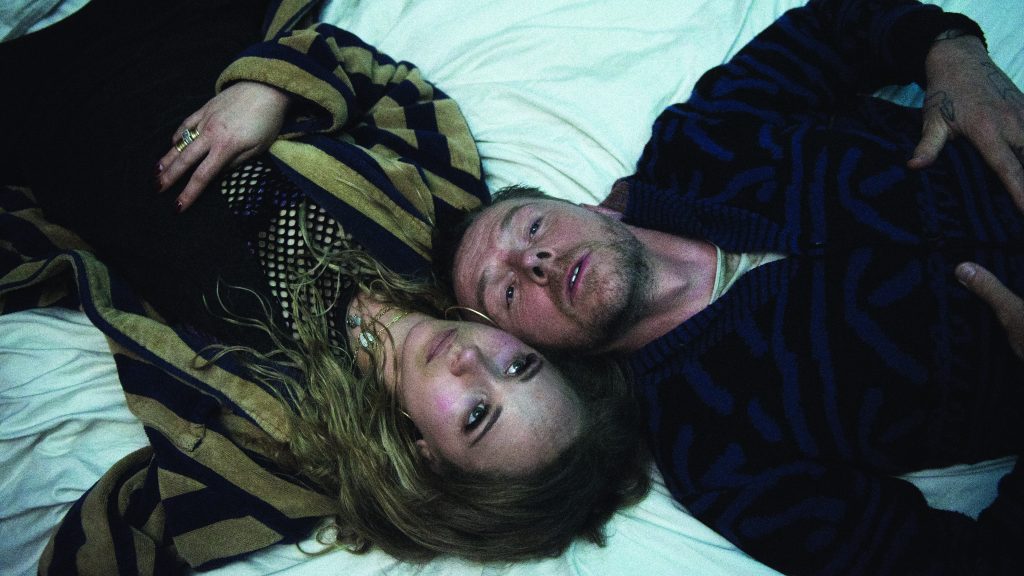
Juno Temple and Simon Pegg in "Lost Transmissions"
Juno Temple and Simon Pegg in “Lost Transmissions” (Photo by Elizabeth Kitchens)

“Lost Transmissions”

Directed by Katharine O’Brien

World premiere at the Tribeca Film Festival in New York City on April 28, 2019.

It’s not easy to do a romantic drama about two people with mental-health issues. The story has to handle the issues in a respectful and believable manner in order not to be too offensive. But the romance in the story has to be appealing too—and that’s where “Lost Transmissions” falls short. Unfortunately, the two lead actors in the movie—Juno Temple and Simon Pegg—are frustratingly mismatched in portraying a couple who have a tumultuous relationship while they navigate their careers in the Los Angeles music industry. Temple and Pegg are very talented in other movies, but watching them trying to create chemistry together that doesn’t exist in “Lost Transmissions” is almost painful to watch.

When we first meet aspiring singer/songwriter Hannah (played by Temple) and music producer Theo Ross (played by Pegg), it’s at a house party where he’s the jolly center of attention, playing the piano, and she’s a little bit on the shy side. Theo is able to bring Hannah out of her shell a little bit by encouraging her to sing while he plays. They exchange phone numbers, and the next day, Theo calls her and invites Hannah over to his home studio, where she’s very impressed by his unique collection of musical instruments.

During their date, Hannah confides in Theo and tells him that she’s on anti-depressants, and she once tried to commit suicide by driving into a tree. Most people don’t share this kind of information on a first date, so it’s the first sign that Hannah is one of those people who’s addicted to personal chaos. Hannah says, “Sometimes I feel stuck in glue, and I feel like I might never move again.” Theo has a sympathetic ear, and he hints that he also has a troubled past, but he doesn’t go into too many details.

Theo offers to help Hannah with her music career, so he puts her in touch with a music executive named Darron (played by Robert Schwartzman), who hires Hannah to write songs for a young pop star named Dana Lee (played in a hilarious cameo by Alexandra Daddario). Dana is a social-media-conscious nymphette with multicolored hair (think Ariana Grande meets Billie Eilish at Coachella) who has more natural chemistry with Hannah than Theo does. Hannah and Dana’s budding friendship, which is so entertaining to watch, unfortunately has very little screen time in this movie. It makes you wish that a movie was made about Hannah and Dana instead of Hannah and Theo.

British actress Temple has made a career out of playing pouty, American women who find it difficult to be happy, so she’s definitely in her comfort zone here as an actress. The problem is that she’s paired with the wrong actor—and it’s not just because Pegg is known for playing mostly comedic characters. Together, Pegg  and Temple are just not convincing as a couple in love. At times, watching this movie feels like watching awkward rehearsals of a play.

Theo and Hannah continue to date, and they think that they’re in love, even though it’s obvious that they’re wrong for each other. It turns out that Theo has even darker problems than Hannah’s depression issues. On the surface, he seems to have it all together—he’s a respected musician who makes a comfortable living as a producer of indie rock acts. But in reality, Theo is actually schizophrenic—and it doesn’t help that around the time that he’s met Hannah, he’s stopped taking his medication. Theo’s mental illness is also exacerbated because he’s had a long history of taking psychedelic drugs such as LSD or mushrooms—a habit that he goes back to during his relationship with Hannah.

When he’s off his medication, there’s nothing to like about Theo. He has angry outbursts, he’s selfish, he’s unreliable, and (this is where the title of the movie comes into play) when he plays static very loud on the radio, he thinks he can hear messages in the transmissions. It’s clear that Theo is headed for a major nervous breakdown, but Hannah—like so many of the type of co-dependent women who go on TV shows like “Dr. Phil” to talk about their toxic relationships—thinks she can “fix” Theo, or at least help nurse him back to health. According to “Lost Transmissions” writer/director Katharine O’Brien, the movie is inspired by real-life experiences that she went through with a male friend who was schizophrenic. Let’s hope that she handled it better than Hannah does in this movie.

When Theo’s mental deterioration leads him to be evicted from his home, none of his longtime, close friends want to take him in, because they say that they’re too busy with other commitments. (Red flags right there.) Hannah, who hasn’t been dating Theo for very long, ignores these warning signs and agrees to let Theo move in with her instead of immediately getting him professional help. Making that kind of bad decision in the name of love might be understandable if Theo treated Hannah better, but the sweet-natured Theo that Hannah met at the party is long gone.

Hannah doesn’t deserve much sympathy here because she makes excuses for Theo’s horrific behavior. There’s a scene in the movie that is an example of this destructive enabling: Theo, Hannah and one of Theo’s pregnant friends are passengers in a car when Theo, in a fit of rage, lunges at the driver and tries to get the driver to run off the road, which could have caused a serious accident. Eventually, the driver takes control of the car, and they pull over on the side of the road. The pregnant woman is understandably furious, and tells Theo that he’s “dangerous.” Hannah protests and says that Theo is just “scared.”

When Theo’s behavior gets worse, and Hannah finally decides that he needs to be in a professional facility, Theo inevitably ends up in a psych ward. But Hannah (who’s obviously not qualified to give medical advice to Theo) continues to be part of the problem when she tells Theo that he can “outsmart” his schizophrenia. Then the movie veers into a subplot where Hannah tries to get Theo to go back to his native London and make amends with his estranged father. At this point in the story, you’ve stopped caring about this badly mismatched couple, and you can’t wait for the movie to be over so that you don’t have to ever see them again. If the person who inspired the Theo character had this kind of relationship in real life, let’s hope that they’ve broken up and stayed away from each other, for the sake of everyone’s sanity.

UPDATE: Gravitas Ventures will release “Lost Transmissions” in select U.S. cinemas and on VOD on March 13, 2020. 

Copyright 2017-2026 Culture Mix
CULTURE MIX