
April 17, 2023
by Carla Hay
Directed by Martin Guigui
Culture Representation: Taking place in various parts of the United States, mostly in 1949 and 1950, the dramatic film “Sweetwater” (based on true events) features an African American and white cast of characters representing the working-class, middle-class and wealthy.
Culture Clash: Nathaniel “Sweetwater” Clifton experiences racism and other obstacles on his way to becoming one of the first African American basketball players in the National Basketball Association.
Culture Audience: “Sweetwater” will appeal primarily to people who are fans of basketball and sports biopics, but viewers should not expect an engaging or realistic-looking story in “Sweetwater.”
“Sweetwater” could have been an inspirational biopic about a groundbreaking basketball player. Instead, the movie is a stale cesspool of awful dialogue, corny scenarios and problematic racial condescension that depicts greedy basketball racists as heroes. People who don’t know anything about Nathaniel “Sweetwater” Clifton (the second African American basketball player to play in the National Basketball Association) before seeing this sorry excuse for a biopic won’t learn much about him from the shallow way that he is presented in this film.
For starters, “Sweetwater” inaccurately depicts him as the first African American to play in the NBA, when in fact that achievement was accomplished that same year (1950) by Earl Lloyd, who was a player with the Washington Capitols. Harold Hunter of the Washington Capitols (who was cut from the team before ever playing in the NBA) and Clifton both signed contracts with the NBA in 1950, but there have been historical disputes over whether Hunter or Clifton should get credit as the first African American to sign a player contract with the NBA. In 1990, Clifton died in relative obscurity in Chicago. He was 67. In the last years of his life, Clifton was working as a taxi driver. Just like the business people who exploited Clifton in real life, the “Sweetwater” movie uses him as a pawn to make money off of his talent, and to present a self-congratulatory image of looking racially progressive.
“Sweetwater” (written and directed by Martin Guigui) doesn’t care about portraying Clifton as a whole person in this movie, because he is mainly presented in the context of what white people wanted to get from Sweetwater (played by Everett Osborne) as a commodity. (For the purposes of this review, the real Clifton is referred to as Clifton, while the movie’s Sweetwater character is referred to as Sweetwater.) The “Sweetwater” movie barely shows anything about Sweetwater’s loved ones in the African American community. The movie also doesn’t care to give much importance to his inner thoughts and feelings.
The closest that the movie shows of Sweetwater’s family background and connection to his family are a few, very brief flashback scenes that last for a combined total of less than 10 minutes of this 114-minute movie. In one scene, his mother (played by Ashani Roberts) gives 7-year-old Sweetwater (played by Ca’Ron Jaden Coleman) some sugar water, which was her way of cheering him up, and it became his favorite drink as a child in Arkansas. (Hence, the nickname Sweetwater.)
In another scene, Sweetwater is shown mournfully saying goodbye to his mother because his father Joe Nathaniel (played by Clifton Nathaniel) had decided to relocate with Sweetwater to Chicago, in search of better job opportunities in Jim Crow-plagued America. It’s in this scene that his mother says that Sweetwater needs to change his name from Clifton Nathaniel (which was his birth name) to his new name of Nathaniel Clifton. The movie gives no explanation for why his mother told Sweetwater to reverse his first and last names.
And (cringe alert) the movie makes a point of having a closeup of the cotton being picked in the field by Sweetwater and his father before they move away from Arkansas. The palms of Sweetwater’s hands have small cuts from the cotton thorns, so his mother gives him some sugar water, to help him with his discomfort. As a child, Sweetwater stares at the palms of his hands when he gets these cotton thorn cuts. And several times in the film, when Sweetwater is an adult, he stares at the palms of his hands in the same way, as if he’s remembering that he literally used to be a cotton-picking kid. It’s filmmaking that goes beyond being trite and plummets right into the depths of being racially tone-deaf.
Viewers of “Sweetwater” never get to see vivid details about what inspired him to start playing basketball and who were his earliest coaches. Instead, the movie erases that part of his life to focus on showing how white people in the basketball industry “discovered” Sweetwater and “rescued” him from a life of poverty. In other words, they wanted a piece of him so they could make money for themselves and get credit for being “visionaries.”
This “rescuing” part of the movie is shown almost immediately. The first scene of Sweetwater playing basketball is when he’s a 27-year-old underpaid player with the Harlem Globetrotters in 1949. At the time, professional basketball in the United States was segregated by race. Only white players were allowed in the NBA. And needless to say, the white basketball players, even the semi-pros, were making a lot more money than professional basketball players who weren’t white.
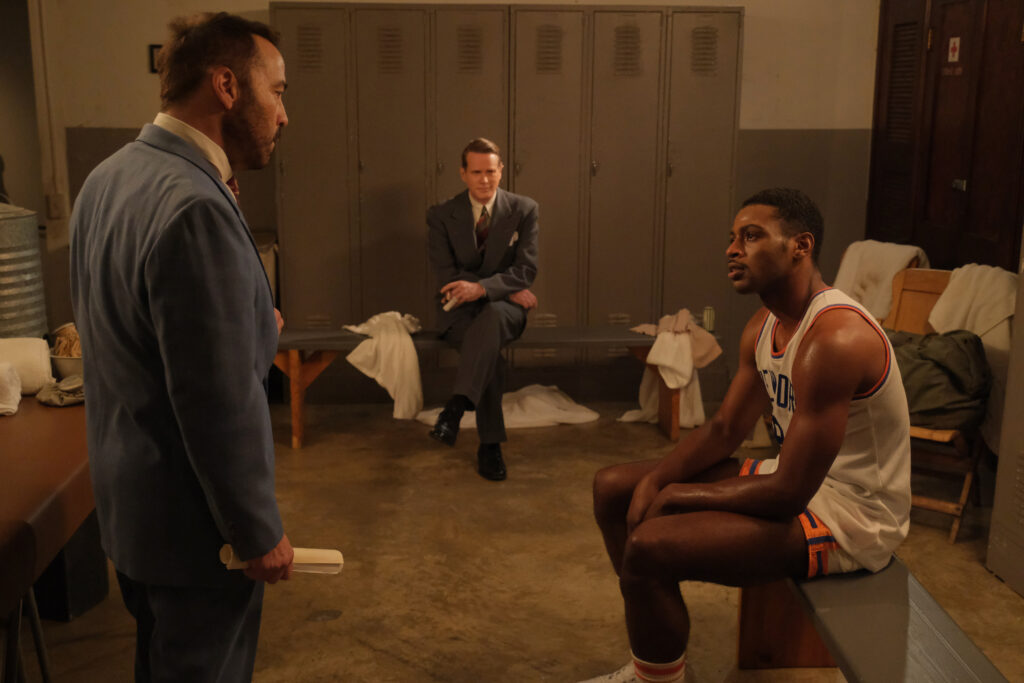
After a mock championship game where the Globetrotters defeated the Minneapolis Lakers (an all-white team), Sweetwater is approached by New York Knickerbockers coach Joe Lapchick (played by Jeremy Piven), who tells Sweetwater that he wants Sweetwater to play for the Knickbockers. (The Knickerbockers would later shorten their name to the Knicks.) Sweetwater, like most of the characters in the movie, thinks it’s impossible for anyone who isn’t white to play in the NBA.
But Joe, who is presented as a crusading “hero,” is determined to prove all the naysayers wrong. “I think you can help make the change,” Joe tells Sweetwater about breaking racial barriers at the NBA, even though throughout the movie, Joe wants to take all the credit for making the change. “You can be the first,” Joe adds, even though the movie wants to forget all about Lloyd of the Washington Capitols.
Joe attends a meeting with the NBA board of directors (who are all white men) and gets a mixed-to-negative reaction when Joe brings up the idea of recruiting Sweetwater for the Knickerbockers. Some of the board members support the idea, but they are outvoted by a majority who want to keep the NBA an all-white group. New York Knickerbockers owner Ned Irish (played by Cary Elwes) is one of the most adamant opponents to racial integration of the NBA, and he makes racist comments to prove it. NBA commissioner Maurice Podoloff (played by Richard Dreyfuss) is open to the idea of racial integration of the NBA, but he will only go with what the majority of the NBA board wants.
One of the worst scenes in the movie is when Joe’s wife (played by Dahlia Waingort Guigui), gives a pep talk to Joe when he thinks he’s failing to convince the necessary people to let Sweetwater join the NBA via the Knickerbockers. Joe keeps rambling about the wall of racism that Sweetwater can’t break through in order to get in the NBA. Joe mentions this “wall” several times in the movie.
Joe’s wife tells him, as if he’s pioneering civil rights activist: “You are Joe Lapchick! You don’t need to break through a wall. You just go get Sweetwater and you climb over that wall with him!” If slogan T-shirts were popular during this time period, then Joe and his wife would be wearing T-shirts that say, “We Are White Saviors.”
Meanwhile, Harlem Globetrotters coach/manager Abe Saperstein (played by Kevin Pollak) has put the Harlem Globetrotters on the basketball equivalent of the “chitlin circuit.” The overworked Globetrotters go on grueling tours to entertain audiences of different races. But because of racial segregation laws, the Globetrotters are treated like second-class citizens and denied entry or service at “whites only” places. The Globetrotters are paid a pittance, while Abe keeps much of the Globetrotters’ earnings for himself.
At times, “Sweetwater” tries to make it look like Abe is an ally to these black Globetrotters whom he is exploiting. When the Globetrotters are denied lodging at a hotel that has an unofficial “whites only” policy, the front desk clerk defensively says, “I don’t make the rules.” Abe puts on a big show of indignation and replies, “Yeah, like Nuremberg,” in reference to the excuse that Nazi officials made while on trial for World War II crimes in Nuremberg, Germany.
But Abe’s “outrage” about racism is really fake allyship. In a later scene on a tour bus, Sweetwater is the first person on the team to openly question Abe about the low payments for the Globetrotters (who win most of their games), compared to the white people (including Abe) who get considerably more money for being involved the same basketball games. When Sweetwater points out this inequality, Abe angrily snaps at him: “I’m the reason this team exists! … Just stick to playing basketball!”
And not long after Abe figures out that Sweetwater is questioning Abe’s exploitative business practices, Abe sells off Sweetwater like cattle to New York Knickerbockers owner Ned. Even though Ned is blatantly racist, he’s changed his mind about Sweetwater joining the team when Ned finally admits (after much pestering from Joe) that Sweetwater can help the team win games and sell more tickets. In other words, it all comes back to not really caring about the racial inequality that Sweetwater and other black basketball players experience. It’s about making more money for the white men in power positions, who want the money and the bragging rights about how “visionary” they are.
Most of the acting in “Sweetwater” is terribly unconvincing. Osborne’s performance is very stiff. Piven hams it up too much. Elwes acts like a robotic wax dummy. Pollak tries to be comedic, but it comes across as annoying. Dreyfuss looks emotionally disconnected, like he just signed up to be in this movie for the paycheck. Eric Roberts has a useless cameo as a racist gas station owner named Judd. Jim Caviezel has a very hokey cameo in the movie, as a sports journalist who meets Sweetwater in 1990, by being a passenger in Sweetwater’s taxi.
The movie’s dialogue is mind-numbingly horrible. Joe treats Sweetwater more like a freakishly tall money-making machine than as a human being. Early in the movie, Joe smugly comments that the size of Sweetwater’s hands “makes the [basket]ball look like a grapefruit.” Two radio announcers named Howard (played by Frank Buckley) and Marty (played by Todd Ant) at the Knickbockers basketball games give exposition-heavy play-by-plays about what was already shown in a scene, as if viewers are complete idiots and don’t understand what was already shown a few seconds earlier.
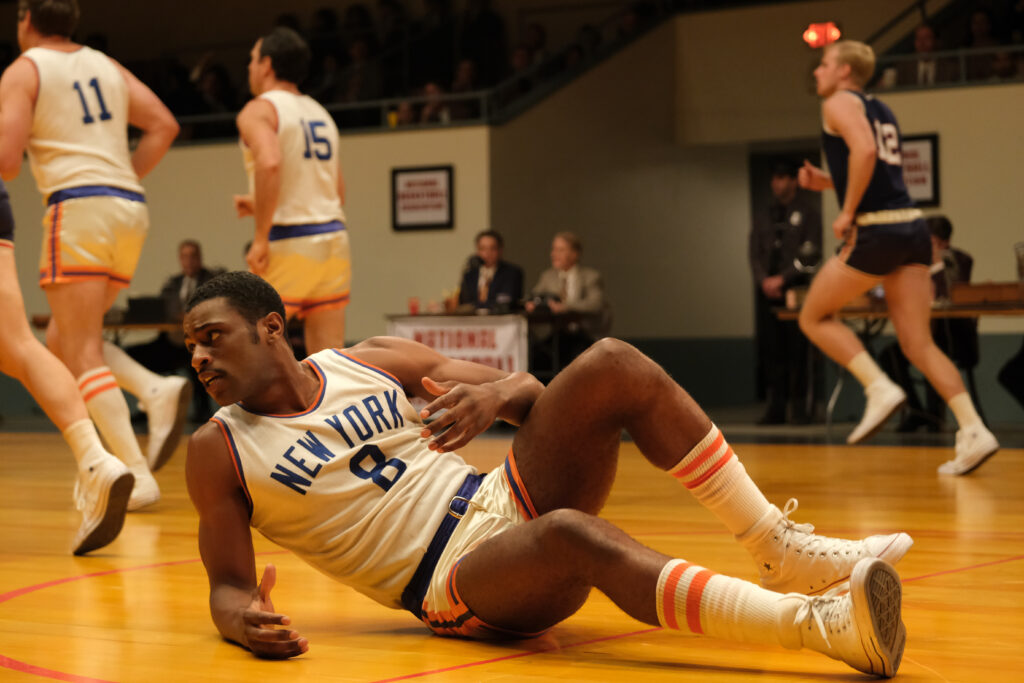
Forget about seeing anything in the movie about any friendships that Sweetwater might have developed with any of his fellow basketball players on any team. None of that meaningful camaraderie is in this dreadful biopic, which makes almost all the other basketball players nameless and generic. The basketball playing scenes in “Sweetwater” are disappointingly predictable and mostly dull. The movie reduces and downplays the racist blackash that Sweetwater got in real life after joining the NBA and instead makes it look like the worst thing that happened to him was a racist referee singling him out for unfair foul penalties.
The closest thing that the movie shows to what Sweetwater is like outside of basketball is when he begins courting a white singer named Jeanne Staples (played by Emmaline), whom he immediately asks out on a date when they meet after one of her nightclub performances. Jeanne sings jazz, but she’s a big fan of blues music, so Sweetwater takes her to a blues club on their first date. Real-life blues singer/musician Gary Clark Jr. has a cameo as in “Sweetwater” as a blues singer/musician named T-Bone, who is an acquaintance of Sweetwater’s.
“Sweetwater” shows this interracial romance, but none of the realistic conversations that would be a part of this romance. No one in Sweetwater’s inner circle makes any comments about this interracial relationship. (Jeanne’s friends are never shown.) Although a few white people glare with disapproval when they see Sweetwater and Jeanne together in public, neither Sweetwater nor Jeanne expresses any concern for their own safety for being in an interracial relationship, even though it would definitely be a concern in real life during this time period. In America in the 1940s and the 1950s, a black man would be in physical danger for dating a white woman, even in states where racial integration was legal.
But you’d never know it from watching this movie, which erases that type of historical context. What makes this erasure look so phony and inconsistent in “Sweetwater” is that the movie has many scenes where racism is a big problem for Sweetwater and his fellow Globetrotters when it’s related to their basketball work, but the movie tries to make it look like racism doesn’t exist when Sweetwater decides to date a white woman. (The movie never shows him romantically interested in any other women.) It’s another example of how the “Sweetwater” filmmakers have huge blind spots because of how they mishandle realistic depictions of race relations when telling this story. And in this male-dominated movie, it looks very sexist that Jeanne is the only female character who is given a name.
By removing so many authentic details about the real Clifton’s life, “Sweetwater” is ultimately a fake-looking, watered-down biopic. Fascinating aspects of Sweetwater’s life before he became a pro basketball player (such as serving in the U.S. Army during World War II) are barely mentioned or not mentioned at all. And the filmmakers of “Sweetwater” should be ashamed that they made his entire existence look like it only mattered in the context of how he elevated the status of the white men who used him for their own benefit.
Briarcliff Entertainment released “Sweetwater” in U.S. cinemas on April 14, 2023.