
February 10, 2021
by Carla Hay
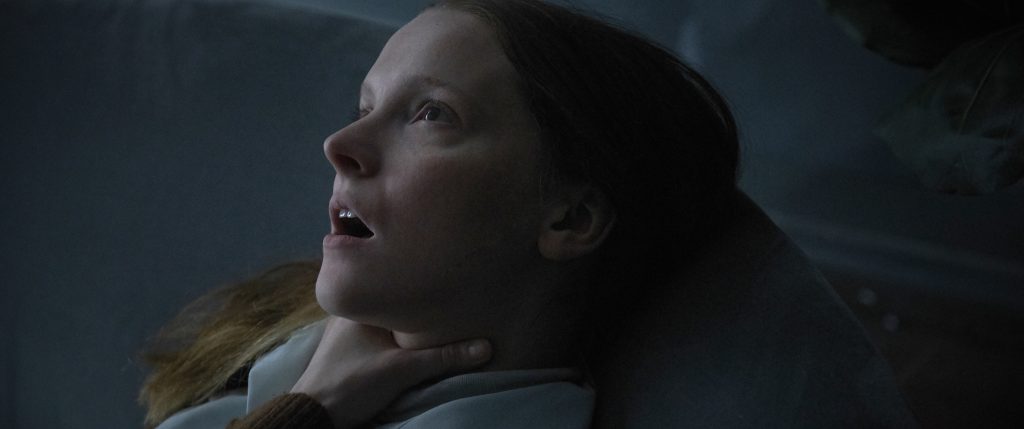
Directed by Rose Glass
Culture Representation: Taking place in unnamed city in England, the horror film “Saint Maud” features a predominantly white cast (with a few black people and Asians) representing the working-class, middle-class and upper-middle-class.
Culture Clash: A hospice nurse in her 20s is convinced that she can communicate with God, but her religious beliefs sometimes conflict with other people.
Culture Audience: “Saint Maud” will appeal primarily to viewers who like “slow burn” horror films that leave a lot that’s open to interpretation.
There’s never any question that something is very wrong with the mental state of the title character in the psychological horror movie “Saint Maud.” The problem is that Maud doesn’t see anything wrong with herself, as long as she’s getting all the guidance she needs from the deity that she thinks is in communication with her. “Saint Maud” (the feature-film debut of writer/director Rose Glass) is a haunting story about the fine line between religious fanaticism and losing touch with reality. Throughout this well-acted film, Maud often blurs those lines, sometimes to devastating effects.
“Saint Maud,” which takes place in an unnamed city in England, never reveals how or why Maud (played by Morfydd Clark) became obsessed with Christianity and the idea that she can communicate with God. The main things that viewers find out about Maud is that she’s a woman in her 20s who works as a hospice nurse, a profession she’s had for about a year. She previously worked in a hospital, where a terrible incident happened that was related to Maud having a mental breakdown. This breakdown isn’t shown in the movie, but it’s discussed by Maud and a former co-worker named Joy (played by Lily Knight), who knows some things about Maud that Maud doesn’t want other people to find out.
Maud lives a solitary life in her sparsely furnished studio apartment, where she spends most of her free time praying, reading the Bible, and engaging in other religious practices. She has a shrine that includes a crucifix of Jesus Christ and illustrations of saints and other holy people. Much of “Saint Maud” is narrated with her voiceovers, where she usually sounds meek and soft-spoken. But all is not tranquil in Maud’s world.
This chaos is clear from the movie’s opening scene, when viewers first see Maud: She looks crazy and almost like she’s in a trance. And she’s crouched on a bathroom floor with blood on her face and hands. The movie eventually shows what led her to get to this horrifying point. Until then, viewers of “Saint Maud” get taken on a ride of her slow descent into pure madness.
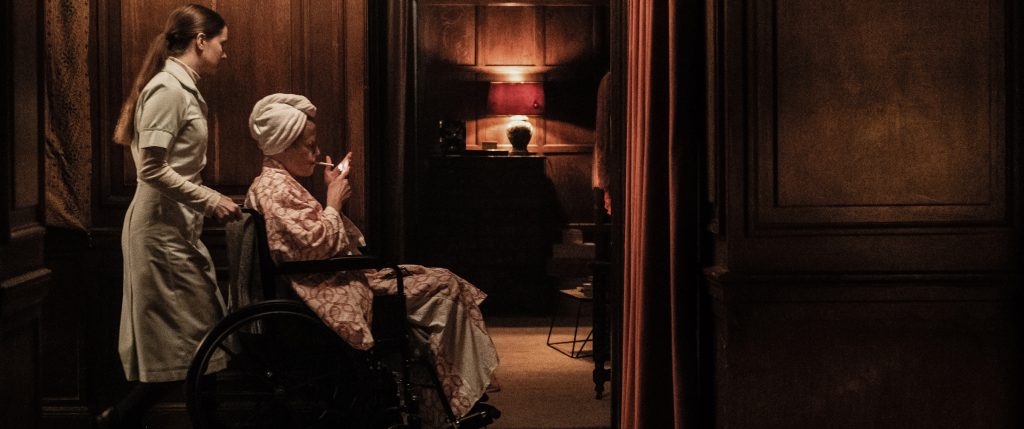
Near the beginning of the movie, Maud is shown as the caretaker a wheelchair-bound patient named Amanda Köhl, a former dancer/choreographer, whom Maud describes in a voiceover as “a minor celebrity.” Amanda, who is in her 50s, lives alone and has no children. There are vague references to Amanda’s past as a bon vivant with an active social life. But now, Amanda is struggling to cope with the reality that she’s dying, she can’t dance anymore, and she’s even losing her hair because of the cancer. That doesn’t stop Amanda from being somewhat of a chainsmoker.
Maud explains in a voiceover that she doesn’t care for creative types because they tend to be very self-involved. In that respect, Amanda fits that description. But it’s obvious that Amanda’s moodiness and difficult attitude has a lot to do with the pain and trauma of having stage 4 lymphoma of the spinal cord. Amanda lives in a village by the sea, in the type of Gothic mansion that’s often see in horror movies. Even though Amanda could be isolated, she welcomes having visitors.
And that’s a problem for Maud, who thinks it’s best for Amanda to live the type of quiet and hermit-like life that Maud has when she’s in her own home. Even though Maud hasn’t been taking care of Amanda for very long, Maud shows a very possessive and manipulative side in how she handles her relationship with Amanda. Maud acts inappropriately jealous when Amanda has visitors who show a sexual interest in Amanda.
One of these visitors is named Richard (played by Marcus Hutton), who dotes on Amanda and around the same age as she is. Richard used to be one of Amanda’s suitors. It’s clear that Richard still has feelings for Amanda, but there’s no romance between them. In fact, Amanda is somewhat rude to him and at one point tells Richard: “Don’t be an idiot.” When he leaves, Amanda tells Maud that Richard is a “pompous asshole,” and Amanda makes a snide comment about Richard’s hair plugs.
The other visitor is more problematic for Maud because Amanda is very fond of this person. Her name is Carol (played by Lily Frazer), who’s about 25 years younger than Amanda. When Carol comes over to visit, and she and Amanda are heard laughing in Amanda’s bedroom, Maud spies on them and sees that Amanda and Carol are lovers. It isn’t long before Maud comes up with a scheme to try to get Carol out of Amanda’s life.
Maud isn’t as uptight as she first appears to be, because there’s a scene in a bar where a very different Maud emerges. She’s literally got her hair down, she’s drinking beer, and looking for some sexual company. One night at the bar, she meets a man (played by Jonathan Milshaw), they exchange looks, and the next thing you know, she’s giving him a hand job in the bathroom. They don’t even bother to find out each other’s names.
And then on the same night, she goes home with another man (played by Turlough Convery) and has sex with him. What’s the name of the man who’s this one-night stand? Christian. Oh, the irony. During their sexual encounter, Maud starts to hallucinate, she has a little bit of freak-out, and Christian tries to calm her down, just so he can keep having sex with her.
Back in Amanda’s home, Maud projects an image of being very religious and modest, almost like a nun. Amanda even jokes that Maude could be Amanda’s “savior.” Amanda senses that Maud is a born-again Christian or a recent convert. Maud confirms that she’s recently become a devout Christian when Amanda asks her about Maud’s spirituality. And when Maud confides in Amanda that she can feel God’s presence, Amanda says she can feel it too. But is Amanda telling the truth or just playing along as a way to amuse herself?
“Saint Maud” is one of those movies where there’s an unreliable narrator, and what might be seen on screen could be a hallucination. As the story goes on, there are scenes of Maud in literal agony and ecstasy as she gets deeper into her religious obsession. Sometimes she pants heavily and writhes on the floor as if she’s in an orgasmic state. Sometimes she engages in some self-harm that might be too hard to watch for people who get easily squeamish.
Clark gives a memorable performance as the tortured Maud, who tries to appear “normal” on the outside, but is falling apart on the inside. Ehle gives a more straightforward performance as Amanda, who has a cruel streak but who also admits her flaws and tries to make amends when she can. It’s obvious from the beginning of the movie that things are not going to end well, but viewers will be curious to see how bad things get.
“Saint Maud” has its gory moments, but most of the movie’s horror has more to do with losing one’s grip on sanity rather than any violent acts that might be in the movie. Glass shows a lot of promise as a director who can tell an intriguing story. Where the movie falls short is in leaving questions unanswered about Maud’s background to give some context of what led her to this point in her life.
There was that incident in her hospital job, but it’s never explained if she discovered religion on her own or was taught. There’s no mention of Maud having any family, friends or love interests. There’s no sense of what kind of upbringing she had or how long she’s had issues with mental health. A little backstory for Maud would’ve gone a long way with this movie.
However, what will keep people interested is the fascinating range of emotions that Maud shows in her present life. She’s one of those “quiet people” whose rage comes out in flashes, from her face distortions when she’s alone, to how she lashes out when things don’t go her way. The visual effects in the movie are used sparingly, but when they’re in the movie, they make an impact.
Some viewers might be surprised by how long it takes before any real violence happens in “Saint Maud.” That would be missing the point of this horror film. This isn’t a dumb slasher flick with a killer on the loose. Sometimes the most terrifying things can happen in the trappings of a sick mind.
A24 released “Saint Maud” in select U.S. cinemas on January 29, 2021. Epix will premiere the movie on February 12, 2021. “Saint Maud” was released in Europe and Canada in 2020.