
September 17, 2021
by Carla Hay
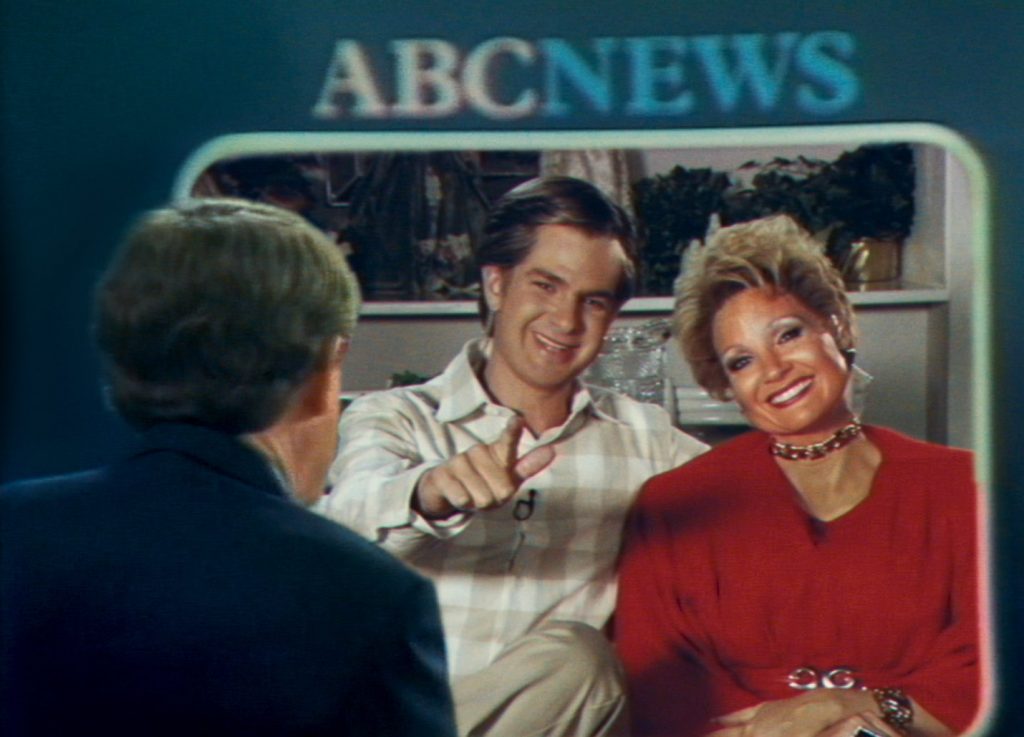
“The Eyes of Tammy Faye” (2021)
Directed by Michael Showalter
Culture Representation: Taking place in various parts of the U.S., the biographical dramatic film “The Eyes of Tammy Faye” features a predominantly white cast of characters (with a few African Americans and Latinos) representing the working-class, middle-class and wealthy.
Culture Clash: Tammy Faye Baker and Jim Bakker rose to the top of the Christian televangelical business, only to have their empire come crashing down in the late 1980s, due to sex scandals and fraud charges.
Culture Audience: “The Eyes of Tammy Faye” will appeal primarily to viewers who are interested in exaggerated depictions of the rise and fall of rich and famous people.
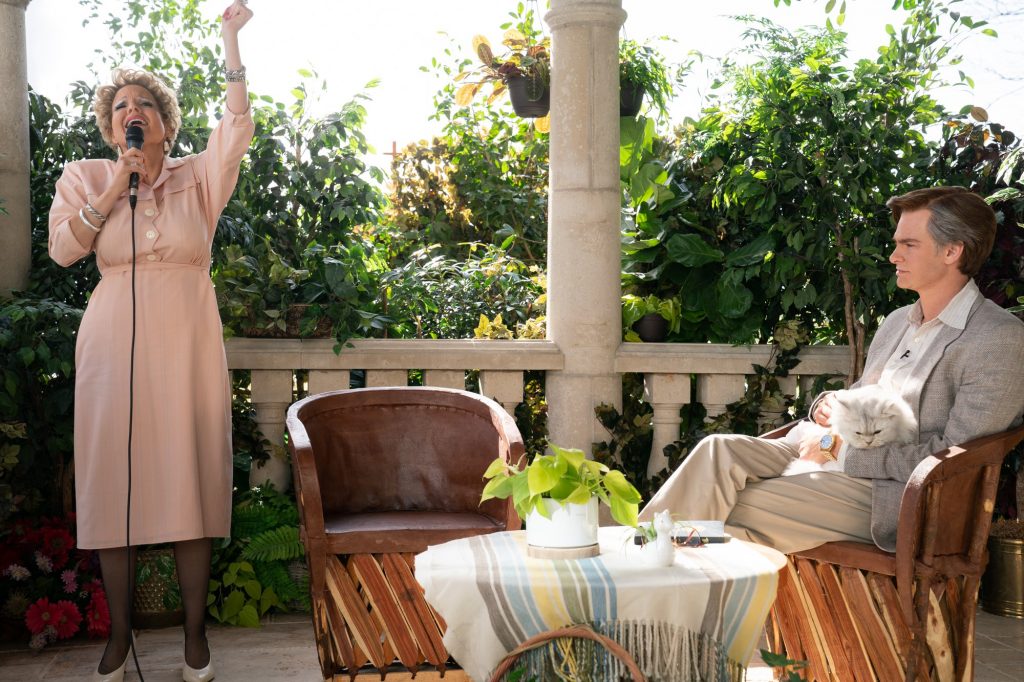
Just like the disgraced televangelists at the center of this story, “The Eyes of Tammy Faye” might have wanted to be taken very seriously, but people will either be repulsed or entertained by the campiness of it all. This biographical movie is best enjoyed if viewers know in advance that Tammy Faye Bakker is going to be presented as a misunderstood, makeup-caked, misled spouse who was both obedient and rebellious, when it came to conservative Christian beliefs. Jessica Chastain and Andrew Garfield give very committed performances as former televangelist power couple Tammy Faye Bakker and Jim Bakker. But when you portray people who became much-ridiculed public figures by their own doing, it’s nearly impossible to avoid becoming caricatures when acting out what it was like to be these human train wrecks.
Directed by Michael Showalter and written by Abe Sylvia, “The Eyes of Tammy Faye” offers a narrative that goes something like this: “Those scandals were all Jim Bakker’s fault. Let’s talk about how Tammy Faye Bakker just wanted to love everyone and be happy.” Tammy Faye (who died of cancer in 2007, at the age of 65) might have a lingering public image of a tear-soaked, sorrowful televangelist brought down by betrayals and scandals. However, the majority of “The Eyes of Tammy Faye” portrays her as relentlessly perky, to a fault. The Bakkers went from doing a low-budget traveling Christian puppet show to owning a lucrative empire that included the Praise the Lord (PTL) network and related businesses headquartered in Fort Mill, South Carolina.
The 1990 TV-movie “Fall From Grace,” starring Kevin Spacey as Jim Bakker and Bernadette Peters as Tammy Faye Bakker, covered similar territory but wasn’t as concerned with casting Jim or Tammy Faye in a redeeming light. One of the biggest criticisms that “The Eyes of Tammy Faye” might get is how it mostly frees her from blame for being a willing participant in the greed that led to her and Jim Bakker’s downfall. She’s portrayed as someone who was just along for the ride and was blissfully unaware of the depth of how much people were being cheated by the Bakkers. It’s a very hard-to-believe premise, but that’s why this movie is a scripted drama, not a documentary.
However, this dramatic version of “The Eyes of Tammy Faye” is based on the 2000 documentary of the same name. Fenton Bailey and Randy Barbato (co-founders of the production company World of Wonder) directed “The Eyes of Tammy Faye” documentary, which was narrated by RuPaul. In 2009, World of Wonder and RuPaul later launched “RuPaul’s Drag Race,” which went on to become an Emmy-winning hit. “The Eyes of Tammy Faye” drama movie goes out of its way to depict Tammy Faye as an underrated influencer of drag queens and other LGBTQ people—and not just because of how she did her hair and makeup.
There are multiple scenes in the movie where Tammy Faye speaks up for LGBTQ people, even though she would face criticism and shunning from many conservative Christians who disagreed with her. In a scene where Tammy Faye and Jim meet powerful preacher Jerry Falwell Sr. (played by Vincent D’Onofrio) for the first time in the early 1970s, Falwell insists that their brand of Christianity should be about helping Republican politicians get elected and should be against a “homosexual agenda.” Tammy disagrees because she thinks Christianity should be about “loving everybody.” She also wonders aloud why she and Jim can’t just stay out of politics, but those thoughts are shut down by Falwell.
In another scene that takes place in 1985, on the PTL network, Tammy Faye does a compassionate interview by live satellite TV with an openly gay minister named Steve Pieters (played by Randy Havens), who is HIV-positive. She starts off the interview with her usual perkiness, but eventually she’s moved to tears by his story, especially when he talks about how people are afraid to touch him or be near him. “I just want to put my arm around you,” she tells Pieters. “I want to put my arms around you too, Tammy Faye,” he replies in a virtual lovefest.
Meanwhile, Jim and Falwell are seen backstage watching the interview, and they’re shocked that Tammy Faye has gone rogue on them. Falwell is predictably outraged and disgusted. Jim acts embarrassed and says he had no idea that this live interview with a gay/HIV-positive minister was going to take place on the PTL network. This backstage brouhaha is the type of melodramatic scene that looks like it was fabricated just for the movie.
The movie chronicles Tammy Faye’s childhood in Minnesota, as one of eight children growing up in a strict Christian household ruled over by their domineering, no-nonsense mother Rachel Grover (played by Cherry Jones) and her “go along to get along” second husband Fred Grover (played by Fredric Lehne), who brought his own children into the marriage as a widower. Rachel and Tammy Faye often disagree because Rachel believes in living modestly, while Tammy Faye obviously does not. In their churchgoing community, Tammy Faye was made to feel “inferior” to her siblings because she was born from Rachel’s first marriage, which ended in divorce.
Rachel endured her own stigma in their conservative Christian community for being someone who had been a divorcée. An early scene in the movie shows that Tammy Faye was aware that people in their church community called Rachel a harlot behind her back. Rachel knows it too, because she says that the only reason why she was let back into the church was because she knows how to play the piano.
The movie depicts Tammy Faye as having a flair for dramatics and wanting attention at an early age. There’s a scene where, after taking her first communion, a 10-year-old Tammy Faye (played by Faye Chandler Head) begins speaking in tongues. Her mother is visibly shocked.
When Tammy Faye met Jim in 1960, they were both students at North Central Bible College in Minneapolis. Their first scene together shows Tammy listening to Jim preach in a chapel to a small group of students. She seems enraptured by his preaching style and is the only one in the group to nod her head and verbally affirm what he says.
And just to put an emphasis on the narrative that Tammy Faye was treated like an “outsider” almost all of her life, she gets called a “jezebel” by someone in the group who mutters this insult, all because Tammy Faye likes to wear makeup. Jim comes to her defense. An instant attraction is sparked.
During Jim and Tammy’s first date together, she tells him that she has no secrets because she’s never done anything scandalous. He confesses to her that he originally wanted to be a radio DJ. He’s secretly a fan of rock music, which is considered sinful in the Christian society where Jim and Tammy live and grew up.
Jim also tells Tammy why he decided to become a preacher. One day, when he was driving his father’s car, he was listening to rock music and having lustful thoughts, which caused him to be distracted from his driving. He ended up in a car accident that hit a boy named Jimmy Summerfield, who suffered serious injuries but survived. Jim made a promise to God that if Jimmy lived, then Jim would give his life over to religion instead of being a DJ.
Jim and Tammy Faye’s awkward first makeout session is filmed with a certain level of comedy, since these teenagers have been taught that sex outside of marriage is a sin. While they’re kissing and groping, they both say, “I can’t.” It’s one of the funnier scenes in the movie. And because Jim and Tammy Faye want to have sex, the next thing you know, Tammy Faye and Jim show up at her parents’ house in 1961, her mother opens the door, and Tammy introduces her husband Jim to her family for the first time.
There’s a fairly long stretch of the movie that’s about Tammy Faye and Jim’s Christian puppet show, which was the start of their career in religious showbiz. They took their puppet show on the road as a way to make money. Tammy Faye is particularly fixated on a female pig puppet with blonde pigtails named Susie Moppett, which later became a bestselling toy for the PTL network. Tammy Faye was also fascinated with Betty Boop, so expect to see several scenes of her talking in high-pitched, breathy voices.
Tammy Faye is depicted as the more creative partner in the marriage. She became famous for her singing. And she was the one who invented the couple’s puppet characters and wrote much of their dialogue. In the movie, Tammy Faye explains to her mother that the puppet show is a way to attract parents whom Jim and Tammy Faye wanted to become followers in a church owned by Jim and Tammy Faye.
Tammy Faye was also the one who supposedly came up with the idea to bring the Bakker ministry to television. When she and Jim see televangelist Pat Robertson (played by Gabriel Olds) preaching on TV, she strokes Jim’s ego by telling him that he’s much more charismatic than Robertson. The Bakkers’ plan is to eventually build a ministry that’s even bigger than Robertson’s.
While staying at a motel, Jim and Tammy Faye discover that their car is missing from the parking lot. Tammy Faye is shocked, while Jim is scatterbrained. At first, he thinks the car was stolen. But then he admits: Yes, maybe he stopped making the last several car payments, so the car was repossessed and towed away. It’s supposed to be an example of how financial matters were handled in their marriage. According to this movie, Jim was in charge of the finances, and he hid his money mishandling from Tammy.
With their car gone, Jim and Tammy Faye try to figure out how they’re going to get to their next destination. But what do you know, in an “only in a movie” moment, a man staying at the same motel just happens to walk right near Jim and Tammy Faye in the motel parking lot. He recognizes them and mentions that they should do their puppet act on Pat Robertson’s TV show. And gee, what a coincidence: This man happens to know Robertson and can make this TV appearance happen.
Jim and Tammy Faye do several appearances on Robertson’s show and develop their own fan base. When they visit Robertson’s lavish estate in Hot Springs, Virginia, for the first time in 1972, their avarice and egos start to go into overdrive when they see a lot of Robertson’s wealth on display. Jim tells Tammy Faye: “We paid for all of this, Tammy!,” as if Jim and Tammy Faye are the reasons why Robertson is so successful.
It’s at the Robertson estate where Jim and Tammy Faye are depicted as meeting Falwell for the first time during a luncheon with several guests. Tammy Faye is shown finagling her way into a men’s-only discussion at a table that includes Jim, Robertson and Falwell. She knows she’s not really welcome at the table, based on the men’s reactions. But with her toddler daughter Tammy Sue in tow, Tammy Faye uses her plucky charm to seat herself at the table and voice her opinions in their conversation.
In a hilarious moment, after the PTL network became successful long after the Bakkers ditched their traveling puppet show, Tammy Faye is seen on the PTL network promoting the use of a penis pump to help improve marital intimacy when a male partner is impotent. In the movie, Tammy is portrayed as being more comfortable than Jim when it came to publicly discussing sex and sexuality. The movie depicts Tammy Faye as a groundbreaking trailblazer in putting things on the PTL network that were traditionally considered taboo or too risqué for religious television.
The rest of the movie shows the rise and fall of Jim and Tammy Faye, as well as Tammy Faye’s failed attempts at a showbiz comeback. Over time, their marriage changed from Tammy Faye being the more confident and more assertive partner to Jim being the one who was mostly in control. The marriage was affected by infidelity, although Tammy Faye is portrayed as less caught up in cheating than Jim was.
Tammy Faye is shown having just one extramarital lover, when she had a brief fling with music producer Gary Paxton (played by Mark Wystrach) in 1975. They worked together on Tammy Faye’s songs. Their affair is depicted as something that Paxton instigated because he showered a lot of attention and praise on her, knowing that Tammy Faye was being neglected by Jim.
An example of the movie’s campy side is the smarmy stream of pickup lines that Paxton uses to try to seduce Tammy Faye. In the recording studio, he tells her after recording some of her vocals: “I haven’t been this excited about an artist since I produced ‘Monster Mash’! We could get a Grammy!”
And later, when Tammy is eight months pregnant with her son Jamie, Paxton comes right out asks her when was the last time she was touched the way she deserves to be touched. It leads to one of the campiest scenes in the movie. Let’s just say that the movie doesn’t leave it up to the imagination on how Tammy Faye went into labor when she gave birth to Jamie.
Jim’s extramarital flings—most notoriously with former church secretary Jessica Hahn—are mentioned in conversations or shown as news headlines but not depicted in any explicit scenes. In real life, Hahn claimed that Jim and his right-hand man Richard Fletcher (played by Louis Cancelmi) drugged her, raped her, and later paid her a six-figure sum from church funds to keep quiet about it. Jim and Fletcher both denied that the sexual encounter was rape, but they admitted that sex occurred and that there was payoff money using PTL church funds.
In real life, Fletcher testified under oath that he was Jim’s secret lover, but Jim denied it under oath. There’s a scene in the movie where Tammy Faye sees Jim and Fletcher play-wrestling with each other on the ground, and she looks at them as if she silently suspects that something sexual might be going on between the two men. And the movie mentions that several men came forward to accuse Jim of making sexual advances on them.
Of course, in a movie about a marriage that goes bad, there are argument scenes between the two spouses. In “The Eyes of Tammy Faye,” these over-the-top scenes are very reminiscent of soap operas that were popular in the 1980s, such as “Dynasty” and “Dallas.” Joan Collins and Larry Hagman would be very proud to see that in “The Eyes of Tammy Faye,” Chastain and Garfield have carried on their tradition of portraying wealthy people screaming hateful things to each other while surrounded by gaudy 1980s decor.
Some choice words include Tammy Faye wailing to Jim: “I’m so sick of my faith in you!” Jim yells back: “You’re a bottomless pit!” Jim shouts at Tammy Faye: “I built you an empire!” Tammy Faye shrieks, “You built you an empire!,” conveniently forgetting her spending sprees. Tammy Faye’s descent into pill-popping hell is duly chronicled, including her being high as a kite on live TV and, on a separate occasion, having a near-fatal overdose. “I’m not a drug addict,” she insists. “I’m only addicted to Diet Coke!”
Chastain, who does her own singing in “The Eyes of Tammy Faye,” certainly gives her utmost in her performance in this movie. She transforms into numerous incarnations of Tammy Faye, whose physical appearance went through drastic changes over the years. Garfield gives a more restrained performance that is most chilling when showing Jim’s cold cruelty, such as when Jim forces Tammy Faye to go on their TV show to confess her infidelity and beg for forgiveness. “The Eyes of Tammy Faye” (which had its world premiere at the 2021 Toronto International Film Festival) won’t get a lot of major awards for acting. However, the film’s makeup and hairstyling will surely get numerous award nominations.
Tammy Faye is mostly portrayed as pathetic, rather than tragic. After all, it’s hard to feel too much sympathy for Tammy Faye when she’s whining about being a persecuted underdog, while she and her fraudster husband are living lavish lifestyles paid for by money that was supposed to be for their church and charitable causes. When she and Jim went on all those over-the-top spending sprees to buy luxurious personal things for themselves, she would’ve known that how they were misusing the money was illegal. The Bakkers made elaborate plans to build a religious theme park called Heritage USA, but it was all going to be funded by a Ponzi scheme.
“The Eyes of Tammy Faye” screenplay is more interested in using broad strokes than in finessing details. Even though building contractor Roe Messner (played by Sam Jaeger) is in the movie as someone who helped the Bakkers with their construction plans, nowhere (not even in the epilogue) is it mentioned in “The Eyes of Tammy Faye” drama that Messner was Tammy Faye’s second husband. They were married from 1993 until her death in 2007. And no one in the movie portrays rape accuser Hahn, who is only referred to in the movie as a news headline or (as Jim describes her) as an extortionist.
If people are looking for entertainment with deliberately hammy acting in “The Eyes of Tammy Faye,” then the movie delivers this type of comedic-tinged drama for viewers. If people are looking for a serious biography with comprehensive and thorough facts, then look elsewhere. People might or might not feel more sympathy for Tammy Faye after seeing “The Eyes of Tammy Faye.” You’ll enjoy the movie more if you take it for what it is: a very Hollywood version of the truth.
Searchlight Pictures released “The Eyes of Tammy Faye” in select U.S. cinemas on September 17, 2021.