Culture Representation: Taking place in an apocalyptic future on a ship in an unnamed ocean, the sci-fi drama film “Last Sentinel” features a nearly all-white cast of characters (with one black/biracial person) representing the working-class and middle-class.
Culture Clash: After an environmental crisis has devastated Earth, four military personnel are stranded at an outpost in the ocean and have conflicts over if or when to leave the outpost.
Culture Audience: “Last Sentinel” will appeal primarily to people who don’t mind watching dull and illogical apocalyptic movies.
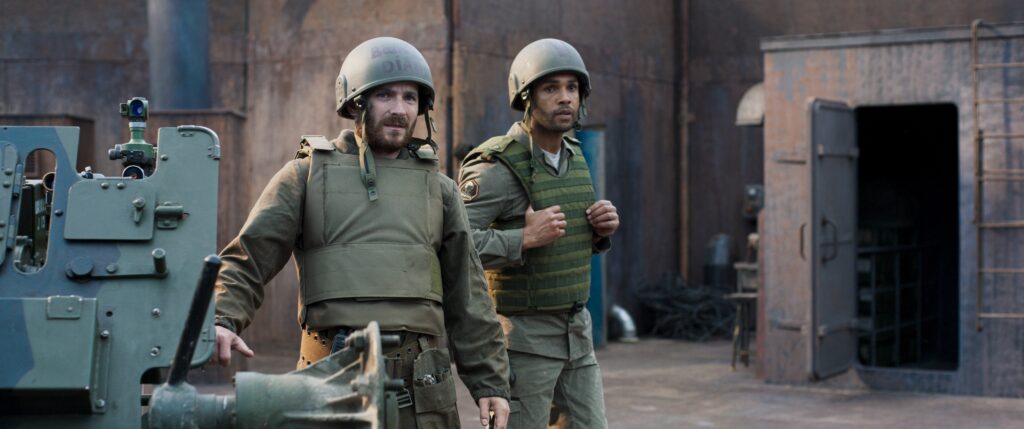
Martin McCann and Lucien Laviscount in “Last Sentinel” (Photo courtesy of Vertical)
“Last Sentinel” is a dreary slog of a movie about four quarreling military people stranded on an outpost in the ocean. This lackluster drama has a thin plot that gets dragged out and tangled up in a lot of nonsense. The majority of the film is tedious repetition of these four people arguing about if or when they should leave the outpost. Viewers will learn very little about these characters and their lives by the end of the movie.
Directed by Tanel Toom and written by Malachi Smyth, “Last Sentinel” is a movie that looks like it would have been better off as a short film. It’s obvious that the filmmakers ran of out ideas of how to make “Last Sentinel” suspenseful, and they just reverted back to having more scenes of the characters arguing. It’s lazy filmmaking, because that screen time could have been used to give viewers more information about the backstories of each of these characters, in order to explain the characters’ motivations and to get viewers to care about these characters.
An on-screen written introduction to “Last Sentinel” explains that the movie takes place in an unidentified future when climate change has devastated Earth and left most of the planet flooded. Most of the human population is now dead. “Survival is a constant fight for land and resources,” the statement reads. A military outpost, consisting of a lookout tower and a mid-sized cargo ship, is stationed in an unnamed ocean. The four people at this outpost signed up to be there for two years.
The two-year period is now over, and they are expecting to go home. (The movie never mentions where “home” is for any of these characters.) These military people have been patiently waiting for other military personnel to arrive who will replace them at this outpost. This expected “relief crew” is now three months overdue.
These are the four sentinels at this outpost:
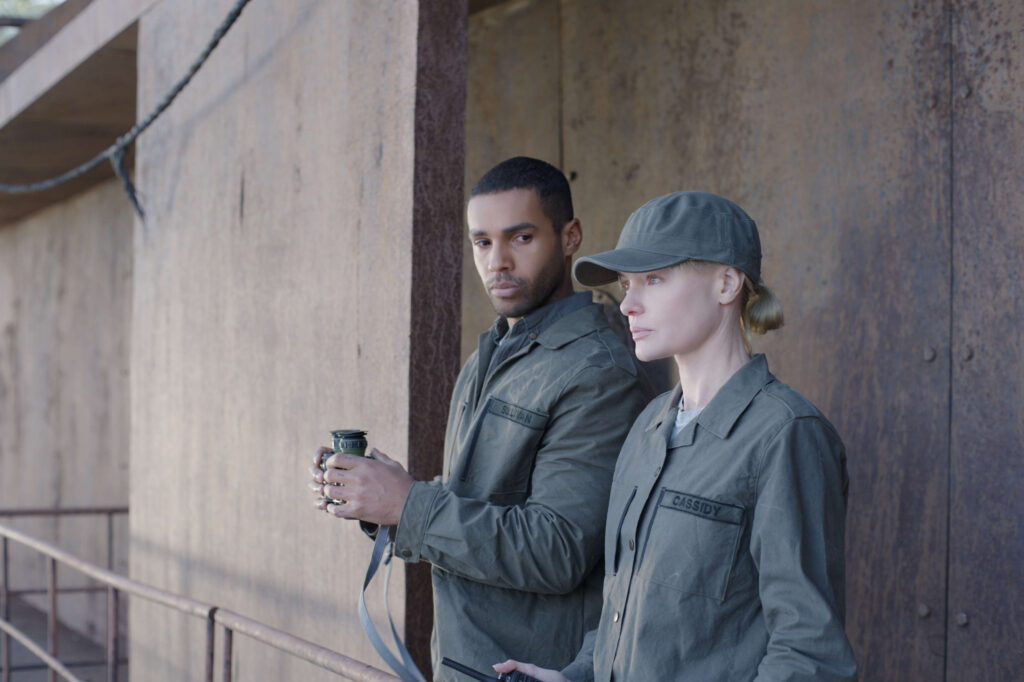
Cassidy (played by Kate Bosworth), a corporal who is American, is the one who is most likely to use the communication equipment on the ship.
Sullivan, nicknamed Sully (played by Lucien Laviscount), is an American, and he does a lot of the fishing and exploring for this team. Cassidy helps with gathering food too.
Richard Baines, nicknamed Baines (played by Martin McCann), is Scottish and the ship’s chief engineer.
Henrichs (played by Thomas Kretschmann), a sergeant with a German accent, is the leader of the team.
Sullivan and Baines are the most anxious of the four to leave the outpost and go home. Henrichs is a stern taskmaster who remains adamant that they can’t leave the outpost until the relief crew shows up to replace them. Cassidy vacillates back and forth about staying at the outpost or leaving. Sullivan and Cassidy are semi-secret lovers, but Sullivan seems to have more romantic feelings for Cassidy than she does for him. Baines is a hothead/loose cannon with a shady past, but he’s not the only one with secrets.
The communications equipment on the ship is faulty, since no one is answering the messages that they send out. The team gets messages that the relief crew already arrived, but there is no sign of this crew. (“Last Sentinel” is not a horror movie with a supernatural element.) Meanwhile, viewers have to sit through idiotic lines of dialogue, such as Cassidy saying: “The only way to un-fuck the world is to wipe out humans.”
The acting in “Last Sentinel” isn’t anything special, although Laviscount (who is British in real life) and McCann (who is from Northern Ireland) do pretty good jobs of having language accents that are different from their real ethnicities. “Last Sentinel” truly wastes a lot of time with meaningless scenes that do little to further the story. By the time a “reveal” happens near the end of the film, it just raises more questions that “Last Sentinel” never bothers to answer.
During this entire long-winded movie that last nearly two hours, it’s never explained what these four people were supposed to be doing for two years on this outpost in the middle of the ocean. In the beginning of the movie, it’s mentioned that these four sentinels are nearly out of food, and their recent fishing attempts have come up empty. The possibility of starving to death is unrealistically never mentioned again, as these four dimwits waste time arguing and pointing guns at each other. There doesn’t seem to be any good reason for this terribly boring and ridiculous movie to exist, unless someone with insomnia wants to use it as an effective way to fall asleep.
Vertical released “Last Sentinel” in select U.S. cinemas on March 24, 2023.
Culture Representation: Taking place in New York City and briefly in Paris, the dramatic film “Trust” features a predominantly white cast of characters (with a few Asians, Latinos and black people) representing the middle-class.
Culture Clash: An art gallery owner and her TV journalist husband are both suspicious of and tempted by possibilities that they could cheat on each other.
Culture Audience: “Trust” will appeal primarily to people who like formulaic stories about marital problems that have all the characteristics of a mediocre made-for-TV movie.
Lucien Laviscount in “Trust” (Photo courtesy of Vertical Entertainment)
People who watch the dramatic film “Trust” might be wondering why this conventional and trite movie wasn’t made for the Lifetime network. The only difference between “Trust” and a Lifetime movie is that “Trust” has some curse words that can’t be in a Lifetime movie. The entire story is as predictable as you might expect. The plot twist in the movie isn’t too surprising.
The entire plot of “Trust” (directed by Brian DeCubellis) revolves around a topic that’s a familiar staple of Lifetime movies: A woman begins to wonder if her husband or boyfriend is keeping secrets from her. In the case of “Trust,” the doubts are about marital fidelity. The entire film would have been more entertaining if there weren’t such long stretches of dullness and if the movie had a more talented cast of actors.
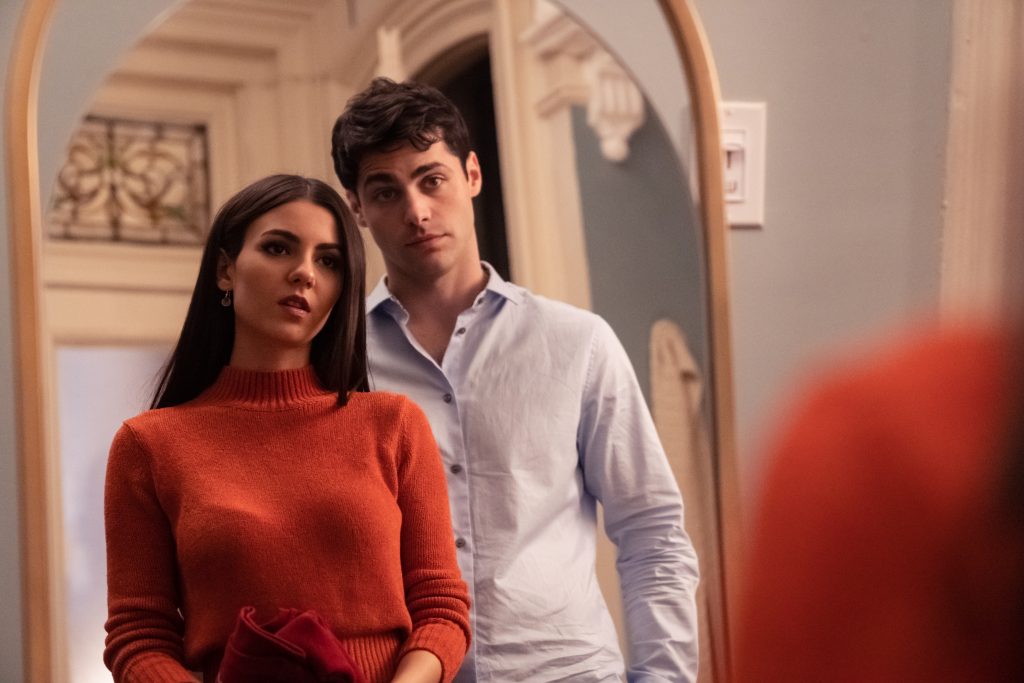
In “Trust,” the New York City married couple at the center of the drama are Brooke Gatwick (played by Victoria Justice) and Owen Shore (played by Matthew Daddario), who are going through a big transition in their lives. Brooke has quit her job at auction house Sotheby’s to open her own self-titled art gallery. It’s a major gamble because Brooke and Owen have poured their entire life savings into the gallery.
Owen is a TV news anchor at a local station, but he’s become bored by all the “soft” news stories (such as dog weddings) that he’s been given to report. He completely supports Brooke’s career ambitions. But Brooke is insecure about Owen’s job situation because he’s surrounded by attractive young women who work with him as producers or other employees. It isn’t made clear how long Brooke and Owen (who are in their late 20s or early 30s) have been married, but they have been a couple since they were in high school.
The opening scene of “Trust” is a sex scene where viewers don’t see the faces of who’s having sex, but it’s clear that it’s a man and a woman. It’s a foreshadowing of what happens later in the movie, when it’s revealed who these sex partners are. While they’re going at it, someone’s phone is on a nearby table. Someone else is sending text messages that are going unanswered on that phone.
The next scene shows Brooke coming home from a business trip that she took in Paris. She looks exhausted. Owen and Brooke hug and tell each other, “I missed you.” It’s revealed later in the movie that Brooke was in Paris to sell some art by an up-and-coming Irish painter named Ansgar Doyle (played by Lucien Laviscount), whom Brooke has paid to relocate to New York City. Brooke is also acting as Ansgar’s official agent.
Laviscount, who is British in real life, tries very hard to be sexy in this role, but his terrible Irish accent is very distracting and almost laughable. Most of the time, he sounds British, and a few times he sounds as if he’s bungling an Italian accent. Based on what happens in this movie, the character of Ansgar didn’t have to be Irish.
It shows bad decision making from the “Trust” filmmakers that they didn’t just let Laviscount keep his natural British accent. No one watching this movie will care what nationality Ansgar is, but they will care if the acting is good or not. It’s not.
Ansgar, whose specialty is sexually themed art, is the first artist whose work is showcased in Brooke’s gallery when it opens. He was a Dublin street artist who was starting to make a name for himself in Europe, but Brooke “discovered” him online and decided that she’s going to make him a star in the United States. Ansgar is arrogant and an obvious playboy.
You know where this is going. And if isn’t obvious enough that Ansgar is going to try and seduce Brooke, his first exhibit at her gallery is titled “Sexual Truth and the Myth of Fidelity.” It’s a series of painted portraits of women who are completely naked.
The first time that viewers see Ansgar, he’s at Brooke’s gallery for a photo shoot and an interview for an unnamed publication. He’s being interviewed by a journalist named Diana (played by Nathalie Carvalho), as he lounges on a chair with his legs spread in a suggestive manner. During the interview, Ansgar brags that he’s slept with all of the models whose nude portraits he’s painted.
Diana asks him, “Is that moral?” Ansgar smirks as he replies, “Why? Are you a model?” When Diana asks him if his art is just all about sex, Ansgar responds, “I only paint those women that are particularly special to me. It’s intimate, sexual, yes. But it’s more than that. It’s the exact moment of ultimate connection that’s captured forever in the painting.”
Watching this interview nearby are Brooke and Owen. As soon as Ansgar starts talking about sleeping with his models, Brooke get uncomfortable. She steps in and cuts the interview short and tells Diana, “No personal questions.”
Diana takes Brooke aside and gives her opinion of Ansgar and his art, “Look, Brooke, he’s brilliant. But as your friend, I’m calling it. The other critics will tear this apart.”
Brooke replies with a certain amount of pretension: “Picasso, Klimt, Lucian Freud—they were all called pornographers. Look, I know what I believe in. And if the critics don’t understand this, then they’re wrong!”
Meanwhile, Ansgar stands next to Owen as they watch Brooke. Ansgar tells Owen that Brooke is hot. Ansgar then adds with his usual smirk, “When women get absorbed in me, you can’t talk to them.” Owen has an expression on his face as if to say, “I can’t believe this clown just said that out loud, but whatever.”
After leaving the gallery, Brooke and Owen have dinner at a Chinatown restaurant with another married couple, who are their closest friends. Adam (played by Ronny Chieng) and Eleanor (played by Lindsey Broad) are both divorce attorneys who are cynical about marriage except their own. For example, Adam and Eleanor tell Brooke and Owen that almost all marriages experience infidelity at one point or another.
The dinner is to celebrate the opening of Brooke’s gallery, and the two couples raise their glasses to toast Brooke. However, Owen chimes in that he deserves a toast too because he thinks Brooke’s gallery will be such a success that Owen half-jokingly says that he will get to “retire early and fulfill my life’s purpose to be a trophy husband.”
The conversation gets a little bit uncomfortable when Eleanor comments that Ansgar is a “hunk” and asks if Owen is okay with Brooke working so closely with him. Adam and Eleanor then rudely talk about how they’ve learned as divorce attorneys that “everyone cheats” in marriages. It’s a buzzkill turn of the conversation for Brooke and Owen.
Do Brooke and Owen have a perfect marriage? Of course not, because there would be no “Trust” movie if they did. Brooke sometimes checks Owen’s phone or iPad when he’s not looking. She questions him if she sees a woman’s name whom Brooke doesn’t recognize. For example, when Owen gets a text from a woman named Susan, Brooke asks Owen who it is, and he says it’s a new co-worker.
But something happens that deepens a crack in Owen and Brooke’s marriage. It’s close to the Christmas holidays, and Owen surprises Brooke with plane tickets for both of them to spend Christmas in Paris. However, Brooke declines the offer when she says that she’ll be too busy with her art gallery work.
And this raises Owen’s eyebrows: Brooke says she also doesn’t want to go to Paris because she doesn’t want to be too far away from Ansgard, who’s never lived in the U.S. before. “He needs me!” Brooke tells Owen, who tries not to get jealous and angry at this remark. Owen expresses disappointment in Brooke’s decision, but ultimately he says that he understands.
Not long after Brooke tells Owen that she doesn’t want to go to Paris, she gets some news that changes her mind. Ansgar tells her that a famous movie director named Damien Light wants to buy some of Ansgar’s art. Damien is filming a movie in Paris, and Ansgar says the best way to seal this art deal is to go to Paris for a meeting that’s set to take place in two days.
At first, Brooke says that she can’t go because she’s too busy and can’t afford the trip. Ansgar says that he’s going with or without her. Brooke then has a conversation with Eleanor, who tells Brooke that she would be crazy not to go to Paris for this trip. And so, Brooke relents and agrees to go to Paris with Ansgar.
Brooke goes to the TV station where Owen works. And when he’s on a break, she brings him coffee and tells him the news that she’s going on a weekend trip to Paris with Ansgar. When Owen hears about it, he’s understandably upset, even though Brooke swears the trip is strictly business.
As “revenge,” Owen announces to the staffers nearby that he’s now available to take a work trip to Las Vegas that same weekend to cover a Christmas event hosted by The New Yorker. A young and attractive female producer cheers and says she and the other women want to sit near Owen on the plane. And now, it’s Brooke’s turn to feel jealous.
Ansgar is an egotistical jerk, but in a movie like this, he’s supposed to be a “bad boy” some women can’t resist. There are hints that Brooke is attracted to and/or intrigued by Ansgar. For example, she doesn’t immediately pull away when he stands too close to her, or when he puts his hands on her legs or on her back, very close to her rear end. Before Brooke leaves for her Paris trip, Owen notices that she’s packed a very slinky red dress. Brooke tells Owen that he has to be understanding.
Owen and Adam have drinks together at a bar during the first night that Brooke is away in Paris. While they’re minding their own business, a pretty blonde in her 20s approaches Owen and says she recognizes him from TV. She introduces herself as Amy (played by Katherine McNamara), and she says she’s a student at the Columbia University Graduate School of Journalism.
Amy mentions that she’s an aspiring TV news journalist and that she admires Owen, even if she doesn’t agree with some of his journalistic opinions. She acts very star-struck and asks Owen for his autograph and if she can take a photo with him. He’s surprised and flattered, so he willingly obliges.
It soon becomes clear from Amy’s flirtations that she wants more than career advice from Owen, who tells her that he’s married. Amy doesn’t seem to care that Owen has a wife. Meanwhile, Adam nervously drops hints that he doesn’t want to stick around for any infidelity shenanigans. He makes an excuse to leave and asks Owen if he wants to leave with him. How Owen handles this situation is the catalyst for the rest of the drama in the story.
“Trust” over-uses a technique of repeating a scene as a flashback or as a flashforward to show how the scene takes on a different meaning once certain secrets are revealed. The movie is based on Kristen Lazarian’s play “Push,” and this flashback/flashforward technique works better in a movie than it would in a play. However, all of this time-jumping in “Trust” (whose screenplay was written by Lazarian, DeCubellis and K.S. Bruce) comes across as clunky storytelling.
There are some plot developments in “Trust” that are unnecessary and not very well-constructed. For example (and it isn’t spoiler information to say this), Owen’s business trip to Las Vegas is never seen or mentioned again, even though it was set up to look like it would be a possible opportunity for him to cheat on Brooke. It doesn’t make sense to have an entire scene of Owen deciding to take this trip when it’s a plot development that’s then ignored.
There are plot holes galore. For example, one of the suspicious spouses goes to the trouble of tracking a rideshare that the other spouse took late one night. It’s later revealed in the movie what that spouse was doing sneaking out so late at night. But the way the truth is revealed is so common-sense basic that the snooping spouse should have found out the truth sooner.
As for the acting, Justice has a few good scenes as the conflicted Brooke, but Justice and Daddario have a “Ken and Barbie doll” type of chemistry that comes across as too plastic. Some of their acting together is monotonous, with awkward pauses. The Adam and Eleanor characters are very smug and grating (especially when they seem to take pleasure in other people’s marriages going bad), but Broad shows more talent in her acting than Chieng does.
Laviscount is woefully miscast for the reasons stated above, and he is in serious need of more acting lessons. His Ansgard character tries too hard to be sexy, which actually makes him very unsexy. It doesn’t help that Ansgard’s costume design includes Ansgard wearing a fur coat and gold chain, as if he’s trying to look like some kind of pimp. And unfortunately, McNamara (who co-starred with Daddario in the Freeform fantasy drama series “Shadowhunters”) is cast as a stereotypical blonde seductress in “Trust,” so she doesn’t have much depth to work with for her Amy character.
The last 20 minutes of “Trust” are a rush job that sloppily crams certain things into the plot to quickly resolve the conflicts in the story. Up until a certain point in the movie, viewers are kept guessing over whether or not Brooke cheated, Owen cheated, or both of them cheated. But by the end of the movie, the only people who should feel cheated are those who wasted their time watching this tedious and unoriginal film.
Vertical Entertainment released “Trust” in select U.S. cinemas, on digital and VOD on March 12, 2021.