
Review: ‘The World According to Allee Willis,’ starring Mark Cuban, Lily Tomlin, Cyndi Lauper, Patti LaBelle, Verdine White, Paul Reubens and Pamela Adlon

December 1, 2024

by Carla Hay

Allee Willis in her home recording studio in “The World According to Allee Willis” (Photo by Maryanne Bilham/Magnolia Pictures)

“The World According to Allee Willis”

Directed by Alexis Manya Spraic

Culture Representation: The documentary film “The World According to Allee Willis” features a predominantly white group of people (with some African Americans), who are mostly entertainers, discussing the life and career of songwriter/visual artist Allee Willis, who died from a heart attack in 2019, at the age of 72.

Culture Clash: Willis struggled for years with going public about being a lesbian and had other insecurities because of turmoil in her family and her failure to become a famous singer.

Culture Audience: “The World According to Allee Willis” will appeal primarily to fans of pop music from the 1970s to 1990s and people who are interested in documentaries about underrated artists.

Allee Willis on the set of MTV’s “Just Say Julie” in “The World According to Allee Willis” (Photo courtesy of the Estate of Allee Willis/Magnolia Pictures)

“The World According to Allee Willis” is an engaging tribute to songwriter/visual artist Allee Willis, who wasn’t a household name, but much of her work is world-famous. The documentary has her quirky charm and empathetically details her personal struggles. People who consider themselves to be aficionados about pop music can still find new things to learn from watching this documentary because so much about Willis is unknown to the general public.

Directed by Alexis Manya Spraic, “The World According to Allee Willis” has its world premiere at the 2024 SXSW Film & TV Festival. Several people are interviewed for this 97-minute documentary, but it does not feel overstuffed or long-winded. Long before the Internet and reality shows existed, Willis filmed much of her adult life from 1978 onward. A great deal of this personal footage is used in the documentary.

Allee Willis was born as Alta Willis in Detroit on November 10, 1947. She was the youngest of three children born to scrapyard dealer Nathan Willis and elementary school teacher Rose Willis. Allee, who was raised Jewish, was heavily influenced by the music of Motown Records, which had its original headquarters in Detroit.

According to interviews shown in the documentary, Allee said she knew from an early age that she was “different” from most other girls. She didn’t like to wear dresses and was attracted to doing things that were usually considered only appropriate for boys. Her mother accepted Allee for who she was, in contrast to Allee’s father.

According to Allee, she always had a difficult relationship with her father, who expected her to be more “ladylike.” In an archival interview, Allee says her father only wanted her to get married. And if she had a career goals, he only wanted her to become a teacher. “I was an outrageous tomboy,” Allee comments.

As she got older and became a teenager, the conflicts between Allee and Nathan increased. They would argue about what radio stations she enjoyed listening to, which were usually stations that played R&B music. Allee said she would often find comfort by going to Motown headquarters and hanging around outside the building when she didn’t want to be at her house, just so she could listen to the music coming out of the Motown building.

The Willis family turmoil went from bad to worse for Allee after her mother died when Allee was 15 years old. Within a year, her father remarried. Allee’s stepmother had daughters who were more feminine than Allee. According to Allee, her father turned his attentions to his new family, and she became an outcast.

When Allee’s mother died, Allee’s older siblings—brother Kent and sister Marlen, who are both interviewed in the documentary—had already moved out of the family home. Marlen (whose married surname is Frost) comments in the documentary: “My mother was my sister’s protector. When she died, that protection was gone.”

The documentary makes it clear that a great deal of the friction between Allee and her father Nathan had to do Nathan being a racist who disliked that Allee had a passion for music made by African American artists. Allee tells a story in the documentary about a note that her father wrote to her before she left home to attend the University of Wisconsin-Madison. In the note, he warned her: “Stay away from black culture.”

Far from taking that racist advice, Allee became involved in civil rights activism when she was in college. After graduating with a bachelor’s degree in journalism, she moved to New York City and worked as a copywriter for Columbia Records, while actually wanting to be a songwriter at a time when songwriting was still very much a male-dominated field. Through her connections at Columbia Records, she got a record deal with Columbia’s sister label Epic Records, which released her first and only album as a solo artist—1974’s “Childstar.”

“Childstar” got good reviews, but it was a sales flop. Many of the people who reviewed Allee’s performances at the time made sexist remarks about her androgynous and unconventional performance style, even though male artists at the time such as David Bowie, Alice Cooper and the New York Dolls were getting praised by critics for being androgynous and unconventional. In archival footage, Allee also talks about how interviewers sometimes mistook her for a man because of her deep voice.

Allee was dropped from Epic after “Childstar” bombed. She decided to start over as a songwriter by relocating from New York City to Los Angeles. And it was in Los Angeles that her luck and her career changed.

Allee was introduced to Earth, Wind & Fire lead singer/songwriter Maurice White by A&R executive Carole Childs, who is one of the people interviewed in the documentary. Maurice White died of Parkinson’s disease in 2016, at the age of 74. However, Maurice’s younger brother Verdine White, who is Earth, Wind & Fire’s bass player, is interviewed in the documentary.

Maurice White and Allee had an instant connection and ended up co-writing (with Al McKay) one of Earth, Wind & Fire’s most beloved songs: the 1978 smash hit “September.” Allee would go on to co-write two more Earth, Wind & Fire songs: “Boogie Wonderland” and “In the Stone,” both released in 1979. The hits set her on a path to becoming an in-demand songwriter.

Ruth Pointer of the Pointer Sisters (whose Grammy-winning 1984 hit “Neutron Dance” was co-written by Allee) says in the documentary that Maurice White told her that he felt Allee was “put on this earth to be a communicator.” “Neutron Dance” was one of the songs on the “Beverly Hills Cop” soundtrack, which also featured another song co-written by Allee: Patti LaBelle’s “Stir It Up.” LaBelle is one of the people interviewed in the documentary. Allee was among of the songwriters who won a Grammy Award (her first Grammy) for the “Beverly Hills Cop” soundtrack, which took the prize for Best Soundtrack Album Background Score from a Motion Picture or Television.

“The World According to Allee Willis” actually begins by telling a true story about how “Neutron Dance” briefly caused controversy in Russia because the Russian government misinterpreted the song as encouraging people to rebel by using neutron weapons. For a while, Allee was described in Russian media as “the most dangerous woman in America.” The documentary has archival footage of Allee being interviewed about this controversy and laughing about it.

Allee was a prolific songwriter who claims to have written hundreds of songs per year, many of which were not recorded by artists. The list of hit songs she’s co-written is long, but among her other best-known hits are the Rembrandts’ “I’ll Be There for You,” the Emmy-nominated theme song from the 1994 to 2004 sitcom “Friends”; the Pet Shop Boys’ “What Have I Done to Deserve This” (featuring Dusty Springfield), released in 1987; and Maxine Nightingale’s “Lead Me On,” released in 1979. Allee also co-wrote the Tony-nominated songs for the stage musical “The Color Purple,” which was made into a 2023 movie.

The documentary dutifully notes Allee’s success as a songwriter, but the movie is much more interesting when it takes a look at her personal life. Allee had a uniquely eccentric style that was reflected in her choice of friends, her fashion wardrobe, how she decorated her house, and how she liked to entertain. She loved to collect kitschy art, which has been kept preserved by her custodian/archivist Sean Welch, who gives a tour of Allee’s pink house (designed by William Kessler) where things have been left intact. One of her quirks was that she liked to collect saddles shoes and had hundreds of pairs of these shoes.

Not content to rest on her songwriting laurels, Allee also became a prolific visual artist who made paintings, sculptures and set designs. She was also successful in visual arts, with her artistic style best described as maximalist and flashy. Her art always conveyed that she seemed to be a kid at heart, bursting with a lot of creative and vibrant energy that was very offbeat but uniquely her own.

Still, Allee had lingering frustrations over two areas of entertainment that she wasn’t fully able to break into as an artist: First was her short-lived career as a recording/performing artist. She also battled sexism in her attempts to become a successful music producer, which is an area of the music industry that is still overwhelmingly dominated by men.

“The World According to Allee Wills” has numerous friends and colleagues of Allee talking about her generous and welcoming personality and her parties where people were encouraged to be as pleasantly weird as they wanted to be. One of her closest friends who’s interviewed in the documentary is actor Paul Reubens, who died at age 70 of respiratory failure in 2023, after living with lung cancer for several years. Reubens was best known for creating the Pee-Wee Herman character for children’s television.

Other friends and colleagues interviewed in the documentary include actress/comedian Lily Tomlin; singer/songwriter Cyndi Lauper; entrepreneur Mark Cuban; writer/director/producer Paul Feig; writer/director/producer Michael Patrick King; musician/former Devo frontman Mark Mothersbaugh, who composed the music for this documentary; actress Lesley Ann Warren; writer/comedian Bruce Vilanch; singer/songwriter Brenda Russell; Pet Shop Boys singer/songwriter Neil Tennant; producer/songwriter Andrae Alexander; comedian/actress Lunell; writer/director Stan Zimmerman; director Jeff Stein; musician Stephen Bray; actor Tim Bagley; humorist/historian Charles Phoenix; singer/songwriter Siedah Garrett; and actress/writer Pamela Adlon, who was Allee’s art assistant when Adlon was in her late teens; and actress/comedian Julie Brown, whose 1980s MTV series “Just Say Julie” had a production set designed by Allee.

Although she had plenty of success and friends in the entertainment business, the documentary doesn’t gloss over that Allee was deeply hurt by her fractured relationship with her father. She remained estranged from her father for years. On the rare occasions that she and family reunions with her father, their conversations remained tense. The documentary includes footage of one such family reunion, where Nathan Willis seems to have a condescending attitude toward Allee, who is clearly bothered by it, but she’s trying not to let her feelings show too much on camera.

Allee was afraid to tell her father and many other people about being a lesbian. At times, she would outright deny her true sexuality because—according to friends in the documentary—she was fearful that it would ruin her career at a time when LGBTQ people weren’t as accepted in the entertainment industry as they are now. Singer/songwriter Lauren Wood, who dated Allee in the early 1980s, says that Allee abruptly ended their relationship out of fear of being “outed” as a lesbian.

Adlon comments, “Allee was an open book, but everyone has a private side.” Cuban, who worked with Allee on Internet ventures in the early years of social media, says about how Allee handled her public image and what she chose to film about her life: “Her life was a movie, and she was always rewriting the script.”

According to what people say in the documentary, Allee didn’t feel completely comfortable about coming out as a lesbian until she became involved with animator/producer Prudence Fenton, who was her partner from 1992 until Allee’s death. Fenton is interviewed in the documentary but she doesn’t get as much screen time as you might expect for someone who was Allee’s partner for 27 years.

“The World According to Allee Willis” is not a pity party for Allee’s problems. Rather, it’s an inspirational look at how someone who had a lot of obstacles and insecurities was able to turn a lot of her pain into bringing joy to other people. It’s a story of resilience and how she found a level of self-acceptance that came with a lot of hard-fought battles. Most of all, “The World According to Allee Willis” stands as great testament for celebrating people for who they are and not what other people expect them to be.

Magnolia Pictures released “The World According to Allee Willis” in select U.S. cinemas, on digital and VOD on November 15, 2024.

Review: ‘House Party’ (2023), starring Jacob Latimore, Tosin Cole, Karen Obilom, D.C. Young Fly and Scott Mescudi

January 14, 2023

by Carla Hay
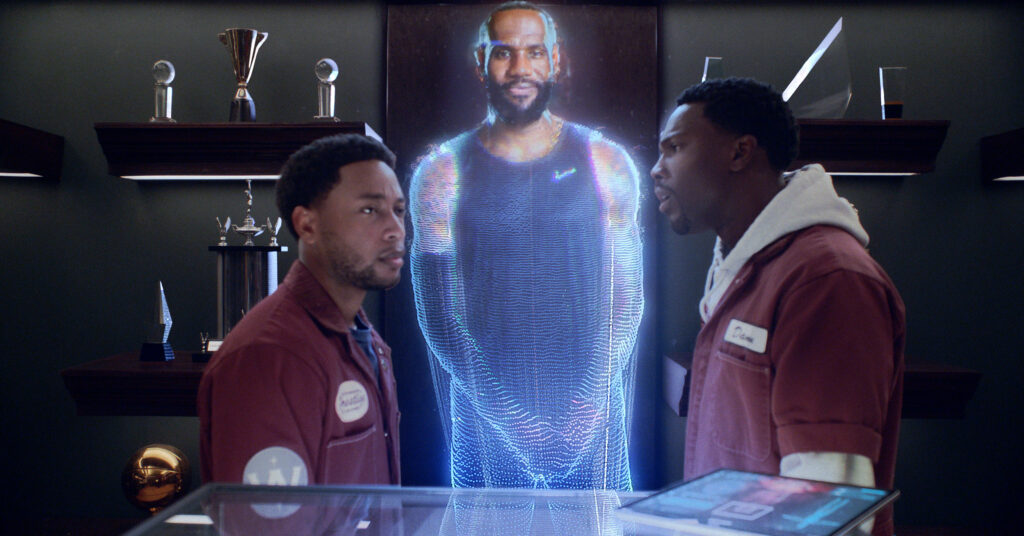
Jacob Latimore, LeBron James and Tosin Cole in “House Party” (Photo courtesy of Warner Bros. Pictures)

“House Party” (2023)

Directed by Calmatic

Culture Representation: Taking place in Los Angeles, the comedy film “House Party” features a predominantly African American cast of characters (with a few white people and Latinos) representing the working-class, middle-class and wealthy.

Culture Clash: In this reboot of the 1990 comedy film “House Party,” two best friends—one who’s an aspiring musician, the other who’s an aspiring party promoter—throw an illegal party at the mansion of basketball superstar LeBron James while James is away on vacation.

Culture Audience: Aside from the obvious target audience of fans of the “House Party” comedy franchise, “House Party” will appeal mainly to people who don’t mind watching silly movie remakes that make African Americans look stupid and ridiculous.
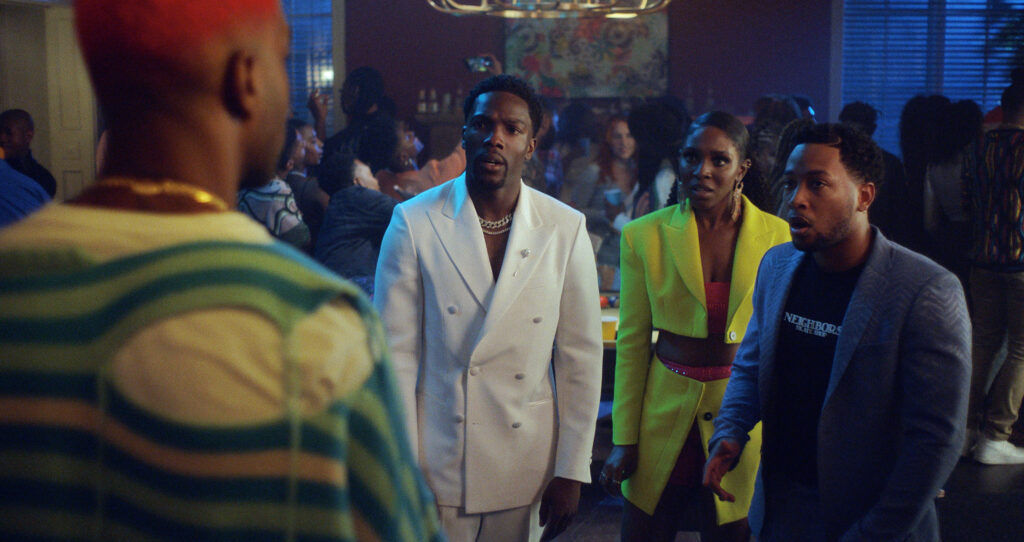
Scott Mescudi (with his back to the camera), Tosin Cole, Karen Obilom and Jacob Latimore in “House Party” (Photo courtesy of Warner Bros. Pictures)

The 2023 reboot of “House Party” is nothing but a shallow cesspool of bad jokes, mindless characters and a relentlessly dull story. The house party doesn’t get started until almost halfway through this vapid movie. The original 1990 “House Party” (written and directed by Reginald Hudlin) was by no means a masterpiece, but it was a low-budget movie that had moments of charm and genuinely hilarious comedy. This 2023 version of “House Party” is just one of many examples of a very misguided and unnecessary movie reboot that is a complete waste of time and money.

Calmatic (whose real name is Charles Kidd II) makes his feature-film directorial debut with the 2023 version of “House Party,” which uses the same concept as the original 1990 “House Party”: Two best friends experience various hijinks during a raucous house party. Jamal Olori and Stephen Glover wrote the terrible screenplay for 2023’s “House Party.”

In 1990’s “House Party” movie, which takes place in an unnamed U.S. city, best friends Christopher “Kid” Robinson Jr. (played by Christopher “Kid” Reid) and Peter “Play” Martin (played by Christopher “Play” Martin) are teenagers in high school. The basic plot is about aspiring rapper Kid sneaking out of his house to go to a house party thrown by aspiring party promoter Play, while Play’s parents are away on vacation. The two pals also have a loudmouth DJ friend, possible love interests, and a trio of bullying thugs who also factor into the story.

The 2023 version of “House Party,” which takes place in Los Angeles, uses the same template of the original “House Party” movie, except the two best friends are in their mid-20s, not underage teens. But because 2023’s “House Party” is polluted with negative stereotypes of African American men, these two clowns are supposed to be financially broke and still living with family members. The two best friends, whose names are Kevin and Damon, both have low-paying day jobs as housecleaners for a company called Windsor Prestige House Cleaning, which has a lot of wealthy people as clients.

In 2023’s “House Party,” Kevin (played by Jacob Latimore) is an aspiring R&B singer/songwriter who shares custody of his toddler daughter Destiny with an ex-girlfriend named Cher (Destiny’s mother), who is never seen in the movie. Kevin lives with his father Pops (played by Bill Bellamy) and Pops’ wife Lisa (played by Nakia Burrise), who will soon be selling the house after Pops’ planned retirement. Kevin has a good relationship with his father and stepmother, but they’ve told Kevin that he will have to find another place to live after the house is sold. Kevin needs money to find a new home and because he wants to send Destiny to an elite private school.

Kevin’s best friend Damon (played by Tosin Cole), whose name is pronounced “Duh-mawn,” is an aspiring party promoter living with his aunt Jean (played by Renata Walsh), who is a cringeworthy stereotype of an “angry black woman” in the brief time that she’s on screen. She bursts into Damon’s bedroom during the day while he’s sleeping and yells at him to wake up. And because it isn’t enough for this horrible movie to portray Damon as lazy, “House Party” depicts him as someone with bad hygiene. Jean complains about the foul body odor in Damon’s bedroom with some insults that include: “It smells like someone fucked an onion in here!”

Just like in 1990’s “House Party,” the lighter-skinned friend is portrayed as the “responsible, smarter” one who is more likely to be worried about getting in trouble, while the darker-skinned friend is the “irresponsible, dumber” one who is more likely to do reckless things that will get the two pals in trouble. It might or might not be colorism from the “House Party” filmmakers, but it sure looks like colorism to a lot of people. Even if this apparent colorism wasn’t intentional, 2023’s “House Party” has so many other problems that can’t save this movie from being a complete flop.

Kevin is confronted on the street by three thugs who are looking for Damon. The leader of this dimwitted, scowling trio is Kyle (played by Allen Maldonado), who is almost always accompanied by sidekicks Larry (played by Melvin Gregg) and Guile (played by Rotimi), who are all cartoonish because of the stupid things that they say and do in the movie. The three bullies want to rough up Damon because they think that Damon has stolen a gold chain necklace from a woman named Daisy, who is Guile’s cousin.

Kevin manages to convince Kyle, Larry and Guile that he doesn’t know anything about this alleged theft. But don’t think this will be the last time that this trio of hoodlums will appear in the movie. Viewers will later find out if Damon really did steal that gold chain necklace. It’s such an uninteresting subplot that it might as well have not been in this “House Party” remake.

Damon and Kevin were hired by Windsor Prestige Housecleaners because Kevin’s ex-girlfriend Venus Bailey (played by Karen Obilom) has some type of managerial position at the company, and she was able to use her clout to get jobs for these two slackers. When it comes to Kevin’s love life, Kevin thinks of Venus as “the one that got away,” so you know what that means: Venus is Kevin’s obvious love interest.

One day, Damon and Kevin are doing a housecleaning job at a mansion, whose owner is away on vacation. It isn’t long before they discover from snooping around the house that the mansion belongs to basketball superstar LeBron James. Damon and Kevin find a private calendar showing that the family members who live in the house are all in India for a two-week spiritual retreat.

While Kevin and Damon are snooping around the mansion, they go into a trophy/memorabilia room, where they see LeBron’s awards and possessions related to basketball, including a championship NBA ring locked in a glass case. (And it’s easy to predict what will happen to the ring and the “race against time” that ensues.) The two pals also see that LeBron has a life-sized hologram of himself in this room, with the hologram giving self-esteem-boosting pep talks.

Why is there all this LeBron James promotion in 2023’s “House Party”? James is a producer of the movie through his SpringHill Company. He also makes a cameo as himself in the movie. Considering that James was a producer and had a starring role in the awful 2021 reboot/sequel “Space Jam: A New Legacy,” maybe it’s time for him to stop making inferior remakes of movies that weren’t very good in the first place.

Not long after Kevin and Damon find out that they’re in LeBron’s mansion, Venus calls them to let them know that Kevin and Damon have been fired. Why? During a previous housecleaning job for the company, Damon and Kevin were caught smoking marijuana on the house’s surveillance video, which was sent to the company.

Kevin is desperate for money, so he comes up with the idea of charging people money to party for one night at LeBron’s mansion, with the intention to mislead the invited people into thinking that LeBron will be at the party too. At first Damon doesn’t want to do it, but he changes his mind and ends up causing more problems during the party. Before they leave LeBron’s house for the day, Kevin and Damon smoke some marijuana on the property. (“House Party” over-relies on marijuana smoking as the gag in jokes that fall very flat.)

“House Party” is so ill-conceived, viewers are supposed to believe that two complete strangers can throw this type of illegal party in a celebrity mansion and that there would be no employees of the celebrity who would find out. In fact, there are no staffers of LeBron James during the party that attracts a few hundred people, including celebrities portraying themselves. The movie never bothers to explain why this mansion doesn’t have any of the James family’s security people or other employees hired to look after it while the family is on vacation. It’s all so mind-numbingly idiotic.

The movie also expects viewers to be morons and think that this party that was marketed as being hosted by LeBron is supposed to be a “secret,” as if word of mouth doesn’t exist. In addition, people at the party are shown filming themselves or taking photos to put on their social media. And yet, there’s a scene during the party when Kevin angrily yells at Damon for revealing the “secret” party because Damon put photos of the party on social media.

One of the worst things about the 2023 version of “House Party” is that all of the characters are boring or very obnoxious. (And so are the performances by the cast members.) Damon and Kevin hire a DJ friend named Vic (played by D.C. Young Fly), who is nothing but an irritating buffoon. He’s nowhere near as funny as Martin Lawrence’s DJ character Bilal in 1990’s “House Party.”

The female characters with prominent roles in the movie are presented as dull love interests or “video vixen” types. Venus has a cousin named Mika (played by Shakira Ja’nai Paye), who’s a very superficial and materialistic party girl. Grammy-winning singer Mya portrays herself in a bland role as LeBron’s neighbor who attracts the lustful attention of Damon.

A subplot from 1990’s “House Party” that isn’t in 2023’s “House Party” is showing how white police officers constantly harass the protagonists when the protagonists aren’t doing anything wrong. It’s a social issue that could have been in a “House Party” movie of the Black Lives Matter era, but apparently this subject matter was too challenging for the filmmakers of 2023’s “House Party.” It’s probably better that 2023’s “House Party” did not have racist police harassment/abuse of African Americans as part of the movie’s story, because it’s a real-life racial problem that’s too important to be in this garbage movie.

The closest that 2023’s “House Party” comes to addressing racial issues is by having a “token” white character named Peter (played by Andrew Santino), who is a nerdy and nosy neighbor of LeBron. Peter becomes the butt of a lot of the movie’s so-called jokes because he’s supposed to be the “clueless white guy” who fails miserably at trying to appear “cool” to black people. Peter inevitably goes over to the house when he sees some of the activity going on and because his female koala named Marley has wandered over to LeBron’s property.

When Kevin and Damon answer the door, Peter is surprised to see these two strangers, who can’t get their stories straight about why they’re at LeBron’s mansion. Before Peter leaves, he tells Damon and Kevin, “By the way, Black Lives Matter.” At various times during “House Party,” the movie uses the koala (which is an obvious fake replica, not a real koala) as a weak gimmick for more unfunny jokes that get run into the ground early, such as the koala getting a contact high from marijuana smoke at the party. The visual effects in this movie are very tacky and unrealistic.

The 2023 version of “House Party” overloads on useless celebrity cameos, as if seeing these celebrities is supposed to make this junkpile movie better. Among the stars who demeaned themselves to portray themselves in this dreadful dud are Snoop Dogg, Lil Wayne, Juvenile, Tinashe, Lena Waithe, Mark Cuban, Odell Beckham Jr., Tristan Thompson and Carl Anthony Payne II. Waithe, who is an Emmy-winning screenwriter in real life, embarrasses herself by portraying a marijuana-smoking party guest who is shown brainstorming ideas for a TV series, including a show that she wants to be like “Roots,” but “in reverse,” with black people enslaving white people.

Scott Mescudi (also known as rapper Kid Cudi) has a poorly written supporting role as himself; his character is another stoned party guest. He has some of the worst lines in the movie, which makes him look like a drug-addled dolt. The 2023 version of “House Party” takes a bizarre turn with a bloody and violent subplot that looks like it’s trying to be a horror-movie parody of 1999’s “Eyes Wide Shut,” but this subplot is neither scary nor funny. Original “House Party” stars Reid and Martin (also known as rap duo Kid ‘n Play) have a very quick cameo in this gruesome part of the movie.

The release of the 2023 version of “House Party” was delayed several times—an obvious indication that Warner Bros. Pictures knew that the movie was an irredeemable bomb. At one point, the movie wasn’t going to have a theatrical release and was supposed to be released directly to HBO Max. Even if people see this version of “House Party” without paying for a movie ticket, it’s still a painfully unfunny waste of time and so horrendously stupid, even the fake koala should be ashamed to be associated with this dreck.

Warner Bros. Pictures released “House Party” in U.S. cinemas on January 13, 2023.

Copyright 2017-2026 Culture Mix
CULTURE MIX