
July 24, 2020
by Carla Hay
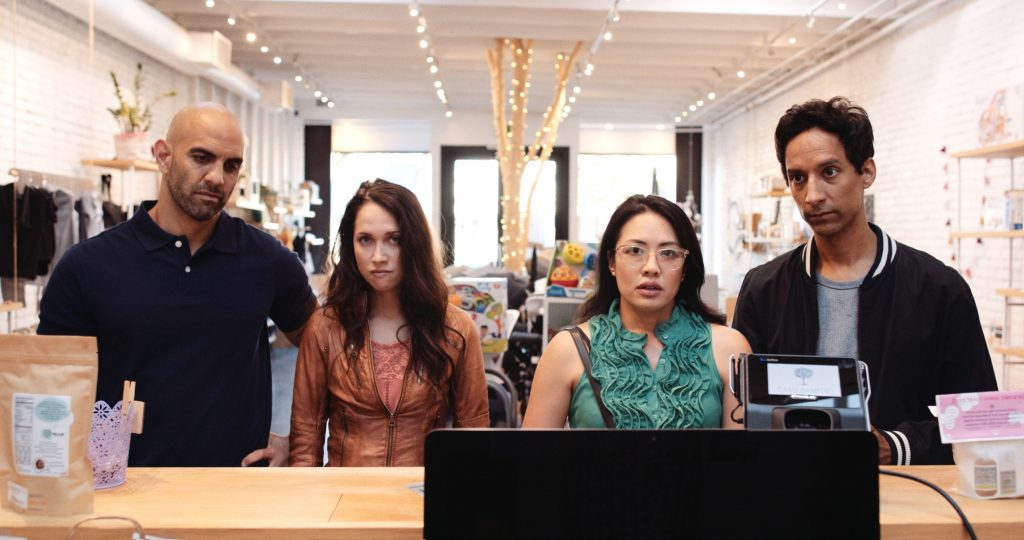
Directed by Sam Friedlander
Culture Representation: Taking place in Los Angeles, the comedy film “Babysplitters” features a racially diverse cast (Asians, white people and a few African Americans) representing the middle-class.
Culture Clash: Two married couples who are best friends with each other decide to have a baby together because one person in each marriage is having an infertility/genetic issue, but some disagreements cause chaos in this arrangement.
Culture Audience: “Babysplitters” will appeal primarily to people who like comedies about parenting, but even the most tolerant viewers will be annoyed by some of the ridiculous plot twists in the movie.

The comedy film “Babysplitters” (written and directed by Sam Friedlander) took what could have been a very unique concept about unconventional parenting and then flushed all that potential down the toilet. The movie—which has an appealing and talented cast—starts out very strong, if a bit far-fetched, and then becomes an outlandish soap-opera train wreck in the last third of the movie before trying to salvage the story with a very formulaic and cop-out ending.
The movie begins, as most comedies about couples do, with a couple having sex. They are husband and wife Jeff Penaras (played by Danny Pudi) and Sarah Penaras (played by Emily C. Chang), who have been married for more than four years but still haven’t agreed on when’s the best time for them to start a family. As shown in the movie’s opening scene, this tension is affecting the sex that Jeff and Sarah are having in the bedroom of their rented Los Angeles home.
Sarah is soon going to turn 35, and Jeff (whose age isn’t stated but he looks like he’s a few years older than Sarah) begin to argue in bed because the issue has come up over when Sarah should get pregnant. She reminds Jeff that women who get pregnant over the age of 35 are considered to have geriatric pregnancies, which come with a high risk of miscarriages and birth defects.
Jeff says that hearing the word “geriatric” is a turnoff for him, and he seems shocked that Sarah thinks that they shouldn’t delay starting a family any longer. But it’s obvious that Jeff isn’t ready. And it has a lot to do with his fear that Sarah will love any children they have more than she loves him.
During the argument, Jeff tells Sarah: “You spend years finding the person you love most in the world, the person you want to spend your life with. Then, for some reason, you conspire to create a third person you like better than each other.”
Jeff adds, “I didn’t sign up to live my life according a biological clock that we don’t even know if you’re reading correctly.” (It’s a very ignorant statement to make, considering that most adults know that it’s harder and riskier for women to get pregnant when they’re over the age of 35.) Sarah replies, “That’s exactly what you signed up for when you married me!”
Family planning isn’t the only discontent in Jeff and Sarah’s marriage. They both feel stifled in jobs that they don’t really like. Jeff works in sales at an online start-up company called FRM 2 TBL, which sells organic farm-to-table food to consumers. (His official title is chief executive of new orders.)
Jeff hates working in an office job where he has to wear a suit and tie. His ideal job is to be an environmental sculpture artist, which is such a niche and unusual career choice that Sarah jokes that there’s only one job opening for it in their area, and it’s already been filled.
In lieu of his dream job, Jeff would rather spend most of his work time outdoors instead of sitting at a desk. But the only outdoor job at FRM 2 TBL is a field job that would be considered a demotion for Jeff. Sarah has an outdoor job, but it’s far beneath someone of her intelligence: She gives parking tickets.
Jeff also feels out-of-place in his job because most of the people who work there are about 10 to 15 years younger than he is, including the company’s CEO, Ben Harris (played by Ben Goldsmith), who likes to skateboard in the office hallways. There’s a hilarious scene in a conference room where Jeff’s leadership skills are tested with a group of millennial subordinates who are overly politically correct. Almost everything Jeff says is offensive to them, including his exasperated response to their criticism: “I can’t correct someone because I have a penis?”
One evening, Sarah and Jeff have a fateful dinner at a restaurant with their two best friends: another married couple named Don Small (played by Eddie Alfano) and Taylor Small (played by Maiara Walsh). Don (who works as a physical trainer) is about the same age as Jeff and Sarah, while Taylor (who’s a professional ballet dancer) is 27. The two couples have the type of friendship where they freely talk about their sex lives and marital issues with each other.
Over dinner, the subject comes up about Jeff and Sarah’s unresolved conflict over when they should start a family together. Sarah is very ready; Jeff is definitely not. The closest that Sarah and Jeff have to a child is their adorable female Chihuahua named Punkie Wooster.
Meanwhile, Taylor has gotten a new job as a principal dancer at a ballet company, which means that she doesn’t feel ready to get pregnant at this point in her life. However, Don is ready to start a family because his father passed away not too long ago, and Don wants any of his future children to be able to know Don’s mother. Don also says that he wants to be the biological father of any child he raises.
Finances are also an issue, because both couples think they’re not completely ready to be able to afford kids, but they think it wouldn’t be too much of a financial strain to have one child. And the spouse who’s more reluctant in the marriage to have kids (Jeff for the Penaras couple, Taylor for the Small couple) worries how it will affect their marriage and leisure time. Jeff makes an off-handed remark that they should all have a baby together and split custody and the cost of raising the child, so that they don’t have to be full-time parents.
Jeff mentions that he has some earlobe defects that run in his family, so Don (who’s very good-looking and has a very muscular physique) would be a better sperm donor than Jeff would be. Sarah thinks it’s all a ridiculous idea, but Taylor thinks it’s a great idea if all four of them agreed to it. “My parents had joint custody, and I turned out fine,” Taylor says.
Sarah says she definitely would want to go through the experience of carrying and giving birth to a child, while Taylor says she doesn’t want to go through that physical situation because, as a ballet dancer, she’s worried about how pregnancy will affect her body. The couples end the dinner with the “babysplitting” idea planted in their heads.
A series of events then happen which result in all four agreeing to Sarah getting pregnant with Bob’s sperm. Sarah is the last holdout before she agrees to the idea. She gives in to the plan because she thinks it will be one of the last chances she has to have a child before she gets too old and before Jeff changes his mind.
Before Sarah, Jeff, Taylor and Don all arrive at this decision, there’s a laugh-out-loud sequence of Sarah and Jeff visiting another married couple who are friends, but they’re not as close to Sarah and Jeff as Taylor and Don are. The other married couple are Marie (played by Andrée Vermeulen) and Brad (played by Kirk Zippel).
Sarah and Jeff’s visit with Marie and Brad is one of the best parts of “Babysplittlers” because of all the hijinks that ensue. Marie and Brad, who are overly permissive parents, have allowed a bunch of kids (about 6 to 11 years old) to have an unsupervised party in their backyard, and the kids have declared the area a “no adult zone.” Jeff doesn’t know this, so when he goes in the backyard, he’s attacked with food, water balloons and Super Soaker water guns.
Marie and Brad are serving dinner for the adults at a table that’s adjacent to the open kitchen. Jeff notices that Marie and Brad’s son (who’s about 6 or 7 years old) is standing on the kitchen counter and urinating into the sink, right where the plates are that Marie is using to serve dessert. What happens next is very funny and made even more amusing because of the comical expressions on Pudi’s face.
After Jeff, Sarah, Don and Taylor decide they’re going to have a child together, there are scenes that show them discussing how they’re going to deal with certain things when raising the child. They decide that they will tell other friends about this unusual parenting arrangement, but they won’t tell their co-workers, and they’ll use discretion on what to tell family members.
They also agree that the child will know the circumstances under which he or she was conceived. After a tense back-and-forth debate, the two couples agree that the child’s last name will be Penaras-Small, but they can’t quite agree on what the child’s first name will be. They decide to wait until they find out the child’s gender. By the way, all of these discussions and arrangements happen without any attorneys or contracts. No one said this movie was realistic.
Of course, when four people have to make decisions on how to raise the same child, there will be inevitable conflicts. Later in the movie, Sarah tells everyone that any children she has must be raised as vegan, while Bob feels the opposite way because he’s a proud meat eater. And even though the couples agreed early on that the child would be raised as spiritual but not in any specific religion, Bob later says that he wants any of his children to have a baptism ceremony, in order to please Bob’s religious mother.
And then there’s the matter of how the child is going to be conceived. After doing some research, the couples find out that artificial insemination will be too costly and time-consuming for them, so they all decide (somewhat reluctantly) that Sarah will get pregnant with Bob’s sperm the natural way. They all agree that it should take place in a hotel suite, and that Taylor and Jeff will be in an adjacent room (with the door open between the rooms) when it happens, so they won’t feel like it’s infidelity. And there’s an awkward discussion over what kind of sexual position will be acceptable to everyone.
Somehow, no one really discusses what they would want to do if Sarah doesn’t get pregnant the first time that she and Bob have sex with each other. It’s certainly not brought up when the two couples gather for group appointments with their chosen obstetrician Dr. Palmer (played by Brian Thomas Smith) or when Jeff meets with his understanding therapist Dr. Cooper (played by Mark Feuerstein) and discusses the entire process. Dr. Cooper’s office is where Jeff has some fantasy sequences (good and bad) about how things will turn out.
When it’s time for the hoped-for impregnation, the sex scene goes on for too long, for reasons that are shown in the movie. It’s one of the funnier parts of “Babysplitters,” and it showcases the comedic talents of all the actors. Unfortunately, the rest of the movie goes downhill quickly after that scene, with some ridiculously bad plot twists. One of the plot twists ends up becoming completely unnecessary.
Although the movie is about two couples, Jeff and Sarah are the main couple whose perspectives are shown, and their family-planning issues are what started this arrangement. Pudi does a very good job at playing the conflicted and often-immature Jeff, but Chang is the standout for her believable and completely natural-looking performance, even when the movie turns into a steaming pile of absurd junk.
Writer/director Friedlander definitely has a knack for filming comedic scenes. But the movie becomes a complete mess because the screenplay has an over-eagerness to have too many implausible, not-very-funny things happening, just to create more contrived comedy. The movie would have been much better without the plot twists.
“Babysplitters” is the equivalent of a false positive on a pregnancy test: It gives the wrong impression that a certain experience is going to happen, when in reality, the results end up being one big mistake.
Gravitas Ventures released “Babysplitters” on digital and VOD on July 24, 2020.