
June 11, 2023
by Carla Hay
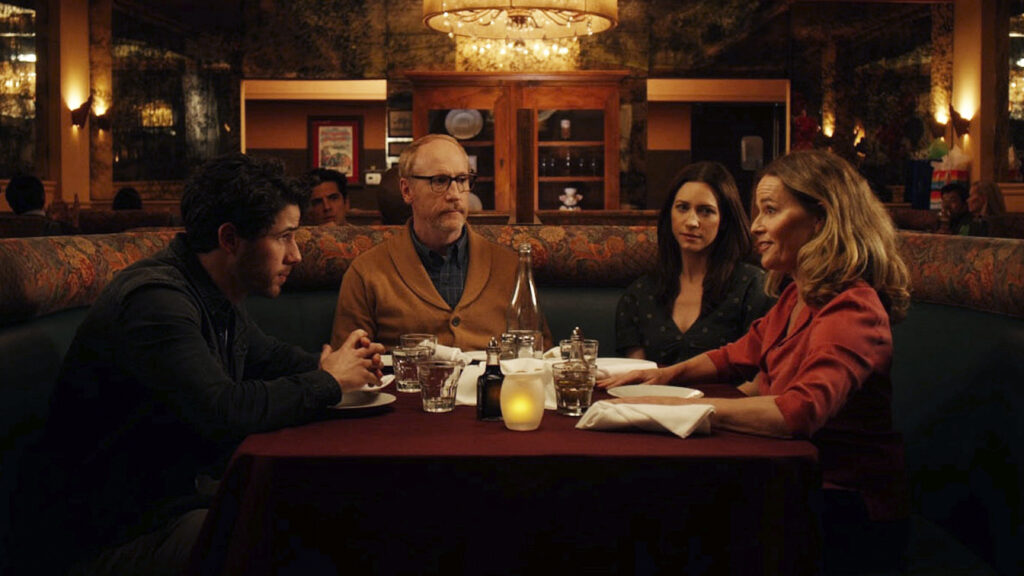
“The Good Half”
Directed by Robert Schwartzman
Culture Representation: Taking place in Cleveland, Ohio, the comedy/drama film “The Good Half” features a predominantly white cast of characters (with a few African Americans and Latinos) representing the working-class and middle-class.
Culture Clash: A 28-year-old aspiring comedy screenwriter returns to his hometown of Cleveland, as he struggles with grief over his mother’s death, as well as tensions with his sister and his stepfather.
Culture Audience: “The Good Half” will appeal primarily to people who are fans of the movie’s headliners and comedy/dramas about complicated family relationships and the effects that a terminal illness has on a family.

In the comedy/drama film “The Good Half,” the movie’s “good half” is the latter half, which shows the most emotional depth. Led by Nick Jonas’ admirable performance, it’s a capably acted story about grief, hope and family tensions. “The Good Half” had its world premiere at the 2023 Tribeca Festival.
Directed by Robert Schwartzman and written by Brett Ryland, “The Good Half” jumps back and forth in the story’s timeline to show life in a family before and after the death of the clan’s matriarch. The movie (which takes place in Cleveland, Ohio) is told from the perspective of her son, who had a close relationship with his mother as a child, but as an adult, he drifted apart from the family after he moved to Los Angeles to pursue a career as a comedy screenwriter. In some ways, “The Good Half” resembles a sitcom with a serious side, but the movie improves when it starts to dig deeper into some realistic family dynamics.
“The Good Half” opens with a flashback scene that takes place when protagonist Renn Wheeland (played by Mason Cufari) is 9 years old and with his neurotic mother Lily Wheeland (played by Elisabeth Shue) near a shopping area. Renn is upset because Lily accidentally left him in a store and didn’t return until about two hours later. A remorseful Lily promises Renn that she will never leave him in a store again. This childhood memory is brought up again later in one of the movie’s most emotionally intense scenes.
Renn (played by Jonas) is now 28 years old and somewhat estranged from his family. He has returned home to Cleveland because Lily has died of a terminal illness. (“The Good Half” was actually filmed in New Jersey and Los Angeles.) On the plane to Cleveland, Renn has a “meet cute” moment with a psychotherapist named Zoey (played by Alexandra Shipp), who tells Renn that she’s visiting Cleveland for a psychotherapist convention. Renn tells a partial lie of omission by saying to Zoey that he’s going to Cleveland for a family reunion. He leaves out the detail that the reunion is under the sad circumstances that it’s for his mother’s funeral.
There’s another airplane passenger sitting in between Renn and Zoey, who have a friendly and flirtatious conversation, while the man in the middle looks slightly uncomfortable. Zoey says that she’s afraid of flying. She jokes that she wishes their flight would turn into the 1997 airplane hijack movie “Con Air.” Zoey adds that all the action movies of the 1990s are great films.
Zoey is very talkative and curious. She asks a lot of questions and finds out from Renn that he is an available bachelor. Renn is a little more guarded and won’t disclose much about himself, except basic information, such as Cleveland is where he was born and raised. After the airplane lands, Zoey and Renn exchange phone numbers, because it’s obvious that they feel an attraction to each other.
When Renn takes a rideshare from the airport, he tells the driver to take the longest way to the destination. It’s an obvious sign that Renn is dreading seeing his family again. Renn has a cordial but emotionally distant relationship with his father Darren Wheeland (played by Matt Walsh), who is mild-mannered and easygoing. Darren and Lily got divorced years ago. Darren has not remarried, and he lives by himself.
Renn’s relationship with his married older sister Leigh (played by Brittany Snow) is much more volatile. Leigh is an uptight control freak who has deep resentment toward Renn for a number of reasons. One of the things she’s angry about is that Renn avoided her numerous attempts to contact him when she needed Renn to help make decisions about their mother’s funeral and other after-death arrangements. It also irritates her that Renn doesn’t seem to care about keeping in touch with anyone in his family.
For now, things will be awkward between Renn and Leigh because he’s staying at the house of Leigh and her husband (who doesn’t say much and barely in the movie) while Renn is visiting Cleveland. On the evening that Renn was supposed to arrive in Cleveland, Leigh had a get-together of Lily’s friends and colleagues. However, Renn showed up too late, and everyone has already left.
“We had a lot of people over here paying their respects,” says a grim-faced Leigh, who can barely hide her disgust that Renn was late. “I’m sorry you missed them.” Renn replies sullenly, “I’m not.” There will be more tension-filled scenes like this between this brother and sister, until the inevitable emotional confrontation where long-held resentments erupt to the surface. Renn and Leigh’s big reckoning with each other has more sorrow than anger.
Renn and Leigh don’t agree on a lot, but there’s one thing that Renn, Leigh and their father all agree on: Lily’s second husband Rick Barona (played by David Arquette) is an annoying jerk. Rick is legally considered Lily’s next of kin, so he’s made a lot of decisions about the funeral that Renn is sure that Lily would not have wanted. Lily wanted to be cremated, but Rick has arranged for her to buried. Lily was Jewish, but Rick has arranged for a Catholic priest to officiate at the funeral.
“The Good Half” has a very effective subplot about the eulogy part of the funeral service. The eulogy is symbolic of the power struggles and disagreements in the family over how Lily wanted to be remembered at her funeral. Needless to say, Rick has very different ideas from what Renn thinks should be said in the family’s eulogies.
Rick wants to hire his eccentric spiritual guru Father Dan (played by Stephen Park), who never met Lily, to officiate the funeral and help family members craft their eulogies. (Father Dan, who teaches piano lessons to children out of his cluttered and messy house, doesn’t appear to be a real ordained priest.) Leigh and Darren try not to get into confrontations with Rick, but Renn has no such qualms. Rick wasn’t exactly a devoted husband during the last months of Lily’s life. And you can bet that the question over who really cared about Lily the most will come up in any arguments between Rick and Renn.
There’s a lot of family drama in “The Good Half,” but the movie seamlessly includes the subplot about Renn and Zoey’s possible romance, which is where some (but not all) of the movie’s comic relief occurs. Renn and Zoey see each other again when he calls her and invites her to meet up with him in a bar. Zoey eventually reveals that she has her own personal issues: She’s going through a divorce.
Zoey says that one of the reasons why she broke up with her soon-to-be ex-husband is because he cheated on her. The Zoey/Renn relationship starts off looking very formulaic. But to the credit of “The Good Half” filmmakers, not everything about this possible romance is predictable.
Anchoring the emotional center of the film is Jonas’ memorable performance as Renn, who is more devastated by Lily’s death than he cares to admit. Shue’s performance as Lily in the flashback scenes is heartfelt and compelling. Lily had her share of quirks (including a habit of stealing table utensils every time she went to a restaurant), but there’s no doubt that she truly loved her children, and they loved her.
In one of the flashback scenes, Renn is spending time with Lily, and he knows that she’s in an unhappy marriage with Rick. Renn advises Lily to end the marriage, and he offers to move back to Cleveland to help her with the divorce. It’s an offer that Lily firmly declines because she says that Renn shouldn’t interrupt his life because of her own personal problems.
And then, Lily blurts out the real reason why she doesn’t want to divorce Rick: “I’ll be a 56-year-old, twice-divorced woman living in Cleveland.” It’s a simple sentence, but it speaks volumes about how some women of a certain age feel when society often treats them like their age is an expiration date for desirability.
“The Good Half” has expected tearjerking moments in scenes showing Lily’s medical treatment and the effects that her illness have on Lily and her loved ones. Despite this depressing part of the movie, “The Good Half” still brings moments of comedic whimsy—some of it is better-placed than others. A subplot about breaking into a home looks very much like it belongs in a sitcom; it turns out to be a set-up to end the scene in a sentimental way.
The movie fares much better with its drama, which is the basis for the best scenes in “The Good Half.” A heart-wrenching monologue by Renn has a line in it that explains why the movie has this title. Does “The Good Half” get a little too sappy in the drama and a little too cutesy in the comedy? Sure, it does. But these are minor flaws that don’t get in the way of this mostly authentic-looking story of how a family can be ripped apart or can come together because of grief.
UPDATE: Utopia Films and Fathom Events will release “The Good Half” in U.S. cinemas for a limited engagement on July 23 and July 25, 2024.