
Review: ‘Christy’ (2025), starring Sydney Sweeney, Ben Foster, Merritt Wever and Katy O’Brian

November 5, 2025

by Carla Hay

Ben Foster (pictured at left) and Sydney Sweeney in “Christy” (Photo courtesy of Black Bear Pictures)

“Christy” (2025)

Directed by David Michôd

Culture Representation: Taking place in various parts of the United States, from 1989 to 2010, the dramatic film “Christy” (a biopic of American former boxing champ Christy Martin) features a predominantly white cast of characters (with some African American and Latin people) representing the working-class, middle-class and wealthy.

Culture Clash: While Martin was at the top of her career, she was also trapped in an abusive marriage to her coach/manager, and she became addicted to cocaine.

Culture Audience: “Christy” will appeal primarily to people who are fans of Martin, the movie’s headliners and formulaic but well-acted celebrity biopics.

Ben Foster and Sydney Sweeney in “Christy” (Photo courtesy of Black Bear Pictures)

The choppy drama Christy is partly a boxing biopic and partly a true crime story about Christy Martin. It’s a showcase for the versatile acting talents of the cast members, but the narrative has some hokey stereotypes usually found in made-for-TV movies. The uneven pacing for the story (including a fairly abrupt ending) doesn’t ruin the movie, but it lowers the quality of the movie, which is a mixed bag of impactful moments and maudlin predictability.

Directed by David Michôd (who co-wrote the “Christy” screenplay with Mirrah Foulkes), “Christy” had its world premiere at the 2025 Toronto International Film Festival. The movie is a fairly ambitious project where Sydney Sweeney plays the role of Martin from when Martin was in her early 20s to when Martin was in her early 40s. Martin was born on June 12, 1968, in Mullens, West Virginia. Unfortunately, the mediocre hairstyling and makeup for “Christy” don’t make the aging process look believable for the Christy Martin character in the movie.

“Christy” viewers have to watch Sweeney wear several obvious wigs (many of them ill-fitting), while the movie’s makeup department didn’t do a very good job to realistically age the character. As Martin, Sweeney looks like she’s in her mid-to-late 20s for most of the movie. It’s a bit distracting for people who know that the story’s timeline is supposed to take place over a period of about 21 years.

“Christy” is told in chronological order, from 1989 to 2010. The movie has a captioned epilogue that mentions what happened in Martin’s life between 2010 and 2025, when the movie was released. For the purposes of this review, the real Christy Martin will be referred to by her last name, while the Christy Martin in the movie will be referred to by her first name.

“Christy” begins by showing with a voiceover of Christy saying, “Someone told me once that I fight like I was trying to destroy everyone who did me wrong … Maybe it’s true.” Christy, whose birth name was Christy Salters, is then shown at about age 21, when she was living in Itmann, West Virginia. At the time, Christy had a basketball scholarship at Concord College in West Virginia.

Christy proudly shows her brother Randy Salters (played by Coleman Pedigo) the $300 she recently won in a Tough Man boxing competition. “Easiest 300 bucks I ever made,” Christy brags. Randy is happy for Christy and proud of her athletic accomplishments. Their mother Joyce Salters (played by Merritt Wever) has the opposite reaction: She’s horrified that Christy has taken an interest in boxing.

Joyce is a religious conservative who’s also displeased about Christy being romantically involved with Christy’s basketball teammate Rosie (played by Jess Gabor) because Joyce firmly believes that homosexuality or queerness is a sin that can send people to hell. Christy and Rosie are mostly closeted in a relationship that no one fully acknowledges but it’s an open secret. (In real life, the Rosie character was Sherry Lusk, a basketball teammate whom Martin began dating when they were in high school.)

Joyce speaks softly, but she’s the domineering and controlling parent in the Salters household. Her husband Johnny Salters (played by Ethan Embry) is also a religious conservative, but he’s not as harsh, judgmental and image-conscious as Joyce is. However, Johnny almost always goes along with whatever Joyce wants.

During a family dinner, Joyce gives this order to Christy about Christy’s relationship with Rosie: “We don’t want you to see her anymore. What you’re doing is not normal. We want you to have a normal and happy life.” Joyce also suggests that Christy and Rosie get counseling from a priest as a way to convince Christy and Rosie to break up.

A conflicted and troubled Christy pours her energy into boxing and getting into other physical fights. At school, Christy gets into trouble for punching a basketball teammate who calls Christy a “fucking lesbian” while the team is having a practice session. Joyce discourages Christy from boxing because she thinks it isn’t ladylike and because women’s boxing was not considered a professional sport in the late 1980s.

However, Joyce starts to change her mind when a Bristol, Tennessee-based boxing promoter named Larry Carrier (played by Bill Kelly) takes an interest in paying Christy to box. Larry offers Christy an all-expenses-paid trip to Bristol to fight in a boxing match where the prize is $5,000. Christy easily wins the boxing match.

After this boxing match, Larry tells Christy that a boxing coach/manager named James “Jim” Martin (played by Ben Foster) wants to meet Christy at a later date. Rosie has accompanied Christy to Bristol. Larry notices how Christy and Rosie are together and quickly figures out that Christy and Rosie are both queer. Jim tells Christy that Christy’s mother needs to accompany Christy on the trip to meet Jim because Jim is a “family-oriented person.” Larry says it in a way so Christy knows that Jim is homophobic, and Jim won’t accept Christy being openly queer.

The first time that Christy meets Jim in a boxing gym, he’s standoffish and rude to her. He doesn’t take her seriously because Christy is a lot shorter than he thought she would be. And he hasn’t seen her fight yet. As a test, Jim has a male boxer do a mock boxing match with Christy. Jim quietly tells the male boxer to “hurt her” because Jim doesn’t want anything to do with Christy. You can easily predict what happens next: Christy ends up knocking out her male opponent.

The more Jim sees Christy box, the more he takes an interest in her and the type of money he can make from her boxing talent. Jim, who is 25 years older than Christy, charms Joyce by giving the impression that he will be a protective and conservative father figure to Christy. Jim convinces Christy to live with him in Bristol while he becomes her coach and her manager. Around the same time, Rosie and Christy drift apart because Rosie stays in West Virginia and begins dating a man.

Jim orders Christy to grow her hair and wear pink boxing outfits, so she looks more “feminine.” It isn’t long before Jim abuses his authority and power over Christy and gets sexually involved with her. By 1991, Jim and Christy are married because he convinces her that he’s the only one who can make her a rich and famous boxing champion. Jim tells Christy that it would be easier to achieve that goal if they were married.

“Christy” then goes through the usual motions showing the “rise, fall, and rise again” story arc that is typical in most celebrity biopics. Christy wins most of her boxing matches and becomes America’s first famous female professional boxer. Jim and Christy eventually move to Florida and settle in the city of Apopka.

The movie is more about how Christy became a boxing champion in spite of Jim, not because of him. Jim is hateful, abusive and controlling in all the worst ways. It also comes as no surprise when the movie shows he was also stealing money from Christy.

There are some lurid aspects to this story, such as when Jim forces Christy to do homemade porn videos, which he uses to blackmail her. The movie also hints that Jim became Christy’s pimp who would sell her to male fans who wanted to do erotic boxing and other sexual activities with her. There’s nothing too explicit in the movie, but there’s enough in the movie for viewers to figure out that it happened.

Christy and Jim’s toxic marriage is also plagued by their cocaine addiction. The movie depicts her account that Jim was the one who introduced her to cocaine and encouraged her to heavily use the drug. And as this dysfunctional marriage continues, the abuse gets worse, until it spirals out of control on the night of November 23, 2010. Even though what happened that night made big news that led to an arrest and trial, this review won’t say what happened, in case “Christy” viewers who don’t know the details might want to see the movie to find out.

Once the “Christy” biopic takes a turn into the true crime aspect of her life, it becomes somewhat like a Lifetime movie, with a very rushed ending where the victim’s recovery is presented as too quick to be an entirely accurate depiction of what happened in real life. However, Foster’s portrayal of the evil and creepy Jim is very unsettling and apparently so realistic, the real Christy Martin said she couldn’t be on the “Christy” film set when Foster was there because his depiction was so similar to the real person. (The real Christy Martin has a cameo in the film, as a hallway bystander who wishes Christy good luck on the way to a boxing match.)

Sweeney’s portrayal of Christy has a lot of grit and effective emotional moments. The boxing matches and the training are shown as “checklist” events in her life, rather than immersive cinematic experiences. Because Christy wins so many of her matches (often by knockouts), the movie’s only real suspense in her fights is for a 2003 boxing match when Christy fights Laila Ali (played by Naomi Graham), who is younger, taller and physically stronger than Christy. It’s the only boxing match in the movie where Christy genuinely is afraid and reluctant, but Jim pushes her into it because they need the money.

The boxing matches in the movie are adequately filmed. However, “Christy” is not convincing that Christy has changed much physically during the more than 20 years that this story takes place. And that’s a problem for a movie about a boxer who’s supposed to go from her early 20s to her early 40s in the story.

Sweeney’s performance is skilled at showing emotions but not very skilled in showing the natural maturity that takes place when most people evolve from their 20s to 40s. Even if Christy has some arrested development in her maturity, she was undoubtedly changed physically and emotionally because of her drug addiction, the abuse she got from her husband, and the effects of her long boxing career. However, the movie makes Christy look like she’s physically and emotionally stuck in her mid-to-late 20s. The movie could have also taken a more realistic approach in how Christy’s boxing injuries affected her.

An early scene in “Christy” is an example of the movie’s uneven filmmaking. Christy and Jim meet with notoriously flamboyant boxing promoter Don King (played by a scene-stealing Chad L. Coleman) when Christy is still an unknown boxer. Jim brings a VHS cassette tape to show some highlights of Christy’s boxing matches, but the tape doesn’t work on the VCR in Don’s office. It’s a very sitcom-type moment because the scene—especially Coleman’s performance—is played for laughs. The scene, although well-acted, sticks out like a sore thumb in this very serious movie.

Christy is able to convince Don to sign her, just by doing a few mock boxing jabs in his office. And he comes up with the idea to give her the nickname the Coal Miner’s Daughter (inspired by Loretta Lynn’s 1971 “Coal Miner’s Daughter” hit song) when Don finds out that Christy’s father really was a coal miner. It’s understandable why a movie would condense all of this in one meeting, but it all looks so fake in the way that this scene is written.

However, “Christy” does a good job of showing how someone can feel trapped in an abusive relationship, especially if the abuser has a lot of power over the abused person and isolates the abused person from loved ones. Years into the marriage, Christy asks her mother for help to get away from Jim, but her mother “gaslights” Christy by saying Christy is the problem in the marriage. Jim manipulates Joyce by convincing Joyce that Christy has become a flaky and pathological liar because Christy has a drug addiction.

Christy’s only true confidantes in the movie are Rosie (who is in and out of Christy’s life) and a boxer named Lisa Holewyne (played by Katy O’Brian), who lost to Christy in one of their high-profile boxing matches. Lisa, who is openly a lesbian, is there for Christy during the lowest point in Christy’s life. O’Brian gives a good performance, but there’s not enough shown or told about Lisa for her to be a well-rounded character in the movie.

“Christy” gives a general overview of Christy’s career and personal life in the way that a biopic tends to do when it’s limited to telling the story in a time frame that’s less than three hours. (“Christy” clocks in at 135 minutes.) The movie doesn’t give enough information about who else knew about Jim’s abuse at the time that it was happening.

Very little is depicted about how the business of women’s professional boxing evolved from the 1990s to the 2010s. There’s a scene where Christy fakes being a heavier weight by putting a lot of coins in her pockets, in her shoes, and in her underwear before she gets weighed, so that she can qualify for a boxing match for a heavier weight class. It’s hard to imagine any professional boxer being able to get away with that trick nowadays.

Because the real Christy Martin has a memoir (2022’s “Fighting for Survival: My Journey Through Boxing Fame, Abuse, Murder, and Resurrection”) and a 2021 documentary (Netflix’s “Untold: Deal With the Devil”), people who are familiar with both of these non-fiction projects will know that “Christy” leaves out a lot of information that could’ve been in the movie. (For example, the “Christy” movie doesn’t mention that Christy has gone public about being sexually abused as a child, and Jim’s longtime abuses were much worse than what’s shown in the movie.) “Christy” is worthwhile as a story of inspirational empowerment. But as a biopic, it falls a little bit on the shallow side that’s held afloat by good performances.

Black Bear Pictures will release “Christy” in U.S. cinemas on November 7, 2025. A sneak preview of the movie was shown in U.S. cinemas on October 27, 2025.

Review: ‘Memory’ (2023), starring Jessica Chastain, Peter Sarsgaard, Merritt Wever, Brooke Timber, Elsie Fisher, Josh Charles and Jessica Harper

January 29, 2024

by Carla Hay

Peter Sarsgaard and Jessica Chastain in “Memory” (Photo courtesy of Ketchup Entertainment)

“Memory” (2023)

Directed by Michel Franco

Culture Representation: Taking place in New York City, the dramatic film “Memory” has a predominantly white cast of characters (with a few African Americans and Latinos) representing the working-class and middle-class.

Culture Clash: A recovering alcoholic, who has traumatic memories from her past, forms an unexpected bond with a former high school classmate who has dementia.

Culture Audience: “Memory” will appeal primarily to people who are fans of stars Jessica Chastain and Peter Sarsgaard; filmmaker Michel Franco; and movies that have realistic portrayals of emotionally damaged adults.

Jessica Chastain in “Memory” (Photo courtesy of Ketchup Entertainment)

“Memory” is a skillfully acted character study of how memories can be blocked out, preserved, or warped to shape personal self-identities or perceptions of others. This drama’s sluggish pacing drags down the movie, but it doesn’t ruin the film. And some of the film’s subject matter, such as taking care of someone with dementia or having dementia, might be triggering or upsetting for people who’ve been through those experiences. However, the movie has a powerful message about how human connections can thrive in unlikely circumstances.

Written and directed by Michel Franco, “Memory” (which was filmed on location in New York City) had its world premiere at the 2023 Venice International Film Festival, where “Memory” co-star Peter Sarsgaard won the prize for Best Actor. The movie made the rounds at other film festivals in 2023, including the Toronto International Film Festival and the BFI London Film Festival. Viewers who see the trailer for “Memory” before seeing the movie should know in advance that the trailer is somewhat misleading, because it makes “Memory” look more suspenseful than it really is.

“Memory” is told from the perspective of middle-aged Sylvia (played by Jessica Chastain), a social worker whose job is at an adult care facility for disabled and emotionally troubled people. Sylvia is a recovering alcoholic who has been sober for the past 13 years. It’s revealed later in the movie that Sylvia was a very rebellious teen who began drinking when she was an adolescent.

The movie opens with a scene of Sylvia in an Alcoholics Anonymous support group meeting, where she is highly respected, and the feeling is mutual. Sylvia is a single mother to a 15-year-old daughter named Anna (played by Brooke Timber), who is an intuitive and obedient child. Sylvia and Anna live in a small apartment in New York City’s Queens borough. They aren’t poor, but they have some financial struggles. Anna notices that their refrigerator isn’t working again, and Sylvia seems bothered that it’s another expense that will put a strain on her finances.

Sylvia doesn’t have a social life and seems every emotionally closed off to many people. At her high school reunion, she sits by herself, looking bored, and she doesn’t really talk to anyone. A man named Saul Shapiro (played by Sarsgaard), one of her former classmates, sits down at the same table and tries to start a conversation with her.

Sylvia looks very annoyed. She gets up and walks out of the building. But then, she notices that Saul is following her. He follows Sylvia on the subway all the way back to her apartment building, but she is able to get to the building’s front door before he does, and she locks it behind her. And then, Saul does something even creepier: He stands outside her apartment building like a stalker, even when it begins to rain.

Sylvia has become alarmed but she doesn’t call the police. The next morning, she sees that Saul has spent the night outside the apartment. She can see that he’s not mentally well, so she asks him for his phone and calls a number of anyone who can identify him and pick him up. Sylvia gets Saul’s protective bother Isaac (played by Josh Charles) on the phone.

Isaac explains that Saul has dementia and that Saul has episodes where he wanders off and goes to places and has no memory of how he got there. Isaac picks up Saul, but that isn’t the last time that Sylvia sees him. She calls Isaac the next day to ask to see Saul and to find out if he’s doing any better. Isaac, who is a single father, lives with teenage daughter Sara (played by Elsie Fisher), who has an almost immediate rapport with Sylvia.

Through a series of circumstances, Sylvia reluctantly accepts Isaac’s offer to be Saul’s part-time caregiver during the day. The rest of “Memory” shows the up-and-down relationship that develops between Saul and Sylvia. She is haunted by traumatic memories of her past that have affected her self-esteem and her relationships with her soft-spoken, married older sister Olivia (played by Merritt Wever) and their widowed mother Samantha (played by Jessica Harper), who has been estranged from Sylvia for years.

“Memory” is not the type of movie where healing comes easily. There are moments of self-awareness and self-sabotage that happen throughout the story. Sylvia has a tendency to be a caretaker to others, but she also has to come to an understanding that she needs a lot of emotional self-care that she has neglected. “Memory” is a testament to how people can find solace in simple moments that can have a much larger impact than expected.

Ketchup Entertainment released “Memory” in U.S. cinemas on December 22, 2023, with an expansion to more U.S. cinemas on January 5, 2024.
2019 New York Film Festival: ‘Marriage Story’ is the centerpiece film

July 30, 2019

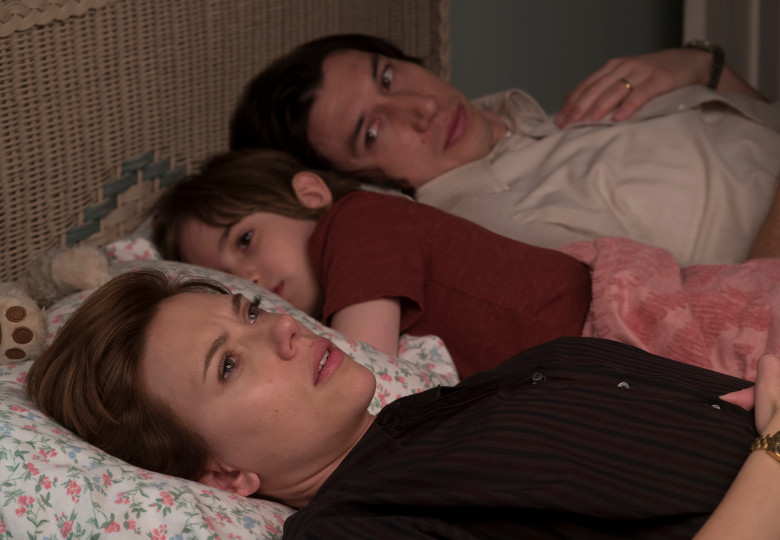
Scarlett Johansson, Azhy Robertson and Adam Driver in “Marriage Story” (Photo by Wilson Webb)

The following is a press release from Film at Lincoln Center:

Film at Lincoln Center announces Noah Baumbach’s “Marriage Story” as Centerpiece of the 57th New York Film Festival (September 27 – October 13), making its New York premiere at Alice Tully Hall on Friday, October 4, 2019. “Marriage Story” will be released in select theaters and on Netflix later this year.

Noah Baumbach’s new film is about the rapid tangling and gradual untangling of impetuosity, resentment, and abiding love between a married couple negotiating their divorce and the custody of their son. Adam Driver is Charlie, a 100-percent New York experimental theater director; Scarlett Johansson is Nicole, his principal actress and soon-to-be L.A.-based ex-wife. Their “amicable” breakup devolves, one painful rash response and hostile counter-response at a time, into a legal battlefield, led on Nicole’s side by Laura Dern and on Charlie’s side by “nice” Alan Alda and “not-so-nice” Ray Liotta. What is so remarkable about “Marriage Story” is its frank understanding of the emotional fluctuations between Charlie and Nicole: they are both short-sighted, both occasionally petty, both vindictive, and both loving. The film is as harrowing as it is hilarious as it is deeply moving. With Merritt Wever and Julie Hagerty as Nicole’s sister and mom, and Azhy Robertson as their beloved son, Henry.

“What amazed me about ‘Marriage Story’ is the way that Noah keeps the many conflicting emotions between his characters flowing into and around and under and over each other, so beautifully that the film achieves the condition of music,” said New York Film Festival Director and Selection Committee Chair Kent Jones. “In fact, it actually flowers into song in two of the film’s loveliest and most surprising moments. ‘Marriage Story’ is a heartbreaker, it’s very funny, and it has an emotional complexity that’s worthy of Bergman.”

“I grew up coming to the New York Film Festival with my parents. And it’s where my first film ‘Kicking and Screaming’ premiered 24 years ago,” said Baumbach. “I couldn’t be more thrilled and proud that ‘Marriage Story’ has been selected as Centerpiece of the NYFF. The 14-year-old me’s mind is blown; the 49-year-old me’s mind is also blown.”

Presented by Film at Lincoln Center, the 17-day New York Film Festival highlights the best in world cinema, featuring works from celebrated filmmakers as well as fresh new talent. The selection committee, chaired by Jones, also includes Dennis Lim, FLC Director of Programming, and Florence Almozini, FLC Associate Director of Programming.

Tickets for the 57th New York Film Festival will go on sale to the general public on September 8. Festival and VIP passes are on sale now and offer one of the earliest opportunities to purchase tickets and secure seats at some of the festival’s biggest events, including Centerpiece. Support for the Centerpiece of the New York Film Festival benefits Film at Lincoln Center in its non-profit mission to support the art and craft of cinema.


FILM AT LINCOLN CENTER
Film at Lincoln Center is dedicated to supporting the art and elevating the craft of cinema and enriching film culture.

Film at Lincoln Center fulfills its mission through the programming of festivals, series, retrospectives, and new releases; the publication of Film Comment; the presentation of podcasts, talks, and special events; the creation and implementation of Artist Initiatives; and our Film in Education curriculum and screenings. Since its founding in 1969, this nonprofit organization has brought the celebration of American and international film to the world-renowned arts complex Lincoln Center, making the discussion and appreciation of cinema accessible to a broad audience, and ensuring that it remains an essential art form for years to come.

Support for the New York Film Festival is generously provided by Official Partners HBO, Campari, and The New York Times, Benefactor Partners Netflix, illy caffè, and Dolby, Supporting Partner Warby Parker, and Contributing Partners Hudson New York-an SBE Hotel and IMDbPro. JCDecaux, Variety, Deadline Hollywood, WNET New York Public Media and Shutterstock serve as Media Sponsors. American Airlines is the Official Airline of Film at Lincoln Center.

Film at Lincoln Center receives generous, year-round support from the National Endowment for the Arts and the New York State Council on the Arts with the support of Governor Andrew M. Cuomo and the New York State Legislature. For more information, visit www.filmlinc.org and follow @filmlinc on Twitter and Instagram.

Copyright 2017-2026 Culture Mix
CULTURE MIX