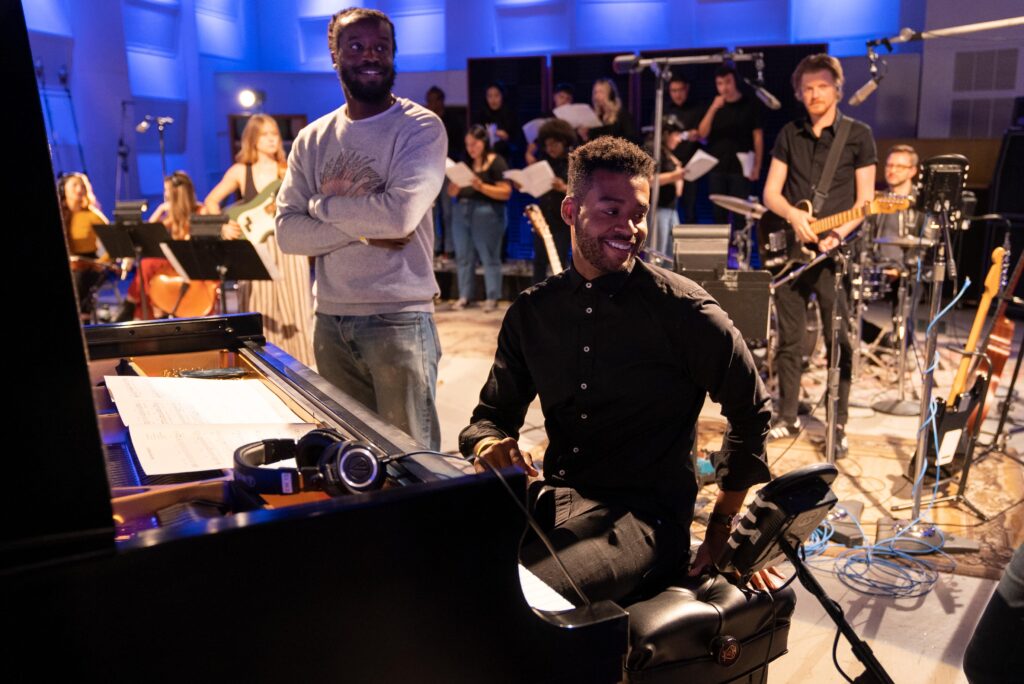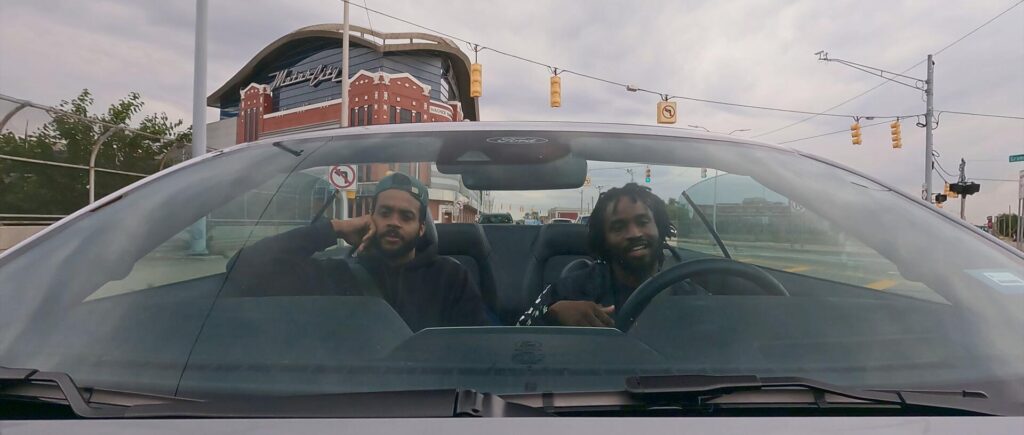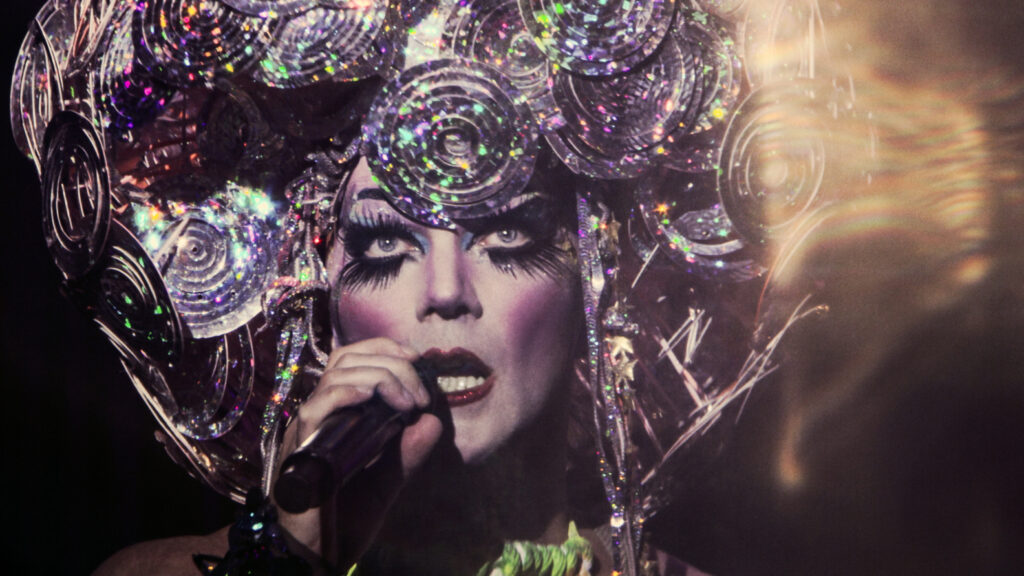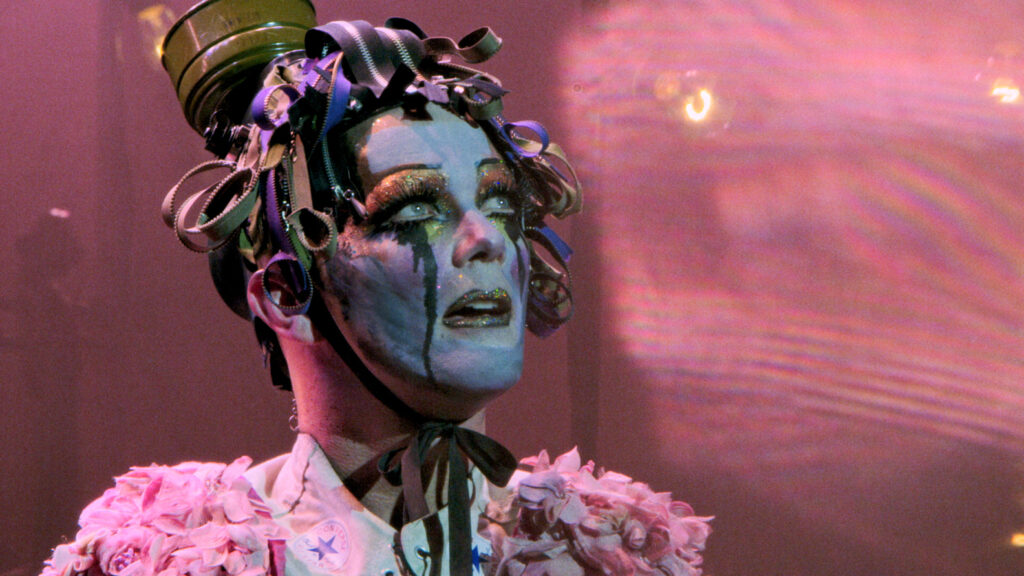
Culture Representation: Taking place in California’s San Fernando Valley, the documentary film “Swamp Dogg Gets His Pool Painted” features an African American and white group of people cast of characters discussing the life and career of singer/songwriter Swamp Dogg.
Culture Clash: Swamp Dogg (whose real name is Jerry Williams Jr.) has had ups and downs in his career, including hit songs and being dropped by Elektra Records in the 1970s for his extreme left-wing views on the Vietnam War.
Culture Audience: “Swamp Dogg Gets His Pool Painted” will appeal primarily to people who are fans of Swamp Dogg, music from the late 20th century, and documentaries about unconventional entertainers.
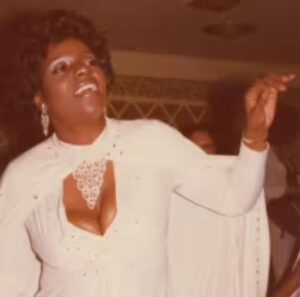
Moogstar in “Swamp Dogg Gets His Pool Painted” (Photo courtesy of Magnolia Pictures)
“Swamp Dogg Gets His Pool Painted” is a unique documentary reflecting underrated singer/songwriter Swamp Dogg: eccentric, rambling, creative, and unpredictable. Some viewers won’t like this nonconformist storytelling style, but others will appreciate it. The movie gets its title from the fact that the swimming pool at Swamp Dogg’s house is being painted while he tells his story during this biographical documentary, which blends archival footage with footage filmed specifically for the documentary. By the end of the movie, the artwork painting in the swimming pool is revealed.
Directed by Isaac Gale and Ryan Olson, “Swamp Dogg Gets His Pool Painted” is narrated by musician/visual artist Greg Grease. The movie had its world premiere at the 2024 SXSW Film and TV Festival. “Swamp Dogg Gets His Pool Painted” jumps back and forth between being a retrospective and being a present-day chronicle of what Swamp Dogg was doing with his life at the time this documentary was filmed.
Swamp Dogg was born as Jerry Williams Jr. on July 12, 1942, in Portsmouth, Virginia. He’s not a household name, but he’s written about 2,000 songs and worked with 500 artists, according to Grease’s narration in the documentary. Swamp Dogg has co-written some well-known hits, including Gene Pitney’s 1969 song “She’s a Heartbreaker” and “She’s All I’ve Got,” a 1971 song originally recorded by R&B singer Freddie North and made more famous by country singer Johnny Paycheck.
Black artists who make music tend to be stereotyped as only capable of working in certain genres, such as R&B, funk, dance, hip-hop, jazz and blues. Unlike many of his peers, Swamp Dogg defied those stereotypes by also working in country music as well as R&B and funk. His unconventionality didn’t catapult him to superstar status, but he’s been a well-respected artist precisely because of being so authentic to himself.
“Swamp Dogg Gets His Pool Painted” begins by showing the pool painter arriving at the Swamp Dogg’s house in California’s San Fernando Valley. Also living at the house are Swamp Dogg’s musical partners Moogstar and Guitar Shorty, who also give their insights and commentary. The documentary shows some of the trio’s jam sessions and songwriting collaborations, which aren’t spectacular but aren’t terrible either.
Swamp Dogg and Moogstar have a relationship that’s similar to the musical partnership that George Clinton and Bootsy Collins had when they were band members in Parliament-Funkadelic. Moogstar has a persona that’s reminiscent of Collins because Moogstar dresses flamboyantly and often talks in “trippy” ways, like he’s on another planet. Guitar Shorty, a longtime venerated blues musician, is not as talkative as Moogstar. But since Guitar Shorty is in the same age group as Swamp Dogg, Guitar Shorty’s has a valuable perspective of certain eras that he lived through long before many other people in the documentary were born.
Swamp Dogg gives a brief overview of his earliest years in the music business. In 1954, when he was 12, his first recording “HTD Blues (Hardsick Troublesome Downout Blues)” was released on the Mechanic record label in 1954. Back then, he used the stage name Little Jerry Williams and continued to record under than name into his teenage years and 20s. In 1964, he had a minor hit with “I’m the Lover Man,” a song which he wrote. His breakthrough song as Little Jerry Williams was “Baby You’re My Everything,” which reached No. 32 on the R&B single chart in 1966.
Throughout the late 1960s, he continued to work as a solo artists and as a songwriter and producer for other artists, including Patti LaBelle & the Blue Belles, Dee Dee Warwick and Doris Duke. It was during this period of time that he also began collaborating with Gary U.S. Bonds (real name: Gary Anderson), who’s had a prolific career as a singer/songwriter. By the end of the 1960s, Williams wanted a change and reinvented himself.
Williams changed his name to Swamp Dogg in 1970. The 1970s were a decade that also marked his transformation as an outspoke political activist. He began to experiment more with the then-emerging genres of funk and psychedelic soul. But this experimentation also included getting scathing criticism for his 1971 album of cover songs “Rat On!,” which was a sales flop.
In the documentary, Swamp Dogg speaks with fondness of joining the “Free the Army” tour, an anti-Vietnam War tour that also featured left-wing progressive Jane Fonda and Dick Gregory. The documentary makes this statement: “His radical political views got him placed on the FBI’s watch list and dropped from Elektra Records.”
Swamp Dogg candidly shares that the 1970s were a decade of his greatest commercial success and most destructive personal excesses. He spent a lot of time back then recording in Muscle Shoals, Alabama. “I became a millionaire down there,” Swamp Dogg comments. “I was eating Zoloft like you eat M&Ms.”
All the drug-taking made him paranoid that people were out to trick him and kill him, Swamp Dogg says. It was a period of time when he bought nine cars that he didn’t need. Swamp Dogg reflects on his tendency at the time to want to show off with material possessions: “I wanted to be grand, but that’s not what it’s all about.”
Swamp Dogg, who says he is accustomed to having strong women in his family, gives credit to his wife Yvonne for being a steady presence in his life and keeping him from getting too out of control. The couple got married in 1963. Yvonne became his business partner, who managed many his dealings in the volatile music industry. Yvonne died in 2003, but the documentary has some archival footage of her.
Swamp Dogg’s daughter Dr. Jeri Williams (whom he calls his “main daughter” out of his five daughters) is interviewed in the documentary. She says she “feels sort of bad” that he put some of his career to the side to help raise her and her siblings. She compares her father to being a like a CIA operative with secrets, because she says that there are many things in his life that she doesn’t know about and he won’t discuss.
“Swamp Dogg Gets His Pool Painted” shows the expected array of clippings from magazine and newspapers, as well interviews and appearances on radio and TV, for the “blast from the past” parts of the documentary. Not surprisingly, some of the footage is grainy, which fits this scrappy, low-budget documentary just fine. There are slightly amusing mentions and clips of Swamp Dogg’s 2021 appearance on “The People’s Court” (a reality TV show for small-claims court cases), when musician Lloyd Wright sued him $1,425, for non-payment of 19 musical tracks. Swamp Dogg lost his case on “The People’s Court” and didn’t seem bothered by it in the show’s post-judgment interview with him.
Aside from Swamp Dogg’s confession to having a drug problem in the 1970s, he doesn’t get too revealing in the documentary about any of his personal shortcomings or scandals. The documentary is quirky in telling some things that we really didn’t need to know about Swamp Dogg. For example, Swamp Dogg says that he got a vasectomy in 1996. He claims it was Yvonne’s idea.
The documentary shows Swamp Dogg getting some celebrity admirers as visitors while his pool is being painted. They include actor/comedian Johnny Knoxville, “SpongeBob SquarePants” creator Tom Kenny, animator Mike Judge (best known for “Beavis and Butt-Head”), visual artist Art Fein and songwriters Jenny Lewis and John Prine. Lewis and Prine collaborated on some of the songs on Swamp Dogg’s 2020 album “Sorry You Couldn’t Make It.” Toward the end of the documentary, there’s footage of a backyard barbecue party for Swamp Dogg’s house, with some of these famous guests in attendance.
Some famous entertainers have the type of personality where a “hangout” documentary is a better fit for them, compared to a “tell all” exposé. Swamp Dogg is one of those artists. A great deal of “Swamp Dogg Gets His Pool Painted” is nostalgic. But the overall feeling is that Swamp Dogg isn’t stuck in the past and is still living life to the fullest in the present.
Magnolia Pictures released “Swamp Dogg Gets His Pool Painted” in Los Angeles on May 2, 2025, and in New York City on May 9, 2025. The movie will be released on digital and VOD on July 1, 2025.
Culture Representation: Taking place in California and briefly in Montana, the dramatic film “Hurry Up Tomorrow” features a racially diverse cast of characters (black, white and Latin) representing the working-class, middle-class and wealthy.
Culture Clash: A troubled pop star is haunted by personal problems and gets entangled with an obsessive fan while he’s on tour.
Culture Audience: “Hurry Up Tomorrow” will appeal primarily to people who are fans of the movie’s headliners and pretentious “stream of consciousness” movies that don’t have much to say.
Jenna Ortega in “Hurry Up Tomorrow” (Photo by Andrew Cooper/Lionsgate)
“Hurry Up Tomorrow” is supposed to be the companion movie to Canadian pop singer The Weeknd’s 2025 album of the same name. It’s a very misguided and confused film that will have an unintended effect of turning off potential fans of The Weeknd. This incoherent vanity cesspool (about egos, fame and trauma) proves that the movie’s production money would’ve been better spent on more therapy for Abel Tesfaye, also known as The Weeknd. Ripping off ideas from the Oscar-winning “Misery” doesn’t help.
Directed by Trey Edward Shults, “Hurry Up Tomorrow” was written by Shults, Tesfaye and Reza Fahim. Tesfaye and Fahim are two of the producers of the movie. Shults is the movie’s film editor. “Hurry Up Tomorrow” was filmed in Los Angeles, San Diego, and Bozeman, Montana. In “Hurry Up Tomorrow,” Tesfaye plays a version of himself, with the same birth name and same stage name. For the purposes of this review, the real Tesfaye will be referred to by his last name. The Abel character in the movie will be referred to by his first name.
“Hurry Up Tomorrow” wants to be a psychological drama/thriller, with large chunks of horror thrown into this messy cinematic stew. But there are almost no thrills to be had in this disjointed story, and the horror elements fail at being scary. Instead, what’s offered is a rambling narrative of a moody and self-absorbed pop star dealing with a recent breakup from a girlfriend, a temporary loss of his singing voice due to stress, “mother issues,” and an obsessive fan who stalks him and does much worse.
“Hurry Up Tomorrow” begins by playing the ranting voice message from an unnamed woman (voiced by Riley Keough) who has recently broken up with Abel. In the message, she unleashes a torrent of rage and hurt of someone who has broken free from an abusive relationship. Abel plays this message over and over so he can feel like a victim.
This ex-girlfriend says things in the message such as: “I’m leaving you. I used to think you were a good person … You broke me and made me feel so small. Your mom would be so ashamed if she knew how you treated me. You’re pathetic. And that’s why you deserve to end up …”
The message abruptly cuts off. Later, because this message is played multiple times throughout the movie, the last thing she said in the message is revealed: “And that’s why you deserve to end up alone.”
Don’t expect Abel to reflect on how this relationship ended so badly and take any responsibility he had in it. Don’t expect to get any insight on who this woman is, how long she and Abel were a couple, and why she’s been emotionally damaged from being in a relationship with him. That’s because this movie about a narcissistic pop star has the pop star make the breakup all about how it’s hurting him.
Tears flow down his face, and he seems upset by the breakup at various time in the movie, but you get the impression it’s because his ego is bruised that she broke up with him. Based on how emotionally disconnected Abel is from the people who are closest to him, when it comes to relationship breakups, he’s probably the type of person who’s accustomed to do the dumping and discarding of people in his life. Throughout the movie, there’s a tiresome tone of “Poor me, I’m a misunderstood jerk who can’t understand why people won’t let me mistreat them,” which is very off-putting, to say the least.
As Abel is wallowing in self-pity while he’s on tour, a young woman named Anima, also known as Ani (played by Jenna Ortega), is in Montana. She’s in a cluttered house and pours gasoline in every room of the house when no one else is there. And then, she sets the house on fire, gets in a truck, and drives away.
Don’t expect the movie to explain who lives in this house and why Anima committed this arson. The only hint of Anima’s personal life is shown in a later scene when she gets a phone call from her mother (also voiced by Keough), who has to leave a message because Anima won’t take the call. In the message, Anima’s mother is very upset with her over something she did, but the message is too vague to know for sure if it’s about the arson.
“Hurry Up Tomorrow” eventually reveals something that was already shown in the movie’s trailers: Anima is an obsessed fan of Abel. She eventually ends up in the audience at one of his concerts in California, and she meets him after the show. Until this meeting, the scenes featuring Anima are dull vignettes of her going on a road trip to this concert.
Abel has an entourage, but the person he is closest to is his manager, enabler, and drug supplier: an Irishman named Lee (played by Barry Keoghan), who has been Abel’s manager from the beginning of Abel’s music career. Lee gives a monologue at one point in the movie that barely explains the extent of their relationship. Apparently, Lee gave up everything in Ireland to be Abel’s manager when they were both broke and struggling.
How did Abel and Lee meet? Don’t expect answers to that question. What’s clear is that whatever genuine friendship that Lee and Abel might have had is now questionable because Abel is now Lee’s “meal ticket” that Lee doesn’t want to give up, at any cost. Their relationship seems transactional and not based on brotherly love, even though Lee often calls Abel “brother.”
Their hypocrisy is so ingrained in their lifestyles, they seem to have no self-awareness of it. Abel is seen working out with dumbbell weights backstage. Lee escorts him to the stage as if Abel is a champion boxer, with Abel wearing a boxer’s robe as part of his usual backstage clothing. Abel is no athlete who responsibly cares about his health. He’s really a cocaine-snorting, hard-drinking, self-destructive adult brat.
When Abel loses his singing voice during a concert and finds out from a doctor (played by Ash T) that the voice loss is mostly from psychological stress, Lee lectures Abel about taking some healing syrup. And yet, Lee (who has an obvious cocaine addiction) is the one who also urges Abel to do cocaine, which is one of the worst drugs a singer can consume because cocaine does damage to nasal passages and the throat, which are vital body parts for singing. The loss of a singing voice happened to Tesfaye in real life at a Los Angeles concert in 2022. In real life, he abruptly ended the concert when he lost his voice. This type of concert cancellation is depicted in the movie.
There’s an underlying tone of misogyny throughout “Hurry Up Tomorrow” because the only women heard speaking at length in this pile-on of annoying self-adulation are women who are portrayed as toxic harpies who intentionally hurt Abel. There are hints that Abel’s dysfunction stems from unresolved anger that Abel has against his mother, whom he blames for his horrible childhood. The movie doesn’t show or tell enough about his background to give much meaningful insight.
Ortega makes a good effort to deliver the lines that she’s been given. However, Anima remains a big mystery throughout the movie, which doesn’t care to explain who she is and is more concerned about showing what she does to make Abel uncomfortable. Keoghan gives a believable performance as an enabling manager, but the Lee character is ultimately hollow and vague too.
Tesfaye is the least talented actor of these three principal cast members because sometimes he over-acts, while other times he’s too stiff. And it’s truly ironic that he gives the movie’s worst performance because he’s the only cast member who’s portraying himself in the movie. Ostensibly, Tesfaye should have the easiest acting performance because he’s just depicting a version of himself.
There are lots of whirling camera angles, close-ups of people’s angst-ridden faces, and neon lighting, in attempts to make “Hurry Up Tomorrow” look more artistic than it really is. Tesfaye and Daniel Lopatin co-wrote the movie’s music score, which is one of the few things that this junkpile movie gets right. And the movie has the expected soundtrack of The Weeknd songs, including “Wake Me Up,” “Red Terror,” “Cry for Me,” “São Paulo,” “Timeless,” “Open Hearts,” “Drive,” “Blinding Lights,” “Gasoline,” “Hurry Up Tomorrow” and “Without a Warning.”
Two things that people might expect this movie to be but the movie is not: First, it’s not a concert film. Abel is seen performing in only three separate concert scenes, with one song in each of these scenes. Second, “Hurry Up Tomorrow” is not sexually explicit, like Tesfaye’s critically panned HBO series flop “The Idol,” a drama that was supposed to be erotic but many people thought was very unsexy for how women were degraded in the show. The only sex in “Hurry Up Tomorrow” is hinted at, when Abel spends the night with someone and wakes up the next morning with her in a hotel room.
“Hurry Up Tomorrow” isn’t even that edgy or unique. The movie’s cursing and depictions of drug use are very cliché. And when “Hurry Up Tomorrow” takes a sudden turn into being a horror movie, that’s when things really go off the rails, and there’s no coming back from the wreckage.
Egomania is on full display here. It’s not just with Abel but it’s also with Anima, who goes from being an arsonist to being much worse when she experiences rejection. There’s plenty to show that these self-centered characters desperately want people to admire them, but it’s hard to admire anyone who doesn’t give enough reasons for you to care in the first place.
Lionsgate released “Hurry Up Tomorrow” in U.S. cinemas on May 16, 2025. The movie will be released on digital and VOD on June 6, 2025.
Culture Representation: Taking place in the 1301, in Verona, Italy, the musical film “Juliet & Romeo” (based on the play “Romeo & Juliet”) features a predominantly white cast of characters (with some black people and Latin people) representing the working-class, middle-class and wealthy.
Culture Clash: A teenage boy and a teenage girl fall in love with each other, even though their families are feuding with each other.
Culture Audience: “Juliet & Romeo” will appeal primarily to people who are fans of William Shakespeare’s “Romeo and Juliet” and the movie’s headliners, but this bland and muddled musical’s drastic change to the original story’s ending might be too much of a turnoff to many viewers.
A scene from “Juliet & Romeo.” Pictured from left to right: Sarah Lazzaro, Tayla Parx, Rupert Everett, Rebel Wilson, Clara Rugaard, Lidia Vitale, Jason Isaacs, Nicholas Podany, Max Parker and Zac Bellward. (Photo courtesy of Briarcliff Entertainment)
“Juliet & Romeo” is a musical with forgettable songs, a romance with no sizzle, and an ending with a terrible revision and tone-deaf announcement about an unwanted sequel. Everyone in this misguided flop looks like they’re doing Renaissance Faire cosplay. Without question, “Juliet & Romeo” will be ranked as one of the worst “Romeo and Juliet” movie adaptations of all time. The movie is supposed to take place in Verona, Italy, in 1301, but it looks and sounds like a Hollywood throwaway musical from 2001.
Written and directed by Timothy Scott Bogart, “Juliet & Romeo” (which takes place over the course of four days) is such a mind-numbing misfire, Juliet (played by Clara Rugaard) and Romeo (played by Jamie Ward) are only in a handful of scenes together. And when Romeo and Juliet are together, they spend most of their time being coy and talking about superfical nonsense. Not once do you believe that these two characters have such a deep connection and a burning passion for each other that they would literally die for each other, which is the famous ending of the “Romeo and Juliet” play that William Shakespeare wrote in the 1590s. And brace yourselves: Bogart has said in interviews that he conceived his “Juliet & Romeo” movies to be a trilogy.
The pop/rock songs in “Juliet & Romeo” aren’t completely terrible, mainly because talented people are singing the songs. Evan Kidd Bogart (Timothy Scott Bogart’s younger brother) and Justin Gray wrote the original songs for “Juliet & Romeo.” The problem with the songs is that they don’t have any catchy and memorable hooks. The lyrics are very bland and don’t add much to the story of Romeo and Juliet. These songs could be on any D-list pop album and you wouldn’t be able to tell that these songs were written for a movie about Romeo and Juliet.
The first scene of “Juliet & Romeo” is actually the funeral of Romeo and Juliet, who are shown embracing each other in a coffin. The funeral service is conducted by Friar Lawrence (played by Derek Jacobi), a clergyman who flip-flops during the story when it comes to his approval of Romeo and Juliet’s romance. The movie then flashes back to three days earlier and shows what happens during those three days and then shows the funeral that took place on the fourth day and what happened after the funeral.
While it’s possible that some people seeing this movie have never heard of the famous ending of “Romeo and Juliet,” by putting Romeo and Juliet’s funeral in the movie’s first scene, it ensures that this spoiler information is revealed from the start. It also shows that the filmmakers don’t have enough respect for the intended impact of the original ending of “Romeo and Juliet” because not only did they reveal this information too early in the movie, but they also used it as a cheap gimmick to fabricate a very different ending. This altered ending is as cringeworthy and superficial as the rest of the movie.
A great deal of the tragedy of “Romeo and Juliet” is because these two doomed lovers died mainly because their prominent Verona families are locked in a bitter feud and would not accept the couple’s relationship. Romeo comes from the Montague family, led by his parents Lord Montague (played by Jason Isaacs) and Lady Montague (played by Lidia Vitale), who are cold and domineering. Juliet comes from the Capulet family, led by her parents Lord Capulet (played by Rupert Everett) and Lady Capulet (played by Rebel Wilson), who are gregarious and manipulative.
Romeo also has a loyal adopted brother named Mercutio (played by Nicholas Podany), who was adopted as an orphan. Also in Romeo’s family is his cousin Benvolio (played by Max Parker), who doesn’t have a personality that stands out. Juliet has a hothead cousin named Tybalt (played by Ferdia Walsh-Peelo), who is constantly picking fights with Romeo. Expect to see many brawls and chase scenes on streets and in alleyways, as if this movie is confused and thinks it’s “West Side Story.”
Why are the Montagues and the Capulets feuding? Don’t expect this movie to give clear answers. There’s a lot of shouting and scheming about who’s going to be loyal to the government and who’s going to be loyal to the Pope. At one point, Lord Montague slaps Romeo hard in the face and snarls, “You stand with this family, or you stand alone, son.” Meanwhile, Juliet’s parents give her distress by arranging for her to be engaged to a count named Paris (played by Dennis Andres), whom she doesn’t know. Juliet finds out about this engagement before she’s even met Paris.
“Juliet & Romeo” spends way too much time on side characters. Juliet has a clique of female friends named Rosaline (played by Tayla Parx), Veronica (played by Martina Ortiz Luis) and Lilly (played by Quinn Scott Bogart) who are like a tame 1301 Verona version of the “Sex and the City” women. There’s even a “female empowerment” sextet song titled “The Mask I Wear,” where each of them gets a solo with Lady Capulet and a newly created character named Vesante (played by Ledisi), whose purpose just seems to be so Grammy-winning singer Ledisi could have a role in this movie. Too bad the song packs a punch like a limp wrist.
Mercutio is having a romance with Veronica, so the movie shows them on dates and the first time that they spend the night together. Rosaline had a thing going with Tybalt, but she loses interest in him because he’s too much of a jerk. Is this the Romeo and Juliet story, or is it a teen soap opera? And by the way: Romeo, Juliet and most of their friends in this movie look much older than the teenagers they are supposed to be.
Surprisingly, Walsh-Peelo (who’s arguably the most talented male singer in the “Juliet & Romeo” cast; see the 2016 movie “Sing Street” for proof) does not get any solo songs as Tybalt, the story’s chief villain. He’s only heard in the group song “Streets on Fire,” which also features Rugaard, Ward, Parx, Ledisi, Podany and Parker. It seems like such a waste of Walsh-Peelo’s musical talent.
Other characters in the movie include Juliet’s nurse from childhood (played by Sarah Lazzaro), who would be called a nanny in modern times, but her character is sidelined for the teen romances. There’s also an unnamed apothecary (played by Dan Fogler), who invents the fateful potion that is consumed by Romeo and Juliet. He is depicted in this movie as a “mad scientist” type who does experiments on rats. And if you waited your whole life to see this story’s friar and apothecary do a duet called “I Should Write This Down” in a musical, then “Juliet & Romeo” is the movie for you.
Juliet and Romeo meet when she is visiting Verona from France, where she has been living as a student. They flirt with each other, but she won’t tell him her name the first time that they meet. Later, when Romeo is getting chased in an alley fight by Tybalt and some of his cronies, Juliet grabs Romeo and kisses him so that his face can be obscured. We’re supposed to believe that the guys chasing Romeo suddenly forget what he’s wearing because they don’t notice Romeo kissing Juliet as Tybalt and his fighting pals run right past Romeo and Juliet.
When Juliet and Romeo kiss again in another scene, she says to him: “I can’t tell if your poetry is prose.” She pauses and says, “Poetry it is then,” as she leans into him to give him another kiss. Rugaard is a little more convincing than Ward at showing emotions, but Ward and Rugaard lack the necessary chemistry together to be believable as a legendary couple. Ward shows more passion in the fight scenes than the love scenes, which is not the way to do things in one of the most famous love stories of all time.
Some of the cast members in “Juliet & Romeo” were in Timothy Scott Bogart’s 2023 feature-film directorial debut “Spinning Gold,” a very flawed biopic of his father Neil Bogart, a record company executive who helped artists such as Kiss, Donna Summer and Parliament-Funkadelic become major stars. Parx, Fogler and Ledisi were in “Spinning Gold,” which had the cast members do their own singing when performing songs from famous artists. “Spinning Gold” and “Juliet & Romeo” have the same problems: good singing trapped in a movie with a bad screenplay and mishandled direction. And when a movie about Romeo and Juliet doesn’t have an authentic-looking romance, it’s doomed to fail.
Briarcliff Entertainment released “Juliet & Romeo” in U.S. cinemas on May 9, 2025.
[Editor’s Note: With 10 nominations each, “Buena Vista Social Club,” “Death Becomes Her” and “Maybe Happy Ending” have the most nominations for the 2025 Tony Awards.]
The following is a press release from the Tony Awards:
Nominations in 26 competitive categories for the American Theatre Wing’s 78th Annual Antoinette Perry Tony Awards® were announced by Tony Award winners Sarah Paulson and Wendell Pierce. The nominees were selected by an independent committee of 54 theatre professionals appointed by the Tony Awards Administration Committee. The 2025 Tony Awards are presented by The Broadway League and the American Theatre Wing. (The list of nominations follows.)
The 78th Annual Tony Awards will return to the legendary Radio City Music Hall in New York City next month. Hosted by Tony, Emmy, and GRAMMY Award-winner and three-time Oscar nominee Cynthia Erivo, The American Theatre Wing’s Tony Awards will broadcast LIVE to both coasts on Sunday, June 8, 2025 (8:00 – 11:00 PM ET/5:00 – 8:00 PM PT) on the CBS Television Network, and streaming on Paramount+ in the U.S.*
CBS and Pluto TV will present The Tony Awards: Act One, a pre-show of live, exclusive content leading into the 78th Annual Tony Awards. Additional details will be available at a future date.
Legitimate theatrical productions opening in any of the 41 eligible Broadway theatres during the current season may be considered for Tony nominations. The 2024/2025 eligibility season began April 26, 2024 and ended April 27, 2025. The Tony Awards will be voted in 26 competitive categories by 840 designated Tony voters within the theatre community.
Special Tony Awards will be presented to:
The musicians who make up the band of Buena Vista Social Club – Marco Paguia (Music Director, Conductor/Piano); David Oquendo (Associate Music Director, Guitar); Renesito Avich (Tres); Gustavo Schartz (Bass); Javier Días, Román Diaz, Mauricio Herrera (Percussion); Jesus Ricardo (Trumpet); Eddie Venegas (Trombone); Hery Paz (Woodwinds); Leonardo Reyna (Piano);
The Illusions & Technical Effects of Stranger Things: The First Shadow (Jamie Harrison, Chris Fisher, Gary Beestone & Edward Pierce).
As previously announced, the 2025 Tony Honors for Excellence in the Theatre will be presented to Great Performances, Michael Price, New 42, and The New York Public Library for the Performing Arts. The Isabelle Stevenson Tony Award will be presented to Celia Keenan-Bolger. Harvey Fierstein will receive the Special Tony Award for Lifetime Achievement in the Theatre.
The 2024-2025 Tony Award Nominating Committee consists of: Bob Balaban, Danielle Barlow, Rick Boynton, Brian Harlan Brooks, Dr. Jamie Cacciola-Price, Kevin Cahoon, Adam Chanler-Berat, Victoria Clark, Jordan E. Cooper, Dan Foster, Donald P. Gagnon, Ph.D., Deeksha Gaur, Linda Goodrich, Miranda Haymon, James Ijames, Michael R. Jackson, Christine Toy Johnson, Rosalie Joseph, Rod Kaats, Michael Korie, Kathy Landau, Andrea Lauer, Zhailon Levingston, Jose Llana, Peter Marks, Jess McLeod, Lisa McNulty, Ira Mont, Jacqueline Diane Moscou, Helen Park, Jessica Paz, Georgina Pazcoguin, Ralph B. Peña, Karen Perry, Nancy Piccione, Jill Rafson, Bill Rauch, T. Oliver Reid, Liam Robinson, Carole Rothman, Susan Sampliner, Dick Scanlan, Florie Seery, Rachel Sheinkin, Devario Simmons, Walt Spangler, Mark Stanley, Susan Soon He Stanton, Sam Strasfeld, Jason Tam, Reginald Van Lee, Alexandria Wailes, Ben Wexler, and David C. Woolard.
A limited number of tickets to the show are now on sale to the general public. Ticket prices begin at $595 for seats in the second and third mezzanines and are available for purchase at TonyAwards.com and Ticketmaster.com. There is a six ticket limit and all ticket sales are final (Ticketmaster services charges will apply).
The Tony Awards are produced in collaboration with Tony Award Productions, a joint venture of the American Theatre Wing and The Broadway League, and White Cherry Entertainment. Ricky Kirshner and Glenn Weiss are executive producers and showrunners for White Cherry Entertainment. Weiss will serve as director.
About the Tony Awards
The American Theatre Wing’s Tony Awards are presented by The Broadway League and the American Theatre Wing. At The Broadway League, Kristin Caskey is Chair and Jason Laks is President. At the American Theatre Wing, Emilio Sosa is Chair and Heather A. Hitchens is President & CEO.
Sponsors for the American Theatre Wing’s Tony Awards include: City National Bank – the official bank of The Tony Awards; American Express – the official payments partner of The Tony Awards; Carnegie Mellon University – the first-ever, exclusive higher education partner; Baccarat – the official partner of the Tony Awards; Cunard – the official cruise partner of The Tony Awards; Dewar’s – the official scotch whisky of The Tony Awards; Rockefeller Center – the official home of the Tony Awards red carpet and events; Sofitel New York – the official hotel of The Tony Awards; Playbill; Rainbow Room – the official partner of the Tony Nominee Luncheon.
Follow @TheTonyAwards on Instagram, TikTok and Facebook.
*Paramount+ with SHOWTIME subscribers will have access to stream live via the live feed of their local CBS affiliate on the service, as well as on-demand. Paramount+ Essential subscribers will not have the option to stream live, but will have access to on-demand the day after the special airs.
# # #
Nominations for the 2024-2025 Season American Theatre Wing’s Tony Awards®
Presented by The Broadway League and the American Theatre Wing
Best Book of a Musical
Buena Vista Social Club, Marco Ramirez
Dead Outlaw, Itamar Moses
Death Becomes Her, Marco Pennette
Maybe Happy Ending, Will Aronson and Hue Park
Operation Mincemeat: A New Musical, David Cumming, Felix Hagan, Natasha Hodgson and Zoë Roberts
Best Original Score (Music and/or Lyrics) Written for the Theatre
Dead Outlaw, Music & Lyrics: David Yazbek and Erik Della Penna
Death Becomes Her, Music & Lyrics: Julia Mattison and Noel Carey
Maybe Happy Ending, Music: Will Aronson; Lyrics: Will Aronson and Hue Park
Operation Mincemeat: A New Musical, Music & Lyrics: David Cumming, Felix Hagan, Natasha Hodgson and Zoë Roberts
Real Women Have Curves: The Musical, Music & Lyrics: Joy Huerta and Benjamin Velez
Best Performance by an Actor in a Leading Role in a Play
George Clooney, Good Night, and Good Luck
Cole Escola, Oh, Mary!
Jon Michael Hill, Purpose
Daniel Dae Kim, Yellow Face
Harry Lennix, Purpose
Louis McCartney, Stranger Things: The First Shadow
Best Performance by an Actress in a Leading Role in a Play
Laura Donnelly, The Hills of California
Mia Farrow, The Roommate
LaTanya Richardson Jackson, Purpose
Sadie Sink, John Proctor is the Villain
Sarah Snook, The Picture of Dorian Gray
Best Performance by an Actor in a Leading Role in a Musical
Darren Criss, Maybe Happy Ending
Andrew Durand, Dead Outlaw
Tom Francis, Sunset Blvd.
Jonathan Groff, Just in Time
James Monroe Iglehart, A Wonderful World: The Louis Armstrong Musical
Jeremy Jordan, Floyd Collins
Best Performance by an Actress in a Leading Role in a Musical
Megan Hilty, Death Becomes Her
Audra McDonald, Gypsy
Jasmine Amy Rogers, BOOP! The Musical
Nicole Scherzinger, Sunset Blvd.
Jennifer Simard, Death Becomes Her
Best Performance by an Actor in a Featured Role in a Play
Glenn Davis, Purpose
Gabriel Ebert, John Proctor is the Villain
Francis Jue, Yellow Face
Bob Odenkirk, Glengarry Glen Ross
Conrad Ricamora, Oh, Mary!
Best Performance by an Actress in a Featured Role in a Play
Tala Ashe, English
Jessica Hecht, Eureka Day
Marjan Neshat, English
Fina Strazza, John Proctor is the Villain
Kara Young, Purpose
Best Performance by an Actor in a Featured Role in a Musical
Brooks Ashmanskas, SMASH
Jeb Brown, Dead Outlaw
Danny Burstein, Gypsy
Jak Malone, Operation Mincemeat: A New Musical
Taylor Trensch, Floyd Collins
Best Performance by an Actress in a Featured Role in a Musical
Natalie Venetia Belcon, Buena Vista Social Club
Julia Knitel, Dead Outlaw
Gracie Lawrence, Just in Time
Justina Machado, Real Women Have Curves: The Musical
Joy Woods, Gypsy
Best Scenic Design of a Play
Marsha Ginsberg, English
Rob Howell, The Hills of California
Marg Horwell and David Bergman, The Picture of Dorian Gray
Miriam Buether and 59, Stranger Things: The First Shadow
Scott Pask, Good Night, and Good Luck
Best Scenic Design of a Musical
Rachel Hauck, Swept Away
Dane Laffrey and George Reeve, Maybe Happy Ending
Arnulfo Maldonado, Buena Vista Social Club
Derek McLane, Death Becomes Her
Derek McLane, Just in Time
Best Costume Design of a Play
Brenda Abbandandolo, Good Night, and Good Luck
Marg Horwell, The Picture of Dorian Gray
Rob Howell, The Hills of California
Holly Pierson, Oh, Mary!
Brigitte Reiffenstuel, Stranger Things: The First Shadow
Best Costume Design of a Musical
Dede Ayite, Buena Vista Social Club
Gregg Barnes, BOOP! The Musical
Clint Ramos, Maybe Happy Ending
Paul Tazewell, Death Becomes Her
Catherine Zuber, Just in Time
Best Lighting Design of a Play
Natasha Chivers, The Hills of California
Jon Clark, Stranger Things: The First Shadow
Heather Gilbert and David Bengali, Good Night, and Good Luck
Natasha Katz and Hannah Wasileski, John Proctor is the Villain
Nick Schlieper, The Picture of Dorian Gray
Best Lighting Design of a Musical
Jack Knowles, Sunset Blvd.
Tyler Micoleau, Buena Vista Social Club
Scott Zielinski and Ruey Horng Sun, Floyd Collins
Ben Stanton, Maybe Happy Ending
Justin Townsend, Death Becomes Her
Best Sound Design of a Play
Paul Arditti, Stranger Things: The First Shadow
Palmer Hefferan, John Proctor is the Villain
Daniel Kluger, Good Night, and Good Luck
Nick Powell, The Hills of California
Clemence Williams, The Picture of Dorian Gray
Best Sound Design of a Musical
Jonathan Deans, Buena Vista Social Club
Adam Fisher, Sunset Blvd.
Peter Hylenski, Just in Time
Peter Hylenski, Maybe Happy Ending
Dan Moses Schreier, Floyd Collins
Best Direction of a Play
Knud Adams, English
Sam Mendes, The Hills of California
Sam Pinkleton, Oh, Mary!
Danya Taymor, John Proctor is the Villain
Kip Williams, The Picture of Dorian Gray
Best Direction of a Musical
Saheem Ali, Buena Vista Social Club
Michael Arden, Maybe Happy Ending
David Cromer, Dead Outlaw
Christopher Gattelli, Death Becomes Her
Jamie Lloyd, Sunset Blvd.
Best Choreography
Joshua Bergasse, SMASH
Camille A. Brown, Gypsy
Christopher Gattelli, Death Becomes Her
Jerry Mitchell, BOOP! The Musical
Patricia Delgado and Justin Peck, Buena Vista Social Club
Best Orchestrations
Andrew Resnick and Michael Thurber, Just in Time
Will Aronson, Maybe Happy Ending
Bruce Coughlin, Floyd Collins
Marco Paguia, Buena Vista Social Club
David Cullen and Andrew Lloyd Webber, Sunset Blvd.
Best Play
English Author: Sanaz Toossi Producers: Roundabout Theatre Company, Todd Haimes, Scott Ellis, Sydney Beers, Christopher Nave, Steven Showalter, Atlantic Theater Company
The Hills of California Author: Jez Butterworth Producers: Sonia Friedman Productions, No Guarantees Productions, Neal Street Productions, Brian Spector, Sand & Snow Entertainment, Stephanie P. McClelland, Barry Diller, Reade St. Productions, Van Dean, Andrew Paradis/We R Broadway Artists Alliance, Patty Baker, Wendy Bingham Cox, Bob Boyett, Butcher Brothers, Caitlin Clements, Kallish Weinstein Creative, Michael Scott, Steven Toll & Randy Jones Toll, City Cowboy Productions/Jamie deRoy, JKVL Productions/Padgett Ross Productions, Koenigsberg Riley/Tulchin Bartner Productions, Todd B. Rubin/Carlos Medina, Silly Bears Productions/Omara Productions, Michael Wolk/Cali e Amici, Manhattan Theatre Club, Lynne Meadow, Chris Jennings
John Proctor is the Villain
Author: Kimberly Belflower
Producers: Sue Wagner, John Johnson, John Mara, Jr., Runyonland, Eric Falkenstein, Jillian Robbins, Jen Hoguet, Rialto Productions, Corets Gough Kench Cohen, The Shubert Organization, James L. Nederlander, John Gore Organization, Patty Baker, Cue to Cue Productions, Echo Lake Entertainment, Harris Rubin Productions, Klausner & Zell, Jennifer Kroman, Mickey Liddell & Pete Shilaimon, Mahnster Productions, Nathan Winoto, The Cohn Sisters & Stifelman-Burkhardt, Astro Lab Productions, Creative Partners Productions, Sarah Daniels & Christopher Barrett, Frimmer & Benmosche, Joan Rechnitz, Melissa Chamberlain & Michael McCartney, Pam Hurst-Della Pietra & Stephen Della Pietra, McCaffrey & Demar, Alan & Peggy Mendelson, Newport & Smerigan, Jamie deRoy, Jaime Gleicher, Wes Grantom, Meena Harris & Jessica Foung, Los Angeles Media Fund, Corey Steinfast, SunnySpot & Valentine, Turchin Clements, Jane Bergère & Douglas Denoff, Amy Wen & Meister Leonard, 7th Inning Stretch & Stella La Rue, Indie Slingshot, Annaleise Loxton
Oh, Mary! Author: Cole Escola Producers: Kevin McCollum & Lucas McMahon, Mike Lavoie & Carlee Briglia, Bob Boyett, The Council, Jean Doumanian Productions, Nicole Eisenberg, Jay Marcus & George Strus, Irony Point, Richard Batchelder/Bradley Reynolds, Tyler Mount/Tommy Doyle, Nelson & Tao, Palomares & Rosenberg, ShowTown Productions
Purpose
Author: Branden Jacobs-Jenkins
Producers: David Stone, Debra Martin Chase, Marc Platt, LaChanze, Rashad V. Chambers, Aaron Glick, Universal Theatrical Group, Eastern Standard Time, Trate Productions, Nancy Nagel Gibbs, James L. Nederlander, John Gore, ATG Entertainment, The Shubert Organization, Steppenwolf Theatre Company
Best Musical
Buena Vista Social Club Producers: Orin Wolf, John Styles, Jr., Barbara Broccoli, Atlantic Theater Company, Viajes Miranda, LaChanze, David Yazbek, John Leguizamo, David F. Schwartz, Zak Kilberg, J. Todd Harris, Cabo Productions, Roy Furman, Hannah Rosenthal, Jamie deRoy/Marvin Rosen, Grove • REG & Frank Marshall, F.K.R.J. Productions, Patrick Milling-Smith/Brian Carmody, DJ Stage Productions, Palitz Wiesenfeld Productions, Richard & Roberta Shaker, Front Row Productions, Cathy Dantchik, Brooke & Brian Devine, Gilad Rogowsky, MacPac Entertainment, No Guarantees Productions, Rhythm & Rain Productions, Hadley Schnuck, James Francis Trezza, Yonge Street Theatricals, Patrick Daly, Olympus Theatricals/Firemused Productions, Ioana Alfonso/Eric Stine, William Berlind/W.M. Klausner, Creative Endeavor Office/Untitled Theatricals, Ruth Hendel/The Kaplans, Pam Hurst-Della Pietra/Philip Van Dijk, Debbie Ohanian/Stone Arch Theatricals, Composite Capital Partners, Larry Levien, Matt Murphy, Marc Platt, Sandy Robertson, Iris Smith, Thomas Steven Perakos/Douglas A. Fellman, Brad Blume/The Klaes’, Ankit Agrawal/Constance Cincotta, Independent Presenters Network, Nick & Nicky Gold, HoriPro Inc., Playful Productions UK, The Shubert Organization, Frederick Zollo, John Gore Organization, Nederlander Presentations Inc., Marco Ramirez, Allan Williams
Dead Outlaw Producers: Lia Vollack Productions, Sonia Friedman Productions, Roy Furman, Ken & Janet Schur, Cue to Cue Productions, James Bolosh/Hillary Wyatt, Carl Moellenberg/Ricardo Hornos, Carl & Jennifer Pasbjerg/H2H Concord Theatricals, Masquerade Partners, Douglas Denoff, John Gore Organization, GFour Productions, Brian Hedden, KFRJ Productions, Lang Entertainment Group, James L. Nederlander, Marvin Rosen, Stanely S. Shuman, James L. Walker, Jr., Winkler & Smalberg, 42nd.club/Aligned Theatricals, Craig Balsam/Richard Batchelder, Jane Bergère/Willette and Manny Klausner, The Broadway Investor’s Club/Eastern Standard Time, Barbara Chiodo/Adam Cohen, Merrie L. Davis/Tony Spinosa, Noah Eisenberg/Sue Drew, Robin Gorman Newman/Laurence Padgett Productions, LLPR Productions/Patinogal, Mary Maggio/Janet Rosen, Thomas Swayne, Lawryn LaCroix, Audible
Death Becomes Her Producers: Universal Theatrical Group, James L. Nederlander, Steven Spielberg & Kate Capshaw, Jason Blum & James Wan, Debra Martin Chase, John Gore Organization, Marc Platt, Lowe Cunningham, Marcia Goldberg
Maybe Happy Ending Producers: Jeffrey Richards, Hunter Arnold, Darren Criss, Dr. Pam Hurst-Della Pietra & Stephen Della Pietra, NHN Link Corporation, Greg & Lisa Love, Kayla Greenspan, Jayne Baron Sherman, Louise Gund, Spencer Ross, Yonge Street Theatricals, Ruth Hendel, Kaplan-Gopal-MMC, Adam Zotovich, At Rise Creative, Broadway Strategic Return Fund, Curt Cronin, Fahs Productions, Greg Field, Paul Gavriani/Michael Patrick, Rebecca Gold, Grace Street Creative Group, John Gore Organization, Willette & Manny Klausner, Kent Knudsen, James L. Nederlander, Salmira Productions, The Shubert Organization, Jacob Stuckelman & John Albert Harris, Wooran Foundation, You Should Smile More Productions, Mark and David Golub Productions, Diego Kolankowsky, Takonkiet Viravan, Brad Blume, Will Aronson & Hue Park, Hugo Six, Clarissa Cueva, Ali Daylami, Maia Kayla Glasman, Patrick W. Jones, Brandon J. Schwartz, Allan Williams
Operation Mincemeat: A New Musical
Producers: Avalon, SpitLip, Jon Thoday, Richard Allen-Turner, Bryan McCaffrey, Walport Productions, LeftNoRing Productions, Barbara Chiodo, Feuille Dooley North Productions, The Shubert Organization, Ken Davenport, Steve & Paula Reynolds, Concord Theatricals, Byron Grote & Susan Miller, John Gore Organization, M. Kilburg Reedy, Sony Music Entertainment, You Should Smile More Productions, Tom Smedes & Peter Stern, Judith Ann Abrams Productions/The Broadway Investor’s Club, Lang Entertainment Group, Alli Folk/Evelyn Hoffman & Gregory Stern, Nick Flatto/Evan & Claudia Caplan Reynolds, Larry Hirschhorn & Ricardo Hornos/Carl & Jennifer Pasbjerg, Independent Presenters Network/Lloyd Tichio Productions, Kendall Kellaway III/Megan Minutillo, Blume Johnson Rubin & Silver, Russell Citron, The Council, Jamie deRoy & Brian Rooney/Corey Brunish & Matthew P. Hui, Dodge Hall Productions, 42nd.club, IJB Productions, Mickey Liddell & Pete Shilaimon, Stephanie P. McClelland, James L. Simon, Mark Weinstein, Adam Cohen/Nick Padgett, Vibecke Dahle Dellapolla/Lynnette Barkley, Willette & Manny Klausner/Elizabeth Faulkner Salem, Michael Page/Burnt Umber Productions, Wallace-Phoebe/Laurie Oki & Alexander Oki, Margot Astrachan/TT Partners, Andrew Fell
Best Revival of a Play
Eureka Day
Author: Jonathan Spector
Producers: Manhattan Theatre Club, Lynne Meadow, Chris Jennings
Romeo + Juliet
Producers: Seaview, Harbor Entertainment, Kevin Ryan, Eric & Marsi Gardiner, Roth-Manella Productions, Kate Cannova, J + J Productions, Julie Boardman, Alexander-Taylor Deignan, Atekwana Hutton, Bensmihen Mann Productions, Patrick Catullo, Chutzpah Productions, Corets Gough Willman Productions, Dave Johnson Productions, DJD Productions, Hornos Moellenberg, Pam Hurst-Della Pietra & Stephen Della Pietra, Mark Gordon Pictures, Oren Michels, No Guarantees Productions, Nothing Ventured Productions, Strus Lynch, Sunset Cruz Productions, Dennis Trunfio, Stephen C. Byrd, Fourth Wall Theatricals, Level Forward, Soto Productions, WMKlausner
Thornton Wilder’s Our Town Producers: Jeffrey Richards, Samsational Entertainment, Louise Gund, Eric Falkenstein, Suzanne Grant, Patty Baker, Daryl Roth/Tom Tuft, Ronald Frankel, Rebecca Gold, Gabrielle Palitz, Brunish-Rooney-Hui/Laura Little, Thom and Karen Lauzon, Pamela Hurst-Della Pietra & Stephen Della Pietra, Score 3 Partners, Secret Hideout, David S. Stone, Craig Balsam, John Gore Organization, Caiola Productions, Concord Theatricals, Melissa & Bradford Coolidge, Irene Gandy, Kenny Leon, Willette & Manny Klausner, Andrew Marderian-Davis, Ellen Susman, Leslie Rainbolt, Randy Jones Toll & Steven Toll, James S. Levine, Hank & Kara Steinberg, Alexander “Sandy” Marshall, Ken & Rande Greiner/David Schwartz & Trudy Zohn, Patrick W. Jones, Maia Kayla Glasman, Brandon J. Schwartz, The Shubert Organization
Yellow Face Author: David Henry Hwang Producers: Roundabout Theatre Company, Todd Haimes, Scott Ellis, Sydney Beers, Christopher Nave, Steven Showalter
Best Revival of a Musical
Floyd Collins Book/Additional Lyrics: Tina Landau Music & Lyrics: Adam Guettel Producers: Lincoln Center Theater, André Bishop, Adam Siegel, Naomi Grabel, Ira Weitzman, Creative Partners Productions, Mark Cortale & Charles D. Urstadt
Gypsy Producers: Tom Kirdahy, Mara Isaacs, Kevin Ryan, Diane Scott Carter, Wendy Federman & Heni Koenigsberg, Roy Furman, Viajes Miranda, Kerry Washington, Peter May, Thomas M. Neff, Cynthia J. Tong, Adam Hyndman, A Perfect Team Productions, Cue to Cue Productions, Da Silva Stone, DMQR Productions, Grant Spark Productions, Marguerite Steed Hoffman, KarmaHendelMcCabe, James L. Nederlander, Janet and Marvin Rosen, Archer Entertainment, Dale Franzen, 42nd.club, Rob Acton, All That JJAS, Mike Audet, Patty Baker, Cohen Soto, Concord Theatricals, Creative Partners Productions, Crumhale Taylor Productions, Ken Davenport, DJD Productions, Flipswitch Entertainment, Frankly Spoken Productions, Roy Gabay, Happy Recap Productions, Sandra and Howard Hoffen, John Gore Organization, Johnson Maggio Productions, Willette and Manny Klausner, Kors Le Pere Theatricals, LaCroix Eisenberg, David Lai, Little Lamb Productions, Bill and Sally Martin, Mohari Media, No Guarantees Productions, Pam Hurst-Della Pietra and Stephen Della Pietra, Regian Davison, Lamar Richardson, Patti and Michael Roberts, RTK Rose, Score 3 Partners, Silva Theatrical Group, Some People, Stone Arch Theatricals, Storyboard Entertainment LE, Mary and Jay Sullivan, The Adams Hendel Group, The Array VI, The Broadway Investor’s Club, Theatre Producers of Color, Tom Tuft, TreAmici Gooding, Waiting in the Wings Productions, Whitney Williams, Sara Beth Zivitz, Jamila Ponton Bragg, The Industry Standard Group
Pirates! The Penzance Musical Producers: Roundabout Theatre Company, Todd Haimes, Scott Ellis, Sydney Beers, Christopher Nave, Steven Showalter, James L. Nederlander, Fran and Paul Turner, ATG Productions/Gavin Kalin Productions
Sunset Blvd. Producers: The Jamie Lloyd Company, ATG Productions, Michael Harrison for Lloyd Webber Harrison Musicals, Gavin Kalin Productions, Wessex Grove, Christopher Ketner, Aleri Entertainment, Sonia Friedman, Roth-Manella Productions, Winkler Smalberg, Caitlin Clements, 42nd.club, Abrams Johnson, Aron on Broadway, The Array V, At Rise Creative, Bad Robot Live, Craig Balsam, Greg Berlanti, Boardman Cannova Productions, Bob Boyett, Burnt Umber Productions, Patrick Catullo, Crane McGill Trunfio, Core Four Productions, Nicole Eisenberg, The Factor Gavin Partnership, Federman Jenen Koenigsberg, Forshaw Turchin, John Gore, Jake Hine, LAMF Secret Hideout, Jack Lane, Lang Entertainment Group, Lelli Armstrong, Alex Levy, Luftig Reade St. Kawana, Mary Maggio, Jay Marcus, Stephanie P. McClelland, James L. Nederlander, No Guarantees Productions, P3 Productions, Thomas Steven Perakos, Pam Hurst-Della Pietra, Shari Redstone, Regian Davison Buckman, Sand & Snow Entertainment, SBK Productions, The Shubert Organization, Smedes Stern Productions, Tilted, Willowrow Entertainment, WMKlausner
Tony Nominations by Production
Buena Vista Social Club – 10
Death Becomes Her – 10
Maybe Happy Ending – 10
Dead Outlaw – 7
John Proctor is the Villain – 7
Sunset Blvd. – 7
The Hills of California – 7
Floyd Collins – 6
Just in Time – 6
Purpose – 6
The Picture of Dorian Gray – 6
English – 5
Good Night, and Good Luck – 5
Gypsy – 5
Oh, Mary! – 5
Stranger Things: The First Shadow – 5
Operation Mincemeat: A New Musical – 4
BOOP! The Musical – 3
Yellow Face – 3
Eureka Day – 2
Real Women Have Curves: The Musical – 2
SMASH – 2
A Wonderful World: The Louis Armstrong Musical – 1
Culture Representation: Filmed during rock musician Neil Young’s 2023 solo tour of the West Coast of the United States, the documentary film “Coastal” features an all-white group of people who are connected in some way to Neil Young and the music industry.
Culture Clash: Young went on a solo tour where he did not have any backup musicians on stage with him, which is a big change from most of his previous tours.
Culture Audience: “Coastal” will appeal primarily to people who are fans of Young and other rock music artists who emerged in the 1960s.
Neil Young in “Coastal” (Photo courtesy of Shakey Pictures/Trafalgar Releasing)
“Coastal” is a “casual hangout” documentary that is an easygoing reflection of Neil Young’s no-frills 2023 solo tour. The cinematic tone is a laid-back family movie with tour bus conversations getting almost as much screen time as the performances. This a movie made mainly for fans of Young. Everyone else might be a bored but could be charmed by how unpretentious he is as an artist on this tour. It his first tour in nearly four years and his first tour since the COVID-19 pandemic forced many tour cancellations. The tour (which lasted from June to July 2023) mainly went to cities in California, with a few concert dates in Oregon and Washington state.
Directed by Daryl Hannah (Young’s actress/filmmaker wife; they’ve been married since 2018), “Coastal” is entirely in black and white, which makes the film look more timeless than it really is. The movie had its world premiere at the 2024 Woodstock Film Festival and then screened at the 2025 Santa Barbara Film Festival. Young (who was born in Toronto on November 12, 1945) has been a longtime U.S. resident who’s lived in California for decades. His familiarity with California is evident in his commentary as his tour bus drives on the highway to get to the venues that are featured in the movie, such as the Greek Theatre in Los Angeles, the Santa Barbara Bowl, and the Greek Theatre in Berkeley.
As most music fans already know, Young can be put in the “legend” category for his talent and influence as a music artist, beginning with Buffalo Springfield, and then with Crosby, Stills, Nash & Young and continuing through his solo career. And even though he’s known for his collaborations with a lot of outstanding musicians throughout his career, Young did something that most singers and musicians with his experience wouldn’t do: He did a tour where he was the only one performing on stage, and he didn’t perform his greatest hits. For this tour and in the “Coastal” documentary, he played guitar, piano and harmonica.
The beginning of “Coastal” (which clocks in at 106 minutes) has a memorable opening shot of Young writing the words “Before & After” in the sand on an unnamed beach. After that, the first 15 minutes of the “Coastal” might throw some viewers off, because it basically shows Young on his tour bus making small talk with his tour bus driver Jerry Don Borden, who looks like he’s from the same Baby Boomer generation as Young. They talk about the traffic and some other mundane things as they head to the Greek Theatre in Los Angeles.
Young does not travel with a large entourage. Young’s longtime colleague Bob Rice (a music producer, guitarist, sound designer and engineer) is on the tour to look after and tune the instruments. Young is not particularly extroverted and social with the backstage people at the venue, but he’s friendly and likes to casually joke around.
“Coastal” director Hannah doesn’t put herself in the documentary very much. She can be heard talking off-camera and is briefly glimpsed on camera, such as when she lovingly fixes Young’s rumpled hair before he goes on stage. And she wasn’t on the entire tour because there’s a scene where Young tells with fondness, backstage before a show, “I missed you.”
The audience members are not shown during the performances, although there’s some footage of fans gathered near the tour bus and saying nice things to Young. The movie doesn’t show him interacting with his fans other than these short encounters. In this documentary, you won’t see him doing backstage meet-and-greets or signing autographs or taking photos with people waiting near his tour bus. Young also doesn’t care about personally going on social media to promote himself, so don’t expect him to see him doing things like livestreams or selfie postings.
Young’s banter with the concert audiences is genial and sometimes self-deprecating. When he performs “I’m the Ocean,” he comments on how he’s aged: “I can hardly recognize myself.” He gets enthusiastic applause and cheers of approval for that statement when he says that maybe some people in the audience can relate to that. He adds, “You might want to find out about me before …” and then his voice trails off. He concludes by saying how people can find out: “There’s the Internet.”
The audience members show a lot of love in return and treat his brief jokey comments as if he’s a masterful stand-up comedian. (He’s not.) Sometimes, the audiences can be heard laughing at anything Young says. It’s mainly because Young looks like he could be a cranky old man, but he’s not when he’s on stage. He does have wry observations that look completely unrehearsed and unscripted. Audiences appreciate that authenticity.
He’s also shown telling anecdotes about some of the instruments he plays on stage. He talks about a Martin D-45 acoustic guitar that his former bandmate Stephen Stills gave to him. Young points out that the guitar is very old and of beat up but it’s one of his most treasured gutars. He adds, “Buffalo Springfield was a lot of fun. We had a good time there.”
During a performance of “Love Earth,” Young begins by asking the crowd, “What’s your favorite planet?” They shout back “Earth!” Then, Young gets a little annoyed when he doesn’t think the audience is singing the song’s chorus loud enough. He tells them to sing louder until he’s satisfied.
At other times in the documentary, Young’s on-stage banter is nothing more than forgettable rambling. Young isn’t trying to prove that he’s got youthful energy. He performs as well as expected and has more passion than energy in his performances.
Off stage, it’s back to the tour bus, where Young is content to have casual conversations with bus driver Borden, occasionally with Hannah, and no one else. When the bus passes a sign for Howard Hughes Parkway, Young asks Borden what Howard Hughes’ main claim to fame and if Hughes had any ties to the entertainment industry. Borden then gives an impressive biographical summary, including talking about Hughes’ business ventures, how Hughes dated some famous actresses, and the famous story of how “mentally unstable” Hughes was told to leave a hotel and bought the hotel instead. Borden concludes by saying, “I can’t believe I know so much about Howard Hughes.
Is this “Coastal” documentary an outstanding technical achievement? No, and it was not meant to be outstanding technical achievement. There are a few visually striking shots, such as a full moon overlooking the outdoor venue when Young performs “Comes a Time.” He’s also a model train enthusiast, so the documentary includes the whimsical way that he ends a concert by switching on a model train set-up on stage.
Young is a truly original artist. “Coastal” won’t be considered his best concert documentary, but it’s a worthy showcase to prove that in many ways, he’s still got a big non-conformist streak by refusing to give in to pressure to just play his hits. What you see is what you get. And sometimes, that’s all that matters.
Here is the complete song list for the “Coastal” documentary:
“I’m the Ocean”
“Comes a Time”
“Prime of Life”
“My Heart”
“Dream That Can Last”
“On the Way Home”
“Love Earth”
“Throw Your Hatred Down”
“Mr. Soul”
“When I Hold You in My Arms”
Trafalgar Releasing will release “Coastal” for a one-night-only limited engagement in cinemas worldwide on April 17, 2025.
Directed by Kevin Macdonald; co-directed by Sam Rice-Edwards
Culture Representation: Taking place from 1971 to 1973, primarily in New York City, the documentary film “One to One: John & Yoko” features a predominantly white group of people (with a few Asians, Latin people and African Americans) discussing the period of time when John Lennon and his wife Yoko Ono were outspoken sociopolitical activists during the first few years that they lived in New York City.
Culture Clash: Lennon’s and Ono’s left-wing liberal political views and the couple’s celebrity influence made them targets of the right-wing conservative then-U.S. President Richard Nixon, whose administration put the couple under surveillance and immigration scrutiny.
Culture Audience: “One to One: John & Yoko” will appeal primarily to people who are fans of Lennon, Ono, the Beatles and documentaries about rock music, pop culture and political activism in the 1970s.
A 1969 photo of Yoko Ono, Kyoko Cox and John Lennon in “One to One: John & Yoko” (Photo courtesy of Magnolia Pictures)
“One to One: John & Yoko” is named after the One to One charity concerts (headlined by spouses John Lennon and Yoko Ono, a member of the Plastic Ono Elephant’s Memory Band) that took place on August 30, 1972 at New York City’s Madison Square Garden, as a fundraiser for the Willowbrook State School for disabled children. There were two concerts for the event: one concert was held in the afternoon, and the other concert was held in the evening. Die-hard fans will already be familiar with many of the concert performances in the documentary. The movie is more interesting with its previously unreleased archival material, such as recordings of John Lennon’s and Yoko Ono’s phone conversations. In this all-archival documentary, the concert footage is prominent, but it’s not the main purpose of the film.
Directed by Kevin Macdonald, “One to One: John & Yoko” had its world premiere at the 2024 Venice International Film Festival and subsequently had screenings at the 2024 Telluride Film Festival and the 2025 Sundance Film Festival. The One to One concert performances were not only Lennon’s first full-length concerts as a solo artist after the 1970 breakup for Lennon’s former band The Beatles but the concerts were also Lennon’s last public performances where he did a full set of songs. Highlights from Lennon’s performances at the One to One concerts were released in 1986 as a John Lennon album and home video titled “Live in New York City.”
“One to One: John & Yoko” features restored and remastered concert footage that includes Ono performing “Don’t Worry Kyoko (Mummy’s Only Looking for Her Hand in the Snow),” a song that was not in the “Live in New York City” compilation. Sean Ono Lennon (the son of Lennon and Ono) produced and remixed the documentary’s score music and serves as one of the movie’s executive producers. Sam Rice-Edwards co-directed and edited “One to One: John & Yoko,” which has Macdonald, Peter Worsley and Alice Ebb as producers. Other performers at the One to One concerts included Stevie Wonder, Roberta Flack, Melanie Safka (also known as just Melanie) and Sha Na Na, but they are only seen in this documentary in the all-star finale when Lennon led a sing-along of “Give Peace a Chance.”
The documentary aims to serve as a time capsule of what was going on in the lives of Lennon and Ono (who got married in 1969) during the years 1971 to 1973, the first years that the couple made New York City their main home base. Lennon (who was born and raised in England) and Ono (who was born and raised in Japan) still maintained a home in England throughout their marriage. On December 8, 1980, Lennon (at the age of 40) was tragically murdered by a lone gunman outside of Lennon’s home in New York City. Lennon’s murderer was sentenced to life in prison.
Lennon and Ono said in interviews that they spent of a lot of their free time watching TV. The documentary has a clip of Lennon quipping in an interview that TV is “the window of the world.” Much of the documentary consists of news clips and pop culture tidbits to give context to the period of time that’s covered in the movie. Sometimes, the clips are well-edited. Other times, the clips look like a hodgepodge of things thrown together to fill up time in the documentary.
These news clips include coverage of the Vietnam War and the 1971 deadly prison rebellion Attica Correctional Facility in Attica, New York. There’s also footage from TV journalist Geraldo Rivera’s 1972 WABC-TV documentary “Willowbrook: The Last Great Disgrace,” which exposed Willowbrook to be a hellish, understaffed institution that abused and neglected its child residents. Rivera was the person credited with persuading Lennon to perform at the One to One concerts, which were intended to raise money to reform Willowbrook. The pop culture clips, which are less substantial than the news footage, include commercials for Coca-Cola, footage from the TV game show “The Price Is Right” and scenes from the family drama “The Waltons,” which was a popular series at the time.
The documentary also includes clips (video and audio) of interviews that Lennon and Ono did during this time period, including their appearances on “The Mike Douglas Show” and “The Dick Cavett Show.” In various other interviews, Ono talks abut feminism and about the racist bullying, death threats and physical attacks (such as hair pulling and worse) that she received from people who wrongfully blamed her for breaking up the Beatles. Lennon praises Ono for being a strong and creative woman.
Lennon’s attitude about the Beatles was summed up in an interview quote included in the documentary: “I don’t want to recreate the past. I want to be me now.” Ono takes issue with the other former members of the Beatles (Paul McCartney, George Harrison and Ringo Starr) by saying that she doesn’t get enough credit for all the compliments that she gave to the Beatles in the media. Ono bitterly comments that McCartney, Harrison and Starr never gave the same compliments to her in the media.
Lennon and Ono both talk about the emotional pain of not seeing Ono’s daughter Kyoko Cox for years, due to a custody battle that Ono was having with Ono’s ex-husband Tony Cox, who was Kyoko’s father. There is no mention of Lennon’s son Julian, who was living with Lennon’s ex-wife Cynthia at the time. Even though there was no custody battle between Julian’s parents, it’s been well-documented (but not mentioned in this documentary) that Julian had a complicated relationship with his father, whom he felt neglected him during much of Julian’s childhood.
“One to One: John & Yoko” is at its best when it shows the evolution of Lennon and Ono as sociopolitical activists. The couple famously spent their 1969 honeymoon doing a Bed-In for Peace, where they stayed in bed in two separate one-week periods (one week in Montreal, another week in Amsterdam) to promote world peace. By 1971, as residents of the United States, the couple became more outspoken against the controversial Vietnam War. As the documentary points out, it’s one thing for celebrities to speak about their political views. It’s another thing for celebrities to use their influence to make a difference in legal and political situations.
And that’s what Lennon and Ono did when they performed a song at the John Sinclair Freedom Rally, an event for left-wing activist/poet John Sinclair, who was sentenced to 10 years in prison for possession of two marijuana joints. The rally took place at the University of Michigan’s Crisler Arena in Ann Arbor, Michigan, which was Sinclair’s home state. Grammy-winning superstar Wonder, Bob Seger and Phil Ochs were among the other performers at the rally, which was filmed for the televised documentary “Ten for Two: The John Sinclair Freedom Rally.”
As a result of the rally, Sinclair was let out of prison. It put the U.S. government on notice that Lennon and Ono had the power to influence public opinion and outcomes of political oppression. Because of this event and the couple’s other high-profile activism, declassified FBI documents have since confirmed that Lennon and Ono were put under U.S. government surveillance and were targeted for immigrant visa problems. Lennon was threatened with deportation and had to go to court to fight these visa problems. Audio clips from recorded phone calls and interviews reveal that Lennon knew that his private phones were tapped, and the U.S. government was listening in on his conversations.
Lennon’s and Ono’s social circles began to include poet Allen Ginsberg and left-wing activist Jerry Rubin, who co-founded the Youth International Party (YIP), also known as the Yippies. Rubin, who was considered a leader of the counterculture/anti-establishment movement of the late 1960s and early 1970s, became such a close confidante of Lennon and Ono, he convinced them to be part of a Free the People tour (a liberal counterculture event mixing politics and music) that was also supposed to have Bob Dylan as a co-headliner. The tour had been planned to culminate at the 1972 Republican National Convention, which was held in Miami.
Phone conversations between Lennon, Ono, Lennon’s manager Allen Klein reveal some of the behind-the-scenes drama and negotiations involved in the couple’s activism. For the John Sinclair Freedom Rally, Klein can be heard objecting to Lennon’s idea to perform the song “Attica State” (which is on Lennon’s 1972 album “Some Time in New York City”) because Klein thinks it’s too much of a controversial political statement. Lennon compromises and says he’ll do another one of his original songs instead. That song was “John Sinclair,” a song that he wrote specifically for the event. “John Sinclair” is also on “Some Time in New York City” album.
There was even more turmoil over Dylan’s involvement in the Free the People tour. In a phone call, Ono asks writer A.J. Weberman (who has been called outside of this documentary a “Dylanologist,” a “Dylan expert” and a “Dylan stalker”) to stop harassing Dylan because she wants Dylan to do the tour. Weberman says he will make an apology to Dylan. By this time, Dylan was having second thoughts about doing the tour and backed out before any official contracts were signed.
Even though Dylan had a “counterculture” image, he was reportedly wary of how the tour would affect his future business prospects. In the end, the Free the People tour didn’t happen. Lennon and Ono also dropped Rubin from their circle of friends. The documentary has a more diplomatic way of putting it by saying that Lennon and Ono “parted ways” with Rubin.
“One to One: John & Yoko” doesn’t have all the songs featured on “Live in New York City.” In addition to “Give Peace a Chance,” the other songs performed in “One to One: John & Yoko” are “Power to the People”; “Come Together” (a song originally recorded by the Beatles); “Instant Karma (We All Shine On)”; “Hound Dog” (a song originally recorded by Big Mama Thornton and made more famous by Elvis Presley’s version of the song); “Cold Turkey”; “Mother”; and “Imagine.”
An epilogue mentions that in August 1973, Lennon and Ono moved out of their relatively small apartment in Manhattan’s Greenwich Village region to a larger apartment in the luxury Dakota building in Manhattan’s Upper West Side region. This move to the Dakota also marked a new chapter in their lives. The documentary doesn’t mention that not long after Lennon and Ono moved to the Dakota, the couple separated for about 18 months (beginning in the summer of 1973 and ending in early 1975), when he lived mostly in Los Angeles with their personal assistant May Pang, who became Lennon’s mistress because Ono demanded it. Pang’s memoirs and the 2023 documentary “The Lost Weekend: A Love Story” have details about this marital separation period of Lennon’s life, when he self-admittedly was abusing alcohol and drugs.
Because “One to One: John & Yoko” was approved by the Lennon estate, these are the messy details of his life that aren’t going to be in this type of documentary. What is presented in this documentary is undoubtedly carefully curated, but still has some meaning in showing how even a world-famous celebrity as Lennon got backlash because he took risks and stood up for the political causes that meant a lot to him. Ono was a willing partner who also went through her own difficulties. “One to One: John & Yoko” doesn’t try to make Lennon and Ono look perfect but makes them look like two celebrities who were aware of the privileges and burdens of fame and did what they could to make the best of it.
Magnolia Pictures will release “One to One: John & Yoko” in select U.S. cinemas on April 11, 2025. The movie will be released on digital and VOD on May 9, 2025.
Culture Representation: The concert documentary film “Hans Zimmer & Friends” (filmed in Dubai, New York City, and Los Angeles, in 2024) features a predominantly white group of people (with some black people and Asian people) performing or talking about the music of Oscar-winning composer Hans Zimmer.
Culture Clash: In off-stage segments, Zimmer talks candidly about his insecurities and conflicts that he’s had in his career and personal life.
Culture Audience: “Hans Zimmer & Friends” will appeal primarily to people who are fans of Zimmer and music scores of popular mainstream films.
Leah Zeger and Hans Zimmer in a publicity photo for “Hans Zimmer & Friends: Diamond in the Desert” (Photo courtesy of RCI Global/Trafalgar Releasing)
“Hans Zimmer & Friends: Diamond in the Desert” is not as pretentious as the title suggests. This candid and immersive concert documentary could have been a vanity project for Oscar-winning music composer Hans Zimmer, but it’s actually a showcase for how he’s generous and astute when it comes to talented people whom he chooses as collaborators. The music performances are outstanding, of course, but the visual presentation is just as stellar, by combining a winning combination of theatrics and technology.
Zimmer (born on September 12, 1957, in Frankfurt, Germany) does frequent world tours. The tour performances captured in this documentary are among the best. John Williams is considered the most celebrated movie music composer of all time. Zimmer comes a close second, in terms of being prolific, but he’s much more experimental than Williams, who sticks to classical music, while Zimmer often explores the music of international cultures.
Directed by Paul Dugdale, “Hans Zimmer & Friends: Diamond in the Desert” was filmed at the Coca-Cola Arena in Dubai and Al Wasl Plaza dome at Expo City Dubai on May 31 and June 1, 2024, with highlights (not the entire set list) from both shows. Zimmer (who usually plays guitar or keyboards on stage) is backed by his touring 18-piece band for the on-stage performances. For these two concerts, the band had musical accompaniment by the National Symphony Orchestra of the United Arab Emirates. The documentary also features concept segments with visual effects of Zimmer performing in a skyscraper and exotic areas such as deserts.
The songs performed are from the music scores of “True Romance,” “Inception,” “Batman v. Superman,” “Man of Steel,” “Gladiator,” “Pirates of the Caribbean,” “The Dark Knight,” “Dark Phoenix,” “Dunkirk,” “Dune,” “Dune: Part Two,” “The Lion King” and “Interstellar.” The concert highlights include songs performed from “The Dark Knight” (which has a laser light show), “The Pirates of the Caribbean” (absolutely epic), “Dune” (a triumph of otherworldly music), “Gladiator” (with a stunning desert setting), “The Lion King” (a tribal celebration, which included Zimmer going out into the audience) and “Interstellar” (a high point of Zimmer’s work). Not all of these performances are without vocals. “Gladiator” features solos from singers Lisa Gerrard and Loire Cotler. “Dune” has Cotler’s iconic haunting vocals. “The Lion King” features a solo turn from Lebo Morake, whom Zimmer praises on stage as “the true Lion King.”
Zimmer is gracious in continually praising the musicians and vocalists on stage. It’s obvious that he wants them to get just as much and sometimes more recognition than he does from the audience. Tina Guo, a cellist with an unforgettable stage presence that might remind people of a warrior queen, was a standout during the “Pirates of the Caribbean” section and got enthusiastic applause from the audience.
Zimmer singles out lead guitarist Guthrie Govan for particularly high praise. Zimmer says on stage that Govan is “the greatest guitarist in the world” and “one of the nicest human beings in the world.” It’s unknown how Zimmer’s other guitarst—Nile Marr, son of “Inception” collaborator/former Smiths guitarist Johnny Marr—felt at that that moment to hear that type of superlative compliment, but there you have it.
All of the musicianship in the concert is top-notch. Other members of Zimmer’s band are music director Nick Glennie-Smith (keyboard/piano/accordion), Judith Sephuma (vocals), Pedro Eustache (woodwinds), Juan Garcia-Herreros (electric bass), Aleksandra Suklar (percussion), Holly Madge Jaspal (drums), Aicha Djidjelli (drums), Steven Doar (keyboards/percussion), Andy Pask (bass/electric bass), Rusanda Panfili (violin), Leah Zeger (violin/vocals) and Molly Rogers (violin/vocals).
In between the performances are segments of conversations (filmed in black and white in New York City and Los Angeles) of Zimmer with some of the people who’ve been cast members or collaborators in some of the most well-known movies for which Zimmer has composed. These creatives include filmmaker Christopher Nolan (“The Dark Knight” trilogy, “Interstellar,” “Inception” “Dunkirk”); sibling songwriters Billie Eilish and Finneas O’Connell (“No Time to Die”); guitarist Johnny Marr (“Inception”); songwriter/producer Pharrell Williams (“The Amazing Spider-Man 2,” “Hidden Figures”); producer Jerry Bruckheimer (“The Pirates of the Caribbean” movies, “Top Gun: Maverick”); and filmmaker Denis Villeneuve, producer Tanya Lapointe, actor Timothée Chalamet and actress Zendaya (the “Dune” trilogy movies).
The conversation with Bruckheimer is a lovefest. “I don’t know where my career would be without you,” gushes Bruckheimer, who is an executive producer of “Hans Zimmer & Friends: Diamond in the Desert.” Bruckheimer says that Zimmer “saved us on [the first] ‘Pirates of the Caribbean'” because the composer who was originally hired for the movie dropped out. Zimmer says in multiple segments that he does his best work when he’s panicking under deadline pressure.
Bruckheimer adds, “My experience with you is you have to be in pain to write something great.” Zimmer, who admits he can be difficult in wanting to stay true to his musical vision, compliments Bruckheimer for sticking by Zimmer when other people would give up on him and leave. “It’s a degree of friendship that goes beyond professionalism,” Zimmer comments on his relationship with Bruckheimer.
Zimmer’s conversations with Gen Z artists Eilish, O’Connell, Chalamet and Zendaya show that they are completely in awe of him. He accepts their flattery humbly. Eilish thanks Zimmer for not being condescending to her during the time they worked together. Eilish and O’Connell won numerous awards, including an Oscar, for their theme song to the 2021 James Bond film “No Time to Die,” the first original song that the sibling duo wrote for a movie.
In this conversation, Zimmer says that he doesn’t have an orchestra conductor for his live shows because “I hate the pretentiousness of a conductor.” Zimmer also confesses that “Man of Steel” (the 2013 Superman origin movie) was the hardest film score he ever composed because he had writer’s block. He was able to overcome this writer’s block by coming up with something on the piano by keeping in mind that the story was about a man who could never be human. Zimmer says the core of the “Man of Steel” music score was about someone who wanted to find the basis of humanity.
“Dune” co-stars Chalamet and Zendaya (who do separate interviews with Zimmer) tell Zimmer that his music has been the soundtrack of their lives. “Your music transcends across generations. It’s timeless,” says Chalamet. Zendaya says that people who visit her at home are required to listen to the “Interstellar” score soundtrack, which she says is music that is “deeply emotional to me.”
Zimmer says that “Interstellar” (a 2014 sci-fi movie know for its melancholy piano music) is the favorite score that he’s written for a Nolan movie. However, you get the feeling (even though Zimmer doesn’t say it out loud) that “Interstellar” is Zimmer’s favorite score that he’s ever written in his career. Zimmer’s conversation with “Interstellar” director Nolan is the most relaxed and natural-looking, since they both talk about things that go beyond music.
Nolan and Zimmer mention that “Interstellar” had about 48 music sessions that were recorded for the movie. (A typical major studio film has 12 music sessions recorded for the movie.) Nolan calls those 48 sessions “proper Zimmer madness.” Zimmer says of the movie scores he’s written, “Every movie is a life-or-death experience for me. I’m willing to die for it.”
In the conversation with Nolan, Zimmer confesses that the 1994 “The Lion King” music score was something he was reluctant to do at first because he didn’t see himself as a composer for animated films. The subject matter (a lion whose childhood is damaged when his father dies) was also touchy for him because Zimmer’s father died when Zimmer was 6. Zimmer comments, “The whole score for ‘The Lion King’ was a requiem for my father.” The risk paid off for Zimmer, who won his first Oscar for composing the score for 1994’s “The Lion King.”
Zimmer’s conversation with Williams is at times unnatural and awkward, mainly because Williams (who’s a self-confessed eccentric) talks in New Age platitudes, as if he’s attending a yoga session instead of talking about music scores. Not much is revealed in this discussion. Zimmer and Williams both agree that listening is just as important and playing music.
“Dune” movie franchise director/co-writer/producer Villeneuve and his producer wife Tanya Lapointe discuss Zimmer’s score for 2021’s “Dune,” which garnered Zimmer his second Oscar. Villeneuve admits that he was a director who was “against music for a long time,” but Zimmer helped make him appreciate what music can do for a movie. Zimmer says during this conversation: “Failure is my biggest teacher.”
“Failure” is not the word to describe “Hans Zimmer & Friends: Diamond in the Desert.” It’s a triumph of a concert film that will win over even the most casual listeners of Zimmer’s music or people who don’t know his music at all. The movie is not the same as being at an actual concert. But if it’s seen on the biggest screen possible with the best possible sound system, it’s the closest thing to experiencing a real Zimmer concert, which is a memorable and uplifting experience.
Here is the complete setlist from “Hans Zimmer & Friends: Diamond in the Desert”:
“True Romance” (from “True Romance”)
“House Artreides” (from “Dune”)
“Mombasa” (from “Inception”)
“Is She With You?” (from “Batman v. Superman”)
“Man of Steel” (from “Man of Steel”)
“Now We Are Free” (from “Gladiator”)
“Pirates of the Caribbean” Suite
“Why So Serious?” (from “The Dark Knight”)
“X-MDP” (from “Dark Phoenix”
“Supermarine” (from “Dunkirk”)
“Paul’s Dream” (from “Dune”)
“Interstellar” (from “Interstellar”)
“The Lion King” Suite
“Time” (from “Inception”)
“Diamond in the Desert” (a tribute to Dubai)
“A Time of Quiet Between the Storms” (from “Dune: Part Two”)
Trafalgar Releasing released “Hans Zimmer & Friends: Diamond in the Desert” for a limited engagement in select U.S. cinemas on March 19 and March 23, 2025. Greenwich Entertainment will release the movie on digital and VOD on September 19, 2025.
Culture Representation: Taking place in an unnamed magical kingdom, the fantasy musical film “Disney’s Snow White” (based on a Brothers Grimm story) features a predominantly white cast of characters (with some Latin people and black people) representing the working-class, middle-class and wealthy.
Culture Clash: Exiled princess Snow White, with the help of seven dwarfs, falls in love with her future prince and battles against her evil stepmother queen, who wants to kill her.
Culture Audience: “Disney’s Snow White” will appeal mainly to people who are fans of the movies headliners, the original Brothers Grimm story, and the 1937 animated “Snow White and the Seven Dwarfs” but this live-action remake is too formulaic and is missing a lot of the original story’s magic.
Gal Gadot in “Disney’s Snow White” (Photo by Giles Keyte/Disney Enterprises Inc.)
Even though Rachel Zegler shines as the title character of “Disney’s Snow White,” the rest of this remake’s live-action performances are mediocre or terrible. No magical spells can erase this cash-grab film’s unconvincing visual effects and other missteps. One of the worst things about “Disney’s Snow White” is the villain is too campy (because of awkwardly hammy acting from Gal Gadot as Evil Queen), instead of being menacing and terrifying. The quality of the movie goes downhill in all of the scenes with Gadot.
Directed by Marc Webb and written by Erin Cressida Wilson, “Disney’s Snow White” is based on the 1812 German fairy title “Snow White,” written by the Brothers Grimm in the first edition of their collection “Grimms’ Fairy Tales.” In 1937, Walt Disney Pictures released “Snow White and the Seven Dwarfs,” an animated film version of the story. Although “Disney’s Snow White” admirably doesn’t make the story an exact copy of “Snow White and the Seven Dwarfs,” some of the changes look overly contrived, including making the Seven Dwarfs all animated characters instead of having these little people portrayed by live actors.
Another big change (and not for the better): The altered fate of Evil Queen at the end of the movie is not as effective in “Disney’s Show White” as her fate was at the end of “Snow White and the Seven Dwarfs.” And for baffling and unnecessary reasons, “Disney’s Snow White” also significantly changes the story arc of one of the Seven Dwarfs, in what seems to be a manipulative way to jerk some tears from audience members. And this live-action version of a classic Disney animated film has the same problem as all of the other live-action remakes that have a Disney princess: Her love interest (in this case, a good-looking future prince named Jonathan, played by Andrew Burnap) is bland as bland can be.
Unlike “Snow White and the Seven Dwarfs,” which only showed Snow White as a young adult, “Disney’s Snow White” shows Snow White’s childhood when she was about 7 or 8 years old. This backstory takes up the first 15 minutes of this 109-minute film. The movie seems to want to silence the controversies over the “ethnic” casting of Zegler (who is mixed-heritage Hispanic and white) by showing (not telling) that Zegler’s Snow White character is also biracial. She was named Snow White because she was born during a snowstorm. In the original fairy tale, the magical kingdom where the story takes place is called Germonia. But since that name sounds too much like Germany, “Disney’s Snow White” simply gives no name to this magical kingdom.
An unseen narrator (whose identity is revealed at the end of the movie) says in a voiceover that Snow White in childhood (played by Emilia Faucher) was the only child of kind and loving parents. These parents are royalty and don’t have names in the movie. Snow White’s father was a king (played Hadley Fraser), while her mother (played by Lorena Andrea) was a queen. Snow White’s mother died suddenly for unnamed reasons. An “enchanting woman from a far-off land” (played by Gadot) then charmed the king and married him.
But this Evil Queen has sinister motives: Get rid of the king and Snow White, so the Evil Queen can be the only ruler of the kingdom. The Evil Queen lies to the king by telling him about an imminent invasion threat in the southern kingdom, so he goes away to defend his people. With the king away, the Evil Queen takes resources away from the kingdom’s residents (causing shortages of food), and she forces a lot of civilians to become soldiers to do her bidding. Snow White’s father has disappeared and is presumed dead.
The Evil Queen also banishes Snow White from living in the royal palace and forces Snow White to become a maid. And if you can believe it, people in the kingdom didn’t notice. Maybe they were too caught up in their own problems. Princess Snow White soon becomes mostly forgotten and presumed dead, as she toils in obscurity.
The Evil Queen has a magic mirror that talks back to her and has a shadowy face that can appear. (Patrick Page is the voice of the mirror.) The Evil Queen asks the mirror, “Who’s the fairest of them all?” to fish for compliments that the Evil Queen is the most beautiful female in the kingdom. The mirror tells the Evil Queen that she is the fairest,
“Disney’s Snow White” changes the “meet cute” moment for young adult Snow White and her future prince, but that doesn’t mean it’s an improvement for the romance part of the story. There is more chemistry between Evil Queen and her mirror, compared to the lack of sizzle for would-be couple Snow White and Jonathan. In the movie, Jonathan isn’t a royal. He’s a commoner who meets Snow White when she catches him stealing potatoes because he says he’s hungry. The Evil Queen finds out about the theft and orders Jonathan to be tied to an outside gate as punishment. Guess who comes to the rescue and frees Jonathan?
One day, the magic mirror tells Evil Queen that Snow White is the “fairest of them all.” This statement enrages the Evil Queen, who orders an unnamed huntsman (played by Ansu Kabia) to find and murder Snow White, who has run away to the Enchanted Forest. The Seven Dwarfs, who are diamond miners, live together in a small house in this forest. One day, when the dwarfs are away at work, Snow White ends up at the house and falls asleep in one of the beds.
Doc (voiced by Jeremy Swift) is the bossy leader of the Seven Dwarfs. The other dwarfs have names that are supposed to be descriptions of their personalities: Happy (voiced by George Salazar), Bashful (voiced by Tituss Burgess), Grumpy (voiced by Martin Klebba), Sleepy (voiced by Andy Grotelueschen), Sneezy (voiced by Jason Kravits) and Dopey (voiced by Andrew Barth Feldman). Dopey is the physically smallest dwarf and is non-verbal, but he can make sounds, such as when Snow White teaches him how to whistle.
Dopey is teased and bullied by some of the other dwarfs for being the misfit of the group. In “Disney’s Snow White,” Dopey is sweet-natured and is supposed to be very misunderstood, in terms of his intelligence. In this respect, “Disney’s Snow White” improves from “Snow White and the Seven Dwarfs.” The 1937 “Snow White and the Seven Dwarfs” movie has a way of demeaning a non-verbal person that would be considered problematic if that movie were released today.
“Disney’s Snow White” has some fairly good musical numbers, with original songs written for the movie by Oscar-winning “La La Land” songwriters Benj Pasek and Justin Paul. “Waiting on a Wish” is the obvious Oscar-bait song from “Disney’s Snow White.” Zegler’s skillful vocal talent is undoubtedly one of the highlights of “Disney’s Snow White,” as she is the cast member who is best able to infuse heartfelt emotions in her singing. (The less said about Gadot’s singing, the better.) As for songs carried over from the original “Snow White and the Seven Dwarfs,” the classic tunes “Heigh-Ho” and “Whistle While You Work” get competent cover versions in “Disney’s Snow White.”
The old-fashioned and patriarchal song “Someday My Prince Will Come” (from “Snow White and the Seven Dwarfs”) is removed from “Disney’s Snow White” and replaced by new and original songs where Snow White expresses more independence—just to let the audience know that her life doesn’t revolve around finding a man to take care of her. It all sounds very feminist-forward, but it’s just performative (not genuine) feminism. The big rescue scene in the movie’s climax still has the story’s Prince Charming (in this case, Jonathan) being the reason why the movie ends the way that it does. And the “Princess Problems” duet peformed by Snow White and Jonathan is about Jonathan being snarky to Snow White about her royal status.
The movie’s large budget is certainly seen in the plethora of visual effects. Viewers who like watching cute animated animals will find a lot to like in “Disney’s Snow White,” which has an overload of adorable creatures (birds, rabbits, squirrels and deer) who befriend Snow White and tag along during her journey. However, the movie never lets you forget that these animals are “too adorable to be true” visual effects, making these effects look forced and fake instead of looking believably natural in this fantasy world. “Disney’s Snow White” is missing a great deal of magic that the original story had. And that magic is undeniable charisma for all the characters that need it.
Walt Disney Pictures will release “Disney’s Snow White” in U.S. cinemas on March 21, 2025.
A “Becoming Led Zeppelin” photo of John Paul Jones, Robert Plant, John Bonham and Jimmy Page at the Bath Festival of Blues on January 28, 1969. (Photo courtesy of Paradise Pictures/Sony Pictures Classics)
Culture Representation: The documentary film “Becoming Led Zeppelin” features the three surviving members of British hard rock band Led Zeppelin talking about the band’s origins and the band’s history through 1970, for Led Zeppelin’s first two albums.
Culture Clash: Led Zeppelin was popular with audiences but was disliked by many music critics in the early years of the band’s career.
Culture Audience: Besides appealing to the obvious target audience of Led Zeppelin fans, “Becoming Led Zeppelin” will appeal primarily to people who are interested in documentaries about rock music from the late 1960s.
A “Becoming Led Zeppelin” photo of Robert Plant, Jimmy Page and John Paul Jones at the Royal Albert Hall in London on January 18, 1970. (Photo by Paul Popper via Getty Images/Paradise Pictures/Sony Pictures Classics)
“Becoming Led Zeppelin” is worth watching for its previously unreleased archival material and exclusive interviews. However, this documentary is limited to Led Zeppelin’s history for the band’s origins and first two albums up to 1970. This two-hour movie seems like the first two episodes of what should have been a series with at least six episodes.
Directed by Bernard MacMahon, “Becoming Led Zeppelin” had its world premiere at the 2021 Venice International Film Festival, where it was shown as a work in progress. The British rock band Led Zeppelin formed in 1968, and burst onto the music scene in 1969, with a distinctive brand of blues-influnced hard rock. Led Zeppelin became one of the most popular music acts in the world, with a string of hit albums and blockbuster tours.
Long before the Internet existed and during a time when several mainstream media outlets ignored or dismissed Led Zeppelin, the band built a fan base through touring and word of mouth. Led Zeppelin broke up after the 1980 death of drummer John Bonham, who died from choking on his own vomit while intoxicated. He was 32.
Since the breakup of Led Zeppelin, the surviving members of the band—lead singer Robert Plant, lead guitarist Jimmy Page and bass player/keyboardist John Paul Jones—have gone on to solo careers and various other projects. Plant, Page and Jones have reunited on four occasions for a rare live performance together, the most recent being the Ahmet Ertegun Tribute Concert at the O2 Arena in London, on December 10, 2007. John Bonham’s son Jason Bonham was the drummer for that concert, which was released in 2012 as Led Zeppelin’s “Celebration Day” concert film and album.
Plant, Page and Jones also participate in official Led Zeppelin retrospective projects, such as Led Zeppelin’s first official memoir book, titled “Led Zeppelin,” published in 2018. “Becoming Led Zeppelin” is the first time that Plant, Page and Jones have participated in a Led Zeppelin documentary. They are the only people interviewed for the movie. Considering the narrow time period that’s covered in the documentary, there didn’t really need to be anyone else interviewed. Many of the other key people responsible for Led Zeppelin’s success are now deceased.
The two-hour “Becoming Led Zeppelin” spends the first 30 minutes on the childhoods of the band members (who were all born in the mid-to-late 1940s) and earliest influences. Plant names Little Richard and Sonny Boy Williamson as his biggest influences, while Page names British skiffle musician Lonnie Donegan as his biggest musical influence. Jones says his earliest experiences as a paid organist in church helped his improvisational skills as a musician and helped pay for his first bass guitar, which is the instrument he said he really wanted to play.
The documentary includes a previously unreleased audio interview with John Bonham, who rarely did interviews. In the interview (whose source is not mentioned), he says Johnny Kidd and the Pirates were strong influences on him when he first started to play the drums. John Bonham also talks about how James Brown’s music was also a big influence because “the drum sound was amazing.” (Clyde Stubblefield and John “Jabo” Starks were Brown’s best-known drummers.)
What comes through loud and clear (especially with Plant) is that African American artists were the biggest influences on Led Zeppelin. Plant repeatedly says that he has had a long fascination with African Amercian music and America, which he thought of as the Promised Land from a very young age. “America was my dream because it was a totally different world than what we were living in,” comments Plant. Led Zeppelin has gotten criticism in the past for not properly acknowledging how much they were influenced by or borrowed from African American artists, but this documentary seems like an attempt to correct some of those perceived wrongs.
The band’s interest in mystical fantasy stories (such as J.R.R. Tolkein’s “The Lord of the Rings” books) can also be heard in Led Zeppelin lyrics. “The Lord of the Rings” location Mordor and the villain Gollum are name-checked in Led Zeppelin’s hit “Ramble On” from “Led Zeppelin II.” Plant, who was Led Zeppelin’s chief lyricist, says in the documentary that mystical references in Led Zeppelin’s music were influenced by not only these types of stories in literature but also the castle-filled places in England that his parents would take him to as a child for tourist visits.
During their teenage years, the future members of Led Zeppelin had varying degrees of parental support in pursuit of musical career. Page says his parents (especially his mother) were supportive of his music career. Page still speaks fondly of his earliest memories of learning how to play guitar and says he and his guitar were “inseparable.” He comments on discovering the art of playing guitar as a showman through Donegan: “It was like a portal. It gave access to a kind of freedom you hadn’t witnessed in England.”
On the opposite end of the spectrum, Plant (who describes his childhood as “sheltered”) says his parents didn’t approve of his choice to not become an accountant and become a musician instead. Plant dropped out of school, moved to London, and says he was semi-estranged from his parents until he found out that he was going to be a father and wanted to introduce his future wife Maureen to his parents. Plant says his parents approved of his career choice only after Led Zeppelin became a success.
Jones grew up in a showbiz family: His parents were semi-famous vaudeville entertainers Marjorie Castle and Joe Brown. Jones says that his parents encouraged him to be a musician, but his father advised him that the saxophone, not bass guitar, would be a better instrument to play if Jones wanted steady employment as a musician. Jones chuckles that his father was wrong.
Die-hard Led Zeppelin fans already know the story about how the band was formed. Page and Jones were established London-based session musicians, having worked with artists such as Donovan (“Sunshine Superman”), Shirley Bassey (“Goldfinger”) and Lulu (“To Sir With Love”). Plant and John Bonham, who used to be in Band of Joy together, had already known each other in the local rock music scene in England’s suburban West Midlands.
For their public personas, Page and Jones were the quieter, more introverted members of the band. Plant and John Bonham were the rowdier extroverts. However, that doesn’t mean that Page and Jones didn’t indulge in the debauchery that was associated with Led Zeppelin during the band’s fame. Some members of the band were just more private about their hedonistic activities than others, according to many unauthorized books about Led Zeppelin.
It was Page’s idea to form Led Zeppelin after his previous band (The Yardbirds) broke up. Page became Led Zeppelin’s producer for all of the band’s albums. Led Zeppelin’s first rehearsals were at Page’s waterfront home at the time. (The documentary shows Page going back to the house but only lookng at it from the outside.) And although all four band members shared songwriting credit on almost all of Led Zeppelin’s songs, Plant was the primary lyricist, while Page often came up with the riffs that were the basis of the songs’ music.
Led Zeppelin was originally named the New Yardbirds. The documentary includes footage of the band (then known as the New Yardbirds) performing “Communication Breakdown” in the band’s first live show. The concert took place at Gladsaxe Teen Club at the Egegård School Festive Hall, in Gladsaxe, Denmark, on September 7, 1968. Some people in the audience don’t look impressed, with some covering their ears. Other audience members are politely attentive but don’t seem very engaged in the performance, which is slightly off-key and very loud with some speaker equipment feedback.
A well-known story is that the name Led Zeppelin was inspired by The Who members Keith Moon (drums) and John Entwhistle joking to Page that this New Yardbirds band idea would be as popular as a lead balloon, so they should call the band Lead Balloon. Page then changed the name to Led Zeppelin. However, in “Becoming Led Zeppelin,” Page says that Led Zeppelin’s manager Peter Grant was actually the one who suggested the name for the band.
Individually, the members of Led Zeppelin were often considered masters of their craft, although music critics who disliked Led Zeppelin often insulted the band for being too bombastic. Plant had a strutting, hair-tossing persona on stage and was known for his stunning vocal range of howls and high notes. Page, who is considered to be a guitar legend, is somewhat soft-spoken and intensely focused on his vision for the band. During Led Zeppelin’s heyday, he often played his guitar with a violin bow on stage and liked to do experimental jamming in performances.
Bonham was a powerhouse on the drums and is often ranked as one of the top rock drummers of all time. Jones was the steady workman of the group and the least likely to get involved in the outrageous rock star antics that Led Zeppelin became known for in the band’s heyday. This documentary doesn’t have those decadent stories, but Plant makes a reference to how the band’s first tours of America were eye-opening experiences that he enjoyed, in terms of the easy availability of drugs and women.
Under the management of Grant (who had a reputation for being very tough), Led Zeppelin didn’t have any long struggles in getting a record deal. Within a year of forming, Led Zeppelin signed a lucrative deal with Atlantic Records, which was led at the time by Ahmet Ertegun. The band’s first two albums—”Led Zeppelin” and “Led Zeppelin II,” both released in 1969—were smash hits. Unlike many other artists, Led Zeppelin got to own the band’s music catalog.
Page, Plant and Jones don’t say anything too revealing in their interviews that hasn’t already been covered by the numerous books and articles about Led Zeppelin. They mostly talk about the music that they made together and the camaraderie they had. The documentary includes photos of the band members when they were children and teenagers, as well as family photos of their parents and spouses. (Plant, Jones and John Bonham got married to their respective wives shortly before Led Zeppelin became famous. Page was an unmarried bachelor during Led Zeppelin’s existence. He got married and divorced twice, much later in his life.)
Plant is the most forthright about any behind-the-scenes conflicts, by saying that John Bonham’s wife Pat was vehemently against John working with Plant, whom she thought was a troublemaker. (The documentary includes pre-Led Zeppelin photos of Plant featured in a newspaper article about hippies doing protest marches in London to make marijuana legal.) Plant also talks about his struggles to find the right band before Led Zeppelin and how he refused to join Led Zeppelin unless John Bonham was the drummer.
Multiple scenes in the documentary show Plant, Page and Jones looking back on photos and film footage of themselves and making comments. The documentary also shows their reactions to hearing John Bonham’s rare audio interview. Plant, who knew Bonham the longest out of all the band members, gets a little misty-eyed when hearing Bonham describe how all the band members got to know each other better while on tour.
Page gives some insight to musical experimentation that he wanted for the recording of “Whole Lotta Love,” the band’s biggest hit (from “Led Zeppelin II”) during the time period that’s covered in the documentary. Plant gets candid about being homeless at the time he was chosen to be in Led Zeppelin. Page, Plant and Jones all say that Led Zeppelin took over their lives for years, especially when they toured and were away from their families.
The movie’s biggest strengths are in the archival material, such as rare live performances of “Dazed and Confused” and “Communication Breakdown.” Audio performances include Led Zeppelin’s 1969 concert at The Fillmore in San Francsico and the 1969 Bath Festival of Blues in England. The documentary also includes the complete performance of “How Many More Times” from a 1969 televised Danmarks Radio appearance, which is footage that was previously released. And, of course, the band’s original studio recordings can be heard in the documentary, such as the aforementioned songs, as well as “Good Times Bad Times,” “Your Time Is Gonna Come,” “Babe I’m Gonna Leave You” and “What Is and What Should Never Be.”
The documentary doesn’t include “Stairway to Heaven” (Led Zeppelin’s most famous song) because “Stairway to Heaven” was on Led Zeppelin’s 1971 untitled fourth album, which is often described as “Led Zeppelin IV.” “Becoming Led Zeppelin” strictly sticks to the timeline of stopping in the year 1970. Considering that many people think Led Zeppelin’s best album is either the band’s fourth album or 1975’s “Physical Graffiti” (Led Zeppelin’s sixth album), there’s a lot of important Led Zeppelin history omitted from the documentary, which is why the movie feels like it ends on a “to be continued” note.
One thing that “Becoming Led Zeppelin” doesn’t mention is that even though the members of Led Zeppelin had a fascination with America and wanted to have massive success in America, the band rarely courted American TV media. That’s why you won’t find old footage of Led Zeppelin performing on American TV shows. Considering how many bad reviews the first Led Zeppelin album got, the band members were selective about which print media outlets got to do interviews with them. Most of the print media coverage shown in the documentary are clippings of news articles or music reviews, not Led Zeppelin interviews.
The mass medium that Led Zeppelin seemed most comfortable with was radio, where the band was extremely popular. Led Zeppelin still remains one of most-played artists on classic rock radio. The documentary includes some semi-amusing recordings of a 1969 interview that Plant did with American radio DJ Wolfman Jack, who took live questions from callers. One unidentified female fan, who is in awe of Plant, says breathlessly that she’s having a heart attack because she’s talking to him. Plant quips that she should be talking to a doctor instead.
The film editing for “Becoming Led Zeppelin” is a mixed bag. Some of the performances are skillfully edited, while others look like an audio track that’s put over grainy footage shown on repeat, with the audio not completely in sync with the video. News clips of various world events are edited into the movie to give context to what was happening during the time period described in the interviews. (Expect to see footage of turmoil over the Vietnam War and civil rights, as well as news footage of Apollo 11’s historic “first men on the moon” voyage.)
“Becoming Led Zeppelin” spends a little too much time in the beginning talking about the band members’ early influences. Most viewers want to hear more behind-the-scenes stories about Led Zeppelin, not see some old footage of Donovan hanging out on a grassy field with his producer Mickie Most. “Becoming Led Zeppelin” is most definitely a very squeaky-clean version of the band’s story, which is not surprising because Led Zeppelin was never a “tell-all confessional” type of band.
“Becoming Led Zeppelin” will not satisfy viewers who are looking for a complete and comprehensive biography of the band. The documentary is just an introduction to how Led Zeppelin became one of the biggest rock bands in history. The movie doesn’t have much discussion about the band’s personal lives, other than Plant, Page and Jones talking about their childhoods and brief mentions of parents and wives. However, this documentary is good enough for anyone interested in Led Zeppelin’s earliest years, including some rare footage with exclusive commentary from Page, Plant and Jones.
Sony Pictures Classics will release “Becoming Led Zeppelin” in U.S. cinemas (exclusively on IMAX screens) on February 7, 2025, with an expansion to more U.S. cinemas on February 14, 2025. A sneak preview of the movie was shown in U.S. cinemas on February 5, 2025.
Beyoncé at the 67th Annual Grammy Awards, at Crypto.com Arena in Los Angeles on February 2, 2025. (Photo by Sonja Flemming/CBS)
With three prizes, including Album of the Year for “Cowboy Carter,” Beyoncé was one of the top winners at the 67th annual Grammy Awards, which were presented at Crypto.com Arena in Los Angeles on February 2, 2025. Trevor Noah hosted the ceremony, which CBS telecast in the U.S. and which was livestreamed on Paramount+ With Showtime. Members of the Record Academy vote for the Grammy nominees and winners. Eligible recordings were released from September 16, 2023 to August 30, 2024.
Kendrick Lamar won the most Grammys (five) at the show for “Not Like Us,” which took the prizes for Record of the Year, Song of the Year, Best Rap Song, Best Rap Performance and Best Music Video. “Not Like Us” is a controversial “diss track” against rapper Drake, who filed a defamation lawsuit in January 2025 against Universal Music Group for releasing the song. Universal Music Group is the distributor of the record companies for Lamar and Drake.
Beyoncé had the most nominations (11) going into the ceremony. “Cowboy Carter” also won the Grammy for Best Country Album, while her song “II Most Wanted” featuring Miley Cyrus got the Grammy for Best Country Duo/Group Performance. Beyoncé also became the first black woman to win in those two Grammy categories.
Beyoncé’s Grammy Award for Album of the Year is the first time that she’s won in this category. She was previously nominated in this category for her albums “I Am… Sasha Fierce” (in 2010); “Beyoncé” (in 2016); “Lemonade” (in 2017); and “Renaissance” (in 2023). She was also nominated for Album of the Year in 2011, for being a featured artist on Lady Gaga’s “The Fame Monster.” Beyoncé currently holds the record for the artist who has won the most Grammys. She now has 35 Grammys out of 99 Grammy nominations.
Lamar had seven nominations going into the ceremony. And so did Charli XCX, Billie Eilish and Post Malone. Eilish and Malone ultimately didn’t win any Grammys this year, but Charli XCX won two Grammys: Best Dance/Electronic Album (for “Brat”) and Best Dance Pop Recording (for “Von Dutch”).
Taylor Swift, Sabrina Carpenter and Chappell Roan had six nominations each. Swift was completely snubbed and didn’t win any Grammys. Roan won Best New Artist. Carpenter won two Grammys: Best Pop Solo Performance (for “Espresso”) and Best Pop Vocal Album (for “Short ‘n Sweet”). Although Carpenter’s song “Espresso (Mark Ronson x FNZ Working Late Remix)” won a Grammy for Best Remixed Recording, that award goes to remixers only—in this case, Mark Ronson and FNZ.
Grammy host Noah and several artists on stage mentioned charity efforts for the wildfire disaster in California that began on January 7, 2025, and which killed about 29 people and destroyed thousands of buildings and acres of land.
In non-competitive categories, Alicia Keys received the Dr. Dre Global Impact Award, which she accepted at the ceremony. The other non-competitive Grammys were awarded at a ceremony that took place at the Wilshire Ebell Theatre in Los Angeles on February 1, 2025. Frankie Beverly, The Clash, Dr. Bobby Jones, Taj Mahal, Prince, Roxanne Shante, and Frankie Valli were Lifetime Achievement Award honorees. Trustees Awards went to Erroll Garner, Glyn Johns, and Tania León. The Technical Grammy Award went to Dr. Leo Beranek.
Performers at the show were Lady Gaga, Bruno Mars, Benson Boone, Billie Eilish, Chappell Roan, Charli XCX, Chris Martin, Cynthia Erivo, Doechii, Herbie Hancock, Jacob Collier, Janelle Monáe, Playboi Carti, Raye, Sabrina Carpenter, Shakira, St. Vincent, The Weeknd, Lainey Wilson, Stevie Wonder and Teddy Swims. Dawes, Sheryl Crow, Brad Paisley, John Legend and Brittany Howard teamed up as a group to perform a cover version of Randy Newman’s “I Love L.A.” as the first performance of the ceremony. The Weeknd, who said in a previous year that he was boycotting the Grammys, made a surprise appearance at the show.
Presenters included Diana Ross, Jennifer Lopez, Cardi B, Gloria Estefan, Victoria Monét, Olivia Rodrigo, Queen Latifah, Will Smith, SZA, Taylor Swift, and Red Hot Chili Peppers members Anthony Kiedis and Chad Smith.
2025 GRAMMY Nominations and Winners Full List
*=winner
General Field
CATEGORY 1
Record Of The Year
Award to the Artist(s), Album Producer(s), Recording Engineer(s), and/or Mixer(s), and Mastering Engineer(s) if other than the artist.
NOMINEES:
“Now and Then”– The Beatles
Giles Martin & Paul McCartney, producers; Geoff Emerick, Steve Genewick, Jon Jacobs, Greg McAllister, Steve Orchard, Keith Smith, Mark ‘Spike’ Stent & Bruce Sugar, engineers/mixers; Miles Showell, mastering engineer
“TEXAS HOLD ‘EM” – Beyoncé
Beyoncé, Nate Ferraro, Killah B & Raphael Saadiq, producers; Hotae Alexander Jang, Alex Nibley & Stuart White, engineers/mixers; Colin Leonard, mastering engineer
Sean Momberger, Mustard & Sounwave, producers; Ray Charles Brown Jr. & Johnathan Turner, engineers/mixers; Nicolas de Porcel, mastering engineer*
“Good Luck, Babe!” – Chappell Roan
Dan Nigro, producer; Mitch McCarthy & Dan Nigro, engineers/mixers; Randy Merrill, mastering engineer
“Fortnight” – Taylor Swift Featuring Post Malone
Jack Antonoff, Louis Bell & Taylor Swift, producers; Louis Bell, Bryce Bordone, Serban Ghenea, Sean Hutchinson, Oli Jacobs, Michael Riddleberger & Laura Sisk, engineers/mixers; Randy Merrill, mastering engineer
CATEGORY 2
Album Of The Year
Award to Artist(s) and to Featured Artist(s), Songwriter(s) of new material, Producer(s), Recording Engineer(s), Mixer(s) and Mastering Engineer(s) credited with 20% or more playing time of the album.)
New Blue Sun – André 3000
André 3000 & Carlos Niño, producers; André 3000, Carlos Niño & Ken Oriole, engineers/mixers; André 3000, Surya Botofasina, Nate Mercereau & Carlos Niño, songwriters; Andy Kravitz, mastering engineer
COWBOY CARTER – Beyoncé*
Beyoncé, Terius “The-Dream” Gesteelde-Diamant & Dave Hamelin, producers; Matheus Braz, Brandon Harding, Hotae Alexander Jang, Dani Pampuri & Stuart White, engineers/mixers; Ryan Beatty, Beyoncé, Camaron Ochs, Terius “The-Dream” Gesteelde-Diamant, Dave Hamelin, S. Carter & Raphael Saadiq, songwriters; Colin Leonard, mastering engineer*
Short n’ Sweet – Sabrina Carpenter
Jack Antonoff, Julian Bunetta, Ian Kirkpatrick & John Ryan, producers; Bryce Bordone, Julian Bunetta, Serban Ghenea, Jeff Gunnell, Oli Jacobs, Manny Marroquin, John Ryan & Laura Sisk, engineers/mixers; Amy Allen, Jack Antonoff, Julian Bunetta, Sabrina Carpenter, Ian Kirkpatrick, Julia Michaels & John Ryan, songwriters; Nathan Dantzler & Ruairi O’Flaherty, mastering engineers
BRAT – Charli xcx
Charli xcx, Cirkut & A. G. Cook, producers; A. G. Cook, Tom Norris & Geoff Swan, engineers/mixers; Charlotte Aitchison, Henry Walter, Alexander Guy Cook, Finn Keane & Jonathan Christopher Shave, songwriters; Idania Valencia, mastering engineer
Djesse Vol. 4 – Jacob Collier
Jacob Collier, producer; Ben Bloomberg, Jacob Collier & Paul Pouwer, engineers/mixers; Jacob Collier, songwriter; Chris Allgood & Emily Lazar, mastering engineers
Chappell Roan The Rise And Fall Of A Midwest Princess – Chappell Roan
Daniel Nigro, producer; Mitch McCarthy & Daniel Nigro, engineers/mixers; Daniel Nigro & Kayleigh Rose Amstutz, songwriters; Randy Merrill, mastering engineer
THE TORTURED POETS DEPARTMENT – Taylor Swift
Jack Antonoff, Aaron Dessner & Taylor Swift, producers; Zem Audu, Bella Blasko, Bryce Bordone, Serban Ghenea, David Hart, Mikey Freedom Hart, Sean Hutchinson, Oli Jacobs, Jonathan Low, Michael Riddleberger, Christopher Rowe, Laura Sisk & Evan Smith, engineers/mixers; Jack Antonoff, Aaron Dessner & Taylor Swift, songwriters; Randy Merrill, mastering engineer
CATEGORY 3
Song Of The Year
A Songwriter(s) Award. A song is eligible if it was first released or if it first achieved prominence during the Eligibility Year. (Artist names appear in parentheses.) Singles or Tracks only.
“A Bar Song (Tipsy)” — Sean Cook, Jerrel Jones, Joe Kent, Chibueze Collins Obinna, Nevin Sastry & Mark Williams, songwriters (Shaboozey)
“BIRDS OF A FEATHER” — Billie Eilish O’Connell & Finneas O’Connell, songwriters (Billie Eilish)
“Die With A Smile” — Dernst Emile II, James Fauntleroy, Lady Gaga, Bruno Mars & Andrew Watt, songwriters (Lady Gaga & Bruno Mars)
“Fortnight” — Jack Antonoff, Austin Post & Taylor Swift, songwriters (Taylor Swift Featuring Post Malone)
“Good Luck, Babe!” — Kayleigh Rose Amstutz, Daniel Nigro & Justin Tranter, songwriters (Chappell Roan)
“Not Like Us” — Kendrick Lamar, songwriter (Kendrick Lamar)*
“TEXAS HOLD ‘EM” — Brian Bates, Beyoncé, Elizabeth Lowell Boland, Megan Bülow, Nate Ferraro & Raphael Saadiq, songwriters (Beyoncé)
CATEGORY 4
Best New Artist
This category recognizes an artist whose eligibility-year release(s) achieved a breakthrough into the public consciousness and notably impacted the musical landscape.
For new vocal or instrumental solo, duo/group or collaborative rock recordings.
“Now and Then” — The Beatles*
“Beautiful People (Stay High)” — The Black Keys
“The American Dream Is Killing Me” — Green Day
“Gift Horse” — IDLES
“Dark Matter” — Pearl Jam
“Broken Man” — St. Vincent
Field 2: Rock, Metal & Alternative Music
CATEGORY 15
Best Metal Performance
For new vocal or instrumental solo, duo/group or collaborative metal recordings.
“Mea Culpa (Ah! Ça ira!)”— Gojira, Marina Viotti & Victor Le Masne*
“Crown of Horns” — Judas Priest
“Suffocate” — Knocked Loose Featuring Poppy
“Screaming Suicide” — Metallica
“Cellar Door” — Spiritbox
CATEGORY 16
Best Rock Song
A Songwriter(s) Award. Includes Rock, Hard Rock and Metal songs. A song is eligible if it was first released or if it first achieved prominence during the Eligibility Year. (Artist names appear in parentheses.) Singles or Tracks only.
“Beautiful People (Stay High)” — Dan Auerbach, Patrick Carney, Beck Hansen & Daniel Nakamura, songwriters (The Black Keys)
“Dark Matter” — Jeff Ament, Matt Cameron, Stone Gossard, Mike McCready, Eddie Vedder & Andrew Watt, songwriters (Pearl Jam)
“Dilemma” — Billie Joe Armstrong, Tré Cool & Mike Dirnt, songwriters (Green Day)
“Gift Horse” — Jon Beavis, Mark Bowen, Adam Devonshire, Lee Kiernan & Joe Talbot, songwriters (IDLES)
CATEGORY 17
Best Rock Album
For albums containing greater than 75% playing time of new rock, hard rock or metal recordings.
Happiness Bastards — The Black Crowes
Romance — Fontaines D.C.
Saviors — Green Day
TANGK — IDLES
Dark Matter — Pearl Jam
Hackney Diamonds — The Rolling Stones*
No Name — Jack White
CATEGORY 18
Best Alternative Music Performance
For new vocal or instrumental solo, duo/group or collaborative Alternative music recordings.
“Neon Pill” — Cage The Elephant
“Song Of The Lake” — Nick Cave & The Bad Seeds
“Starburster” — Fontaines D.C.
“BYE BYE” — Kim Gordon
“Flea”— St. Vincent*
CATEGORY 19
Best Alternative Music Album
Vocal or Instrumental.
Wild God — Nick Cave & The Bad Seeds
Charm — Clairo
The Collective — Kim Gordon
What Now — Brittany Howard
All Born Screaming— St. Vincent*
Field 3: R&B, Rap & Spoken Word Poetry
CATEGORY 20
Best R&B Performance
For new vocal or instrumental R&B recordings.
“Guidance” — Jhené Aiko
“Residuals” — Chris Brown
“Here We Go (Uh Oh)” — Coco Jones
“Made For Me (Live On BET)”— Muni Long*
“Saturn” — SZA
CATEGORY 21
Best Traditional R&B Performance
For new vocal or instrumental traditional R&B recordings.
“Wet” — Marsha Ambrosius
“Can I Have This Groove” — Kenyon Dixon
“No Lie” — Lalah Hathaway Featuring Michael McDonald
“Make Me Forget” — Muni Long
“That’s You”— Lucky Daye*
CATEGORY 22
Best R&B Song
A Songwriter(s) Award. A song is eligible if it was first released or if it first achieved prominence during the Eligibility Year. (Artist names appear in parentheses.) Singles or Tracks only.
“After Hours” — Diovanna Frazier, Alex Goldblatt, Kehlani Parrish, Khris Riddick-Tynes & Daniel Upchurch, songwriters (Kehlani)
“Burning” — Ronald Banful & Temilade Openiyi, songwriters (Tems)
“Here We Go (Uh Oh)” — Sara Diamond, Sydney Floyd, Marisela Jackson, Courtney Jones, Carl McCormick & Kelvin Wooten, songwriters (Coco Jones)
“Ruined Me” — Jeff Gitelman, Priscilla Renea & Kevin Theodore, songwriters (Muni Long)
“Saturn”— Rob Bisel, Carter Lang, Solána Rowe, Jared Solomon & Scott Zhang, songwriters (SZA)*
CATEGORY 23
Best Progressive R&B Album
For albums containing greater than 75% playing time of newly recorded progressive vocal tracks derivative of R&B.
For albums containing greater than 75% playing time of new R&B recordings.
11:11 (Deluxe)— Chris Brown*
VANTABLACK — Lalah Hathaway
Revenge — Muni Long
Algorithm — Lucky Daye
COMING HOME — Usher
CATEGORY 25
Best Rap Performance
For a Rap performance. Singles or Tracks only.
“Enough (Miami)” — Cardi B
“When The Sun Shines Again” — Common & Pete Rock Featuring Posdnuos
“NISSAN ALTIMA” — Doechii
“Houdini” — Eminem
“Like That” — Future & Metro Boomin Featuring Kendrick Lamar
“Yeah Glo!” — GloRilla
“Not Like Us” — Kendrick Lamar*
CATEGORY 26
Best Melodic Rap Performance
For a solo or collaborative performance containing both elements of R&B melodies and Rap.
“KEHLANI” — Jordan Adetunji Featuring Kehlani
“SPAGHETTII” — Beyoncé Featuring Linda Martell & Shaboozey
“We Still Don’t Trust You” — Future & Metro Boomin Featuring The Weeknd
“Big Mama” — Latto
“3” — Rapsody Featuring Erykah Badu*
CATEGORY 27
Best Rap Song
A Songwriter(s) Award. A song is eligible if it was first released or if it first achieved prominence during the Eligibility Year. (Artist names appear in parentheses.) Singles or Tracks only.
“Carnival” — Jordan Carter, Raul Cubina, Grant Dickinson, Samuel Lindley, Nasir Pemberton, Dimitri Roger, Ty Dolla $ign, Kanye West & Mark Carl Stolinski Williams, songwriters (¥$ (Kanye West & Ty Dolla $Ign) Featuring Rich The Kid & Playboi Carti)
For albums containing greater than 75% playing time of new instrumental jazz recordings.
Owl Song — Ambrose Akinmusire Featuring Bill Frisell & Herlin Riley
Beyond This Place — Kenny Barron Featuring Kiyoshi Kitagawa, Johnathan Blake, Immanuel Wilkins & Steve Nelson
Phoenix Reimagined (Live) — Lakecia Benjamin
Remembrance— Chick Corea & Béla Fleck*
Solo Game — Sullivan Fortner
CATEGORY 33
Best Large Jazz Ensemble Album
For albums containing greater than 75% playing time of new large ensemble jazz recordings.
Returning To Forever — John Beasley & Frankfurt Radio Big Band
And So It Goes — The Clayton-Hamilton Jazz Orchestra
Walk A Mile In My Shoe — Orrin Evans & The Captain Black Big Band
Bianca Reimagined: Music for Paws and Persistence— Dan Pugach Big Band*
Golden City — Miguel Zenón
CATEGORY 34
Best Latin Jazz Album
For vocal or instrumental albums containing greater than 75% playing time of newly recorded material. The intent of this category is to recognize recordings that represent the blending of jazz with Latin, Iberian-American, Brazilian, and Argentinian tango music.
Spain Forever Again — Michel Camilo & Tomatito
Cubop Lives!— Zaccai Curtis*
COLLAB — Hamilton de Holanda & Gonzalo Rubalcaba
Time And Again — Eliane Elias
El Trio: Live in Italy — Horacio ‘El Negro’ Hernández, John Beasley & José Gola
Cuba And Beyond — Chucho Valdés & Royal Quartet
As I Travel — Donald Vega Featuring Lewis Nash, John Patitucci & Luisito Quintero
CATEGORY 35
Best Alternative Jazz Album
For vocal or instrumental albums containing greater than 75% playing time of new Alternative jazz recordings.
Night Reign — Arooj Aftab
New Blue Sun — André 3000
Code Derivation — Robert Glasper
Foreverland — Keyon Harrold
No More Water: The Gospel Of James Baldwin— Meshell Ndegeocello*
CATEGORY 36
Best Traditional Pop Vocal Album
For albums containing greater than 75% playing time of new traditional pop recordings.
À Fleur De Peau — Cyrille Aimée
Visions— Norah Jones*
Good Together — Lake Street Dive
Impossible Dream — Aaron Lazar
Christmas Wish — Gregory Porter
CATEGORY 37
Best Contemporary Instrumental Album
For albums containing greater than 75% playing time of new contemporary instrumental recordings.
Plot Armor— Taylor Eigsti*
Rhapsody In Blue — Béla Fleck
Orchestras (Live) — Bill Frisell Featuring Alexander Hanson, Brussels Philharmonic, Rudy Royston & Thomas Morgan
Mark — Mark Guiliana
Speak To Me — Julian Lage
CATEGORY 38
Best Musical Theater Album
For albums containing greater than 51% playing time of new recordings. Award to the principal vocalist(s), and the album producer(s) of 50% or more playing time of the album. The lyricist(s) and composer(s) of 50% or more of a score of a new recording are eligible for an Award if any previous recording of said score has not been nominated in this category.
Hell’s Kitchen— Shoshana Bean, Brandon Victor Dixon, Kecia Lewis & Meleah Joi Moon, principal vocalists; Adam Blackstone, Alicia Keys & Tom Kitt, producers (Alicia Keys, composer & lyricist) (Original Broadway Cast)*
Merrily We Roll Along — Jonathan Groff, Lindsay Mendez & Daniel Radcliffe, principal vocalists; David Caddick, Joel Fram, Maria Friedman & David Lai, producers (Stephen Sondheim, composer & lyricist) (New Broadway Cast)
The Notebook — John Clancy, Carmel Dean, Kurt Deutsch, Derik Lee, Kevin McCollum & Ingrid Michaelson, producers; Ingrid Michaelson, composer & lyricist (Original Broadway Cast)
The Outsiders — Joshua Boone, Brent Comer, Brody Grant & Sky Lakota-Lynch, principal vocalists; Zach Chance, Jonathan Clay, Matt Hinkley, Justin Levine & Lawrence Manchester, producers; Zach Chance, Jonathan Clay & Justin Levine, composers/lyricists (Original Broadway Cast)
Suffs — Andrea Grody, Dean Sharenow & Shaina Taub, producers; Shaina Taub, composer & lyricist (Original Broadway Cast)
The Wiz — Wayne Brady, Deborah Cox, Nichelle Lewis & Avery Wilson, principal vocalists; Joseph Joubert, Allen René Louis & Lawrence Manchester, producers (Charlie Smalls, composer & lyricist) (2024 Broadway Cast Recording)
Field 5: Country & American Roots Music
CATEGORY 39
Best Country Solo Performance
For new vocal or instrumental solo country recordings.
“16 CARRIAGES” — Beyoncé
“I Am Not Okay” — Jelly Roll
“The Architect” — Kacey Musgraves
“A Bar Song (Tipsy)” — Shaboozey
“It Takes A Woman”— Chris Stapleton*
CATEGORY 40
Best Country Duo/Group Performance
For new vocal or instrumental duo/group or collaborative country recordings.
“Cowboys Cry Too” — Kelsea Ballerini With Noah Kahan
“II MOST WANTED” — Beyoncé Featuring Miley Cyrus*
“Break Mine” — Brothers Osborne
“Bigger Houses” — Dan + Shay
“I Had Some Help” — Post Malone Featuring Morgan Wallen
CATEGORY 41
Best Country Song
A Songwriter(s) Award. A song is eligible if it was first released or if it first achieved prominence during the Eligibility Year. (Artist names appear in parentheses.) Singles or Tracks only.
“A Bar Song (Tipsy)” — Sean Cook, Jerrel Jones, Joe Kent, Chibueze Collins Obinna, Nevin Sastry & Mark Williams, songwriters (Shaboozey)
“I Am Not Okay” — Casey Brown, Jason DeFord, Ashley Gorley & Taylor Phillips, songwriters (Jelly Roll)
“I Had Some Help” — Louis Bell, Ashley Gorley, Hoskins, Austin Post, Ernest Smith, Ryan Vojtesak, Morgan Wallen & Chandler Paul Walters, songwriters (Post Malone Featuring Morgan Wallen)
“TEXAS HOLD ‘EM” — Brian Bates, Beyoncé, Elizabeth Lowell Boland, Megan Bülow, Nate Ferraro & Raphael Saadiq, songwriters (Beyoncé)
CATEGORY 42
Best Country Album
For albums containing greater than 75% playing time of new country recordings.
COWBOY CARTER — Beyoncé
F-1 Trillion — Post Malone
Deeper Well— Kacey Musgraves*
Higher — Chris Stapleton
Whirlwind — Lainey Wilson
CATEGORY 43
Best American Roots Performance
For new vocal or instrumental American Roots recordings. This is for performances in the style of any of the subgenres encompassed in the American Roots Music field including bluegrass, blues, folk or regional roots. Award to the artist(s).
“Blame It On Eve” — Shemekia Copeland
“Nothing In Rambling” — The Fabulous Thunderbirds Featuring Bonnie Raitt, Keb’ Mo’, Taj Mahal & Mick Fleetwood
“Lighthouse”— Sierra Ferrell*
“The Ballad Of Sally Anne” — Rhiannon Giddens
CATEGORY 44
Best Americana Performance
For new vocal or instrumental Americana performance. Award to the artist(s).
“YA YA” — Beyoncé
“Subtitles” — Madison Cunningham
“Don’t Do Me Good” — Madi Diaz Featuring Kacey Musgraves
“American Dreaming”— Sierra Ferrell*
“Runaway Train” — Sarah Jarosz
“Empty Trainload Of Sky” — Gillian Welch & David Rawlings
CATEGORY 45
Best American Roots Song
A Songwriter(s) Award. Includes Americana, bluegrass, traditional blues, contemporary blues, folk or regional roots songs. A song is eligible if it was first released or if it first achieved prominence during the Eligibility Year. (Artist names appear in parentheses.) Singles or Tracks only.
“Ahead Of The Game” — Mark Knopfler, songwriter (Mark Knopfler)
“All In Good Time” — Sam Beam, songwriter (Iron & Wine Featuring Fiona Apple)
“All My Friends” — Aoife O’Donovan, songwriter (Aoife O’Donovan)
“American Dreaming”— Sierra Ferrell & Melody Walker, songwriters (Sierra Ferrell)*
“Blame It On Eve” — John Hahn & Will Kimbrough, songwriters (Shemekia Copeland)
CATEGORY 46
Best Americana Album
For albums containing greater than 75% playing time of new vocal or instrumental Americana recordings.
The Other Side — T Bone Burnett
$10 Cowboy — Charley Crockett
Trail Of Flowers— Sierra Ferrell*
Polaroid Lovers — Sarah Jarosz
No One Gets Out Alive — Maggie Rose
Tigers Blood — Waxahatchee
CATEGORY 47
Best Bluegrass Album
For albums containing greater than 75% playing time of new vocal or instrumental bluegrass recordings.
I Built A World — Bronwyn Keith-Hynes
Songs of Love and Life — The Del McCoury Band
No Fear — Sister Sadie
Live Vol. 1— Billy Strings*
Earl Jam — Tony Trischka
Dan Tyminski: Live From The Ryman — Dan Tyminski
CATEGORY 48
Best Traditional Blues Album
For albums containing greater than 75% playing time of new vocal or instrumental traditional blues recordings.
Hill Country Love — Cedric Burnside
Struck Down — The Fabulous Thunderbirds
One Guitar Woman — Sue Foley
Sam’s Place — Little Feat
Swingin’ Live at The Church in Tulsa— The Taj Mahal Sextet*
CATEGORY 49
Best Contemporary Blues Album
For albums containing greater than 75% playing time of new vocal or instrumental contemporary blues recordings.
Blues Deluxe Vol. 2 — Joe Bonamassa
Blame It On Eve — Shemekia Copeland
Friendlytown — Steve Cropper & The Midnight Hour
Mileage— Ruthie Foster*
The Fury — Antonio Vergara
CATEGORY 50
Best Folk Album
For albums containing greater than 75% playing time of new vocal or instrumental folk recordings.
American Patchwork Quartet — American Patchwork Quartet
Weird Faith — Madi Diaz
Bright Future — Adrianne Lenker
All My Friends — Aoife O’Donovan
Woodland— Gillian Welch & David Rawlings*
CATEGORY 51
Best Regional Roots Music Album
For albums containing greater than 75% playing time of new vocal or instrumental regional roots music recordings.
25 Back To My Roots — Sean Ardoin And Kreole Rock And Soul
Live At The 2024 New Orleans Jazz & Heritage Festival — Big Chief Monk Boudreaux & The Golden Eagles Featuring J’Wan Boudreaux
Live At The 2024 New Orleans Jazz & Heritage Festival — New Breed Brass Band Featuring Trombone Shorty
Kuini— Kalani Pe’a*
Stories From The Battlefield — The Rumble Featuring Chief Joseph Boudreaux Jr.
Field 6: Gospel & Contemporary Christian Music
CATEGORY 52
Best Gospel Performance/Song
This award is given to the artist(s) and songwriter(s) (for new compositions) for the best traditional Christian, roots gospel, or contemporary gospel single or track.
“Church Doors” — Yolanda Adams; Sir William James Baptist & Donald Lawrence, songwriters
“Yesterday” — Melvin Crispell III
“Hold On (Live)” — Ricky Dillard
“Holy Hands” — DOE; Jesse Paul Barrera, Jeffrey Castro Bernat, Dominique Jones, Timothy Ferguson, Kelby Shavon Johnson, Jr., Jonathan McReynolds, Rickey Slikk Muzik Offord & Juan Winans, songwriters
“One Hallelujah”— Tasha Cobbs Leonard, Erica Campbell & Israel Houghton Featuring Jonathan McReynolds & Jekalyn Carr; G. Morris Coleman, Israel Houghton, Kenneth Leonard, Jr., Tasha Cobbs Leonard & Naomi Raine, songwriters*
CATEGORY 53
Best Contemporary Christian Music Performance/Song
This award is given to the artist(s) and songwriter(s) (for new compositions) for the best contemporary Christian music single or track (including pop, rap/hip-hop, Latin, or rock).
“Praise” — Elevation Worship Featuring Brandon Lake, Chris Brown & Chandler Moore; Pat Barrett, Chris Brown, Cody Carnes, Steven Furtick, Brandon Lake & Chandler Moore, songwriters
“Firm Foundation (He Won’t)” — Honor & Glory Featuring Disciple
“In The Name Of Jesus” — JWLKRS Worship & Maverick City Music Featuring Chandler Moore; Austin Armstrong, Ran Jackson, Chandler Moore, Sajan Nauriyal, Ella Schnacky, Noah Schnacky & Ilya Toshinskiy, songwriters
“In The Room” — Maverick City Music, Naomi Raine & Chandler Moore Featuring Tasha Cobbs Leonard; G. Morris Coleman, Tasha Cobbs Leonard & Naomi Raine, songwriters
“That’s My King”— CeCe Winans; Taylor Agan, Kellie Gamble, Llyod Nicks & Jess Russ, songwriters*
CATEGORY 54
Best Gospel Album
For albums containing greater than 75% playing time of newly recorded, vocal, traditional or contemporary/R&B gospel music recordings.
Covered Vol. 1 — Melvin Crispell III
Choirmaster II (Live) — Ricky Dillard
Father’s Day — Kirk Franklin
Still Karen — Karen Clark Sheard
More Than This— CeCe Winans*
CATEGORY 55
Best Contemporary Christian Music Album
For albums containing greater than 75% playing time of newly recorded, vocal, contemporary Christian music, including pop, rap/hip-hop, Latin, or rock recordings.
Heart Of A Human — DOE*
When Wind Meets Fire — Elevation Worship
Child Of God — Forrest Frank
Coat Of Many Colors — Brandon Lake
The Maverick Way Complete — Maverick City Music, Naomi Raine & Chandler Moore
CATEGORY 56
Best Roots Gospel Album
For albums containing greater than 75% playing time of newly recorded, vocal, traditional/roots gospel music, including country, Southern gospel, bluegrass, and Americana recordings.
The Gospel Sessions, Vol 2 — Authentic Unlimited
The Gospel According To Mark — Mark D. Conklin
Rhapsody — The Harlem Gospel Travelers
Church— Cory Henry*
Loving You — The Nelons
Field 7: Latin, Global, Reggae & New Age, Ambient, or Chant
CATEGORY 57
Best Latin Pop Album
For albums containing greater than 75% playing time of new Latin pop recordings.
Funk Generation — Anitta
El Viaje — Luis Fonsi
GARCÍA — Kany García
Las Mujeres Ya No Lloran— Shakira*
ORQUÍDEAS — Kali Uchis
CATEGORY 58
Best Música Urbana Album
For albums containing greater than 75% playing time of new Música Urbana recordings.
nadie sabe lo que va a pasar mañana — Bad Bunny
Rayo — J Balvin
FERXXOCALIPSIS — Feid
LAS LETRAS YA NO IMPORTAN— Residente*
att. — Young Miko
CATEGORY 59
Best Latin Rock or Alternative Album
For albums containing greater than 75% playing time of new Latin rock or alternative recordings.
Compita del Destino — El David Aguilar
Pa’ Tu Cuerpa — Cimafunk
Autopoiética — Mon Laferte
GRASA — NATHY PELUSO
¿Quién trae las cornetas?— Rawayana*
CATEGORY 60
Best Música Mexicana Album (Including Tejano)
For albums containing greater than 75% playing time of new regional Mexican (banda, norteño, corridos, gruperos, mariachi, ranchera and Tejano) recordings.
Diamantes — Chiquis
Boca Chueca, Vol. 1— Carín León*
ÉXODO — Peso Pluma
De Lejitos — Jessi Uribe
CATEGORY 61
Best Tropical Latin Album
For albums containing greater than 75% playing time of new tropical Latin recordings.
MUEVENSE — Marc Anthony
Bailar — Sheila E.
Radio Güira — Juan Luis Guerra 4.40
Alma, Corazón y Salsa (Live at Gran Teatro Nacional)— Tony Succar, Mimy Succar*
Vacilón Santiaguero — Kiki Valera
CATEGORY 62
Best Global Music Performance
For new vocal or instrumental Global music recordings.
“Raat Ki Rani” — Arooj Aftab
“A Rock Somewhere” — Jacob Collier Featuring Anoushka Shankar & Varijashree Venugopal
“Rise” — Rocky Dawuni
“Bemba Colorá”— Sheila E. Featuring Gloria Estefan & Mimy Succar*
**”Sunlight To My Soul”**— Angélique Kidjo Featuring Soweto Gospel Choir
“Kashira” — Masa Takumi Featuring Ron Korb, Noshir Mody & Dale Edward Chung
CATEGORY 63
Best African Music Performance
For new vocal or instrumental African music recordings.
“Tomorrow” — Yemi Alade
“MMS” — Asake & Wizkid
“Sensational” — Chris Brown Featuring Davido & Lojay
“Higher” — Burna Boy
“Love Me JeJe”— Tems*
CATEGORY 64
Best Global Music Album
For albums containing greater than 75% playing time of new vocal or instrumental Global Music recordings.
ALKEBULAN II— Matt B Featuring Royal Philharmonic Orchestra*
Paisajes — Ciro Hurtado
Heis — Rema
Historias de un Flamenco — Antonio Rey
Born in the Wild — Tems
CATEGORY 65
Best Reggae Album
For albums containing greater than 75% playing time of new reggae recordings.
Take It Easy — Collie Buddz
Party With Me — Vybz Kartel
Never Gets Late Here — Shenseea
Bob Marley: One Love – Music Inspired By The Film (Deluxe)— (Various Artists)*
Evolution — The Wailers
CATEGORY 66
Best New Age, Ambient, or Chant Album
For albums containing greater than 75% playing time of new vocal or instrumental new age recordings.
Chapter II: How Dark It Is Before Dawn — Anoushka Shankar
Warriors Of Light — Radhika Vekaria
Field 8: Children’s, Comedy, Audio Books, Visual Media & Music Video/Film
CATEGORY 67
Best Children’s Music Album
For albums containing greater than 75% playing time of new musical or spoken word recordings that are created and intended specifically for children.
Brillo, Brillo!— Lucky Diaz And The Family Jam Band*
Creciendo — Lucy Kalantari & The Jazz Cats
My Favorite Dream — John Legend
Solid Rock Revival — Rock For Children
World Wide Playdate — Divinity Roxx and Divi Roxx Kids
CATEGORY 68
Best Comedy Album
For albums containing greater than 75% playing time of new recordings.
Armageddon — Ricky Gervais
The Dreamer— Dave Chappelle*
The Prisoner — Jim Gaffigan
Someday You’ll Die — Nikki Glaser
Where Was I — Trevor Noah
CATEGORY 69
Best Audio Book, Narration, and Storytelling Recording
For an album that is spoken word in format.
All You Need Is Love: The Beatles in Their Own Words (Various Artists) — Guy Oldfield, producer
…And Your Ass Will Follow — George Clinton
Behind the Seams: My Life in Rhinestones — Dolly Parton
Last Sundays in Plains: A Centennial Celebration— Jimmy Carter*
My Name Is Barbra — Barbra Streisand
CATEGORY 70
Best Compilation Soundtrack For Visual Media
Award to the principal artist(s) and/or ‘in studio’ producer(s) of a majority of the tracks on the album. Award also goes to appropriately credited music supervisor(s).
The Color Purple — (Various Artists)
Deadpool & Wolverine — (Various Artists)
Maestro: Music By Leonard Bernstein — London Symphony Orchestra, Yannick Nézet-Séguin, Bradley Cooper*
Saltburn — (Various Artists)
Twisters: The Album — (Various Artists)
CATEGORY 71
Best Score Soundtrack For Visual Media (Includes Film And Television)
Award to Composer(s) for an original score created specifically for a current motion picture, television show, or series.
Shōgun — Nick Chuba, Atticus Ross & Leopold Ross, composers
CATEGORY 72
Best Score Soundtrack for Video Games and Other Interactive Media
Award to Composer(s) for an original score created specifically for, or as a companion to, video games and other interactive media.
Avatar: Frontiers of Pandora — Pinar Toprak, composer
God of War Ragnarök: Valhalla — Bear McCreary, composer
Marvel’s Spider-Man 2 — John Paesano, composer
Star Wars Outlaws — Wilbert Roget, II, composer
Wizardry: Proving Grounds of the Mad Overlord— Winifred Phillips, composer*
CATEGORY 73
Best Song Written For Visual Media
A Songwriter(s) award. For a song (melody & lyrics) written specifically for a motion picture, television, video game or other visual media. Singles or Tracks only.
Ain’t No Love In Oklahoma [From “Twisters: The Album”] — Jessi Alexander, Luke Combs & Jonathan Singleton, songwriters (Luke Combs)
Better Place [From “TROLLS Band Together”] — Amy Allen, Shellback & Justin Timberlake, songwriters (*NSYNC & Justin Timberlake)
Can’t Catch Me Now [From “The Hunger Games: The Ballad of Songbirds & Snakes”] — Daniel Nigro & Olivia Rodrigo, songwriters (Olivia Rodrigo)
It Never Went Away [From “American Symphony”]— Jon Batiste & Dan Wilson, songwriters (Jon Batiste)*
Love Will Survive [From “The Tattooist of Auschwitz”] — Walter Afanasieff, Charlie Midnight, Kara Talve & Hans Zimmer, songwriters (Barbra Streisand)
CATEGORY 74
Best Music Video
Award to the artist, video director, and video producer.
“Tailor Swif” — A$AP Rocky
Vania Heymann & Gal Muggia, video directors
“360” — Charli xcx
Aidan Zamiri, video director; Jami Arceo & Evan Thicke, video producers
“Houdini” — Eminem
Rich Lee, video director; Kathy Angstadt, Lisa Arianna & Justin Diener, video producers
“Not Like Us”— Kendrick Lamar*
Dave Free & Kendrick Lamar, video directors; Jack Begert, Sam Canter & Jamie Rabineau, video producers
“Fortnight” — Taylor Swift Featuring Post Malone
Taylor Swift, video director; Jil Hardin, video producer
CATEGORY 75
Best Music Film
For concert/performance films or music documentaries. Award to the artist, video director, and video producer.
“American Symphony”— Jon Batiste*
Matthew Heineman, video director; Lauren Domino, Matthew Heineman & Joedan Okun, video producers
“June” — (June Carter Cash)
Kristen Vaurio, video director; Josh Matas, Sarah Olson, Jason Owen, Mary Robertson & Kristen Vaurio, video producers
“Kings From Queens” — Run DMC
Kirk Fraser, video director; William H. Masterson III, video producer
“Stevie Van Zandt: Disciple” — Steven Van Zandt
Bill Teck, video director; Robert Cotto, David Fisher & Bill Teck, video producers
“The Greatest Night in Pop” — (Various Artists)
Bao Nguyen, video director; Bruce Eskowitz, George Hencken, Larry Klein, Julia Nottingham, Lionel Richie & Harriet Sternberg, video producers
Field 9: Package, Notes & Historical
CATEGORY 76
Best Recording Package
For the best artistic package of an album.
The Avett Brothers — Jonny Black & Giorgia Sage, art directors (The Avett Brothers)
Baker Hotel — Sarah Dodds & Shauna Dodds, art directors (William Clark Green)
BRAT— Brent David Freaney & Imogene Strauss, art directors (Charli xcx)*
F-1 Trillion — Archie Lee Coates IV, Jeffrey Franklin, Blossom Liu, Kylie McMahon & Ana Cecilia Thompson Motta, art directors (Post Malone)
Hounds Of Love The Baskerville Edition — Kate Bush & Albert McIntosh, art directors (Kate Bush)
Jug Band Millionaire — Andrew Wong & Julie Yeh, art directors (The Muddy Basin Ramblers)
Pregnancy, Breakdown, And Disease — Lee Pei-Tzu, art director (iWhoiWhoo)
CATEGORY 77
Best Boxed Or Special Limited Edition Package
For the best package of a special edition album.
Half Living Things — Patrick Galvin, art director (Alpha Wolf)
Hounds Of Love The Boxes Of Lost At Sea — Kate Bush & Albert McIntosh, art directors (Kate Bush)
In Utero — Doug Cunningham & Jason Noto, art directors (Nirvana)
Mind Games— Simon Hilton & Sean Ono Lennon, art directors (John Lennon)*
Unsuk Chin — Takahiro Kurashima & Marek Polewski, art directors (Unsuk Chin & Berliner Philharmoniker)
We Blame Chicago — Rebeka Arce & Farbod Kokabi, art directors (90 Day Men)
CATEGORY 78
Best Album Notes
Award to the album notes writer.
After Midnight — Tim Brooks, album notes writer (Ford Dabney’s Syncopated Orchestras)
The Carnegie Hall Concert — Lauren Du Graf, album notes writer (Alice Coltrane)
Centennial— Ricky Riccardi, album notes writer (King Oliver’s Creole Jazz Band & Various Artists)*
John Culshaw — The Art Of The Producer – The Early Years 1948-55 — Dominic Fyfe, album notes writer (John Culshaw)
SONtrack Original De La Película “Al Son De Beno” — Josh Kun, album notes writer (Various Artists)
CATEGORY 79
Best Historical Album
For historical albums containing reissues or compilations. Award to compilation producers and mastering engineers.
Centennial— Meagan Hennessey & Richard Martin, compilation producers; Richard Martin, mastering engineer (King Oliver’s Creole Jazz Band And Various Artists)*
Diamonds And Pearls: Super Deluxe Edition — Charles F. Spicer, Jr. & Duane Tudahl, compilation producers; Brad Blackwood & Bernie Grundman, mastering engineers (Prince & The New Power Generation)
Paul Robeson – Voice of Freedom: His Complete Columbia, RCA, HMV, and Victor Recordings — Tom Laskey & Robert Russ, compilation producers; Nancy Conforti & Andreas K. Meyer, mastering engineers (Paul Robeson)
Pepito y Paquito — Pepe De Lucía & Javier Doria, compilation producers; Jesús Bola, mastering engineer (Pepe De Lucía And Paco De Lucía)
The Sound Of Music (Original Soundtrack Recording – Super Deluxe Edition) — Mike Matessino & Mark Piro, compilation producers; Steve Genewick & Mike Matessino, mastering engineers (Rodgers & Hammerstein & Julie Andrews)
CATEGORY 80
Best Engineered Album, Non-Classical
An Engineer’s Award. (Artists’ names appear in parentheses.)
Algorithm — Dernst Emile II, Michael B. Hunter, Stephan Johnson, Rachel Keen, John Kercy, Charles Moniz & Todd Robinson, engineers; Colin Leonard, mastering engineer (Lucky Daye)
Cyan Blue — Jack Emblem, Jack Rochon & Charlotte Day Wilson, engineers; Chris Gehringer, mastering engineer (Charlotte Day Wilson)
Deeper Well — Craig Alvin, Shawn Everett, Mai Leisz, Todd Lombardo, John Rooney, Konrad Snyder & Daniel Tashian, engineers; Greg Calbi, mastering engineer (Kacey Musgraves)
empathogen — Beatriz Artola, Zach Brown, Oscar Cornejo, Chris Greatti & Mitch McCarthy, engineers; Joe La Porta, mastering engineer (WILLOW)
i/o— Tchad Blake, Oli Jacobs, Katie May & Dom Shaw, engineers; Matt Colton, mastering engineer (Peter Gabriel)*
Short n’ Sweet — Bryce Bordone, Julian Bunetta, Serban Ghenea, Jeff Gunnell, Oli Jacobs, Ian Kirkpatrick, Jack Manning, Manny Marroquin, John Ryan & Laura Sisk, engineers; Nathan Dantzler & Ruairi O’Flaherty, mastering engineers (Sabrina Carpenter)
CATEGORY 81
Best Engineered Album, Classical
An Engineer’s Award. (Artists’ names appear in parentheses.)
Adams: Girls Of The Golden West — Alexander Lipay & Dmitriy Lipay, engineers; Alexander Lipay & Dmitriy Lipay, mastering engineers (John Adams, Daniela Mack, Ryan McKinny, Paul Appleby, Hye Jung Lee, Elliot Madore, Julia Bullock, Davóne Tines, Los Angeles Philharmonic & Los Angeles Master Chorale)
Andres: The Blind Banister — Silas Brown, Doron Schachter & Michael Schwartz, engineers; Matt Colton, mastering engineer (Andrew Cyr, Inbal Segev & Metropolis Ensemble)
Bruckner: Symphony No. 7; Bates: Resurrexit— Mark Donahue & John Newton, engineers; Mark Donahue, mastering engineer (Manfred Honeck & Pittsburgh Symphony Orchestra)*
Clear Voices In The Dark — Daniel Shores, engineer; Daniel Shores, mastering engineer (Matthew Guard & Skylark Vocal Ensemble)
Ortiz: Revolución Diamantina — Alexander Lipay & Dmitriy Lipay, engineers; Alexander Lipay & Dmitriy Lipay, mastering engineers (Gustavo Dudamel, María Dueñas, Los Angeles Philharmonic & Los Angeles Master Chorale)
CATEGORY 82
Producer Of The Year, Classical
A Producer’s Award. (Artist names appear in parentheses.) (S) stands for Single, (T) stands for Track, and (A) stands for Album.
Adams: Girls Of The Golden West (John Adams, Daniela Mack, Ryan McKinny, Paul Appleby, Hye Jung Lee, Elliot Madore, Julia Bullock, Davóne Tines, Los Angeles
Philharmonic & Los Angeles Master Chorale) (A)
Messiaen: Des Canyons Aux Étoiles… (Ludovic Morlot & Seattle Symphony) (A)
Ortiz: Revolución Diamantina (Gustavo Dudamel, Gabriela Ortiz, María Dueñas, Los Angeles Philharmonic, Los Angeles Master Chorale) (A)
Elaine Martone*
Bartók: String Quartet No.3; Suite From ‘The Miraculous Mandarin‘ (Franz Welser-Möst & The Cleveland Orchestra) (A)
Dvořák: Symphony No. 9, ‘From The New World’; American Suite (Nathalie Stutzmann & Atlanta Symphony Orchestra) (A)
Radiance Untethered – The Choral Music Of John Wykoff (Cameron F. Labarr & Missouri State University Chorale) (A)
Field 10: Production, Engineering, Composition & Arrangement
CATEGORY 83
Best Immersive Audio Album
For albums in any genre that provide a new immersive audio experience. Award to the immersive mix engineer, immersive mastering engineer, and immersive producer (if applicable).
Genius Loves Company — Michael Romanowski, Eric Schilling & Herbert Waltl, immersive mix engineers; Michael Romanowski, immersive mastering engineer; John Burk, immersive producer (Ray Charles With Various Artists)
A Composer’s Award for an original composition (not an adaptation) first released during the Eligibility Year. Singles or Tracks only.
“At Last” — Shelton G. Berg, composer (Shelly Berg)
“Communion” — Christopher Zuar, composer (Christopher Zuar Orchestra)
“I Swear, I Really Wanted To Make A “Rap” Album But This Is Literally The Way The Wind Blew Me This Time” — André 3000, Surya Botofasina, Nate Mercereau & Carlos Niño, composers (André 3000)
“Remembrance” — Chick Corea, composer (Chick Corea & Béla Fleck)
“Strands”— Pascal Le Boeuf, composer (Akropolis Reed Quintet, Pascal Le Boeuf & Christian Euman)CATEGORY 85*
Best Arrangement, Instrumental or A Cappella
An Arranger’s Award. (Artist names appear in parentheses.) Singles or Tracks only.
“Baby Elephant Walk – Encore” — Michael League, arranger (Snarky Puppy)
“Bridge Over Troubled Water” — Jacob Collier, Tori Kelly & John Legend, arrangers (Jacob Collier Featuring John Legend & Tori Kelly)*
“Rhapsody In Blue(Grass)” — Béla Fleck & Ferde Grofé, arrangers (Béla Fleck Featuring Michael Cleveland, Sierra Hull, Justin Moses, Mark Schatz & Bryan Sutton)
“Rose Without The Thorns” — Erin Bentlage, Alexander Lloyd Blake, Scott Hoying, A.J. Sealy & Amanda Taylor, arrangers (Scott Hoying Featuring säje & Tonality)
“Stravinsky: The Firebird” — Esa-Pekka Salonen, conductor (San Francisco Symphony)
CATEGORY 88
Best Opera Recording
Award to the conductor, album producer(s), and principal soloists, and to the composer and librettist (if applicable) of a world premiere Opera recording only.
“Adams: Girls Of The Golden West” — John Adams, conductor; Paul Appleby, Julia Bullock, Hye Jung Lee, Daniela Mack, Elliot Madore, Ryan McKinny & Davóne Tines; Dmitriy Lipay, producer (Los Angeles Philharmonic; Los Angeles Master Chorale)
“Catán: Florencia En El Amazonas” — Yannick Nézet-Séguin, conductor; Mario Chang, Michael Chioldi, Greer Grimsley, Nancy Fabiola Herrera, Mattia Olivieri, Ailyn Pérez & Gabriella Reyes; David Frost, producer (The Metropolitan Opera Orchestra; The Metropolitan Opera Chorus)
“Moravec: The Shining” — Gerard Schwarz, conductor; Tristan Hallett, Kelly Kaduce & Edward Parks; Blanton Alspaugh, producer (Kansas City Symphony; Lyric Opera Of Kansas City Chorus)
“Puts: The Hours” — Yannick Nézet-Séguin, conductor; Joyce DiDonato, Renée Fleming & Kelli O’Hara; David Frost, producer (Metropolitan Opera Orchestra; Metropolitan Opera Chorus)
“Saariaho: Adriana Mater” — Esa-Pekka Salonen, conductor; Fleur Barron, Axelle Fanyo, Nicholas Phan & Christopher Purves; Jason O’Connell, producer (San Francisco Symphony; San Francisco Symphony Chorus; Timo Kurkikangas)*
CATEGORY 89
Best Choral Performance
Award to the conductor, and to the choral director and/or chorus master where applicable and to the choral organization/ensemble.
“Clear Voices In The Dark” — Matthew Guard, conductor (Carrie Cheron, Nathan Hodgson, Helen Karloski & Clare McNamara; Skylark Vocal Ensemble)
“A Dream So Bright: Choral Music Of Jake Runestad” — Eric Holtan, conductor (Jeffrey Biegel; True Concord Orchestra; True Concord Voices)
“Handel: Israel in Egypt” — Jeannette Sorrell, conductor (Margaret Carpenter Haigh, Daniel Moody, Molly Netter, Jacob Perry & Edward Vogel; Apollo’s Fire; Apollo’s Singers)
“Ochre” — Donald Nally, conductor (The Crossing)*
“Sheehan: Akathist” — Elaine Kelly, conductor; Melissa Attebury, Stephen Sands & Benedict Sheehan, chorus masters (Elizabeth Bates, Paul D’Arcy, Tynan Davis, Aine Hakamatsuka, Steven Hrycelak, Helen Karloski, Enrico Lagasca, Edmund Milly, Fotina Naumenko, Neil Netherly, Timothy Parsons, Stephen Sands, Miriam Sheehan & Pamela Terry; Novus NY; Artefact Ensemble, The Choir Of Trinity Wall Street, Downtown Voices & Trinity Youth Chorus)
CATEGORY 90
Best Chamber Music/Small Ensemble Performance
Award to the ensemble and conductor if applicable.
“Adams, J.L.: Waves & Particles” — JACK Quartet
“Beethoven For Three: Symphony No. 4 and Op. 97, ‘Archduke'” — Yo-Yo Ma, Leonidas Kavakos & Emanuel Ax
“Rectangles and Circumstance” — Caroline Shaw & Sō Percussion*
CATEGORY 91
Best Classical Instrumental Solo
Award to the instrumental soloist(s) and to the conductor when applicable.
“Akiho: Longing” — Andy Akiho
“Bach: Goldberg Variations” — Víkingur Ólafsson*
“Eastman: The Holy Presence Of Joan D’Arc” — Seth Parker Woods; Christopher Rountree, conductor (Wild Up)
“Entourer” — Mak Grgić (Ensemble Dissonance)
“Perry: Concerto For Violin & Orchestra” — Curtis Stewart; James Blachly, conductor (Experiential Orchestra)
CATEGORY 92
Best Classical Solo Vocal Album
Award to vocalist(s), collaborative artist(s) (e.g., pianists, conductors), producer(s), and recording engineers/mixers with greater than 50% playing time of new material.
Beyond The Years – Unpublished Songs Of Florence Price— Karen Slack, soloist; Michelle Cann, pianist*
A Change Is Gonna Come — Nicholas Phan, soloist; Palaver Strings, ensembles
Award to the artist(s) and to the album producer(s) and engineer(s) of over 50% playing time of the album, and to the composer and librettist (if applicable) with over 50% playing time of a world premiere recording only.
Akiho: BeLonging — Andy Akiho & Imani Winds; Andy Akiho, Sean Dixon & Mark Dover, producers
American Counterpoints — Curtis Stewart; James Blachly, conductor; Blanton Alspaugh, producer
Foss: Symphony No. 1; Renaissance Concerto; Three American Pieces; Ode — JoAnn Falletta, conductor; Bernd Gottinger, producer
Mythologies II — Sangeeta Kaur, Omar Najmi, Hilá Plitmann, Robert Thies & Danaë Xanthe Vlasse; Michael Shapiro, conductor; Jeff Atmajian, Emilio D. Miler, Hai Nguyen, Robert Thies, Danaë Xanthe Vlasse & Kitt Wakeley, producers
A Composer’s Award. (For a contemporary classical composition composed within the last 25 years, and released for the first time during the Eligibility Year.) Award to the librettist, if applicable.
Casarrubios: Seven For Solo Cello — Andrea Casarrubios, composer (Andrea Casarrubios)
Lang: Composition As Explanation — David Lang, composer (Eighth Blackbird)
Ortiz: Revolución Diamantina— Gabriela Ortiz, composer (Gustavo Dudamel, Los Angeles Philharmonic & Los Angeles Master Chorale)*
Saariaho: Adriana Mater — Kaija Saariaho, composer (Esa-Pekka Salonen, Fleur Barron, Nicholas Phan, Christopher Purves, Axelle Fanyo, San Francisco Symphony Chorus & Orchestra)