
Review: ‘Kuberaa,’ starring Dhanush, Nagarjuna, Rashmika Mandanna, Jim Sarbh and Dalip Tahil

June 20, 2025

by Carla Hay

Dhanush and Rashmika Mandanna in “Kuberaa” (Photo courtesy of Pratyangira Cinemas)

“Kuberaa”

Directed by Abishan Jeevinth

Telugu or Tamil and some Hindi with subtitles

Culture Representation: Taking place in the Indian cities of Mumbai, Delhi, and Tirupati, the action film “Kuberaa” features an all-Asian cast of characters representing the working-class, middle-class and wealthy.

Culture Clash: A ruthless business mogul and a corrupt former Central Bureau of Investigation agent to recruit unsuspecting beggars to commit financial fraud, but one of the beggars escapes and has to run for his life before it’s too late. 

Culture Audience: “Kuberaa” will appeal primarily to people who are fans of the movie’s headliners and tension-filled thrillers about the intersections of wealth, greed and poverty.

Nagarjuna and Saurav Khurana in “Kuberaa” (Photo courtesy of Pratyangira Cinemas)

“Kuberaa” is a wild and suspenseful crime thriller about corrupt officials using homeless beggars to do dirty deeds in a massive fraud scheme. Some of the action scenes are far-fetched, but the movie has some satire and sharp commentary about classism. Even though there’s some deadly violence in the movie, “Kuberaa” still has moments of comedy relief without bungling these tonal shifts.

Directed by Sekhar Kammula, “Kuberaa” was co-written by Chaithanya Pingali and Kammula. The movie takes place primarily in Mumbai, India, where “Kuberaa” was filmed on location. “Kuberaa” is a non-stop ride that keeps viewers on edge about what will happen next. The movie is also a study in contrasts between the extremely wealthy and the desperately poor.

“Kuberaa” begins by showing an oil rigger discovering 14 trillion cubic tons of oil reserve in the Indian Ocean. Neeraj Mithra (played by Jim Sarbh)—the extremely wealthy, greedy and ruthless CEO of Global Enterprise—hatches a plan to blow up the oil rigger and seize control of this extremely valuable oil reserve. The explosion of the oil rigger is a distraction to make the area look unsafe so that Global Enterprise can swoop in and mine the oil reserve area. Neeraj’s unnamed father (played by Dalip Tahil) reluctantly approves of this plan but warns Neeraj that it’s a risky plan and he has to be careful about not getting caught.

Neeraj uses the fortune from this newfound oil reserve to bribe certain lawmakers and politicians. Neeraj also decides to launder the money fortune that he’s gotten and find a way to do wire transfers without the transactions being traced back to him. One day, Neeraj sees homeless beggars on the street and comes up with the idea of recruiting beggars, giving them makeovers, and having them pretend to be business people to do the wire transfers.

Neeraj doesn’t want to do the dirty work himself. Instead, he decides to enlist the help of Deepak Tej (played by Nagarjuna), a former Central Bureau of Investigation (CBI) officer, who is in prison on corruption charges. Deepak has maintained that he is not guilty of the charges and is in the process of appealing his case. Neeraj tells Deepak that he can get Deepak out of prison if Deepak works with Neeraj, who expects unwavering loyalty in return.

Deepak’s wife Shilpa (played by Sunaina) believes in and supports Deepak’s fight to prove Deepak’s did not commit the crimes he’s been accused of committing. Deepak is anxious to get out of prison so he can be reunited with Shilpa and their underage daughter, which is why he agrees to work with Neeraj. Neeraj tells Deepak about the plan to use homeless people to commit financial fraud. Deepak reluctantly goes along with the plan and only agrees to it because he thinks that violence won’t be involved. Deepak is very wrong about that assumption.

Neeraj has a group of thugs working for him. The most vicious of these thugs is Robo (played by Saurav Khurana), who is later shown to be a sadist and a misogynist who sexually abuses women. Neeraj puts Deepak in charge of Robo and the thugs to do what is necessary if things get rough. Deepak often has to scold Robo for going too far in being violent when Robo inevitably roughs up people during Robo’s cruel bullying.

Four homeless beggars are chosen as unwitting perpetrators of this fraud. All of the, are in their late 20s or 30s. The one who is a main character in the story is naïve, kind and uneducated Deva (played Dhanush), who spent most of his childhood as an orphan. As an adolescent, Deva ran away from the foster care system after he was the victim of human trafficking. He has been living on the streets ever since.

The three other homeless people who’ve been recruited are Kehlu, a duplicitous thief; Debya, an immigrant from Nepal; and Khushboo, an unmarried pregnant woman. Under the direction of Deepak, all four vagrants undergo makeovers and learn how to act like business people so that they can convincingly do wire transfers of large funds without arousing suspicions.

Deepak treats these recruits with kindness and respect. The same can’t be said for Robo, who doesn’t hesitate to bully the recruits any chance that he gets, Robo has an extreme hated of homeless people who beg on the streets. He openly calls them scum and the lowest forms of human beings.

Neeraj has no intention of letting these recruits live after they fulfill his purpose to complete the transaction. Robo has been selected as the one who will murder the recruits. Deepak and Deva eventually find out about these deadly plans. Deepak objects to the recruits being murdered, but Neeraj orders Deepak to stay loyal to Neeraj by threatening Deepak with sending Deepak back to prison and making Deepak’s family destitute.

As already revealed in the “Kuberaa” trailer, Deva escapes from the compound. An enraged Neeraj orders Deepak to find Deva. Much of the movie is about Deva’s desperate attempts to hide and stay alive. Along the way, he meets a helpful young woman named Sameera (played by Rashmika Mandanna), who has her own personal issues.

Deva first encounters Sameera at a train station platform at night. She is heartbroken because a man she had hoped to elope with hasn’t show up at the train station, which is his way of breaking up with her. Deva is so exhausted and hungry, he faints on the platform. Sameera helps him regain consciousness and lets Deva borrow her phone.

The movie’s comedic moments happen because just when Sameera thinks she’s seen the last of Deva, he comes back into her life asking for more help. “Kuberaa” eventually shows if Sameera finds about how much danger Deva is in and who is looking for him. Sameera often gets impatient with Deva because he is very ignorant about many things, and she feels obligated to teach him.

“Kuberaa” would have enough story if it only focused on Sameera and Deva. However, the movie also takes a compelling look at the inner conflicts of Deepak, who is torn between his humane instincts to have mercy on Deva and between Deepak’s fear of what will happen if Deepak disobeys Neeraj. There are several times when Deepak is faced with a moral dillemma and he has to live with the consequences and guilt if he decides to do something that erodes his soul and humanity.

Neeraj is the mastermind of these horrific crimes and is the person giving the orders. And for that reason, Neeraj is the story’s chief villain. However, “Kuberaa” is really a tug of war between Deepak and Deva. Dhanush and Nagarjuna each give impressive performances as Deva and Deepak change during the course of the story. Credit should also be given to the screenplay for making Deva and Deepak fully formed people instead of two-dimensional characters.

Sarbh (as Neeraj) and Khurana (as Robo) give capable performances, as far as depicting two characters who are pure evil. Neeraj is the more dangerous villain because he has unchecked power and he’s fooled many people in the general public by presenting himself as a loving family man. Mandanna does an adequate job in her role as Sameera; her mannerisms are at times too exaggerated in attempts to be comedic. Beyond the action-packed scenes of chases and fights, “Kuberaa” has something meaningful to say about human beings’ real value that has nothing to do with money.

Prathyangira Cinemas released “Kuberaa” in select U.S. cinemas and in India on June 20, 2025.

Review: ‘Naa Saami Ranga,’ starring Nagarjuna, Allari Naresh, Raj Tarun, Ashika Ranganath and Shabeer Kallarakkal

January 18, 2023

by Carla Hay
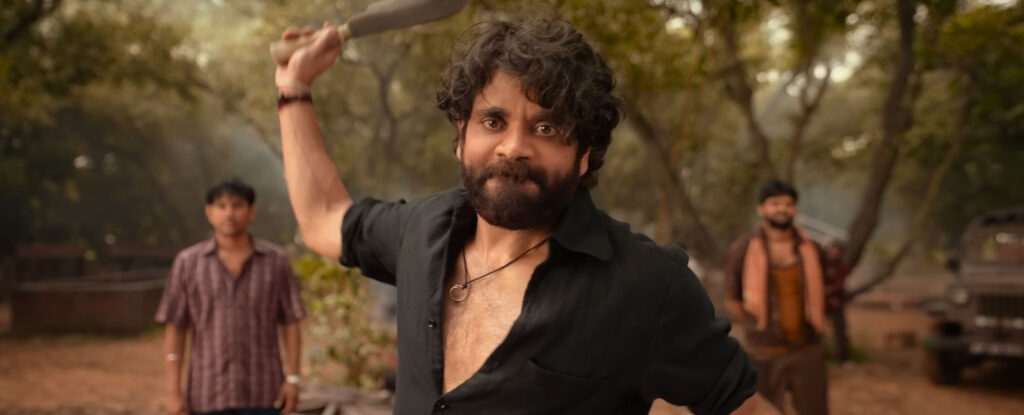
Nagarjuna Akkineni in “Naa Saami Ranga” (Photo courtesy of RKD Studios)

“Naa Saami Ranga”

Directed by Vijay Binni

Telugu with subtitles

Culture Representation: Taking place in an unnamed city in India, in the late 1980s (and briefly in 1963), the action film “Naa Saami Ranga” features an all-Indian cast of characters representing the working-class, middle-class and wealthy.

Culture Clash: An orphan gets adopted by a powerful government family, and when he’s an adult, he becomes involved in the family’s power struggles.

Culture Audience: “Naa Saami Ranga” will appeal primarily to people who are interested in watching formulaic action movies with many unrealistic fight scenes.

Shabeer Kallarakkal and Rao Ramesh in “Naa Saami Ranga” (Photo courtesy of RKD Studios)

“Naa Saami Ranga” has more of the same predictable action-movie story about a hero character who’s caught up in violent feuding, revenge schemes, and a difficult romance. The generic and uninspiring plot becomes incoherent and annoying after a while. The awkwardly placed musical numbers are forgettable and formulaic.

Written and directed by Vijay Binni, “Naa Saami Ranga” is so derivative of many other similar movies, if you’ve seen enough of them, then you’ll know exactly how the movie is gong to end about 15 to 20 minutes after the movie starts. “Naa Saami Ranga” (which means “my goodness gracious” in Hindi) recycles the same old story of an underdog “hero,” who battles against enemies (usually those with more money and more power), while his love life consist mostly of chasing after a woman who seems to be unattainable.

The movie (which place in an unnamed village in India) begins in 1963, when an orphan named Kishtaiah, who’s about 12 to 13 years old, is invited to live with his best friend Anji (who’s about 10 or 11 years old) and Anji’s single mother. Kishtaiah and Anji are raised as brothers. The movie never bothers to explain what happened to Kishtaiah’s parents or anything about his family background.

One day, tragedy strikes when Anji’s mother suddenly dies. No cause of death is given n the movie. At the time of her death, she was heavily in mortgage debt to a wealthy businessman named Varadaraju (played by Rao Ramesh), who demands that Kishtaiah and Anji give the deceased mother’s house to him, in order to pay off the debt.

Instead of leaving these boys poor and orphaned, a powerful local government official named Peddayya (played by Nassar) volunteers to pay off the debt and raise Kishtaiah and Anji alongside his three other pre-teen sons. One of Peddayya’s sons is named Dasu, who shows the most resentment over having two new boys in the household. And you know what that means later in the story.

Kishtaiah meets Varamahalakshmi, nicknamed Varalu, the daughter of Varadaraju. It’s love at first sight, but Kishtaiah is too shy to approach her when he first sees her. He eventually starts talking to Varalu but is afraid to tell her how he really feels about her. Anji gives encourgagement to Kishtaiah, who gets enough confidence to tell Varalu his true feelings.

But on the day that Kishtaiah plans to do that, he sees his adoptive father Peddayya frantically driving a car that is being chased by a gang of about 20 thugs in a remote area. Peddayya is wounded. It just so happens that Kishtaiah has a gun with him, which he takes out an aims at the thugs.

“Naa Saami Ranga” then fast-fowards to 1988. The movie never shows what happened after Kishtaiah took out that gun, but it’s explained later that Kishtaiah shot the thugs and saved Peddayya’s life. In gratitude, Peddayya began to treat Kishtaiah (played by Nagarjuna) as equal to his biological sons. And you just know that this is going to cause major problems between Kishtaiah and Dasu (played by Shabeer Kallarakkal), who wants to be Peddayya’s favorite son.

During this time, Kishtaiah and Anji (played by Allari Naresh) are still best friends. Anji has fallen in love with a woman named Manga (played by Mirnaa Menon), and they get married. Kishtaiah and Anji are so close, Kishtaiah continues to live with Anji even after Anji gets married.

Kishtaiah now acts like a village protector against bullies, with a machete as a weapon of choice. No longer a shy teenager, Kishtaiah (who is a chainsmoker) walks around with a lot of swagger and arrogance. It’s more than enough to attract Varalu (played by Ashika Ranganath), who becomes charmed by Kishtaiah, and they fall in love with each other after she plays “hard to get.”

The relationshp between Kishtaiah and Varalu doesn’t go smoothly. Her father Varadaraju hasn’t forgotten about Kishtaiah’s poverty-striken childhood before Kishtaiah was adopted by Peddayya. Varadaraju doesn’t approve of Varalu dating Kishtaiah for caste reasons and because he thinks Kishtaiah deserves to be with someone who is more refined.

That’s not the only storyline about a father disapproving of a couple. There’s also a subplot about Kishtaiah and Anji befriending a guy named Bhaskar (played by Raj Tarun), who is dating a woman named Kumari (played by Rukshar Dhillon) whom Bhaskar wants to marry. However, Kumari’s father Veerabhadrudu (played by Madhusudan Rao), who is the president of a nearby village named Jagganna Thota, vehemently opposes the idea of Bhaskar marrying Kumari, because Veerabhadrudu doesn’t think Bhaskar is good enough to marry Kumari.

The rest of “Naa Saami Ranga” is about conflicts over these romance problems, which lead to family feuds and a lot of silly-looking fight scenes in a messy story. There is absolutely nothing creatively imaginative about “Naa Saami Ranga.” The acting is mediocre, and the dialogue is simplistic. It will be difficult for many viewers to emotionally connect with the adult Kishtaiah, because he comes across as very shallow and has a nasty temper, even though he is very loyal to his loved ones.

Because there’s a missing 25-year gap in the story, there’s no real explanation for the drastic personality change from the shy teenage Kishtaiah to the combative adult Kishtaiah. It’s implied that when he shot the thugs who were attacking Peddayya, this violent incident changed Kishtaiah. But there’s no real indication in the movie that this theory is true, because this entire movie is poorly written.

The action scenes are sloppy and very unrealistic. For example, in one of the major showdown scenes, a certain person is brutally stabbed, and then gets up and moves around as if that person has no injuries at all. The movie expects viewers to take this idiotic scene seriously. Ultimately, “Naa Saami Ranga” fails to bring suspense or an interesting story, which makes the movie’s 150-minute runtime feel much longer.

RKD Studios released “Naa Saami Ranga” in select U.S. cinemas and in India on January 14, 2024.

Copyright 2017-2026 Culture Mix
CULTURE MIX