
Review: ‘Here’ (2024), starring Tom Hanks and Robin Wright

November 2, 2024

by Carla Hay

Robin Wright and Tom Hanks in “Here” (Photo courtesy of TriStar Pictures)

“Here” (2024)

Directed by Robert Zemeckis

Culture Representation: Taking place in Philadelphia from 1503 to 2022, the dramatic film “Here” (based on the graphic novel of the same name) features a predominantly white cast of characters (with a few Native Americans and African Americans) representing the working-class and middle-class.

Culture Clash: The movie’s story shows what happens on a section of land through various centuries, including the conflicts and challenges of families who lived in a house that was built on the land in 1907.

Culture Audience: “Here” will appeal mainly to people who are fans of the movie’s headliners and don’t mind experimental movies that are dull and disjointed.

Tom Hanks and Robin Wright (center) in “Here” (Photo courtesy of TriStar Pictures)

“Here” is an overinflated bore that should have been a brief visual arts installation instead of a feature-length movie. The story is too fragmented for character development. The visual effects make real people look like video game characters. “Here” has a much-hyped reunion of the director and the two main stars of the Oscar-winning 1994 blockbuster “Forrest Gump” for an entirely different story, but this reunion in “Here” fizzles instead of sizzles. “Here” had its world premiere at the 2024 edition of AFI Fest.

Directed by Robert Zemeckis (who co-wrote the “Here” screenplay with “Forrest Gump” screenwriter Eric Roth), “Here” is adapted from Richard McGuire’s 2014 graphic novel of the same name. “Forrest Gump” co-stars Tom Hanks and Robin Wright, who played a couple with a troubled relationship in “Forrest Gump,” also portray a couple with a troubled relationship in “Here.” The story concept of “Here” is simple, but it’s difficult to make a meaningful movie out of it. That’s because the story structure (which takes place over multiple centuries) is constructed as visual snippets of the lives of people who occupied a particular section of land in what would become the U.S. city of Philadelphia.

“Here” begins with eye-rolling pretentiousness by showing this section of land during an era when dinosaurs roamed the earth. Dinosaurs are seen galloping and charging through this land. During this brief part of “Here,” people might be wondering, “What is this? A dinosaur movie?” A montage then shows changing seasons and how the land evolved over the next centuries.

And then, the movie’s story officially begins in 1503, when an oak tree sapling begins to grow. The movie later shows that the oak tree was cut down in 1899. In 1907, a Cape Cod-styled house was built where the oak tree used to be.

Some people who hear about this movie might have the wrong impression that “Here” only shows the interior of a house’s family living room throughout various decades. That’s only partially true. Although the majority of “Here” consists of the interior living room scenes, the movie has many scenes that take place outdoors, before this house was built in 1907. These pre-1907 outdoor scenes are ultimately unnecessary and distracting.

These pre-1907 scenes take place in the section of land when it was an undeveloped wooded area. In 1609 and 1610, an unnamed man (played by Joel Oulette) and an unnamed woman (played by Dannie McCallum), who are both Native American, become a couple and have a baby. Their “courtship” consists of the man giving the woman a handmade necklace. That is all you will learn about this couple in this dreadfully shallow movie.

The couple is only shown hanging out in this wooded area. You don’t get to see where they live for shelter. You don’t get to see their personalities. You don’t get to see how they raise their child. You don’t get to see anything about their tribe or community. And you don’t even get to see them talk, because the “Here” filmmakers decided that the Native American characters needed to be completely mute in this movie.

Depriving these Native American characters of names and dialogue just reeks of filmmaker condescension, as if just showing these Native Americans in a few short-lived moments is enough to fulfill diversity requirements. It’s an appallingly tone-deaf approach to diversity. And it’s an example of how underrepresented people are often presented as “inferior” or “less than” the demographics who get the most screen time and dialogue in the average Hollywood studio movie.

“Here” also has intermittent scenes taking place in the 1700s to show portions of the life of Benjamin Franklin (played by Keith Bartlett), his wife Elizabeth Franklin (played by Leslie Zemeckis), their son William Franklin (played by Daniel Betts) and William’s son Billy Franklin (played by Alfie Todd). “Here” isn’t a biopic of the Benjamin Franklin family, so these scenes look jarringly out-of-place, especially since “Here” does a lot of non-chronological timeline jumping.

One minute, there could be a scene taking place in the house in the 20th century. The next minute, there could be a scene taking place in the wooded area before the house was built. There are superficial references to the Revolutionary War in the Benjamin Franklin family scenes. You will not be getting any history lessons from watching this movie.

In “Here,” Hanks and Wright portray a longtime married couple named Richard “Ricky” Young and Margaret Young. Most people who want to watch “Here” for the scenes with Hanks and Wright will be disappointed to see that these two stars are only in about half of the movie. The other scenes are for the characters who are in various timelines. Some of these other characters are family members of Richard and Margaret, while most of the other characters do not know the Young family at all.

Here are the characters who live in this house at various times:

Married couple John Harter (played by Gwilym Lee) and Pauline Harter (played by Michelle Dockery) are the house’s first residents in 1907. John really wants the house and persuades a reluctant Pauline that they should buy the house. John is enthusiastic about being a private airplane pilot in his spare time, so he later mortgages the house to buy a small airplane. John’s airplane pilot activities cause tension in the marriage because Pauline thinks it’s a dangerous hobby. Pauline is particularly upset when she finds out that John took their daughter (born in 1911) on the plane with him for a short ride.

Leo Beekman (played by David Fynn) and Stella Beekman (played by Ophelia Lovibond) are a free-spirited, childless married couple who live in the house from 1925 to 1944. The scenes with the Beekmans are competently acted but have no real emotional connection to the rest of the movie. All you will learn about this couple is that they have a fixation on a reclining, swiveling chair that they call a “relaxy boy chair,” and at one point in time Leo took partially nude photos of Stella to make some extra money.

Al Young (played by Paul Bettany) and his pregnant wife Rose Young (played by Kelly Reilly) move into the house in 1945. At the time, Al is 22 years old and a World War II veteran. It’s later shown that Al has undiagnosed post-traumatic stress disorder (PTSD), and he abuses alcohol as a way to cope with his mental illness. Al has a moody personality that becomes volatile when he’s drunk. Rose is a dutiful and passive wife who has to cope with Al’s unpredictable mood swings.

Al, who grew up during the Great Depression, is constantly worried about money, which is why he took a stable job as a corporate salesperson. Their first child Richard, nicknamed Ricky, is born shortly after they move into the house in 1945. Al and Rose eventually have two other children: Elizabeth (born in 1950) and Jimmy (born in 1952). When Richard is about 16 years old, Al loses his job and has a period of unemployment, which causes turmoil in the marriage of Al and Rose.

Various performers depict the children of Al and Rose, at various stages of the children’s lives. The role of underage Richard is portrayed by Ellis Grunsell, Teddy Russell, Finn Guegan and Callum Macreadie. Lauren McQueen has the role of young adult Elizabeth, while Grace Lyra, Jemima Macintyre, Billie Gadsdon and Beau Gadsdon portray Elizabeth as an underage child. Harry Marcus has the role of young adult Jimmy, while Diego Scott, Logan Challis and Albie Salter portray Jimmy as an underage child.

Richard is very artistic and shows from a young age that he has a talent for drawing and painting. He especially likes to make portraits of his loved ones. Richard wants to be a graphic designer, but Al discourages this career and tells Richard that Richard should choose a profession that has more financial stability and requires wearing a suit in an office.

At 18 years old, Richard (played by Hanks) and his 17-year-old girlfriend Margaret (played by Wright) are in love with each other. The first time that Richard brings Margaret to his house to meet his family, she makes a good impression. Rose tells Margaret that Rose regrets giving up a career as a bookkeeper to become a homemaker. Rose advises Margaret to not make the same mistake and to pursue any career path that Margaret wants to have.

One night, when Richard and Margaret are alone in the living room, they have sex on the living room couch. She gets pregnant from this encounter. Richard and Margaret then have a quickie wedding in the living room in April 1964. In case viewers don’t know it’s 1964 in this scene, the movie makes a point of showing that during the wedding ceremony, the TV in the living room is tuned in to the Beatles performing on “The Ed Sullivan Show.”

In September 1964, Richard and Margaret’s first and only child Vanessa is born. Richard puts aside his dream to become a graphic designer and takes a job as a life insurance salesman to support his family, as they continue to live in this house that is owned by Al and Rose. Vanessa as a child is portrayed by Albie Mander, Eloise Ferreira, Eliza Daley, Elodie Crapper and Faith Delaney. Vanessa as a young adult is portrayed by Zsa Zsa Zemeckis.

Richard and Margaret are loving and devoted parents to Vanessa, but trouble is brewing in the marriage, beginning in the marriage’s early years. Richard keeps postponing plans for him and Margaret to get their own home because he says they can’t afford it. Margaret, who is a homemaker, offers to get a part-time job to help with the expenses, but Richard wants to be the only income earner for their family. Adding to the marital strain, someone in the Young family has a major health crisis in 1979.

While all of these issues are going on in the Young family, “Here” abruptly cuts in and out to scenes that happen before and after the Young family members are living in that house. It’s later revealed that someone in the Young family sold the house in 2005, but Richard and Margaret go back to visit the house in 2022, when the house is up for sale again. This visit is not spoiler information because it’s in the trailer for “Here.”

In 2015, a family of three move into the house: Devon Harris (played by Nicholas Pinnock); his wife Helen Harris (played by Nikki Amuka-Bird); and their teenage son Justin Harris (played by Cache Vanderpuye), who is a high school student. The Harris family has a housekeeper named Raquel (played by Anya Marco-Harris), who gets COVID-19 in November 2020. Don’t expect to learn much more about this family.

Just like in the scenes with the Native Americans, “Here” clumsily handles the scenes with characters who aren’t white. The Harris family scenes have a racially condescending tone to them because the most memorable scenes with the Harris family have to do with pointing out that this family is African American. When the Harris family first moves into the house, Devon comments on how this house probably used to be owned years ago by people who never thought a black family would live there. Later, “Here” has a scene where Justin gets a family talk about how to deal with racist police officers.

“Here” is so enamored with its concept of “scenes (mostly) from a living room,” this ultimately flat and listless movie fails to explore deeper issues and refuses to answer inevitable questions. One of the biggest unanswered questions is: Why is married Richard so stubborn about living with his parents when he knows it makes his wife unhappy?

Richard took a job as a life insurance salesperson so that he could support his family, but obviously the job doesn’t pay enough for him to feel financially independent. It’s not as if Richard and Margaret have several children to financially support. They only have one child. This isn’t a situation where Richard and Margaret stayed in his parents’ house for a few years after their marriage. They stayed for several years.

After a while, it just doesn’t ring true that Richard (who lives rent-free in his parents’ house) isn’t making enough money to save for a down payment and mortgage on a small house for his family of three. Richard doesn’t have any addiction or spending problems that would explain why he keeps using the excuse that he can’t afford to buy a home of his own. By having Richard and Margaret “stuck” in the house for more years than what Margaret wants, it looks like a very contrived reason for the couple’s marital strife.

And speaking of things that look phony, the de-aging visual effects in “Here” are not entirely convincing, especially in scenes with Hanks, Wright and Bettany portraying characters who are supposed to be younger than 25. The faces don’t look natural. And neither do many of the body movements.

The best aspects of “Here” have to do with the movie’s production design, which looks meticulously accurate for each era that is depicted. There are some scenes where the background of the living room is clearly not real but is the creation of computer-generated imagery (CGI), making it obvious that “Here” blurs the lines between real production design and CGI design. The movie’s costume design is quite notable. However, production design and costume design are not enough to make a good movie.

“Here” undoubtedly has a very talented cast, but they are restricted by having characters with personalities that lack depth and have scenes that are cut too short and edited in an off-putting way. If “Here” had omitted everything that happened before the house was built and just focused on the two most interesting families who lived in the house, then “Here” might have been a meaningful film. As it stands, “Here” is a fairly ambitious experiment that is a failed experiment because of muddled storytelling that is in service of soulless visual effects.

TriStar Pictures released “Here” in U.S. cinemas on November 1, 2024.

Review: ‘Timmy Failure: Mistakes Were Made,’ starring Winslow Fegley, Ophelia Lovibond, Kyle Bornheimer, Wallace Shawn and Craig Robinson

February 7, 2020

by Carla Hay

Winslow Fegley in "Timmy Failure: Mistakes Were Made"
Winslow Fegley in “Timmy Failure: Mistakes Were Made” (Photo by Dale Robinette/Disney+)

“Timmy Failure: Mistakes Were Made”

Directed by Tom McCarthy

Culture Representation: In this comedy based on the children’s book of a similar title, the racially diverse characters are primarily middle-class in Portland, Oregon.

Culture Clash: The story’s protagonist is a grim pre-teen boy who aspires to be a private detective, but he dislikes school, authority figures and almost everyone around him.

Culture Audience: This movie will appeal mostly to children and other people who want to see a series of antics on screen instead of a compelling and coherent story.
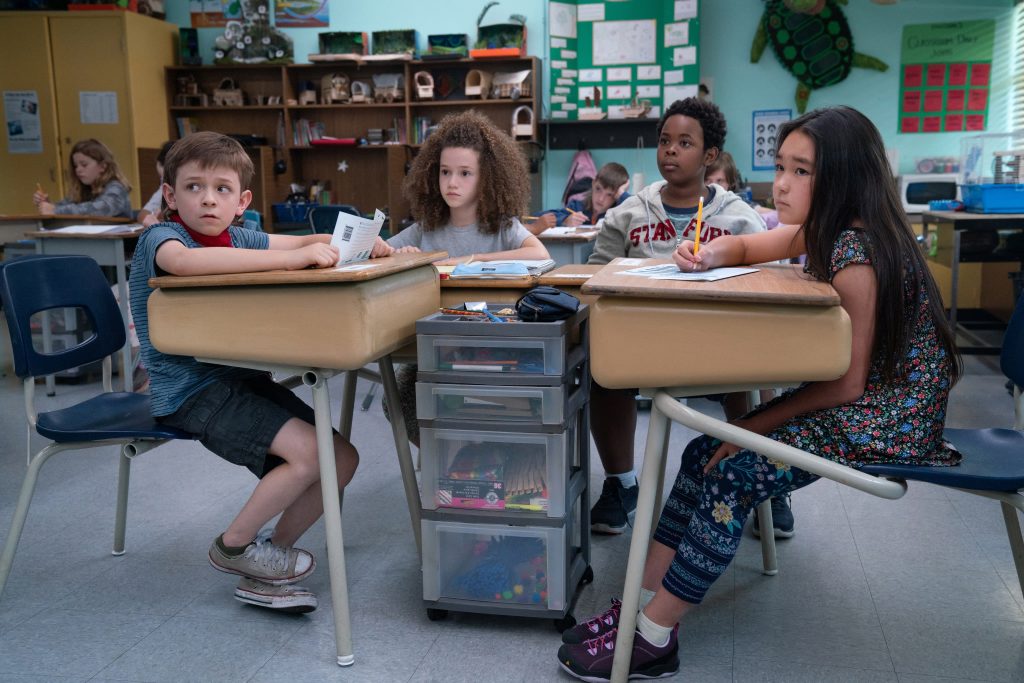
Winslow Fegley, Chloe Coleman, Kei and Ai-Chan Carrier in "Timmy Failure: Mistakes Were Made"
Winslow Fegley, Chloe Coleman, Kei and Ai-Chan Carrier in “Timmy Failure: Mistakes Were Made” (Photo by Dale Robinette/Disney+)

If you’re tired of children’s entertainment that has a sweet-natured and upbeat protagonist, then “Timmy Failure: Mistakes Were Made,” which is about a pessimistic child who’s a wannabe detective, might be up your alley. However, this comedy film’s flawed and scattered story will test the patience of anyone looking for a realistic and cohesive plot.

The “Timmy Failure” book series (written by Stephan Pastis) began in 2013 with “Timmy Failure: Look What Mistakes Were Made,” so this Disney+ movie adaptation might become a movie series too. If so, the “Timmy Failure” movie series is off to a very questionable start, but there’s a lot of room to improve. “Timmy Failure: Mistakes Were Made” was directed by Oscar-winning “Spotlight” screenwriter Tom McCarthy, who co-wrote the “Timmy Failure: Mistakes Were Made” screenplay with Pastis. “Timmy Failure: Mistakes Were Made” is perfect for a streaming service such as Disney+, since it’s doubtful that people would be willing to pay full ticket prices to see a movie about such an unlikable kid.

Timmy Failure is a fifth grader (about 10 or 11 years old) who lives in Portland, Oregon, and is—to put it nicely—very eccentric. He’s an antisocial loner who never smiles, and he has an extreme (and warped) sense of superiority about his intelligence. (He’s not as smart as he thinks he is.) He’s the kind of deliberately negative character who’s much more amusing to watch than to be around in real life. Timmy does a lot of deadpan narration in this film, and he says in the beginning of the story: “I am only concerned with one thing: greatness.”

But in reality, Timmy’s life isn’t so great. He’s barely getting by in school, because he’d prefer to start his own detective agency instead of studying and doing his homework. He has such a disdain for school that he doodles and sketches on test forms instead of filling out the tests with real answers. He also doesn’t think much of other people—his favorite word to describe most people is “problematic”—and his single-minded focus on becoming a private investigator includes a condescending attitude toward police.

Timmy also has a strange prejudice against Russians, whom he automatically suspects of being the perpetrators of any real or perceived crimes that he starts to investigate. His hatred of Russians (he calls them “evil”) seems out of place in a children’s story. Because Tommy’s animosity toward Russians is never explained and certainly never justified, this type of bigotry ultimately isn’t necessary. Imagine if he spouted that kind of hatred toward females or people of a different race. It wouldn’t make it past the editing process of this story.

Timmy’s parents split up years ago, so his bohemian single mother Patty Failure (played by Ophelia Lovibond) isn’t as attentive as she could be, because she’s overwhelmed with working to pay their bills. Timmy’s only “friend” is a 1,500-pound polar bear named Total, who showed up at Timmy’s house one day after the bear was forced out of its home due to global warming. It’s implied in the movie that Total is a figment of Timmy’s imagination, because the bear is seen walking around town, riding in automobiles and going to places where no wild animal of that size would be allowed, and yet people act like it’s perfectly normal.

In his cluttered and messy home, Timmy has set up his one-person “detective agency.” Another sign of his eccentricity is his unwillingness to use 21st-century or computerized resources in his work. His business cards are hand-written. He doesn’t seem to use the Internet. And to record interviews, he uses an old audiocassette recorder that’s held together by tape.

Another one of Timmy’s quirks his that he likes to wear a red scarf as often as possible. He also has this response whenever someone gets angry at something he did: “Normal is for normal people.” And whenever something disastrous happens because of one of his inevitable bad decisions, he says, “Mistakes were made.”

According to Timmy, the polar bear Total is supposed to be a partner in the detective agency, but the polar bear doesn’t do much in this movie except wander around town by itself and show up at infrequent, random moments when Timmy is around. Timmy transports himself by a Segway that his mother won in a church raffle. So, when the Segway (which he calls the Failure Mobile) gets stolen, he makes it his mission to find it and hold the thief responsible.

But before that happens, there are several side “investigations” that Timmy starts and then leaves hanging. He offers to find a fellow student’s lost backpack, but then never follows through on that promise. He’s tasked with the responsibility of taking care of his science class’ pet hamster in his home when it’s his turn to do so. But when he goes to pick up the hamster at the home of a fellow student, the hamster is dead, so Timmy says he’s going to launch a “homicide investigation” to find out who “murdered” the animal. (It never occurs to him that the hamster could have died of natural causes.) These subplots are really distractions and only serve the purpose of showing how annoying Timmy can be.

Timmy attends Cavarette Elementary School, where the classmate who can tolerate him the most is Charles “Rollo” Tookus (played by Kei), whom Timmy treats more as a sidekick than a real friend. Rollo and Timmy have an up-and-down relationship, since Timmy only seems to want to be around Rollo when he needs Rollo to help him with “detective work.” They’ve been estranged in the past: Timmy says in a voiceover narration that he had to “fire” Rollo as his business associate, but Rollo says he actually quit. As much as Timmy distrusts authority and breaks rules, Rollo (who has ambitions to go to Stanford University) likes to follow rules and respect authority.

Two other classmates who are in Timmy’s orbit are smart and likable Molly Moskins (played by Chloe Coleman) and rich girl Corrina Corrina (played by Ai-Chan Carrier). For reasons that aren’t explained in the movie, Timmy really dislikes Corrina to the point where he calls her the “most problematic” person he knows. He says that she and her family are Russian, even though there’s no proof that they are. And he refuses to call her by her name. He only refers to her as “The Nameless One.”

Is she some pre-teen female version of “Harry Potter” villain Voldemort? No. She’s actually very nice to Timmy and other people, but it’s implied that Timmy dislikes and fears her so much because he might have a secret crush on her and he thinks she’s out of his league. Timmy’s negativity about Corrina is so irrational that he thinks the Segway might be hidden in the bank that her father owns. So, Timmy and Rollo go “undercover” to the bank to investigate (their idea of “undercover” is  wearing hockey masks), and some slapstick silliness ensues.

During the course of the movie, Timmy’s mother Patty begins dating a “regular Joe” type of guy named Crispin (played by Kyle Bornheimer), who works as a parking enforcement officer. He’s so self-deprecating about his job that he even calls himself a “meter maid.” It’s a joke that’s made repeatedly in the movie until it starts to wear very thin. Not surprisingly, Timmy doesn’t respect or trust Crispin, even though Crispin tries to establish a rapport with him.

Timmy’s assigned school counselor Mr. Jenkins (played by Craig Robinson) also tries to form a friendly and caring bond with Timmy, but Timmy brushes off attempts by any adults (except his mother) to get close to him. She’s really the only adult he’s willing to obey—and that moment comes when a series of mishaps caused by Timmy result in her finally getting fed up with him and grounding him.

Meanwhile, there’s someone whom Timmy considers a true enemy: Mr. Crocus (played by Wallace Shawn), Timmy’s no-nonsense authoritarian science teacher, who’s been an educator for 43 years and who openly dislikes Timmy.  (The feeling is very mutual.) In a meeting with Timmy’s mother, Mr. Crocus tells her that he’s close to flunking Timmy if Timmy doesn’t drastically improve. Mr. Crocus mentions that Timmy and his mother have been given plenty of warnings, and this will be their last chance. If Timmy fails to pass Mr. Crocus’ class, then Timmy won’t graduate to middle school.

One of the best aspects of “Timmy Failure: Mistakes Were Made” is when the movie shows glimpses of fantasy sequences that are in his imagination. When middle school is first mentioned in the story, the scene flashes to Timmy’s imagination of kids being marched into a truck titled “Our Crusher of Souls.” When Timmy’s mother Patty mentions how great it would be to live in New York City, the scene cuts to a theater stage showing Timmy’s detective agency as the inspiration of an elaborate Broadway musical, complete with Total descending on the stage in a prop shaped like a half-moon. Another fantasy shows Total causing havoc in Crispin’s office at the police station, while Crispin lets out a horrified scream. But those refreshingly amusing fantasy sequences can’t quite make up for the trite and unfocused aspects of the story.

“Timmy Failure: Mistakes Were Made” will be enjoyed best by people (mostly children) who just want to see a weird kid get into all kinds of trouble on screen. Fans of mystery/detective stories will be disappointed because crime-solving is not the real attraction. The real purpose of the Timmy Failure character is to show how someone who thinks very highly of himself is in reality very inept and clueless—and that will make viewers feel better about themselves. Timmy Failure is basically an American kid version of Inspector Clouseau of “The Pink Panther” series, but with a lot less clever writing.

Disney+ premiered “Timmy Failure: Mistakes Were Made” on February 7, 2020.

Copyright 2017-2025 Culture Mix
CULTURE MIX