
Review: ‘The Last Supper’ (2025), starring James Oliver Wheatley, Jamie Ward, Charlie MacGechan, Nathalie Rapti Gomez, Robert Knepper and James Faulkner

March 14, 2025

by Carla Hay

Jamie Ward in “The Last Supper” (Photo courtesy of Pinnacle Peak Pictures)

“The Last Supper” (2025)

Directed by Mauro Borrelli

Culture Representation: Taking place in the years 32 and 33 A.D., in Judaea (later known as Israel), the dramatic film “The Last Supper” features a predominantly white group of people (with a few Middle Eastern people) depicting the Christian story of Jesus Christ and his last days before he was crucified.

Culture Clash: Jesus Christ was betrayed by his apostle Judas Iscariot and crucified by Romans for saying that he was the Son of God.

Culture Audience: “The Last Supper” will appeal primarily to people who are interested in watching faith-based movies that are depictions of stories in the Christian Bible.

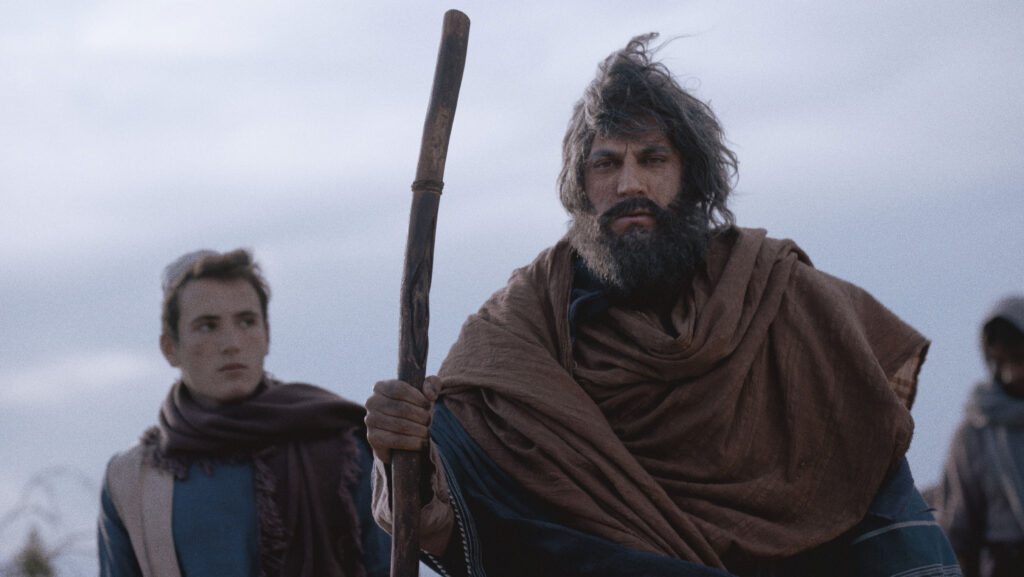
James Oliver Wheatley, Charlie MacGechan and Jamie Ward in “The Last Supper” (Photo courtesy of Pinnacle Peak Pictures)

“The Last Supper” has some pacing issues, but the movie gives an adequately entertaining interpretation of this well-known Christian story. The movie’s performances are credible and not as cringeworthy as those in other low-budget faith-based movies. This film knows its target audience and does not deviate too far from the source material of the Christian Bible.

Directed by Mauro Borrelli (who co-wrote “The Last Supper” screenplay with John Collins), “The Last Supper” could have done the predictable narrative by having the story told from the perspective of Jesus Christ. Instead, the story is told from the perspective of Peter, one of Jesus’ apostles. Peter is the narrator of the movie, which delves a little more into the motives of Judas Iscariot, the apostle who betrayed Jesus.

“The Last Supper” (which takes place in Judea, later known as Israel) begins in the year 32 A.D., near the Sea of Galilee, to show the Loaves and Fishes miracle, also known as the Feeding of the 5,000. In this scene a starving crowd of about 5,000 people have gathered near the sea to greet Jesus, who has a reputation as a miracle worker. Jesus (played by Jamie Ward) is able to turn five loaves of bread and two fish into enough fish and loaves of bread to feed the crowd and still have some left over. Jesus also performs another miracle by giving the ability to see to a blind boy.

Local leaders offer Jesus a chance to be “king among men.” Jesus turns down the offer by saying, “My kingdom is not of this world.” Judas (played by Robert Knepper), who is overly ambitious and craves power, is dismayed that Jesus has turned down this offer. Judas does not understand Jesus’ humility. By contrast, Peter (played by James Oliver Wheatley) is in constant awe and admiration of Jesus.

One year later, in 33 A.D., the Cleansing of the Temple happens, when Jesus is at the main temple in Jerusalem and gets angry when he sees that merchants have taken over the temple courtyard. Jesus thinks it’s disrespectful and sinful for people to buy and sell things in a sacred place of worship. He overturns the merchant tables and yells at the merchants: “My house is a house of prayer! And you have turned it into a den of thieves!”

As far as the merchants are concerned, this is vandalism by self-righteous hoodlum who thinks he’s the Messiah. Jesus has now made several enemies in Judea. Caiaphas (played by James Faulkner) is the High Priest of Israel and becomes the chief schemer to murder Jesus. Caiaphas attempts to bribe Judas to help with this assassination plot, but Judas refuses. Caiaphas keeps the offer open in case Judas changes his mind.

Throughout the movie, Judas is shown as being conflicted over whether or not to betray Jesus. This conflict is depicted as Satan (played by Ahmed Hammoud) appearing to Judas as a demon and as a snake while saying tempting words to Judas. These scenes are like something out of a fairly mild horror movie. They aren’t gory scenes, but they might be a little too intense for viewers under the age of 8.

“The Last Supper” also depicts the ongoing tensions between Jews and Romans during this time period. At the time that Jesus is alive, the Romans had control of Judea. The Romans would ultimately decide Jesus’ fate when he was arrested for claiming to be the Messiah.

The movie’s namesake scene of a fateful Passover dinner is a highlight of the movie. Jesus washes the feet of apostle John (played by Charlie MacGechan) as a sign of humility, in one of the more memorable scenes in the film. The movie does not show the crucifixion, but it has some scenes of Jesus being whipped. This violence is not too explicit, but it might be disturbing to some viewers.

One of the things that the movie could have done better is give personalities to the apostles who aren’t Peter, Judas and John. Peter is loyal but he has his flaws, and his loyalty will be test. Judas is brooding and morally conflicted. John is a fun-loving good guy.

The rest of Jesus’ 12 apostles are blank slates when it comes to their personalities in the movie. Andrew (played by Fredrik Wagner), James (played by Ottavio Taddei), Philip (played by Vincenzo Galluzzo), Bartholomew (played by Abdeslam Bouhssini), Thomas (played by Billy Rayner), Matthew (played by Youssef Ben Hayoun), James the Lesser (played by Youssef Tounzi), Thaddaeus (played by Yassin Aamir) and Simon the Zealot (played by Harry Anton) don’t say much in the movie, compared to Peter, Judas and John.

Jesus’ mother Mary (played by Mayssae El Halla) and Mary Magdalene (played by Nathalie Rapti Gomez), the reformed sex worker who becomes part of Jesus’ entourage, are also underdeveloped characters. All of the villains except for ruthless Caiaphas have vague or non-existent personalities. Pontius Pilate, the Roman official who presided over the trial of Jesus, is not in this movie.

Some of “The Last Supper” is dragged down by slow pacing. However, the performances—particularly Wheatley as Peter and Knepper as Judas—stand out as realistically human. Ward’s depiction of Jesus is satisfactory and very empathic. During scenes where Jesus gets tearfully emotional, people in the audience might feel the same way.

The cinematography, musical score and costume design for “The Last Supper” are admirable, considering the movie’s budget is lower than most cinematic versions of Biblical stories. Is this version of “The Last Supper” outstanding? No. But it’s not terrible either. It’s a solid option for anyone who is inclined to see this type of movie and doesn’t want to see disturbing scenes about Jesus’ crucifixion.

Pinnacle Peak Pictures released “The Last Supper” in select U.S. cinemas on March 14, 2025.

Review: ‘His Only Son,’ starring Nicolas Mouawad, Sara Seyed, Edaan Moskowitz, Ottavio Taddei and Nicolai Perez

April 7, 2023

by Carla Hay
Edaan Moskowitz and Nicolas Mouawad in “His Only Son” (Photo courtesy of Angel Studios)

“His Only Son”

Directed by David Helling

Culture Representation: Taking place in ancient Canaan and Moriah, the dramatic film “His Only Son” features a white, Middle Eastern and Egyptian cast of characters representing the working-class and middle-class from Judeo-Christian teachings.

Culture Clash: Religious prophet Abraham travels to Moriah after he gets a command from God to prove his loyalty by sacrificing the life of Abraham’s son Isaac. 

Culture Audience: “His Only Son” will appeal primarily to people who are interested in faith-based movies that are dramatic movie versions of religious teachings.

Nicolas Mouawad and Edaan Moskowitz in “His Only Son” (Photo courtesy of Angel Studios)

“His Only Son” is a worthy, low-budget drama about religious figure Abraham, when he was called by God to make his greatest sacrifice: the life of his son. The depiction of Abraham’s troubled marriage gives this reverent movie some grit. “His Only Son” is a mixed bag, with some acting performances and technical aspects that are better than other acting performances and technical aspects in the movie. However, viewers who are inclined to watch faith-based films will probably find a lot to like about this earnest movie.

Written and directed by David Helling, “His Only Son” is truly a passion project, since Helling decided to become a filmmaker so he could make this movie and other movies about religious figures from the Christian Bible. Helling has said the production budget for “His Only Son” was only $250,000. That low budget can be seen in the movie’s hairstyling (wigs and fake beards that look cheap) and the small number of locations and cast members in the film. However, the movie’s cinematography is often striking, visually creative, and on par with movies that have production costs that are 100 times higher than what it cost to make “His Only Son.”

People who already know the story of Abraham’s journey from his land of Canaan (where he is the leader) to Moriah to sacrifice his son Isaac won’t find any surprises in “His Only Son,” regarding the outcome of this journey. The movie also has faithful depictions of the Judeo-Christian teachings of Abraham frequently having visions where he communicates with God and gets commands and prophecies from God. What might surprise people is how the movie portrays how all of these visions took a serious toll on Abraham’s marriage.

“His Only Son” frequently shows flashbacks of Abraham’s life while Abraham (played by Nicolas Mouawad) goes on the journey to Moriah with Isaac and two other young men from Canaan: loyal Kelzar (played by Ottavio Taddei) and skeptical Eshcolam (played by Nicolai Perez, also know as Reji Lukai). Kelzar is son of Abraham’s chief servant Eliezer (played by Luis Fernandez-Gil), who offered Kelzar to be a part of this travel group.

The trip to Moriah takes three days by walking. “His Only Son” has a subplot about this group facing a moral dilemma concerning a severely wounded man (played by Matthew Dorio) and his kidnapped young adult daughter (played by Alexandria Lior), who have been attacked by four marauders (played by Kevin Kapellas, Steve Judkins, Nathan Tetreault and Mario Dagget). “His Only Son” doesn’t make too much of a detour in this subplot, but it seems like it was put in the movie to fill up time and so the story would have some action-oriented suspense.

The flashbacks to Abraham’s life go as far as back 40 years before he took this journey to Moriah. Abraham has been having visions of God (played by Daniel da Silva), who promised Abraham that he would rule over Canaan and pass on this legacy to his children. The problem is that Abraham’s wife Sarah (played Sara Seyed) has spent several years of their marriage trying to get pregnant, to no avail. Canaan’s barren land has made the couple’s financial future very insecure. And so, at Sarah’s urging, Abraham and Sarah move to Egypt for more fruitful land.

As the years go by and Sarah still appears to be infertile, she becomes tired of Abraham telling her to be patient. Abraham repeatedly reminds Sarah that God told Abraham that Abraham would have a son. Sarah begins to panic when she approaches the age range when most women are menopausal. She thinks the prophecy that Abraham will have a son is God’s way of saying that Abraham will have a child with another woman, so she offers her maid Hagar (played by Eta Pico) to be Abraham’s other “wife.”

Sarah regrets the decision after Hagar gets pregnant. Sarah is angry and ashamed, because she thinks that she has lost respect from Hagar and others in the community who know about this arrangement. Sarah verbally lashes out at Abraham for accepting Sarah’s insistent offer to get another woman pregnant so that Abraham can have an heir. Abraham isn’t wrong when he reminds Sarah that it was all her idea for him to impregnant Hagar, because Sarah lost faith that Sarah would get pregnant.

It’s not spoiler information to say that Sarah gets pregnant and gives birth to Isaac. It’s necessary to mention that information in this review because “His Only Son” mishandles the subplot about Hagar getting pregnant. Hagar and her pregnancy are not seen or mentioned in the movie again after Sarah gives birth to Isaac. It’s a plot hole that ignores the religious teaching that Hagar gave birth to Abraham’s first son Ishmael, who lived to a very old age. Therefore, it’s not entirely accurate to name this movie “His Only Son.”

As the Abraham character, Mouawad gives a solid performance in portraying someone with strong faith that still gets tested. Seyed’s depiction of Sarah can get a tad too melodramatic, but she’s a scene stealer who grounds the movie in the realism that it would not be easy to be married to a prophet who claims to have a direct line of communication with God. It’s also refreshing that “His Only Son” does not portray all of the women in the film as passive or subservient to men (as many Bible-oriented movies tend to do), since Sarah has a very strong-willed and opionionated personality. The rest of the cast members are serviceable in their roles.

“His Only Son” occasionally plods along at a dull pace. And some of the dialogue is terribly simplistic. However, the main characters are compelling, and the movie does a very good job of showing people’s different perspectives of what it means to have “faith in God.” Helling also admirably didn’t try to make these characters sound British or American (another historical inaccuracy that many Bible-based movies have) and instead had the characters in “His Only Son” talk with historically accurate Hebrew or Egyptian accents. It’s a movie that certainly makes the most out of its low budget and delivers a capable story about one of the most lauded religious figures of all time.

Angel Studios released “His Only Son” in U.S. cinemas on March 31, 2023.

https://www.youtube.com/watch?v=35SO8kOW7Ro
Copyright 2017-2026 Culture Mix
CULTURE MIX