
October 14, 2022
by Carla Hay
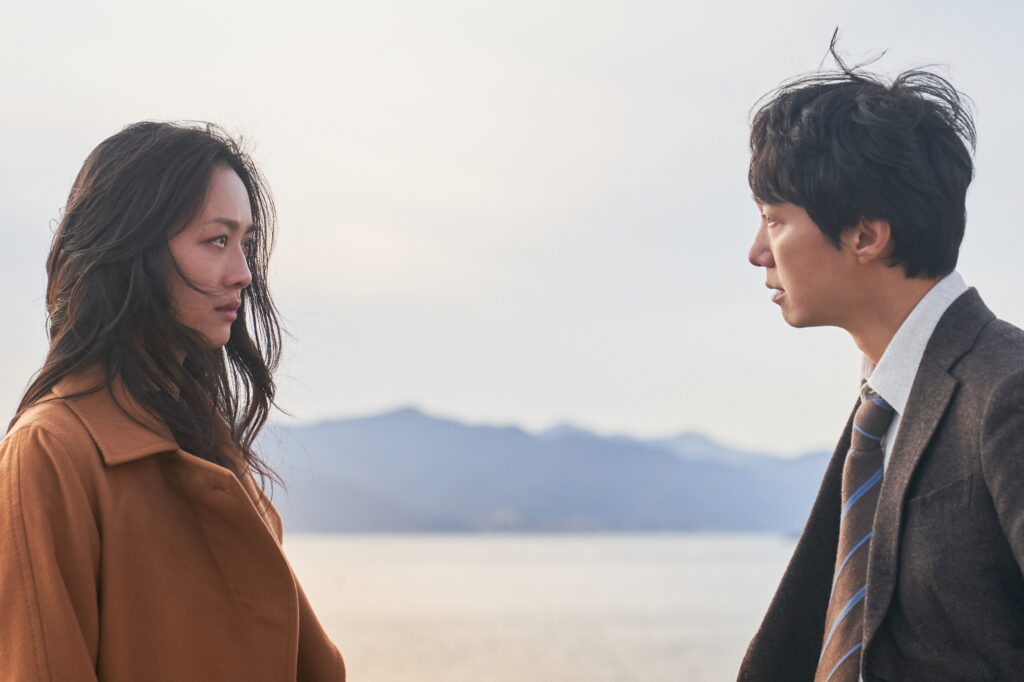
Directed by Park Chan-wook
Korean and Chinese with subtitles
Culture Representation: Taking place in 2020 and 2021 in the South Korean cities of Busan and Ipo, the dramatic film “Decision to Leave” features an all-Asian cast of characters representing the working-class, middle-class and wealthy.
Culture Clash: A police detective becomes emotionally involved with a widow whom he investigates in the suspicious death of her wealthy husband.
Culture Audience: “Decision to Leave” will appeal primarily to people who are fans of filmmaker Park Chan-wook and well-made psychological dramas that keep viewers guessing about what will happen in the story.
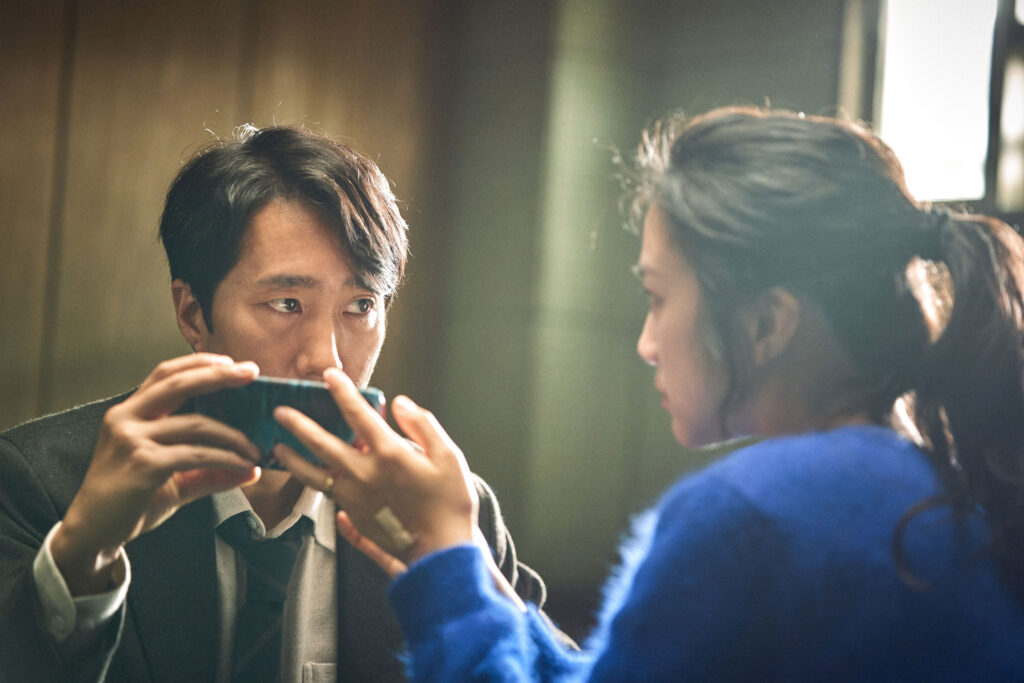
“Decision to Leave” plays with any viewer’s preconceived notions on how the story is going to end. The pacing sometimes becomes too slow, but this well-made movie skillfully blends noir, romance and mystery with talented acting. It’s a cinematic rollercoaster ride that offers food for thought about how people handle power, wealth, loyalty and love on individual levels and in society at large.
Directed by Park Chan-wook (who co-wrote the “Decision to Leave” screenplay with Jeong Seo-kyeong), “Decision to Leave” is does not take sex and violence to explicit levels in ways that can be seen in two of Park’s most well-known previous psychological thriller films: 2003’s “Oldboy” and 2016’s “The Handmaiden.” Much of what is going on with the “Decision to Leave” characters isn’t “in your face” obvious, but rather is lurking underneath the surface and can be intelligently observed through facial expressions, body language and unspoken thoughts that are later revealed in certain characters’ actions. It’s why the movie’s principal cast members deserve a lot of credit for bringing complexities to these characters that look authentic.
With a total running time of 138 minutes, “Decision to Leave” is the type of movie that requires patience and perhaps more than one viewing in order to fully appreciate many of the subtleties in this drama. “Decision to Leave” had its world premiere at the 2022 Cannes Film Festival in France, where the Park won the prize for Best Director. The movie has since made the rounds at several other film festivals, including the Toronto International Film Festival; Fantastic Fest in Austin, Texas; and the New York Film Festival in New York City. “Decision to Leave” is South Korea’s selection to be a contender for Best International Feature at the 2023 Academy Awards.
“Decision to Leave” begins iin 2020, in Busan, South Korea, where a police detective in his 40s named Hae-jun (played by Park Hae-il) is shown at work asking for a transfer to the smaller city of Ipo. Viewers later find out that Hae-jun has made this request mostly because his wife Jung-an (played by Lee Jung-hyun) thinks being a big-city cop has taken a toll on their 16-year marriage.
Jung-an wants to Hae-jun to work in a smaller city, where she thinks his work will be less stressful. She tells him half-jokingly that “55% of all sexless marriages end in divorce. It’s the first indication that the sex life of Hae-jun and Jung-an has dwindled. Later, this apathy is shown when she tries to be sexually intimate with Jung-an, and he shows a lack of interest. Jung-an feels insulted by this rejection, but she also seems to not be surprised by it.
What becomes obvious after a while is that Hae-jun is a workaholic, so moving to a smaller city won’t automatically end his addiction to police work, nor will it automatically fix the problems in his marriage. Before his transfer officially takes place, Hae-jun and some of his colleagues are called to the scene of a mysterious death. The deceased body of man in his 50s named Ki Do-soo (played by Yoo Seung-mok) has been found at the bottom of the cliff. Was this death caused by suicide, murder or an accident?
Investigators find out that Ki Do-soo was a part-time interviewer at a South Korean immigration office, but he was also wealthy. His widow is a Chinese immigrant named Seo-rai (played by Tang Wei), who doesn’t seem shocked when the police arrive at her home to tell her that her husband is dead and to interview her. In real life, Tang is much older than the Seo-rai character whom she portrays in the movie. Seo-rai is supposed to be in her 30s and is presented as a “trophy wife.”
Hae-jun (who is leading the investigation) is both puzzled and intrigued by Seo-rai’s calm, cool and collected demeanor during the police interviews. Hae-yun’s younger hothead cop partner Soo-wan (played by Go Kyung-pyo) immediately believes the theory that Ki Do-soo was murdered, and he zeroes in on Seo-rai as the prime suspect. Hae-jun doesn’t want to jump to any conclusions until he gets all the facts and evidence that he can.
Seo-rai, who is a hospital nurse, tells the investigators that she had nothing to do with Ki Do-soo’s death. She says she doesn’t speak Korean very well, but viewers later see that doesn’t mean Seo-rai isn’t highly intelligent and manipulative. She reveals to investigators that not only did her husband Ki Do-soo physically abused her and that she also had self-inflicted injuries. Seo-rai has recent bruises and medical records to prove it, as well as photos of past injuries that she said were made by herself and Ki So-Doo.
Seo-rai also tells the investigators that she and her husband argued because she didn’t like him to take these mountain hiking trips because she thought they were too dangerous. They also argued about her self-harming activities and would get into physical fights over it. (Their volatile marriage is shown in some flashbacks.)
Seo-rai is told by the cops that another person’s DNA was found underneath Ki Do-soo’s fingernails. And so, Seo-rai explains that if her DNA is found underneath his fingernails, it was probably because of one of the physical fights that they had before he went on the hiking trip that resulted in his death. Throughout much of “Decision to Leave,” viewers are kept wondering if Seo-rai is really a victim, a villain or both.
More suspicion falls on Seo-rai when the investigators find out that she is the only heir to her dead husband’s fortune. Until the cause of death can be determined, Seo-rai because the most likely person of interest if the medical examiner rules that Ki Do-soo’s death was by murder. In the meantime, Hae-jun decides to put Seo-rai under surveillance, and he’s the main person doing the stakeouts outside of her house.
As time goes on, Hae-jun becomes more obsessed with Seo-rai, who sensed from ther first meeting that he was romantically attracted to her. And Seo-rai, who seems to be starved for compassion, seems to be feeling the same way. Meanwhile, Hae-jun’s wife Jung-an become increasingly agitated that he’s spending so much time working on this case. Hae-jun won’t tell Jung-an many details about the case, but she begins to suspect that Hae-jung is having an affair.
Seo-rai has seemed to stirred up some long-dormant feelings of romance in Hae-jun, who goes to great lengths to show her that he is a gentleman and doesn’t want to betray the ethics of his job and his marriage. Another change has come over Hae-jun as he gets to know Seo-rai better: Before Hae-hun met Seo-rai, he seemed to be an incurable insomniac. After he met her, he began to sleep better.
What happens in the rest of “Decision to Leave” revolves around how Seo-rai and Hae-jun affect each other, as the story continues into 2021. It’s enough to say that even after Hae-jun transfers to Ipo, Seo-rai is still a part of his life. And his experiences with Seo-rai in Ipo cause even more confusion and angst.
“Decision to Leave” is a very stylish film to look at, thanks to stellar cinematography from Kim Ji-yong. The movie, which uses water in some pivotal scenes, is often awash in various shades of blue. Depending on the scene, these blue palettes contribute to feelings of melancholy or hope.
Even with a possible romance brewing between Seo-rai and Hae-jun, “Decision to Leave” never lets viewers forget that this relationship could be dangerous for either or both Seo-rai and Hae-jun. Whose motives are really pure and genuine? Through the immersive storytelling in “Decision to Leave,” that question hovers throughout as a reminder to viewers that in this movie, just like in real life, not everything is what it might first appear to be, and people can be taken to unexpected places.
MUBI released “Decision to Leave” in select U.S. cinemas on October 14, 2022. The movie was released in South Korea and France on June 29, 2022.