
February 2, 2024
by Carla Hay
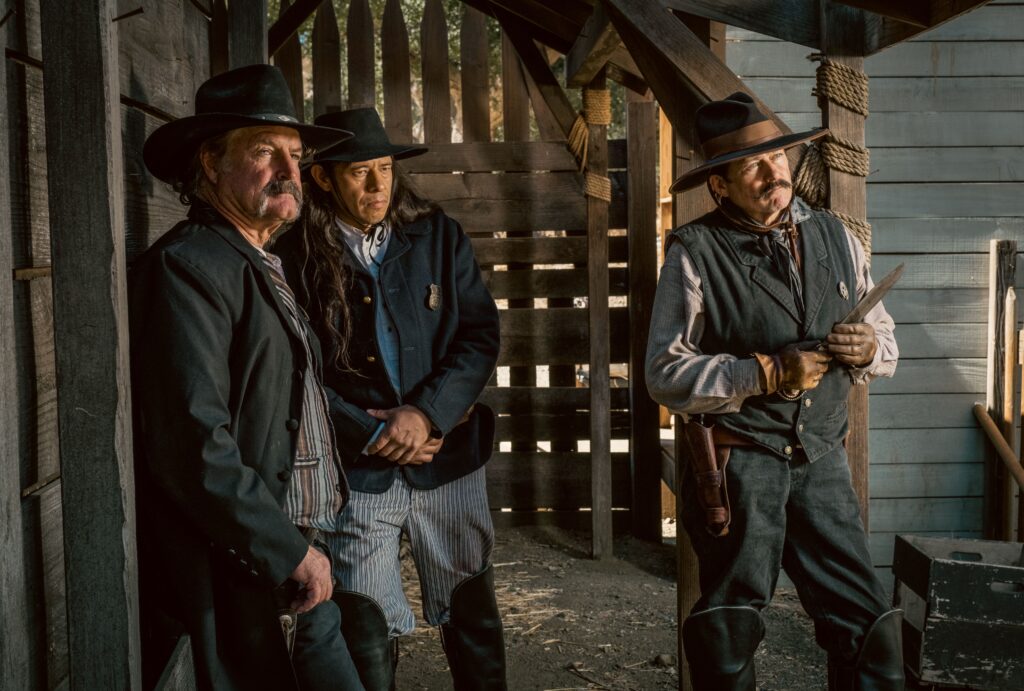
Directed by Paul G. Volk
Culture Representation: Taking place in 1895 and 1896, in Arkansas and in Oklahoma, the Western action film “The Night They Came Home” (based very loosely on true events) features a racially diverse cast of characters (white, African American and Native American) representing the working-class, middle-class and the criminal underground.
Culture Clash: A marshal and his deputy go on the hunt for the Rufus Buck Gang, a group of ruthless biracial criminals who are committing racist hate crimes against white people.
Culture Audience: “The Night They Came Home” will appeal primarily to people who are fans of the movie’s headliners and Western movies, but this movie is more nonsensical than historically accurate.
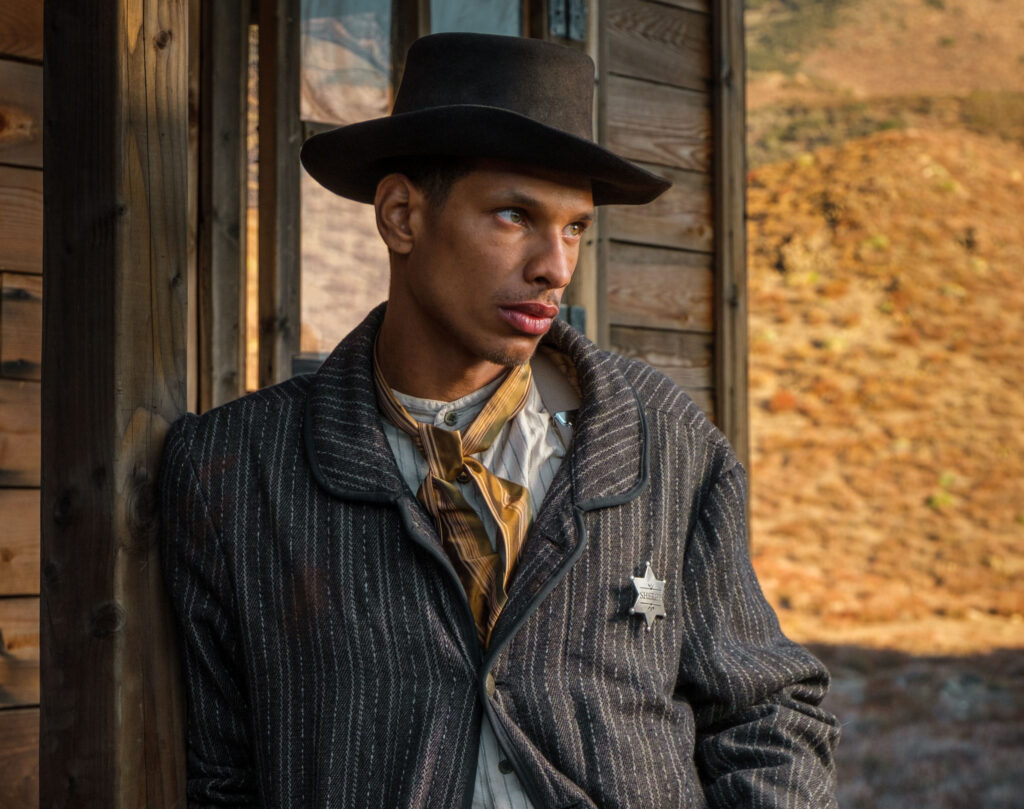
“The Night They Came Home” is an endurance test to see how long viewers are willing to watch an excruciatingly bad movie. Everything about this shoddily made Western reeks of amateurish filmmaking. It’s also a terrible depiction of a half-Black/half-Native American gang on a racist rampage against white people, with horribly acted scenes pretending to be historically true.
Directed by Paul G. Volk and written by John A. Russo (with additional writing by James O’Brien), “The Night Came Home” is very loosely based on true events of the real-life Rufus Buck Gang. This group of biracial marauders went on a killing spree specifically targeting white people out of “revenge” for the racism they and their ancestors experienced by other white people. The gang members are angry about enslavement of black people and the near-genocide of Native Americans, so these thugs are taking out their anger on anyone who is white.
“The Night They Came Home” is not supposed to be a “revenge fantasy,” such as filmmaker Quentin Tarantino’s 2012 fictional movie “Django Unchained,” which is about an enslaved man who gets revenge on his captors. “The Night They Came Home” is supposed to be based on real history and is just a pathetic excuse to make a “reverse racism” Western. All the acting, dialogue and technical aspects of the movie look as phony as a $3 bill. Very few people in the film look convincing as being from the 1890s.
“The Night They Came Home” begins on July 1, 1896, by showing gang leader Rufus Buck (played by Charlie N. Townsend) in Fort Smith Jail in Arkansas. Rufus is awaiting his execution. For viewers who don’t know the story of the Rufus Buck Gang, there goes any suspense about what’s going to happen to the gang leader, since the movie reveals right from the start that he was captured and executed.
Rufus, who seems to have some mental health problems, looks unusually cheerful for someone who knows he’s about to die. As the sun shines into his jail cell, Rufus smiles and says out loud, “Hello, sun. My last time getting to see your rise.” He also mentions that he’s separated from his “brothers, though I know we shall reunite when we leave this earth.”
A flashback then shows a younger Rufus being physically hit by a white priest, who snarls: “We will kill the Indian in you, Rufus Buck, to save the man.” The “man” is supposed to refer to the white race, but somehow in this 1890s lingo, these character in the movie are talking about “the man” as if they’re stuck in a 1960s counterculture movie.
It gets worse. “The Night They Came Home” has an added narrative layer of a gravedigger named Digger (played by Danny Trejo), who’s sitting in a bar when he meets a stranger with no name (played by Martin Kove) to tell the story of the Rufus Buck Gang and the law enforcement people who went on the hunt for the gang. Digger says that the end of the Wild, Wild West was on July 1, 1896, when the “last outlaw gang was hanged.”
The stranger has a nameless “lady of the night” (played by Carson Lee Bradshaw) by his side as his companion. She’s basically a prop who doesn’t say much of anything. The stranger and his companion sit down at Digger’s table to listen to Digger’s tale. Most of the movie then flashes back to 1895, the year of the Rufus Buck Gang’s biggest reign of terror.
In addition to Rufus, the other gang members are Sam Sampson (played by Hugh McCrae Jr.), Mamoa July (played by Ivan Villanueva) and brothers Lucky Davis (played by Phillip Andre Botello) and Lewis Davis (played by Nicholas Rising), who all have indistinctive personalities. Someone who later joins the gang is Rufus’ cousin Charles “Charlie” Buck (played by Chase Stephens), who is portrayed as someone who was recruited by Rufus and gets corrupted by these criminals. During the gang’s crime spree, Rufus impersonates a sheriff to gain the trust of his victims, who are usually viciously tortured and killed.
The Palmer family in Choctaw Nation, about 20 miles outside of Fort Smith, will be among those who have the misfortune of encountering the Rufus Buck Gang. The ranch-dwelling Palmer family consists of married parents Chuck Palmer (played by Brian Austin Green) and his wife, whose name and actress are not listed in the movie’s credits; their teenage children Tommy Palmer (played by Kassius Marcil-Green) and Jolene Palmer (played by Kelsey Reinhardt); and Chuck’s parents Jake Palmer (played by Bobby Reed) and another unnamed and uncredited female character.
There’s a home invasion of the Palmer family’s ranch that leaves one person dead in the house and another person kidnapped. The gang also goes after two other members of the family in a separate place outdoors, and only one of the two will make it out alive. Let’s just say that even though Green gets top billing in “The Night They Came Home,” he’s in the movie for no more than 15 minutes.
The law enforcement officials who go after the gang are marshal Heck Thomas (played by Tim Abell) and his deputy marshal George Maledon (played by Peter Sherayko), who are both from Fort Smith. Heck and George barely do any interviews in their investigation. Their main informant is Peter Nocono (played by Jayd Swendseid), who conveniently gives them the crucial information they need to know which way the gang is headed. They also enlist the help of locals such as Sam Sixkiller (played by Sam Bearpaw) and Paden Tolbert (played by Tommy Wolfe).
One of the most cringeworthy scenes in the movie shows what deputy marshal George says to a surviving Palmer family member who has found out that most of the other family members have been murdered: “We all die. It was their turn. Relax.” And he’s supposed to be one of the good guys?
There are also some random-looking cameos. Weston Cage (Nicolas Cage’s eldest child, also known as Weston Cage Coppola) plays a silent bartender named Bob in the bar where Digger tells his story. The bartender looks more like he’s in a heavy metal band from the 1980s, not a bartender from the 1890s. Robert Carradine has a very brief appearance as a bootlegger named Bart, whose fate is exactly what you think it will be.
“The Night They Came Home” is a complete failure of trying to show anything except senseless killings, chase scenes, and occasional interruptions to remind people that Trejo (doing his usual “gruff and rough character” schtick) is in this movie as the “storyteller.” Townsend portrays the sadist Buck as someone who’s constantly smirking, but it comes across as more clownish than villainous. At least he puts effort into his character having something memorable about his character. Everyone else’s performances in the movie are just dull or sometimes painful to watch. For a movie that’s about murder and mayhem in the Wild West, “The Night They Came Home” is actually limp and listless, and the only real assaults are on viewers’ intelligence, patience and time.
Lionsgate released “The Night They Came Home” in select U.S. cinemas, digital and VOD on January 12, 2024. The movie will be released on Blu-ray and DVD on February 27, 2024.