
April 23, 2023
by Carla Hay
“Shaakuntalam”
Directed by Gunasekhar
Telugu with subtitles
Culture Representation: Taking place in India, the fantasy film “Shaakuntalam” (based on Kalidasa’s ancient play “Shakuntala”) features an all-Indian cast of characters representing the working-class, middle-class and wealthy royalty.
Culture Clash: A king and his wife are driven apart by a curse and might or might not get back together after the curse is lifted.
Culture Audience: “Shaakuntalam” will appeal primarily to people who are fans of “Shakuntala” and tacky movie versions of classic fairy tales.

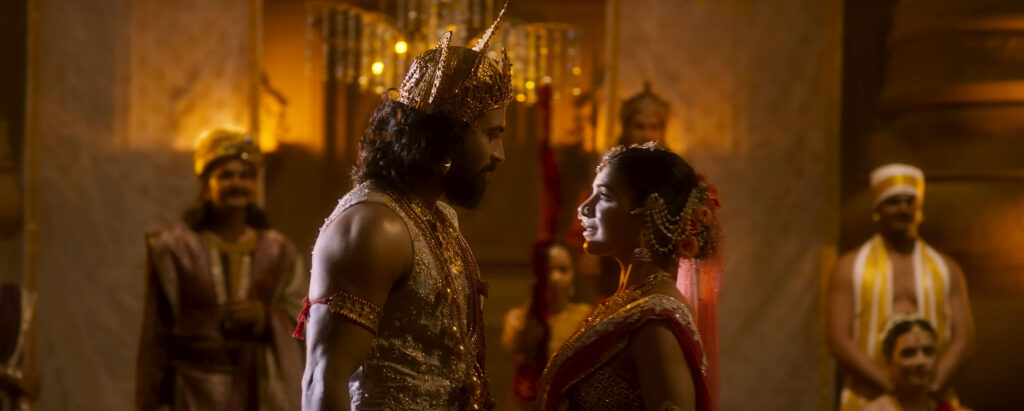
The best thing that can be said about the bloated fantasy drama “Shaakuntalam” is that the costumes are eye-catching. Everything thing else is terrible, including the acting and fake-looking visual effects. It’s too much money spent on hackneyed filmmaking. With a total running time of 142 minutes, and with scene after scene filled with mind-numbingly stupid dialogue, “Shaakuntalam” will quickly induce boredom and/or irritation with viewers who know this could have been a much better movie with the right filmmakers.
Written and directed by Gunasekhar, “Shaakuntalam” is based on the ancient Indian play “Shakuntala,” written by Kaludasa. It has all the elements of old fairy tales (usually written by men) that are told in many other cultures. In these stories, dashing royal men meet, fall in love, and court beautiful women whom the royal men want to marry.
The women in these stories tend to be too good to be true: always kind, always patient, and always with the implication that their royal suitor is the “first, only, and greatest love” of the woman who’s being courted. We all know that these stories have inevitable “happily ever after” endings. But the journey to get there—and how it’s presented—determines if a fairy tale is a classic or not.
“Shaakuntalam” looks like a movie where the filmmakers cared more about cramming in as many phony-looking, obviously computer-generated animals in scenes, rather than in crafting a good story. This entire movie could have been 80 minutes or less, but it’s dragged out to 142 minutes of repetitive and moronic scenes. The original songs in the movie’s musical numbers have incredibly basic and soulless lyrics that could have been generated from any old computer program.
The maiden-turned-queen in “Shaakuntalam” is Shakuntala (played by Samantha Ruth Prabhu), who was abandoned as a baby. The movie’s opening scene shows baby Shakuntala being found in a forest and adopted by a kind of loving guru named Kanva Maharishi (played by Sachin Khedekar), who raises her along with several of his young male disciples. Kanva, who names the baby Shakuntala, is so wise, he already knows who are the parents of this abandoned baby is the daughter.
Shakuntala grows up to be a young women who has never met her parents: mother Menaka (played by Madhoo) and father Vishwamitra, who died before Shakuntala could meet him. Through a series of circumstances, Menaka ends up back in Shakuntala’s life and becomes a domineering force in trying to control Shakuntala. Menaka only seems to care about what Shakuntala can get out of Shakuntala’s relationship with a wealthy king.
Meanwhile, Shakuntala meets the powerful king Dushyanta (played by Dev Mohan), who charms and seduces her. There’s a very over-the-top scene of Dushyanta being a one-man army in fighting of a group of rampaging tigers who invade Shakuntala’s village. This fight scene is one of many in “Shaakuntalam” that look like scenes from a video game. It isn’t long before Shakuntala and Dushyanta get married, and she becomes pregnant.
Shakuntala has two best friends named Anasuya (played by Ananya Nagalla) and Sarangi (played by Prakash Raj), whose personalities are indistinguishable from each other. The purpose of Anasuya and Sarangi in the movie is to hang around and be like a “Greek chorus” for Shakuntala. Anasuya and Sarangi are supportive pals to Dushyanta, but these two sidekicks also spread gossip and misinformation.
One day, a pregnant Shakuntala meets a guru named Durvasa Maharishi (played by Mohan Babu), who is the guru of anger. Durvasa asks Shakuntala some questions that he thinks she doesn’t want to answer. In reality, Shakuntala has tuned out Durvasa’s attempts to start a conversation with her because she is lost in her thoughts about the impending arrival of her baby.
Durvasa thinks Shakuntala is being arrogant and disrespectful to him, so he curses her by saying that her husband will forget all about her. And sure enough, the next time that Shakuntala sees Dushyanta in the palace court, with several of the king’s court members in attendance, Dushyanta says that he doesn’t know who Shakuntala is, even though she insists that they are married and are expecting their first child together.
Dushyanta thinks that Shakuntala is pregnant with another man’s child and is trying to fool him into making this child his heir. Dushyanta publicly humiliates Shakuntala and banishes her from his kingdom. The curse, which caused temporary amnesia, is eventually lifted. Dushyanta is heartbroken to find out that Shakuntala has disappeared because of his own cruelty. He then goes on a mission to find her.
The rest of “Shaakuntalam” plays out exactly like you think it will. However, it’s done in such a lumbering and long-winded away, you could fall asleep or do other things in the middle of the film and you really won’t miss anything substantial. “Shaakuntalam” is an unfortunate example of filmmakers thinking that a movie with a “barely there” plot will somehow be better if the movie is more than two hours long. That lengthy time just shows up the movie’s flaws even more and makes it more obvious that watching this dreadful dud is a waste of time.
AA Films released “Shaakuntalam” in select U.S. cinemas and in India on April 17, 2023.