
February 17, 2022
by Carla Hay
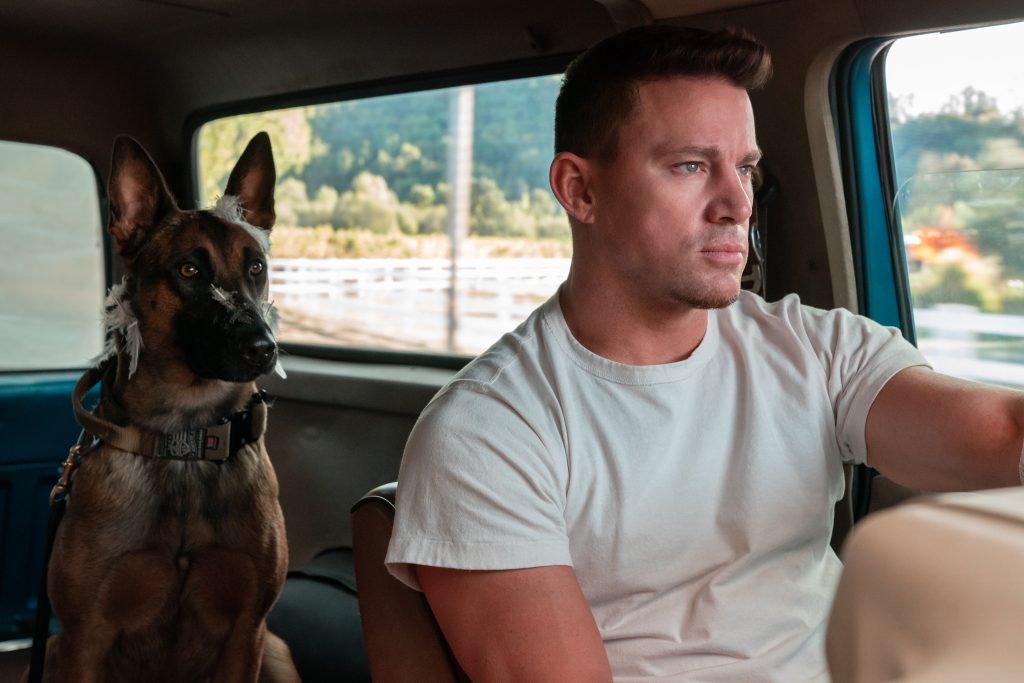
Directed by Reid Carolin and Channing Tatum
Culture Representation: Taking place in Montana and the West Coast of the United States, the comedy/drama “Dog” features a predominantly white cast of characters (with a few African Americans and Latinos) representing the working-class and middle-class.
Culture Clash: In exchange for a job recommendation from an ex-boss, a former Army Ranger agrees to take an unruly Belgian Malinois named Lulu, who has been hailed as a war hero, to the funeral of the Army sergeant who was her handler.
Culture Audience: “Dog” will appeal mainly to people who are fans of star Channing Tatum and anyone who likes “rowdy dog” movies, no matter how dull and cliché they are.
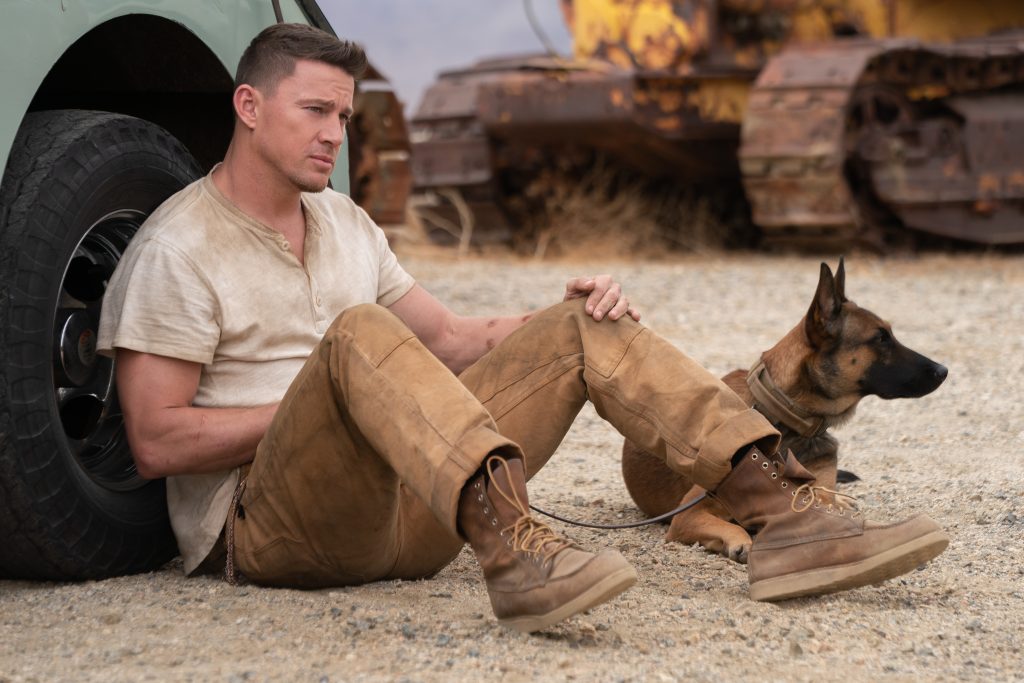
“Dog” can’t seem to decide if it wants to be a wacky comedy or a sentimental drama. Either way, it’s a dull misfire. The movie’s star dog literally takes a back seat to stupid antics from humans. Considering how irritating so many of the human characters are in the movie, it would have been a welcome improvement to give more screen time to the dog. In addition, “Dog” is completely irresponsible in showing legal issues of how people should handle problematic dogs that were trained to attack and kill.
“Dog” is one of those films where the funniest scenes are already in the movie’s trailer. And they’re not very funny, because the concept of an exasperated person who’s stuck taking care of an unruly dog has been done so much better in other movies. In addition, “Dog” is a road trip movie that rehashes the same old stereotypes of “mismatched duos” who are forced to go on the road together. And yes, one of the movie’s numerous clichés is a car breaking down during a crucial part of the road trip.
Channing Tatum stars in “Dog,” his feature-film directorial debut, which he co-directed with Reid Carolin, who wrote the “Dog” screenplay. In the movie, Tatum plays Jackson Briggs (who likes to be called by his last name), a down-on-his-luck former U.S. Army Ranger, who wants to get back into some type of government protection job. Instead, Briggs is living in Montana and working at a low-paying, behind-the-counter job at a deli. Briggs lives alone and is divorced. His ex-wife Niki (played by Q’orianka Kilcher) and their 3-year-old daughter (played by identical twins Jacqueline Seaman and Francine Seaman) live in Arizona.
The biggest obstacle to Briggs getting his dream job is that he has a history of brain injuries. Briggs has applied for a diplomatic security job at a company called Black Canopy Global Security. This job application won’t be considered unless he gets a full medical exam certified by his former commanding officer. The movie has some repetitive scenes of Briggs persistently calling Black Canopy Global Security to find out what he has to do to make it to the next level of this job application process.
Briggs has been told repeatedly that even though he has completed the medical exam with a doctor’s approval, he still needs to have his former commanding officer sign off on the exam. During one of these phone calls, Briggs finds out that the applications have a yearly rotation (people can only apply once a year), and this year’s rotation closes on the following Wednesday. “I can’t wait until next year’s rotation!” Briggs exclaims. “You’ll be hearing from me.”
Meanwhile, Briggs gets some bad news: A former Army buddy named Sgt. Riley Rodriguez (played by Eric Urbiztondo, seen only in photos) has died in a single-car crash, when Riley’s car rammed into a tree. Was it an accident or a suicide? The answer is revealed in the movie. And it’s exactly what you think it is.
Briggs goes to his former work base Fort Lewis in Joint Base Lewis–McChord in Washington state for the memorial. He meets up with some of his former Army buddies at a bar, but he feels slightly out of place because he’s the only one at this gathering who’s not in the military. They talk about Riley and the good times they had with him.
While he’s in the area, Briggs visits his former commanding officer at Fort Lewis. He almost doesn’t get in because his employee pass has expired, and the Fort Lewis MP (played by Devin White) at the gate won’t let him through the gate. Briggs acts hostile and defensive, even though the MP is just doing his job. It’s the first sign that Briggs can be an entitled jerk.
But luckily, right at that moment, Briggs’ former commanding officer Captain Luke Jones (played by Luke Forbes) drives up and tells the MP at the gate that it’s okay to give Briggs access. Briggs then drives through the gate while giving the MP a smug grin. This gatekeeping scenario is repeated again in other parts of the movie, with Briggs reacting in obnoxious ways to the guard at the gate, such has giving him the middle finger and cursing at him. Briggs is so immature, you almost expect him to stick out his tongue like a bratty child during these interactions.
When Briggs explains to Captain Jones that he needs him to certify Briggs’ medical exam for this security job application, Captain Jones initially refuses and asks sarcastically if Briggs paid a bribe to get a doctor clearance on a medical exam. However, Captain Jones changes his mind when he tells Briggs that he needs someone to transport Riley’s combat dog—a Belgian Malinois named Lulu—to Riley’s home state of Arizona to attend Riley’s funeral. After that, the dog will undergo euthanasia, because Lulu has been deemed unfit for adoption.
Captain Jones says that if Briggs can get Lulu to the funeral and back to Fort Lewis with no mishaps, then he will certify the medical exam for Briggs’ job application. The trip has to be done by car, because Lulu is too dangerous to take on public transportation. Captain Jones warns Briggs: “Lulu is not the same dog you served with. She’s got every combat trigger in the book.”
A montage at the beginning of the movie shows that Lulu was born on August 12, 2014. She was adopted at 5 months old by the Fort Lewis 75th Ranger Regiment. She served with Riley in the Afghanistan War. Lulu is considered too hard to handle because she has the canine version of post-traumatic stress disorder. She’s easily agitated and might attack if she’s “triggered.” (Three dogs actually play Lulu in the movie. Their names are Zuza, Britta and Lana 5.)
Lulu often has to wear a muzzle because of how unpredictable she is with her attacks. Briggs finds out the hard way when he sees Lulu for the first time in years. And she immediately knocks him down during an attack. Captain Jones and the kennel master (played by Trent McDonald) just laugh at this spectacle. Expect to see more “out-of-control attacking dog” scenes that wouldn’t be funny at all in real life.
As so, off Briggs and Lulu go on this road trip in his 1984 Ford Bronco. Briggs is told the dog can only wear the muzzle for two hours at a time, or else she’ll get overheated. Briggs starts his road trip with Lulu on a Wednesday. The funeral is four days later, on a Sunday. His job application is due the following Wednesday. Therefore, “Dog” is not only a road trip movie, but it’s also a “race against time” movie. But you wouldn’t know it by how this movie drags and lumbers along with distractions that would take up valuable hours in real time.
Early on in the road trip, Briggs stops at a shooting range to spend time there for fun. When he comes back to his Bronco, he finds that Lulu has broken out of her carrier and chewed up the upholstery seating. “You’re just a demon!” he yells at Lulu, before he drugs her so that she’ll go to sleep. Briggs openly laughs that he can make this dog unconscious whenever he wants. Yes, this movie tries to make a pathetic joke out of a dog being drugged to unconsciousness.
It should come as no surprise that at some point in the movie, Briggs doesn’t bother putting the muzzle on her. That’s because there are many scenes contrived so that Lulu’s agitated barking causes unwanted attention, with Briggs acting mortified, while some unrealistic slapstick comedy scenario ensues. These scenarios have no imagination and are actually not very amusing.
One of the stops on the Briggs Buffoonery Tour is Portland, Oregon. The filmmakers of “Dog” must have some type of grudge against Portland, because there’s a big chunk of the movie that shows open disdain for Portland residents. Everyone in Portland is depicted as progressive liberal hipsters, weirdos or aging hippies who automatically dislike/distrust people with a military background. It’s an over-the-top portrayal that’s supposed to be funny, but it just comes across as lazy and unrealistic stereotyping. Portland is a lot more diverse than the narrow-minded, warped way that the city’s residents are depicted in “Dog.”
On his first night in Portland, Briggs goes to a bar to find any woman who wants to have sex with him. The bartender (played by Luke Jones) announces to Briggs that they only serve organic beer. While waiting in line to use the restroom, Briggs is pestered by a guy (played by Cole Walliser) babbling to him about technology and virtual gifts. And then, Briggs meets a succession of women who don’t have regular conversations with him. They give sanctimonious lectures spouting their political views to let him know how “woke” they are.
One woman named Sonia (played by Tory Freeth) says she likes country music but has a problem with how country music celebrates “toxic masculinity.” Did she forget that there are plenty of successful female country artists? Another woman named Natalie (played by Skyler Joy) scolds Briggs after she find out he’s an Afghanistan War veteran: “Did you realize you were just a pawn for Big Oil? Just body bags carrying out ecological genocide for the corporate elite?” Another woman named Tara (Patricia Isaac) says she’d like to meet any man who doesn’t have a “white savior complex.”
Briggs leaves the bar in disgust at all the politically correct people he met there. In the parked truck, he tells Lulu, “We’ve got to get out of here, because you’re the only woman in this entire city that I’d like to have a conversation with.” But just then, Briggs thinks he’s going to get lucky with two women who approach him in the parking lot because they see Lulu in his truck. The women—whose names are Bella (played by Emmy Raver-Lampman) and Zoe (played by Nicole LaLiberte)—live together and have Shih Tzus with them, so they all talk about their dogs. Bella and Zoe, who describes themselves as “tantric healers,” invite Briggs back to their house, for what he’s sure will be a sexual threesome.
Bella, Zoe and Briggs start to get touch-feely at the house, and his shirt comes off. Lulu doesn’t like being cooped up in the truck, of course. She starts barking loudly while the Bronco is parked out on the street, in front of Bella and Zoe’s house. A nosy next-door neighbor named Brad (played by Timothy Eulich) comes out of his house and gets angry—not at Lulu, but at Briggs for keeping the dog in the car. Brad yells that the dog is an “abused animal” and continues his rant by saying, “Animals are people too!”
A shirtless Briggs runs outside to see what all the commotion is about, and he sees that Brad has a rock in his hand. Briggs tells Brad to put down the rock, but an incensed Brad calls Briggs a “redneck,” even though Brad knows nothing about Briggs. And then, Brad throws the rock at the back window to smash it and so Lulu can jump out of the car. (And apparently, with “concerned animal lover” Brad not caring if the shattered glass could injure the dog.)
After the entire back window is broken, Lulu jumps out and tears off part of Brad’s jacket before he quickly runs back into his house. Bella and Zoe, who witnessed all this chaos, are so turned off by this violence, they don’t want anything to do with Briggs. Briggs has a hissy fit while he puts Lulu back in the car again. He yells at Lulu: “You ruined an epic threesome!” And then he shouts at her: “Bitch!” Yes, the movie is that idiotic.
Briggs finds himself in more ridiculous scenarios. In one sequence, Lulu runs away in a wooded area, with Briggs giving chase on foot. He ends up in a marijuana greenhouse owned by a hippie-ish married couple named Gus (played by Kevin Nash) and Tamara (played by Jane Adams), who’s another “cosmic” type who likes to talk about karma and energy. It’s one of the worst parts of the movie because of how mindless and unfunny it is. (Hint: A tranquilizer gun and a kidnapping are involved in this scenario.)
More of Briggs’ asinine antics continue. Another low point in the movie is in San Francisco, where he pretends to be a blind military veteran so he can get a free room at a luxury hotel. What happens in the hotel is partially shown in the trailer for “Dog.” But there’s a tone-deaf scenario in the movie where Briggs is accused of being a racist after Lulu attacks a man wearing Muslim garb in the hotel lobby, because she was trained to attack men wearing Muslim garb in the Afghanistan War.
Unrealistically, Briggs is arrested for a hate crime, when he should have been arrested for negligent handling of an animal. As shown in the movie’s trailer, Lulu’s rampage also “outed” Briggs for not being blind, as he claimed he was, so he’s also arrested for fraud. Needless to say, there’s more time wasted as Briggs is locked up in jail.
The man who was attacked is named Dr. Al-Farid (played by Junes Zahdi), who has to decide whether or not he’ll press charges against Briggs. Because this movie is so sloppily written, it never addresses how the hotel wants to handle the fraud charges. It also never shows what would happen in real life: The dog would be taken away to a city animal shelter and undergo euthanasia because it viciously attacked a human being who did not provoke the dog.
But there would be no “Dog” movie in all of its awfulness if the movie tried to be realistic. Briggs’ version of “dog therapy” is to show Lulu videos of herself fighting in a combat zone. (Briggs gets the videos from an I Love Me scrapbook that Riley made for Lulu.) Not only does Briggs stupidly reinforce anti-social behavior for the dog, but he also rewards the dog for it with treats, like she’s a child who needs to just be parked in front of a TV and given snacks while watching violent videos of herself. It’s so heinous and absolutely the wrong way to teach a dog how to un-learn violent training.
After a lot of pathetic attempts to be a zany comedy, the movie takes an abrupt turn into sappiness that’s supposed to be tearjerking but comes across as cynical and calculated. It’s all very unearned. People who know how long it takes for a problematic dog to un-learn any dangerous training will be rolling their eyes at the ending of the movie. Lulu’s personality transformation in less than a week is very unreal.
There’s a scene where Briggs meets a man named Noah (played by Ethan Suplee), and it’s enough to say that no expert “dog whisperer”/dog trainer in the world would be able to accomplish what Noah does in less than an hour. This dog would’ve been permanently taken away from Briggs after his arrest in San Francisco. An incompetent character like Briggs makes things worse, but the movie lets him off the hook too easily. The redemption arc that’s rushed in at the end of the movie is extremely phony.
There’s not much to say about the acting in this movie except that most of it ranges from adequate to not very impressive. The movie’s editing, tone and pacing are all very uneven. The horrendous screenplay has too many plot holes and unrealistic scenarios that give misleading depictions of how military combat dogs are handled. And a big takeaway from “Dog” is that Tatum has the dubious distinction of co-directing himself in a movie where a dog has a better personality and more intelligence than the character he plays in the movie.
Metro Goldwyn Mayer Pictures will release “Dog” in U.S. cinemas on February 18, 2022.