
Review: ‘Folktales,’ starring Hege Wik, Romain Le Biannic, Bjørn Tore Måseid, Ketil Foss, Iselin Breivold and Thor-Atle Svortevik

September 4, 2025

by Carla Hay

Hege Wik and Odin in “Folktales” (Photo by Lars Erlend Tubaas Øymo/Magnolia Pictures)

“Folktales”

Directed by Heidi Ewing and Rachel Grady

Some language in Norwegian and Spanish with subtitles

Culture Representation: Filmed from August 2023 to May 2024, the documentary film “Folktales” features a predomninantly white group of people (with one Latin person and one Asian person) who are connected in some way to Pasvik Folk High School in Norway.

Culture Clash: Students of Pasvik Folk High School spend time in the Arctic Circle in harsh weather conditions and learn survival skills and how to participate in dog sledding in a year-long program.

Culture Audience: “Folktales” will appeal primarily to people who are interested in watching a beautifully atomspheric “coming of age” documentary that is more contemplative than informative.

A scene from “Folktales” (Photo by Tori Edvin Eliassen/Magnolia Pictures)

“Folktales” is a documentary that is style over substance. However, there’s enough substance for people interested in seeing how a Norwegian folk high school builds character and confidence through dog sledding. Heartfelt moments balance out slow pacing.

Directed by Heidi Ewing and Rachel Grady, “Folktales” was filmed from August 2023 to May 2024. The movie had its world premiere at the 2025 Sundance Film Festival. The documentary’s title refers to how the modern-day events of the documentary are somehow relevant or linked to ancient Norwegian folktales of Norns: goddesses who weave people’s fates through yarn.

“Folktales” begins by showing foreboding scenes of a wintry Norwegian wooded area at night. A woman says in a voiceover in Norwegian: “Odin, the king of the gods, walked through an enchanted forest toward the Tree of Life. On the roots of the tree, he found the Norns, the three Fates who weave our destinies out of yarn.”

The narration continues: “‘Give me the gifts that ensure a happy life,’ said Odin. ‘No,’ said the Fates. ‘You cannot receive those gifts so easily … You must earn those gifts on your own.'” It’s somewhat of a pretentious way to begin the documentary, which doesn’t have any other reference to Norse mythology except scenes that show red yarn wrapped around forest trees, with the yarn obviously put there by the filmmakers.

Pasvik Folk High School is an “alternative” learning institution, which has a year-long program. The school is based in Finnmark, Norway, which is 200 miles above the Arctic and is near the border of Russia. The purpose of the school and other Norwegian folk schools is to “offer a way for teens to seek a year of independence before embarking on adulthood,” according to a caption in the documentary. “Folktales” focuses on three students of Pasvik Folk High School:

  • Hege Wik, who was 19 when this documentary was filmed, is from Sandnes, Norway. She says to be a young woman is “chaos.” She describes herself as someone who’s gotten tired about being overly concerned about what other people think about her. Wik also says her father was killed, but she doesn’t like to talk about it. And that’s when you that there will be a part of the documentary where she will talk about it.
  • Bjørn Tore Måseid, who was 19 when this documentary was filmed, is from Fauske, Norway. He describes himself this way: “I’m nice, but I’m kind of annoying.” He says it’s hard for him to find and keep friends because he can be socially awkward and often says things that make people feel uncomfortable.
  • Romain Le Biannic, who was 18 when this documentary was filmed, is from Groningen, Netherlands. He describes himself this way: “I’m not really a confident person … I hope to overcome social anxiety.” He mentions that he dropped out of high school because he wasn’t doing well in school, and he lost interest in school activities.

In addition to dog sledding, the school’s program involves “survival skills” camping in the woods for a period of time during the brutal winter weather. The documentary shows the students gathered for a welcoming orientation session led by Pasvik Folk High School principal Ketil Foss, who has a kind but firm way of communicating and treats students like a supportive father. Also featured prominently in the documentary are dog sledding teachers Iselin Breivold and Thor-Atle Svortevik.

Some other students are shown talking, but their personal stories are not told in the documentary. Although Pasvik Folk High School is open to students from all over the world, “Folktales” gives some acknowledgement that Pasvik Folk High School has very homogenous racial demographics, with white Western Europeans comprising the overwhelming majority. And even in those demographics, there are minorities: Le Biannic, who is white, says he feels like an outsider because he’s from the Netherlands, not Norway.

The movie shows one unidentified Spanish-speaking male student talking to his mother on the phone. The mother asks him if he’s found any ethnic food markets in Norway. The student somewhat laughs and says there are no ethnic food markets in Norway because there are hardly any ethnic people. Elsewhere, one unidentified Asian female student is seen briefly in the orientation sessions and is never really seen again.

For a documentary about teenagers learning dog sledding, there’s not a lot of footage of the nitty-gritty training instructions that take place on the sleds. And the actual dog sledding scenes are less than 15% of the movie’s screen time. Instead, there are scenes of the students getting to know the dogs (most of dogs are Siberian Huskies) and getting familiar with how to use leashes on the dogs when the dogs are not on the sleds.

There are also cute but somewhat superficial scenes of the students frolicking in the snow, such as overhead shots of them forming play circles, or making “snow angels” by lying on their backs and moving their arms and feet. There’s no question that “Folktales” has gorgeous cinematography (Lars Erlend Tubaas Øymo was the chief cinematographer) that showcases the natural beauty of the locations where the documentary was filmed. The documentary falls a bit short when it comes to telling the stories of the living beings who are involved in the dog sledding.

Wik, Måseid and Le Biannic are somewhat presented as narrating observers of their own stories, like reality show cast members, instead of just letting viewers see how these participants evolve, in pure cinéma vérité style. Their physical hardships in the program seem to be glossed over or sidelined. Anyone expecting more of an outdoor adventure-styled documentary will be disappointed because “Folktales” can get sluggish and repetitive with a lot of scenes of casual and innocuous conversations indoors.

People who love dogs will be disappointed that “Folktales” doesn’t delve deeper into stories of the dogs that Wik, Måseid and Le Biannic get attached to the most. Billy is a very sociable male dog that Måseid seems to like a lot. Guinness is a pregnant dog, who is later shown giving birth to her pups. Diamante, nicknamed Dia, is a shy female dog who bonds very early with Le Biannic, who also describes himself as shy. Le Biannic also likes a male dog named Mjød. Saatso is a male dog with cancer, and Wik is shown spending time comforting him. There’s also a cat named Tigergutt, who’s sort of like a mascot for the dog sledding team.

“Folktales” has gotten some criticism from people who think dog sledding is barbaric and cruel to dogs. It’s a bit unrealistic to think that dogs living in arctic environments won’t be shielded from brutally cold weather. There is certainly room for debate on whether or not dog sledding is necessary as a sport. The dogs shown in “Folktales” look like they are being taking care of very well by the humans responsible for taking care of them.

In “Folktales,” the dogs trained for dog sledding actually look eager to pull the sleds, like athletes ready to participate in a physically demanding sport. The main thing in the documentary that might lead anyone to think that the dogs could be abused is how the dogs look restless and uncomfortable when chained on fairly short leashes to dog houses outside before they are taken to the sleds.

It’s not stated or shown in the documentary how long these dogs have to wait outside in the cold under these circumstances. The dogs are seen having indoor shelter for sleeping, and none look like they are underfed—even in the scenes where the students have to “rough it” outdoors during the survival skills part of the program. “Folktales” could have been more diligent and responsible about explaining how the dogs are cared for in this program. It’s not enough information just to show the students feeding and petting the dogs.

Even without these dog stories, the human stories have moments of emotional vulnerability to give “Folktales” substance beyond just showing scenic shots of people and things in snowy wooded locations. Wik opens up about what happened when her father was killed. One of the students (it’s easy to guess who) abruptly quits the program and then returns after having a change of heart. Interestingly, the most emotional moments in “Folktales” are at the graduation ceremony, near the end of the film.

In the first half of the documentary, Ketil makes this comment about the school’s program: “In the beginning, the students think it’s all about the dogs … but the dogs are just the method. Of course, we have the higher goal. The higher goal is the human being. The dogs teach us to be more human, to maybe be more patient, and we might pay attention to others even more.”

“Folktales” is satisfying enough to show the expected outcomes of Wik, Måseid and Le Biannic going through this folk school program. Måseid (an extrovert) and Le Biannic (an introvert) end up becoming friends in the way that’s familiar to anyone who’s seen enough “coming of age” movies where two teenagers with opposite personalities form an seemingly unlikely friendship. “Folktales” is predictable, in the sense that it could also be used as a marketing/public relations tool for the school. You’re not going to hear any criticisms of Pasvik Folk High School in “Folktales.”

It’s not necessarily a bad thing for a documentary to put a positive spin on whatever the focus of the documentary is. “Folktales” has plenty of artfully filmed scenes that make living in the snowy woods of Norway look both enchanting and challenging. What “Folktales” needed was more of a window into the souls of the people who were chosen to be the focus of this documentary, because viewers still won’t know much about these people by the end of the movie.

Magnolia Pictures released “Folktales” in select U.S. cinemas on July 25, 2025, with an expansion to more U.S. cinemas on August 1, 2025. The movie was released on digital and VOD on September 2, 2025.

Review: ‘Call Your Mother,’ starring David Spade, Louie Anderson, Awkwafina, Roy Wood Jr., Norm Macdonald, Kristen Schaal, Bridget Everett and Fortune Feimster

May 10, 2020

by Carla Hay
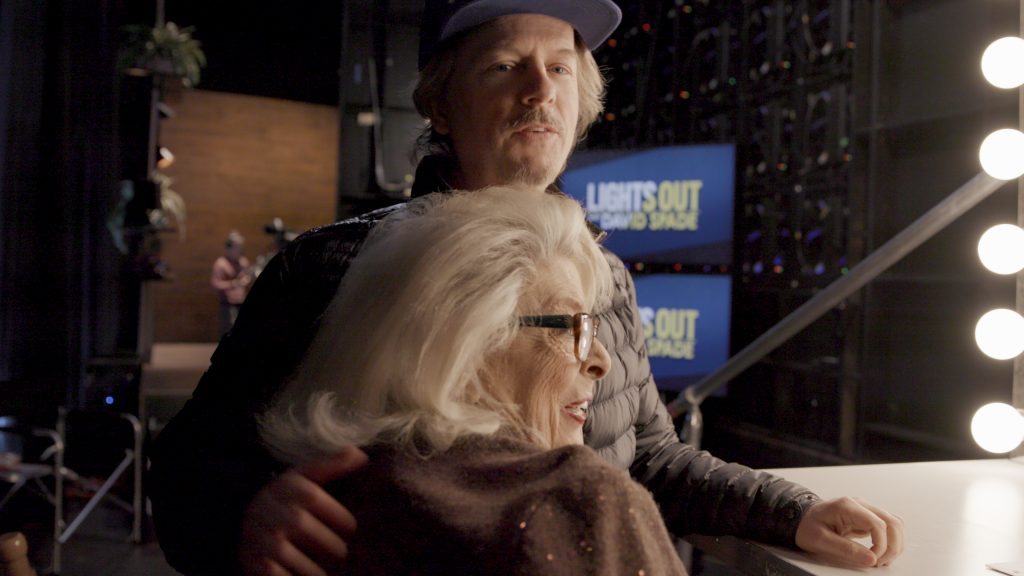
David Spade and his mother, Judy Todd, in “Call Your Mother” (Photo by Jenna Rosher/Comedy Central)

“Call Your Mother”

Directed by Heidi Ewing and Rachel Grady

Culture Representation: The documentary “Call Your Mother” features a racially diverse (white, African American and Asian) group of mostly American comedians talking about how their mothers have affected their lives, with some of the comedians’ mothers also participating in the documentary,.

Culture Clash: Some of the comedians describe having nonconformist or dysfunctional childhoods that are often used as material for their stand-up comedy acts.

Culture Audience: “Call Your Mother” will appeal primarily to people who want to learn more about the family backgrounds of some well-known comedians.

Louie Anderson with a picture of his mother, Ora Zella Anderson, in “Call Your Mother” (Photo by Alex Takats/Comedy Central)

If you ask any stand-up comedian who’s the family member most likely to inspire material for their stand-up comedy act, chances are the comedian will answer, “My mother.” With that in mind, the documentary “Call Your Mother” interviews a variety of comedians (and some of their mothers) to talk about how with these mother-child relationships have affected the comedians’ lives. Directed by Heidi Ewing and Rachel Grady, “Call Your Mother” might not have a deep impact on society, but it accomplishes what it intends to do. The film is a mostly light-hearted, sometimes emotionally moving and occasionally raunchy ride that will give some psychological insight into how and why these comedians ended up where they are now.

“Call Your Mother” includes interviews with a notable list of comedians (almost all of them are American), including Louie Anderson, Awkwafina, Jimmy Carr, Bridget Everett, Fortune Feimster, Rachel Feinstein, Judah Friedlander, Jim Gaffigan, Judy Gold, Jen Kirkman, Jo Koy, Bobby Lee, the Lucas Brothers, Norm Macdonald, Jim Norton, Tig Notaro, Yvonne Orji, Kristen Schaal, David Spade and Roy Wood Jr.

In some cases, the mothers of these comedians are interviewed alongside their comedic children: Everett, Feimster, Schaal, Spade and Wood all have wisecracking moments with their mothers, who are also shown in the audiences while their children are on stage, as well as backstage or at home. Former “Saturday Night Live” star Macdonald is also interviewed with his mother.  (For whatever reason, no Latino comedians are in the documentary, which is a shame, because there are many Latino comedians who talk about their mothers in their stand-up acts.)

Bridget Everett’s mother, Freddie Everett, is memorable for being as foul-mouthed and crude as Bridget. (Freddie even gives the middle finger to the camera, but all in good fun.) Bridget Everett says, “My mother is really one of a kind. She’s the person you meet that you never forget. She can be kind of mean, but somehow she gets away with it.”

Bridget continues, “She’s got a real naughty streak in her,” when describing how her mother was the type to wear very revealing outfits in places where it would be inappropriate for a woman’s breasts to be openly displayed. “There’s something really liberating about that in a small, conservative town.”

Like many of the comedians interviewed in this documentary, Bridget Everett is a child of divorce. After her parents’ divorce, her mother Freddie (who raised six kids) would take a pre-teen Bridget with her to stalk her ex-husband, mainly to see if he was dating anyone new or other reasons to spy on his post-divorce love life.

Bridget remembers her mother telling her to look in windows and report what she saw to her mother. These experiences are part of Bridget Everett’s stand-up act.  And just like her mother used to do when she was young, Bridget Everett dresses in cleavage-baring outfits on stage. “My mom pulses through my performance,” she says. “It’s really a tribute to her.”

British comedian Carr says although his mother “was the funny person in the house,” she often suffered from depression. He turned to comedy to help cheer her up. He says of stand-up comedians: “Most of us come from unhappy childhoods.”

Fans of Louie Anderson already know about how he grew up in a home with an abusive, alcoholic father and a loving mother, because he’s used his childhood as joke material in his stand-up act for years. In the documentary, Anderson (who’s been doing stand-up comedy since 1978) says that he started out doing self-deprecating fat jokes, but he eventually switched to mostly jokes about his family when he saw that it got a stronger reaction from audiences. He also says that dressing in drag for his Christine Baskets character in the FX comedy series “Baskets” was a tribute to his mother, Ora Zella Anderson.

Anderson believes that there’s a reason why so many stand-up comedians come from dysfunctional, often abusive households: “I think comics are about control. They’re trying to control the whole situation, because we had no control growing up.”

Anderson also echoes what most stand-up comedians said in Comedy Central’s documentary “This Is Stand-Up” about gravitating to stand-up comedy because it was their way of being the center of attention and getting unconditional love from people, even if it’s for the limited time that the comedians are on stage.

Spade is another child of divorce. His father left his mother when he was a child, and he says it had long-lasting effects on him and undying respect for his mother, Judy Todd. “My mom is very positive and upbeat and also very funny and clever.”

Todd is seen visiting the set of her son’s talk show “Lights Out With David Spade” on her 82nd birthday, where the audience shouts “Happy Birthday” to her, and she’s invited on stage with the interview guests. Todd is somewhat “normal,” compared to what other comedians have to say about their mothers. She’s almost downright reserved, since she doesn’t do anything to embarrass her son.

The same can’t be said for what comedians Koy, Lee and Gold have to say about their mothers, whose cringeworthy mothering techniques have been fodder for much of these two comedians’ stand-up comedy acts. Koy, who was raised by his divorced Filipino mother, Josie Harrison, remembers how his outspoken mother would inflict terror on anyone who would dare to criticize him.

Bobby Lee talks about how his Korean immigrant mother, Jeanie Lee, used to call his name to get his attention, just so she could fart in front of him. And when they would go to a shopping mall, she would encourage Lee and his younger brother to play in the shopping-mall fountain, while she would take a nap on the floor in a store. Lee, who is a recovering alcoholic/drug addict, also claims that his mother was fairly good-natured about his multiple trips to rehab, whereas most other mothers would be horrified or ashamed. He describes a moment during a family rehab meeting where his mother got the family to laugh so hard in what was supposed to be a serious gathering, they almost got kicked out of the meeting.

Judy Gold says in the documentary that she had the quintessential nagging, over-protective Jewish mother, Ruth Gold, who liked to leave long, demanding phone messages. Gold’s mother passed away in 2015, but Gold still plays some of her mother’s phone messages in her stand-up comedy act. She also plays some of the phone messages in the documentary and remembers that she did not get much overt affection from her parents when she was growing up.

Gold also says that her parents weren’t the type to hug their children and say, “I love you.” Instead, in her family, people would be rewarded based on whoever did the best to “one-up” the others with a quip. Still, Gold says that toward the end of her mother’s life, she did express her love more openly, and she shares an emotionally touching memory of what happened the last time she spoke with her mother.

One of the issues that the documentary covers is how mothers react when they find out that their children want to be professional comedians. Roy Wood Jr. says it was a very uncomfortable experience for him, since he had dropped out of Florida A&M University after being put on probation for shoplifting. He secretly started doing stand-up comedy in 1999, and when he told his mother, Joyce Dugan Wood, that he wanted to do stand-up comedy full-time, she was very upset.

“She definitely felt my priorities were in the wrong place,” he says. So, in order to please his mother, Roy went back to Florida A&M. And when he graduated, he gave his mother the plaque of the college degree that “I didn’t need” and began pursuing a full-time comedy career. Now that he’s become a successful comedian (including a stint as a correspondent on “The Daily Show”), Wood says of his mother’s approval: “These days, I feel supported.”

When comedian/actress Awkwafina (whose real name is Nora Lum) was 4 years old, her mother died, so when she was growing up, her paternal grandmother was Awkwafina’s main mother figure. While most people in Awkwafina’s family had expectations for her to going into a traditional profession, her paternal grandmother encouraged Awkwafina to pursue her dreams in entertainment.

Although many of these comedians say vulgar things about their families in their stand-up acts, the documentary shows that a lot of stand-up comedians have a soft spot for their mothers and like to hang out with them. Kristen Schaal and her look-alike mother, Pam Schaal, are seen shopping together at a fabric store. Norm Macdonald and his mother, Ferne Macdonald, play Scrabble and golf together. Wood’s mother Joyce accompanies him to a tuxedo fitting.

But not all of these mother-child moments are warm and fuzzy. Some of the comedians, such as Norton and Spade, admit to changing their shows to being less offensive and less raunchy if they know their mothers are going to be in the audience.

Norton says that he’s felt uncomfortable at times when his sex life (which he talks about in his stand-up comedy routine) is a topic of conversation with his mother. Norton remembers how after he did a stand-up show where he talked about his experiences of hiring hookers, he got a call from his mother suggesting that he join a gym to meet new people and improve his dating life. (In the documentary, he even plays the voice mail from 2001 to prove it.)

As for talking about their mothers in their stand-up comedy acts, Koy says that it was hard for him to do at first, but his mother and the rest of his family have gotten used to it. Feinstein says about her mother: “She likes it when I impersonate her. She gets upset if I don’t.”

Fortune Feimster says something similar, in an interview seated next her mother, Ginger Feimster: “She would rather me talk about her and be the center of attention than me not talk about her at all,” Fortune says. “She’s a good sport and she likes the attention.” Ginger Feimster says in response, “That is so true.”

Whether these comedians’ relationships with their mothers have been good or not-so-good, one thing that most people can agree on is a sentiment that Gold expresses in the movie that is a tried and true cliché: “There’s nothing like a mother’s love.” And at the very least, this documentary might inspire people to get in touch with their mothers to express gratitude if their mothering wasn’t a complete disaster.

Comedy Central premiered “Call Your Mother” on May 10, 2020.

Copyright 2017-2026 Culture Mix
CULTURE MIX