
September 11, 2022
by Carla Hay

Directed by Andrew Semans
Culture Representation: Taking place in upstate New York, the horror film “Resurrection” features a predominantly white cast of characters (with one Asian American) representing the working-class and middle-class.
Culture Clash: A business executive, who’s a single mother to a teenage daughter, experiences emotional turmoil when a man from her past comes back into her life.
Culture Audience: “Resurrection” will appeal primarily to people who are fans of stars Rebecca Hall and Tim Roth, and will appeal to viewers who are open to watching horror movies with unexpected and disturbing twists.
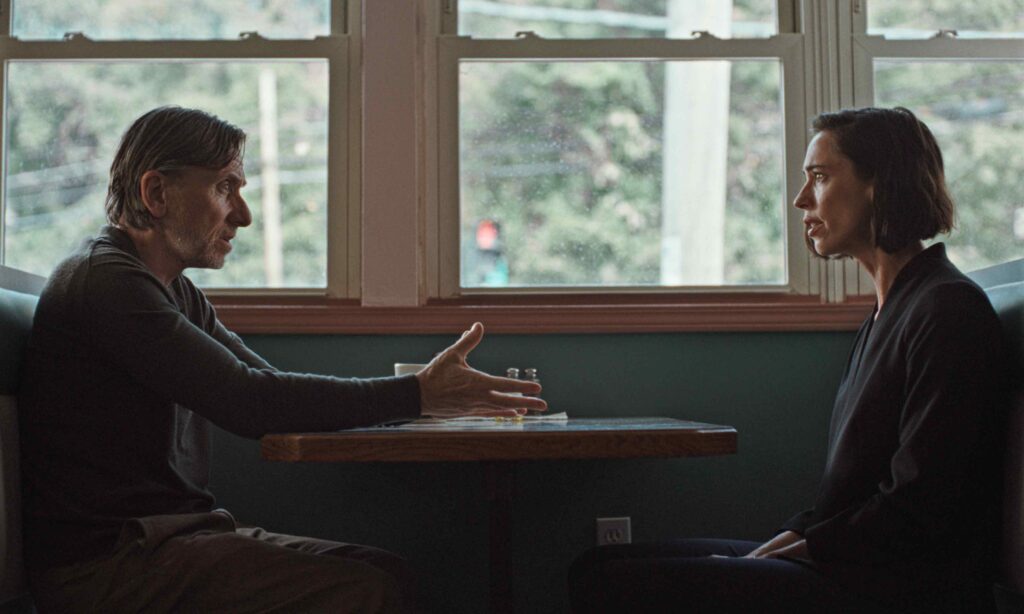
Just like the 2021 horror film “Malignant,” the 2022 horror film “Resurrection” has an unsettling and shocking reveal that viewers will either love or hate. The movie isn’t perfect, but the surprise ending offers a bizarre twist that shows bold originality. “Resurrection” is better than the average horror movie, largely due to the suspenseful mystery at the center of the story, as well as the cast members’ convincing performances.
“Resurrection” is the second feature film from writer/director Andrew Semans, who previously directed the offbeat comedy/drama “Nancy, Please,” about a hellish experience with a roommate. “Nancy, Please” made the rounds at several film festivals in 2012, before getting a very limited release in the U.S. in 2013. “Resurrection” (which has its world premiere at the 2022 Sundance Film Festival) is a movie that is much darker in tone and will leave many viewers disturbed by some of the visuals and how the story concludes.
“Resurrection” takes place in an unnamed part of upstate New York (the movie was actually filmed in Albany, New York), where biotech executive Margaret Ballian (played by Rebecca Hall) thinks she has her entire life under control and in order. The movie’s opening scene shows Margaret having a private meeting in her office with her young intern/administrative assistant Gwyn (played by Angela Wong Carbone), with Margaret giving Gwyn some advice about Gwyn’s personal life. Apparently, Gwyn is in a very bad relationship with a love partner, because Margaret tells Gwyn that Gwyn’s belittling partner is a “sadist,” so Margaret advises Gwyn to end this toxic romance.
Because of the sensitive nature of this conversation, Gwyn asks Margaret not to tell anyone about what they discussed in this meeting. Gwyn doesn’t know it, but Margaret’s own love life isn’t exactly going so well either. She’s having a secret affair with a married man named Peter (played by Michael Esper), who is the father of a teenage daughter named Chloe. Margaret, who is not married, is also a parent to a teenage daughter. Margaret’s daughter Abbie (played by Grace Kaufman), who 17 or 18 years old, is a college-bound student in her last year of high school.
Although Peter and Margaret care about each other, they’re not in love with each other. They both know it’s a dead-end affair that came about from lust and a need for companionship. During one of their sexual trysts, Margaret gets an alarming phone call: Abbie is in a hospital after getting into a drunken biking accident with a friend named Lucy. Luckily, Abbie recovers from her injuries, but this health scare starts to trigger maternal feelings in Margaret that affect her for the rest of the story.
Margaret and Gwyn are then shown in another private meeting in Margaret’s office, where Gwyn confides in Margaret that she broke up with the abusive partner. Margaret congratulates Gwyn and praises her by saying, “You’re tougher than leather.” Although Margaret and Gwyn have not been working together for very long, it’s apparent that Margaret feels protective of Gwyn, almost like a mother is protective of a child.
Not long after this meeting, Margaret attends the Biotech Rising Conference and is shocked to see who someone who is one of the conference’s speakers: His name is David Moore (played by Tim Roth), who is a confident and intelligent scientific researcher. Margaret’s reaction to seeing David on stage is that of someone who suddenly physically ill from fear.
Margaret is so unnerved by seeing David, she rushes to her home and calls out for Abbie, who is at home, safe and sound. Margaret bursts into Abbie’s room and asks Abbie if she is okay. Abbie says yes. Margaret is immensely relieved to see that nothing has happened to Abbie, who is confused over why Margaret is acting so paranoid, and she asks Margaret why.
Margaret won’t tell Abbie anything, except to insist that everything is just fine. But when Margaret goes into a bathroom, she begins sobbing. What is it about David that’s caused Margaret to be so distressed? It should come as no surprise that David is someone from Margaret’s past whom she wants to forget. And he ends up making contact with her, much to her dread.
Most of “Resurrection” is about the unnerving cat-and-mouse game between David and Margaret. David takes pleasure in knowing that his presence is upsetting to Margaret. She starts having nightmares, including one where she finds a burned baby inside of a stove. It’s enough to say that much of the horror in “Resurrection” is about Margaret’s issues with motherhood and abuse.
The nightmare about the burned baby isn’t what most viewers will think it is, because the secrets about Margaret’s past, which are eventually revealed in the movie, have some unpredictable elements. Hall gives a very tormented performance as Margaret, whose mental health begins to unravel the more that she sees David. Roth gives an effective performance too, but he’s played creepy villains in many other movies, so there are no real surprises in how Roth portrays David in “Resurrection.”
The pacing of “Resurrection” sometime drags slowly, but Semans’ writing and directing are solid enough to maintain viewers’ curiosity about what will happen next. “Resurrection” has some horror imagery about children that might be too upsetting for sensitive viewers. As gruesome as “Resurrection” can be, it’s a horror movie that offers glimmers of hope and makes a memorable statement about the power of a mother’s love.
IFC Films released “Resurrection” in select U.S. cinemas on July 29, 2022. The movie was released on digital and VOD on August 5, 2022.