Culture Representation: Taking place in various parts of the world, the fantasy action flick “Knights of the Zodiac” (based on Masami Kurumada’s manga series “Saint Seiya”) features a predominantly white cast of characters (with a few Asians) portraying humans and beings with mystical powers.
Culture Clash: A teenage street fighter, who is looking for his missing sister, finds out that he has mystical superpowers, and he gets caught up in a war between saints while he is assigned to protect Greek goddess Athena, who has been reincarnated as an American teenager named Sienna.
Culture Audience: Besides the obvious target audience of people who are fans of the “Knights of the Zodiac” franchise, this live-action “Knights of the Zodiac” movie will appeal primarily to people who don’t mind seeing boring and poorly made fantasy action films.
Famke Janssen and Diego Tinoco in “Knights of the Zodiac” (Photo by David Lukacs/ Stage 6 Films and Toei Animation)
“Knights of the Zodiac” is an example of everything wrong when a manga-based anime TV series turns into a horribly acted live-action movie that will make even die-hard fans cringe. The action scenes are sloppily staged and dull. The non-action scenes are even more tedious. There are bad video games that are more entertaining than this boring flop.
Directed by Tomek Baginski, “Knights of the Zodiac” is based on Masami Kurumada’s manga series “Saint Seiya,” which has been turned into the short-lived 1986 anime TV series “Knights of the Zodiac” and the spinoff series “Knights of the Zodiac: Saint Seiya,” which launched in 2019. Josh Campbell, Matt Stuecken and Kiel Murray wrote this live-action movie version of “Knights of the Zodiac,” which was changed to be centered on Western culture.
Unfortunately, everything about this “Knights of the Zodiac” movie looks like it was given to filmmakers who cared more about the visual effects than crafting a good story. Even the visual effects look cheap and tacky, even though it’s obvious that these effects were a major part of the movie’s multimillion-dollar production budget. But no money in the world can buy natural charisma, which is lacking among the most of cast members in this shoddily made film.
In the “Knights of the Zodiac” movie, a street fighter named Seiya (played by Mackenyu) , who’s in his late teens, makes money by participating in illegal, underground fights in an unnamed part of the United States. During one of these fights with a thug named Cassios (played by Nick Stahl), Seiya finds out that he has mystical powers, and he defeats a humiliated Cassios. “This ain’t over,” snarls Cassios.
During this “mystical power” discovery scene, Seiya is shown with glowing angel wings sprouting out of his back. It’s one of many tacky-looking visual effects in the movie. The action scenes also have choppy editing that make the movie look even more disjointed than it needed to be.
After this fight, Seiya is abducted by a wealthy retired businessman named Alman Kido (played by Sean Bean) and Alman’s most trusted henchman Mylock (played by Mark Dacascos), who bring Seiya on a private jet to Alman’s home. It’s where Seiya meets Alman’s adopted daughter Sienna (played by Madison Iseman), who is 18 years old and the reincarnation of Athena, the Greek goddess of war and wisdom.
Alman has kidnapped Seiya because he found out about Seiya’s special powers. After the fight, Cassios also called someone and said, “I think I found one of your cosmos.” Get used to hearing the words “cosmo” and “cosmos” repeated many times in the movie. In the world of “Knights of the Zodiac,” a cosmo is the life force that gives power to gods, goddesses and warriors. Alman is looking for a special person to protect Sienna.
Alman’s ex-wife owns a recruitment operation to have her own private army. Her name is Vander Guraad (played by Famke Janssen), who goes by the name Guraad, and she’s the chief villain of the story. Seiya obviously doesn’t want to be held captive by Alman, who tells Seiya that Seiya is a safer with Alman than with Guraad. “She’s already killed many kids,” Alman tells Seiya. Guraad’s sidekick is a smirking pretty boy named Nero (played by Diego Tinoco), who always looks like he’s on his way to a modeling shoot instead of a shoot-out with enemies.
Seiya is told that it’s his destiny to protect Sienna, who explains to Seiya that she has not turned into the goddess Athena yet because Sienna still hasn’t found her cosmo. Seiya is reluctant to be involved in this unusual and dysfunctional family feud because he’s got his own family to worry about: specifically, his younger sister Patricia, also known as Pat, who has gone missing. Seiya believes that Patricia has been kidnapped.
The rest of “Knights of the Zodiac” is a mind-numbing slog of awkward acting, bad jokes and unimaginative action scenes. Seiya receives training from a masked Silver Knight named Marin (played by Caitlin Hutson and Katie Moy), a red-haired warrior who wears a creepy full-face mask that looks like something out of a “Purge” horror movie. “Knights of the Zodiac” also has a weird, disconnected-sounding voice for Marin that makes her sound like a faraway robot.
Everything about “Knights of the Zodiac” looks fake and unconvincing, including the budding romance between Seiya and Sienna. The more experienced cast members fare a little better in trying to make the horrible screenplay into something entertaining, but the less-experienced cast members (who are also the least-talented members of the cast) get most of the screen time. Mackenyu’s acting is especially wooden and is very hard to watch. He definitely needs more acting lessons before he can be considered a worthy headliner for other big-budget films.
The ending of “Knights of the Zodiac” makes it obvious that the movie studio plans to continue this live-action movie series. But this “Knights of the Zodiac” movie is such a colossal flop, any more sequels with the same filmmaking team and cast members would be like repeating the same foolish mistakes. Only a complete overhaul for a rebooted remake could redeem how this “Knights of the Zodiac” abomination is such an embarrassing flop in the franchise.
Stage 6 Films will release “Knights of the Zodiac” in select U.S. cinemas on May 12, 2023.
Culture Representation: Taking place in London and in an underworld in Egypt, the animated film “Mummies” features a cast of characters that are Egyptian mummies and humans.
Culture Clash: A male mummy and a mummy princess are expected be engaged in an arranged marriage, but they are reluctant to get married to anyone, and their travel from their underworld in Egypt to modern-day London in search of a valuable wedding ring that was stolen from them.
Culture Audience: “Mummies” will appeal primarily to people who are interested in watching any type of fantasy animation, no matter how dull and predictable it is.
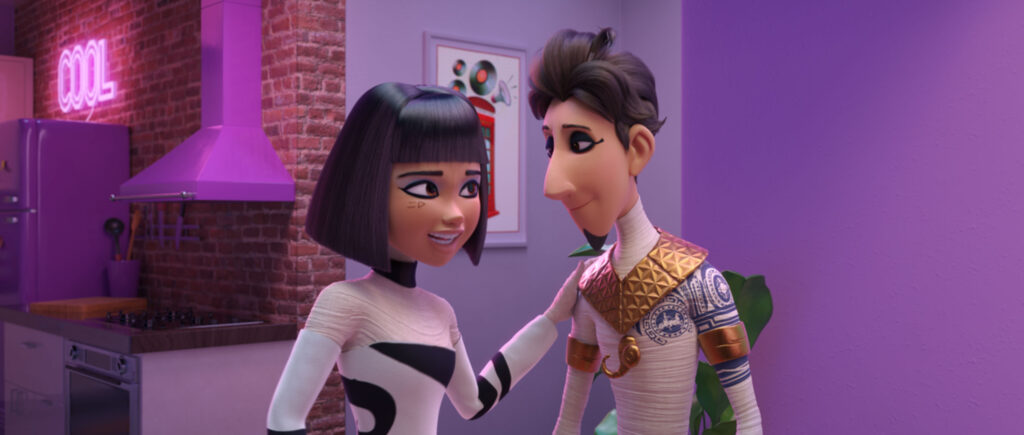
Sekhem (voiced by Santiago Winder), Croc and Thut (voiced by Joe Thomas) in “Mummies” (Image courtesy of Warner Bros. Pictures)
“Mummies” could have been a wildly imaginative adventure about the contrasts between ancient Egypt and modern London, but this boring animated film has a clunky narrative, unremarkable visuals and a stale plot. Perhaps some viewers will be satisfied with “Mummies” if they have very low standards or haven’t seen many animated films. However, this movie is so derivative and trite, it seems like a throwaway from the 1980s.
Directed by Juan Jesús García Galocha, “Mummies” has the most basic of basic plots that is really a very lukewarm, watered-down version of a Disney princess movie. Javier Barreira and Jordi Gasull wrote the frequently awkward screenplay, which was originally written as a Spanish-language film, but the movie has an English-language version too. The language difference isn’t the problem, because the dialogue in the movie would be just as witless and dull, no matter what the language.
“Mummies” begins by showing a championship charioteer named Thut (voiced by Joe Thomas) in an ancient Egyptian underworld called the World of Mummies, populated entirely by mummified creatures that are human and non-human. Thut holds the record for winning the most chariot races in the World of Mummies. Thut is in a chariot race and wins, but one of his chariot wheels falls off, and he tumbles out of his chariot. It’s a blow to his confidence, and he never enters a chariot race again.
Publicly, Thut tells people that he retired because he has no more storage space for trophies. Privately, Thut has become afraid of moving at a fast speed because of his chariot accident. As a retired charioteer, Thut occupies his time cashing in on his past glories by signing autographs. He is also the sole guardian of his energetic 8-year-old brother Sekhem (voiced by Santiago Winder), who greatly admires Thut. Sekhem has a baby crocodile as a pet named Croc, who acts like a puppy and is Sekhem’s constant companion.
Meanwhile, a greedy archaeologist named Lord Sylvester Carnaby (voiced by Hugh Bonneville), who is visiting Egypt from London, finds the tomb of an ancient Egyptian named Princess Nefer. To the dismay of Lord Carnaby, the tomb is empty. He has two bumbling sidekicks named Dennys (pronounced Dennis) and Danny (both voiced by Dan Starkey), who are fraternal twins. Viewers of “Mummies” will learn nothing about these two subordinate characters, who are essentially useless and take up space.
Princess Nefer (voiced by Eleanor Tomlinson) is actually alive and well, as an undead mummy living in the World of Mummies. In this movie, mummies do not want to interact with living human beings. The filmmakers’ world building in “Mummies” is so poorly constructed and vaguely explained, when certain mummy characters inevitably cross over into the living world, this transition just looks very tossed-off and underwhelming.
Thut and Nefer meet by chance one day on the street in the World of Mummies. Nefer and Thut trade sarcastic commentary and don’t seem to like each other very much. It’s at this point you know that they will eventually be each other’s love interest. However, Thut and Nefer tell everyone they know that they are not ready to get married to anyone. Thut says he wants to permanently remain a bachelor. Nefer, who is an only child, tells her father Pharaoh (voiced by Sean Bean): “I need at least 100 more years before I get engaged.”
Nefer loves to sing, but her old-fashioned mother (voiced by Celia Imrie) scolds Nefer for singing out loud. She tells Nefer that singing is inappropriate for royalty and should only be done by entertainers. (Karina Pasian is the singing voice of Nefer.) The only thing that Nefer’s parents want for Nefer is for her to get married, so that she can produce and heir to continue the family legacy.
In this World of Mummies, a royal family heirloom is a magical trinket in the shape of phoenix, which was given by the goddess of love. Through an ancient ritual, the phoenix comes to life and is supposed fly to the person who will become the spouse of any unmarried heir to the throne. Nefer’s family does the ritual, and the phoenix (which looks like a burning flame) flies near Thut’s home and is accidently hit with a rock by Sekhem.
When Nefer and Thut find out that the phoenix has “chosen” them to get married, they both resist the idea. Thut is told that he has to safeguard the wedding ring anyway. Through a series of events, the ring is stolen by Lord Carnaby, who brings it to London to sell and put on display in a prominent museum. Thut, Sekhem, Croc and Nefer then go to London to retrieve the ring and experience culture shock at all the modern technology.
In between the mindless dialogue and terribly staged action sequences, “Mummies” has a few musical scenes where Nefer sings, including a silly sequence where she ends up performing in a West End musical that just happens to be about Egyptian mummies. There’s nothing wrong with the singing or any of the cast members’ voice work, but the movie’s original songs and musical scenes are very bland and forgettable. You know that “Mummies” is creatively lacking in innovation when it has to over-rely on the Bangles’ 1986 hit “Walk Like An Egyptian” for its biggest musical moments.
Adding to the movie’s substandard quality, “Mummies” has a character named Ed (voiced by Shakka), who is a London-based aspiring pop music producer/composer. Ed is illustrated as someone of South Asian heritage, but the “Mummies” filmmakers made him a very corny and cringeworthy subservient stereotype. Predictably, Ed (who first saw Nefer perform in the West End musical) says that he can make Nefer a music star. And there’s some nonsense in the movie about Nessa (with Ed’s help) making a music video that becomes a viral sensation.
Everything about “Mummies” could have been pre-programmed on a computer with a data dump of outdated princess movies where the main goal is for the princess to get married and “live happily ever after.” The World of Mummies is supposed to have characters who live by ancient traditions in Egypt, so no one is expecting this movie to be about progressive feminism. But even depictions of Cleopatra in movies give her some autonomy, while Nefer has no autonomy. Even though Nefer pretends to have a mind of her own, she ultimately follows whatever the male characters tell her to do.
And you already know how this movie is going to end, which isn’t necessarily a bad thing if the journey along the way is entertaining to watch. In that regard, “Mummies” falls very short. “Mummies” has a few “cutesy” moments, but the overall movie is just so lazy for not bothering to have a truly innovative story and interesting characters. The entire movie is lacking in personality, just like a mummified corpse in a coffin.
Warner Bros. Pictures released “Mummies” in U.S. cinemas and in Spain on February 24, 2023.
Culture Representation: Taking place in an unnamed Canadian city, the sci-fi horror film “Possessor Uncut” features a predominantly white cast (with some black, Asian and Latino people) representing the middle-class and wealthy.
Culture Clash: An elite assassin, who carries out murders by having her mind possess the bodies of other people, finds herself trapped in the body of someone who could threaten to destroy her.
Culture Audience: “Possessor Uncut” will appeal primarily to people who like sci-fi horror with a lot of disturbing visuals and concepts.
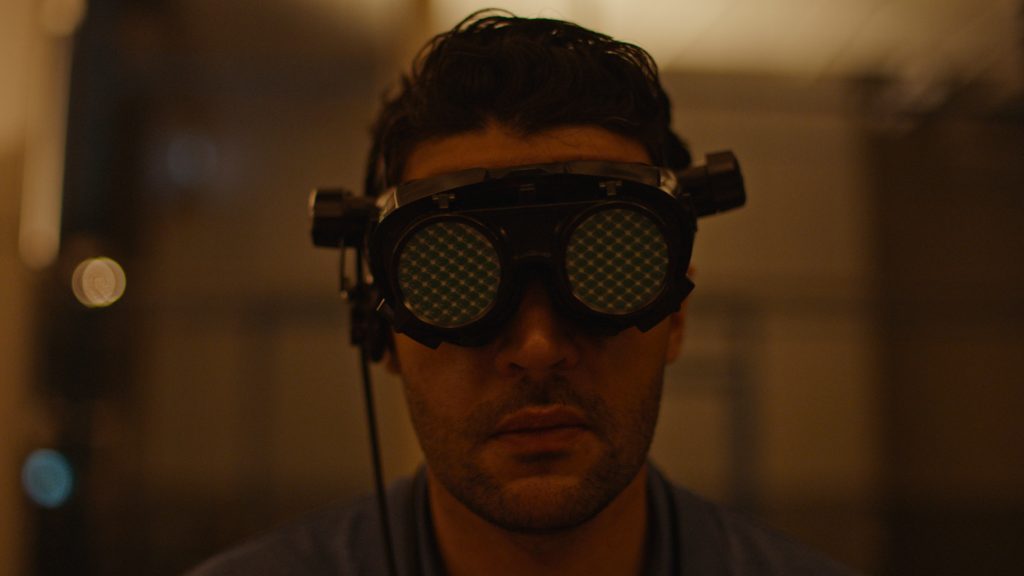
Christopher Abbott in “Possessor Uncut” (Photo courtesy of Neon)
What happens when an assassin’s target turns on the assassin? It’s a concept that writer/director Brandon Cronenberg depicts in the harrowing sci-fi horror film “Possessor Uncut,” but there’s a twist: The assassin’s mind is trapped in a man’s body that she has possessed to carry out her assigned murder spree. When she tries to get her mind back into her real body, the man she has possessed won’t let her go.
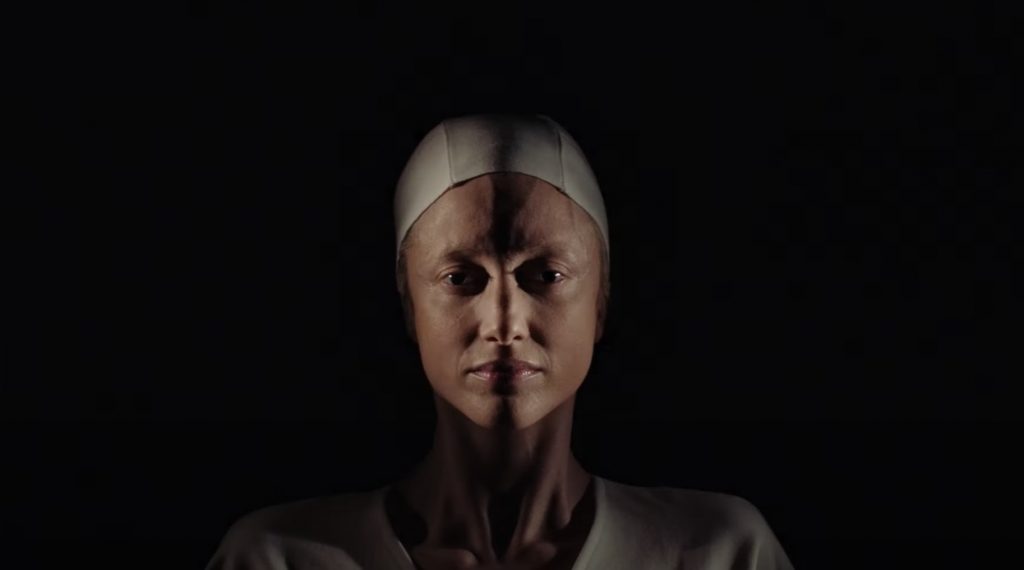
“Possessor Uncut” doesn’t get to this crucial part of the story until the last third of the film. Before then, the movie spends a lot of time showing the audience the personal backgrounds and circumstances that lead to this assassination assignment that goes horribly wrong for the assassin. Tasya Vos (played by Andrea Riseborough) is an elite assassin who works for a mysterious Canadian company that’s in the business of murdering powerful people.
The company’s name and city are not mentioned in the movie, but the company’s wealthy clients are enemies of the murder victims. In the movie’s opening scene, a lounge hostess named Holly Bergman (played Gabrielle Graham), who works at an upscale place called the Blue Light Sky Lounge, has viciously stabbed to a death a rich and powerful man named Elio Mazza (played by Matthew Garlick), in full view of several people who are in the crowded lounge.
After she commits the murder, Holly utters, “Pull me out.” She then takes a gun and appears to get ready to place it in her mouth to commit suicide. But for whatever reason, she can’t do it. The police arrive, she shoots the gun at them, and the police fire their guns at Holly and kill her. Instead of shooting herself, Holly has decided to commit “suicide by cop.”
It turns out that Holly’s mind had been “possessed” by the mind of Tasya, whose real body is lying in what looks like a compression chamber. When Holly said, “Pull me out,” it was Tasya telling the company’s employees overseeing her mind transference to pull her mind out of Holly’s body and back into Tasya’s real body. It’s a routine that Tasya has been trained to take every time her mind possesses the body of someone who commits the assassination that Tasya has been assigned to complete.
The company that Tasya works for has a certain procedure that Tasya is supposed to follow: After the murder or murders for the assignment have occurred, the person whose body Tasya has inhabited is supposed to commit suicide. Right before that suicide happens, Tasya has to request to “pull me out,” so the company can pull Tasya’s mind back into her real body.
After the assassination, the next step is that Tasya has to undergo an evaluation by a supervisor named Girder (played by Jennifer Jason Leigh), who’s usually in the room when Tasya’s mind is transported back to her real body. The evaluation includes a test of Tasya’s memories, to see if her own personal memories are intact and not mixed up and with or “charred by” the mind she previously inhabited. Tasya is shown a series of objects from her childhood (such as her father’s pipe and a framed butterfly) and asked to identify them and describe her memories of them.
The assassination of Elio Mazza was completed, and Tasya’s post-assassination evaluation yielded “normal results.” Girder is pleased that Tasya’s evaluation showed no problems. Girder comments, “Our next assignment is almost finalized. I can’t have our star performer falling apart on me.”
But the murder of Elio Mazza didn’t go exactly according to the company’s plan. The murder was supposed to be committed by shooting, but the murder was instead committed by stabbing. And after the murder, Holly did not immediately shoot herself but instead waited to be shot by police. Girder asks Tasya, “Why stab Elio Mazza? We provided you with a pistol.” Tasya can’t really answer the question.
Despite these discrepancies in Tasya not following these instructions, Girder wants to go ahead and give Tasya a very lucrative assignment. One of Girder’s colleagues expresses concern to Girder that Tasya didn’t follow the suicide instructions according to plan, and he wonders if Tasya will also not follow the instructions during the next assignment. However, Girder dismisses her colleague’s concerns and tells Tasya about her next assignment.
The company wants Tasya’s mind to inhabit the body of Colin Tate (played by Christopher Abbott), who started out as the cocaine dealer for a spoiled heiress named Ava Parse (played by Tuppence Middleton) and ended up becoming her lover and is now engaged to be married to her. Colin and Ava are both in their 30s. Ava’s rich and powerful father is John Parse (played by Sean Bean), a tech mogul who owns a company that makes devices similar to Apple Inc.’s Siri or Amazon’s Alexa. Tasya is supposed to possess the body of Colin for three days.
The company has decided that Ava’s fiancé Colin is the best person to commit the murder, since he has a sketchy background as a drug dealer and it will be framed to look like he had insecurity issues over his life being controlled by a wealthy family. Colin works for John’s company, but Colin is in a low-level position that is probably emasculating for Colin.
Girder explains to Tasya that John’s stepson Reid Parse (played by Christopher Jacot) wants an assassin to murder John and Ava, so that Reid can inherit the family fortune. John is divorced from Ava’s mother and Reid’s mother, so these two women presumably aren’t in John’s will. (Neither woman is seen in the movie, although later in the story, John makes a bitter comment to Ava about Ava’s mother leaving him years ago.) Because Reid has John’s last name, it’s inferred that John adopted Reid when John was married to Reid’s mother.
As is the company’s usual procedure, the plan is for Colin (the possessed assassin) to commit suicide immediately after the murders of John and Ava. Rather than have the police look for a stranger assassin, the case will be closed because investigators will conclude that it was a murder-suicide committed by Colin. A sizeable chunk of the fortune that Reid wants to inherit will go to the company that employs Tasya and Girder. Girder also mentions to Tasya that the assassin company will essentially “control” Reid, because it’s implied that the assassin company has so much dirt on Reid (including his murder-for-hire scheme) that the company could easily get more money out of him by blackmailing him.
As a star employee of this assassin company, Tasya’s work life might be going well, but her home life is not going well at all. She’s separated from her husband Michael Vos (played by Rossif Sutherland), who is living with their son Ira (played by Gage Graham-Arbuthnot), who’s about 7 or 8 years old. Michael and Ira don’t know what Tasya does for a living. Throughout the story, it’s implied that because Tasya has such a secretive job that requires her to spend long periods of time away from home, it’s taken a toll on her marriage to Michael.
Although Tasya is officially separated from Michael, she still goes back and forth between her home (where she lives by herself) and the home where Michael and Ira live. It seems that Tasya can’t quite make up her mind if she wants to get back together with Michael or go through with a divorce. During one of those times that she’s back with Michael and sleeping with him, she has nightmares about the stabbing of Elio Mazza.
The marketing materials of “Possessor Uncut” prominently feature star Riseborough as the main character, but she is really only in half of this movie. Abbott gets a lot of screen time as Colin, and he could easily be considered a co-lead actor for this film. In the movie, Tasya is seen spying on Colin and Ava in their home by telescope (apparently Tasya has rented a place near the home), so that she can study Colin’s speech patterns, mannerisms and home routines. It’s her preparation before Tasya’s mind will inhabit Colin’s body.
One of the plot holes in “Possessor” is that it never fully explains how the person who’s supposed to be possessed gets into a situation where the mind transfer can be completed without their full knowledge. There’s some vague imagery of the mind transfer happening to Colin while he’s asleep. Tasya has to be hooked up to machine for the mind transfer, but the body she possesses apparently doesn’t have to be hooked up to a machine when the mind transfer happens. This is a science-fiction film, so viewers will just have to go with this murky explanation for how the mind transfer happens.
As part of her training, Tasya has been warned that although her mind can possess someone else’s body, the original mind of that person can still exist in the body. The trick is for Tasya’s mind to dominate the other person’s mind and then leave no trace of her mind when she leaves the person’s body. The danger comes when the other mind is conscious of being possessed by Tasya and attempts to take back control.
This twisty concept of “Possessor Uncut” might be too confusing to some viewers, because it’s all explained in bits and pieces and not in a completely straightforward manner. This is a movie that can be fully appreciated if it’s watched without other distractions going on. There are many details that need to be paid attention to when watching this movie, in order to get the full picture of what’s happening and the subtle indications of what’s going to happen.
About halfway through the movie, when Andrea’s mind possesses Colin’s body, the movie pivots to showing Colin’s life. At John’s company, Colin works at a job that barely pays minimum wage. He works as some kind of surveillance monitor (he wears virtual-reality goggles as part of his job), for the Siri/Alexa-type devices that are in people’s homes, to make sure that the devices are working properly.
It’s really just a legal way to spy on people in their homes, since people who buy these devices have waived certain rights to privacy as part of the user agreement. Therefore, a lot of this company’s employees can watch many intimate things that go on in people’s homes, including people having sex. It’s what Colin does in one of the movie’s scenes. And it’s writer/director Cronenberg’s way of showing viewers that this part of the movie isn’t really science fiction, because devices like Siri and Alexa have embedded audio and video components that can be monitored by employees of the companies that make these devices.
Colin has a smarmy co-worker named Eddie (played by Raoul Bhaneja), who gets off on watching people have sex without them knowing it. Eddie considers the sexual voyeurism one of the perks of the job, because it happens so often, and he tries to compare “spying” stories with Colin. Colin doesn’t really engage in these conversations because he just sees this spying activity as part of a job, not as a way to feel power over people. However, Colin is curious enough to keep watching when he does see people having sex.
Colin’s relationship with Ava is still fueled by cocaine, which he supplies for them since he has the connections. However, now that he is engaged to Ava and can live off her money, it’s implied that he just buys cocaine and has stopped selling it. Ava seems to be in love with him but it’s not clear how Colin really feels about her because the movie mainly shows Colin when he’s possessed by Tasya’s mind.
During a scene in Ava and Colin’s home where they’re having a small party with their friends, one of the friends named Reeta (played by Kaniehtiio “Tiio” Horn), who works at John’s company, hints that Ava has some “daddy issues.” Ava has a history of dating men who don’t get the approval of Ava’s father John, who then finds ways to humiliate these boyfriends. In Colin’s case, John’s way of humiliating Colin is to give him a very low-paying job at the company. It’s never fully explained why Colin doesn’t just work somewhere else, but it’s implied that Colin wants to do whatever it takes to get in this rich family’s good graces.
Under the orders of Girder, Tasya is told that while Tasya’s mind is in possession of Colin’s body, Colin is supposed to stage a big public fight with John, to give investigators a motive for the murders. The opportunity comes at a lavish party that John has, where many of his business colleagues are in attendance. But all does not go according to plan.
And there were signs that things would go wrong, because Tasya’s memories and thoughts were being in “invaded” by Colin’s memories and thoughts. The movie has some very striking and sometimes unsettling visuals depicting this messy melding and the eventual mind battle that takes place in Colin’s body. All of these visual effects have a very “scary psychedelic trip” look to them that will definitely make people remember this movie.
Riseborough is the top-billed star of “Possessor Uncut,” and she does a good job in her role, but the Tasya character remains a mystery throughout the entire film. The movie shows more of Colin’s personal life than it shows of Tasya’s personal life. Perhaps writer/director Cronenberg wanted to keep Tasya an enigma, so that it would be easier for viewers to see her as a chameleon who could inhabit other people’s bodies.
Abbott has the more difficult performance in conveying a person whose body is being possessed and fought over by two different people. It’s a very convincing performance that takes “Possessor Uncut” to a higher-quality level than the average “body possession” horror movie. The movie’s storyline is sometimes a bit choppy, but if people can handle the film’s dark themes and uniquely horrifying imagery, then “Possessor Uncut” is worth watching for some unnerving depictions of mind power and control.
Neon and Well Go USA released “Possessor Uncut” in select U.S. cinemas on October 2, 2020.