
Review: ‘O’ Romeo,’ starring Shahid Kapoor, Tripti Dimri, Nana Patekar, Avinash Tiwary, Tamannaah Bhatia, Disha Patani, Farida Jalal and Vikrant Massey

February 17, 2026

by Carla Hay

Shahid Kapoor and Tripti Dimri in “O’ Romeo” (Photo courtesy of Pen Marudhar)

“O’ Romeo”

Directed by Vishal Bhardwaj

Hindi and Spanish with subtitles

Culture Representation: Taking place in India, Spain, and Nepal, the action film “O’ Romeo” features an cast of predominantly Asian cast of characters (with some Latin people) representing the working-class, middle-class and wealthy.

Culture Clash: A former gang member, who works as a vigilante assassin for hire by a secretive government operation, gets involved with a widow who wants to kill the men who were responsible for her husband’s death.

Culture Audience: “O’ Romeo” will appeal primarily to people who are fans of the movie’s headliners and extremely violent movies that are predictable, long-winded and cynically try to look romantic.

Avinash Tiwary in “O’ Romeo” (Photo courtesy of Pen Marudhar)

“O’ Romeo” is yet another bloated, soulless cesspool of nasty violence that serves no purpose but to try to make a serial killer look like a sexy hero. This movie thinks it’s clever to have a woman become his assassin accomplice, but everything is just vile. If a movie is going to be extremely violent, at least it should have a compelling and interesting story, instead of dumping this predictable, regurgitated slop into the world.

Directed by Vishal Bhardwaj (who co-wrote the awful “O’ Romeo” screenplay with Rohan Narula), “O’ Romeo” takes place in India, Spain, and Nepal. “O’ Romeo” is one of those movies whose plot is so unimaginative and basic, it could really could have been a movie that’s 100 minutes or less. But this cinematic equivalent of toxic sludge is poured on too thick and spread out over a unnecessarily long 278 minutes.

“O’ Romeo” is nearly three hours of sadistic beatings, vicious stabbings, body-decimating shootings and disgusting tortures in a checklist of murders. In between this excessive violence and mindless dialogue, “O’ Romeo” throws in some song-and-dance numbers and uncovincingly tries to make this rage-filled homicidal “hero” show his “soft side” when he falls for a widow who wants to hire him as assassin. He ends up training her on how to murder people, and she joins him on his killing spree. The movie tries very hard to make it all look so romantic, but it’s really just glorifying disgusting murders.

It doesn’t take long for “O’ Romeo” to starts with its bloody slaughter scenes. The movie begins to show playboy assassin Ustara (played by Shahid Kapoor) living in Mumbai, on a ramshackle trawler that isn’t really used for fishing but more as a place for Ustara to strut, lounge around, and have sex with random women. A bunch of Ustara’s no-name sycophant hoodlum buddies often hang out with Ustara and don’t do much except worship him and occasionally help in group fights.

However, “O’ Romeo” is the type of moronic mess where the “hero” is usually a one-man army defeating several opponents who outnumber him and have more weapons. It all looks so fake and gives this idiotic movie no suspense. The first big fight involves Ustara defeating someone called Chhotu (played by Hussain Dalal) in a completely useless scene where Ustara ambushes Chhotu and Chhotu’s cohorts on another boat. This fight is then followed by a very unrealistic shoot-out inside a movie theater during a private screening for two filmmakers. A group of about 50 to 70 security guards storm into the theater and join the fight. But unsurprisingly, Ustara is able to defeat them all.

Ustara is a former gang member who is in “exile” because he killed the brother of a powerful and ruthless crime lord named Jalal (played by Avinash Tiwary), who is the chief enemy in this story. Jalal has another reason to hold a grudge against Ustara: Jalal’s wife Rabia (played by Tamannaah Bhatia) had a miscarriage from the stress caused by Ustara’s murder of Jalal’s brother. Jalal is seeking revenge on Ustara and wants Ustara to be murdered.

Ustara now works as an assassin for a mysterious government operation, where Ustara reports to an Intelligence Bureau supervisor named Ismail Khan (played by Nana Patekar), who likes to call himself The Godfather. If Ustara is supposed to be “undercover” or “in hiding,” he has a ridiculous way of going about it, because there are many scenes where Ustara is dancing up a storm and partying in nightclubs. (In other words, he’s not that hard to find.) Disha Patani has a small role as a belly dancer named Julie in one of these song-and-dance scenes.

An elderly woman named Dadi (played by Farida Jalal) acts as a “grandmother” figure who looks after Ustara and his thug cronies. The only reason why she’s in the movie is so she can make not-very-funny remarks while occasionally cursing. It’s a very tried and stale gimmick for filmmakers to think it’s supposed to automatically be hilarious when an old woman uses coarse language. Dadi’s screen time in “O’ Romeo” is very limited (less than 15 minutes), which means her only purpose in the movie is to be a token old lady who is supposed to be laughed at by viewers.

One day, while Ustara is lounging on his boat deck and surrounded by his hooligan followers, a widow named Afsha Qureshi (played by Triptii Dimri) arrives for an unannounced visit. Afsha wants to hire Ustara to murder the four men whom she says are responsible for her husband’s murder and the cover-up of his murder: crime lord Jalal, Jalal’s high-ranking associate Shankar (played by Rohit Pathak), a corrupt police officer named Inspector Pathare (played by Rahul Deshpande), and criminal defense attorney Anjum Ansari (played by Resh Lamba).

Ustara rejects this offer repeatedly, so Afsha makes a botched attempt to kill Anjum herself, when she tries to shoot him in a cafe where there are several witnesses. Anjum fights back, Afsha gets wounded by a gun bullet, Anjum pins Afsha to the floor, and then he puts a gun in her mouth. Just as he’s about to shoot her, Ustara comes from behind and slits Anjum’s throat.

Nothing ever happens to Ustara for committing murder in such a public way. He’s never questioned or arrested. Ustara carries Afsha back to his houseboat, takes out the bullet that wounded her, and then helps her recover. During this recovery, Ustara goes into detail about why she wants this four men to be murdered.

“O’ Romeo” then spends quite a bit of time on flashbacks showing the marriage of Afsha and Mehmood “Mamdu” Qureshi (played by Vikrant Massey), who was an accountant for Jalal. Mamdu knew that he was doing illegal things for Jalal, but Mamdu justified it to himself because he wanted the money so that he and Afsha could have a comfortable lifestyle. However, Afsha found out that Mamdu was committing accounting crimes while working for Jalal, and she convinced Mamdu to quit working for Jalal.

Out of revenge and to ensure that Mamdu wouldn’t go to authorities, Jalal ordered the murder of Mamdu, who was gunned down on a street by one of the men who is now on Afsha’s hit list. The movie shows who actually pulled the trigger. Afsha tells Ustara that she won’t be satisfied until all four men on her hit list are murdered.

The rest of “O’ Romeo” shows what happens when Ustara convinces Afsha that she should “empower” herself and become an assassin too. He trains her on how to become an assassin. During this training, Ustara takes Afsha to Kathmandu, Nepal—which is just the movie’s excuse to show Ustara and Afsha in more exoctic locales than Mumbai—as Ustara and Afsha slowly and predictably fall in love with each other.

Jalal has been living in Spain, where he has been involved in international terrorist activities while still leading his criminal operations going on in India. In Spain’s La Línea de la Concepción municipality, Jalal has been spending a lot of time bull fighting. And so, there are repetitive scenes of him in the bull ring, as he performs to arena-sized crowds. “O’ Romeo” has enough bull fighting scenes to make it obvious that a big showdown is going to take place during a bull fight.

The performances in “O’ Romeo” are nothing special because all the characters are stereotypes in some way. The movie’s attempts at comedy are clumsy and out-of-place. For example, there’s a scene where Ustara feels some guilt over all the misery he has caused his life, so he starts sobbing uncontrollably. His copycat friends then all start crying in the same way too. It’s supposed to be amusing, but the joke falls flat.

All of these attempts to make Ustara look more “sensitive” and “caring” don’t ring true when the movie repeatedly shows how much pleasure he takes from his grotesque overkill way of murdering people. And it’s very off-putting how “O’ Romeo” turns Afsha from a weeping and meek widow into a cold-blooded killer. There’s nothing romantic about the toxicity that’s on vulgar display in this shoddily made movie. And the way a classic line from William Shakespeare’s “Romeo and Juliet” is repurposed to be a pun title for this trashy movie would have Shakespeare rolling over in his grave, although people who don’t watch “O’ Romeo” should consider themselves lucky.

Pen Marudhar released “O’ Romeo” in select U.S. cinemas and in India on February 13, 2026.

Review: ‘Teri Baaton Mein Aisa Uljha Jiya,’ starring Shahid Kapoor and Kriti Sanon

March 11, 2024

by Carla Hay
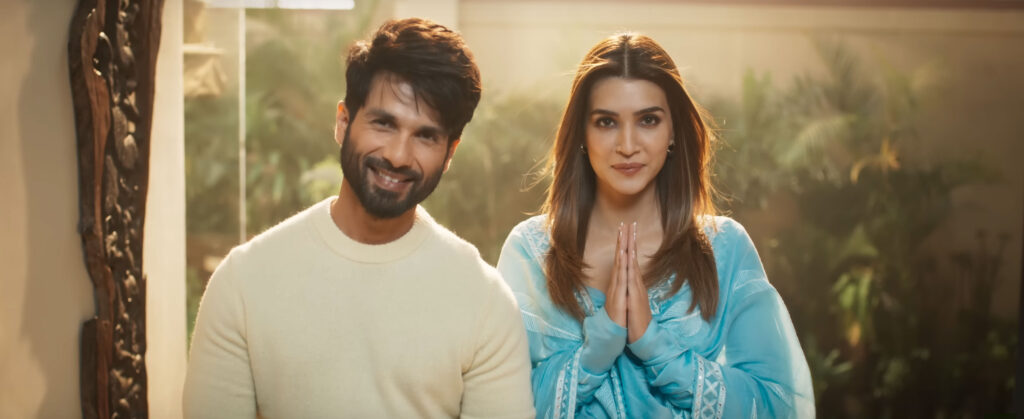
Shahid Kapoor and Kriti Sanon in “Teri Baaton Mein Aisa Uljha Jiya” (Photo courtesy of FunAsia Films and Nirvana Cinemas)

“Teri Baaton Mein Aisa Uljha Jiya”

Directed by Amit Joshi and Aradhana Sahy

Hindi with subtitles

Culture Representation: Taking place in India and in the United States, the sci-fi comedy film “Teri Baaton Mein Aisa Uljha Jiya” features a predominantly Indian cast of characters (with some white people) representing the working-class, middle-class and wealthy.

Culture Clash: A robotics engineer, who works for his aunt’s company, finds out that the woman he has fallen in love with is a robot that was programmed by his aunt to seduce him. 

Culture Audience: “Teri Baaton Mein Aisa Uljha Jiya” will appeal primarily to people who are fans of the movie’s headliners and silly romantic comedies.
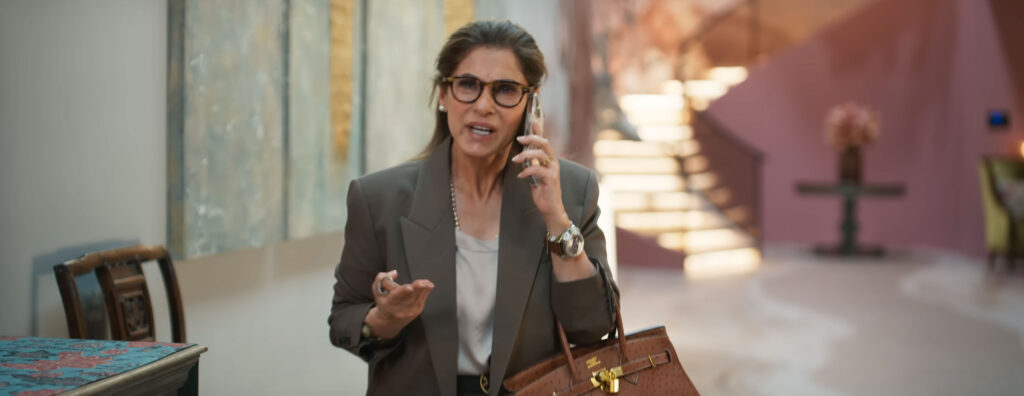
Dimple Kapadia in “Teri Baaton Mein Aisa Uljha Jiya” (Photo courtesy of FunAsia Films and Nirvana Cinemas)

“Teri Baaton Mein Aisa Uljha Jiya” is an overly long, repetitive movie that not only does not justify being 143 minutes, but the film also does not justify its entire existence. This unimaginative comedy relies too much on clichés about a guy falling in love with a “perfect female,” who happens to be a robot. This vapid movie becomes increasingly foolish until it becomes a very bad joke on viewers expecting it to get better.

Written and directed by Amit Joshi and Aradhana Sahy, “Teri Baaton Mein Aisa Uljha Jiya” (which means “got s tangled n your words” in Hindi) runs its weak slapstick jokes into the ground very early and then repeats them to irritating levels. Viewers who watch this onslaught of terrible filmmaking will be subjected to watching people in the movie act even worse than their bad dialogue. About the only thing that this time-wasting movie can brag about is that it has pretty scenery and physically attractive leading cast members.

In “Teri Baaton Mein Aisa Uljha Jiya” (which takes place mostly in Mumbai, India), playboy bachelor Aryan Agnihotri (played by Shahid Kapoor) is a robotics engineer who works for Robotex, a company owned by his aunt Urmila Shukla (played by Dimple Kapadia), who is demanding and impatient. Two of Aryan’s co-workers are flirtatious Myra (played by Amisha Thakur) and married man Monty (played by Ashish Verma), who gives Aryan simplistic relationship advice, such as “Everything is a compromise.”

“Teri Baaton Mein Aisa Uljha Jiya” is so inept and repetitive in its storytelling, it opens with a scene that’s a too-early foreshadowing of the rest of the story. In this first scene, Aryan’s family has arranged a marriage for him that he does not want. When he meets his bride-to-be for the first time, she is wearing a long veil over her face. And he finds out that she’s a robot that malfunctions. But surprise! It’s just a nightmare that Aryan had.

In reality, Aryan’s parents are very worried that he isn’t married yet. When Urmila reminds him that Aryan’s parents are eager to see him settle down and get married, Aryan reminds Urmila that she didn’t get married until she was 40 years old, and she got divorced six months later. Aryan will soon find out that Urmila is more of a meddler in his love life than she appears to be.

One day, Urmila tells Aryan to go to the United States on business. He stays at a luxury villa that the company uses for high-ranking visiting employees. Aryan is greeted at the villa by a woman named Sifra (played by Kriti Sanon), who tells him that she works for Urmila and has been tasked with taking care of all of Aryan’s needs during his stay. Aryan is immediately attracted to Sifra, who seems to seems to “have it all,” in terms of looks, intelligence and personality. Aryan and Sifra become lovers after some flirtations and romantic dates.

The trailer for “Teri Baaton Mein Aisa Uljha Jiya” already reveals about 80% of the movie’s very thin plot: Aryan finds out that Sifra is a robot made by Robotex. Her name is actually spelled SIFRA, an acronym for Super Intelligent Female Robot Automation. And she was programmed by Urmila to seduce Aryan as an experiment to see if a human being could fall in love with a robot. When Aryan asks SIFRA how she can so respond so well to his needs, SIFRA says that she can expertly read people’s facial expressions and body language and react accordingly.

What’s a playboy bachelor to do when his family is pressuring him to get married and he’s found his “ideal woman,” but she’s a robot? In a moronic movie like “Teri Baaton Mein Aisa Uljha Jiya,” he takes her home to meet his family, introduces her as a girlfriend he’s in a serious relationship with, and then he proposes to her, as they plan a wedding that the family wants to happen as soon as possible. The majority of “Teri Baaton Mein Aisa Uljha Jiya” is about Aryan trying to keep it a secret from his family that SIFRA is a robot.

“Teri Baaton Mein Aisa Uljha Jiya” fills up some of its time with stereotypical musical numbers that have forgettable music and generic lyrics. Aryan’s family is a predictable clan that is usually found in romantic comedies: large, loud and intrusive. These squawking family members include Aryan’s father Jai Singh Agnihotri (played by Dharmendra); Aryan’s mother Sharmila Agnihotri (played by Anubha Fatehpuria); Aryna’s teenage sister Tim Tim (played by Maahi Raj Jain); and assorted grandparents, aunts, uncles and cousins of Aryan.

As the wedding of Aryan and SIFRA approaches, “Teri Baaton Mein Aisa Uljha Jiya” becomes a pile-on of ludicrous “close-call” scenarios that usually involve whether or not SIFRA’s battery is charged enough for her to function, or how much memory she has. The worst part of the movie is in the last half-hour when it really goes off the rails with violence. And there’s a misogynistic tone to the plot, because it revolves around objectifying the main female character. An over-used gag in “Teri Baaton Mein Aisa Uljha Jiya” is showing what happens when SIFRA malfunctions, but this dreadfully unfunny movie is nothing but a giant malfunction.

FunAsia Films and Nirvana Cinemas released “Teri Baaton Mein Aisa Uljha Jiya” in U.S. cinemas on February 9, 2024, the same day that the movie was released in India.

Copyright 2017-2026 Culture Mix
CULTURE MIX