
Review: ‘The Diplomat’ (2025), starring John Abraham, Sadia Khateeb, Kumud Mishra, Sharib Hashmi, Revathy and Ashwath Bhatt

March 16, 2025

by Carla Hay

John Abraham, Vidhatri Bandi and Sadia Khateeb in “The Diplomat” (Photo courtesy of Panorama Pictures)

“The Diplomat” (2025)

Directed by Shivam Nair

Culture Representation: Taking place in 2011, in Pakistan, in India and briefly in Malaysia, in 2017, the dramatic film “The Diplomat” (based on real events) features an all-Asian group of people representing the working-class, middle-class and wealthy.

Culture Clash: J. P. Singh, Deputy High Commissioner of India in Pakistan, leads a rescue effort to save an Indian woman who wants to be classified as a refugee because she says a Pakistani man forced her into abusive marriage and wants to keep her in captivity in Pakistan.

Culture Audience: “The Diplomat” will appeal primarily to people who are interested in watching dramatic recreations of real-life international political stories involving refugee rescues.

Jagjeet Sandhu in “The Diplomat” (Photo courtesy of Panorama Pictures)

Based on a true story about an Indian woman seeking an embassy rescue from her abusive Pakistani husband, “The Diplomat” tends to portray the heroes and villains as two-dimensional. This drama is still very compelling. And even when some of the movie gets melodramatic, the performances are never boring and carry the story through to a predictable but gratifying ending

Directed by Shivam Nair and written by Ritesh Shah, “The Diplomat” (which takes place in 2017) does not change the names of the main real-life people who are depicted in the movie. The movie’s first sequence is filled with gripping tension that doesn’t really let up until the expected outcome. “The Diplomat” realistically shows how the woman asking to be rescued had to go through clearance checks and skepticism before she was believed.

“The Diplomat” begins on May 5, 2017, by showing Uzma Ahmed (played by Sadia Khateeb), a woman in he 20s who is covered head-to-toe in veiled clothing as a passenger in a car driven by her husband Tahir Bashir (played by Jagjeet Sandhu), with Tahir’s best friend Basheer (played by Bhawani Muzamil) as a passenger. They are traveling in Pakistan from the district of Buner to the capital city of Islamabad. Uzma is an Indian citizen and they are going to the Indian Embassy in Islamabad to get some legalities sorted out for her passport.

At first glance, it looks like a leisurely trip. But Uzma is very quiet, and there is tension brewing. When Tahir, Basheer and Uzma arrive at the embassy, they go through the usual security checkpoints. But as soon as Uzma gets out of the eyesight range of Tahir and Basheer, she frantically runs to an employee in a glass enclosed booth, announces that she’s an Indian citzien, and begs for help because she says her life is in danger because she’s being forcibly detained in Buner.

The employee lets her go into a room that has other employees. The room has a locked door. Uzma grows increasingly hysterical and paranoid that the employees will let Tahir and Basheer into the room. Uzma says she was tricked into going to Pakistan and forced to marry Tahir, who has been physically abusing and keeping her in captivity.

The employees don’t know what to think without proof that what Uzma is saying is true. Uzma has a valid passport. A background check shows that she does not have a criminal history. Meanwhile, Tahir and Basheer are outside and demanding that Uzma go back to the car with them. Uzma refuses.

And that’s when a supervisor is called in to investigate the matter: J.P. Singh, the Deputy High Commissioner of India in Pakistan. J.P. (played by John Abraham) has a tall, commanding presence and a take-charge, no-nonsense style of leadership. When he questions Uzma in a conference room, he’s skeptical of her story because Uzma says that she was able to go to Buner without passing through checkpoints or having any records on immigration travel sheets.

When Uzma is in a room with two female employees, Uzma shows them the bruises that she says came from Tahir’s beating. A medical inspection shows that Uzma has bruises from sexual assault. A female employee named Seerat (played by Vidhatri Bandi) sees all of Uzma’s injuries and tells J.P. that she believes Uzma. J.P. still does not want to come to any conclusions because he says that even if the injuries were not self-inflicted, there’s no proof that Tahir caused these injuries and no proof that Uzma is being held captive.

Other people involved in the investigation are Sushma Swaraj (played by Revathy), India’s Union Minister of External Affairs, who calls J.P. to get updates on the case; Tiwari (played by Sharib Hashmi), an Indian Foreign Service official in Pakistan; and Malik Sahab (played by Ashwath Bhatt), Pakistan’s Director General of Inter-Services Intelligence. N.M. Syed (played by Kumud Mishra) is a senior diplomat/attorney who works at the Indian Embassy in Pakistan. N.M. brings a little bit of comic relief to the movie because he is a character who often seems surprised when J.P. tells him to do something that N.M. thinks he won’t be able to handle, but then N.M. ends up handling it pretty well.

Of course, Uzma is telling the truth about being kidnapped and trapped in an abusive marriage. Tahir is the type of abuser who wants to appear calm and rational to authorities, but Basheer is a loose cannon and immediately threatens violence if Uzma is not returned to them. It’s enough for the embassy officials to see that Uzma is probably telling the truth. And the movie quickly mentions that Uzma’s brother Aamir works for the Indian Embassy. Having that type of inside connection definitely helped.

What also helps Uzma is that because her rescue plea was so dramatic and so public, the media latches on to the story, which becomes big news in India and in Pakistan. With all the media attention, Uzma’s refugee story becomes an international political and legal case that can’t be dealt with quietly. Tahir ends up filing legal action that leads to a big courtroom showdown.

Before that happens, Uzma tells her story (shown in flashbacks) about how she ended up in this terrible situation. Uzma is a divorcée raising a daughter named Noor (played by Maryam Patel), who looks about 3 or 4 years old. Noor has thalassemia, an inherited blood disorder that causes the body to have less hemoglobin than normal. Uzma cannot afford the medical treatments that Noor needs.

Uzma met Tahir while they were both visiting in Kuala Lumpur, Maylasia. Tahir charms Uzma into a romance. He convinces her to move to Pakistan because he says that Noor can get affordable medical care in Pakistan. Uzma has relatives in Pakistan, which is why she did not hesitate to make this move. The relationship with Tahir and Uzma becomes serious enough where they make plans to live together.

On the drive to Buner (which is an area that is a lot more isolated and rural than Uzma expected), Tahir and Basheer are in the car with Uzma. Because they are driving in a winding mountain area, Tahir says Uzma might get motion sickness, so he gives her pill that he says will help her not get motion sickness. The pill is really a drug that makes Uzma feel disoriented.

When they arrive at Tahir’s home, the nightmare begins for Uzma. She finds out that he’s already married with kids and has a harem of other women who do whatever he says. Uzma is locked up in a room, where she is frequently beaten and raped by Tahir. The rape scenes are not graphic and poignantly show a closeup of Uzma’s eyes while she has this abuse inflicted on her.

Tahir then forces Uzma to marry him. (Polygamy is legal in Pakistan, with certain restrictions.) Uzma is living like a tortured prisoner. But with help from another woman in Tahir’s harem, Uzma is able to make a phone call that saves Uzma’s life. It’s the phone call that gives her the opportunity to go the Indian Embassy in Islamabad.

“The Diplomat” is focused primarily on showing J.P. to be the type of crusading professional that almost seems too good to be true. There are brief glimpses into J.P.’s home life in a few scenes that show he has a wife (played by Shriswara) and an underage son (played by Shaunak Duggal), as if to prove that he has a life outside of work. J.P.’s only vulnerability is shown in flashback scenes that reveal that J.P. is still feeling trauma over being in an embassy bomb explosion caused by the Haqqani Network, a Sunni Islamist militant group.

“The Diplomat” tells a story about the best and worst of humanity. However, the movie tends to depict its characters in broad strokes, with performances to match. All the “heroes” don’t have any personality flaws. All the “villains” are nothing but personality flaws. The performances are very watchable in the way that most superhero movies are watchable: You know that what’s on screen is exaggerated for dramatic purposes, but it’s a “good versus evil” story that’s kind of irresistible despite the familiar filmmaking formulas.

“The Diplomat” has no subtlety or nuances about its intentions to be a valiant refugee movie, with the Indian government presented as the best possible rescuer. It’s not quite propaganda, but the movie noticeably diminishes or sidelines the roles of the Pakistani government diplomats in this case. “The Diplomat” is not trying to educate people on the intricacies of international law. This movie succeeds in its main intention to tell a gripping refugee story based on real events, while tugging at viewers’ heartstrings.

Panorama Pictures released “The Diplomat” in select U.S. cinemas and in India on March 14, 2025.

Review: ‘Afwaah,’ starring Nawazuddin Siddiqui, Bhumi Pednekar, Sumeet Vyas and Sharib Hashmi

May 21, 2023

by Carla Hay

Bhumi Pednekar and Nawazuddin Siddiqui in “Afwaah” (Photo courtesy of Reliance Entertainment)

“Afwaah”

Directed by Sudhir Mishra

Hindi with subtitles

Culture Representation: Taking place in India, the action film “Afwaah” features an all-Indian cast of characters representing the working-class, middle-class and wealthy.

Culture Clash: An advertising professional becomes unwittingly involved in deadly political corruption when he agrees to help a political socialite go into hiding. 

Culture Audience: “Afwaah” will appeal primarily to people who like watching action-oriented movies about dangerous political feuds and how social media gossip can easily spread to mainstream media.
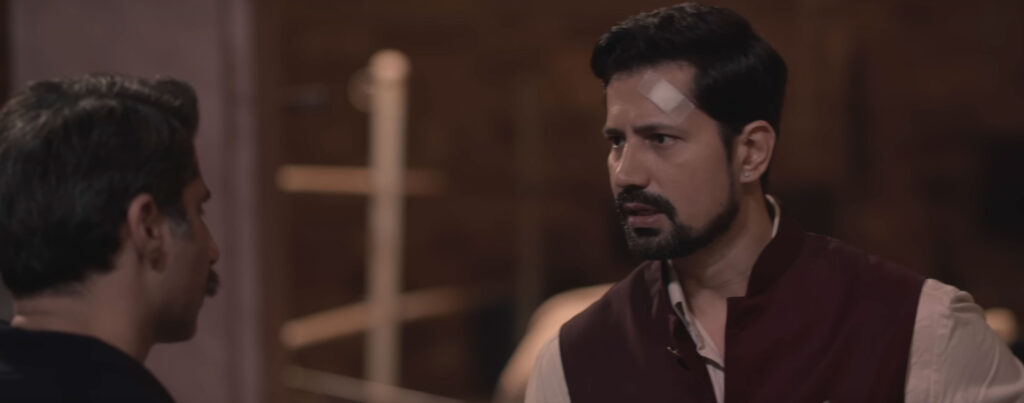
Sumit Kaul and Sumeet Vyas in “Afwaah” (Photo courtesy of Reliance Entertainment)

“Afwaah” is a flawed political thriller that has enough suspenseful and well-acted moments that outweigh the movie’s shortcomings. The movie has pointed observations about how social media can be used as a way to manipulate mainstream news media. “Afwaah” (which means “rumor” in Hindi) is less skilled at showing realism in this story about two people hiding out from kidnappers and assassins.

Directed by Sudhir Mishra (who co-wrote the “Afwaah” screenplay with Nisarg Mehta and Shiva Bajpai), “Afwaah” is also a story about how two people from different worlds can become unlikely allies under certain circumstances. The two people whose worlds collide in “Afwaah” (which takes place in India) are advertising professional Rahab Ahmed (played by Nawazuddin Siddiqui) and political socialite Nivedita “Nivi” Singh (played by Bhumi Pednekar), who end up going into hiding together.

Rahab, who is Muslim, is a well-respected expert in his profession. He often gives motivational and charismatic speeches to large audiences. Rahab comes from a working-class background (his father was a carpenter) and has been able to elevate his social status from his parents, by getting a college education and earning a high ranking in the advertising profession.

Nivi, who is Hindu, grew up in wealth and privilege. Her father is Chandan Singh (played by Sharib Hashmi), who is the leader of a political party. Nivi works with her father and is expected to spend her life in politics. She is engaged to an ambitious politician named Vicky (played by Sumeet Vyas), who is likely to be named the deputy of the political party because he will be the future son-in-law of Chandan.

But as is always the case in politics, there are power struggles. Some backstabbing plans have been set in motion by police inspector Sandeep Tomar (played by Sumit Kaul) and Vicky, who are is secretly plotting to have Chandan assassinated. Sandeep tells Vicky that Chandan has to die because Chandan has “grown a conscience.”

The assassination plot comes soon after Vicky and three of his cronies were caught on video beating up some political protestors. The video goes viral. Nivi is alarmed and starts to doubt that Vicky has the type of ethics and character that she wants in a husband. Vicky brushes off her concerns and tries to convince her that the viral video is not work making a fuss over, and people will eventually forget about the video.

The relationship between Vicky and Nivi begins to deteriorate. Knowing that Nivi can influence what Chandan thinks, Vicky secretly wants Chandan out of the way so that Vicky will take over the political party. And then, Nivi finds out that she’s in danger too.

One night, Nivi is out by herself in an open marketplace area. A man suddenly starts to harass her. And then, more men show up and surround Nivi, who is no pushover. It’s a kidnapping attempt, and Nivi fights back with kicks and punches.

Rahab happens to be driving his car though this area the same time, and he witnesses this attack. A frantic Nivi runs up to Rahab’s car, opens the door, and tells him to drive away. The kidnappers chase after them on motorbikes, but Rahab is able to lose them by driving down in an alley. Unfortunately, the car crashes.

The rest of “Afwaah” is a tension-filled journey, as Rahab and Nivi go into hiding. Soon after they meet under these stressful circumstances, Nivi tells Rahab who she is and that she doesn’t want to marry Vicky. “He’s lost his mind since the new alliance,” says Nivi. “He’s become nothing but a power-hungry bigot.”

When Vicky finds out that the kidnapping attempt failed and some people on the street took videos of the incident, Vicky takes the advice of a computer hacker named Bobby (played by Appurv Gupta) to twist the story into making Rahab the villain. Vicky plants a story on social media that Rahab was the real mastermind behind the kidnapping. Vicky’s cronies, who were the actual kidnappers, are praised as “heroes” who tried to save Nivi from Rahab.

This lie spreads on social media and is quickly reported as the truth by mainstream media. The lie gets even more warped with the untruth that Rahab (who is married) and Nivi ran off together to elope in a bigamy situation. The lie seems to have credibility because Nivi is still missing. Rahab then becomes the chief suspect in her disappearance.

Why doesn’t Nivi come forward and tell the truth? She’s afraid that people will believe Vicky over her. She knows that Vicky has a lot of allies in law enforcement, and she doesn’t know who to trust. Nivi and Rahab are also aware that too many people believe the lie because the media coverage has been reporting the lie as the truth.

“Afwaah” is at its best in the scenes of Nivi and Rahab together, since they have the best dialogue in the movie. All the “villains” in “Afwaah” tend to be caricatures. There’s also a somewhat unnecessary subplot involving a murder on Vicky’s property. And the movie goes into soap opera territory with a subplot about corrupt police inspector Rahab (who is married) having a secret affair with a female cop colleague named Riya Rathod (played by T.J. Bhanu), who might or might not find out how he’s involved in an assassination plot.

“Afwaah” also doesn’t do a very good job of showing certain aspects of the “fugitive” part of Nivi and Rahab going into hiding. The scenes involving Rahab’s wife Nandita (played by Eisha Chopra) have melodrama that lowers the quality of the movie. However, the performances of Siddiqui and Pednekar enliven “Afwaah” and bring credible emotional gravitas when needed.

There are plenty of movies about ruthless people trying to gain political power. What’s more interesting about “Afwaah” is how accurately it portrays media manipulation. It’s an insightful commentary on how much social media can play a role in shaping news coverage in mainstream media. If you don’t believe it, look at many mainstream news stories cite anonymous and unverified people on social media as “sources,” when that type of sourcing would not have met journalistic standards at a lot of the same media outlets in previous years. “Afwaah” is a fictional movie, but it’s also a cautionary tale of what can go on in the real world when it comes to media, politics and public images.

Reliance Entertainment released “Afwaah” in select U.S. cinemas and in India on May 5, 2023.

Copyright 2017-2026 Culture Mix
CULTURE MIX