
Review: ‘Dìdi’ (2024), starring Izaac Wang and Joan Chen

July 26, 2024

by Carla Hay

Izaac Wang in “Dìdi” (Photo courtesy of Focus Features/Talking Fish Pictures)

“Dìdi”

Directed by Sean Wang

Some language in Mandarin with subtitles

Culture Representation: Taking place in 2008, in Fremont, California, the comedy/drama “Dìdi” features an Asian and white cast of characters (with a few African Americans) representing the working-class and middle-class.

Culture Clash: A 14-year-old boy feels alienated from his mother and older sister, as he tries to make new friends and has insecurities about being Asian in a mostly white community. 

Culture Audience: “Dìdi” will appeal primarily to people who are interested in watching realistic movies about teenagers who come from immigrant families.

Pictured clocwise from left: Izaac Wang, Chang Li Hua, Joan Chen and Shirley Chen in “Dìdi” (Photo courtesy of Focus Features/Talking Fish Pictures)

The comedy/drama “Dìdi” authentically depicts teenage angst about self-identity and wanting to belong somewhere independently from a family. The story’s perspective is from a 13-year-old Taiwanese American boy, but the themes transcend generations and cultures. Anyone who is or has been a teenager will probably find something in “Dìdi” that is relatable.

Written and directed by Sean Wang, “Dìdi” is his feature-film directorial debut and is inspired by Wang’s own real-life experiences as a teenager in Fremont, California, where the movie was filmed on location. “Dìdi” had its world premiere at the 2024 Sundance Film Festival, where it won two prizes: the Audience Award: U.S. Dramatic and U.S. Dramatic Special Jury Award: Ensemble.

“Dìdi” takes place in the summer of 2008, during the last month before 13-year-old Chris Wang (played by Izaac Wang) will enroll in high school. Chris lives with his protective homemaker mother Chungsing Wang (played by Joan Chen); his moody sister Vivian Wang (played by Shirley Chen, no relation to Joan Chen), who is about 17 or 18 years old; and his paternal grandmother Nai Nai (played by Chang Li Hua), who is cheerful and optimistic. Chris’ parents and grandmother were born in Taiwan, while Chris and Vivian were born in the United States.

Chris’ parents are married, but his father lives and works in Taiwan and sends money to Chungsing to support the family. Chris’ father is never seen in the movie. Observant viewers will notice that Chris’ father doesn’t communicate with Chris and Vivian during the period of time shown in the movie. This absence and emotional neglect from their father probably cause feelings of bitterness and rejection and might explain why Chris and Vivian are quick to get angry and take their anger out on each other.

Throughout the movie, Chris goes through an identity crisis. He feels like an outsider in his own home. And he even though he has friends from middle school who will be going to the same high school, he feels restless and bored with these friends and wants to make new friends. Vivian excels in academics and seems to have goals in life. Chris does not.

Part of Chris’ identity crisis has to do with his insecurity and sometimes embarrassment of coming from an Asian immigrant family. There are many times throughout “Dìdi” where Chris tries to downplay, deny or degrade his Asian heritage. There’s a scene were Chris lies to some of his peers and claims to be biracial (half Asian, half white) instead of telling the truth that his racial identity is fully Asian.

As an example of the different identities that Chris is juggling, he has three different names in this story. His birth name is Chris. His friends call him the nickname Wang Wang. And his mother and grandmother call him Dìdi, which is a nickname he really dislikes. (Dìdi means “younger brother” in Mandarin.) Chris angrily tells his family members not to call him Dìdi.

Chris and Vivian bicker over petty things, but these arguments are really about their sibling rivalry and unspoken feelings that their relationship will change when Vivian is moving away to go to college around the same time that Chris will start going to high school. Vivian and Chris have a relationship with its share of ups and downs. They love each other but don’t always show it.

An early scene in the movie takes place with the Wang family having dinner together. Vivian insults Chris and gripes at him because he’s wearing one of her sweatshirts. Their argument turns into cursing. Chris and Vivan don’t listen to Vivian and Mai Mai, who tell the kids to stop arguing.

Chris calls Vivian a “bitch.” He then goes in the bathroom and urinates in Vivian’s lotion bottle. When she later finds out, Vivian threatens Chris by saying that he ever does something like that again, she’ll put her menstruation blood in his food.

A great deal of “Dìdi” is about how technology that was fairly new in 2008 is used as catalysts or tools in teenagers’ social lives. Facebook and YouTube are prominently featured throughout the movie. In 2008, most people didn’t have the types of smartphones that exist today, so phones were mainly used for calling, texting and taking photos.

Chris has a crush on a classmate named Madi Peters (played by Mahaela Park), a popular girl who will be going to the same high school a Chris. He looks at Madi’s Facebook page to find out what her interests are—she’s a big fan of Paramore lead singer Hayley Williams and the 2002 romantic drama “A Walk to Remember”—so Chris pretends to be a fan of the same things. Chris has a nervous conversation with Madi at a house party, and the movie shows how their relationship develops from there.

Youth skateboard culture is also a big part of the movie. Chris and his friends Soup (played by Aaron Chang), Fahad (played by Rahul Dial) and Hardeep (played by Tarnvir Kamboj) like to skateboard. However, Chris prefers filming videos of people skateboarding rather than skateboarding himself. He posts videos that he’s filmed on his YouTube channel, which is an indication that he has an interest in filmmaking.

Later, Chris meets three friends named Donovan, Corey and Nugget, who take skateboarding more seriously than Soup, Fahad and Hardeep. Chris thinks Donovan (played by Chiron Cillia Denk), Corey (played by Montay Boseman) and Nugget (played by Sunil Maurillo) are a lot cooler to hang out with than Soup, Fahad and Hardeep. It should come as no surprise that Chris wants to join a new clique and is desperate for this new clique’s approval.

One of the things that “Dìdi” shows with credibility is how teenagers are often embarrassed by their parents, no matter what their parents do. There’s a scene that’s uncomfortable to watch (but very realistic) when Chungsing goes in Chris’ room while Donovan, Corey and Nugget are visiting. Chungsing is friendly, but Chris’ hostile reaction to her is a reflection of his insecurities about himself.

“Dìdi” is told from Chris’ perspective, but the movie gives glimpses into Chungsing’s interior life. She’s married but she has to raising her kids like a single mother. One child is moving away from home. The other child acts like he doesn’t want to be around her. Chungsing is a loving mother who wants the best for her family, but it’s easy to feel empathy for her because she’s obviously going through her own identity crisis. As way to find solace from her pain, she does paintings that she feels no one appreciates.

Chris is socially awkward but he is not always a likable dork. He often doesn’t know the difference between saying something that he thinks is “cool” and something that is very offensive. He’s also very rude and verbally cruel to his mother. There’s a scene where Chungsing and Chris are eating together in a fast food restaurant. She is using a fork and knife to eat her hamburger. Chris mutters in disgust but loud enough for her to hear this racist comment: “So Asian.” The wounded look on Chungsing’s face could say a thousand words, even though she says nothing in response.

“Dìdi” has a well-cast ensemble but the best acting performances are from Joan Chen and Izaac Wang, who both are utterly convincing as a mother and a son having a hard time with each other because they both feel misunderstood and frustrated by how their lives are going. The tension-filled relationship between Chungsing and Chris is a reflection how they want to feel accepted in a world that is not always welcoming to them. They are both experiencing emotional pain for reasons that are similar and different.

“Dìdi” is not a perfect film (some of the movie’s scenes could have used better pacing), but what this movie does perfectly is not overstate or over-explain things that are realistically left unsaid. Many people in life have a hard time admitting what’s really bothering them because they often don’t want to admit it to themselves. “Dìdi” is snapshot of one month in the life of a teenager experiencing emotional growing pains and finding out in his desperate search for peer acceptance if he can ultimately have self-acceptance.

Focus Features released “Dìdi” in select U.S. cinemas on July 26, 2024, with an expansion to more U.S. cinemas on August 16, 2024.

Review: ‘Beast Beast,’ starring Shirley Chen, Will Madden and Jose Angeles

June 8, 2021

by Carla Hay
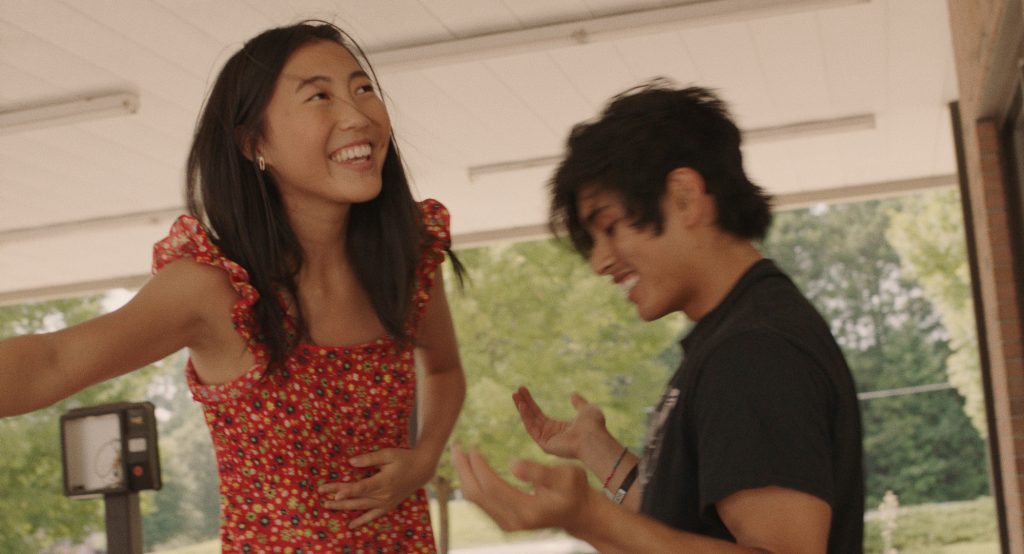
Shirley Chen and Jose Angeles in “Beast Beast” (Photo courtesy of Vanishing Angle)

“Beast Beast”

Directed by Danny Madden

Culture Representation: Taking place in an unnamed state in the U.S. South, the dramatic film “Beast Beast” features a predominantly white cast of characters (with some Asians, African Americans and Latinos) representing the middle-class and working-class.

Culture Clash: Three young people’s lives are forever changed by an act of gun violence.

Culture Audience: “Beast Beast” will appeal primarily to people interested in watching “slow burn” movies where the movie’s biggest impact doesn’t happen until the last 20 minutes of the film.

Will Madden and Jonathan Silva in “Beast Beast” (Photo courtesy of Vanishing Angle)

The lives of three young people collide in “Beast Beast,” a patchwork-like, dramatic observation of the devastating effects of gun violence. If viewers have the patience to sit through the meandering tone of the first two-thirds of the movie, then they’ll find that the last third of the film is where the heart of the story is.

Written and directed by Danny Madden, “Beast Beast” takes its time to let viewers get to know the story’s three main characters, who live in an unnamed city somewhere in the Southern part of the United States. All three of the young people who are at center of the story are very different from each other, but by the end of the movie, they will all have something in common.

Krista Zhang (played by Shirley Chen) is a pretty, smart and popular student in her last year of high school. She comes from a stable, middle-class household where her parents (played by Kurt Yue and Grace Rowe) seem to be very loving and supportive of her. Krista is an aspiring actress and is very involved in the school’s drama department. She is kind, generous and open-minded. Although she hangs out mostly with a racially diverse clique of other artistic/creative students, Krista isn’t afraid to make friends with other students outside of this clique.

Nito (played by Jose Angeles) is new to the high school, and he’s in the same graduating class as Krista. Nito is a quiet misfit who has recently moved to a working-class area of the city with his scruffy single father (played by Matt Skollar), who has an emotionally distant relationship with Nito. Money is so tight in their household that Nito doesn’t have his own phone, so he has to use his father’s phone. One of Nito’s biggest passions in life is skateboarding. He has videos of himself doing some skateboard tricks that he’s uploaded on the Internet.

Adam Manigan (played by Will Madden), who lives next door to Krista, is a 24-year-old aspiring YouTube star who’s still living with his parents. (Will Madden is “Beast Beast” writer/director Danny Madden’s younger brother.) Adam is a gun enthusiast whose YouTube channel (called Prime Shooter) does tutorials on how to use guns.

Adam’s parents Lance (played by Chip Carriere) and Mabel (played Cynthia Barrett) are skeptical that the YouTube channel will be a viable way for Adam to make a living. However, they don’t discourage Adam from working on his YouTube channel. The family members even discuss the YouTube channel when they have guests over for dinner.

Most of “Beast Beast” shows snippets of Krista’s, Nito’s and Adam’s lives until it becomes clear how they will be forever connected in a way that they did not plan or expect. Krista is an ideal student who excels in school. But she’s not completely uptight, because she likes to party too. Her partying is considered tame by many of her peers’ standards, because she’ll have only a few alcoholic drinks, she doesn’t do drugs, and isn’t the type of person to get highly intoxicated.

Soon after Nito and his father move into their apartment, Nito meets a troublemaker named Yoni (played by Daniel Rashid), who graduated from the high school a few years earlier. Yoni is a neighbor of Nito’s, and one of the first things that Yoni does when they meet is offer Nito a cigarette and invite Nito to a party. Nito gets arrested at the party when the cops arrive to break up the loud and rowdy bash, and Nito is caught getting into a fight that he didn’t start. The arrest gives Nito a “bad boy” reputation at the school.

Yoni hangs out with two other people who are around his early 20s age: Lena (played by Anissa Matlock) and Jarrett (played by Stephen Ruffin), who are literally Yoni’s partners in crime. The three troublemakers entice Nito to become part of their thieving activities, such as shoplifting food from grocery stores or breaking into stores and houses and stealing what they can. Yoni and Jarrett don’t seem to have jobs, while during the course of the movie, Lena gets fired from her retail store job. Later, as an act of revenge, the four of them go to the store at night when it’s closed to break in and steal things.

Nito is so desperate for approval and to fit in with a group of people, he doesn’t comprehend that Yoni, Lena and Jarrett don’t really care about Nito. They’re just using Nito because his skateboarding skills have given him more agility than the other three to do things like jump on roofs or slide into cramped spaces. Nito does whatever Yoni, Lena and Jarrett tell him to do, such as being the one to put himself at the most risk in these break-ins.

Meanwhile, “good girl” Krista and “bad boy” Nito start to get to know each other better, but Nito doesn’t tell her about his criminal activities. Nito has an immediate crush on Krista, but it takes her longer to warm up to him. Eventually, Krista starts feeling attracted to Nito too.

Nito and Krista bring out the sensitive and goofy sides of each other. He also shows an interest in artistic activities and she’s impressed by his skateboarding skills. At one point in the movie, Krista (who likes to do acting improv exercises) acts out a sketch in a rehearsal room with Nito, while he improvs a drum solo on a drum kit in the room.

Adam has been frustrated with the slow growth of his YouTube channel, which only gets less than 100 views per video. He spends a lot of time trying to make his videos more enticing. But he gets a lot of negative comments on his videos. Adding to his frustration and anger, Adam’s father informs Adam that it’s time for him to move out of the house and be on his own financially.

It should come as no surprise that Adam is a loner. The only person he’s seen hanging out with is an acquaintance named Nick (played by Jonathan Silva), who helps him with camerawork on Adam’s YouTube videos. Because “Beast Beast” telegraphs so early that Adam fits the profile of someone who’s prone to commit gun violence, it’s not hard to figure out who’s the ticking time bomb in the story. The only question is, “What’s going to happen?”

The overall tone, pacing and acting performances of “Beast Beast” serve the story well, but they’re not particularly outstanding, compared to other movies that tackle a similar subject matter. The title of the movie comes from the opening scene of Krista and other members of her drama group chanting, “Beast beast! Ready to act!” as a warm-up to their acting routines. Krista’s circle of friends from these drama classes include Cody (played by Marvin Leon), Johanna (played by Courtney Dietz), Jazmine (played by Airaka Nicole) and Silva (played by William J. Harrison), but these friends’ personalities aren’t given enough screen time for them to be particularly memorable or impactful in this story.

The last 20 minutes of the film cram in some events that seem a little bit rushed, but it can also be interpreted as how quickly lives can be permanently altered by a split-second, irreversible decision. “Beast Beast” doesn’t seem to do any moralistic preaching about gun culture, but the movie does take a look at various opinions on when and how guns should be used. The melodrama in the last third of the movie is a mostly effective counterpoint to the movie’s earlier scenes that show the mundane activities of people who are unaware of how drastically their lives are going to change.

Vanishing Angle released “Beast Beast” in select U.S. cinemas on April 16, 2021, and on digital and VOD on May 4, 2021.

Copyright 2017-2026 Culture Mix
CULTURE MIX