
April 28, 2023
by Carla Hay

Directed by Nida Manzoor
Culture Representation: Taking place in London, the comedy film “Polite Society” features a racially diverse cast of characters (South Asian, white and a few black people) representing the working-class, middle-class and wealthy.
Culture Clash: A teenage girl, who wants to become a stunt performer, tries to stop her older sister from getting married to a smooth-talking, wealthy man, who wants the couple to move to Singapore after the wedding.
Culture Audience: “Polite Society” will appeal primarily to people who are interested in watching female-empowerment comedies, told from a multicultural perspective.
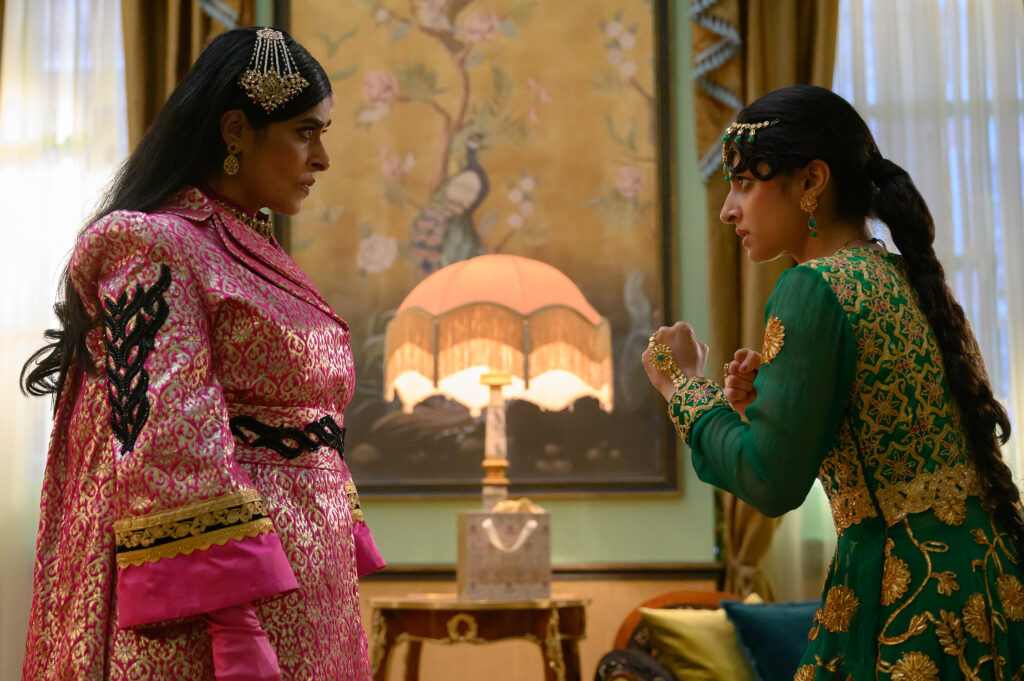
“Polite Society” has fun with its absurdist take on action films. It makes clever commentary about modern feminism and how aspirational culture affects people. Nida Manzoor has sharp writing and directing in this well-cast movie with great comedic timing. It’s an impressive feature-film debut for Manzoor, who has TV directing credits for “Doctor Who” and “We Are Parts.” “Polite Society” had its world premiere at the 2023 Sundance Film Festival.
In “Polite Society” (which takes place in London), two intelligent sisters named Ria Khan (played by Priya Kansara) and Lena Khan (played by Ritu Arya) are feeling frustrated with their lives for different reasons. Ria, who’s about 16 years old, wants to be a stunt performer and is taking martial arts classes in preparation. Ria believes in herself when pursuing this goal, even though most people around her think that this goal in unattainable for her. Lena, who’s in her early-to-mid 20s, is enrolled in art school in the very beginning of the film, but she drops out of school because she doesn’t believe that she has the talent to become a successful artist.
Ria is very upset that Lena has dropped out of school because she thinks that Lena is a talented artist but just gave up too easily. Lena moves back into the family home and mopes around while she contemplates what she might want to do with her life. The parents of Ria and Lena are immigrants from Pakistan. Based on the language accents of the Khan family members, it’s implied that Ria and Lena were either born in the United Kingdom or have been raised in the United Kingdom from a very young age.
Ria and Lena live and experience British and Pakistani cultures. Even though Lena has dropped out of school and is unemployed, her traditional Pakistani parents aren’t as worried about Lena as they are about Ria. That’s because Lena’s accountant father Rafe (played by Jeff Mirza) and homemaker mother Fatima (played Shobu Kapoor) think that Lena can redeem herself by finding a husband, preferably someone who is affluent. Rafe and Fatima think Ria’s interest in being a stunt performer is an unrealistic dream and not very feminine.
Ria attends an elite private school, where her two best friends are classmates: feisty Clara (played by Seraphina Beh) and mild-mannered Alba (played by Ella Bruccoleri), who are the only people in Ria’s life who encourage Ria to pursue her goals of being a stunt performer. Ria also makes amateur stunt videos that she puts on social media. Lena sometimes does camera work for these videos.
One of Ria’s goals is to do an internship with Eunice Huthart, a longtime stunt performer/coordinator who has worked on several superhero films and other action flicks. “Polite Society” includes voiceover narration from Ria, including Ria reading aloud the fan mail that she sends to Eunice. You know where this part of the story is going, of course.
Early on in the movie, Ria’s mother scolds Ria by saying, “Do you think your father sends you to that school to be a stunt woman?” At Ria’s school, there’s a guidance counselor session where students are assigned internships, according to what a counselor decides would be the best career direction for each student. It’s something that should be discussed privately, but these evaluations are done in front of the entire classroom.
When it’s Ria’s turn to get her assignment, she tells the counselor Ms. Spence (played by Jenny Funnell) that she wants to be a stunt performer. Ms. Spence is dismissive of that career goal, because she thinks being a stunt performer isn’t a real job for women or even a real job in acting. Ms. Spence assigns Ria to be an intern to a medical doctor, even though Ria tells her she has no interest in this line of work. There are some racial undertones to this assignment because of the stereotype that children of Pakistani immigrants want to work in careers involving science, technology, engineering or mathematics.
A loudmouth bully named Kovacs (played by Shona Babayemi), who is a female classmate, predictably taunts Ria about Ria’s desire to be a stunt performer. Ria retorts by loudly reminding the class that Kovacs’ father was in prison for financial fraud. At one point in the movie, Ria and Kovacs get in a physical fight in a school library. It won’t be revealed who wins this fight, but it’s enough to say that the fight confirms to Ria that she shouldn’t give up on her goal to be a stunt performer.
Meanwhile, Fatima is seen having lunch with a small group of high-society Pakistani immigrant women. The “queen bee” of this group is wealthy widow Raheela Shah (played by Nimra Bucha), who loves to brag about her eligible bachelor son Salim Shah (played by Akshay Khanna), a doctor whose specialty is in genetics. Fatima comes from a lower-income household than those of the other women, and she somewhat desperately wants to fit in this group.
And now that Lena has a lot of time on her hands, Fatima thinks it would be a good idea to play matchmaker for Lena. It just so happens that Raheela has invited the Khan family to a party at her mansion. Salim (who is in his late 20s or early 30s) is at the party, and he’s surrounded by adoring women, who all look like they want to date him. However, Raheela has been telling all of her lady friends that Salim is very picky and rejects almost all the women whom Raheela introduces to him.
As soon as Lena arrives at the party and isn’t one of the women fawning over Salim, you just know he’s going to take an interest in her. Lena and Salim begin talking. When he asks her what she’s doing with her life, Salim seems impressed by Lena’s honesty when she tells him, “What do I do? I disappoint my parents.” And when Lena says that she’s taking some time to figure out what she wants to do with her life, Salim tells her: “I think it’s great that you’re allowing yourself to be working it out.”
Meanwhile, Ria doesn’t have a very good impression of Salim. At the party, Ria tells an acquaintaince named Jezah (played by Tia Dutt), who’s close to Ria’s age, what she thinks about Salim as soon as she sees him: “What a prick.” Jezah openly swoons about how handsome and rich Salim is and says to Ria: “I hear he’s quite nice.” Ria says in sarcastic response: “Biscuits are nice.”
Ria is bored at this party, so she goes wandering around the mansion. And she makes a discovery that further raises her suspicions: In a study room, she finds a desk with several individual photos of women on it. Lena is one of the women in these photos. It looks like someone is planning which women could possibly date Salim. This type of planned matchmaking is very common in South Asian cultures, but Ria thinks it’s offensive.
It’s already revealed in the trailer for “Polite Society” that Lena and Salim get engaged. It’s a whirlwind courtship where Salim proposed to Lena after they were dating for only one month. Ria, who vehemently disapproves of this relationship, gets even more upset when she finds out that Lena and Salim plan to move to Singapore after the wedding. Ria also thinks it’s alarming that Salim is a “mama’s boy” who seems overly attached to his mother.
The rest of “Polite Society” is about Ria’s schemes to stop the wedding by any means necessary. She enlists the help of Clara and Alba. And the three pals also get some assistance from an unlikely person. There’s a lot of slapstick comedy in “Polite Society” but also some emotional moments about family relationships.
“Polite Society” takes a satirical look at the lengths that some people might go to climb up a social ladder or to stroke their own egos. The movie is filled with examples of how several people want to be accepted by those who are rich and powerful, while those who are rich and powerful often want to make other people feel inferior. In the beginning of the movie, Lena likes to think of herself as bohemian and edgy, but even she gets caught up in the idea of being a pampered trophy wife who is the opposite of bohemian and edgy.
Even with all the jokes and over-the-top action scenes, “Polite Society” also depicts examples of how women and girls can be “gaslighted” into thinking that they’re “crazy” for pursuing certain goals or for trusting their gut instincts. Although much of the plot is about Ria trying to stop Lena from getting married, the movie isn’t anti-marriage. It’s against the idea that people, especially women, have to give up who they are, in order to fit into someone else’s idea of what a “perfect spouse” should be.
One of the reasons why “Polite Society” is so entertaining to watch is because of the believable chemistry between the cast members. Kansara and Arya are especially convincing as sisters who have a volatile relationship that still has a lot of love. Bucha has some standout moments as Raheela, who becomes Ria’s biggest nemesis in the story.
“Polite Society” doesn’t present Ria as always being correct. It would be very easy to portray Ria as a crusading feminist who has all the answers, but the movie doesn’t make that lazy mistake. Ria is realistically presented as a flawed human being. Ria can get obnoxious in trying to prove her point, because one of Ria’s flaws is that she thinks she is always right. And it causes an even bigger rift between Ria and Lena.
In the last third of “Polite Society,” there’s a plot development that some viewers might not like because they’ll think the movie is taking a sharp turn into science fiction. However, there are clear indications throughout the movie that this story is a heightened version of reality. It’s not easy to balance wacky comedy with serious commentary about how women and girls are constantly being dictated to about how they should look or act when living their lives. “Polite Society” handles this balance as skillfully as an agile stunt performer.
Ria makes some comments in the movie that are criticisms of patriarchy, but “Polite Society” is not a feminist film that’s about bashing men. It’s a movie that encourages tolerance for women’s choices in life. Some of those choices might be mistakes, but people should be given an opportunity to learn from those mistakes.
Ria has to learn that her way of approaching life might not work for other people. Ria’s first impulse is to “rescue” her sister Lena from a life that Ria thinks will make Lena unhappy, but does Lena really need Ria to tell Lena what should make Lena happy? These types of meaningful observations make “Polite Society” better than the average female-oriented action comedies, which often depict feminism as shallow scenarios instead of experiences that truly embody female empowerment.
Focus Features released “Polite Society” in U.S. cinemas on April 28, 2023.