
February 26, 2022
by Carla Hay
Directed by Mamoru Hosoda
Available in the original Japanese version (with English subtitles) or in a dubbed English-language version.
Culture Representation: This Japanese animated fantasy film takes place primarily in unnamed village and in an online virtual world called U, with teenagers as the lead characters and adults as supporting characters.
Culture Clash: A misfit teenage girl creates an online persona called Belle, who becomes the most popular singer in the universe, and she befriends a hunted creature called Dragon under this new persona in this online world.
Culture Audience: “Belle” will appeal primarily to people who are interested in anime films and unique interpretations of Disney classics.
“Belle” is more than just another version of “Beauty and the Beast.” It’s a highly imaginative, visually stunning and emotionally stirring film that embodies some of the best anime of the 21st century. Written and directed by Mamoru Hosada, “Belle” captures the essence of “Beauty and the Beast” but also brings many unique elements to the story, so that “Belle” shouldn’t be considered a remake but a true reimagining.
The central character in Belle is a misunderstood student named Suzu, who is about 15 or 16 years old. She lives with her unnamed widower father in a small, unnamed village in Japan. Suzu is somewhat of a loner who has been depressed and grieving over the loss of her mother about five or six years earlier in a tragic accident, when her mother saved a girl from drowning in a river, and Suzu witnessed her mother’s death.
Because of this trauma and grief, Suzu has grown emotionally distant from her father, who tries to connect with Suzu. But she usually acts irritated by him, so they don’t communicate much with each other. Suzu has self-esteem issues too. She doesn’t think she’s as attractive and intelligent as her peers, so she tends to be quiet and emotionally withdrawn from people. She pours her thoughts into her journals, where she writes and sometimes sketches illustrations.
Suzu is haunted by the memory of begging her mother not to go in the river to save the drowning girl. This memory is shown as a flashback multiple times in the movie. Suzu writes in her journal: “Why did mom go in the river and leave me behind? Why was a stranger’s life more important than her life with me?”
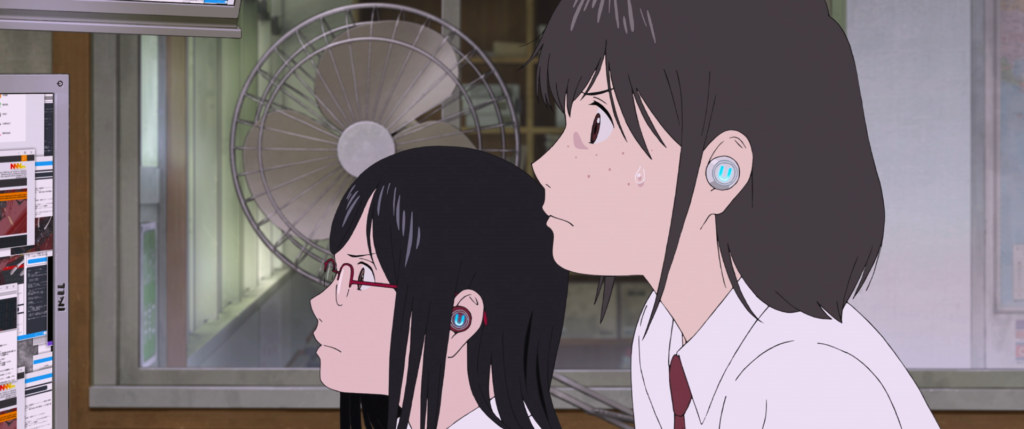
At school, Suzu’s only real friend is a sassy computer whiz named Hiro, who sometimes gives pep talks to Suzu to boost her confidence and other times outright insults Suzu when she becomes frustrated by Suzu’s self-pitying ways. Hiro has a blunt way of communicating that might sometimes hurt people’s feelings, but Hiro believes it’s just being brutally honest.
For example, one day at school, Suzu and Hiro admire from afar a pretty and popular student named Ruku, who is described as “the school princess” and president of their student class. When Suzu laments to Hiro that she will never be as pretty and popular as Ruku, Hiro agrees. However, Hiro comes up with an idea that she thinks will help Suzu with her self-esteem issues.
In “Belle,” there’s an online virtual universe called U, where people can create their own personas/avatars, using their real-life DNA. Here’s how U is described in the movie’s opening scene: “U is the ultimate virtual community, created by five sages called the Voices, who preside over the intellect of this world. It’s the biggest Internet society in history that’s still growing with 5 billion registered users.”
The description continues: “U employs body-sharing technology. Your avatar in U is called AS. It is already created, based on your biometric information. You can’t start over in reality, but you can start over in U.”
Hiro suggests that Suzu create a new persona in U. At first, Suzu is reluctant and a little scared to do so. But when she tentatively starts fiddling around with the app to create a U avatar, she accidentally scans a photo of Ruku from a student group photo and can’t reverse this action. And the next thing you know, Suzu has a new U persona: a pink-haired beauty named Belle, whose only facial characteristic that she shares with Suzu are Suzu’s freckles.
One of the things that Suzu is self-conscious about in real life is her singing. But as Belle in U, she immediately becomes not just a hit singer but also the most popular singer in the universe. That’s because, as explained in the movie, the body-sharing technology of U brings out people’s hidden strengths in their U avatars. Belle’s sudden fame gives her millions of fans, but also the inevitable backlash from “haters,” some of whom are other U celebrities who are envious that Belle has surpassed them in popularity.
Seeing this online criticism upsets Suzu. When she complains to Hiro about it, Hiro has this response: “They’re just jealous. If you only get compliments, you only have hardcore fans. Minor league. In U, stardom is built on mixed reception.” Hiro adds, “Be more confident!”
When Suzu worries that people will find out that she’s Belle, Hiro says in response: “Nobody will ever guess that Belle is a mousy country bumpkin like you.” Because Belle has become a rich and famous singer, Suzu feels guilty about getting all this money under a fake persona. And so, Hiro tells Suzu: “Don’t worry. I’ll anonymously donate every dollar to charity.”
There’s a lot more trouble in U than online trolls and bullying. Seven months earlier, a mysterious creature called Beast (also known as Dragon) has been wreaking havoc by physically lashing out at random residents of U. The attacks have gotten so bad, Beast has now become a wanted entity who is sought after by law enforcement for punishment.
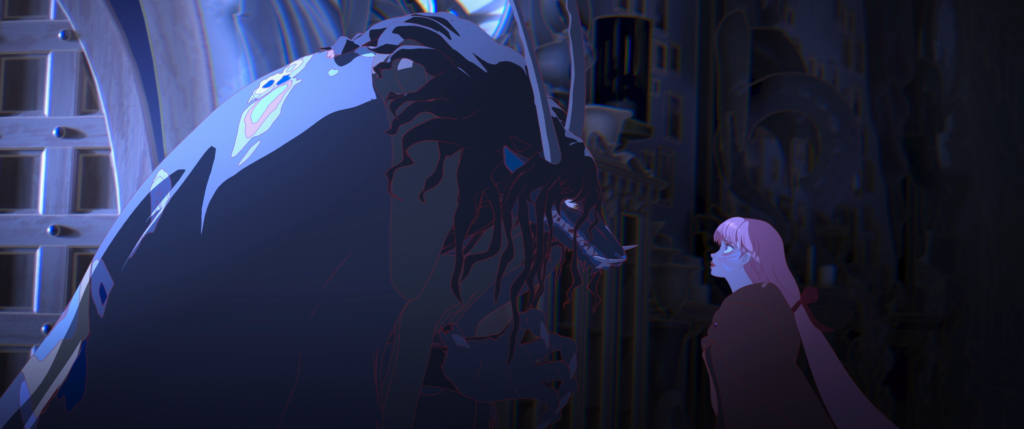
Beast has horns and wears a cloak designed to look like there are bruises on the coat. Other than that, no one seems to know who the Beast really is. Eight superheroes called the Justices, who are the protectors of U, are on the hunt for Beast. The leader of the Justices is a blonde alpha male named Justin, who is the most ambitious one in the group who wants to find and capture Beast.
Through a series of circumstances, Belle ends up meeting Beast, who lives as a recluse in his castle. He is very standoffish and rude to her at first. He even orders her to leave on more than one occasion. But eventually, Belle ends up gaining Beast’s trust, and they become close. Belle is aware that Beast is being hunted, but she is determined not to betray him by turning him into the authorities.
Meanwhile, the hunt for Beast and guessing the real identity of Beast have become an obsession for the residents of U. All sorts of people are accused of being Beast, with many having to prove their innocence. And this guessing game becomes big business, as Beast merchandise and other Beast-related ventures become hot-selling moneymakers. It’s this movie’s clever commentary on how gossip and fads quickly spread.
One of the ways that “Belle” is a big departure from other interpretations of “Beauty and the Beast” is that there is no romance between Belle and Beast. Instead, they form a genuine friendship that doesn’t always go smoothly. Suzu/Belle’s feels a connection to Beast, because they are both lost and wounded souls who want to hide their true selves from the world.
“Belle” also offers an incisive view of how people create online personas to feel better about themselves because they don’t like their lives in the real world. The movie also doesn’t shy away from depicting how this fakery can actually backfire in people’s attempts to boost their egos. With Suzu, it somewhat messes with her mind that she’s so popular in U, but she’s still an ignored “nobody” in the real world. People around Suzu go crazy for Belle, so Suzu starts to wonder if they would still feel the same way about Belle if they knew Suzu was the real person behind this avatar.
However, Suzu isn’t quite the outcast that she thinks she is. At school, Suzu seems to be oblivious to attention from a fellow student named Shinobu Hisatake, whom she rejects every time he makes an attempt to hang out with her. Suzu and Shinobu have known each other since childhood. He’s described as someone who proposed marriage to Suzu when she was 6 years old.
Another student at their school is Kamishin, who is bullied by some other students for being eccentric. Kamishin has started a canoe club where he is the only member. He seems comfortable with who he is, but could he be hiding any dark feelings about being a social pariah? Suzu, Hiro and Shinobu all know Kamishin, but they aren’t close friends with him.
Meanwhile, viewers will also be wondering who’s the person behind the Beast avatar, who definitely identifies as male. That’s why in addition to being a story about love between friends, “Belle” is also a mystery. There’s a major plot development in “Belle” that’s a big departure from the usual “Disney princess movie” formula. This twist to the story comes in the last third of the film and results in the movie’s biggest emotional moments.
“Belle” not only has a richly layered story, but the anime visuals are top-notch. The world of U can be dark and foreboding (such as Beast’s castle) or a brightly lit, vibrant paradise filled with fantastical whimsy, such as the environment where Belle does her musical performances. Suzu’s world is also vividly designed as a small town that affected by modern technology. The songs in “Belle” suit the story, but the visuals and screenplay are the movie’s strongest high points.
The voices of the “Belle” characters are portrayed by different actors, depending on which version of “Belle” that you see. The original Japanese version (with English subtitles) has Kaho Nakamura as Suzu/Belle, Takeru Satoh as Beast/Dragon, Lilas Ikuta as Hiro, Ryō Narita as Shinobu, Shōta Sometani as Kamishin, Kōji Yakusho as Suzu’s father, Sumi Shimamoto as Suzu’s mother, Tina Tamashiro as Ruka and Toshiyuki Morikawa as Justin. There’s also a U.S. version, with the dialogue dubbed in English, that has Kylie McNeill as Suzu/Belle, Paul Castro Jr. as Beast/Dragon, Jessica DiCicco as Hiro, Manny Jacinto as Shinobu, Brandon Engman as Kamishin, Ben Lepley as Suzu’s father, Julie Nathanson as Suzu’s mother, Hunter Schafer as Ruka and Chace Crawford as Justin.
Even though “Belle” is a great anime achievement, the movie was not nominated for an Academy Award for Best Animated Feature Film. Hosoda’s 2018 film “Mirai” was Oscar-nominated in this category, even though “Belle” is a far superior movie. We’ll never really know why “Belle” got snubbed by the Academy Awards, but a logical explanation might be that not enough Academy Awards voters saw “Belle.” With or without an Oscar nomination, “Belle” is worth seeing as a visual treat and as an emotionally touching story of substance.
GKIDS released “Belle” for special sneak-preview screenings in select U.S. cinemas on January 12, 2022. “Belle” arrived in wider release in U.S. cinemas on January 14, 2022. The movie was originally released in Japan in 2021.