
Review: ‘She Dances’ (2026), starring Steve Zahn, Sonequa Martin-Green, Mackenzie Ziegler, Wynn Everett, Ron Livingston, Rosemarie DeWitt, Ethan Hawke and Audrey Zahn

March 26, 2026

by Carla Hay

Audrey Zahn and Steve Zahn in “She Dances” (Photo courtesy of EKKL Entertainment)

“She Dances” (2026)

Directed by Rick Gomez

Culture Representation: Taking place in Kentucky, the comedy/drama film “She Dances” features a predominantly white cast of characters (with a few African Americans) representing the working-class, middle-class and wealthy.

Culture Clash: A divorced dad and his teenage daughter have various tensions and conflicts during a road trip to Kentucky, where the daughter and his best friend are teammates in a dance competition. 

Culture Audience: “She Dances” will appeal primarily to people who are fans of the movie’s headliners and movies about volatile parent-child relationships.

Audrey Zahn, Steve Zahn and Mackenzie Ziegler in “She Dances” (Photo courtesy of EKKL Entertainment)

The comedy/drama “She Dances” is a well-acted and bittersweet story of a divorced dad trying to reconnect with his 17-year-old daughter, as he chaperones her and her best friend during a road trip for a dance competition. The movie sometimes tries to do a little too much with some subplots, but the overall tone of the film is fairly consistent in balancing its funny and serious tones.

Directed by Rick Gomez, “She Dances” was co-written by Gomez and “She Dances” star Steve Zahn. The movie had its world premiere at the 2025 Tribeca Festival. “She Dances” was loosely inspired by a real-life road trip that Steve Zahn and his daughter Audrey Zahn (who makes her feature-film debut as an actress in “She Dances”) took in Kentucky for a dance competition where Audrey was a contestant. “She Dances” takes place in Kentucky, where the movie was filmed on location.

In “She Dances,” Steve Zahn portrays divorced dad Jason, who is recovering from alcohol addiction. Jason has a somewhat fractured relationship with his 17-year-old daughter Claire (played by Audrey Zahn), who has lived primarily with Claire’s mother Deb (played by Rosemarie DeWitt) since the divorce. As Deb says to Claire in a scene shown early in the movie: “This family has been through hell and back and some of us are still fragile.”

Jason owns a liquor company named Two Jacks Bourbon with his best friend Brian (played by Ethan Hawke), who is as supportive as he can be to Jason during Jason’s recovery from alcoholism. Two Jacks Bourbon has been financially struggling recently, but two business partners named Bev (played by Wynn Everett) and Andrew (played by Ron Livingston) are interested in buying the company. Brian and Jason were scheduled to have a meeting about this possible acquisition when Jason’s plans change and he can’t attend the meeting.

Claire is passionate about dancing (her main style is modern dance) and has been a contestant in several competitions. Claire and her best friend Kat (played by Mackenzie Ziegler) are a duo who will be competing in the Young Miss Southeast Regional Dance Finals, taking place in an unnamed city in Kentucky. A road trip was planned to take Claire and Kat to this competition, but the trip’s chaperone, a woman named Amanda, injured herself from falling off a ladder.

Jason is asked to be the chaperone on short notice. He reluctantly agrees. Claire isn’t happy about this change in plans, but she has no other choice but to go along with it. Jason is nervous because it’s the first time that he’s chaperoning teenage girls on a road trip. He asks Deb what to do, and she replies: “Just be there.”

The road trip has occasional cliché moments—some funnier than others. Claire doesn’t want to listen to Jason’s playlist. When Claire insists on driving for part of the road trip and the car gets a flat tire, Jason makes Claire and Kat change the flat tire instead of calling a car insurance company. They find out there was a scheduling mix-up at the hotel that Jason booked, so Jason, Claire and Kat have to stay at a budget motel.

“She Dances” doesn’t have a lot of character development for other people in the competition. Predictably, there’s a competition “villain,” who wants to win at any cost and likes to intimidate her rivals. Her nickname is Dolph (played by Haley Fish), but her real name is Marla. Meanwhile, Jason makes a friendly acquaintance with another chaperone named Jamie (played by Sonequa Martin-Green), who is friendly and helpful.

Although Claire and Kat are ultra-focused on winning the competition, “She Dances” isn’t really about who will be the competition’s winner. It’s through this road trip that Claire and Jason start to discover each other as people and accepting who they are now, compared to their past perceptions of each other. Claire starts to see that Jason might no longer be an irresponsible dad with an alcohol abuse problem, while Jason gets a better understanding that Claire isn’t a little girl anymore.

On another level, Claire and Jason are also on a self-discovery journey. For many years, dancing has been the central point of Claire’s time and identity. She’s at a crossroads in her life in deciding whether or not she’ll pursue professional dancing as a career after she graduates from high school. Jason has mixed feelings about the sale of a company that represents a huge part of his identity and a large part of his friendship with Brian.

Perhaps because Steve Zahn and Audrey Zahn are father and daughter in real life, there’s an emotional authenticity to “She Dances” that will resonate with viewers. Claire and Jason have tension and conflicts, but there is also family love between them that never went away, even during their lowest points. “She Dances” beautifully depicts the life lesson that healing fractured relationships isn’t always about placing blame on who’s most at fault but it’s about trying to move on in the best way possible under the circumstances.

EKKL Entertainment will release “She Dances” in select U.S. cinemas on March 27, 2026.

Review: ‘Sarah’s Oil,’ starring Zachary Levi, Naya Desir-Johnson, Sonequa Martin-Green, Garret Dillahunt, Mel Rodriguez, Kenric Green and Bridget Regan

November 7, 2025

by Carla Hay

Zachary Levi, Naya Desir-Johnson and Garret Dillahunt in “Sarah’s Oil” (Photo by Shane Brown/Amazon Content Services)

“Sarah’s Oil”

Directed by Cyrus Nowrasteh

Culture Representation: Taking place in 1913, in eastern Oklahoma, the dramatic film “Sarah’s Oil” (based on real events) features an African American and white cast of characters (with some Native Americans and Latin people) representing the working-class, middle-class and wealthy.

Culture Clash: An 11-year-old African American girl named Sarah Rector becomes a multi-millionaire when oil is discovered on the land that she inherited because of the United States’ Treaty of 1866, but she and her family experience violence and racism from greedy white business owners who want to steal the land from her.

Culture Audience: “Sarah’s Oil” will appeal primarily to people who are fans of the movie’s headliners and dramas that are “rags-to-riches” true stories and American life in the Jim Crow South.

Adyan Copes, Sonequa Martin-Green, Kenric Green and Naya Desir-Johnson in “Sarah’s Oil” (Photo by Shane Brown/Amazon Content Services)

Based on a true story with some obviously added fictional elements, “Sarah’s Oil” is a predictable drama that should satisfy viewers looking for family entertainment. This story gives some basic truths about Sarah Rector, racism, and generational wealth. Most people don’t know that Rector was one of the first African American females to become a multi-millionaire (which happened in 1913, when she was 11 years old), because of oil-rich land that she inherited in her home state of Oklahoma. “Sarah’s Oil” aims to bring more awareness to this real-life story that is usually not taught in American history classes.

Directed by Cyrus Nowrasteh (who co-wrote the “Sarah’s Oil” screenplay with his wife Betsy Giffen Nowrasteh), “Sarah’s Oil” is adapted from Tonya Bolden’s 2014 non-fiction book “Searching for Sarah Rector: The Richest Black Girl in America.” The movie takes place in 1913, in Oklahoma, where “Sarah’s Oil” was filmed on location. “Sarah’s Oil” can be considered a faith-based movie because there are several scenes that mention God, Jesus and praying. However, it’s not an overly religious movie.

“Sarah’s Oil” begins with a caption quote from oily tycoon J. Paul Getty: “The meek shall inherit the earth, but not its mineral rights.” “Sarah’s Oil” has intermittent voiceover narration from an unseen adult Sarah Rector (voiced by Tamala Jones) as she tells her story as a childhood memory. (For the purposes of this review, the real people will be referred to by their last names, while the characters in the movie will be referred to by their first names.) is a cynical twist on a biblical quote, attributed to oil tycoon J. Paul Getty.

The adult Sarah explains in a voiceover why she inherited 160 acres of oil-rich land in eastern Oklahoma. Sarah was born in Oklahoma, which became a U.S. state in 1907. She and her parents were direct descendants of the Muscogee Nation tribe of Native Americans (also known as Muscogee Indians or Creek Indians), one of five Native American tribes who are entitled to tribal land under the United States’ Treaty of 1866.

Her parents were also counted as descendants of Freedmen (formerly enslaved African Americans) who would be entitled to this land if they were also descendants of the five qualifying Native American tribes: Muscogee (Creek), Cherokee, Chickasaw, Choctaw and Seminole. The deed to the land was entirely in Sarah’s name. At the time Sarah inherited the land, it was considered worthless.

As depicted in “Sarah’s Oil,” in 1913, 11-year-old Sarah (played by Naya Desir-Johnson) lives with her parents and her younger brother Junior (played by Adyan Copes), who is about 5 or 6 years old. Sarah’s farmer father Joe Rector (played by Kenric Green) wants her to sell the land because the family needs the money. Sarah’s mother Rose Rector (played by Sonequa Martin-Green) also thinks that Sarah should sell the land.

Sarah says in a voiceover about her land: “I was determined to keep it.” Why? Because when Sarah puts her ears to the land’s ground, she says she hears there is oil underground. Sarah’s mother Rose is very skeptical: “If there was oil in that patch, they would’ve never given it to you.” A confident Sarah replies, “God gave me ears to hear, Mama. He gave me that land for a reason.”

Sarah is so sure that the land is rich with oil, she convinces her father Joe to go with her to visit various oil companies in their town to see if they can get the land assessed. During this period of time of Jim Crow laws in the American South, racial segregation was legal. And so, it’s a big risk for Joe and Sarah to walk into a “whites only” building.

Not surprisingly, Joe and Sarah are rudely told to leave without getting a meeting when they visit the Condor Oil Company and the J.J. Ransom Oil Company. The latter place literally has Joe thrown out the door. Sarah and Joe also get hostile stares from some white people while walking on the streets of this mostly white business district.

After this rejection, Sarah goes into the “whites only” Busy Bee Cafe to buy a glass of water. A server named Karla (played by Carrie-Rose Menocal) dismissively tells Sarah that Sarah needs to leave immediately. However, a man named Bert Smith (played by Zachary Levi) is sitting by himself and reading a newspaper when he sees what’s happening to Sarah. Bert tells Karla that he wants to buy a glass of lemonade for Sarah, who thanks Bert for his kindness.

Meanwhile, Joe has snuck into the headquarters of Pan-Okie Petroleum by pretending to be a sanitation worker. Joe finds his way to the office of Pan-Okie Petroleum partner “Big” Jim Devnan (played by Garret Dillahunt), who is curious to hear what Joe has to say about Sarah’s land. In an “only in a movie” moment, Sarah suddenly shows up in the office while Joe and Jim are talking.

Sarah is depicted as a prodigy who is able to shrewdly negotiate deals and who has a great deal of knowledge about real-estate laws and contracts. Even though 11-year-old Sarah is never shown going to school, the movie doesn’t explain why she talks like she has a business degree and a law degree. It’s hinted she got her knowledge through a lot of reading. Still, the way she talks like an adult in these business deals seems very much exaggerated for the movie. Meanwhile, Sarah has to explain to her father Joe what a financial royalty means for oil land owners.

Sarah is able to negotiate a deal with Jim for Pan-Okie to survey the land for oil. She outsmarts Jim when he tries to lowball her on the current wholesale oil price. Pan-Okie Petroleum workers arrive on Sarah’s land with equipment for the survey. The final assessment is that no oil was found on the land. Jim says the company will cut its losses in this survey and will leave behind the drilling equipment and other equipment for the Rector family to keep.

Not long after this apparently failed survey, a sleazy worker named Earl Raskin (played by
Stelio Savante) shows up at the Rector family home by himself with an offer to buy Sarah’s land. Sarah is inside the house, while Joe is the person who communicates with this stranger outside the house. Just like Jim, Earl starts off with a lowball offer because he thinks the Rectors are too stupid to know that they’re being lowballed.

Joe repeatedly tells Earl that it’s up to Sarah to decide if she will sell the land, but Joe won’t let Earl talk to Sarah. Earl keeps increasing the offer, but the answer is still no. Earl’s racism comes out when he calls Joe a “cagey coon,” but then tries to sweet talk his way by offering $6 an acre for the land, which at the time was worth $3 to $3.25 per acre. Earl eventually leaves in frustration when he can’t close the deal.

When Sarah hears about Earl’s visit and the purchase offer, she and her mother Rose immediately know that this land is a lot more valuable than Pan-Okie told them it was. And sure enough, a scene shows that Earl actually works for Jim at Pan-Okie. Earl and another Pan-Okie goon named Horace (played by Vic Trevino) later trespass on the Rector family’s property at night to look for Sarah’s deed to the land, just as the family is somewhere else on the property to bury the deed in a box for safety.

The family catches Earl and Rector during this home invasion where the family finds their home in disarray from the intruders’ frantic search. Before the intruders escape, they shoot at the family’s female Collie dog Blue Bonnett, who runs away. When the intruders report to Jim what happened, Jim is furious with these bungling employees because he didn’t want any guns to be used during this home invasion, because it would tip off the Rector family that someone desperately wants Sarah’s land deed.

The next day, Sarah is looking for Blue Bonnett and finds part of the dog’s roped leash, which has blood stains on it. The leash is found near an encampment inhabited by wildcatting drifters. And lo and behold, there’s Bert (the lemonade Good Samaritan), who is a con artist originally from Texas. Bert’s specialty is charming and swindling wealthy widows (he regularly checks newspaper obituaries to find out who’s been recently widowed), but he’s also on the hunt for any “get rich quick” schemes in oil prospecting.

Quicker than you can say “unsurprising plot development,” Sarah gets reacquainted with Bert, who has a buddy sidekick named Mason “Mace” Hernandez (played by Mel Rodriguez). Sarah makes a deal with Bert and Mace to continue the oil drilling work on her land, by using the equipment that Pan-Okie left behind. And they find a lot of oil, of course.

Because Sarah is an underage African American, she doesn’t have certain rights for legal disputes, so Bert is named her guardian regarding legal matters that inevitably go to court. A crusading attorney named Kate Barnard (played by Bridget Regan) gets involved in Sarah’s case and offers to represent Sarah. You can easily predict the rest of the story. The Pan-Okie villains try to use every dirty trick they can think of to steal the land from Sarah. The tactics get violent. And not everyone gets out alive.

“Sarah’s Oil” has solid performances from the cast members, with Desir-Johnson giving a charming portrayal of the precocious and plucky Sarah. Martin-Green and Green, who are married in real life, have an easy chemistry with each other and are convincing as Sarah’s kind and supportive parents. Dillahunt’s portrayal of Jim is of a typical corrupt corporate villain.

The character of Bert, who was fabricated for this movie, is far from being a saintly do-gooder. He has his selfish reasons for wanting to help Sarah. And he has some ingrained racism that comes out when he describes a predominantly African American neighborhood as a “coon town” in front of Sarah.

Bert sees how much Sarah is hurt and offended by his derogatory comment, and he makes an apology to her. However, the movie doesn’t sugarcoat the racism that the Rector family and other African Americans experience in this story. Ultimately, Bert (who has most of the “comic relief” scenes in the movie) is portrayed as a charismatic rogue who might or might not want to be redeemed.

“Sarah’s Oil” is mostly well-paced and gives a an easy-to-understand (in other words, simplified and condensed) version of battles that Sarah and her family had to go through in order for her to keep her land. If people think this type of racist thievery of land is in the distant past, think again. There are many Native Americans and African Americans who are still fighting to keep their rightful ownership of inherited land in the United States when other people are trying to take away this land for racist reasons.

Rector’s story is unusual because she happened to become a multi-millionaire from land that was given to her because it was originally deemed worthless. The movie wisely leaves her multi-millionaire status as an epilogue to the story. That’s because the most important part of her story is her perseverance in standing up for herself and fighting for her rights when other people underestimated her and tried to oppress her.

Amazon MGM Studios’ Orion Pictures released “Sarah’s Oil” in U.S. cinemas on November 7, 2025.

Review: ‘My Dead Friend Zoe,’ starring Sonequa Martin-Green, Natalie Morales, Gloria Reuben, Utkarsh Ambudkar, Morgan Freeman and Ed Harris

March 2, 2025

by Carla Hay

Natalie Morales and Sonequa Martin-Green in “My Dead Friend Zoe” (Photo courtesy of Briarcliff Entertainment)

“My Dead Friend Zoe”

Directed by Kyle Hausmann-Stokes

Culture Representation: Taking place in Oregon and in Afghanistan, the dramatic film “My Dead Friend Zoe” (inspired by true events) features a racially diverse cast of characters (African American, white, Asian and Latin) representing the working-class and middle-class.

Culture Clash: A former U.S. Army mechanic feels guilty about her Army best friend dying and sees visions of the dead best friend everywhere she goes.

Culture Audience: “My Dead Friend Zoe” will appeal primarily to people who are fans of the movie’s headliners and dramatic films about military veterans coping with post-traumatic stress disorder.

Natalie Morales and Sonequa Martin-Green in “My Dead Friend Zoe” (Photo courtesy of Briarcliff Entertainment)

Inspired by true events, the well-acted drama “My Dead Friend Zoe” takes what could’ve been a mishandled gimmick (seeing visions of a dead person) and made it into a meaningful portrait of recovery from PTSD experienced by military veterans. The movie also has a subplot about tough decisions that people have to make when they have a family member with a deadly disease. “My Dead Friend Zoe” has the right touches of comedy without diminishing the serious issues in the movie.

“My Dead Friend Zoe” (which had its world premiere at the 2024 SXSW Film and TV Festival) is the feature-film directorial debut of Kyle Hausmann-Stokes, who co-wrote the movie with A.J. Bermudez. Hausmann-Stokes based the screenplay on things he experienced in his own life as a military veteran who lost close friends during war combat. The movie’s epilogue mentions that military veterans Luis Ramirez-Jimenez and Boris Ventura, who both died in the mid-2010s, are the two people who inspired the movie’s Zoe character.

“My Dead Friend Zoe” begins in 2016 in Afghanistan, where best friends Merit Charles (played by Sonequa Martin-Green) and Zoe Ramirez have been deployed. They are outdoors having lunch when Zoe sarcastically tells Merit: “If you ever catch me in some dopey group therapy, you have permission to kill me.”

The movie then abruptly cuts to a scene of Merit and Zoe seated next to each other in a group therapy circle somewhere in Oregon, where Merit currently lives. (“My Dead Friend Zoe” was filmed in Oregon and Los Angeles.) It’s soon revealed that Zoe is just a figment of Merit’s imagination in this therapy session because Zoe is actually dead.

In the movie, Zoe appears only in flashbacks or when Merit is hallucinating that Zoe is there. The flashbacks show how Merit used to be a different, livelier person when Zoe was in her life. The movie’s flashbacks eventually reveal how Zoe died.

Merit is a loner who doesn’t open up in these meetings. It’s why the group leader Dr. Cole (played by Morgan Freeman) won’t sign the paperwork to verify that Merit has completed the program. Dr. Cole is a Vietnam War veteran who’s in recovery for addiction issues and says that he’s been sober since 1978.

Dr. Cole tells Merit privately in a scolding tone: “What is it that you’re so afraid to talk about? If I were you, I’d think very seriously about what living in the past is worth.”

It’s revealed early on in the movie that Merit is under court order to get this therapy. If she doesn’t graduate from the program, she will go to jail. In other words, there’s more at stake for Merit than just her mental health.

While all of this turmoil is going on, another member of Merit’s family is going through a different type of mental health crisis. Merit’s widower grandfather Stan (played by Ed Harris), a Vietnam War veteran who also served in the U.S. Army, has been diagnosed with early on-set Alzheimer’s disease. Stan’s daughter Kris (played by Gloria Reuben), who is Merit’s mother, is considering putting Stan in an assisted living facility, which is an idea that Stan hates when he finds out about it.

“My Dead Friend Zoe” goes back and forth between Merit dealing with her personal issues and her grandfather’s issues. Most of the flashbacks with Merit and Zoe show that their friendship had a lot of semi-bickering banter. A major source of tension in their friendship was Merit had plans to go to an Oregon university after leaving the Army, while Zoe didn’t want to discuss any of her own post-Army plans.

Utkarsh Ambudkar has a supporting role as Alex, who works at Shady Acres Retirement Community, which is owned by Alex’s family. “My Dead Friend Zoe” keeps people guessing over whether or not Alex and Merit might or might not be attracted to each other. Merit seems annoyed by Alex—and not in a cute romantic comedy way—because she generally isn’t very sociable.

Although it’s inevitable that Merit will have to come to terms with her grief, “My Dead Friend Zoe” doesn’t make it a completely formulaic journey. Even though Stan can be ill-tempered, Merit has great admiration for him (he inspired her to enlist in the Army), so it’s breaking her heart to see his mental decline. Merit doesn’t have a close emotional bond with her mother Kris, who seems to have given up on trying to help Merit.

“My Dead Friend Zoe” occasionally has dull pacing, but it’s a minor flaw. The movie has the benefit of talented cast members who know how to handle tricky scenes that blend comedy and drama. Martin-Green does a superb job of portraying how complicated Merit is, while the other cast members also give credible performances. “My Dead Friend Zoe” has a powerful message about human connections, helping others in need, and how important it is to remember that grief does not have to experienced alone.

Briarcliff Entertainment released “My Dead Friend Zoe” in U.S. cinemas on February 28, 2025.

Review: ‘Space Jam: A New Legacy,’ starring LeBron James

August 18, 2021

by Carla Hay

LeBron James and Bugs Bunny in “Space Jam: A New Legacy” (Photo courtesy of Warner Bros. Pictures)

“Space Jam: A New Legacy”

Directed by Malcolm D. Lee

Culture Representation: Taking place in the Los Angeles area and in an alternate technology universe, the live-action/animated film “Space Jam: A New Legacy” features a predominantly African American cast of characters (with some white people, Latinos and Asians) representing the middle-class and wealthy.

Culture Clash: A computer algorithm traps basketball superstar LeBron James in a technology universe, where he joins forces with Warner Bros.-owned Looney Tunes characters for a high-stakes basketball game against computer-generated villains that want to take over the world. 

Culture Audience: Besides appealing to the obvious target audience of LeBron James fans and Looney Tunes fans, “Space Jam: A New Legacy” will appeal primarily to people interested in watching a mindless but harmless family film that overloads on shilling for various Warner Bros. entertainment products and services.
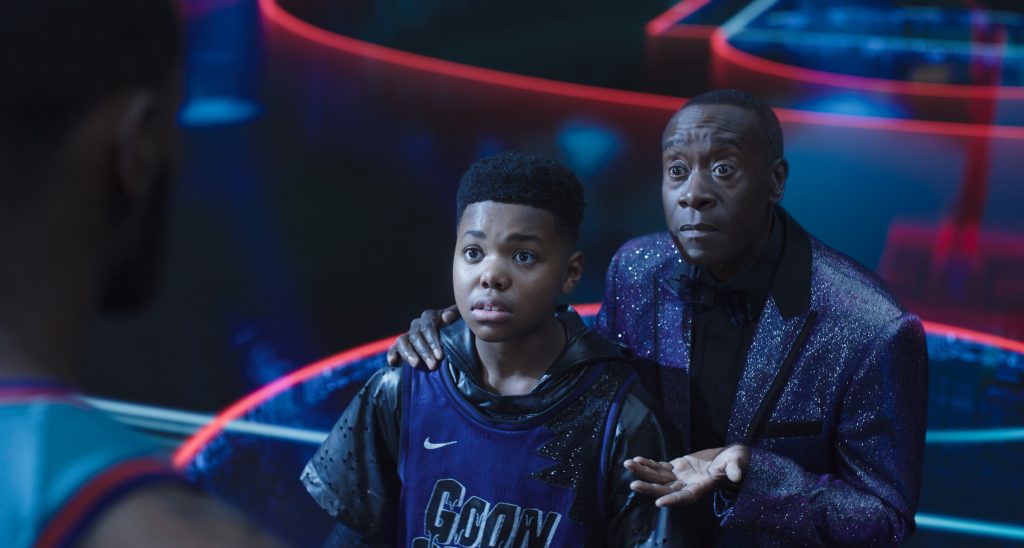
Cedric Joe and Don Cheadle in “Space Jam: A New Legacy” (Photo courtesy of Warner Bros. Pictures)

“Space Jam: A New Legacy” is not meant to be a real movie. It’s just a long and witless commercial for Warner Bros. entertainment entities, with LeBron James as a celebrity spokesperson. Even young children and gullible people will notice the over-the-top, shameless plugging of all things Warner Bros. in “Space Jam: A New Legacy.” It’s hard not to miss this obnoxious promotion, because it’s in every scene.

Directed by Malcolm D. Lee, “Space Jam: A New Legacy” is the sequel to 1996’s “Space Jam.” Both are hybrid live-action/animated movies about basketball superstars who team up with Warner Bros.-owned Looney Tunes characters to play against villains in a life-or-death basketball game. Michael Jordan starred in “Space Jam,” which was also a silly movie, but it had a lot more heart and sincerity than “Space Jam: A New Legacy,” which stars LeBron James.

Both “Space Jam” movies have celebrity athletes portraying themselves. All of these athletes have limited acting skills, even if some of these basketball icons have loads of charisma in real life. However, “Space Jam: A New Legacy” is a much more cynically made movie, because its highest priority is selling Warner Bros. characters and products. At least the first “Space Jam” movie made more of an attempt to be humorous and have several significant characters whose purpose was not to be a mascot for Warner Bros.

It’s not a good sign when a movie has more than four credited screenwriters, because it usually means that there were “too many cooks in the kitchen.” “Space Jam: A New Legacy” has six screenwriters: Celeste Ballard, Keenan Coogler, Jesse Gordon, Terence Nance, Tony Rettenmaier and Juel Taylor. And what’s even worse is that all of these “Space Jam: A New Legacy” screenwriters couldn’t come up with a truly original story for this sequel.

“Space Jam: A New Legacy” essentially copies the same template as “Space Jam,” with just a few changes, such as the reason for the big showdown basketball game that happens in the last third of the film. In “Space Jam,” Jordan has to do battle against basketball-playing monsters from outer space that were literally stealing the talent (by suctioning it out in gas form) from NBA stars. In “Space Jam: A New Legacy,” James has to do battle against a computer algorithm (which can take the shape of a man) that has stolen his younger son and created a team of monsters for the basketball showdown.

Each movie opens with a highlight montage of the basketball superstar’s career, up until the movie was made. Each movie has someone saying more than once, “You can’t be great without putting in the work.” Each movie ends exactly how you think it will end.

In “Space Jam: A New Legacy” LeBron’s 12-year-old son Dominic, nicknamed Dom (played by Cedric Joe), is a computer whiz and aspiring video game developer who has been kidnapped by a computer algorithm called Al G. Rhythm (played by Don Cheadle) into the algorithm’s universe called the Warner 3000 server-verse. Inside this server-verse exists everything Warner Bros., including Looney Tunes World.

Dom feels unappreciated and misunderstood by LeBron, who is pushing Dom to become a basketball star. Dom likes playing basketball and is on his school’s basketball team, but he’s an average player, and he doesn’t have the passion for the game like his father does. There’s a predictable scene in the beginning of the film where Dom is playing in a school game, and he misses a shot that causes the team to lose the game.

Dom wants to attend an E3 Game Design camp, but it’s taking place on the same weekend as a basketball camp that LeBron wants Dom to attend. Father and son argue about it. But in the end, LeBron is the adult in charge and tells Dom that he has no choice but to go to the basketball camp. Dom is predictably resentful about this decision and his father’s control over his life.

The rest of LeBron’s family are just filler characters that don’t get much screen time and don’t add much to the story. LeBron’s wife Kamiyah (played by Sonequa Martin-Green) chimes in early in the movie to say to LeBron about his parenting skills for Dom: “I’m worried that you’re pushing him too hard … He doesn’t need a coach. He needs a dad.”

In this movie, LeBron and Kamiyah have two other children: teenager Darius (played by Ceyair J Wright) and kindergarten-age Xosha (played by Harper Leigh Alexander). Darius’ only purpose in the movie is to be a teasing older brother and occasional basketball practice opponent with Dom. Xosha’s only purpose in the movie is to be a cute and charming kid.

Because “Space Jam: Legacy” is a Warner Bros. commercial, LeBron and takes Dom with him to a business meeting at Warner Bros. Studios headquarters in Burbank, California. Also in this meeting is LeBron’s childhood friend Malik (played by Khris Davis), who is now LeBron’s manager. It’s at Warner Bros. headquarters that viewers first see Al G. Rhythm giving a monologue, as he lurks in the recesses of some giant computer mainframe somewhere in a back room.

Al G. Rhythm can take many different shapes and forms, but he comes out looking like Cheadle when he wants to look like a human. Al G. Rhythm has concocted an idea to use Warner 3000 technology to scan LeBron into Warner Bros. movies so that LeBron’s image can replace major characters in these movies. Warner Bros. executives will present this idea to LeBron in this meeting. The unnamed executives are portrayed in cameo roles by Sarah Silverman and Steven Yeun, who look like they know they’re in a dumb movie and just want a quick and easy paycheck.

Al G. Rhythm has a sidekick named Pete, which is a mute blue blob that doesn’t do much but act as a sounding board for Al G. Rhythm. Before the meeting takes place, Al G. Rhythm gives this monologue: “I’ve searched far and wide for the perfect partner for this launch. And I finally found him, Pete. He’s a family man, an entrepreneur, a social media superstar, with millions of fans worldwide. Algorithmically speaking, he’s more than an athlete. He’s a king!”

Is this an algorithm or a LeBron James fanboy? Al G. Rhythm then continues with his ranting manifesto, “I’m stuck in the server-verse. No one knows who I am or what I do. But all that changes today, because Warner Bros. launches the revolutionary technology that I masterminded. Today, it’s my time to shine! Once I partner with King James and combine his fame with my incredible tech, I will finally get the recognition and respect that I so richly deserve!”

There’s just one big problem. In the business meeting, LeBron says he hates the idea of being scanned and put into Warner Bros. movies as a replacement character. (But in real life, apparently, he had no problem being put into a Warner Bros. commercial posing as a movie.) The sycophantic executives agree, and the idea is scrapped.

Al G. Rhythm is angry and insulted that his idea was rejected, so he kidnaps Dom, who becomes trapped in the server-verse. And the only way that Dom can be returned to his family is if LeBron and a basketball team that LeBron has assembled win in a “death match” game against Al G. Rhythm and the villain basketball team that Al G. Rhythm has assembled. All of this requires LeBron to go in the server-verse to find Dom. When LeBron (in animated form) ends up in Looney Tunes World, you know what happens next.

At first, LeBron arrives in Looney Tunes World in simplistic animated form. But then, Al G. Rhythm shows up to “enhance” all the players who will be on Lebron’s basketball team, so they go from looking like hand-drawn 2-D animation to computer-generated 3-D animation. The team is called the Tune Squad. The Looney Tunes characters who are on LeBron’s team act exactly how you would expect them to act.

The “Space Jam: A New Legacy” filmmakers got their money’s worth because a small number of voice actors protray several of the Looney Tunes characters, instead having all of the characters each voiced by a different actor. Jeff Bergman is the voice of Bugs Bunny, Sylvester, Yosemite Sam, Fred Flintstone and Yogi Bear. Eric Bauza is the voice of Daffy Duck, Porky Pig, Foghorn Leghorn, Elmer Fudd and Marvin the Martian. Gabriel Iglesias is the voice of Speedy Gonzales. Zendaya is the voice of Lola Bunny. Candi Milo is the voice of Granny. Bob Bergen is the voice of Tweety Bird. Fred Tatasciore is the voice of Taz.

In opposition to the Tune Squard, Al G. Rhythm has created the Good Squad by enhancing real-life NBA and WNBA star players into computerized mutant super-villains. Anthony Davis is The Brow, a giant blue falcon-like creature with a 30-foot wing span. Diana Taurasi is White Mamba, a super-sized mutant snake. Klay Thompson is Wet/Fire, a creature that can create flames and water, as if that wouldn’t be considered a major foul on a basketball court. Nneka Ogwumike is Arachnneka, a large mutant spider. Damien Lillard is Chronos, a time-manipulating creature that can use Dame Time to slow down opponents while he can quickly use fighting techniques.

The big basketball showdown that serves as the movie’s climax is so formulaic that it will be easy to get distracted by trying to spot all the characters from Warner Bros. movies that are in the audience. The audience is supposed to consists of thousands of LeBron’s social media followers who were beamed in from the Internet. But somehow, those who ended up getting the most prominent placement in the front rows were various characters from Warner Bros.-owned entertaint entities, such as Harry Potter, King Kong, Joker, Wonder Woman, Batman, Superman, Scooby-Doo, Neo from “The Matrix,” Austin Powers, plus characters from “The Wizard of Oz,” “Game of Thrones,” “Gremlins,” “The Mask,” and “Mad Max: Fury Road.”

Some of the Warner Bros. promotion overload is ridiculous and embarrassing to those involved. There’s a scene where Bugs Bunny is dressed as Batman and LeBron is dressed as Robin. There’s a scene where Porky Pig starts rapping in a way that’s has as much hip-hop cred as Judy Garland singing in “The Wizard of Oz.” (In other words: none.)

And there’s even a scene where Al G. Rhythm yells, “King Kong’s got nothing on me!” It’s a famous line said by Denzel Washington in his Oscar-winning role as a corrupt cop in 2001’s “Training Day,” which is (you guessed it) a Warner Bros. movie. After Al G. Rhythm shouts, “King Kong’s got nothing on me!,” King Kong is shown in the audience, crossing his arms in a snit, like a kid who’s been insulted on a playground.

The “family-friendly” messages of “Space Jam: Legacy” are secondary to the constant regurgitation of whatever “intellectual property” Warner Bros. is hawking. The word “inellectual” is an oxymoron for this idiotic film. The animation and visual effects aren’t going to be nominated for any major awards. Much of what happens in the movie is duller than it should be. And even the big basketball game toward the end isn’t very exciting. There’s a big “reveal” about someone on the Goon Squad that’s not surprising at all.

Cheadle is the movie’s only live-action cast member who seems to be having some fun because his performance is deliberately campy. His computer algorithm character has more personality than the human characters in this movie. The rest of the cast members in the movie’s live-action roles give mediocre and bland performances.

Ernie Johnson and Lil Rel Howery portray the basketball game’s announcers in what should have been hilarious roles, but everything these characters say is uninteresting. And unlike the original songs in the first “Space Jam” movie (which featured R. Kelly’s “I Believe I Can Fly”), none of the original songs in “Space Jam: A New Legacy” will become a hit anthem. The lines of dialogue given to the animated characters are also forgettable. The jokes fall flatter than Daffy Duck’s beak.

And as for LeBron James (who is one of the producers of “Space Jam: A New Legacy”), even the filmmakers know he wasn’t cast in this movie for his acting, because he says this line in the movie’s scene with the Warner Bros. executives: “I’m a ball player. And athletes acting—that never goes well.” That’s probably one of the most genuine things said in this overly contrived corporate movie that pushes plenty to sell but ultimately has a shortage of good filmmaking.

Warner Bros. Pictures released “Space Jam: A New Legacy” in U.S. cinemas and on HBO Max on July 16, 2021. The movie is set for release on digital and VOD on September 3, 2021, and on Blu-ray and DVD on October 5, 2021.

Copyright 2017-2026 Culture Mix
CULTURE MIX