
June 3, 2021
by Carla Hay
Directed by Eoin Macken
Culture Representation: Taking place in Dublin from June to August 2003, the dramatic film “Here Are the Young Men” features an all-white cast of characters representing the working-class and middle-class.
Culture Clash: Three teenage hoodlum friends spend their first summer out of high school by making mischief and partying, but they are haunted by witnessing a car accident that killed a young girl, and their friendship will be tested by other issues.
Culture Audience: “Here Are the Young Men” will appeal primarily to people who are interested in watching a coming-of-age film about rebellious youth, but the movie is ultimately a shallow exercise in glorifying criminal activities.

Rebellious teens have been the subjects of countless movies, so audiences need to have a reason to care when yet another one of these stories is made into a movie. Unfortunately, “Here Are the Young Men” should have been titled “Here Are the Young Men Being Glorified for Getting Away With Serious Crimes.” The movie tries to be artsy with some psychedelic-like hallucinations throughout the film, and the cast members do the best that they can with the weak material that they’ve been given. But it’s not enough to save this very hollow film that tries to justify atrocious and violent crimes with the excuse that angry young men just need to let off some steam.
“Here Are the Young Men” was written and directed by Eoin Macken, who adapted the movie from Rob Doyle’s 2014 novel of the same name. And this movie, which attempts to be a gritty portrayal of working-class life in Dublin in 2003, actually comes across as a fantasy of what it would be like to be a teenage male hoodlum who gets away with everything. The movie gives very little thought to the victims who have been hurt by the increasingly despicable actions of one of the main characters. Instead, the movie puts all the sympathy on the trio of hooligans who are the cause of all the mayhem in the story.
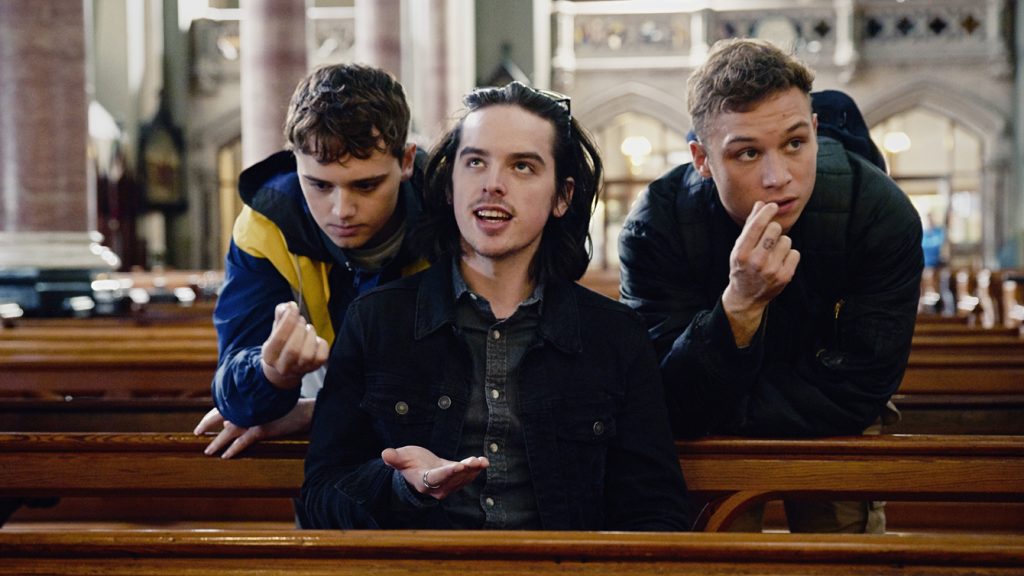
The movie takes place from June to August 2003, the first summer after pals Matthew Connolly (played by Dean-Charles Chapman), Joseph Kearney (played by Finn Cole) and Rez (played by Ferdia Walsh-Peelo) have left high school. Matthew and Rez have graduated, while Joseph (the most problematic one in the trio) was expelled. Viewers can assume these alcohol-guzzling pub-hoppers are all 18 years old, the minimum legal age to drink alcohol in Ireland. It’s one of the few legal things that these hoodlums do when they party.
The movie’s opening scene takes place at a funeral attended by Matthew. He says in a voiceover: “They say that the summer you finish school is the best time of your life because it’s your final summer of freedom and you become men. It’s important. I just didn’t realize how important it would be. This is a real story … I’m sorry for some of the choices we made.”
The funeral is shown again at the end of the film. But in between, the majority of the story is a flashback, told from Matthew’s perspective, of what happened during that fateful summer. Opening with the funeral scene was artistically a big mistake, because viewers will immediately know that a major character is going to die in this story. And it’s not going to be Matthew.
And so, there’s no real suspense or surprise when that death happens, because the tension builds to such a predictable point that it’s fairly easy to guess who’s going to die. The only real question is how will that person die? The cause of death is also easily predicted during a pivotal moment in the last third of the film.
The flashback begins with Matthew in a meeting with his school headmaster Mr. Landerton (played by Ralph Ineson), who is conducting an exit interview, as is the school’s custom with all graduating students. Matthew seems bored and reluctant to tell Mr. Landerton what Matthew’s plans are after high school, probably because Matthew doesn’t have any plans.
Matthew says, “If it makes you happy for your report, just write that I’ve improved as an individual, grown into a respectable young scholar—and it’s all because of you.” Mr. Landerton shakes Matthew hand and says that he knows that things have been difficult for Matthew. Mr. Landerton adds, “Be careful with your choices.”
What has been difficult for Matthew? It’s not fully explained in the movie, but Matthew’s father is no longer in the home. Based on the way that this absentee father is not discussed in Matthew’s household, it’s implied that his father isn’t dead but has abandoned the family. Matthew is an only child and he lives with mother Lynn Connolly (played by Susan Lynch), who seems to have a drinking problem because in the few times she’s seen, she’s holding an alcoholic drink and/or appears to be drunk.
Joseph also lives in a single-parent household, but with his father Mark Kearney (played by Conleth Hill), who pays more attention to what’s on television than he pays attention to Joseph. The movie doesn’t explain what happened to Joseph’s mother. Joseph has an older brother named Dwayne Kearney (played by Chris Newman), who lives in another household and appears in one of Joseph’s many hallucinations. Joseph is the angriest and most mentally disturbed of the three pals, as it becomes very clear later on in the story.
Rez is the friend who is the most mysterious. In other words, he’s the most underwritten of the three friends. He doesn’t even have a last name in the movie. Nothing is shown of Rez’s home life. All viewers know about Rez is that he likes to dress all in black, he does a lot of drugs, and he makes money by selling drugs. Rez is also a lot more sensitive than he’s willing to show most people. One of the few people he opens up to is another teenager named Julie (played by Lola Petticrew), who has a sexual relationship with Rez that can best be described as “friends with benefits.”
The graduation ceremony at the school is never shown. However, it isn’t long after Matthew and Rez get their “freedom” that Matthew, Rez and Joseph decide to go back to their school to vandalize it during the daytime when the school is on a summer break. They start by going to a local church, popping some pills and mocking the communion ritual, with Rez saying “Body of Christ,” before he swallows a pill.
Then, they head to the school and spraypaint graffiti on an instruction board. The graffiti they put on the board shows a penis and a stick figure with the words, “Luke, I am your father, but you are my god.” And because Joseph is the group’s biggest troublemaker, he throws a desk through a closed window, thereby shattering the window with no regard that someone could be hit by the desk or the broken glass on the street below. (Fortunately, no one gets injured.)
The mayhem continues when they go to the school’s parking garage. Joseph sees Mr. Landerton’s car and starts destroying it with a crowbar. During this vandalism, he has a rage-filled rant, as if he’s taking out all of his anger on Mr. Landerton, who expelled him from the school. After a while, Rez joins in on the destruction too.
Matthew shows some restraint and seems reluctant to participate in this senseless act of violence. Just then, Mr. Landerton shows up with some police officers. And this is where the movie starts to go downhill with a very unrealistic scene. Instead of the cops immediately arresting these young punks, Mr. Landerton just stands there and tries to reason with these vandals.
First, the headmaster asks Matthew if he really wants to be a part of this criminal activity. In defiance, Matthew chooses to side with his pals, so he bashes one of the car’s outside mirrors. Matthew, Joseph and Rez then climb out a nearby window and run away, with two or three cops in pursuit.
The chase continues through some streets and an alley, but the cops are out of shape and can’t keep with these teenagers. The last cop to keep the chase going eventually gives up in frustration. But here’s the thing that’s so ridiculous about this movie: Matthew, Joseph and Rez don’t face any consequences.
They are never arrested for the vandalism, even though Mr. Landerton knows where they live and could easily send the cops to the teens’ homes to arrest them. But that never happens. Viewers have to assume that Mr. Landerton might have decided not to press charges, but what kind of school headmaster would let anyone get away with all that damage on the school property when the perpetrators were caught in the act?
It’s just one of many plot holes of stupidity that plague this movie, which is really just a showcase to make it look like just because someone is a working-class teen, it’s enough to feel angst and justify committing crimes. We won’t even get into the racial inequalities of what kinds of punishments these teens would experience if they weren’t white. It’s a privileged blind spot that this movie has because its only concern is making it look like these lazy cretins are just going through a rebellious rite of passage.
The reality is that these teens are not “oppressed” in any way and have no good reason for committing any crimes. They might not come from rich families, but they’re not homeless and not scrounging for food. They don’t experience racism, sexism or other forms of discrimination. They have other people (their parents) paying their bills and providing them with a place to live. Rez’s home life isn’t shown, but it’s implied that he doesn’t have to worry about paying rent.
And apparently, even their school headmaster is willing to look the other way and not hold them accountable for their crimes. There’s no logical reason for why this headmaster would be an enabler, when his job would be at stake for letting these destructive teens get away with the vandalism they committed on school property. These are not wealthy kids who can buy their way out of trouble, but there’s an air of bratty entitlement that this movie has that’s just so annoying.
Later in the movie, Matthew gets a job at an auto tire shop. It’s one of the few mature and responsible things that he does in the story. But then, there’s a scene where Matthew deliberately sets the shop on fire. And yet, the movie never shows him facing any consequences and never mentions what happened as a result of the fire. In fact, the rest of the movie acts like the fire never even happened. It’s all just sloppy screenwriting.
One thing that the movie constantly brings up is how a certain car accident affected these three troublemaking friends. Shortly after they get away with the vandalism at their school, Matthew, Joseph and Rez are on a busy commercial street when they witness a fatal car accident. The driver hit and killed a girl who was about 7 or 8 years because she suddenly ran out on the street. The girl’s mother rushed to her side and wailed for help.
On the surface, the three buddies all try to get on with their lives and continue their partying and mischief making. But seeing someone die right before their eyes is something that has a psychological effect on them. Matthew tries to “clean up” his life a little bit by getting a job at the tire shop. (It’s all for nothing though, because Matthew ends up setting the shop on fire.) Rez falls into a deep depression. Joseph develops a macabre obsession to see someone else die in front of him.
Joseph drops many hints that after seeing someone die, he now has a desire to become a murderer. When he tries to talk about it with his friends, they give him strange looks and he says he’s just joking. Joseph’s increasingly twisted mindset is manifested in a series of hallucinations centered on a TV talk show that Joseph’s father Mark likes to watch.
The program is called “Big Show,” and it’s hosted by a black-haired unnamed man (played by Travis Fimmel) who is styled to look like a menacing satanic figure, but without devil horns. His has a pointy beard and long sideburns and a constant sinister smirk. In the hallucinations about “Big Show,” this TV host brings on certain guests to taunt them, humiliate them and test their endurance.
At various points in the movie, Joseph and Matthew imagine themselves as guests on “Big Show.” Much of the program revolves around the TV presenter talking about masculinity and what it means to be a real man. In one “episode,” the presenter has a woman called Angel Dust (played by Noomi Rapace, in a cameo) on stage and ends up sexually groping her without consent, as the all-male audience cheers.
Sometimes, in Joseph’s “Big Show” hallucinations, his brother Dwayne is in the audience too. It’s supposed to represent Joseph’s conscious or subconscious desire to get his brother Dwayne’s approval. The more violent crimes that Joseph commits, the more he seems to get approval from the “Big Show” host, until it reaches the point where Joseph struts around as if he’s the star of the show.
Matthew’s “Big Show” hallucinations show him as a more hesitant guest, since in real life, he’s the only one out of the three friends who seems to be a little uncomfortable with violent crimes, and he tries to make an honest living. Joseph is never seen doing any work (legal or illegal) in this story, but early on in the movie he mentions that he wants to be a video game developer. Joseph says he has an idea for an Irish Republican Army video game that he wants to call “The Provos.”
Someone who occasionally hangs out with these troublemakers is a fellow teen named Jen (played by Anya Taylor-Joy), who was in the same graduating class as Matthew and Rez. Jen is smart and level-headed. Matthew has a big crush on her, and the feeling might be mutual. They have typical flirty banter where they try to pretend that they aren’t as attracted to each other as they really are.
Jen wants to leave Dublin as soon as she can. Her dream is to live in the United States and become an entertainer or a fashion designer. In the meantime, she sings at a local nightclub. (In one of these nightclub scenes, she performs a cover version of Joy Division’s “She’s Lost Control.”) Taylor-Joy is a good singer, but the scenes of her on stage don’t add much to the story, except to show Matthew ogling Jen. The movie’s soundtrack, which has several songs by Magnets & Ghosts, is mostly alternative rock and some electronica.
Joseph also wants to go to America, and he gets a chance to take a trip to visit the U.S. at one point in the movie. (“Here Are the Young Men” director Macken has a quick cameo as an unnamed homeless man who has an unfortunate encounter with Joseph.) Joseph is never actually seen in America, but he’s made videos of his trip. Some of those videos are shown in the movie.
When Joseph comes back to Dublin, he reveals certain things about himself that show he’s gone beyond vandalism to committing crimes that are even more violent and disturbing. Matthew, Rez and Jen are all affected by Joseph’s increasingly unhinged, out-of-control behavior. And in a predictable teen movie like this one, that means it’s all going to culiminate with some heavy melodrama.
“Here Are the Young Men” takes a very disappointing approach of having mayhem for mayhem’s sake. The hallucinatory “Big Show” scenes aren’t very clever. And the movie’s best and most authentic-looking scene isn’t even about the boys’ friendship but it’s a scene where Matthew and Jen have a big argument over something that happened at a party.
It’s a scene that affects Matthew and Jen’s relationship and brings up very realistic issues about how perceptions are affected by intoxication from alcohol and drugs, which can impair the ability to give consent in sexual situations. The scene also candidly addresses gender roles and expectations in dating relationships. And it’s where Matthew gets some awareness of how the toxic masculinity that he participates in and enables can hit closer to home than he expected.
Unfortunately, this awareness comes so late in the story that it’s questionable how much Matthew might have really learned to become a better person when he makes a certain decision in reaction to something that upset him. Ironically, for a movie called “Here Are the Young Men,” the character of Jen is the most fascinating and has the most interesting things to say. However, she is written as a secondary character.
The scenes with Jen and Matthew have a familiar “will they or won’t they get together” arc that’s often seen in teen dramas. However, Taylor-Joy (who’s an award-winning actress on the rise) and Chapman (who was quite memorable in his role as a young British soldier in the World War I movie “1917”) are good-enough in their roles to bring believable emotions to characters that wouldn’t be as watchable if portrayed by less-talented actors. Jen is about the same age as Matthew, Rez and Joseph, but she’s much more emotionally mature than they are.
The characters of Joseph and Rez both struggle with personal demons more than Matthew does. Joseph’s anger is explosive and mostly directed at other people, while Rez tends to be more introverted and self-destructive. Cole and Ferdia-Peelo give convincing but not particularly outstanding performances of how Joseph and Rez mentally unravel in their own ways. All the parental/authority figures are essentially just background characters who don’t have much influence in what these teens say or do.
The main problem with “Here Are the Young Men” isn’t the cast members’ performances but in the way that writer/director Macken seems more concerned with showing how much worse the criminal chaos can get for these teen delinquents, rather than any true character development. There’s a tone throughout the movie that’s seems to say, “You thought what so-and-so did was bad, just wait until you see what this person does next.” After a while, it feels very hollow and lacking in suspense, since apparently the movie is intent on making it look like Dublin law enforcement is incompetent and that these three law-breaking jerks are untouchable.
This movie starts to look very unrealistic when these known hoodlums, who commit their crimes out in the open, never seem to be at any real risk of beng arrested. The movie becomes a repetitive series of crimes and drug-induced hallucinations that ultimately serve no purpose except to show these characters getting away with these crimes. The movie didn’t need to have any moralistic preaching to be improved. By the end of the film, viewers just won’t care about these self-absorbed troublemakers who are so bored with their lives that they create damaging problems for themselves and other people.
Well Go USA released “Here Are the Young Men” on digital and VOD on April 27, 2021.